seats MAZDA MODEL 2 2012 User Guide
[x] Cancel search | Manufacturer: MAZDA, Model Year: 2012, Model line: MODEL 2, Model: MAZDA MODEL 2 2012Pages: 346, PDF Size: 3.93 MB
Page 33 of 346
Black plate (33,1)
Child Restraint Precautions
Mazda strongly urges the use of child-restraint systems for children small enough to use
them.
You are required by law to use a child-restraint system for children in the U.S. and Canada.
Check your local and state or provincial laws for specific requirements regarding the safety
of children riding in your vehicle.
Whatever child-restraint system you consider, please pick the appropriate one for the age
and size of the child, obey the law and follow the instructions that come with the individual
child-restraint system.
A child who has outgrown child-restraint systems should sit in the rear and use seat belts,
both lap and shoulder. If the shoulder belt crosses the neck or face, move the child closer to
the center of the vehicle in the outboard seats, and towards the buckle on the right if the
child is seated on the center seat.
Statistics confirm that the rear seat is the best place for all children up to 12 years of age,
and more so with a supplemental restraint system (air bags).
A rear-facing child-restraint system shouldNEVERbe used on the front seat with the air
bag system activated. The front passenger's seat is also the least preferred seat for other
child-restraint systems.
To reduce the chance of injuries caused by deployment of the front passenger air bag, the
front passenger seat weight sensors work as a part of the supplemental restraint system.
This system deactivates the front passenger front and side air bags and also the front
passenger seat belt pretensioner system when the front passenger air bag deactivation
indicator light illuminates.
When an infant or small child sits on the front passenger seat, the system shuts off the front
passenger front and side air bags and seat belt pretensioner system, so make sure the front
passenger air bag deactivation indicator light illuminates.
Even if the front passenger air bag is shut off, Mazda strongly recommends that children be
properly restrained and child-restraint systems of all kinds are properly secured on the rear
seats which are the best place for children.
For more details, refer to “Front passenger seat weight sensors ”(page 2-50).
Essential Safety Equipment
Child Restraint
2-21
Mazda2_8CC7-EA-11H_Edition2 Page33
Monday, September 26 2011 1:54 PM
Form No.8CC7-EA-11H
Page 35 of 346
Black plate (35,1)
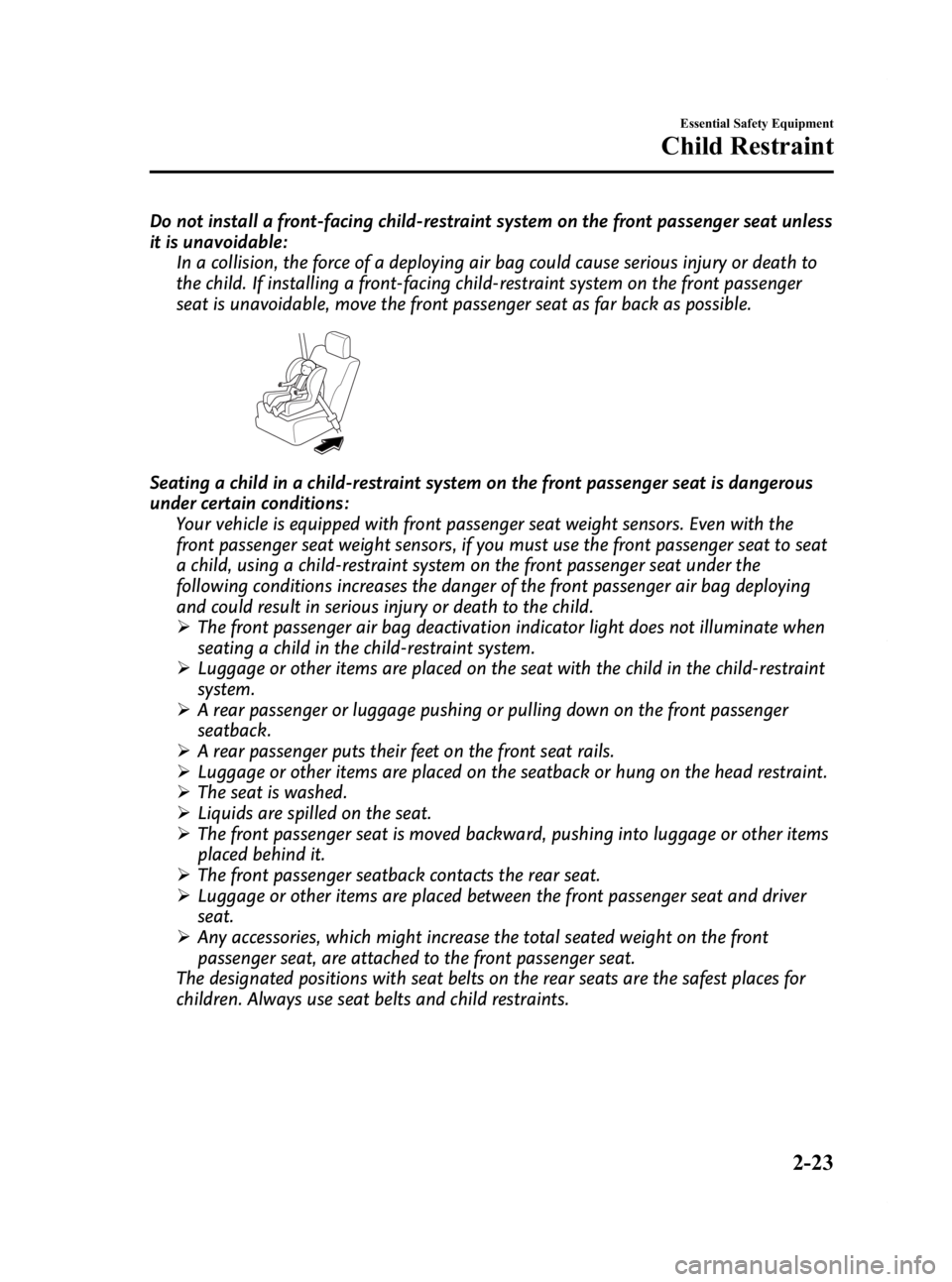
Do not install a front-facing child-restraint system on the front passenger seat unless
it is unavoidable:In a collision, the force of a deploying air bag could cause serious injury or death to
the child. If installing a front-facing child-restraint system on the front passenger
seat is unavoidable, move the front passenger seat as far back as possible.
Seating a child in a child-restraint system on the front passenger seat is dangerous
under certain conditions:Your vehicle is equipped with front passenger seat weight sensors. Even with the
front passenger seat weight sensors, if you must use the front passenger seat to seat
a child, using a child-restraint system on the front passenger seat under the
following conditions increases the danger of the front passenger air bag deploying
and could result in serious injury or death to the child.
ØThe front passenger air bag deactivation indicator light does not illuminate when
seating a child in the child-restraint system.
Ø Luggage or other items are placed on the seat with the child in the child-restraint
system.
Ø A rear passenger or luggage pushing or pulling down on the front passenger
seatback.
Ø A rear passenger puts their feet on the front seat rails.
Ø Luggage or other items are placed on the seatback or hung on the head restraint.
Ø The seat is washed.
Ø Liquids are spilled on the seat.
Ø The front passenger seat is moved backward, pushing into luggage or other items
placed behind it.
Ø The front passenger seatback contacts the rear seat.
Ø Luggage or other items are placed between the front passenger seat and driver
seat.
Ø Any accessories, which might increase the total seated weight on the front
passenger seat, are attached to the front passenger seat.
The designated positions with seat belts on the rear seats are the safest places for
children. Always use seat belts and child restraints.
Essential Safety Equipment
Child Restraint
2-23
Mazda2_8CC7-EA-11H_Edition2 Page35
Monday, September 26 2011 1:54 PM
Form No.8CC7-EA-11H
Page 37 of 346
Black plate (37,1)
Child-Restraint System
Installation Position
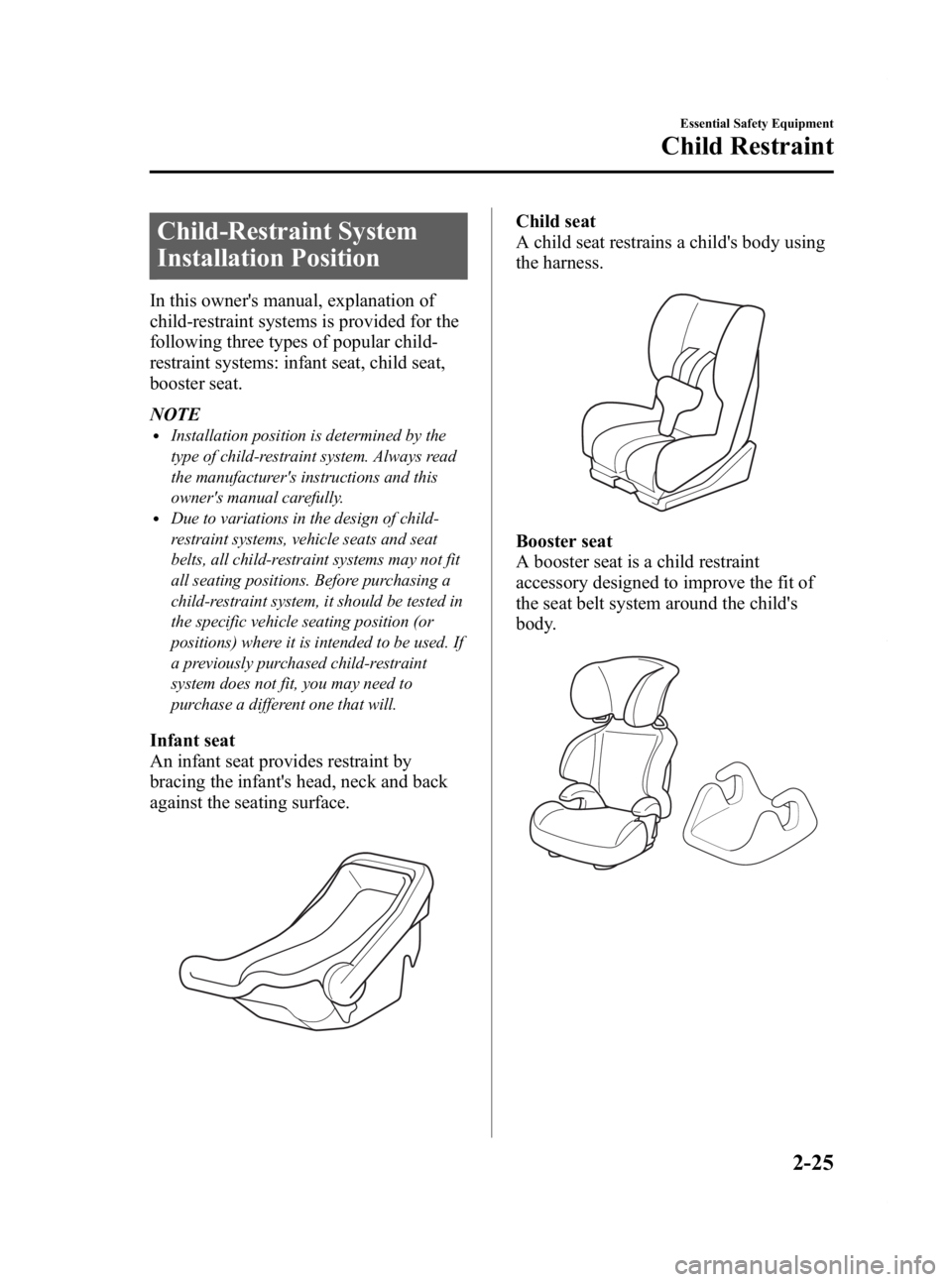
In this owner's manual, explanation of
child-restraint systems is provided for the
following three types of popular child-
restraint systems: infant seat, child seat,
booster seat.
NOTE
lInstallation position is determined by the
type of child-restraint system. Always read
the manufacturer's instructions and this
owner's manual carefully.
lDue to variations in the design of child-
restraint systems, vehicle seats and seat
belts, all child-restraint systems may not fit
all seating positions. Before purchasing a
child-restraint system, it should be tested in
the specific vehicle seating position (or
positions) where it is intended to be used. If
a previously purchased child-restraint
system does not fit, you may need to
purchase a different one that will.
Infant seat
An infant seat provides restraint by
bracing the infant's head, neck and back
against the seating surface.
Child seat
A child seat restrains a child's body using
the harness.
Booster seat
A booster seat is a child restraint
accessory designed to improve the fit of
the seat belt system around the child's
body.
Essential Safety Equipment
Child Restraint
2-25
Mazda2_8CC7-EA-11H_Edition2 Page37
Monday, September 26 2011 1:54 PM
Form No.8CC7-EA-11H
Page 38 of 346
Black plate (38,1)
Installing Child-Restraint
Systems
Accident statistics reveal that a child is
safer in the rear seat. The front passenger's
seat is clearly the worst choice for any
child under 12, and with rear-facing child-
restraint systems it is clearly unsafe due to
air bags.
NOTE
Even if your vehicle is equipped with front
passenger seat weight sensors (page 2-50),
which automatically deactivates the front
passenger air bag, a rear seat is the safest
place for a child of any age or size.
Some child-restraint systems now come
with tethers and therefore must be
installed on the seats that take tethers to
be effective. In your Mazda, tethered
child-restraint systems can only be
accommodated in the three positions on
the rear seat.
Some child-restraint systems also employ
specially designed LATCH attachments;
refer to“LATCH Child-Restraint
Systems ”(page 2-32).
WARNING
Tethered Child-Restraint Systems Work
Only on Tether-Equipped Rear Seats:
Installation of a tether equipped
child-restraint system in the front
passenger's seat defeats the safety
design of the system and will result in
an increased chance of serious injury
if the child-restraint system goes
forward without benefit of being
tethered.
Place tether equipped child-restraint
systems where there are tether
anchors.
qRear Seat Child-Restraint System
Installation
Follow these instructions when using a
child-restraint system, unless you are
attaching a LATCH-equipped child-
restraint system to the rear LATCH lower
anchors. Refer to “LATCH Child-
Restraint Systems ”(page 2-32).
NOTE
Follow the child-restraint system
manufacturer's instructions carefully. If you
are not sure whether you have a LATCH
system or tether, check in the child-restraint
system manufacturer's instructions and follow
them accordingly. Depending on the type of
child-restraint system, it may use LATCH
system instead of seat belts or if the belt goes
across the child's chest, may recommend
against using automatic locking mode.
1. Make sure the seatback is securely latched by pushing it back until it is
fully locked.
2. Raise the head restraint to the top locked position (except center seat
position).
Refer to Head Restraints on page 2-7.
2-26
Essential Safety Equipment
Child Restraint
Mazda2_8CC7-EA-11H_Edition2 Page38
Monday, September 26 2011 1:54 PM
Form No.8CC7-EA-11H
Page 41 of 346

Black plate (41,1)
qIf You Must Use the Front Seat
for Children
If you cannot put all children in the rear
seat, at least put the smallest children in
the rear and be sure the largest child up
front uses the shoulder belt over the
shoulder.
NEVER put a rear-facing child-restraint
system on the front passenger seat
whether your vehicle is equipped with a
seat weight sensor or not.
This seat is also not set up for tethered
child-restraint systems, put them in one of
the rear seat positions set up with tether
anchors.
Likewise the LATCH child-restraint
system cannot be secured in the front
passenger's seat and should be used in the
rear seat.
Do not allow anyone to sleep against the
side window if you have optional side and
curtain air bags, it could cause serious
injuries to an out of position occupant. As
children more often sleep in cars, it is
better to put them in the rear seat. If
installing the child-restraint system on the
front seat is unavoidable, follow these
instructions when using a front-facing
child-restraint system in the front
passenger's seat.
NOTE
lTo check if your front seats have side air
bags:
Mazda vehicles equipped with side air bag
will have a “SRS AIRBAG ”tag on the
outboard shoulder of the front seats.
lTo check if your vehicle has curtain air
bags:
Mazda vehicles equipped with curtain air
bag will have an “SRS AIRBAG ”marking
on the window pillars along the roof edge.
WARNING
Always move the front passenger seat
as far back as possible if installing a
front-facing child-restraint system on it
is unavoidable: As your vehicle has front air bags
and doubly so because your vehicle
has side air bags, a front-facing
child-restraint system should be put
on the front passenger seat only
when it is unavoidable.
Even if the front passenger air bag
deactivation indicator light
illuminates, always move the seat as
far back as possible, because the
force of a deploying air bag could
cause serious injury or death to the
child.
Never use a rear-facing child-restraint
system in the front seat with an air bag
that could deploy: Rear-facing child-restraint systems
on the front seat are particularly
dangerous.
Even in a moderate collision, the
child-restraint system can be hit by a
deploying air bag and moved
violently backward resulting in
serious injury or death to the child.
Even though you may feel assured
that the front passenger air bag will
not deploy based on the fact that the
front passenger air bag deactivation
indicator light illuminates, you
should not use a rear-facing child-
restraint system in the front seat.
Essential Safety Equipment
Child Restraint
2-29
Mazda2_8CC7-EA-11H_Edition2 Page41
Monday, September 26 2011 1:54 PM
Form No.8CC7-EA-11H
Page 44 of 346

Black plate (44,1)
LATCH Child-Restraint Systems
Your Mazda is equipped with LATCH lower anchors for attachment of specially designed
LATCH child-restraint systems in the rear seats. Both anchors must be used, otherwise the
seat will bounce around and put the child in danger. Most LATCH child-restraint systems
must also be used in conjunction with a tether to be effective. If they have a tether you
must use it to better assure your child's safety.
WARNING
Follow the manufacturer's instructions for the use of the child-restraint system:An unsecured child-restraint system is dangerous. In a sudden stop or a collision it
could move causing serious injury or death to the child or other occupants. Make
sure the child-restraint system is properly secured in place according to the child-
restraint system manufacturer's instructions.
Never attach two child-restraint systems to the same LATCH lower anchor: Attaching two child-restraint systems to the same LATCH lower anchor is dangerous.
In a collision, one anchor may not be strong enough to hold two child-restraint
system attachments, and it may break, causing serious injury or death. If you use the
seat position for another child-restraint system when an outboard LATCH position is
occupied, use the center seat belts instead, and the tether if tether-equipped.
Make sure the child-restraint system is properly secured: An unsecured child-restraint system is dangerous. In a sudden stop or a collision it
could move causing serious injury or death to the child or other occupants. Follow
the child-restraint system manufacturer's instructions on belt routing to secure the
seat just as you would with a child in it so that nobody is tempted to put a child in
an improperly secured seat later on. When not in use, remove it from the vehicle or
fasten it with a seat belt, or latch it down to BOTH LATCH lower anchors for LATCH
child-restraint systems.
Make sure there are no seat belts or foreign objects near or around the LATCH child-
restraint system: Not following the child-restraint system manufacturer's instructions when installing
the child-restraint system is dangerous. If seat belts or a foreign object prevent the
child-restraint system from being securely attached to the LATCH lower anchors and
the child-restraint system is installed improperly, the child-restraint system could
move in a sudden stop or collision causing serious injury or death to the child or
other occupants. When installing the child-restraint system, make sure there are no
seat belts or foreign objects near or around the LATCH lower anchors. Always follow
the child-restraint system manufacturer's instructions.
2-32
Essential Safety Equipment
Child Restraint
Mazda2_8CC7-EA-11H_Edition2 Page44
Monday, September 26 2011 1:54 PM
Form No.8CC7-EA-11H
Page 45 of 346

Black plate (45,1)
qLATCH Child-Restraint System
Installation Procedure (Rear
Outboard Seats)
1. First, adjust the front seat to allow
clearance between the child-restraint
system and the front seat (page 2-2).
2. Make sure the seatback is securely latched by pushing it back until it is
fully locked.
3. Expand the area between the seat bottom and the seatback slightly to
verify the locations of the LATCH
lower anchors.
NOTE
The markings above the LATCH lower anchors
indicate the locations of LATCH lower
anchors for the attachment of a child-restraint
system.
4. Raise the head restraint to the top
locked position.
Refer to Head Restraints on page 2-7.
5. Secure the child-restraint system using BOTH LATCH lower anchors,
following the child-restraint system
manufacturer's instruction. Pull on the
child-restraint to be sure both anchors
are engaged. 6. If your child-restraint system came
equipped with a tether, that means it is
very important to properly secure the
tether for child safety. Please carefully
follow the child-restraint system
manufacturer's instructions when
installing tethers.
Anchor bracket location
Tether strap position
Forward
Tether strap
Essential Safety Equipment
Child Restraint
2-33
Mazda2_8CC7-EA-11H_Edition2 Page45
Monday, September 26 2011 1:54 PM
Form No.8CC7-EA-11H
Page 50 of 346

Black plate (50,1)
Never use a rear-facing child-restraint system in the front seat with an air bag that
could deploy:Rear-facing child-restraint systems on the front seat are particularly dangerous even
though you may feel assured that a front passenger air bag will not deploy based on
the fact that the front passenger air bag deactivation indicator light illuminates. The
child-restraint system can be hit by a deploying air bag and moved violently
backward resulting in serious injury or death to the child.
Do not sit too close to the driver and front passenger air bags:
Sitting too close to the driver and front passenger air bag modules or placing hands
or feet on them is extremely dangerous. The driver and front passenger air bags
inflate with great force and speed. Serious injuries could occur if someone is too
close. The driver should always hold onto only the rim of the steering wheel. The
front seat passenger should keep both feet on the floor. Front seat occupants should
adjust their seats as far back as possible and always sit upright against the
seatbacks with seat belts worn properly.
Sit in the center of the seat and wear seat belts properly: Sitting too close to the side air bag modules or placing hands on them, or sleeping
up against the door or hanging out the windows is extremely dangerous. The side
and curtain air bags inflate with great force and speed directly expanding along the
door on the side the car is hit. Serious injury could occur if someone is sitting too
close to the door or leaning against a window, or if rear seat occupants grab the
sides of the front seatbacks. Give the side and curtain air bags room to work by
sitting in the center of the seat while the vehicle is moving with seat belts worn
properly.
Do not attach objects on or around the area where driver and front passenger air
bags deploy: Attaching an object to the driver and front passenger air bag modules or placing
something in front of them is dangerous. In an accident, an object could interfere
with air bag inflation and injure the occupants.
2-38
Essential Safety Equipment
SRS Air Bags
Mazda2_8CC7-EA-11H_Edition2 Page50
Monday, September 26 2011 1:54 PM
Form No.8CC7-EA-11H
Page 51 of 346

Black plate (51,1)
Do not attach objects on or around the area where a side air bag deploys:Attaching objects to the front seat in such a way as to cover the outboard side of the
seat in any way is dangerous. In an accident the object could interfere with the side
air bag, which inflates from the outboard side of the front seats, impeding the added
protection of the side air bag system or redirecting the air bag in a way that is
dangerous. Furthermore, the bag could be cut open releasing the gas.
Do not hang net bags, map pouches or backpacks with side straps on the front
seats. Never use seat covers on the front seats. Always keep the side air bag modules
in your front seats free to deploy in the event of a side collision.
Do not attach objects on or around the area where a curtain air bag deploys: Attaching objects to the areas where the curtain air bag activates such as on the
windshield glass, side door glass, front and rear window pillars and along the roof
edge and assist grips is dangerous. In an accident the object could interfere with the
curtain air bag, which inflates from the front and rear window pillars and along the
roof edge, impeding the added protection of the curtain air bag system or redirecting
the air bag in a way that is dangerous. Furthermore, the bag could be cut open
releasing the gas.
Do not place hangers or any other objects on the assist grips. When hanging clothes,
hang them on the coat hook directly. Always keep the curtain air bag modules free
to deploy in the event of a side collision.
Do not place luggage or other objects under the front seats: Placing luggage or other objects under the front seats is dangerous. The components
essential to the supplemental restraint system could be damaged, and in the event of
a side collision, the appropriate air bags may not deploy, which could result in death
or serious injury. To prevent damage to the components essential to the
supplemental restraint system, do not place luggage or other objects under the front
seats.
Do not touch the components of the supplemental restraint system after the air bags
have inflated: Touching the components of the supplemental restraint system after the air bags
have inflated is dangerous. Immediately after inflation, they are very hot. You could
get burned.
Never install any front-end equipment to your vehicle: Installation of front-end equipment, such as frontal protection bar (kangaroo bar,
bull bar, push bar, or other similar devices), snowplow, or winches, is dangerous. The
air bag crash sensor system could be affected. This could cause air bags to inflate
unexpectedly, or it could prevent the air bags from inflating during an accident.
Front occupants could be seriously injured.
Essential Safety Equipment
SRS Air Bags
2-39
Mazda2_8CC7-EA-11H_Edition2 Page51
Monday, September 26 2011 1:54 PM
Form No.8CC7-EA-11H
Page 52 of 346

Black plate (52,1)
Do not modify the suspension:Modifying the vehicle suspension is dangerous. If the vehicle's height or the
suspension is modified, the vehicle will be unable to accurately detect a collision
resulting in incorrect or unexpected air bag deployment and the possibility of serious
injuries.
Do not modify the supplemental restraint system: Modifying the components or wiring of the supplemental restraint system is
dangerous. You could accidentally activate it or make it inoperable. Do not make
any modifications to the supplemental restraint system. This includes installing trim,
badges, or anything else over the air bag modules. It also includes installing extra
electrical equipment on or near system components or wiring. An Authorized Mazda
Dealer can provide the special care needed in the removal and installation of front
seats. It is important to protect the air bag wiring and connections to assure that the
bags do not accidentally deploy, the driver seat slide position sensor and front
passenger seat weight sensors are not damaged and that the seats retain an
undamaged air bag connection.
NOTE
lWhen an air bag deploys, a loud inflation noise can be heard and some smoke will be released.
Neither is likely to cause injury, however, the texture of the air bags may cause light skin injuries
on body parts not covered with clothing through friction.
lShould you sell your Mazda, we urge you to tell the new owner of its air bag systems and that
familiarization with all instructions about them, from the Owner's Manual, is important.
2-40
Essential Safety Equipment
SRS Air Bags
Mazda2_8CC7-EA-11H_Edition2 Page52
Monday, September 26 2011 1:54 PM
Form No.8CC7-EA-11H