tires MAZDA MODEL 2 2012 Owner's Manual
[x] Cancel search | Manufacturer: MAZDA, Model Year: 2012, Model line: MODEL 2, Model: MAZDA MODEL 2 2012Pages: 346, PDF Size: 3.93 MB
Page 215 of 346

Black plate (215,1)
qSpare Tire
Your Mazda has a temporary spare tire.
The temporary spare tire is lighter and
smaller than a conventional tire, and is
designed only for emergency use and
should be used only for VERY short
periods. Temporary spare tires should
NEVER be used for long drives or
extended periods.
WARNING
Do not install the temporary spare tire
on the front wheels (driving wheels):
Driving with the temporary spare tire
on one of the front driving wheels is
dangerous. Handling will be affected.
You could lose control of the vehicle,
especially on ice or snow bound
roads, and have an accident. Move a
regular tire to the front wheel and
install the temporary spare tire to the
rear.
CAUTION
ØWhen using the temporary spare
tire, driving stability may decrease
compared to when using only the
conventional tire. Drive carefully.
Ø To avoid damage to the temporary
spare tire or to the vehicle, observe
the following precautions:
ØDo not exceed 80 km/h (50
mph).
ØAvoid driving over obstacles.
Also, do not drive through an
automatic car wash. This tire's
diameter is smaller than a
conventional tire, so the ground
clearance is reduced about
10 mm (0.4 in).
ØDo not use a tire chain on this
tire because it will not fit
properly.
ØDo not use your temporary
spare tire on any other vehicle,
it has been designed only for
your Mazda.
ØUse only one temporary spare
tire on your vehicle at the same
time.
NOTE
(With Tire Pressure Monitoring System)
A tire pressure sensor is not installed to the
temporary spare tire. The warning light will
flash continuously while the temporary spare
tire is being used (page 5-25).
In Case of an Emergency
Flat Tire
7-5
Mazda2_8CC7-EA-11H_Edition2 Page215
Monday, September 26 2011 1:55 PM
Form No.8CC7-EA-11H
Page 217 of 346

Black plate (217,1)
NOTElMake sure the jack is well lubricated before
using it.
(With Tire Pressure Monitoring System)
lBe sure to register the tire pressure sensor
ID signal code whenever tires or wheels are
changed (page 5-27).
1. Park on a level surface off the right-of- way and firmly set the parking brake.
2. Put a vehicle with an automatic transaxle in Park (P), a manual
transaxle in Reverse (R) or 1, and turn
off the engine.
3. Turn on the hazard warning flasher.
4. Have everyone get out of the vehicle and away from the vehicle and traffic.
5. Remove the jack, tool bag, and spare tire (page 7-3).
6. Block the wheel diagonally opposite the flat tire. When blocking a wheel,
place a tire block both in front and
behind the tire.
NOTE
When blocking a tire, use rocks or wood blocks
of sufficient size if possible to hold the tire in
place.
qRemoving a Flat Tire
1. If your vehicle is equipped with a
wheel cover, pry off the wheel cover
with the beveled end of the jack lever.
NOTE
Force the end of the jack lever firmly between
wheel and cover, or removal will be difficult.
CAUTION
There is a valve-stem mark inside the
wheel cover. When installing the
wheel cover, align this mark with the
tire's valve stem.
Damage could occur during
installation if the wheel cover is not
properly aligned.
In Case of an Emergency
Flat Tire
7-7
Mazda2_8CC7-EA-11H_Edition2 Page217
Monday, September 26 2011 1:55 PM
Form No.8CC7-EA-11H
Page 220 of 346

Black plate (220,1)
WARNING
Do not jack up the vehicle higher than
is necessary:Jacking up the vehicle higher than is
necessary is dangerous as it could
destabilize the vehicle resulting in an
accident.
Do not start the engine or shake the
vehicle while it is jacked up: Starting the engine or shaking the
vehicle while it is jacked up is
dangerous as it could cause the
vehicle to fall off the jack resulting in
an accident.
Never go under the vehicle while it is
jacked up: Going under the vehicle while it is
jacked up is dangerous as it could
result in death or serious injury if the
vehicle were to fall off the jack.
9. Remove the lug nuts by turning them counterclockwise; then remove the
wheel and center cap.
qLocking Lug Nuts
If your vehicle has optional antitheft
wheel lug nuts, one on each wheel will
lock the tires and you must use a special
key to unlock them. This key is attached
to the lug wrench and is stored with the
spare tire. Register them with the lock
manufacturer by filling out the card
provided in the glove compartment and
mailing it in the accompanying envelope.
If you lose this key, consult an Authorized
Mazda Dealer or use the lock
manufacturer's order form, which is with
the registration card.
Special key
Antitheft lug nut
To remove an antitheft lug nut
1. Obtain the key for the antitheft lug nut.
2. Place the key on top of the nut, and be
sure to hold the key square to it. If you
hold the key at an angle, you may
damage both key and nut. Do not use a
power impact wrench.
3. Place the lug wrench on top of the key and apply pressure. Turn the wrench
counterclockwise.
7-10
In Case of an Emergency
Flat Tire
Mazda2_8CC7-EA-11H_Edition2 Page220
Monday, September 26 2011 1:55 PM
Form No.8CC7-EA-11H
Page 221 of 346

Black plate (221,1)
To install the nut
1. Place the key on top of the nut, and besure to hold the key square to it. If you
hold the key at an angle, you may
damage both key and nut. Do not use a
power impact wrench.
2. Place the lug wrench on top of the key, apply pressure, and turn it clockwise.
qMounting the Spare Tire
1. Remove dirt and grime from the
mounting surfaces of the wheel and
hub, including the hub bolts, with a
cloth.
WARNING
Make sure the mounting surfaces of
the wheel, hub and lug nuts are clean
before changing or replacing tires: When changing or replacing a tire,
not removing dirt and grime from the
mounting surfaces of the wheel, hub
and hub bolts is dangerous. The lug
nuts could loosen while driving and
cause the tire to come off, resulting in
an accident.
2. Mount the spare tire. 3. Install the lug nuts with the beveled
edge inward; tighten them by hand.
WARNING
Do not apply oil or grease to lug nuts
and bolts and do not tighten the lug
nuts beyond the recommended
tightening torque: Applying oil or grease to lug nuts and
bolts is dangerous. The lug nuts
could loosen while driving and cause
the tire to come off, resulting in an
accident. In addition, lug nuts and
bolts could be damaged if tightened
more than necessary.
4. Turn the lug wrench counterclockwise and lower the vehicle. Use the lug
wrench to tighten the nuts in the order
shown.
In Case of an Emergency
Flat Tire
7-11
Mazda2_8CC7-EA-11H_Edition2 Page221
Monday, September 26 2011 1:55 PM
Form No.8CC7-EA-11H
Page 224 of 346

Black plate (224,1)
15. Insert the luggage compartment coverfrom the top of the luggage
compartment opening with the cloth
side of the cover facing outward, and
slide it between the flat tire and the
inside perimeter of the luggage
compartment opening.
16. Check the tire inflation pressure.Refer to Tires on page 10-6.
17. Have the flat tire repaired or replaced as soon as possible.
WARNING
Do not drive with any tires that have
incorrect air pressure:Driving on tires with incorrect air
pressure is dangerous. Tires with
incorrect pressure could affect
handling and result in an accident.
When you check the regular tires' air
pressure, check the spare tire, too.
NOTE
(With Tire Pressure Monitoring System)
A tire pressure sensor is not installed to the
temporary spare tire. The warning light will
flash continuously while the temporary spare
tire is being used (page 5-25).
NOTE
To prevent the jack and tool from rattling, store
them properly.
7-14
In Case of an Emergency
Flat Tire
Mazda2_8CC7-EA-11H_Edition2 Page224
Monday, September 26 2011 1:55 PM
Form No.8CC7-EA-11H
Page 235 of 346
Black plate (235,1)
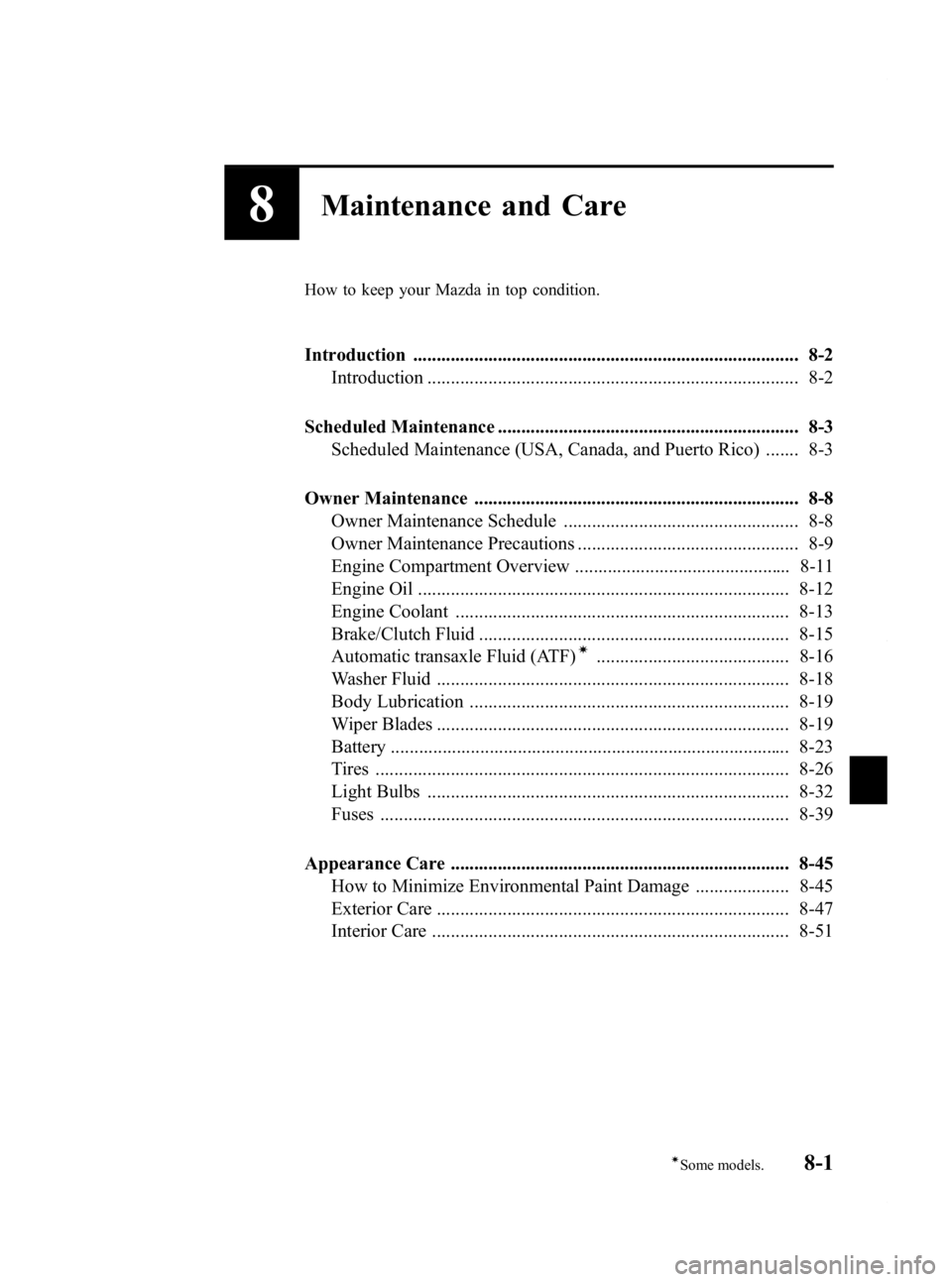
8Maintenance and Care
How to keep your Mazda in top condition.
Introduction .................................................................................. 8-2Introduction ............................................................................... 8-2
Scheduled Maintenance ................................................................ 8-3 Scheduled Maintenance (USA, Canada, and Puerto Rico) ....... 8-3
Owner Maintenance ..................................................................... 8-8 Owner Maintenance Schedule .................................................. 8-8
Owner Maintenance Precautions ............................................... 8-9
Engine Compartment Overview .............................................. 8-11
Engine Oil ............................................................................... 8-12
Engine Coolant ....................................................................... 8-13
Brake/Clutch Fluid .................................................................. 8-15
Automatic transaxle Fluid (ATF)
í......................................... 8-16
Washer Fluid ........................................................................... 8-18
Body Lubrication .................................................................... 8-19
Wiper Blades ........................................................................... 8-19
Battery ..................................................................................... 8-23
Tires ........................................................................................ 8-26
Light Bulbs ............................................................................. 8-32
Fuses ....................................................................................... 8-39
Appearance Care ........................................................................ 8-45 How to Minimize Environmental Paint Damage .................... 8-45
Exterior Care ........................................................................... 8-47
Interior Care ............................................................................ 8-51
8-1íSome models.
Mazda2_8CC7-EA-11H_Edition2 Page235
Monday, September 26 2011 1:55 PM
Form No.8CC7-EA-11H
Page 260 of 346

Black plate (260,1)
Tires
For reasons of proper performance, safety,
and better fuel economy, always maintain
recommended tire inflation pressures and
stay within the recommended load limits
and weight distribution.
WARNING
Using Different Tire Types:Driving your vehicle with different
types of tires is dangerous. It could
cause poor handling and poor
braking; leading to loss of control.
Except for the limited use of the
temporary spare tire, use only the
same type tires (radial, bias-belted,
bias-type) on all four wheels.
Using Wrong-Sized Tires: Using any other tire size than what is
specified for your Mazda (page 10-6)
is dangerous. It could seriously affect
ride, handling, ground clearance, tire
clearance, and speedometer
calibration. This could cause you to
have an accident. Use only tires that
are the correct size specified for your
Mazda.
qTire Inflation Pressure
WARNING
Always inflate the tires to the correct
pressure:
Overinflation or underinflation of
tires is dangerous. Adverse handling
or unexpected tire failure could result
in a serious accident.
Refer to Tires on page 10-6.
Use only a Mazda-genuine tire valve
cap: Use of a non-genuine part is
dangerous as the correct tire air
pressure cannot be maintained if the
tire valve becomes damaged. If the
vehicle is driven under this condition,
the tire air pressure will decrease
which could result in a serious
accident. Do not use any part for the
tire valve cap that is not a Mazda-
genuine part.
8-26
Maintenance and Care
Owner Maintenance
Mazda2_8CC7-EA-11H_Edition2 Page260
Monday, September 26 2011 1:55 PM
Form No.8CC7-EA-11H
Page 261 of 346

Black plate (261,1)
The Tire Pressure Monitoring Systemí
does not alleviate the need to check the
tire condition every day, including
whether the tires all look inflated properly.
Inspect all tire pressure monthly
(including the spare) when the tires are
cold. Maintain recommended pressures
for the best ride, handling, and minimum
tire wear.
When checking the tire pressures, use of a
digital tire pressure gauge is
recommended.
Refer to the specification charts (page
10-6).NOTE
lAlways check tire pressure when tires are
cold.
lWarm tires normally exceed recommended
pressures. Don't release air from warm tires
to adjust the pressure.
lUnderinflation can cause reduced fuel
economy, uneven and accelerated tire wear,
and poor sealing of the tire bead, which
will deform the wheel and cause separation
of tire from rim.
lOverinflation can produce a harsh ride,
uneven and accelerated tire wear, and a
greater possibility of damage from road
hazards.
Keep your tire pressure at the correct
levels. If one frequently needs inflating,
have it inspected.
q
Tire Rotation
WARNING
Rotate tires periodically:
Irregular tire wear is dangerous. To
equalize tread wear for maintaining
good performance in handling and
braking, rotate the tires according to
the scheduled maintenance charts.
Refer to Scheduled Maintenance on
page 8-3.
Maintenance and Care
Owner Maintenance
8-27íSome models.
Mazda2_8CC7-EA-11H_Edition2 Page261
Monday, September 26 2011 1:55 PM
Form No.8CC7-EA-11H
Page 262 of 346

Black plate (262,1)
During rotation, inspect them for correct
balance.
Do not include (TEMPORARY USE ONLY)
spare tire in rotation.Forward
Also, inspect them for uneven wear and
damage. Abnormal wear is usually caused
by one or a combination of the following:
lIncorrect tire pressurelImproper wheel alignmentlOut-of-balance wheellSevere braking
After rotation, inflate all tire pressures to
specification (page 10-6) and inspect the
lug nuts for tightness.
CAUTION
Rotate unidirectional tires and radial
tires that have an asymmetrical tread
pattern or studs only from front to
rear, not from side to side. Tire
performance will be reduced if
rotated from side to side.
q Replacing a Tire
WARNING
Always use tires that are in good
condition:
Driving with worn tires is dangerous.
Reduced braking, steering, and
traction could result in an accident.
Replace all four tires at the same time: Replacing just one tire is dangerous.
It could cause poor handling and
poor braking resulting in loss of
vehicle control. Mazda strongly
recommends that you replace all four
tires at the same time.
CAUTION
(With Tire Pressure Monitoring
System)
When replacing/repairing the tires or
wheels or both, have the work done
by an Authorized Mazda Dealer, or
the tire pressure sensors may be
damaged.
NOTE
(With Tire Pressure Monitoring System)lWhen tires with steel wire reinforcement in
the sidewalls are used, the system may not
function correctly even with a genuine
wheel.
Refer to System Error Activation on page
5-27.
lBe sure to install the tire pressure sensors
whenever tires or wheels are replaced.
Refer to Tires and Wheels on page 5-27.
8-28
Maintenance and Care
Owner Maintenance
Mazda2_8CC7-EA-11H_Edition2 Page262
Monday, September 26 2011 1:55 PM
Form No.8CC7-EA-11H
Page 263 of 346

Black plate (263,1)
If a tire wears evenly, a wear indicator
will appear as a solid band across the
tread.
Replace the tire when this happens.
New treadTread wear indicator
Worn tread
You should replace the tire before the
band crosses the entire tread.
NOTE
Tires degrade over time, even when they are
not being used on the road. It is recommended
that tires generally be replaced when they are
6 years or older. Heat caused by hot climates
or frequent high loading conditions can
accelerate the aging process. You should
replace the spare tire when you replace the
other road tires due to the aging of the spare
tire. The period in which the tire was
manufactured (both week and year) is
indicated by a 4-digit number.
Refer to Tire Labeling on page 9-22.
qTemporary Spare Tire
Inspect the temporary spare tire at least
monthly to make sure it's properly inflated
and stored.
NOTE
The temporary spare tire condition gradually
deteriorates even if it has not been used.
The temporary spare tire is easier to
handle because of its construction which
is lighter and smaller than a conventional
tire. This tire should be used only for an
emergency and only for a short distance.
Use the temporary spare tire only until the
conventional tire is repaired, which should
be as soon as possible.
Maintain its pressure at 420 kPa (4.2
kgf/cm
2or bar, 60 psi).
CAUTION
Ø Do not use your temporary spare
tire rim with a snow tire or a
conventional tire. Neither will
properly fit and could damage
both tire and rim.
Ø The temporary spare tire has a
tread life of less than 5,000 km
(3,000 miles). The tread life may
be shorter depending on driving
conditions.
Ø The temporary spare tire is for
limited use, however, if the tread
wear solid-band indicator
appears, replace the tire with the
same type of temporary spare
(page 8-28).
NOTE
Tires degrade over time, even when they are
not being used on the road. It is recommended
that tires generally be replaced when they are
6 years or older. Heat caused by hot climates
or frequent high loading conditions can
accelerate the aging process. You should
replace the spare tire when you replace the
other road tires due to the aging of the spare
tire. The period in which the tire was
manufactured (both week and year) is
indicated by a 4-digit number.
Refer to Tire Labeling on page 9-22.
Maintenance and Care
Owner Maintenance
8-29
Mazda2_8CC7-EA-11H_Edition2 Page263
Monday, September 26 2011 1:55 PM
Form No.8CC7-EA-11H