wheel MAZDA MODEL 2 2014 Workshop Manual
[x] Cancel search | Manufacturer: MAZDA, Model Year: 2014, Model line: MODEL 2, Model: MAZDA MODEL 2 2014Pages: 356, PDF Size: 4.02 MB
Page 272 of 356

Black plate (272,1)
The Tire Pressure Monitoring Systemí
does not alleviate the need to check the
tire condition every day, including
whether the tires all look inflated properly.
Inspect all tire pressure monthly
(including the spare) when the tires are
cold. Maintain recommended pressures
for the best ride, handling, and minimum
tire wear.
When checking the tire pressures, use of a
digital tire pressure gauge is
recommended.
Refer to the specification charts (page
10-6).NOTE
lAlways check tire pressure when tires are
cold.
lWarm tires normally exceed recommended
pressures. Don't release air from warm tires
to adjust the pressure.
lUnderinflation can cause reduced fuel
economy, uneven and accelerated tire wear,
and poor sealing of the tire bead, which
will deform the wheel and cause separation
of tire from rim.
lOverinflation can produce a harsh ride,
uneven and accelerated tire wear, and a
greater possibility of damage from road
hazards.
Keep your tire pressure at the correct
levels. If one frequently needs inflating,
have it inspected.
q
Tire Rotation
WARNING
Rotate tires periodically:
Irregular tire wear is dangerous. To
equalize tread wear for maintaining
good performance in handling and
braking, rotate the tires according to
the scheduled maintenance charts.
Refer to Scheduled Maintenance on
page 8-4.
8-28
Maintenance and Care
íSome models.
Owner Maintenance
Mazda2_8DB2-EA-13G_Edition4 Page272
Thursday, May 15 2014 1:38 PM
Form No.8DB2-EA-13G
Page 273 of 356

Black plate (273,1)
During rotation, inspect them for correct
balance.
Do not include (TEMPORARY USE ONLY)
spare tire in rotation.Forward
Also, inspect them for uneven wear and
damage. Abnormal wear is usually caused
by one or a combination of the following:
lIncorrect tire pressurelImproper wheel alignmentlOut-of-balance wheellSevere braking
After rotation, inflate all tire pressures to
specification (page 10-6) and inspect the
lug nuts for tightness.
CAUTION
Rotate unidirectional tires and radial
tires that have an asymmetrical tread
pattern or studs only from front to
rear, not from side to side. Tire
performance will be reduced if
rotated from side to side.
q Replacing a Tire
WARNING
Always use tires that are in good
condition:
Driving with worn tires is dangerous.
Reduced braking, steering, and
traction could result in an accident.
Replace all four tires at the same time: Replacing just one tire is dangerous.
It could cause poor handling and
poor braking resulting in loss of
vehicle control. Mazda strongly
recommends that you replace all four
tires at the same time.
CAUTION
(With Tire Pressure Monitoring
System)
When replacing/repairing the tires or
wheels or both, have the work done
by an Authorized Mazda Dealer, or
the tire pressure sensors may be
damaged.
NOTE
(With Tire Pressure Monitoring System)lWhen tires with steel wire reinforcement in
the sidewalls are used, the system may not
function correctly even with a genuine
wheel.
Refer to System Error Activation on page
5-27.
lBe sure to install the tire pressure sensors
whenever tires or wheels are replaced.
Refer to Tires and Wheels on page 5-27.
Maintenance and Care
Owner Maintenance
8-29
Mazda2_8DB2-EA-13G_Edition4 Page273
Thursday, May 15 2014 1:38 PM
Form No.8DB2-EA-13G
Page 275 of 356

Black plate (275,1)
qReplacing a Wheel
WARNING
Always use wheels of the correct size
on your vehicle:
Using a wrong-sized wheel is
dangerous. Braking and handling
could be affected, leading to loss of
control and an accident.
CAUTION
ØA wrong-sized wheel may
adversely affect:
ØTire fit
ØWheel and bearing life
ØGround clearance
ØSnow-chain clearance
ØSpeedometer calibration
ØHeadlight aim
ØBumper height
ØTire Pressure Monitoring
System
Ø (With Tire Pressure Monitoring
System)
ØWhen replacing/repairing the
tires or wheels or both, have the
work done by an Authorized
Mazda Dealer, or the tire
pressure sensors may be
damaged.
ØThe wheels equipped on your
Mazda are specially designed
for installation of the tire
pressure sensors. Do not use
non-genuine wheels, otherwise
it may not be possible to install
the tire pressure sensors.
NOTE
Be sure to install the tire pressure sensors
whenever tires or wheels are replaced. Refer to
Tires and Wheels on page 5-27.
When replacing a wheel, make sure the
new one is the same as the original factory
wheel in diameter, rim width, and offset
(inset/outset).
Proper tire balancing provides the best
riding comfort and helps reduce tread
wear. Out-of-balance tires can cause
vibration and uneven wear, such as
cupping and flat spots.
Maintenance and Care
Owner Maintenance
8-31
Mazda2_8DB2-EA-13G_Edition4 Page275
Thursday, May 15 2014 1:38 PM
Form No.8DB2-EA-13G
Page 277 of 356
Black plate (277,1)
WARNING
Never touch the glass portion of a
halogen bulb with your bare hands and
always wear eye protection when
handling or working around the bulbs:When a halogen bulb breaks, it is
dangerous. These bulbs contain
pressurized gas. If one is broken, it
will explode and serious injuries
could be caused by the flying glass.
If the glass portion is touched with
bare hands, body oil could cause the
bulb to overheat and explode when
lit.
Always keep halogen bulbs out of the
reach of children: Playing with a halogen bulb is
dangerous. Serious injuries could be
caused by dropping a halogen bulb
or breaking it some other way.
qReplacing Exterior Light Bulbs
Headlight bulbs
1. If you are changing the right bulb, start
the engine, turn the steering wheel all
the way to the left, and turn off engine.
If you are changing the left bulb, turn
the steering wheel to the right, and turn
off engine.
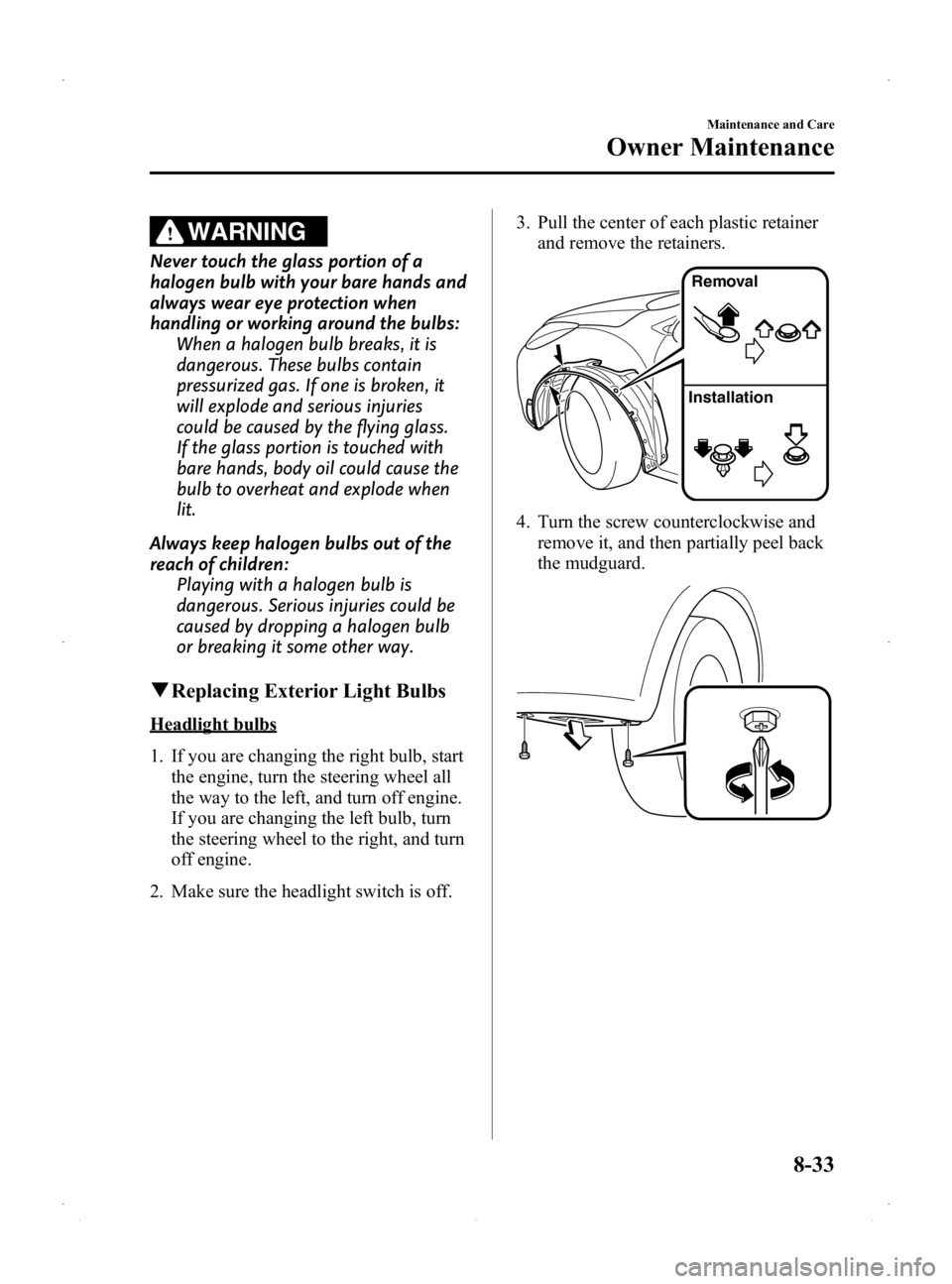
2. Make sure the headlight switch is off. 3. Pull the center of each plastic retainer
and remove the retainers.
Removal
Installation
4. Turn the screw counterclockwise and remove it, and then partially peel back
the mudguard.
Maintenance and Care
Owner Maintenance
8-33
Mazda2_8DB2-EA-13G_Edition4 Page277
Thursday, May 15 2014 1:38 PM
Form No.8DB2-EA-13G
Page 280 of 356
Black plate (280,1)
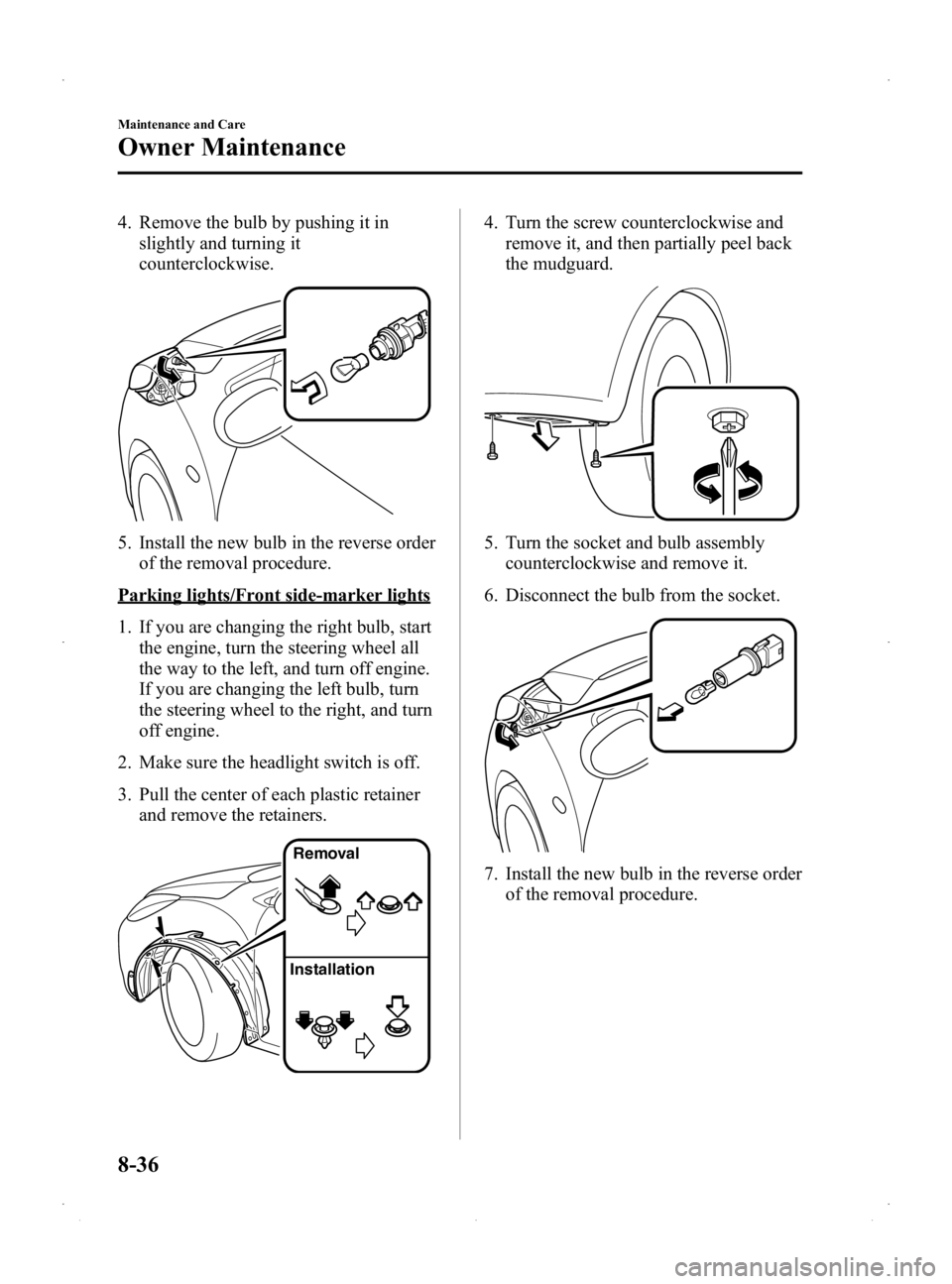
4. Remove the bulb by pushing it inslightly and turning it
counterclockwise.
5. Install the new bulb in the reverse orderof the removal procedure.
Parking lights/Front side-marker lights
1. If you are changing the right bulb, start
the engine, turn the steering wheel all
the way to the left, and turn off engine.
If you are changing the left bulb, turn
the steering wheel to the right, and turn
off engine.
2. Make sure the headlight switch is off.
3. Pull the center of each plastic retainer and remove the retainers.
Removal
Installation
4. Turn the screw counterclockwise and remove it, and then partially peel back
the mudguard.
5. Turn the socket and bulb assemblycounterclockwise and remove it.
6. Disconnect the bulb from the socket.
7. Install the new bulb in the reverse order of the removal procedure.
8-36
Maintenance and Care
Owner Maintenance
Mazda2_8DB2-EA-13G_Edition4 Page280
Thursday, May 15 2014 1:38 PM
Form No.8DB2-EA-13G
Page 294 of 356

Black plate (294,1)
qUnderbody Maintenance
Road chemicals and salt used for ice and
snow removal and solvents used for dust
control may collect on the underbody. If
not removed, they will speed up rusting
and deterioration of such underbody parts
as fuel lines, frame, floor pan, and exhaust
system, even though these parts may be
coated with anti-corrosive material.
Thoroughly flush the underbody and
wheel housings with lukewarm or cold
water at the end of each winter. Try also
to do this every month.
Pay special attention to these areas
because they easily hide mud and dirt. It
will do more harm than good to wet
down the road grime without removing
it.
The lower edges of doors, rocker panels,
and frame members have drain holes that
should not be clogged. Water trapped
there will cause rusting.
WARNING
Dry wet brakes by driving very slowly
and applying the brakes lightly until
brake performance is normal: Driving with wet brakes is
dangerous. Increased stopping
distance or the vehicle pulling to one
side when braking could result in a
serious accident. Light braking will
indicate whether the brakes have
been affected.
qAluminum Wheel Maintenanceí
A protective coating is provided over the
aluminum wheels. Special care is needed
to protect this coating.
CAUTION
Do not use any detergent other than
mild detergent. Before using any
detergent, verify the ingredients.
Otherwise, the product could discolor
or stain the aluminum wheels.
NOTE
lDo not use a wire brush or any abrasive
cleaner, polishing compound, or solvent on
aluminum wheels. They may damage the
coating.
lAlways use a sponge or soft cloth to clean
the wheels.
Rinse the wheels thoroughly with lukewarm
or cold water. Also, be sure to clean the
wheels after driving on dusty or salted
roads to help prevent corrosion.
lAvoid washing your vehicle in an automatic
car wash that uses high-speed or hard
brushes.
lIf your aluminum wheels lose luster, wax
the wheels.
(With Tire Pressure Monitoring System)
Check special requirements for Tire Pressure
Monitoring System.
Refer to Tires and Wheels on page 5-27.
8-50
Maintenance and Care
íSome models.
Appearance Care
Mazda2_8DB2-EA-13G_Edition4 Page294
Thursday, May 15 2014 1:38 PM
Form No.8DB2-EA-13G
Page 318 of 356

Black plate (318,1)
Uniform Tire Quality Grading System (UTQGS)
This information relates to the tire grading system developed by the U.S. National
Highway Traffic Safety Administration for grading tires by tread wear, traction, and
temperature performance.
qTread Wear
The tread wear grade is a comparative rating based on the wear rate of the tire when tested
under controlled conditions on a specified government test course.
For example, a tire graded 150 would wear one-and-a-half times as well on the government
course as a tire graded 100.
The relative performance of tires depends upon the actual conditions of their use, however,
and may depart significantly from the norm because of variations in driving habits, service
practices and differences in road characteristics and climate.
qTraction-AA, A, B, C
The traction grades, from highest to lowest, are AA, A, B, and C. These grades represent
the tire's ability to stop on wet pavement as measured under controlled conditions on
specified government test surfaces of asphalt and concrete. A tire marked C may have poor
traction performance.
WARNING
The traction grade assigned to this tire is based on braking (straight ahead) traction
tests and does not include acceleration cornering (turning), hydroplaning, or peak
traction characteristics.
qTemperature-A, B, C
The temperature grades A (the highest), B, and C, represent the tire's resistance to the
generation of heat and its ability to dissipate heat when tested under controlled conditions
on a specified indoor laboratory test wheel.
Sustained high temperature can cause the material of the tire to degenerate and reduce tire
life, and excessive temperatures can lead to sudden tire failure.
Grade C corresponds to a level of performance which all passenger vehicle tires must meet
under the Federal Motor Vehicle Safety Standard No. 109. Grades B and A represent
higher levels of performance on the laboratory test wheel than the minimum required by
law.
9-20
Customer Information and Reporting Safety Defects
Uniform Tire Quality Grading System (UTQGS)
Mazda2_8DB2-EA-13G_Edition4 Page318
Thursday, May 15 2014 1:38 PM
Form No.8DB2-EA-13G
Page 321 of 356

Black plate (321,1)
11. Max. load rating
12. Tread wear, traction and temperature grades
13. Max. permissible inflation pressure
14. SAFETY WARNING
P215/65R15 95H is an example of a tire size and load index rating. Here is an explanation
of the various components of that tire size and load index rating. Note that the tire size and
load index rating may be different from the example.
P
Indicates a tire that may be installed on cars, SUVs, minivans and light trucks as designated
by the Tire and Rim Association (T&RA).
NOTE
If your tire size does not begin with a letter this may mean it is designated by either ETRTO
(European Tire and Rim Technical Organization) or JATMA (Japan Tire Manufacturing Association).
215
“215 ”is the nominal width of the tire in millimeters. This three-digit number gives the
width in millimeters of the tire from sidewall edge to sidewall edge. In general, the larger
the number, the wider the tire.
65
“ 65 ”is the aspect ratio. This two-digit number indicates the tire's ratio of height to width.
R
“R” is the tire construction symbol. R indicates “Radial ply construction ”.
15
“15 ”is the wheel rim diameter in inches.
95
“95 ”is the Load Index. This two-or three-digit number indicates how much weight each
tire can support.
Customer Information and Reporting Safety Defects
Tire Information (except Canada)
9-23
Mazda2_8DB2-EA-13G_Edition4 Page321
Thursday, May 15 2014 1:38 PM
Form No.8DB2-EA-13G
Page 323 of 356
Black plate (323,1)
Tread Wear, Traction and Temperature Grades
Tread wear:The tread wear grade is a comparative rating based on the wear rate of the tire
when tested under controlled conditions on a specified government test course. For
example, a tire graded 150 would wear one and one-half (1 1/2) times as well on the
government course as a tire graded 100.
Traction: The traction grades, from highest to lowest are AA, A, B, and C. The grades
represent the tire's ability to stop on wet pavement as measured under controlled conditions
on specified government test surfaces of asphalt and concrete. A tire marked C may have
poor traction performance.
Temperature: The temperature grades are A (the highest), B and C, representing the tire's
resistance to the generation of heat and its ability to dissipate heat when tested under
controlled conditions on a specified indoor laboratory test wheel.
Snow Tires
In some heavy snow areas, local governments may require true snow tires, those with very
deeply cut tread. These tires should only be used in pairs or placed on all four wheels.
Make sure you purchase snow tires that are the same size and construction type as the other
tires on your vehicle.
SAFETY WARNING
The following safety warning appears on the tire's sidewall.
SERIOUS INJURY MAY RESULT FROM:
lEXPLOSION OF TIRE/RIM ASSEMBLY DUE TO IMPROPER MOUNTING-
MATCH TIRE DIAMETER TO RIM DIAMETER; NEVER EXCEED 40 psi (275 kPa)
TO SEAT BEADS-ONLY SPECIALLY TRAINED PERSONS SHOULD MOUNT
TIRES.
lTIRE FAILURE DUE TO UNDER-INFLATION/OVERLOADING/DAMAGE-
FOLLOW OWNER'S MANUAL AND PLACARD IN VEHICLE-FREQUENTLY
CHECK INFLATION PRESSURE AND INSPECT FOR DAMAGE.
Customer Information and Reporting Safety Defects
Tire Information (except Canada)
9-25
Mazda2_8DB2-EA-13G_Edition4 Page323
Thursday, May 15 2014 1:38 PM
Form No.8DB2-EA-13G
Page 325 of 356
Black plate (325,1)
70
“70 ”is the aspect ratio. This two-digit number indicates the tire's ratio of height to width.
D
“D ”is the tire construction symbol. D indicates “diagonal ply construction ”.
16
“16 ”is the wheel rim diameter in inches.
90
“90 ”is the Load Index. This two-or three-digit number indicates how much weight each
tire can support.
M
“ M ”is the speed rating. The speed rating denotes the maximum speed for which the use of
the tire is rated.
Letter Rating Speed Rating
M 81 mph
Customer Information and Reporting Safety Defects
Tire Information (except Canada)
9-27
Mazda2_8DB2-EA-13G_Edition4 Page325
Thursday, May 15 2014 1:38 PM
Form No.8DB2-EA-13G