brake MAZDA MODEL 3 4-DOOR 2010 Workshop Manual
[x] Cancel search | Manufacturer: MAZDA, Model Year: 2010, Model line: MODEL 3 4-DOOR, Model: MAZDA MODEL 3 4-DOOR 2010Pages: 504, PDF Size: 5.62 MB
Page 389 of 504

Black plate (389,1)
Engine Compartment Overview
Power steering fluid reservoir
Power steering fluid reservoir
Windshield washer fluid reservoir
Windshield washer fluid reservoir
Engine coolant reservoirFuse block
Engine coolant reservoir
Engine oil-filler cap
Engine oil-filler capEngine oil dipstick
Brake/Clutch fluid reservoir
Brake/Clutch fluid reservoir
Battery
Battery
Fuse block
Automatic transaxle fluid-level dipstick
(Only for automatic transaxle)
2.0-liter and 2.5-liter engine
2.3-liter turbocharged engine
Engine oil dipstick
Maintenance and Care
Owner Maintenance
8-17
Mazda3_8BG3-EA-09J_Edition2 Page389
Tuesday, December 8 2009 1:30 PM
Form No.8BG3-EA-09J
Page 395 of 504
Black plate (395,1)
Brake/Clutch Fluid
qInspecting Brake/Clutch Fluid Level
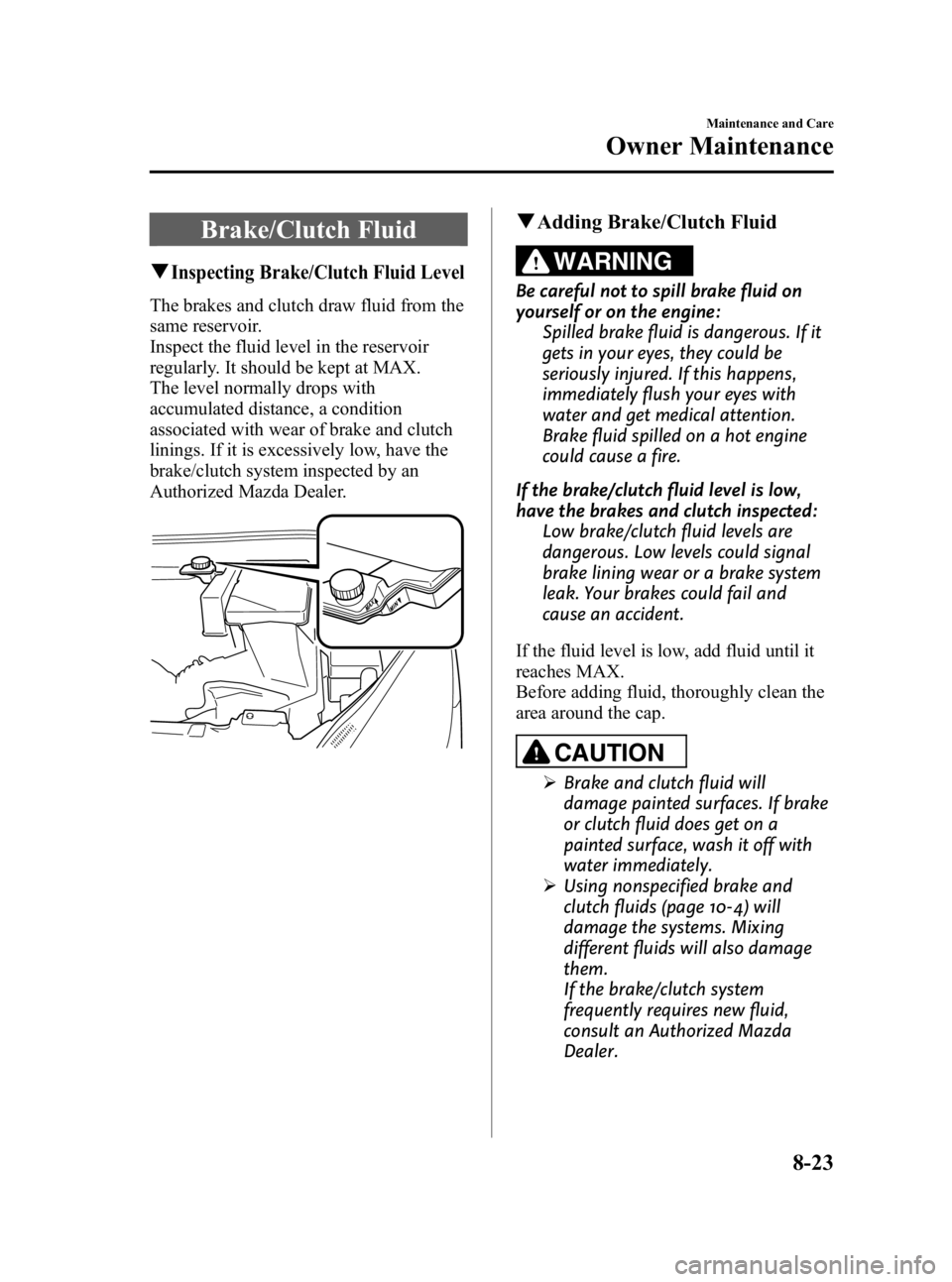
The brakes and clutch draw fluid from the
same reservoir.
Inspect the fluid level in the reservoir
regularly. It should be kept at MAX.
The level normally drops with
accumulated distance, a condition
associated with wear of brake and clutch
linings. If it is excessively low, have the
brake/clutch system inspected by an
Authorized Mazda Dealer.
qAdding Brake/Clutch Fluid
WARNING
Be careful not to spill brake fluid on
yourself or on the engine:
Spilled brake fluid is dangerous. If it
gets in your eyes, they could be
seriously injured. If this happens,
immediately flush your eyes with
water and get medical attention.
Brake fluid spilled on a hot engine
could cause a fire.
If the brake/clutch fluid level is low,
have the brakes and clutch inspected: Low brake/clutch fluid levels are
dangerous. Low levels could signal
brake lining wear or a brake system
leak. Your brakes could fail and
cause an accident.
If the fluid level is low, add fluid until it
reaches MAX.
Before adding fluid, thoroughly clean the
area around the cap.
CAUTION
Ø Brake and clutch fluid will
damage painted surfaces. If brake
or clutch fluid does get on a
painted surface, wash it off with
water immediately.
Ø Using nonspecified brake and
clutch fluids (page 10-4) will
damage the systems. Mixing
different fluids will also damage
them.
If the brake/clutch system
frequently requires new fluid,
consult an Authorized Mazda
Dealer.
Maintenance and Care
Owner Maintenance
8-23
Mazda3_8BG3-EA-09J_Edition2 Page395
Tuesday, December 8 2009 1:30 PM
Form No.8BG3-EA-09J
Page 396 of 504

Black plate (396,1)
Power Steering Fluid
qInspecting Power Steering Fluid
Level
CAUTION
To avoid damage to the power
steering pump, don't operate the
vehicle for long periods when the
power steering fluid level is low.
NOTE
Use specified power steering fluid (page 10-4).
Inspect the fluid level in the reservoir at
each engine oil change with the engine off
and cold. Add fluid if necessary; it does
not require periodic changing.
The level must be kept between MIN and
MAX.
Visually examine the lines and hoses for
leaks and damage.
If new fluid is required frequently, consult
an Authorized Mazda Dealer.
Automatic Transaxle Fluid
(ATF)
í
q Inspecting Automatic Transaxle
Fluid Level
The automatic transaxle fluid level should
be inspected regularly. Measure it as
described below.
CAUTION
Ø Always check the automatic
transaxle fluid level according to
the following procedure. If the
procedure is not done correctly,
the automatic transaxle fluid level
cannot be measured accurately
which could lead to automatic
transaxle damage.
Ø A low fluid level can cause
transaxle slippage. Overfilling can
cause foaming, loss of fluid, and
transaxle malfunction.
Ø It is recommended to use Mazda
Genuine automatic transaxle fluid
(page 10-4).
1. Park on a level surface and set the parking brake firmly.
2. Make sure there is no ATF leakage from the ATF hose or the housing.
3. Shift the shift lever to the park position (P), start the engine and warm it up.
CAUTION
Do not shift the shift lever while the
engine is warming up. If the ATF level
is extremely low, the automatic
transaxle could be damaged.
8-24
Maintenance and Care
íSome models.
Owner Maintenance
Mazda3_8BG3-EA-09J_Edition2 Page396
Tuesday, December 8 2009 1:30 PM
Form No.8BG3-EA-09J
Page 397 of 504

Black plate (397,1)
4. While the engine is still idling, pull outthe dipstick and wipe it clean, and then
put it back.
5. Check the ATF level. If there is no ATF adhering 5 mm from the end of the
dipstick, add ATF.
CAUTION
If there is no ATF adhering to the
dipstick even after the engine has
been warmed up, do not drive the
vehicle. Otherwise, the automatic
transaxle could be damaged.
6. Shift the shift lever to each range and position, and make sure there is no
abnormality.
7. Drive the vehicle on city roads for 5 km (3.1 mile) or more.
8. Park on a level surface and set the parking brake firmly.
9. Shift the shift lever to the park position (P), check the ATF level while the
engine is idling, and make sure that the
ATF level is within the proper level. If
the ATF level is not within the proper
level, add ATF. The proper fluid level
is marked on the dipstick as follows.
Full
OK
Low
CAUTION
Ø Use the cold scale only as a
reference.
Ø If outside temperature is lower
than about 20 °C (70 °F), start the
engine and inspect the fluid level
after the engine reaches operating
temperature.
Ø If the vehicle has been driven for
an extended period at high speeds
or in city traffic in hot weather,
inspect the level only after
stopping the engine and allowing
the fluid to cool for 30 minutes.
Fully insert the dipstick. When adding
fluid, inspect with the dipstick to make
sure it does not pass full.
NOTE
Inspect the fluid on both sides of the dipstick in
a well lit area for an accurate reading.
Maintenance and Care
Owner Maintenance
8-25
Mazda3_8BG3-EA-09J_Edition2 Page397
Tuesday, December 8 2009 1:30 PM
Form No.8BG3-EA-09J
Page 412 of 504

Black plate (412,1)
Light Bulbs
Overhead light/Map lights (Front)Overhead light (Rear) Overhead light (Rear)
Front turn signal lights/Front side-
marker lights/ Parking lights
Xenon fusion bulb/Adaptive Front
Lighting System
Fog lights
Parking lights/
Adaptive Front Lighting
System (AFS)
Overhead light/Map lights (Front)
Front turn signal lights
/Front side-marker lights
/Parking lights
Head lights (Low beam)
Head lights (High beam)/
Daytime running lights
Head lights (Low/High beam)
Fog lights
Side turn signal light (LED type)
Trunk light
Brake lights/Taillights Brake lights/Taillights
Rear turn signal lights Rear turn signal lights
Rear side marker lights
Rear side marker lights
Except Canada
Some models.
Reverse lights
Reverse lights
License plate lights License plate lights
High-mount brake light Halogen bulb
212
2
1
2
High-mount brake light
Side turn signal lights
(Bulb type) Side turn signal lights
(LED type)
Luggage
compartment light
4 Door
5 Door
Canada
Daytime running lights
8-40
Maintenance and Care
Owner Maintenance
Mazda3_8BG3-EA-09J_Edition2 Page412
Tuesday, December 8 2009 1:30 PM
Form No.8BG3-EA-09J
Page 418 of 504

Black plate (418,1)
2. Slide the unit as shown in the figure toremove it.
3. Detach the electrical connector from
the unit by pulling it to the rear.
4. Install the new side turn signal unit inthe reverse order of removal.
Brake lights/Taillights (Rear side
marker lights)
With LED bulb
Due to the complexity and difficulty of
the procedure, the LED bulbs should be
replaced by an Authorized Mazda Dealer.
NOTE
LED bulb replacement is not possible. The
rear combination component must be replaced.
With Non-LED bulb
(4 Door)
1. Pull the center of each plastic retainer
and remove the retainers and the trunk
end trim.
InstallationRemoval
2. Turn the socket and bulb assembly
counterclockwise and remove it.
3. Disconnect the bulb from the socket.
4. Install the new bulb in the reverse order of removal.
(5 Door)
1. Make sure the ignition is switched off, and the headlight switch is off.
8-46
Maintenance and Care
Owner Maintenance
Mazda3_8BG3-EA-09J_Edition2 Page418
Tuesday, December 8 2009 1:30 PM
Form No.8BG3-EA-09J
Page 421 of 504

Black plate (421,1)
2. Remove the cover.
3. Turn the socket and bulb assemblycounterclockwise and remove it.
4. Disconnect the bulb from the socket.
5. Install the new bulb in the reverse order of removal.
High-mount brake light
(4 Door)
1. Make sure the ignition is switched off,and the headlight switch is off. 2. Pull the center of each plastic retainer
and remove the retainers and the trunk
end trim.
InstallationRemoval
3. Turn the socket and bulb assembly
counterclockwise and remove it.
4. Disconnect the bulb from the socket.
5. Install the new bulb in the reverse order of removal.
(5 Door)
With LED bulb
Due to the complexity and difficulty of
the procedure, the LED bulbs should be
replaced by an Authorized Mazda Dealer.
NOTE
LED bulb replacement is not possible. The
rear combination component must be replaced.
Maintenance and Care
Owner Maintenance
8-49
Mazda3_8BG3-EA-09J_Edition2 Page421
Tuesday, December 8 2009 1:30 PM
Form No.8BG3-EA-09J
Page 428 of 504

Black plate (428,1)
DESCRIPTIONFUSE
RATING PROTECTED COMPONENT
18 INJ 30 A Injector
í
19R.DEF 30 A Rear window defroster
20 IGKEY 2 40 A For protection of various circuits
21 IGKEY 1 40 A For protection of various circuits
22 HORN 15 A Horn
23 STOP 15 A Brake lights
24
10A Engine control system
25 FUEL PUMP 25 A Fuel system
26 ABS 40 A ABS
27 SEAT WARM 20 A Seat warmer
í
28 EHPAS 80 A Electro-Hydraulic Power Assist Steering
29 ―― ―
30 ABS IG 7.5 A ABS
31 ―― ―
32 H/L LO RH 15 A Headlight low beam (RH)
33 H/L LO LH 15 A Headlight low beam (LH)
34 ILLUM 7.5 A Dashboard illumination
35 TAIL 15 A Taillights
36 ENG INJ 15 A Engine control system
37 ENG BAR 15 A PCM
38 ENG BAR 2 20 A PCM
39 ETV 15 A Electric throttle valve
8-56
Maintenance and Care
íSome models.
Owner Maintenance
Mazda3_8BG3-EA-09J_Edition2 Page428
Tuesday, December 8 2009 1:30 PM
Form No.8BG3-EA-09J
Page 434 of 504
Black plate (434,1)
Pay special attention to removing salt,
dirt, mud, and other foreign material from
the underside of the fenders, and make
sure the drain holes in the lower edges of
the doors and rocker panels are clean.
Insects, tar, tree sap, bird droppings,
industrial fallout, and similar deposits can
damage the finish if not removed
immediately. When prompt washing with
plain water is ineffective, use a mild soap
made for use on vehicles.
Thoroughly rinse off all soap with
lukewarm or cold water. Do not allow
soap to dry on the finish.
After washing the vehicle, dry it with a
clean chamois to prevent water spots from
forming.
WARNING
Dry wet brakes by driving very slowly
and applying the brakes lightly until
brake performance is normal:Driving with wet brakes is
dangerous. Increased stopping
distance or the vehicle pulling to one
side when braking could result in a
serious accident. Light braking will
indicate whether the brakes have
been affected. When using a high water pressure car
wash
High water temperature and high water
pressure car washers are available
depending on the type of car wash
machine. If the car washer nozzle is put
too close to the vehicle, the force of the
spray could damage or deform the
molding, affect the sealability of parts,
and allow water to penetrate the interior.
Keep a sufficient space (30 cm or more)
between the nozzle and the vehicle. In
addition, do not spend too much time
spraying the same area of the vehicle, and
be very careful when spraying between
gaps in doors and around windows.
Waxing
Your vehicle needs to be waxed when
water no longer beads on the finish.
Always wash and dry the vehicle before
waxing it. In addition to the vehicle body,
wax the metal trim to maintain its luster.
1. Use wax which contains no abrasives.
Waxes containing abrasive will remove
paint and could damage bright metal
parts.
2. Use a good grade of natural wax for metallic, mica, and solid colors.
3. When waxing, coat evenly with the sponge supplied or a soft cloth.
4. Wipe off the wax with a soft cloth.
NOTE
A spot remover to remove oil, tar, and similar
materials will usually also take off the wax.
Rewax these areas even if the rest of the
vehicle does not need it.
8-62
Maintenance and Care
Appearance Care
Mazda3_8BG3-EA-09J_Edition2 Page434
Tuesday, December 8 2009 1:30 PM
Form No.8BG3-EA-09J
Page 435 of 504
Black plate (435,1)
qRepairing Damage to the Finish
Deep scratches or chips on the finish
should be repaired promptly. Exposed
metal quickly rusts and can lead to major
repairs.
CAUTION
If your Mazda is damaged and needs
metal parts repaired or replaced,
make sure the body shop applies
anti-corrosion materials to all parts,
both repaired and new. This will
prevent them from rusting.
qBright-Metal Maintenance
lUse tar remover to remove road tar and
insects. Never do this with a knife or
similar tool.
lTo prevent corrosion on bright-metal
surfaces, apply wax or chrome
preservative and rub it to a high luster.
lDuring cold weather or in coastal areas,
cover bright-metal parts with a coating
of wax or preservative heavier than
usual. It would also help to coat them
with noncorrosive petroleum jelly or
some other protective compound.
CAUTION
Don't use steel wool, abrasive
cleaners, or strong detergents
containing highly alkaline or caustic
agents on chrome-plated or anodized
aluminum parts. This may result in
damage to the protective coating and
cause discoloration or paint
deterioration.
qUnderbody Maintenance
Road chemicals and salt used for ice and
snow removal and solvents used for dust
control may collect on the underbody. If
not removed, they will speed up rusting
and deterioration of such underbody parts
as fuel lines, frame, floor pan, and exhaust
system, even though these parts may be
coated with anti-corrosive material.
Thoroughly flush the underbody and
wheel housings with lukewarm or cold
water at the end of each winter. Try also
to do this every month.
Pay special attention to these areas
because they easily hide mud and dirt. It
will do more harm than good to wet
down the road grime without removing
it.
The lower edges of doors, rocker panels,
and frame members have drain holes that
should not be clogged. Water trapped
there will cause rusting.
WARNING
Dry wet brakes by driving very slowly
and applying the brakes lightly until
brake performance is normal: Driving with wet brakes is
dangerous. Increased stopping
distance or the vehicle pulling to one
side when braking could result in a
serious accident. Light braking will
indicate whether the brakes have
been affected.
Maintenance and Care
Appearance Care
8-63
Mazda3_8BG3-EA-09J_Edition2 Page435
Tuesday, December 8 2009 1:30 PM
Form No.8BG3-EA-09J