brake MAZDA MODEL 3 4-DOOR 2012 Owner's Manual
[x] Cancel search | Manufacturer: MAZDA, Model Year: 2012, Model line: MODEL 3 4-DOOR, Model: MAZDA MODEL 3 4-DOOR 2012Pages: 528, PDF Size: 6.47 MB
Page 173 of 528
Black plate (173,1)
If the ABS warning light stays on while
you're driving, the ABS control unit has
detected a system malfunction. If this
occurs, your brakes will function normally
as if the vehicle had no ABS.
Should this happen, consult an Authorized
Mazda Dealer as soon as possible.
NOTE
lWhen the engine is jump-started to charge
the battery, uneven rpm occurs and the ABS
warning light may illuminate. If this occurs,
it is the result of the weak battery and does
not indicate an ABS malfunction.
Recharge the battery.
l(With DSC vehicles)
The brake assist system does not operate
while the ABS warning light is illuminated.
qElectronic Brake Force
Distribution System Warning
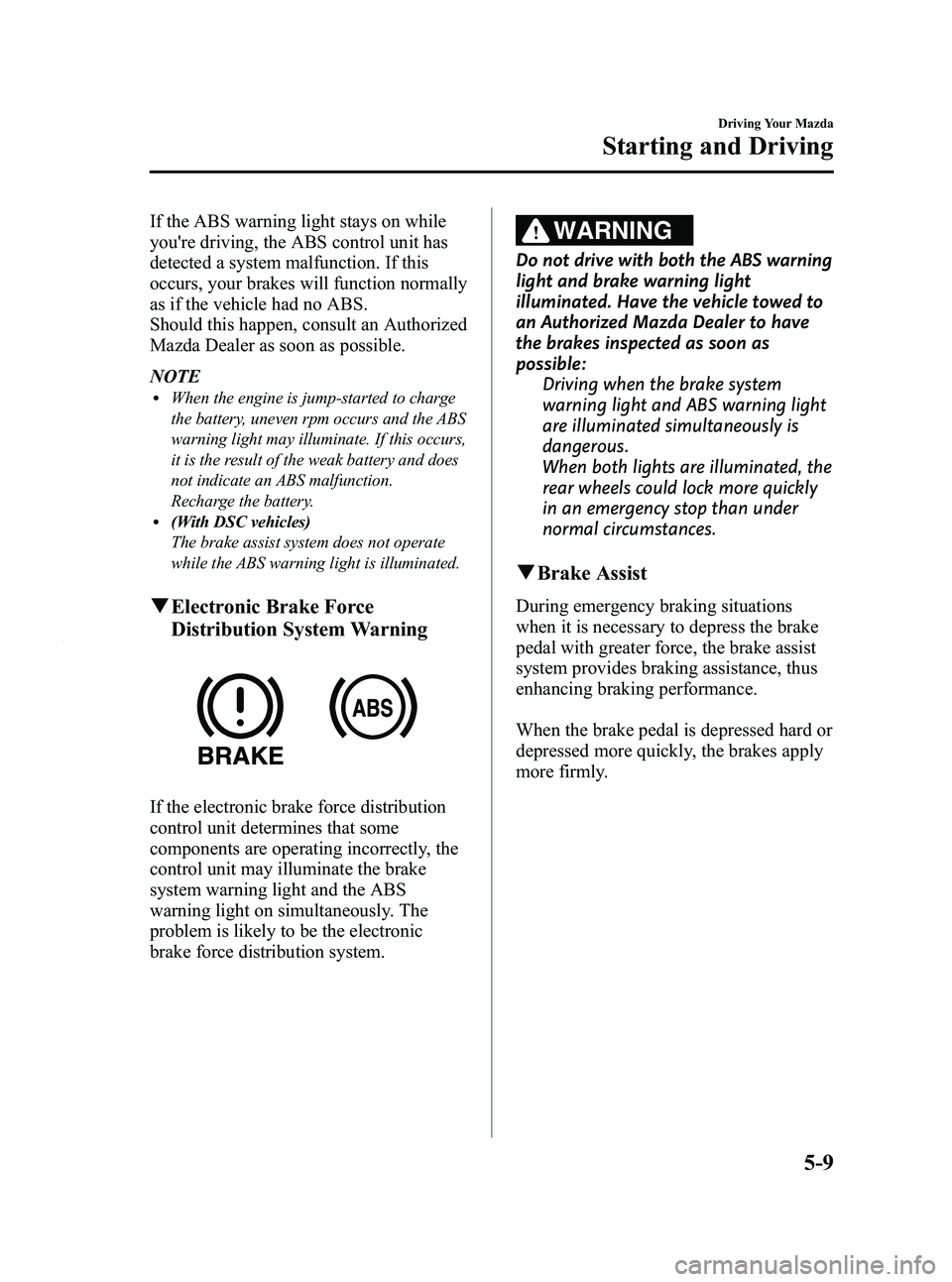
If the electronic brake force distribution
control unit determines that some
components are operating incorrectly, the
control unit may illuminate the brake
system warning light and the ABS
warning light on simultaneously. The
problem is likely to be the electronic
brake force distribution system.
WARNING
Do not drive with both the ABS warning
light and brake warning light
illuminated. Have the vehicle towed to
an Authorized Mazda Dealer to have
the brakes inspected as soon as
possible:
Driving when the brake system
warning light and ABS warning light
are illuminated simultaneously is
dangerous.
When both lights are illuminated, the
rear wheels could lock more quickly
in an emergency stop than under
normal circumstances.
qBrake Assist
During emergency braking situations
when it is necessary to depress the brake
pedal with greater force, the brake assist
system provides braking assistance, thus
enhancing braking performance.
When the brake pedal is depressed hard or
depressed more quickly, the brakes apply
more firmly.
Driving Your Mazda
Starting and Driving
5-9
Mazda3_8BY6-EA-11F_Edition3 Page173
Thursday, March 1 2012 10:17 AM
Form No.8BY6-EA-11F
Page 174 of 528
Black plate (174,1)
NOTElWhen the brake pedal is depressed hard or
depressed more quickly, the pedal will feel
softer but the brakes will apply more firmly.
This is a normal effect of the brake assist
operation and does not indicate a
malfunction.
l(Without DSC vehicles)
When the brake pedal is depressed hard or
depressed more quickly, a clicking noise
from the brake booster may be heard. This
is a normal effect of the brake assist and
does not indicate a malfunction.
l(With DSC vehicles)
When the brake pedal is depressed hard or
depressed more quickly, a motor/pump
operation noise may be heard. This is a
normal effect of the brake assist and does
not indicate a malfunction.
lThe brake assist equipment does not
supersede the functionality of the vehicle's
main braking system.
Manual Transaxle Operation
qManual Transaxle Shift Pattern
5-speed transaxle
6-speed transaxleNeutral position
Neutral position
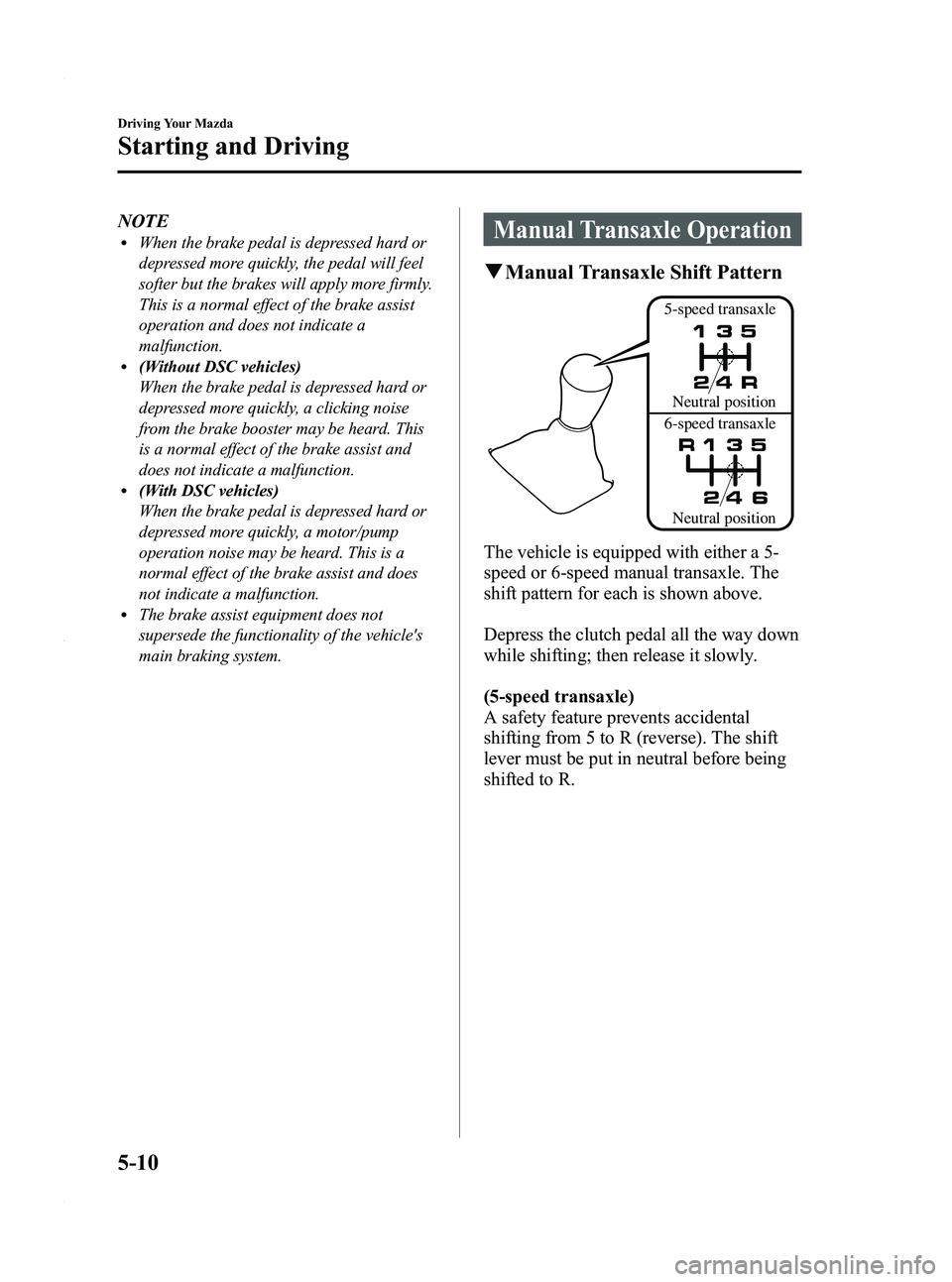
The vehicle is equipped with either a 5-
speed or 6-speed manual transaxle. The
shift pattern for each is shown above.
Depress the clutch pedal all the way down
while shifting; then release it slowly.
(5-speed transaxle)
A safety feature prevents accidental
shifting from 5 to R (reverse). The shift
lever must be put in neutral before being
shifted to R.
5-10
Driving Your Mazda
Starting and Driving
Mazda3_8BY6-EA-11F_Edition3 Page174
Thursday, March 1 2012 10:17 AM
Form No.8BY6-EA-11F
Page 175 of 528
Black plate (175,1)
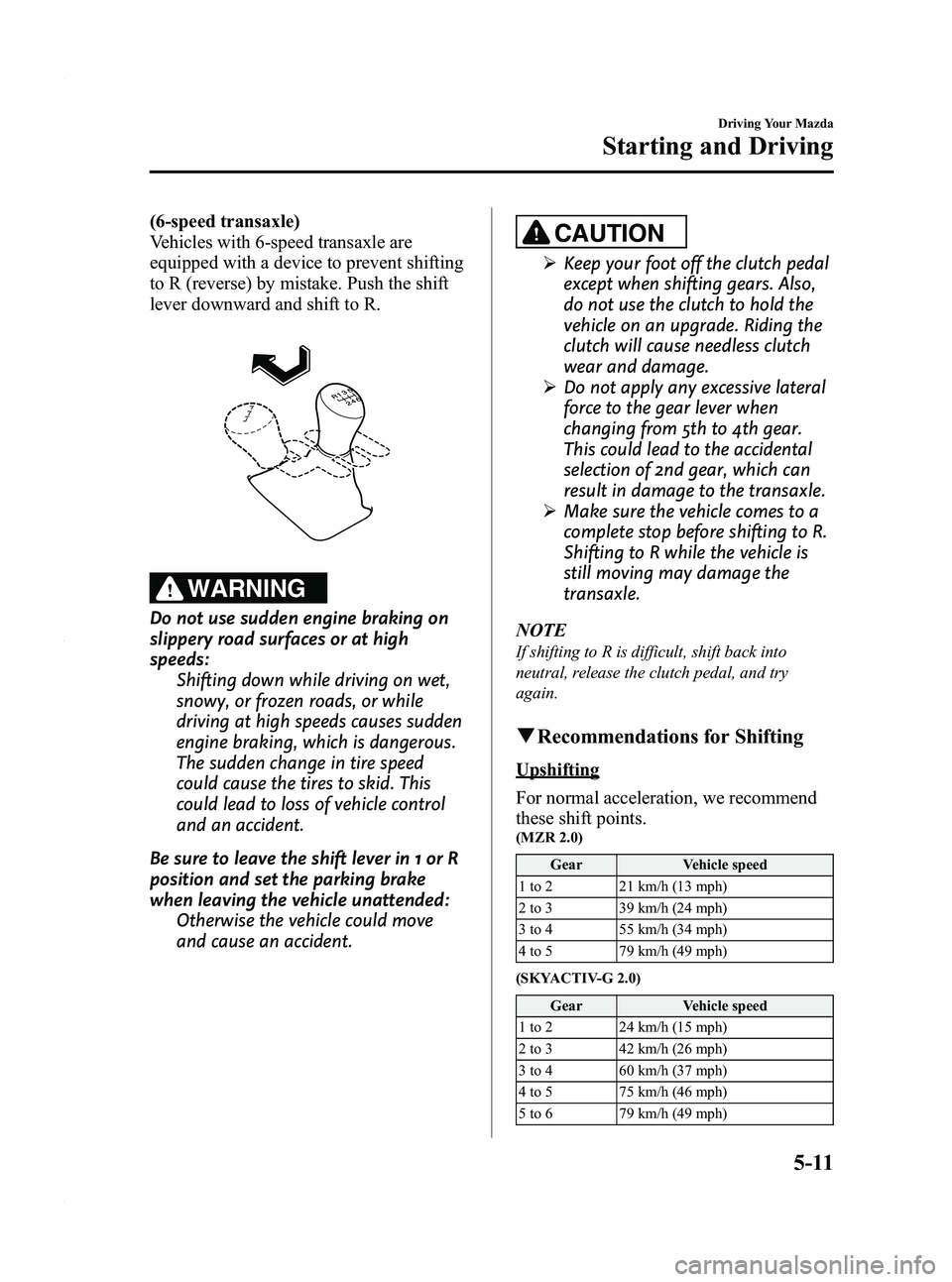
(6-speed transaxle)
Vehicles with 6-speed transaxle are
equipped with a device to prevent shifting
to R (reverse) by mistake. Push the shift
lever downward and shift to R.
WARNING
Do not use sudden engine braking on
slippery road surfaces or at high
speeds:Shifting down while driving on wet,
snowy, or frozen roads, or while
driving at high speeds causes sudden
engine braking, which is dangerous.
The sudden change in tire speed
could cause the tires to skid. This
could lead to loss of vehicle control
and an accident.
Be sure to leave the shift lever in 1 or R
position and set the parking brake
when leaving the vehicle unattended: Otherwise the vehicle could move
and cause an accident.
CAUTION
ØKeep your foot off the clutch pedal
except when shifting gears. Also,
do not use the clutch to hold the
vehicle on an upgrade. Riding the
clutch will cause needless clutch
wear and damage.
Ø Do not apply any excessive lateral
force to the gear lever when
changing from 5th to 4th gear.
This could lead to the accidental
selection of 2nd gear, which can
result in damage to the transaxle.
Ø Make sure the vehicle comes to a
complete stop before shifting to R.
Shifting to R while the vehicle is
still moving may damage the
transaxle.
NOTE
If shifting to R is difficult, shift back into
neutral, release the clutch pedal, and try
again.
q Recommendations for Shifting
Upshifting
For normal acceleration, we recommend
these shift points.
(MZR 2.0)
Gear Vehicle speed
1 to 2 21 km/h (13 mph)
2 to 3 39 km/h (24 mph)
3 to 4 55 km/h (34 mph)
4 to 5 79 km/h (49 mph)
(SKYACTIV-G 2.0) Gear Vehicle speed
1 to 2 24 km/h (15 mph)
2 to 3 42 km/h (26 mph)
3 to 4 60 km/h (37 mph)
4 to 5 75 km/h (46 mph)
5 to 6 79 km/h (49 mph)
Driving Your Mazda
Starting and Driving
5-11
Mazda3_8BY6-EA-11F_Edition3 Page175
Thursday, March 1 2012 10:17 AM
Form No.8BY6-EA-11F
Page 176 of 528
Black plate (176,1)
(MZR 2.3 DISI Turbo)Gear Vehicle speed
1 to 2 24 km/h (15 mph)
2 to 3 40 km/h (25 mph)
3 to 4 65 km/h (40 mph)
4 to 5 73 km/h (45 mph)
5 to 6 81 km/h (50 mph)
(MZR 2.5)
Gear Vehicle speed
1 to 2 24 km/h (15 mph)
2 to 3 43 km/h (27 mph)
3 to 4 56 km/h (35 mph)
4 to 5 73 km/h (45 mph)
5 to 6 90 km/h (56 mph)
For cruising(MZR 2.0)
Gear Vehicle speed
1 to 2 18 km/h (11 mph)
2 to 3 29 km/h (18 mph)
3 to 4 47 km/h (29 mph)
4 to 5 68 km/h (42 mph)
(SKYACTIV-G 2.0) Gear Vehicle speed
1 to 2 13 km/h (8 mph)
2 to 3 29 km/h (18 mph)
3 to 4 49 km/h (30 mph)
4 to 5 63 km/h (39 mph)
5 to 6 70 km/h (43 mph)
(MZR 2.3 DISI Turbo) Gear Vehicle speed
1 to 2 24 km/h (15 mph)
2 to 3 40 km/h (25 mph)
3 to 4 65 km/h (40 mph)
4 to 5 73 km/h (45 mph)
5 to 6 81 km/h (50 mph) (MZR 2.5)
Gear Vehicle speed
1 to 2 16 km/h (10 mph)
2 to 3 32 km/h (20 mph)
3 to 4 49 km/h (30 mph)
4 to 5 60 km/h (37 mph)
5 to 6 71 km/h (44 mph)
Downshifting
When you must slow down in heavy
traffic or on a steep upgrade, downshift
before the engine starts to overwork. This
reduces the chance of stalling and gives
better acceleration when you need more
speed.
On a steep downgrade , downshifting
helps maintain safe speed and prolongs
brake life.
5-12
Driving Your Mazda
Starting and Driving
Mazda3_8BY6-EA-11F_Edition3 Page176
Thursday, March 1 2012 10:17 AM
Form No.8BY6-EA-11F
Page 177 of 528
Black plate (177,1)
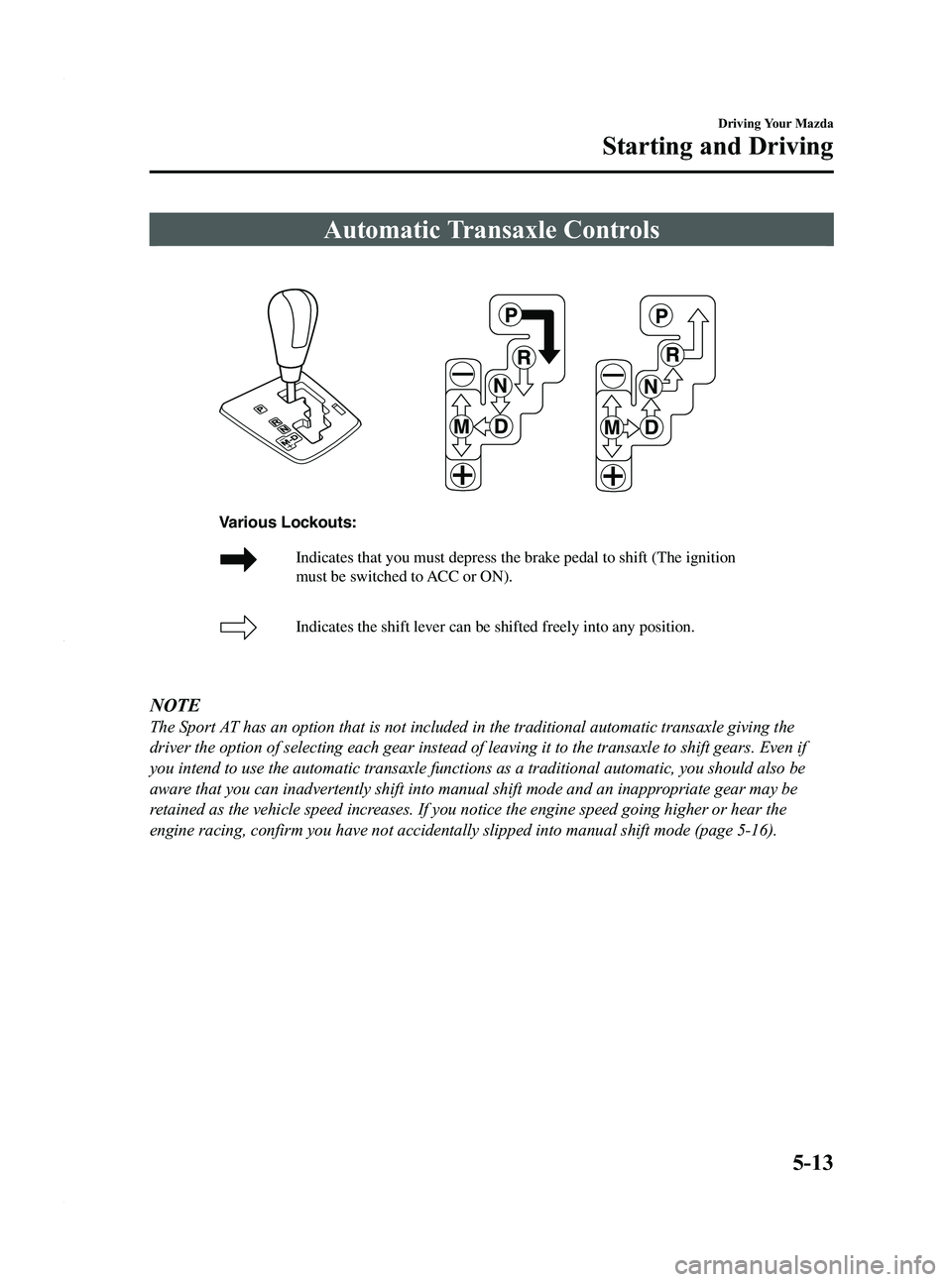
Automatic Transaxle Controls
Indicates that you must depress the brake pedal to shift (The ignition
must be switched to ACC or ON).
Indicates the shift lever can be shifted freely into any position.
Various Lockouts:
NOTE
The Sport AT has an option that is not included in the traditional automatic transaxle giving the
driver the option of selecting each gear instead of leaving it to the transaxle to shift gears. Even if
you intend to use the automatic transaxle functions as a traditional automatic, you should also be
aware that you can inadvertently shift into manual shift mode and an inappropriate gear may be
retained as the vehicle speed increases. If you notice the engine speed going higher or hear the
engine racing, confirm you have not accidentally slipped into manual shift mode (page 5-16).
Driving Your Mazda
Starting and Driving
5-13
Mazda3_8BY6-EA-11F_Edition3 Page177
Thursday, March 1 2012 10:17 AM
Form No.8BY6-EA-11F
Page 178 of 528
Black plate (178,1)
qTransaxle Ranges
The shift lever must be in P or N to
operate the starter.
P (Park)
P locks the transaxle and prevents the
front wheels from rotating.
WARNING
Always set the shift lever to P and set
the parking brake:
Only setting the shift lever to the P
position without using the parking
brake to hold the vehicle is
dangerous. If P fails to hold, the
vehicle could move and cause an
accident.
CAUTION
ØShifting into P, N or R while the
vehicle is moving can damage
your transaxle.
Ø Shifting into a driving gear or
reverse when the engine is running
faster than idle can damage the
transaxle.
R (Reverse)
In position R, the vehicle moves only
backward. You must be at a complete stop
before shifting to or from R, except under
rare circumstances as explained in
Rocking the Vehicle (page 4-9).
N (Neutral)
In N, the wheels and transaxle are not
locked. The vehicle will roll freely even
on the slightest incline unless the parking
brake or brakes are on.
WARNING
If the engine is running faster than idle,
do not shift from N or P into a driving
gear:
It's dangerous to shift from N or P
into a driving gear when the engine
is running faster than idle. If this is
done, the vehicle could move
suddenly, causing an accident or
serious injury.
Do not shift into N when driving the
vehicle: Shifting into N while driving is
dangerous. Engine braking cannot be
applied when decelerating which
could lead to an accident or serious
injury.
CAUTION
Do not shift into N when driving the
vehicle. Doing so can cause transaxle
damage.
NOTE
Apply the parking brake or depress the brake
pedal before moving the shift lever from N to
prevent the vehicle from moving unexpectedly.
D (Drive)
D is the normal driving position. From a
stop, the transaxle will automatically shift
through a 5-gear/6-gear
*sequence.
* SKYACTIV-G 2.0
M (Manual)
M is the manual shift mode position.
Gears can be shifted up or down by
operating the shift lever.
Refer to Manual Shift Mode (page 5-16).
5-14
Driving Your Mazda
Starting and Driving
Mazda3_8BY6-EA-11F_Edition3 Page178
Thursday, March 1 2012 10:17 AM
Form No.8BY6-EA-11F
Page 179 of 528
Black plate (179,1)
qActive Adaptive Shift (AAS)
Active Adaptive Shift (AAS)
automatically controls the transaxle shift
points to best suit the road conditions and
driver input. This improves driving
comfort.
(SKYACTIV-G 2.0)
The transaxle may switch to AAS mode
when driving up and down slopes,
cornering, or depressing the accelerator
pedal quickly while the shift lever is in the
D position.
Depending on the driving conditions and
vehicle operations, it may not be possible
to shift gears, however, this does not
indicate a problem because the AAS
mode will maintain the optimum gear
position.
(Except SKYACTIV-G 2.0)
If the driver accelerates rapidly, or
accelerates and decelerates rapidly by
operating the accelerator and brake pedal
for a certain period of time while the shift
lever is in the D position, AAS mode
could activate.
When cornering the vehicle, AAS mode
will hold the transaxle in the gear the
vehicle was in before entering the curve,
allowing the vehicle to be accelerated
from the same gear after exiting the curve.
AAS mode will maintain the transaxle in
the optimum gear and the driver may
sense that the transaxle is not shifting,
however this does not indicate an
abnormality.
qShift-Lock System
The shift-lock system prevents shifting
out of P unless the brake pedal is
depressed.
To shift from P:
1. Depress and hold the brake pedal.
2. Start the engine.
3. Move the shift lever.
NOTE
lWhen the ignition is switched off, the shift
lever cannot be shifted from P.
lTo be sure the vehicle is in park, the
ignition key cannot be removed unless the
shift lever is in P.
l(With Advanced Key)
The ignition cannot be switched from ACC
to OFF when the shift lever is not in P.
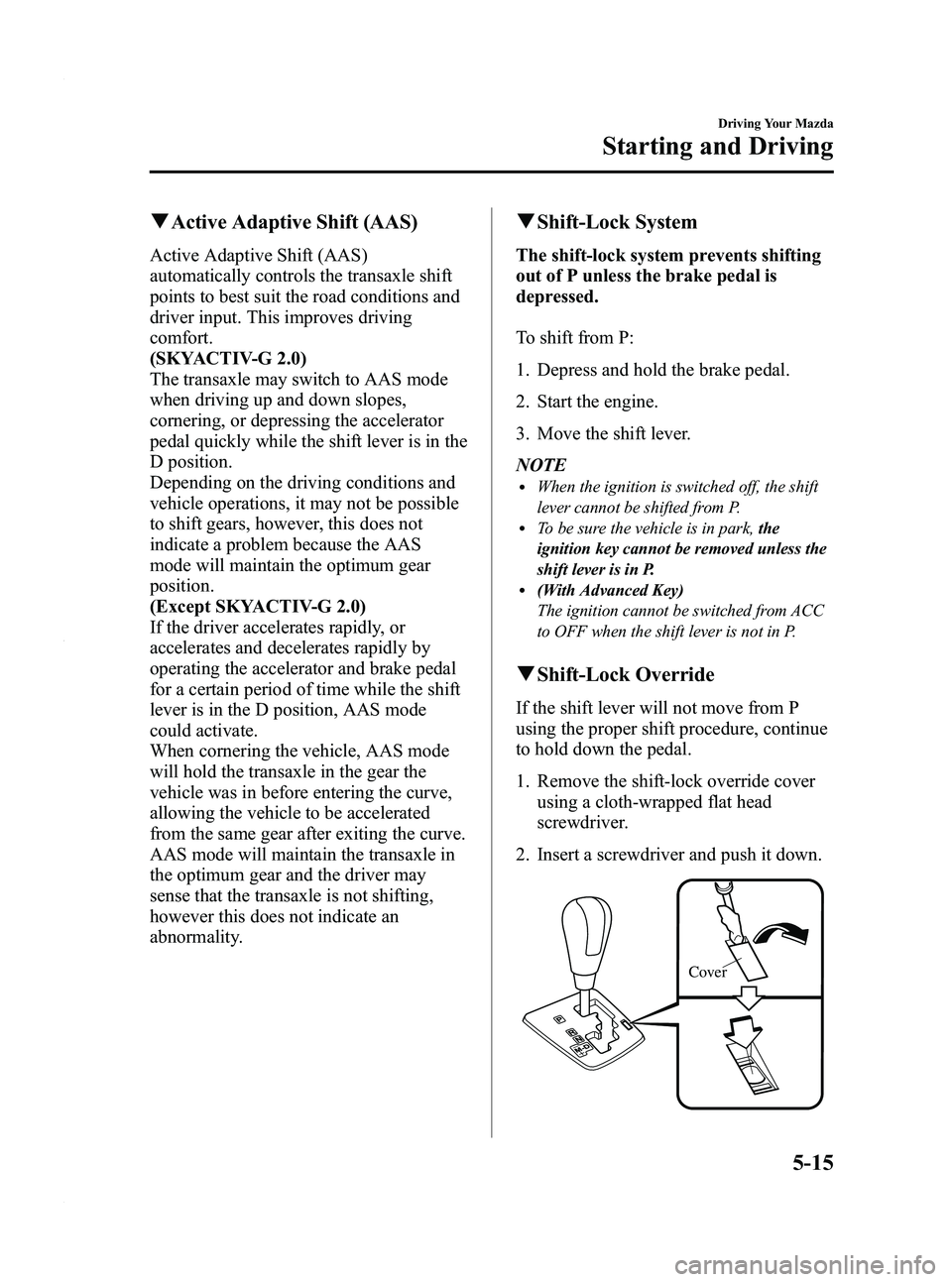
q Shift-Lock Override
If the shift lever will not move from P
using the proper shift procedure, continue
to hold down the pedal.
1. Remove the shift-lock override cover
using a cloth-wrapped flat head
screwdriver.
2. Insert a screwdriver and push it down.
Cover
Driving Your Mazda
Starting and Driving
5-15
Mazda3_8BY6-EA-11F_Edition3 Page179
Thursday, March 1 2012 10:17 AM
Form No.8BY6-EA-11F
Page 184 of 528
Black plate (184,1)
Downshifting
When you must slow down in heavy
traffic or on a steepupgrade, downshift
before the engine starts to overwork. This
gives better acceleration when you need
more speed.
On a steep downgrade , downshifting
helps maintain safe speed and prolongs
brake life.
q Driving Tips
WARNING
Do not allow the vehicle to move in
reverse on an up-slope while the
selector lever is in a forward gear
position, or move forward on a down-
slope while the selector lever is in the
reverse position.
Otherwise, the engine will stop,
causing the loss of the power brake
and power steering functions, and
make it difficult to control the vehicle
which could result in an accident.
Passing
For extra power when passing another
vehicle or climbing steep grades, depress
the accelerator fully. The transaxle will
shift to a lower gear, depending on vehicle
speed.
Climbing steep grades from a stop
To climb a steep grade from a stopped
position:
1. Depress the brake pedal.
2. Shift to D or M1, depending on theload weight and grade steepness.
3. Release the brake pedal while gradually accelerating.
Descending steep grades
When descending a steep grade, shift to
lower gears, depending on load weight
and grade steepness. Descend slowly,
using the brakes only occasionally to
prevent them from overheating.
5-20
Driving Your Mazda
Starting and Driving
Mazda3_8BY6-EA-11F_Edition3 Page184
Thursday, March 1 2012 10:17 AM
Form No.8BY6-EA-11F
Page 190 of 528
Black plate (190,1)
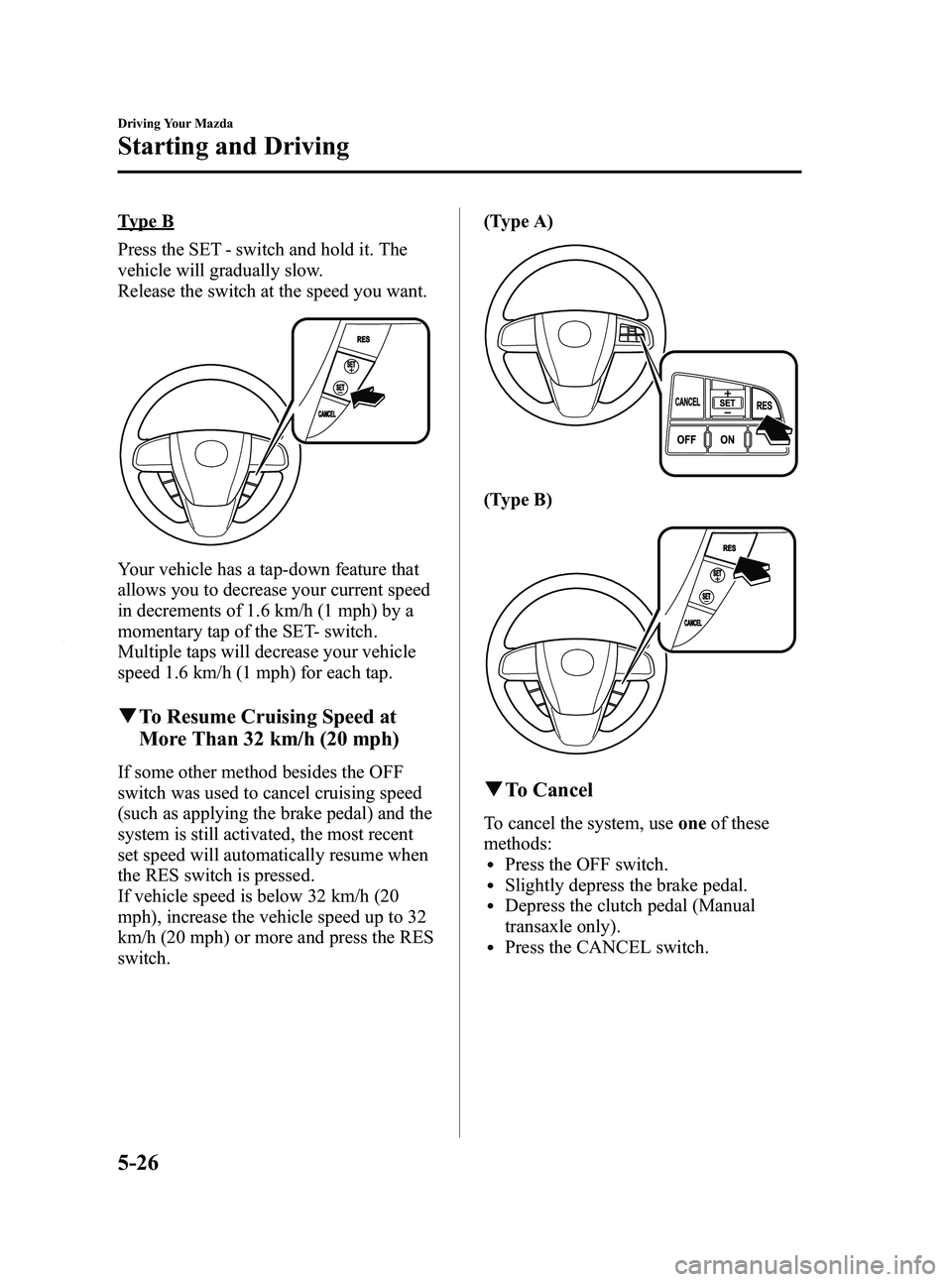
Type B
Press the SET - switch and hold it. The
vehicle will gradually slow.
Release the switch at the speed you want.
Your vehicle has a tap-down feature that
allows you to decrease your current speed
in decrements of 1.6 km/h (1 mph) by a
momentary tap of the SET- switch.
Multiple taps will decrease your vehicle
speed 1.6 km/h (1 mph) for each tap.
qTo Resume Cruising Speed at
More Than 32 km/h (20 mph)
If some other method besides the OFF
switch was used to cancel cruising speed
(such as applying the brake pedal) and the
system is still activated, the most recent
set speed will automatically resume when
the RES switch is pressed.
If vehicle speed is below 32 km/h (20
mph), increase the vehicle speed up to 32
km/h (20 mph) or more and press the RES
switch. (Type A)
(Type B)
q
To Cancel
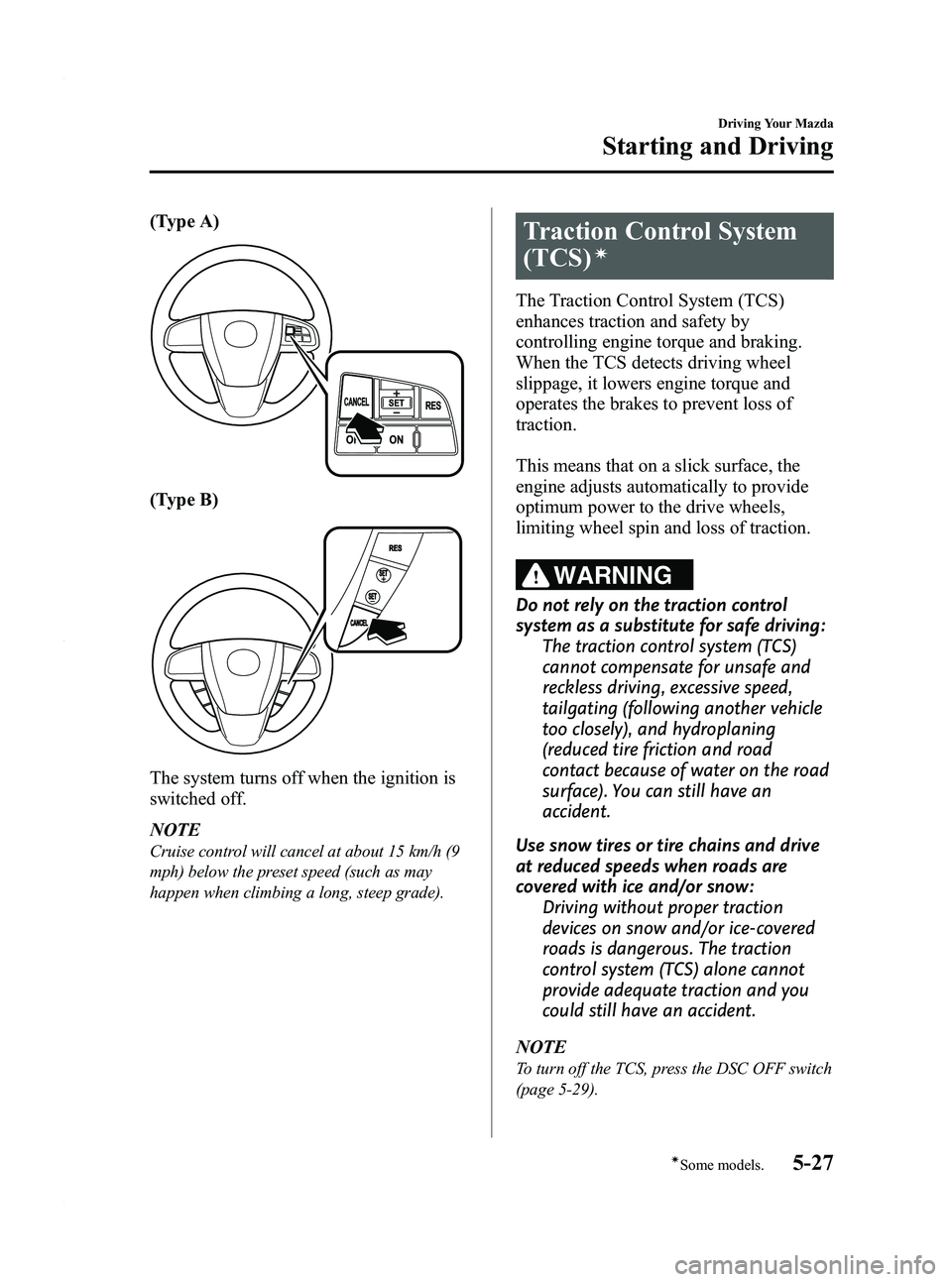
To cancel the system, use oneof these
methods:
lPress the OFF switch.lSlightly depress the brake pedal.lDepress the clutch pedal (Manual
transaxle only).
lPress the CANCEL switch.
5-26
Driving Your Mazda
Starting and Driving
Mazda3_8BY6-EA-11F_Edition3 Page190
Thursday, March 1 2012 10:17 AM
Form No.8BY6-EA-11F
Page 191 of 528
Black plate (191,1)
(Type A)
(Type B)
The system turns off when the ignition is
switched off.
NOTE
Cruise control will cancel at about 15 km/h (9
mph) below the preset speed (such as may
happen when climbing a long, steep grade).
Traction Control System
(TCS)
í
The Traction Control System (TCS)
enhances traction and safety by
controlling engine torque and braking.
When the TCS detects driving wheel
slippage, it lowers engine torque and
operates the brakes to prevent loss of
traction.
This means that on a slick surface, the
engine adjusts automatically to provide
optimum power to the drive wheels,
limiting wheel spin and loss of traction.
WARNING
Do not rely on the traction control
system as a substitute for safe driving:The traction control system (TCS)
cannot compensate for unsafe and
reckless driving, excessive speed,
tailgating (following another vehicle
too closely), and hydroplaning
(reduced tire friction and road
contact because of water on the road
surface). You can still have an
accident.
Use snow tires or tire chains and drive
at reduced speeds when roads are
covered with ice and/or snow: Driving without proper traction
devices on snow and/or ice-covered
roads is dangerous. The traction
control system (TCS) alone cannot
provide adequate traction and you
could still have an accident.
NOTE
To turn off the TCS, press the DSC OFF switch
(page 5-29).
Driving Your Mazda
Starting and Driving
5-27íSome models.
Mazda3_8BY6-EA-11F_Edition3 Page191
Thursday, March 1 2012 10:17 AM
Form No.8BY6-EA-11F