seats MAZDA MODEL 3 4-DOOR 2012 Owner's Manual
[x] Cancel search | Manufacturer: MAZDA, Model Year: 2012, Model line: MODEL 3 4-DOOR, Model: MAZDA MODEL 3 4-DOOR 2012Pages: 528, PDF Size: 6.47 MB
Page 49 of 528
Black plate (49,1)
WARNING
Use the tether and tether anchor only
for a child-restraint system:Using the tether or tether anchor to
secure anything but a child-restraint
system is dangerous. This could
weaken or damage the tether or
tether anchor and result in injury.
Always route the tether strap between
the head restraint and the seatback (4
Door): Routing the tether strap on top of the
head restraint is dangerous. In a
collision the tether strap could slide
off the head restraint and loosen the
child-restraint system. The child-
restraint system could move which
may result in death or injury to the
child.
Always attach the tether strap to the
correct tether anchor position: Attaching the tether strap to the
incorrect tether anchor position is
dangerous. In a collision, the tether
strap could come off and loosen the
child-restraint system. If the child-
restraint system moves it could result
in death or injury to the child.
qIf You Must Use the Front Seat
for Children
If you cannot put all children in the rear
seat, at least put the smallest children in
the rear and be sure the largest child up
front uses the shoulder belt over the
shoulder.
NEVER put a rear-facing child-restraint
system on the front passenger seat
whether your vehicle is equipped with a
seat weight sensor or not.
This seat is also not set up for tethered
child-restraint systems, put them in one of
the rear seat positions set up with tether
anchors.
Likewise the LATCH child-restraint
system cannot be secured in the front
passenger's seat and should be used in the
rear seat.
Do not allow anyone to sleep against the
side window if you have optional side and
curtain air bags, it could cause serious
injuries to an out of position occupant. As
children more often sleep in cars, it is
better to put them in the rear seat. If
installing the child-restraint system on the
front seat is unavoidable, follow these
instructions when using a front-facing
child-restraint system in the front
passenger's seat.
NOTE
lTo check if your front seats have side air
bags:
Mazda vehicles equipped with side air bag
will have a “SRS AIRBAG ”tag on the
outboard shoulder of the front seats.
lTo check if your vehicle has curtain air
bags:
Mazda vehicles equipped with curtain air
bag will have an “SRS AIRBAG ”marking
on the window pillars along the roof edge.
Essential Safety Equipment
Child Restraint
2-35
Mazda3_8BY6-EA-11F_Edition3 Page49
Thursday, March 1 2012 10:16 AM
Form No.8BY6-EA-11F
Page 54 of 528
Black plate (54,1)
qLATCH Child-Restraint System
Installation Procedure (Rear
Outboard Seats)
1. First, adjust the front seat to allow
clearance between the child-restraint
system and the front seat (page 2-2).
2. Make sure the seatback is securely latched by pushing it back until it is
fully locked.
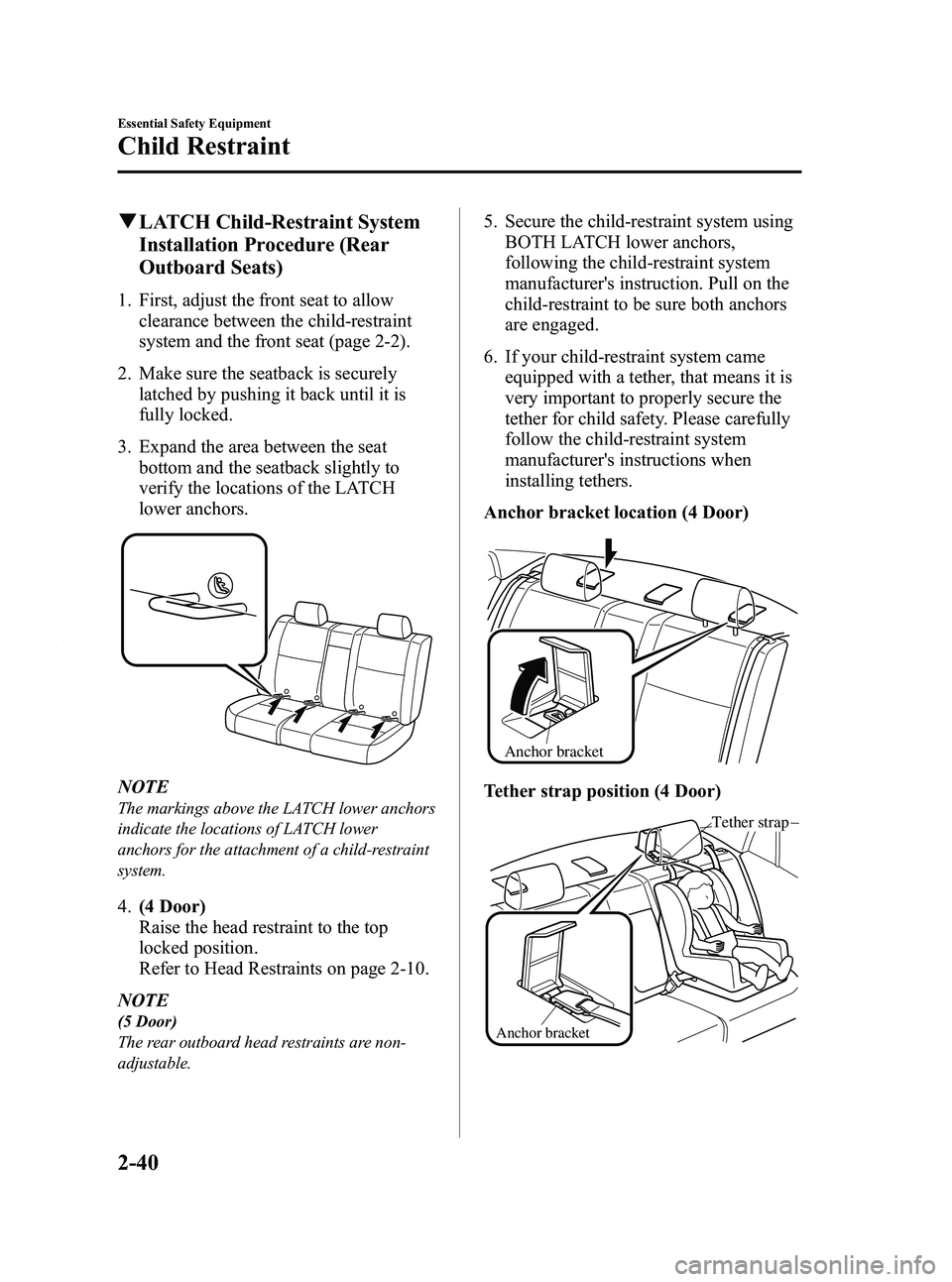
3. Expand the area between the seat bottom and the seatback slightly to
verify the locations of the LATCH
lower anchors.
NOTE
The markings above the LATCH lower anchors
indicate the locations of LATCH lower
anchors for the attachment of a child-restraint
system.
4.(4 Door)
Raise the head restraint to the top
locked position.
Refer to Head Restraints on page 2-10.
NOTE
(5 Door)
The rear outboard head restraints are non-
adjustable.
5. Secure the child-restraint system using BOTH LATCH lower anchors,
following the child-restraint system
manufacturer's instruction. Pull on the
child-restraint to be sure both anchors
are engaged.
6. If your child-restraint system came equipped with a tether, that means it is
very important to properly secure the
tether for child safety. Please carefully
follow the child-restraint system
manufacturer's instructions when
installing tethers.
Anchor bracket location (4 Door)
Anchor bracket
Tether strap position (4 Door)
Anchor bracket
Tether strap
2-40
Essential Safety Equipment
Child Restraint
Mazda3_8BY6-EA-11F_Edition3 Page54
Thursday, March 1 2012 10:16 AM
Form No.8BY6-EA-11F
Page 60 of 528
Black plate (60,1)
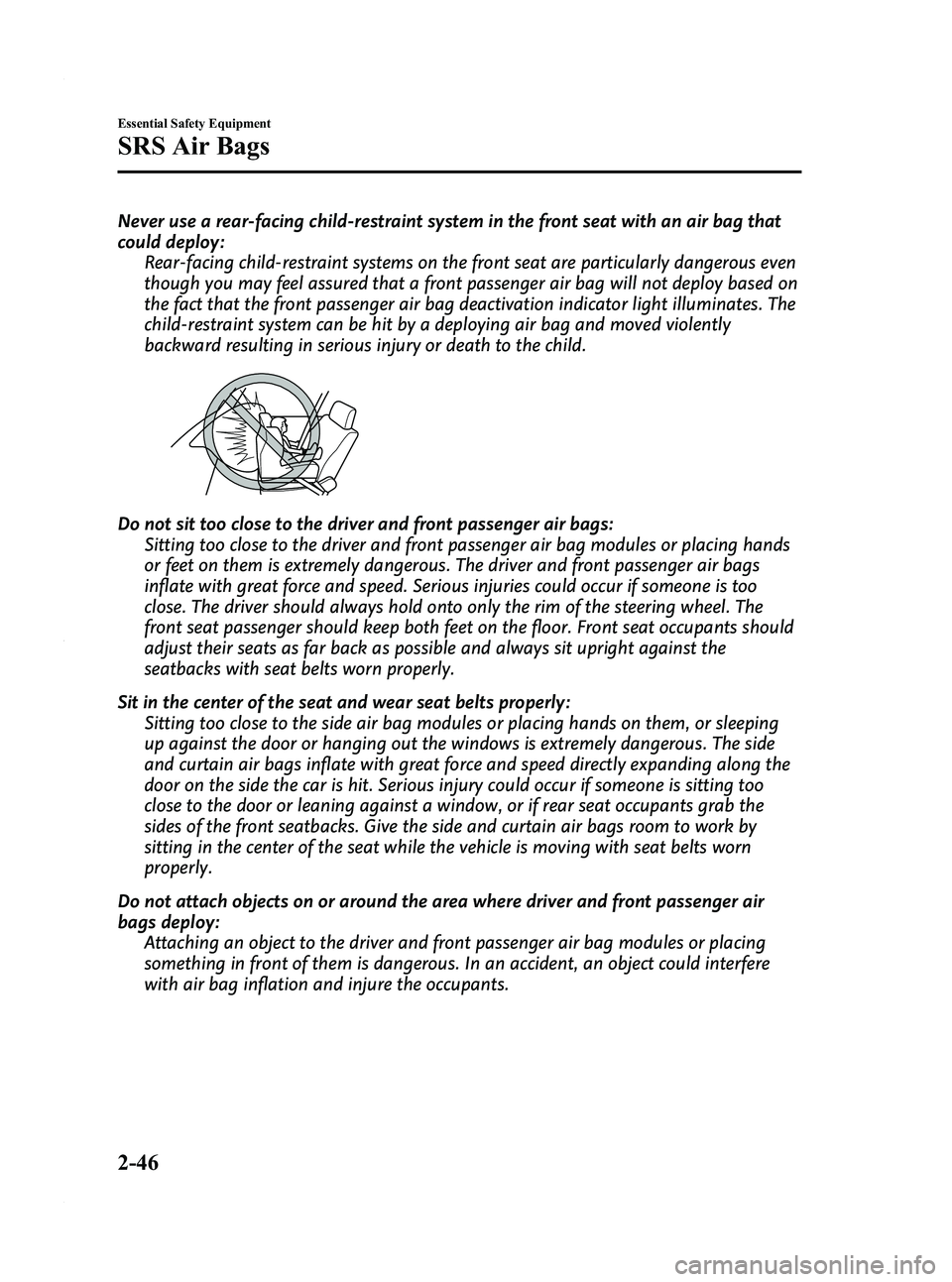
Never use a rear-facing child-restraint system in the front seat with an air bag that
could deploy:Rear-facing child-restraint systems on the front seat are particularly dangerous even
though you may feel assured that a front passenger air bag will not deploy based on
the fact that the front passenger air bag deactivation indicator light illuminates. The
child-restraint system can be hit by a deploying air bag and moved violently
backward resulting in serious injury or death to the child.
Do not sit too close to the driver and front passenger air bags:
Sitting too close to the driver and front passenger air bag modules or placing hands
or feet on them is extremely dangerous. The driver and front passenger air bags
inflate with great force and speed. Serious injuries could occur if someone is too
close. The driver should always hold onto only the rim of the steering wheel. The
front seat passenger should keep both feet on the floor. Front seat occupants should
adjust their seats as far back as possible and always sit upright against the
seatbacks with seat belts worn properly.
Sit in the center of the seat and wear seat belts properly: Sitting too close to the side air bag modules or placing hands on them, or sleeping
up against the door or hanging out the windows is extremely dangerous. The side
and curtain air bags inflate with great force and speed directly expanding along the
door on the side the car is hit. Serious injury could occur if someone is sitting too
close to the door or leaning against a window, or if rear seat occupants grab the
sides of the front seatbacks. Give the side and curtain air bags room to work by
sitting in the center of the seat while the vehicle is moving with seat belts worn
properly.
Do not attach objects on or around the area where driver and front passenger air
bags deploy: Attaching an object to the driver and front passenger air bag modules or placing
something in front of them is dangerous. In an accident, an object could interfere
with air bag inflation and injure the occupants.
2-46
Essential Safety Equipment
SRS Air Bags
Mazda3_8BY6-EA-11F_Edition3 Page60
Thursday, March 1 2012 10:16 AM
Form No.8BY6-EA-11F
Page 61 of 528
Black plate (61,1)
Do not attach objects on or around the area where a side air bag deploys:Attaching objects to the front seat in such a way as to cover the outboard side of the
seat in any way is dangerous. In an accident the object could interfere with the side
air bag, which inflates from the outboard side of the front seats, impeding the added
protection of the side air bag system or redirecting the air bag in a way that is
dangerous. Furthermore, the bag could be cut open releasing the gas.
Do not hang net bags, map pouches or backpacks with side straps on the front
seats. Never use seat covers on the front seats. Always keep the side air bag modules
in your front seats free to deploy in the event of a side collision.
Do not attach objects on or around the area where a curtain air bag deploys: Attaching objects to the areas where the curtain air bag activates such as on the
windshield glass, side door glass, front and rear window pillars and along the roof
edge and assist grips is dangerous. In an accident the object could interfere with the
curtain air bag, which inflates from the front and rear window pillars and along the
roof edge, impeding the added protection of the curtain air bag system or redirecting
the air bag in a way that is dangerous. Furthermore, the bag could be cut open
releasing the gas.
Do not place hangers or any other objects on the assist grips. When hanging clothes,
hang them on the coat hook directly. Always keep the curtain air bag modules free
to deploy in the event of a side collision.
Do not place luggage or other objects under the front seats: Placing luggage or other objects under the front seats is dangerous. The components
essential to the supplemental restraint system could be damaged, and in the event of
a side collision, the appropriate air bags may not deploy, which could result in death
or serious injury. To prevent damage to the components essential to the
supplemental restraint system, do not place luggage or other objects under the front
seats.
Do not touch the components of the supplemental restraint system after the air bags
have inflated: Touching the components of the supplemental restraint system after the air bags
have inflated is dangerous. Immediately after inflation, they are very hot. You could
get burned.
Never install any front-end equipment to your vehicle: Installation of front-end equipment, such as frontal protection bar (kangaroo bar,
bull bar, push bar, or other similar devices), snowplow, or winches, is dangerous. The
air bag crash sensor system could be affected. This could cause air bags to inflate
unexpectedly, or it could prevent the air bags from inflating during an accident.
Front occupants could be seriously injured.
Essential Safety Equipment
SRS Air Bags
2-47
Mazda3_8BY6-EA-11F_Edition3 Page61
Thursday, March 1 2012 10:16 AM
Form No.8BY6-EA-11F
Page 62 of 528
Black plate (62,1)
Do not modify the suspension:Modifying the vehicle suspension is dangerous. If the vehicle's height or the
suspension is modified, the vehicle will be unable to accurately detect a collision
resulting in incorrect or unexpected air bag deployment and the possibility of serious
injuries.
Do not modify a front door or leave any damage unrepaired. Always have an
Authorized Mazda Dealer inspect a damaged front door: Modifying a front door or leaving any damage unrepaired is dangerous. Each front
door has a side crash sensor as a component of the supplemental restraint system. If
holes are drilled in a front door, a door speaker is left removed, or a damaged door is
left unrepaired, the sensor could be adversely affected causing it to not detect the
pressure of an impact correctly during a side collision. If a sensor does not detect a
side impact correctly, the side and curtain air bags and the front seat belt
pretensioner may not operate normally which could result in serious injury to
occupants.
Do not modify the supplemental restraint system: Modifying the components or wiring of the supplemental restraint system is
dangerous. You could accidentally activate it or make it inoperable. Do not make
any modifications to the supplemental restraint system. This includes installing trim,
badges, or anything else over the air bag modules. It also includes installing extra
electrical equipment on or near system components or wiring. An Authorized Mazda
Dealer can provide the special care needed in the removal and installation of front
seats. It is important to protect the air bag wiring and connections to assure that the
bags do not accidentally deploy, the driver seat slide position sensor and front
passenger seat weight sensors are not damaged and that the seats retain an
undamaged air bag connection.
NOTE
lWhen an air bag deploys, a loud inflation noise can be heard and some smoke will be released.
Neither is likely to cause injury, however, the texture of the air bags may cause light skin injuries
on body parts not covered with clothing through friction.
lShould you sell your Mazda, we urge you to tell the new owner of its air bag systems and that
familiarization with all instructions about them, from the Owner's Manual, is important.
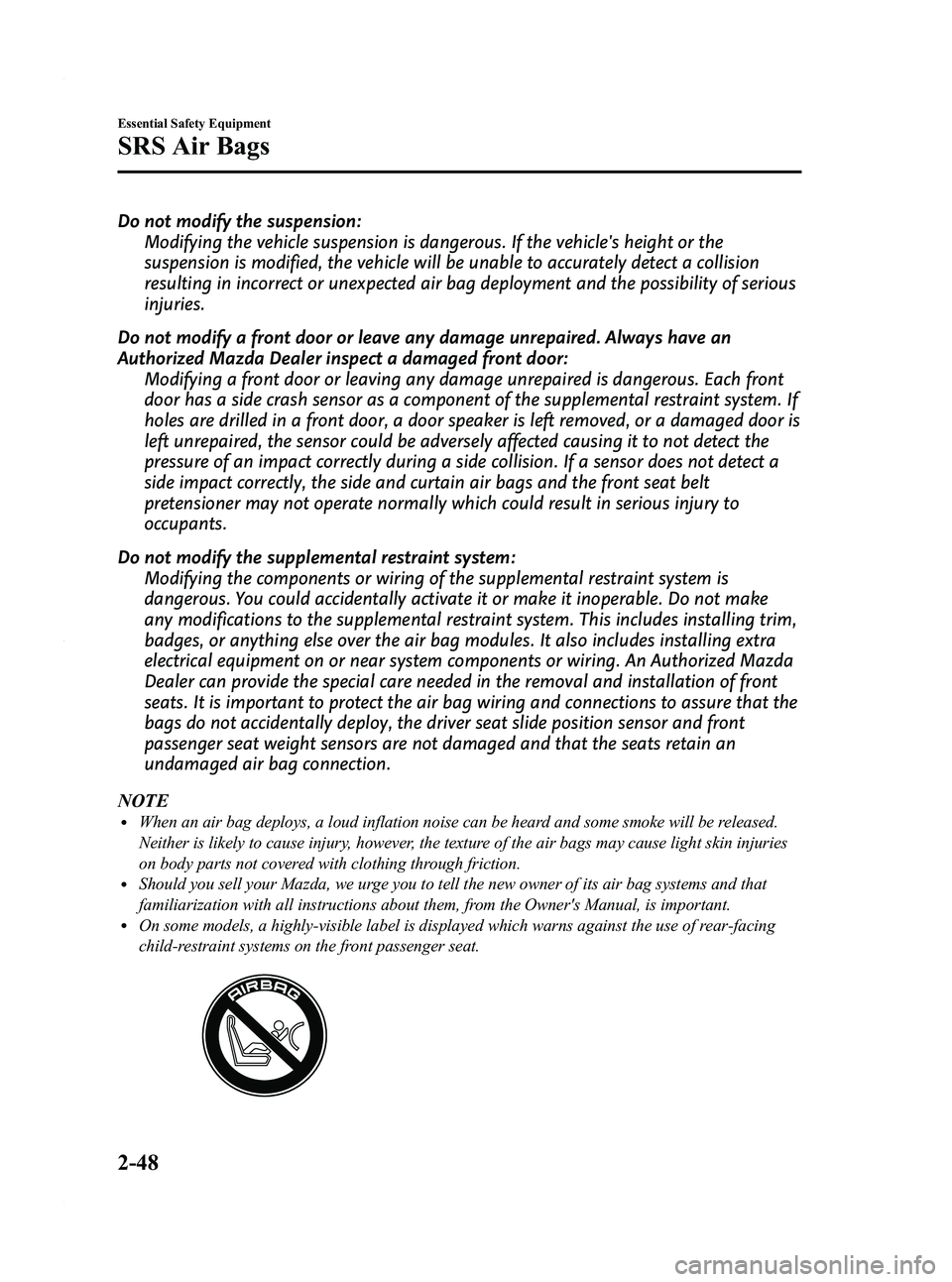
lOn some models, a highly-visible label is displayed which warns against the use of rear-facing
child-restraint systems on the front passenger seat.
2-48
Essential Safety Equipment
SRS Air Bags
Mazda3_8BY6-EA-11F_Edition3 Page62
Thursday, March 1 2012 10:16 AM
Form No.8BY6-EA-11F
Page 74 of 528
Black plate (74,1)
Do not increase the total seated weight on the front passenger seat:When an infant or small child sits on the front passenger seat, increasing the total
seated weight on the front passenger seat is dangerous. The front passenger seat
weight sensors will detect the increased total seated weight, which could result in the
unexpected deployment of the front passenger front and side air bags and seat belt
pretensioner system in an accident and may cause serious injury. Increasing the total
seated weight on the front passenger seat could result in the front passenger front
and side air bags and seat belt pretensioner system deployment in an accident under
the following conditions, for example:
ØLuggage or other items are placed on the seat with the child in the child-restraint
system.
Ø A rear passenger or luggage push or pull down on the front passenger seatback.
Ø A rear passenger steps on the front passenger seat rails with their feet.
Ø Luggage or other items are placed on the seatback or hung on the head restraint.
Ø Heavy items are placed in the seatback map pocket.
Ø The seat is washed.
Ø Liquids are spilled on the seat.
Ø The front passenger seat is moved backward, pushing into luggage or other items
placed behind it.
Ø The front passenger seatback contacts the rear seat.
Ø Luggage or other items are placed between the front passenger seat and driver
seat.
Ø Any accessories which might increase the total seated weight on the front
passenger seat are attached to the front passenger seat.
The front passenger front and side air bags and seat belt pretensioner systems will
deactivate if the front passenger air bag deactivation indicator light illuminates.
CAUTION
Ø To assure proper deployment of the front air bag and to prevent damage to the
sensors in the front seat bottoms:
ØDo not place sharp objects on the front seat bottoms or leave heavy luggage on
them.
ØDo not spill any liquids on the front seats or under the front seats.
Ø To allow the sensors to function properly, always perform the following:
ØAdjust the front seats as far back as possible and always sit upright against the
seatbacks with seat belts worn properly.
ØIf you place your child on the front passenger seat, secure the child-restraint
system properly and slide the front passenger seat as far back as possible (page
2-36).
2-60
Essential Safety Equipment
SRS Air Bags
Mazda3_8BY6-EA-11F_Edition3 Page74
Thursday, March 1 2012 10:16 AM
Form No.8BY6-EA-11F
Page 77 of 528
Black plate (77,1)
WARNING
Do not operate a vehicle with damaged air bag/seat belt pretensioner system
components:Expended or damaged air bag/seat belt pretensioner system components must be
replaced after any collision which caused them to deploy or damage them. Only a
trained Authorized Mazda Dealer can fully evaluate these systems to see that they
will work in any subsequent accident. Driving with an expended or damaged air bag
or pretensioner unit will not afford you the necessary protection in the event of any
subsequent accident which could result in serious injury or death.
Do not remove interior air bag parts: Removing any components such as the front seats, front dashboard, the steering
wheel or parts on the front and rear window pillars and along the roof edge,
containing air bag parts or sensors is dangerous. These parts contain essential air
bag components. The air bag could accidentally activate and cause serious injuries.
Always have an Authorized Mazda Dealer remove these parts.
Dispose of the air bag properly: Improper disposal of an air bag or a vehicle with live air bags in it can be extremely
dangerous. Unless all safety procedures are followed, injury can result. Ask an
Authorized Mazda Dealer how to safely dispose of an air bag or how to scrap an air
bag equipped vehicle.
NOTE
If it becomes necessary to have the components or wiring system for the supplementary restraint
system modified to accommodate a person with certain medical conditions in accordance with a
certified physician, contact an Authorized Mazda Dealer, refer to “Customer Assistance (U.S.A.) ”
(page 9-2).
Essential Safety Equipment
SRS Air Bags
2-63
Mazda3_8BY6-EA-11F_Edition3 Page77
Thursday, March 1 2012 10:16 AM
Form No.8BY6-EA-11F
Page 120 of 528
Black plate (120,1)
Trunk Lid (4 Door)
WARNING
Never allow a person to ride in the
trunk:Allowing a person to ride in the trunk
is dangerous. In addition, the person
in the trunk could be seriously
injured or killed during sudden
braking or a collision.
Keep the trunk closed when driving: Exhaust gas entering the cabin of a
vehicle through an open trunk is
dangerous. This gas contains CO
(carbon monoxide), which is
colorless, odorless, and highly
poisonous. If inhaled, it can cause
loss of consciousness and death.
qOpening and Closing the Trunk Lid
WARNING
Close the trunk lid, be sure the seat
backs are latched and do not allow
children to play inside the vehicle:Leaving the trunk lid open or leaving
children in the vehicle with the keys is
dangerous. Children could open the
trunk lid and climb inside resulting in
possible injury or death from heat
exposure.
Always keep the car from being a
tempting place to play by latching the
rear seats, doors and the trunk, and
keeping the keys where children can
not play with them: Leaving children or animals
unattended in a parked vehicle is
dangerous. Babies left sleeping and
children who lock themselves in cars
or trunks can die very quickly from
heat prostration. Do not leave your
children or pets alone in a car at any
time. Do not leave the car, the rear
folding seats or the trunk unlocked.
CAUTION
For vehicles equipped with a rear
spoiler, do not raise or lower the
trunk lid using the spoiler. Otherwise,
the rear spoiler and the trunk lid
could be damaged.
3-42
Knowing Your Mazda
Doors and Locks
Mazda3_8BY6-EA-11F_Edition3 Page120
Thursday, March 1 2012 10:17 AM
Form No.8BY6-EA-11F
Page 123 of 528
Black plate (123,1)
WARNING
Close the trunk lid, be sure the seat
backs are latched and do not allow
children to play inside the vehicle:Leaving the trunk lid open or leaving
children in the vehicle with the keys is
dangerous. Children could open the
trunk lid and climb inside resulting in
possible injury or death from heat
exposure.
Always keep the car from being a
tempting place to play by latching the
rear seats, doors and the trunk, and
keeping the keys where children can
not play with them: Leaving children or animals
unattended in a parked vehicle is
dangerous. Babies left sleeping and
children who lock themselves in cars
or trunks can die very quickly from
heat prostration. Do not leave your
children or pets alone in a car at any
time. Do not leave the car, the rear
folding seats or the trunk unlocked.
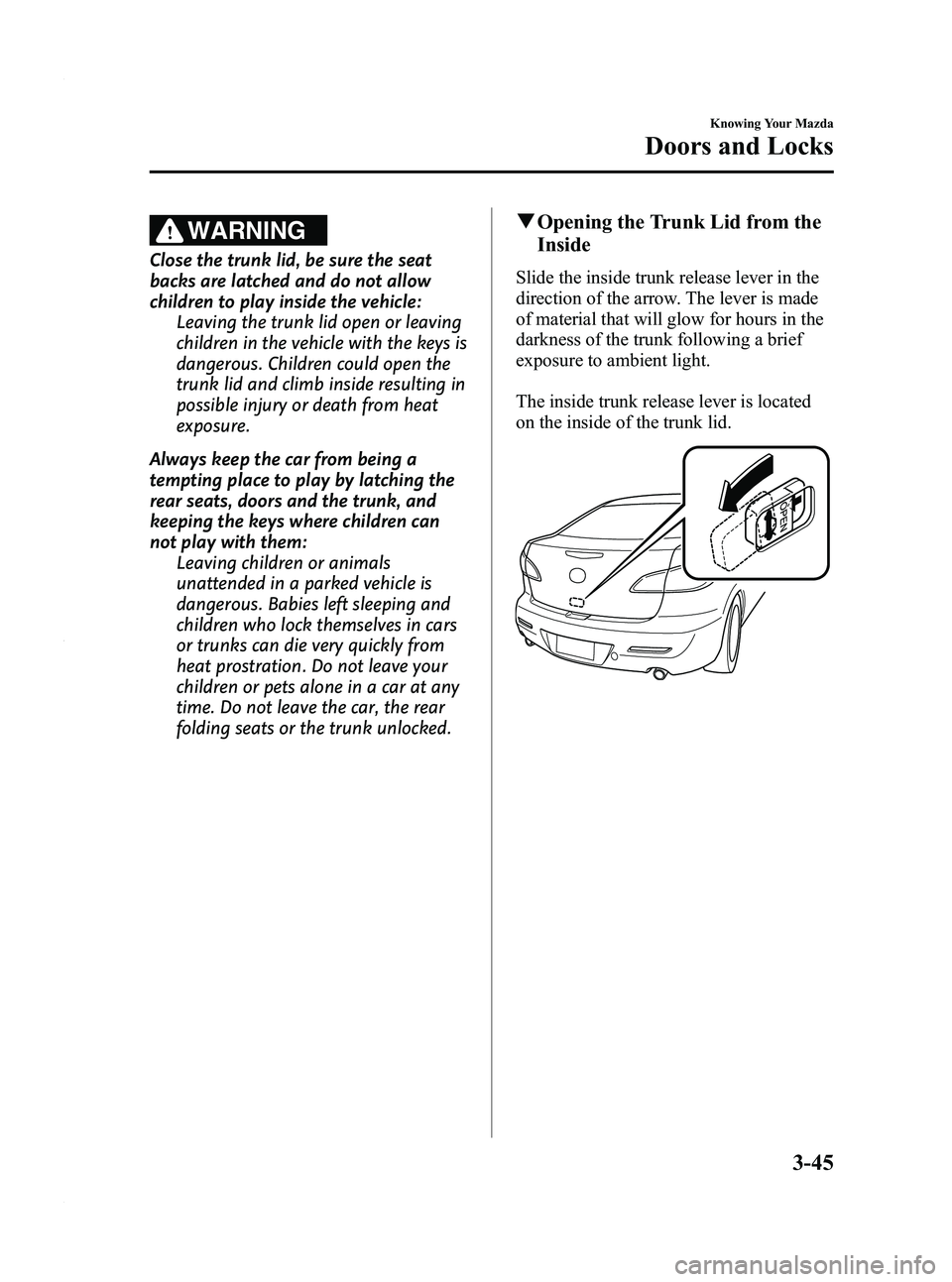
qOpening the Trunk Lid from the
Inside
Slide the inside trunk release lever in the
direction of the arrow. The lever is made
of material that will glow for hours in the
darkness of the trunk following a brief
exposure to ambient light.
The inside trunk release lever is located
on the inside of the trunk lid.
Knowing Your Mazda
Doors and Locks
3-45
Mazda3_8BY6-EA-11F_Edition3 Page123
Thursday, March 1 2012 10:17 AM
Form No.8BY6-EA-11F
Page 456 of 528
Black plate (456,1)
qCleaning the Upholstery and
Interior Trim
Vinyl
Remove dust and loose dirt from vinyl
with a whisk broom or vacuum cleaner.
Clean vinyl with a leather-and-vinyl
cleaner.
Leatherí
Remove dust and sand first using a
vacuum cleaner or other means, then wipe
dirt off using a soft cloth with a leather
cleaner or a soft cloth soaked in mild
soap.
Wipe off the remaining cleaner or soap
using a cloth soaked in clean water and
wrung out well.
Remove moisture with a dry, soft cloth
and allow the leather to further dry in a
well-ventilated, shaded area. If the leather
gets wet such as from rain, also remove
moisture and dry it as soon as possible. NOTE
lBecause genuine leather is a natural
material, its surface is not uniform and it
may have natural scars, scratches, and
wrinkles.
lTo maintain the quality for as long as
possible, periodical maintenance, about
twice a year, is recommended.
lSand and dust on the seat surface may
damage the overcoat of the genuine leather
surfaces and accelerate wear.
lGreasy soiling on genuine leather may
cause molding and stains.
lRubbing hard with a stiff brush or cloth
may cause damage.
lDo not wipe the leather using alcohol,
chlorine bleach, or organic solvents such as
thinner, benzene, or gasoline. Otherwise, it
may cause discoloration or stains.
lIf the seats get wet, promptly remove
moisture with a dry cloth. Remaining
moisture on the surface may cause
deterioration such as hardening and
shrinkage.
lExposure to direct sunlight for long periods
may cause deterioration and shrinkage.
When parking the car under direct sunlight
for long periods, shade the interior using
sunshades.
lDo not leave vinyl products on the seats for
long periods as they may affect the leather
quality and coloring. If the cabin
temperature becomes hot, the vinyl may
deteriorate and adhere to the genuine
leather.
Fabric
Remove dust and loose dirt from fabric
with a whisk broom or vacuum cleaner.
Clean it with a mild soap solution good
for upholstery and carpets. Remove fresh
spots immediately with a fabric spot
cleaner.
8-70
Maintenance and Care
íSome models.
Appearance Care
Mazda3_8BY6-EA-11F_Edition3 Page456
Thursday, March 1 2012 10:19 AM
Form No.8BY6-EA-11F