flat tire MAZDA MODEL 3 4-DOOR 2016 User Guide
[x] Cancel search | Manufacturer: MAZDA, Model Year: 2016, Model line: MODEL 3 4-DOOR, Model: MAZDA MODEL 3 4-DOOR 2016Pages: 598, PDF Size: 30.13 MB
Page 426 of 598
6–22
Maintenance and Care
Owner Maintenance
Owner Maintenance Precautions
The owner or a qualified service technician should make these vehicle inspections at the
indicated intervals to ensure safe and dependable operation.
Bring any problem to the attention of an Authorized Mazda Dealer or qualified service
technician as soon as possible.
When Refueling
Brake and clutch fluid level (page 6-32) Engine coolant level (page 6-30) Engine oil level (page 6-30) Washer fluid level (page 6-32)
At Least Monthly
Tire inflation pressures (page 6-43)
At Least Twice a Year (For Example, Every Spring and Fall)
You can do the following scheduled maintenance items if you have some mec\
hanical ability
and a few basic tools and if you closely follow the directions in this m\
anual.
Engine coolant (page 6-30) Engine oil (page 6-27)
Improper or incomplete service may result in problems. This section gives instructions only
for items that are easy to perform.
As explained in the Introduction (page 6-2), several procedures can be done only by a
qualified service technician with special tools.
Improper owner maintenance during the warranty period may affect warranty coverage.
Refer to Introduction (page 6-2) for owner's responsibility in protecting your investment.
For details, read the separate Mazda Warranty statement provided with the vehicle. If you
are unsure about any servicing or maintenance procedure, have it done by\
an Authorized
Mazda Dealer.
There are strict environmental laws regarding the disposal of waste oil and fluids. Please
dispose of your waste properly and with due regard to the environment.
We recommend that you entrust the oil and fluid changes of your vehicle to an Authorized
Mazda Dealer.
Mazda3_8FA4-EA-15G_Edition1.indb 222015/05/11 14:02:12
Page 447 of 598
6–43
Maintenance and Care
Owner Maintenance
Tires
For reasons of proper performance, safety,
and better fuel economy, always maintain
recommended tire inflation pressures and
stay within the recommended load limits
and weight distribution.
WARNING
Using Different Tire Types:
Driving your vehicle with different
types of tires is dangerous. It could
cause poor handling and poor braking;
leading to loss of control.
Except for the limited use of the
temporary spare tire, use only the
same type tires (radial, bias-belted,
bias-type) on all four wheels.
Using Wrong-Sized Tires: Using any other tire size than what is
specified for the vehicle (page 9-10)
is dangerous. It could seriously affect
ride, handling, ground clearance,
tire clearance, and speedometer
calibration. This could cause you to
have an accident. Use only tires that
are the correct size specified for the
vehicle.
Tire Inflation Pressure
WARNING
Always inflate the tires to the correct
pressure:Overinflation or underinflation of tires
is dangerous. Adverse handling or
unexpected tire failure could result in a
serious accident.
Refer to Tires on page 9-10.
Use only a Mazda-genuine tire valve
cap: Use of a non-genuine part is
dangerous as the correct tire air
pressure cannot be maintained if the
tire valve becomes damaged. If the
vehicle is driven under this condition,
the tire air pressure will decrease which
could result in a serious accident. Do
not use any part for the tire valve cap
that is not a Mazda-genuine part.
Inspect all tire pressures monthly
(including the spare) when the tires are
cold. Maintain recommended pressures for
the best ride, handling, and minimum tire
wear.
Refer to the specification charts (page
9-10).
(With tire pressure monitoring system)
After adjusting the tire pressure,
initialization of the tire pressure
monitoring system is necessary to make
the system operate normally.
Refer to Tire Pressure Monitoring System
Initialization on page 4-126.
Mazda3_8FA4-EA-15G_Edition1.indb 432015/05/11 14:02:21
Page 448 of 598

6–44
Maintenance and Care
Owner Maintenance
NOTE
Always check tire pressure when tires
are cold. Warm tires normally exceed
recommended pressures. Do not release
air from warm tires to adjust the
pressure.
Underinflation can cause r educed fuel
economy, uneven and accelerated tire
wear, and poor sealing of the tire bead,
which will deform the wheel and cause
separation of tire from rim.
Overinflation can produce a harsh ride,
uneven and accelerated tire wear, and a
greater possibility of damage from road
hazards.
Keep your tire pressure at the correct
levels. If one frequently needs inflating,
have it inspected.
Tire Rotation
WARNING
Rotate tires periodically:
Irregular tire wear is dangerous. To
equalize tread wear for maintaining
good performance in handling and
braking, rotate the tires every 12,000
km (7,500 miles). However Mazda
recommends to rotate every 8,000 km
(5,000 miles) to help increase tire life
and distribute wear more evenly.
Refer to Scheduled Maintenance on
page 6-4. During rotation, inspect them for correct
balance.
Do not include (TEMPORARY USE ONLY) spare tire in rotation.
Forward
Also, inspect them for uneven wear and
damage. Abnormal wear is usually caused
by one or a combination of the following:
Incorrect tire pressure Improper wheel alignment Out-of-balance wheel Severe braking
After rotation, inflate all tire pressures to
specification (page
9-10) and inspect the
lug nuts for tightness.
(With tire pressure monitoring system)
After adjusting the tire pressure,
initialization of the tire pressure
monitoring system is necessary to make
the system operate normally.
Refer to Tire Pressure Monitoring System
Initialization on page 4-126.
CAUTION
Rotate unidirectional tires and radial
tires that have an asymmetrical tread
pattern or studs only from front to rear,
not from side to side. Tire performance
will be reduced if rotated from side to
side.
Mazda3_8FA4-EA-15G_Edition1.indb 442015/05/11 14:02:21
Page 449 of 598
6–45
Maintenance and Care
Owner Maintenance
Replacing a Tire
WARNING
Always use tires that are in good
condition:Driving with worn tires is dangerous.
Reduced braking, steering, and
traction could result in an accident.
Replace all four tires at the same time: Replacing just one tire is dangerous. It
could cause poor handling and poor
braking resulting in loss of vehicle
control. Mazda strongly recommends
that you replace all four tires at the
same time.
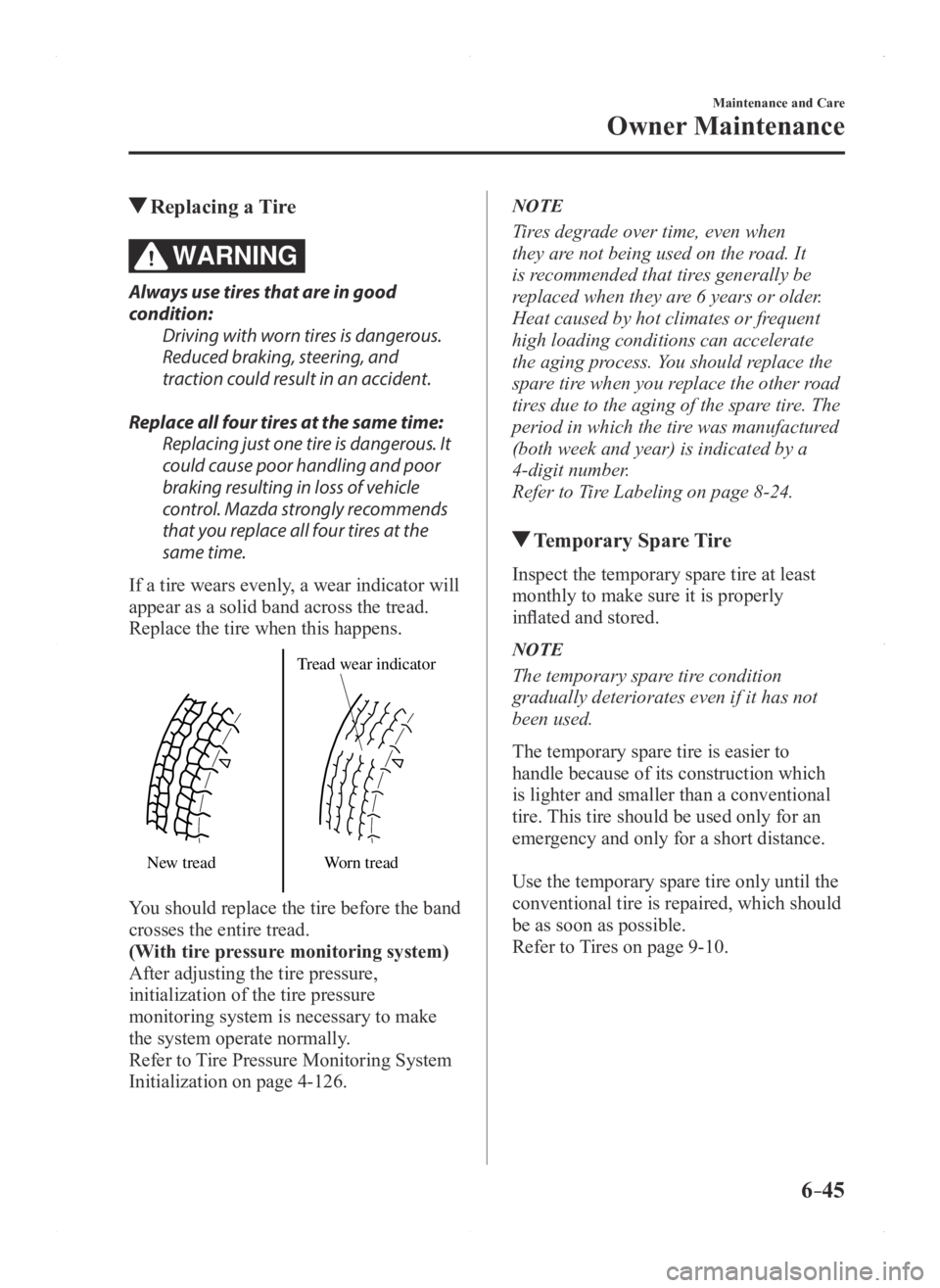
If a tire wears evenly, a wear indicator will
appear as a solid band across the tread.
Replace the tire when this happens.
New tread Tread wear indicator
Worn tread
You should replace the tire before the band
crosses the entire tread.
(With tire pressure monitoring system)
After adjusting the tire pressure,
initialization of the tire pressure
monitoring system is necessary to make
the system operate normally.
Refer to Tire Pressure Monitoring System
Initialization on page 4-126.
NOTE
Tires degrade over time, even when
they are not being used on the road. It
is recommended that tires generally be
replaced when they are 6 years or older.
Heat caused by hot climates or frequent
high loading conditions can accelerate
the aging process. You should replace the
spare tire when you replace the other road
tires due to the aging of the spare tire. The
period in which the tire was manufactured
(both week and year) is indicated by a
4-digit number.
Refer to Tire Labeling on page 8-24.
Temporary Spare Tire
Inspect the temporary spare tire at least
monthly to make sure it is properly
inflated and stored.
NOTE
The temporary spare tire condition
gradually deteriorates even if it has not
been used.
The temporary spare tire is easier to
handle because of its construction which
is lighter and smaller than a conventional
tire. This tire should be used only for an
emergency and only for a short distance.
Use the temporary spare tire only until the
conventional tire is repaired, which should
be as soon as possible.
Refer to Tires on page 9-10.
Mazda3_8FA4-EA-15G_Edition1.indb 452015/05/11 14:02:21
Page 450 of 598
6–46
Maintenance and Care
Owner Maintenance
*Some models.
CAUTION
Do not use your temporary spare tire
rim with a snow tire or a conventional
tire. Neither will properly fit and could
damage both tire and rim.
The temporary spare tire has a tread life
of less than 5,000 km (3,000 miles). The
tread life may be shorter depending on
driving conditions.
The temporary spare tire is for limited
use, however, if the tread wear solid-
band indicator appears, replace the tire
with the same type of temporary spare
(page 8-24).
NOTE
Tires degrade over time, even when
they are not being used on the road. It
is recommended that tires generally be
replaced when they are 6 years or older.
Heat caused by hot climates or frequent
high loading conditions can accelerate
the aging process. You should replace the
spare tire when you replace the other road
tires due to the aging of the spare tire. The
period in which the tire was manufactured
(both week and year) is indicated by a
4-digit number.
Refer to Tire Labeling on page 8-24.
Replacing a Wheel
WARNING
Always use wheels of the correct size on
your vehicle:
Using a wrong-sized wheel is
dangerous. Braking and handling
could be affected, leading to loss of
control and an accident.
CAUTION
A wrong-sized wheel may adversely
affect:
Tire fit Wheel and bearing life Ground clearance Snow-chain clearance Speedometer calibration Headlight aim Bumper height Tire Pressure Monitoring System*
NOTE
When replacing a wheel, make sure
the new one is the same as the original
factory wheel in diameter, rim width,
and offset (inset/outset).
For details, contact an Authorized
Mazda Dealer.
Proper tire balancing provides the best
riding comfort and helps reduce tread
wear. Out-of-balance tires can cause
vibration and uneven wear, such as
cupping and flat spots.
Mazda3_8FA4-EA-15G_Edition3.indb 462015/12/04 19:25:15
Page 483 of 598

7–1*Some models.
7If Trouble Arises
Helpful information on what to do if a problem arises with the vehicle.
Parking in an Emergency
..................................................................7-2
Parking in an Emergency
..............................................................7-2
Flat Tire ........................................................................\
....................... 7-3
Spare Tire and Tool Storage
..........................................................7-3
Changing a Flat Tire
......................................................................7-6
Battery Runs Out
........................................................................\
.....7-15
Jump-Starting
........................................................................\
......7-15
Emergency Starting
........................................................................\
.7-18
Starting a Flooded Engine
...........................................................7-18
Push-Starting
........................................................................\
.......7-18
Overheating
........................................................................\
..............7-19
Overheating
........................................................................\
.........7-19
Emergency Towing
........................................................................\
...7-21
Towing Description
.....................................................................7-21
Tiedown Hooks* ........................................................................\
..7-22
Warning/Indicator Lights and Warning Sounds
...........................7-24
If a Warning Light Turns On or Flashes ......................................7-24
Message Indicated on Display
* ...................................................7-33
Warning Sound is Activated
........................................................7-35
When Liftgate/Trunk Lid Cannot be Opened
...............................7-40
When Liftgate/Trunk Lid Cannot be Opened
.............................7-40
Active Driving Display Does Not Operate
* ....................................7-42
If the Active Driving Display Does Not Operate
........................7-42
Mazda3_8FA4-EA-15G_Edition1.indb 12015/05/11 14:02:33
Page 485 of 598

7–3
If Trouble Arises
Flat Tire
Spare Tire and Tool Storage
Spare tire and tools are stored in the locations illustrated in the diag\
ram.
Tiedown eyeletFlat tire beltSpare tire Jack
Spare tire hold-down bolt
Lug wrench Tool bag
Jack lever
Flat tire belt
Jack lever
Lug wrench
Spare tire Jack
Spare tire hold-down bolt
5-Door 4-Door
Some models.
Tiedown eyelet
Mazda3_8FA4-EA-15G_Edition1.indb 32015/05/11 14:02:33
Page 486 of 598
7–4
If Trouble Arises
Flat Tire
Jack
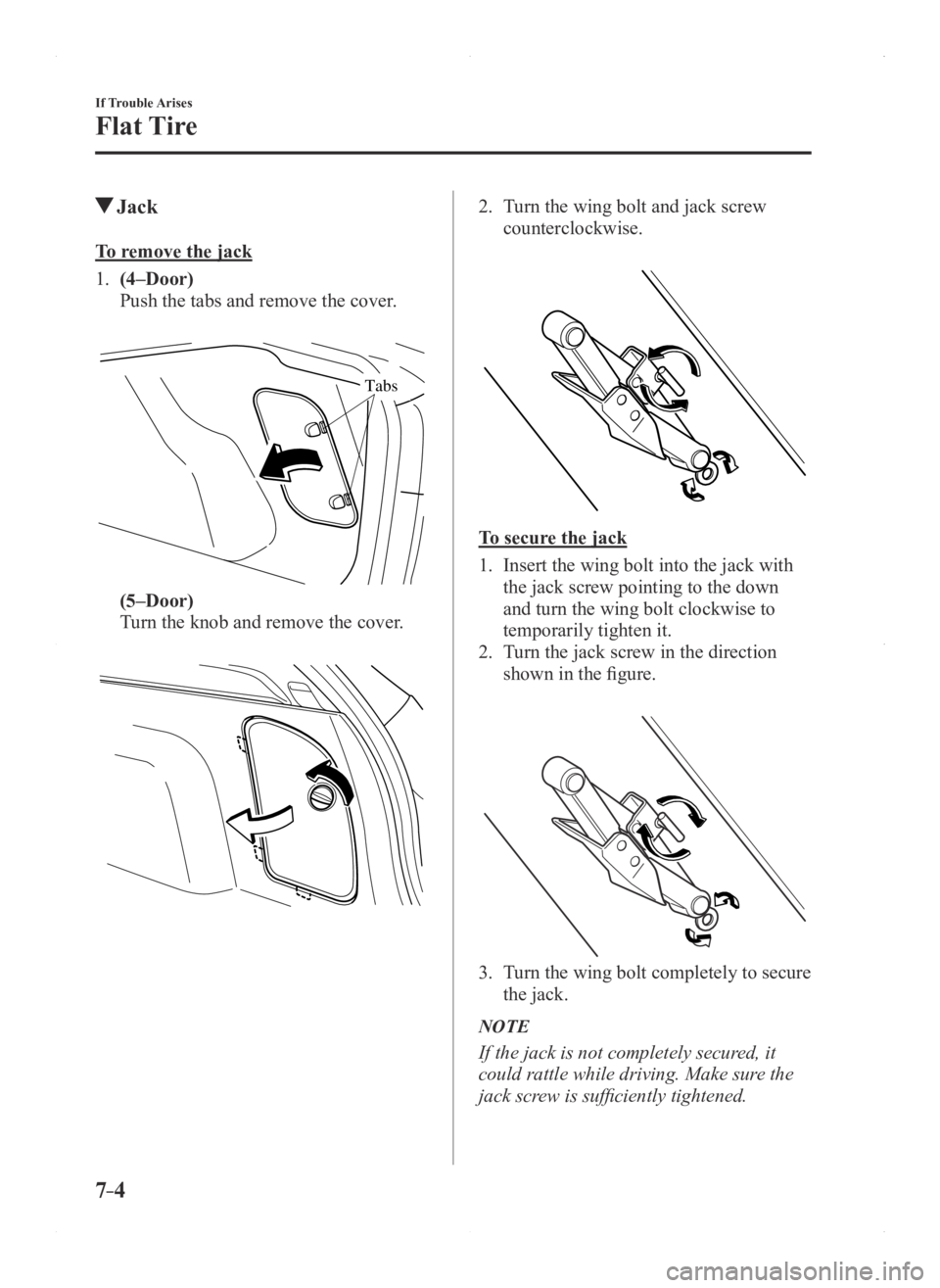
To remove the jack
1. (4–Door)
Push the tabs and remove the cover.
Tabs
(5–Door)
Turn the knob and remove the cover.
2. Turn the wing bolt and jack screw
counterclockwise.
To secure the jack
1. Insert the wing bolt into the jack with
the jack screw pointing to the down
and turn the wing bolt clockwise to
temporarily tighten it.
2. Turn the jack screw in the direction
shown in the figure.
3. Turn the wing bolt completely to secure
the jack.
NOTE
If the jack is not completely secured, it
could rattle while driving. Make sure the
jack screw is sufficiently tightened.
Mazda3_8FA4-EA-15G_Edition1.indb 42015/05/11 14:02:34
Page 487 of 598
7–5
If Trouble Arises
Flat Tire
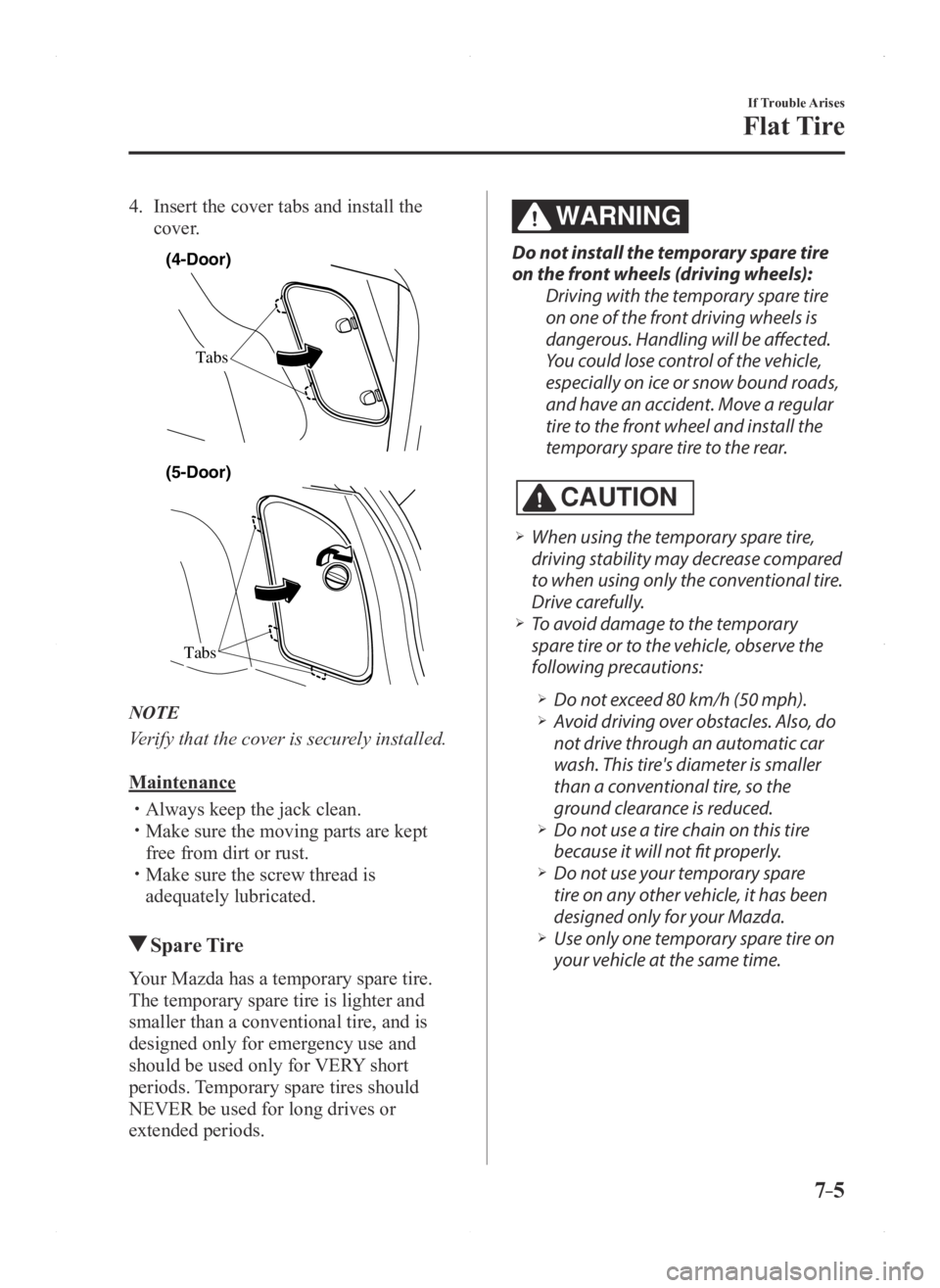
4. Insert the cover tabs and install the
cover.
(4-Door)
Tabs
Tabs
(5-Door)
NOTE
Verify that the cover is securely installed.
Maintenance
Always keep the jack clean. Make sure the moving parts are kept
free from dirt or rust. Make sure the screw thread is
adequately lubricated.
Spare Tire
Your Mazda has a temporary spare tire.
The temporary spare tire is lighter and
smaller than a conventional tire, and is
designed only for emergency use and
should be used only for VERY short
periods. Temporary spare tires should
NEVER be used for long drives or
extended periods.
WARNING
Do not install the temporary spare tire
on the front wheels (driving wheels):Driving with the temporary spare tire
on one of the front driving wheels is
dangerous. Handling will be affected.
You could lose control of the vehicle,
especially on ice or snow bound roads,
and have an accident. Move a regular
tire to the front wheel and install the
temporary spare tire to the rear.
CAUTION
When using the temporary spare tire,
driving stability may decrease compared
to when using only the conventional tire.
Drive carefully.
To avoid damage to the temporary
spare tire or to the vehicle, observe the
following precautions:
Do not exceed 80 km/h (50 mph). Avoid driving over obstacles. Also, do
not drive through an automatic car
wash. This tire's diameter is smaller
than a conventional tire, so the
ground clearance is reduced.
Do not use a tire chain on this tire
because it will not fit properly. Do not use your temporary spare
tire on any other vehicle, it has been
designed only for your Mazda.
Use only one t emporary spare tire on
your vehicle at the same time.
Mazda3_8FA4-EA-15G_Edition1.indb 52015/05/11 14:02:34
Page 488 of 598
7–6
If Trouble Arises
Flat Tire
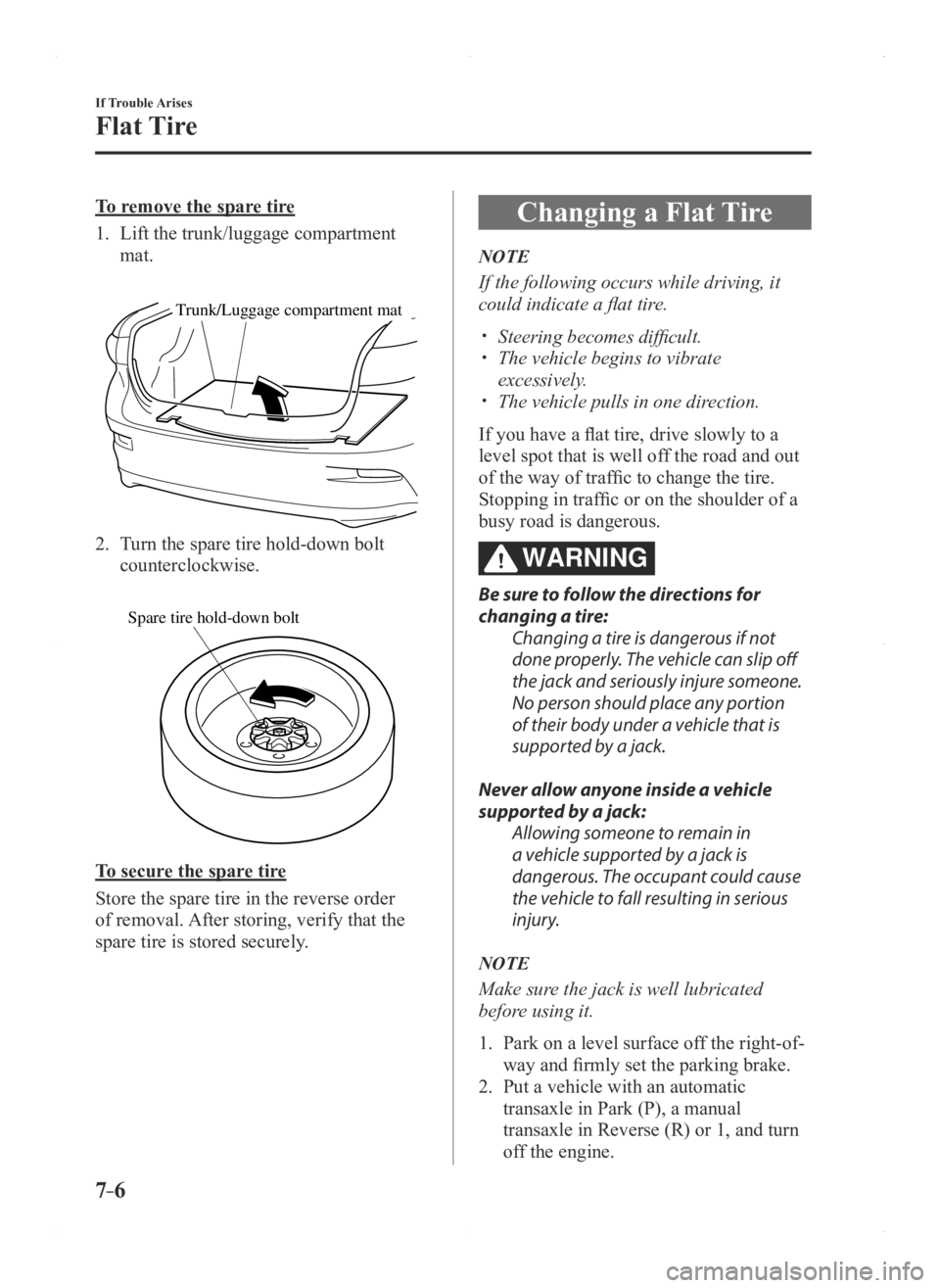
To remove the spare tire
1. Lift the trunk/luggage compartment
mat.
Trunk/Luggage compartment mat
2. Turn the spare tire hold-down bolt
counterclockwise.
Spare tire hold-down bolt
To secure the spare tire
Store the spare tire in the reverse order
of removal. After storing, verify that the
spare tire is stored securely.
Changing a Flat Tire
NOTE
If the following occurs while driving, it
could indicate a flat tire.
Steering becomes difficult. The vehicle begins to vibrate
excessively. The vehicle pulls in one direction.
If you have a flat tire, drive slowly to a
level spot that is well off the road and out
of the way of traffic to change the tire.
Stopping in traffic or on the shoulder of a
busy road is dangerous.
WARNING
Be sure to follow the directions for
changing a tire:
Changing a tire is dangerous if not
done properly. The vehicle can slip off
the jack and seriously injure someone.
No person should place any portion
of their body under a vehicle that is
supported by a jack.
Never allow anyone inside a vehicle
supported by a jack: Allowing someone to remain in
a vehicle supported by a jack is
dangerous. The occupant could cause
the vehicle to fall resulting in serious
injury.
NOTE
Make sure the jack is well lubricated
before using it.
1. Park on a level surface of f the right-of-
way and firmly set the parking brake.
2. Put a vehicle with an automatic
transaxle in Park (P), a manual
transaxle in Reverse (R) or 1, and turn
off the engine.
Mazda3_8FA4-EA-15G_Edition1.indb 62015/05/11 14:02:35