weight MAZDA MODEL 3 4-DOOR 2016 User Guide
[x] Cancel search | Manufacturer: MAZDA, Model Year: 2016, Model line: MODEL 3 4-DOOR, Model: MAZDA MODEL 3 4-DOOR 2016Pages: 598, PDF Size: 30.13 MB
Page 67 of 598

2–53
Essential Safety Equipment
SRS Air Bags
*Some models.
SRS Air Bag Deployment Criteria
This chart indicates the applicable SRS equipment that will deploy depending on the type of
collision.
(The illustrations are the representative cases of collisions.)
SRS
equipment Types of collision
A severe frontal/near frontal collision A severe side
collision
*4A roll-over/near roll-over*3A rear collision
Front seat belt
pretensioner X*1 (both sides)
X*1 (impact side
only) X*1 (both sides)
No air bag and
front seat belt
pretensioner will be
activated in a rear
collision.
Driver air
bag X
Front
passenger air bag X
*1
Side air bag*X*2X*1 (impact side
only)
Curtain air bag
*X*2X (impact side only) X (both sides)
X: The SRS air bag equipment is designed to deploy in a collision.
*1 (With Front Passenger Occupant Classification System) The front passenger front and side air bags and the seat belt pretension\
er are designed to deploy depending on the condition of the total seated weight on the front passenger seat.*2 (With Front Passenger Occupant Classification System) In an angled collision, the side air bag and curtain air bag may deploy .*3 (With Front Passenger Occupant Classification System) In a roll-over accident, the seat belt pretensioners and the curtain air\
bags deploy .*4 (With Side/Curtain Air Bags) In a side collision, the seat belt pretensioners and the side/curtain ai\
r bags deploy (only on the side in which the collision occurs).
Mazda3_8FA4-EA-15G_Edition1.indb 532015/05/11 14:00:15
Page 70 of 598

2–56
Essential Safety Equipment
SRS Air Bags
*Some models.
Front Passenger Occupant Classification System*
First, please read "Supplemental Restraint System (SRS) Precautions" (page 2-40)
carefully.
Front Passenger Seat Weight Sensor
Your vehicle is equipped with a front passenger seat weight sensors as a part of the
supplemental restraint system. These sensors are located under both of the front passenger
seat rails. These sensors determine the total seated weight on the front passenger s\
eat and
monitor the seat belt buckle for the front passenger seat. The SAS unit is designed to prevent
the front passenger front and side air bags and seat belt pretensioner s\
ystem from deploying
if the front passenger air bag deactivation indicator light illuminates.\
To reduce the chance of injuries caused by deployment of the front passen\
ger air bag,
the system deactivates the front passenger front and side air bags and a\
lso the seat
belt pretensioner system when the front passenger air bag deactivation i\
ndicator light
illuminates. Refer to the following table for the front passenger air bag deactivation
indicator light illumination conditions.
This system shuts off the front passenger front and side air bags and seat belt pretensioner\
system, so make sure the front passenger air bag deactivation indicator \
light illuminates
according to the following table.
The air bag/front seat belt pretensioner system warning light flashes and the front passenger
air bag deactivation indicator light illuminates if the sensors have a p\
ossible malfunction.
If this happens, the front passenger front and side air bags and seat be\
lt pretensioner system
will not deploy.
Front passenger air bag deactivation indicator light
This indicator light illuminates to remind you that the front passenger \
front and side air bags
and seat belt pretensioner will not deploy during a collision.
If the front passenger weight sensors are normal, the indicator light il\
luminates when the
ignition is switched ON. The light turns off after a few seconds. Then, the indicator light
illuminates or is off under the following conditions:
Mazda3_8FA4-EA-15G_Edition1.indb 562015/05/11 14:00:16
Page 72 of 598
2–58
Essential Safety Equipment
SRS Air Bags
WARNING
Do not decrease the total seated weight on the front passenger seat:
When an adult or large child sits on the front passenger seat, decreasing the total seated
weight on the front passenger seat required for air bag deployment is dangerous. The
front passenger seat weight sensors will detect the reduced total seated weight condition
and the front passenger front and side air bags and seat belt pretensioner system will
not deploy during an accident. The front passenger will not have the supplementary
protection of the air bag, which could result in serious injury. Decreasing the total seated
weight on the front passenger seat could result in an air bag not deploying under the
following conditions, for example:
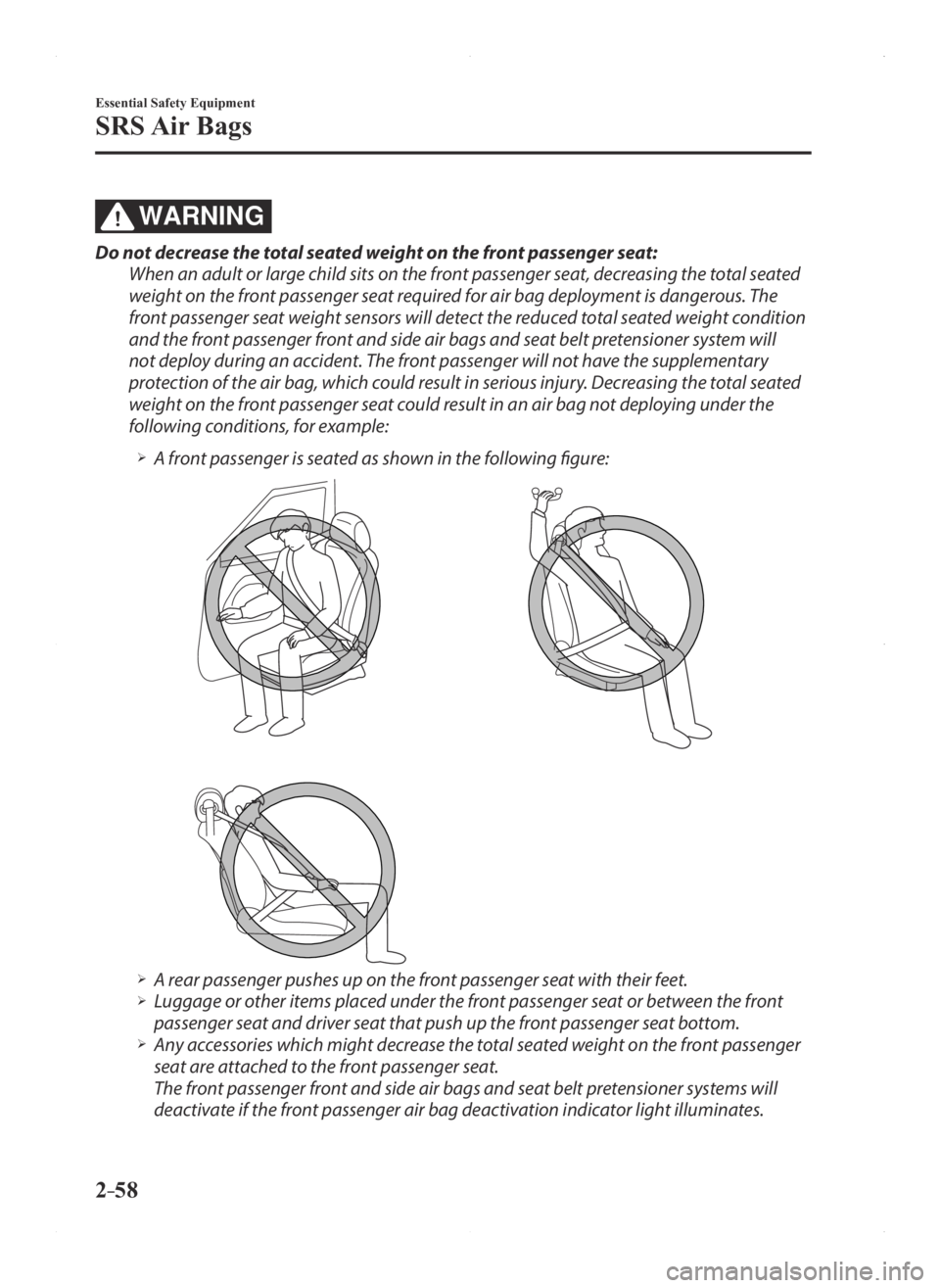
A front passenger is seated as shown in the following figure:
A rear passenger pushes up on the front passenger seat with their feet. Luggage or other items placed under the front passenger seat or between the front
passenger seat and driver seat that push up the front passenger seat bottom. Any accessories which might decrease the total seated weight on the front passenger
seat are attached to the front passenger seat.
The front passenger front and side air bags and seat belt pretensioner systems will
deactivate if the front passenger air bag deactivation indicator light illuminates.
Mazda3_8FA4-EA-15G_Edition1.indb 582015/05/11 14:00:16
Page 73 of 598
2–59
Essential Safety Equipment
SRS Air Bags
Do not increase the total seated weight on the front passenger seat:When an infant or small child sits on the front passenger seat, increasing the total seated
weight on the front passenger seat is dangerous. The front passenger seat weight sensors
will detect the increased total seated weight, which could result in the unexpected
deployment of the front passenger front and side air bags and seat belt pretensioner
system in an accident and may cause serious injury. Increasing the total seated weight on
the front passenger seat could result in the front passenger front and side air bags and
seat belt pretensioner system deployment in an accident under the following conditions,
for example:
Luggage or other items are placed on the seat with the child in the child-restraint
system. A rear passenger or luggage push or pull down on the front passenger seatback. A rear passenger steps on the front passenger seat rails with their feet. Luggage or other items are placed on the seatback or hung on the head restraint. Heavy items are placed in the seatback map pocket. The seat is washed. Liquids are spilled on the seat. The front passenger seat is moved backward, pushing into luggage or other items
placed behind it. The front passenger seatback contacts the rear seat. Luggage or other items are placed between the front passenger seat and driver seat. Any accessories which might increase the total seated weight on the front passenger
seat are attached to the front passenger seat.
CAUTION
To assure proper deployment of the front air bag and to prevent damage to the sensors in
the front seat bottoms:
Do not place sharp objects on the front seat bottoms or leave heavy luggage on them. Do not spill any liquids on the front seats or under the front seats.
To allow the sensors to function properly, always perform the following:
Adjust the front seats as far back as possible and always sit upright against the
seatbacks with seat belts worn properly. If you place your child on the front passenger seat, secure the child-restraint system
properly and slide the front passenger seat as far back as possible (page 2-30).
Mazda3_8FA4-EA-15G_Edition1.indb 592015/05/11 14:00:16
Page 74 of 598
2–60
Essential Safety Equipment
SRS Air Bags
NOTE
The system requires about 10 seconds to alternate between turning the front passenger
front and side air bags and seat belt pretensioner system on or off. The front passenger air bag deactivation indicator light may illuminate repeatedly if
luggage or other items are put on the front passenger seat, or if the temperature of the
vehicle's interior changes suddenly.
The front passenger air bag deactivation indicator light may illuminate for 10\
seconds if
the total seated weight on the front passenger seat changes. The air bag/fr ont seat belt pretensioner system warning light might illuminate if the front
passenger seat receives a severe impact. If the front passenger air bag deactivation indicator light does not illuminate a\
fter
installing a child-restraint system on the front passenger seat, first, re-install your child-
restraint system according to the procedure in this owner's manual. Then, if the front
passenger air bag deactivation indicator light still does not illuminate\
, install the child-
restraint system on the rear seat and consult an Authorized Mazda Dealer as soon as
possible.
If the front passenger air bag deactivation indicator light illuminates when an a\
dult is
seated in the front passenger seat, have the passenger re-adjust their posture by sitting
with their feet on the floor, and then re-fastening the seat belt. If the front passenger air
bag deactivation indicator light still illuminates, move the passenger t\
o the rear seat.
If sitting in the rear seat is not possible, slide the front passenger seat as far back as
possible. Consult an Authorized Mazda Dealer as soon as possible.
Driver and Front Passenger Buckle Switches
The buckle switches on the front seat belts detect whether or not the fr\
ont seat belts are
securely fastened and further control the deployment of the air bags.
Mazda3_8FA4-EA-15G_Edition1.indb 602015/05/11 14:00:16
Page 75 of 598

2–61
Essential Safety Equipment
SRS Air Bags
Constant Monitoring
The following components of the air bag systems are monitored by a diagn\
ostic system:
Crash sensors, and diagnostic module (SAS unit) Front air bag sensors Air bag modules Side crash sensors Air bag/Front seat belt pretensioner system warning light Front seat belt pretensioners Related wiring
(With Front Passenger Occupant Classification System)
Front passenger air bag deactivation indicator light Front passenger seat weight sensors Front passenger seat weight sensor control module Front passenger seat belt buckle switches
The diagnostic module continuously monitors the system's readiness. This begins when the
ignition is switched ON and continues while the vehicle is being driven.
Mazda3_8FA4-EA-15G_Edition1.indb 612015/05/11 14:00:16
Page 96 of 598
3–20
Before Driving
Doors and Locks
Liftgate/Trunk Lid
WARNING
Never allow a person to ride in the
luggage compartment/trunk:Allowing a person to ride in the
luggage compartment/trunk is
dangerous. The person in the luggage
compartment/trunk could be seriously
injured or killed during sudden braking
or a collision.
Do not drive with the liftgate/trunk lid
open: Exhaust gas in the cabin of a vehicle is
dangerous. An open liftgate/trunk lid
in a moving vehicle will cause exhaust
gas to be drawn into the cabin. This
gas contains CO (carbon monoxide),
which is colorless, odorless, and highly
poisonous, and it can cause loss of
consciousness and death. Moreover,
an open liftgate/trunk lid could cause
occupants to fall out in an accident.
Do not stack or leave loaded luggage
unsecured in the luggage compartment: Otherwise, the luggage may move
or collapse, resulting in injury or an
accident. In addition, do not load
luggage higher than the seatbacks. It
may affect the side or rear field of view.
CAUTION
Before opening the liftgate/trunk lid,
remove any snow and ice accumulation
on it. Otherwise, the liftgate/trunk lid
could close under the weight of the snow
and ice resulting in injury.
Be careful when opening/closing the
liftgate/trunk lid during strong winds.
If a strong gust blows against the
liftgate/trunk lid, it could close suddenly
resulting in injury.
Fully open the liftgate/trunk lid and
make sure that it stays open. If the
liftgate/trunk lid is only opened partially,
it could slam shut by vibration or wind
gusts resulting in injury.
When loading or unloading luggage in
the luggage compartment/trunk, turn
off the engine. Otherwise, you could get
burned by the heat of the exhaust gas.
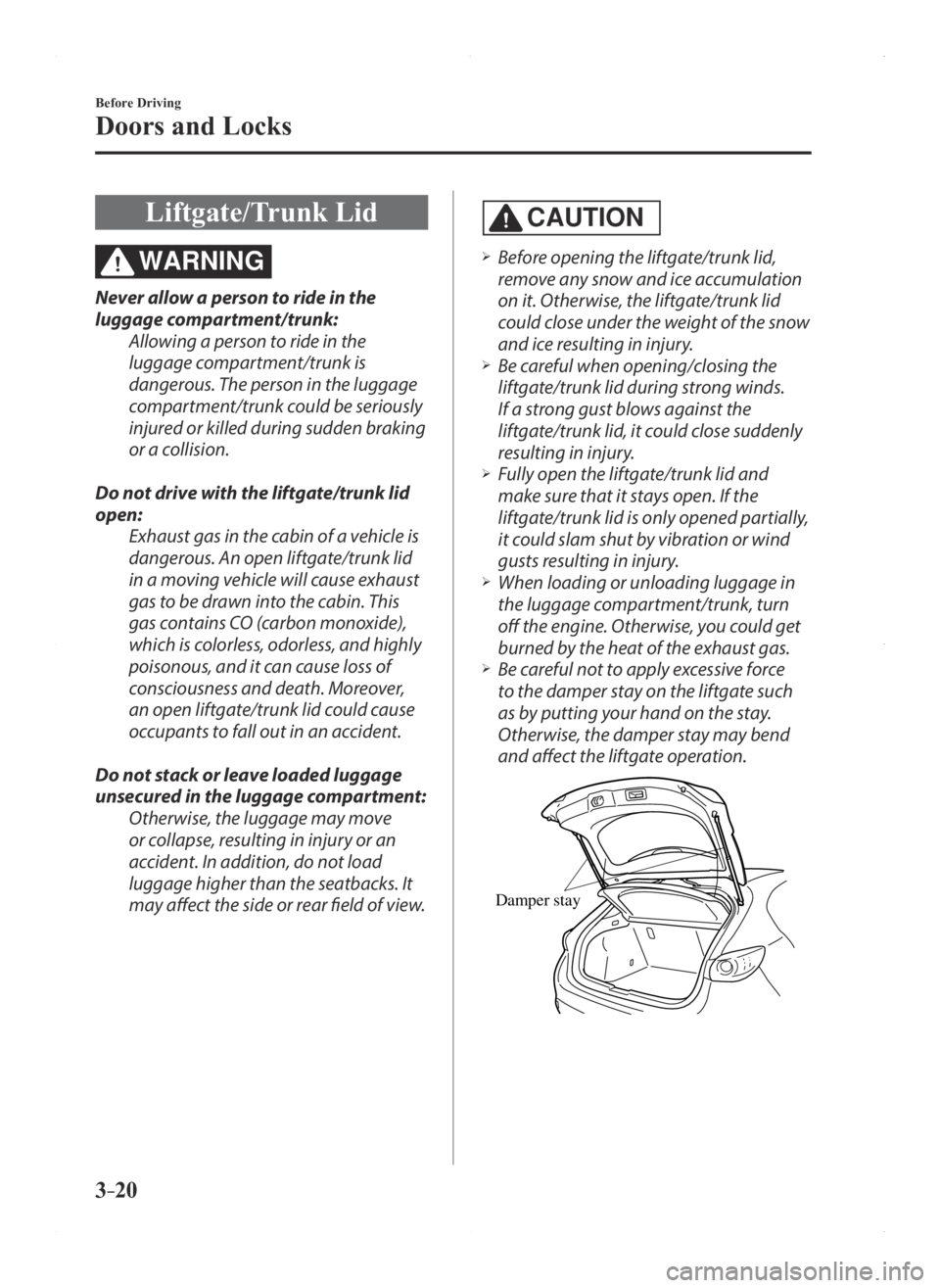
Be careful not to apply excessive force
to the damper stay on the liftgate such
as by putting your hand on the stay.
Otherwise, the damper stay may bend
and affect the liftgate operation.
Damper stay
Mazda3_8FA4-EA-15G_Edition1.indb 202015/05/11 14:00:22
Page 99 of 598

3–23
Before Driving
Doors and Locks
Luggage Compartment
Luggage compartment cover (5-door)
WARNING
Do not place anything on top of the
cover:Placing luggage or other cargo on top
of the luggage compartment cover is
dangerous. During sudden braking or
a collision, the cargo could become
a projectile that could hit and injure
someone. The vehicle has a light
weight luggage compartment cover to
keep the contents of your luggage area
out of sight; it will not retain heavy
objects that are not tied down in an
accident such as a rollover. Tie down
all heavy objects, whether luggage or
cargo, using the tie down hooks.
Make sure luggage and cargo are
secured before driving: Not securing cargo while driving is
dangerous as it could move or be
crushed during sudden braking or a
collision and cause injury.
CAUTION
Make sure the luggage compartment
cover is firmly secured. If it is not
firmly secured, it could unexpectedly
disengage resulting in injury. The luggage compartment can be accessed
by opening the liftgate when the straps are
attached to the sides of the liftgate.
Strap
Removing the cover
This cover can be removed for more room.
1. Remove the straps from the hooks.
2. Lift the end of the luggage
compartment cover a little, pull it
outward, and remove it from the pins.
Pin
Pin
3. Lift the front end of the luggage
compartment cover and remove it.
Mazda3_8FA4-EA-15G_Edition1.indb 232015/05/11 14:00:23
Page 120 of 598

3–44
Before Driving
Driving Tips
Break-In Period
No special break-in is necessary, but a
few precautions in the first 1,000 km
(600 miles) may add to the performance,
economy, and life of the vehicle.
Do not race the engine. Do not maintain one constant speed,
either slow or fast, for a long period of
time.
Do not drive constantly at full-throttle or
high engine rpm for extended periods of
time.
Avoid unnecessary hard stops. Avoid full-throttle starts.
Saving Fuel and
Protection of the
Environment
How you operate your Mazda determines
how far it will travel on a tank of fuel. Use
these suggestions to help save fuel and
reduce CO2.
Avoid long warm-ups. Once the engine
runs smoothly, begin driving. Avoid fast starts. Drive at lower speeds. Anticipate when to apply the brakes
(avoid sudden braking). Follow the maintenance schedule
(page 6-4) and have an Authorized
Mazda Dealer perform inspections and
servicing.
Use the air conditioner only when
necessary. Slow down on rough roads. Keep the tires properly inflated. Do not carry unnecessary weight. Do not rest your foot on the brake pedal
while driving. Keep the wheels in correct alignment. Keep windows closed at high speeds. Slow down when driving in crosswinds
and headwinds.
WARNING
Never stop the engine when going down
a hill:Stopping the engine when going
down a hill is dangerous. This causes
the loss of power steering and power
brake control, and may cause damage
to the drivetrain. Any loss of steering
or braking control could cause an
accident.
Mazda3_8FA4-EA-15G_Edition1.indb 442015/05/11 14:00:31
Page 125 of 598

3–49
Before Driving
Driving Tips
Overloading
WARNING
Be careful not to overload your vehicle:
The gross axle weight rating (GAWR)
and the gross vehicle weight rating
(GVWR) of the vehicle are on the
Motor Vehicle Safety Standard Label
on the driver's door frame. Exceeding
these ratings can cause an accident
or vehicle damage. You can estimate
the weight of the load by weighing the
items (or people) before putting them
in the vehicle.
Mazda3_8FA4-EA-15G_Edition1.indb 492015/05/11 14:00:31