brakes MAZDA MODEL 3 4-DOOR 2016 Owner's Manual
[x] Cancel search | Manufacturer: MAZDA, Model Year: 2016, Model line: MODEL 3 4-DOOR, Model: MAZDA MODEL 3 4-DOOR 2016Pages: 598, PDF Size: 30.13 MB
Page 420 of 598

6–16
Maintenance and Care
Scheduled Maintenance
Schedule 2
Maintenance IntervalNumber of months or kilometers, whichever comes first
Months 36912 1518212427303336
×1000 km 510 15202530354045505560
ENGINE
Drive belts I
Engine oil & filter RRRRRRRRRRRR
COOLING SYSTEM
Cooling system I
Engine coolant
*1Replace at first 200,000 km or 10 years; after that, every 100,000 km or 5 years
Engine coolant level IIIIIIIIIIII
FUEL SYSTEM
Air filter CRCRCR
Fuel lines and hoses I
*2
Hoses and tubes for emissionI*2
Fuel filterReplace every 60,000 km
IGNITION SYSTEM
Spark plugs Replace every 120,000 km
ELECTRICAL SYSTEM
Function of all lights IIIIIIIIIIII
CHASSIS and BODY
Brake lines, hoses and connections III
Brake and clutch fluid level III II
Brake fluid R
Disc brakes IIIIII
Tire (Rotation)
*3Rotate every 10,000 km
Tire inflation pressure and tire wear
*3I IIIII
Steering operation and linkages IIIII
I
Front and rear suspension, ball joints and wheel
bearing axial play I
II
Driveshaft dust boots III
Bolts and nuts on chassis and body TTT
Exhaust system and heat shields III
All locks and hinges LLLLLL
Washer fluid level IIIIII
AIR CONDITIONER SYSTEM
Cabin air filter RRR
Mazda3_8FA4-EA-15G_Edition1.indb 162015/05/11 14:02:11
Page 422 of 598

6–18
Maintenance and Care
Scheduled Maintenance
(Cont.)
Maintenance IntervalNumber of months or kilometers, whichever comes first
Months 394245485154576063666972
×1000 km 65707580859095
100 10511 011 5120
ENGINE
Drive belts II
Engine oil & filter RRRRRRRRRRRR
COOLING SYSTEM
Cooling system II
Engine coolant
*1Replace at first 200,000 km or 10 years; after that, every 100,000 km or 5 years
Engine coolant level IIIIIIIIIIII
FUEL SYSTEM
Air filter CRCRCR
Fuel lines and hoses I
*2I
Hoses and tubes for emission I
*2I
Fuel filter Replace every 60,000 km
IGNITION SYSTEM
Spark plugs Replace every 120,000 km
ELECTRICAL SYSTEM
Function of all lights IIIIIIIIIIII
CHASSIS and BODY
Brake lines, hoses and connections III
Brake and clutch fluid level IIII
Brake fluid RR
Disc brakes IIIIII
Tire (Rotation)
*3Rotate every 10,000 km
Tire inflation pressure and tire wear
*3I IIIII
Steering operation and linkages I
IIIII
Front and rear suspension, ball joints and wheel
bearing axial play I
II
Driveshaft dust boots III
Bolts and nuts on chassis and body TTT
Exhaust system and heat shields III
All locks and hinges LLLLLL
Washer fluid level IIIIII
AIR CONDITIONER SYSTEM
Cabin air filter RRR
Mazda3_8FA4-EA-15G_Edition1.indb 182015/05/11 14:02:12
Page 436 of 598
6–32
Maintenance and Care
Owner Maintenance
Brake/Clutch Fluid
Inspecting Brake/Clutch Fluid
Level
WARNING
If the brake/clutch fluid level is low, have
the brakes inspected:A low brake/clutch fluid level is
dangerous.
A low level could indicate brake lining
wear or a brake system leak which
could cause the brakes to fail and lead
to an accident.
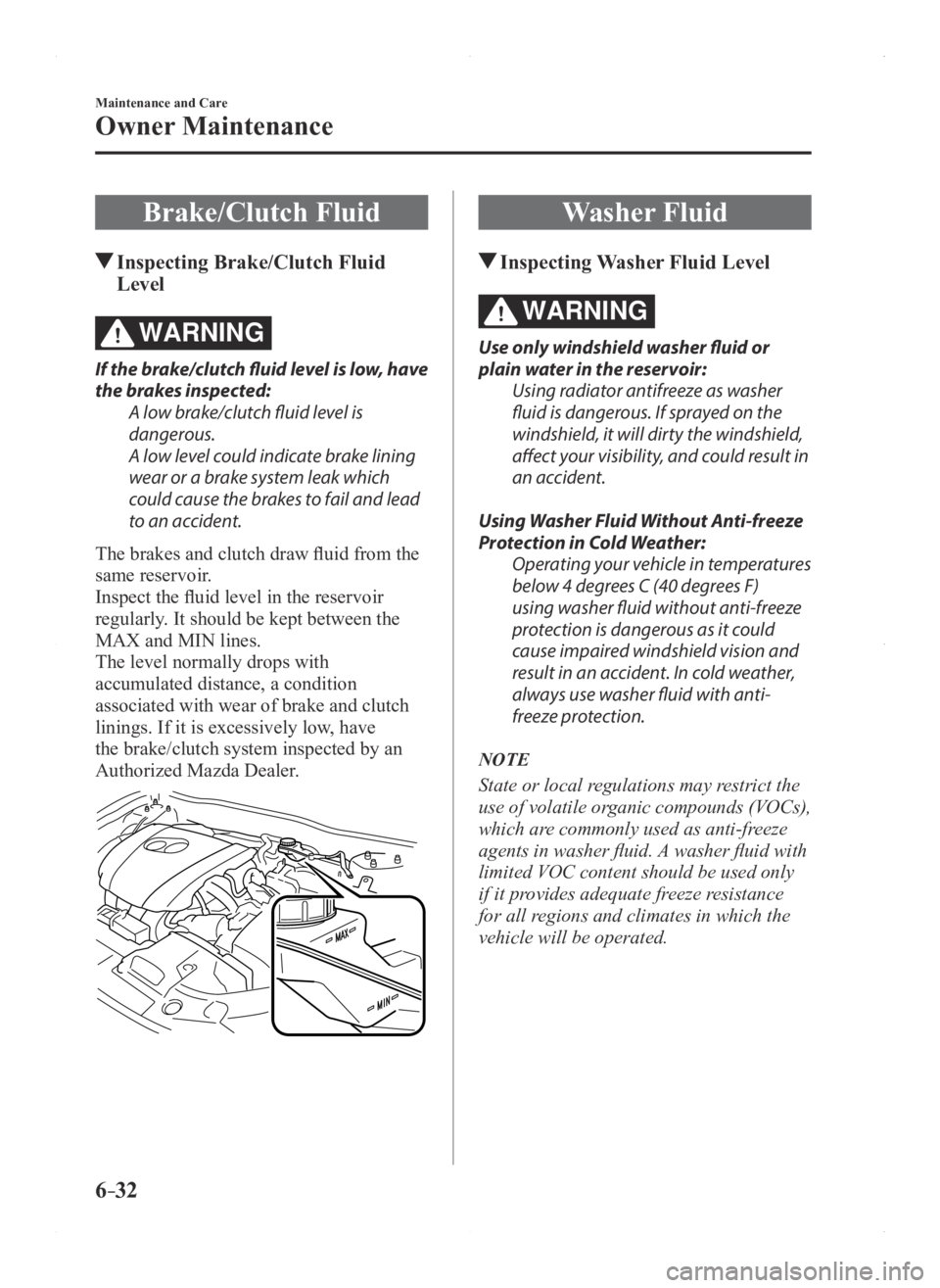
The brakes and clutch draw fluid from the
same reservoir.
Inspect the fluid level in the reservoir
regularly. It should be kept between the
MAX and MIN lines.
The level normally drops with
accumulated distance, a condition
associated with wear of brake and clutch
linings. If it is excessively low, have
the brake/clutch system inspected by an
Authorized Mazda Dealer.
Washer Fluid
Inspecting Washer Fluid Level
WARNING
Use only windshield washer fluid or
plain water in the reservoir: Using radiator antifreeze as washer
fluid is dangerous. If sprayed on the
windshield, it will dirty the windshield,
affect your visibility, and could result in
an accident.
Using Washer Fluid Without Anti-freeze
Protection in Cold Weather: Operating your vehicle in temperatures
below 4 degrees C (40 degrees F)
using washer fluid without anti-freeze
protection is dangerous as it could
cause impaired windshield vision and
result in an accident. In cold weather,
always use washer fluid with anti-
freeze protection.
NOTE
State or local regulations may restrict the
use of volatile organic compounds (VOCs),
which are commonly used as anti-freeze
agents in washer fluid. A washer fluid with
limited VOC content should be used only
if it provides adequate freeze resistance
for all regions and climates in which the
vehicle will be operated.
Mazda3_8FA4-EA-15G_Edition1.indb 322015/05/11 14:02:16
Page 475 of 598
6–71
Maintenance and Care
Appearance Care
CAUTION
Do not use steel wool, abrasive
cleaners, or strong detergents
containing highly alkaline or caustic
agents on chrome-plated or anodized
aluminum parts. This may damage the
protective coating; also, cleaners and
detergents may discolor or deteriorate
the paint.
Pay special attention to removing salt, dirt,
mud, and other foreign material from the
underside of the fenders, and make sure
the drain holes in the lower edges of the
doors and rocker panels are clean.
Insects, tar, tree sap, bird droppings,
industrial fallout, and similar deposits
can damage the finish if not removed
immediately. When prompt washing with
plain water is ineffective, use a mild soap
made for use on vehicles.
Thoroughly rinse off all soap with
lukewarm or cold water. Do not allow
soap to dry on the finish.
After washing the vehicle, dry it with a
clean chamois to prevent water spots from
forming.
WARNING
Dry off brakes that have become
wet by driving slowly, releasing the
accelerator pedal and lightly applying
the brakes several times until the brake
performance returns to normal: Driving with wet brakes is dangerous.
Increased stopping distance or the
vehicle pulling to one side when
braking could result in a serious
accident. Light braking will indicate
whether the brakes have been affected.
When using an automatic car wash
Retract the door mirrors. The automatic car wash brushes could
reduce the paint lustre or hasten paint
deterioration.
When using a high water pressure car
wash
High water temperature and high water
pressure car washers are available
depending on the type of car wash
machine. If the car washer nozzle is
put too close to the vehicle, the force of
the spray could damage or deform the
molding, affect the sealability of parts,
and allow water to penetrate the interior.
Keep a sufficient space (30 cm (12 in) or
more) between the nozzle and the vehicle.
In addition, do not spend too much time
spraying the same area of the vehicle, and
be very careful when spraying between
gaps in doors and around windows.
Mazda3_8FA4-EA-15G_Edition1.indb 712015/05/11 14:02:31
Page 477 of 598
6–73
Maintenance and Care
Appearance Care
*Some models.
Pay special attention to these areas
because they easily hide mud and dirt.
It will do more harm than good to wet
down the road grime without removing
it.
The lower edges of doors, rocker panels,
and frame members have drain holes that
should not be clogged. Water trapped there
will cause rusting.
WARNING
Dry off brakes that have become
wet by driving slowly, releasing the
accelerator pedal and lightly applying
the brakes several times until the brake
performance returns to normal:Driving with wet brakes is dangerous.
Increased stopping distance or the
vehicle pulling to one side when
braking could result in a serious
accident. Light braking will indicate
whether the brakes have been affected.
Aluminum Wheel Maintenance*
A protective coating is provided over the
aluminum wheels. Special care is needed
to protect this coating.
CAUTION
Do not use any detergent other than
mild detergent. Before using any
detergent, verify the ingredients.
Otherwise, the product could discolor
or stain the aluminum wheels.
NOTE
Do not use a wir e brush or any abrasive
cleaner, polishing compound, or solvent
on aluminum wheels. They may damage
the coating.
Always use a sponge or soft cloth to
clean the wheels.
Rinse the wheels thor oughly with
lukewarm or cold water. Also, be sure
to clean the wheels after driving on
dusty or salted roads to help prevent
corrosion.
Avoid washing your vehicle in an
automatic car wash that uses high-
speed or hard brushes.
Plastic Part Maintenance
When cleaning the plastic lenses of the
lights, do not use gasoline, kerosene,
rectified spirit, paint, thinner, highly
acidic detergents, or strongly alkaline
detergents. Otherwise, these chemical
agents can discolor or damage the
surfaces resulting in a significant loss
in functionality. If plastic parts become
inadvertently exposed to any of these
chemical agents, flush with water
immediately.
If plastic parts such as the bumpers
become inadvertently exposed to
chemical agents or fluids such as
gasoline, oil, engine coolant, or battery
fluid, it could cause discoloration,
staining, or paint peeling. Wipe off any
such chemical agents or fluids using a
soft cloth immediately.
Mazda3_8FA4-EA-15G_Edition1.indb 732015/05/11 14:02:32
Page 506 of 598

7–24
If Trouble Arises
Warning/Indicator Lights and Warning Sounds
If a Warning Light Turns On or Flashes
If any warning light turns on/flashes, take appropriate action for each light. There is no
problem if the light turns off, however if the light does not turn off or turns on/flashes again,
consult an Authorized Mazda Dealer.
(Vehicles with type B audio)
The warning contents can be verified on the audio.
1. Select the icon on the home screen to display the applications screen.
2. Select the “Warning Guidance”.
Stop Vehicle in Safe Place Immediately
If any of the following warning lights turns on, the system may have a m\
alfunction. Stop the
vehicle in a safe place immediately and contact an Authorized Mazda Dealer.
Signal Warning
Brake System Warning Light
This warning has the following functions:
Parking brake warning/Warning light inspection
The light illuminates when the parking brake is applied with the ignitio\
n switched to
START or ON. It turns off when the parking brake is fully released.
Low brake fluid level warning
If the brake warning light remains illuminated even though the parking b\
rake is
released, the brake fluid may be low or there could be a problem with the brake system.
Park the vehicle in a safe place immediately and contact an Authorized Mazda Dealer.
WARNING
Do not drive with the brake system warning light illuminated. Contact an Authorized Mazda Dealer to have the brakes inspected as soon as possible:
Driving with the brake system warning light illuminated is dangerous. It indicates
that your brakes may not work at all or that they could completely fail at any
time. If this light remains illuminated, after checking that the parking brake is fully
released, have the brakes inspected immediately.
CAUTION
In addition, the effectiveness of the braking may diminish so you may need to depress the brake pedal more strongly than normal to stop the vehicle.
Mazda3_8FA4-EA-15G_Edition1.indb 242015/05/11 14:02:42
Page 507 of 598
7–25
If Trouble Arises
Warning/Indicator Lights and Warning Sounds
SignalWarning
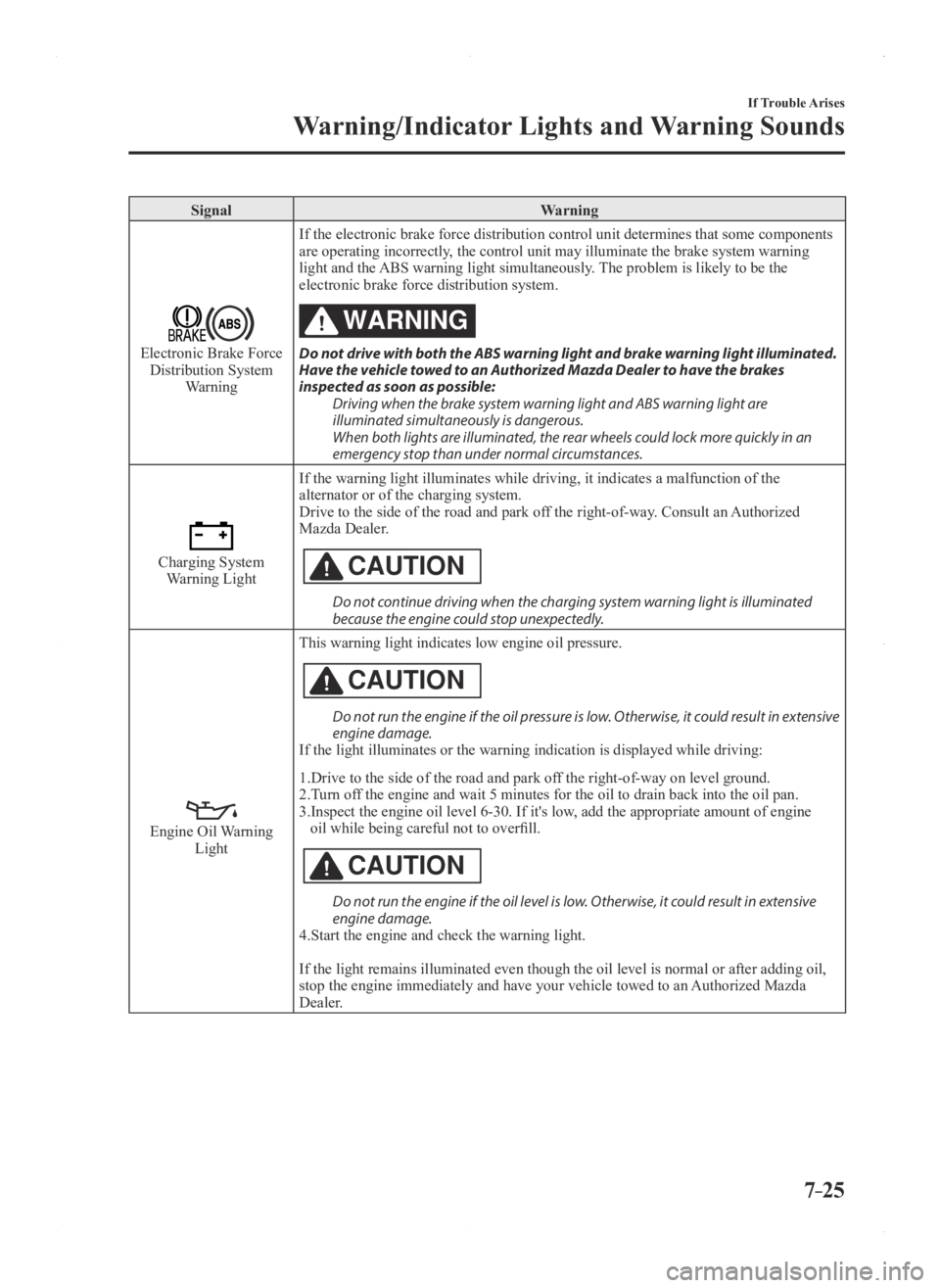
Electronic Brake Force Distribution System
Warning If the electronic brake force distribution control unit determines that \
some components
are operating incorrectly, the control unit may illuminate the brake system warning
light and the ABS warning light simultaneously. The problem is likely to be the
electronic brake force distribution system.
WARNING
Do not drive with both the ABS warning light and brake warning light illuminated. Have the vehicle towed to an Authorized Mazda Dealer to have the brakes
inspected as soon as possible:
Driving when the brake system warning light and ABS warning light are
illuminated simultaneously is dangerous.
When both lights are illuminated, the rear wheels could lock more quickly in an
emergency stop than under normal circumstances.
Charging System Warning Light If the warning light illuminates while driving, it indicates a malfuncti\
on of the
alternator or of the charging system.
Drive to the side of the road and park off the right-of-way. Consult an Authorized
Mazda Dealer.CAUTION
Do not continue driving when the charging system warning light is illuminated because the engine could stop unexpectedly.
Engine Oil Warning LightThis warning light indicates low engine oil pressure.
CAUTION
Do not run the engine if the oil pressure is low. Otherwise, it could result in extensive engine damage.
If the light illuminates or the warning indication is displayed while dr\
iving:
1.Drive to the side of the road and park off the right-of-way on level ground.
2.Turn off the engine and wait 5 minutes for the oil to drain back into the oil p\
an.
3.Inspect the engine oil level 6-30. If it's low, add the appropriate amount of engine
oil while being careful not to overfill.
CAUTION
Do not run the engine if the oil level is low. Otherwise, it could result in extensive engine damage.
4.Start the engine and check the warning light.
If the light remains illuminated even though the oil level is normal or \
after adding oil,
stop the engine immediately and have your vehicle towed to an Authorized Mazda
Dealer.
Mazda3_8FA4-EA-15G_Edition1.indb 252015/05/11 14:02:42
Page 509 of 598
7–27
If Trouble Arises
Warning/Indicator Lights and Warning Sounds
*Some models.
SignalWarning
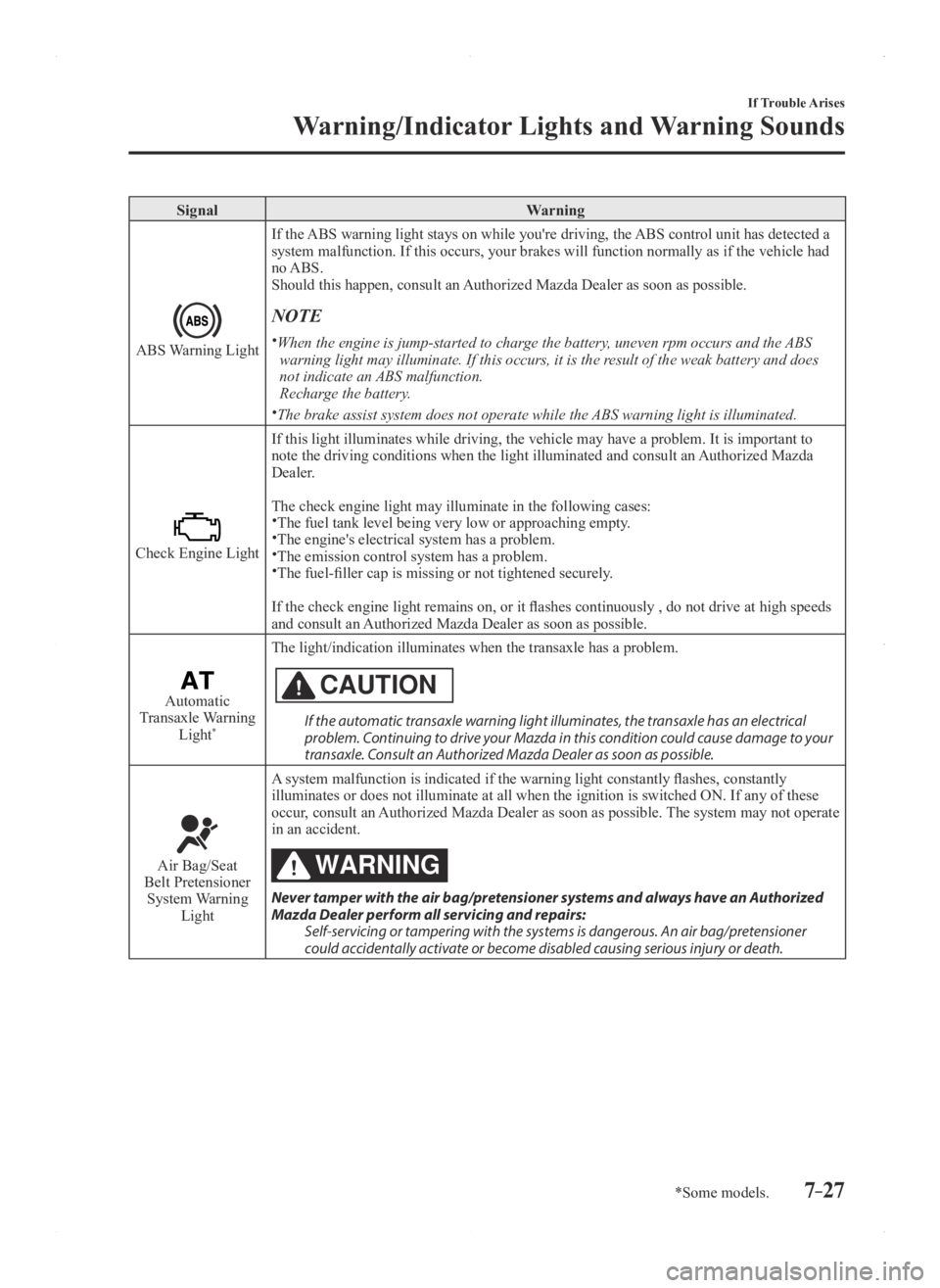
ABS Warning Light
If the ABS warning light stays on while you're driving, the ABS control unit has detected a
system malfunction. If this occurs, your brakes will function normally a\
s if the vehicle had
no ABS.
Should this happen, consult an Authorized Mazda Dealer as soon as possible.
NOTE
When the engine is jump-started to charge the battery, uneven rpm occurs and the ABS
warning light may illuminate. If this occurs, it is the result of the weak battery and does
not indicate an ABS malfunction.
Recharge the battery.
The brake assist system does not operate while the ABS warning light is illuminated.
Check Engine Light
If this light illuminates while driving, the vehicle may have a problem.\
It is important to
note the driving conditions when the light illuminated and consult an Authorized Mazda
Dealer.
The check engine light may illuminate in the following cases:
The fuel tank level being very low or approaching empty.The engine's electrical system has a problem.The emission control system has a problem.The fuel-filler cap is missing or not tightened securely.
If the check engine light remains on, or it flashes continuously , do not drive at high speeds
and consult an Authorized Mazda Dealer as soon as possible.
Automatic
Transaxle Warning Light
*
The light/indication illuminates when the transaxle has a problem.
CAUTION
If the automatic transaxle warning light illuminates, the transaxle has an electrical problem. Continuing to drive your Mazda in this condition could cause damage to your
transaxle. Consult an Authorized Mazda Dealer as soon as possible.
Air Bag/Seat Belt Pretensioner System Warning Light A system malfunction is indicated if the warning light constantly flashes, constantly
illuminates or does not illuminate at all when the ignition is switched ON. If any of these
occur, consult an Authorized Mazda Dealer as soon as possible. The system may not operate
in an accident.WARNING
Never tamper with the air bag/pretensioner systems and always have an Authorized Mazda Dealer perform all servicing and repairs:
Self-servicing or tampering with the systems is dangerous. An air bag/pretensioner
could accidentally activate or become disabled causing serious injury or death.
Mazda3_8FA4-EA-15G_Edition1.indb 272015/05/11 14:02:43
Page 556 of 598
8–32
Customer Information and Reporting Safety Defects
Tire Information (U.S.A.)
Glossary of Terms
Tire Placard: A label indicating the OE tire sizes, recommended inflation pressure, and the
maximum weight the vehicle can carry.
Tire Identification Number (TIN): A number on the sidewall of each tire providing
information about the tire brand and manufacturing plant, tire size, and\
date of manufacture.
Inflation Pressure: A measure of the amount of air in a tire.
kPa: Kilopascal, the metric unit for air pressure.
psi: Pounds per square inch, the English unit for air pressure.
B-pillar: The structural member at the side of the vehicle behind the front door.
Original Equipment (OE): Describes components originally equipped on the vehicle.
Vehicle Load Limit: The maximum value of the combination weight of occupants and
cargo.
Bead Area of the Tire: Area of the tire next to the rim.
Sidewall Area of the Tire: Area between the bead area and the tread.
Tread Area of the Tire: Area on the perimeter of the tire that contacts the road when it's
mounted on the vehicle.
Seating capacity means the total allowable number of vehicle occupants. Seating capacity\
is described on the tire label.
Production options weight is the combination weight of installed regular production
options weighing over 2.3 kilograms in excess of the standard items whic\
h they replace,
and not previously considered in the curb weight or accessory weight, in\
cluding heavy duty
brakes, ride levelers, roof rack, heavy duty battery, and special trim.
Rim is the metal support (wheel) for a tire or a tire and tube assembly u\
pon which the tire
beads are seated.
Mazda3_8FA4-EA-15G_Edition1.indb 322015/05/11 14:02:51
Page 560 of 598
8–36
Customer Information and Reporting Safety Defects
Tire Information (U.S.A.)
Vehicle Loading
WARNING
Do not tow a trailer with this vehicle:
Towing a trailer with this vehicle is dangerous because it has not been designed to tow a
trailer and doing so will affect the drive system which could result in vehicle damage.
This section will guide you in the proper loading of your vehicle, to ke\
ep your loaded
vehicle weight within its design rating capability. Properly loading your vehicle will provide
maximum return of vehicle design performance. Before loading your vehicle, familiarize
yourself with the following terms for determining your vehicle's weight \
ratings, from the
vehicle's Safety Certification Label and Tire and Load Information Label:
WARNING
Overloaded Vehicle:
Overloading a vehicle is dangerous. The results of overloading can have serious
consequences in terms of passenger safety. Too much weight on a vehicle's suspension
system can cause spring or shock absorber failure, brake failure, handling or steering
problems, irregular tire wear, tire failure or other damage.
Overloading makes a vehicle harder to drive and control. It also increases the distance
required for stopping. In cases of serious overloading, brakes can fail completely,
particularly on steep grades. The load a tire will carry safely is a combination of the size of
the tire, its load range, and corresponding inflation pressure.
Never overload the vehicle and always observe the vehicle's weight ratings from the
vehicle's Safety Certification and Tire and Load Information labels.
Mazda3_8FA4-EA-15G_Edition1.indb 362015/05/11 14:02:52