MAZDA MODEL 3 4-DOOR 2017 Repair Manual
Manufacturer: MAZDA, Model Year: 2017, Model line: MODEL 3 4-DOOR, Model: MAZDA MODEL 3 4-DOOR 2017Pages: 612
Page 61 of 612

2–47
Essential Safety Equipment
SRS Air Bags
NOTE
If it becomes necessary to have the components or wiring system for the \
supplementary
restraint system modified to accommodate a person with certain medical conditions in
accordance with a certified physician, contact an Authorized Mazda Dealer, refer to
“Customer Assistance (U.S.A.)” (page
8-2). When an air bag deploys, a loud inflation noise can be heard and some smoke will be
released. Neither is likely to cause injury, however, the texture of the air bags may cause
light skin injuries on body parts not covered with clothing through friction.
Should you sell your Mazda, we urge you to tell the new owner of its air bag systems
and that familiarization with all instructions about them, from the Owner's Manual, is
important.
This highly-visible label is displayed which warns against the use of a \
r ear-facing child-
restraint system on the front passenger seat.
(Except Mexico)(Mexico)
Mazda3_8FL6-EA-16F_Edition2.indb 472016/08/10 17:35:07
Page 62 of 612
2–48
Essential Safety Equipment
SRS Air Bags
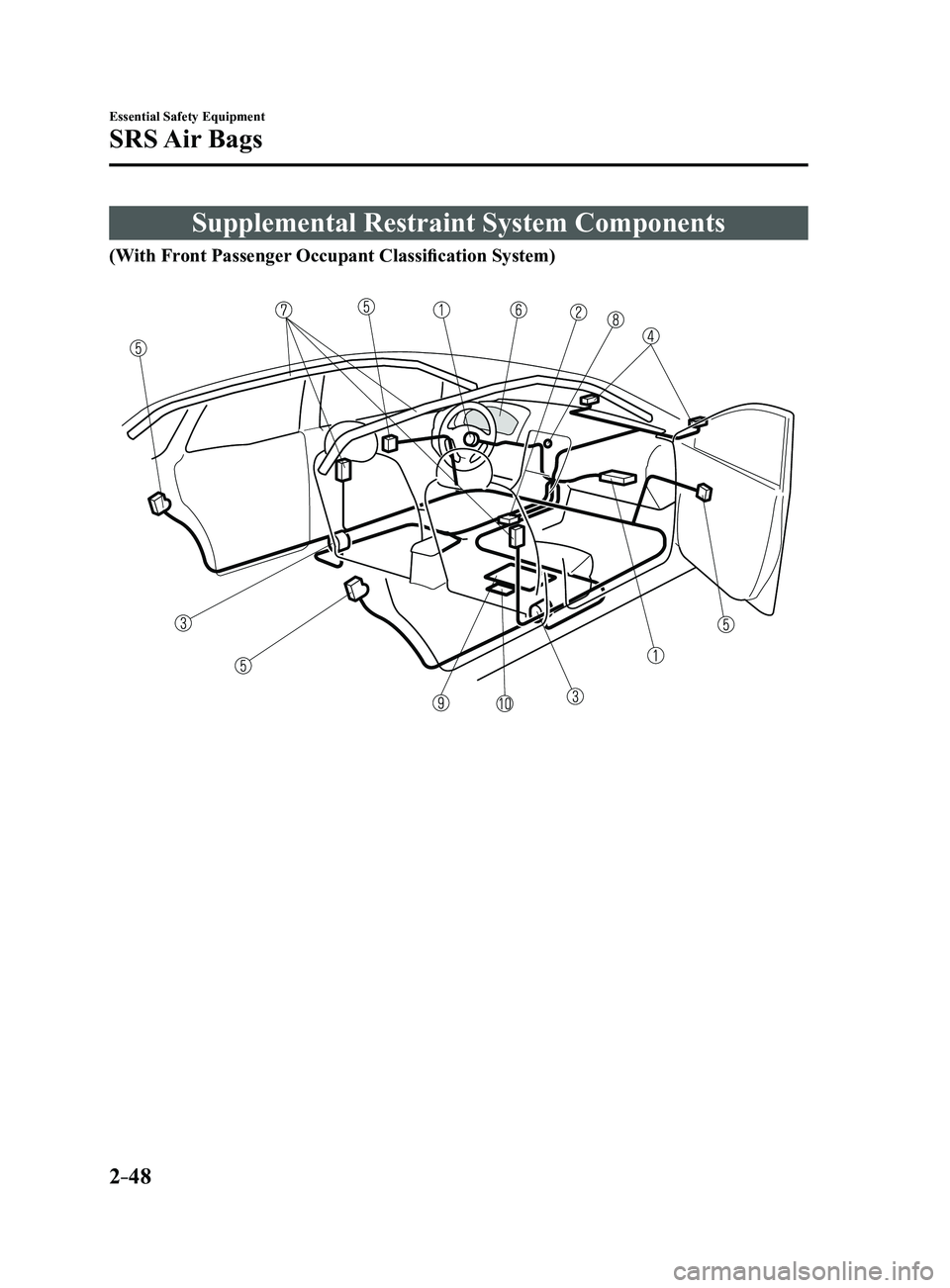
Supplemental Restraint System Components
(With Front Passenger Occupant Classification System)
Mazda3_8FL6-EA-16F_Edition2.indb 482016/08/10 17:35:07
Page 63 of 612
2–49
Essential Safety Equipment
SRS Air Bags
*Some models.
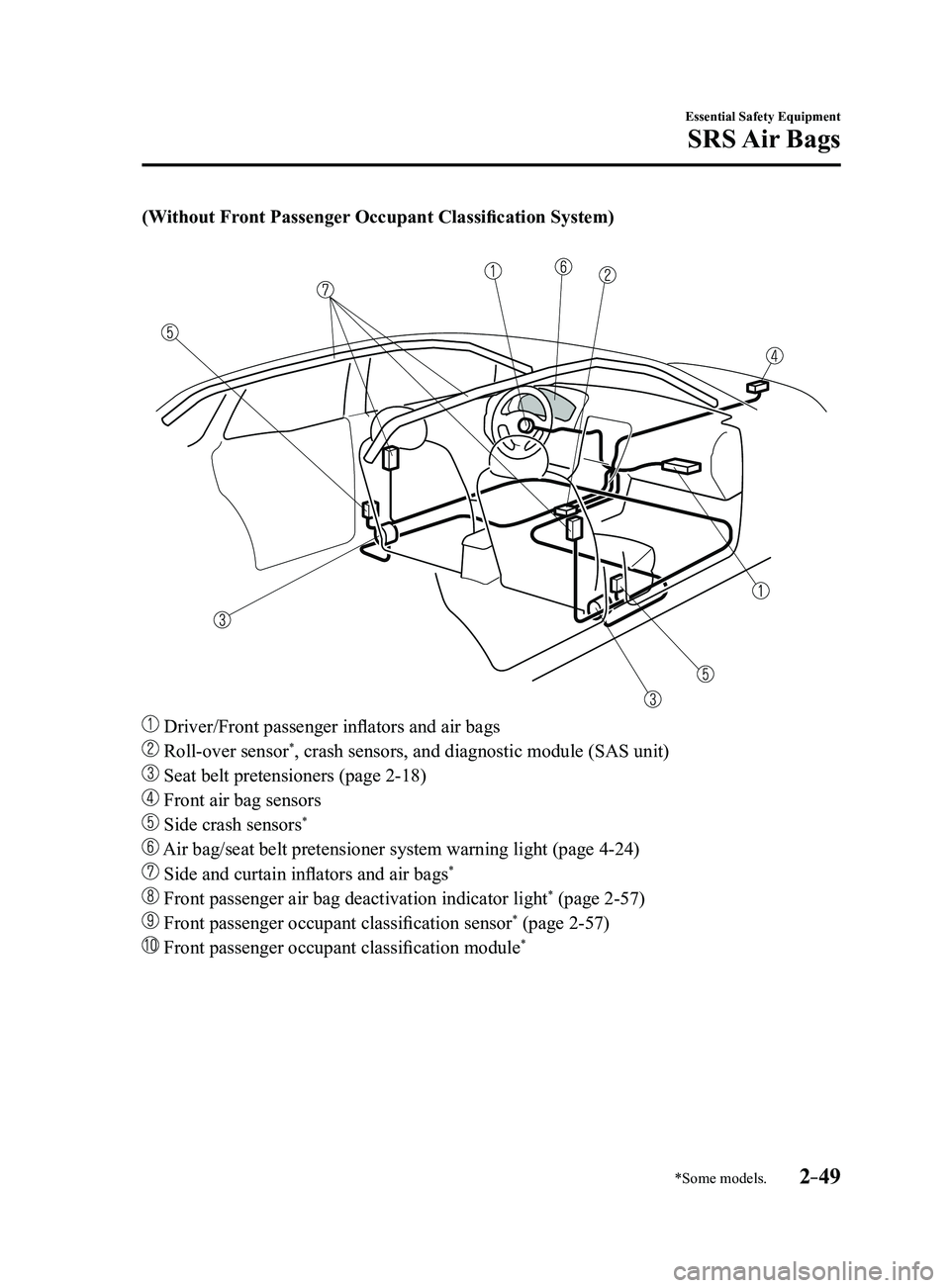
(Without Front Passenger Occupant Classification System)
Driver/Front passenger inflators and air bags
Roll-over sensor*, crash sensors, and diagnostic module (SAS unit)
Seat belt pretensioners (page 2-18)
Front air bag sensors
Side crash sensors*
Air bag/seat belt pretensioner system warning light (page 4-24)
Side and curtain inflators and air bags*
Front passenger air bag deactivation indicator light* (page 2-57)
Front passenger occupant classification sensor* (page 2-57)
Front passenger occupant classification module*
Mazda3_8FL6-EA-16F_Edition2.indb 492016/08/10 17:35:09
Page 64 of 612
2–50
Essential Safety Equipment
SRS Air Bags
How the SRS Air Bags Work
Your Mazda is equipped with the following types of SRS air bags. SRS air bags are
designed to work together with the seat belts to help to reduce injuries\
during an accident.
The SRS air bags are designed to provide further protection for passengers in addition to the
seat belt functions. Be sure to wear seat belts properly.
Front Seat Belt Pretensioners
The front seat belt pretensioners are designed to deploy in moderate or \
severe frontal, near
frontal collisions.
In addition, the pretensioners operate when a side collision (only on t\
he side in which the
collision occurs) or a roll-over accident is detected. The pretensioners operate differently
depending on what types of air bags are equipped. For more details about seat belt
pretensioner operation, refer to the SRS Air Bag Deployment Criteria (page
2-54).
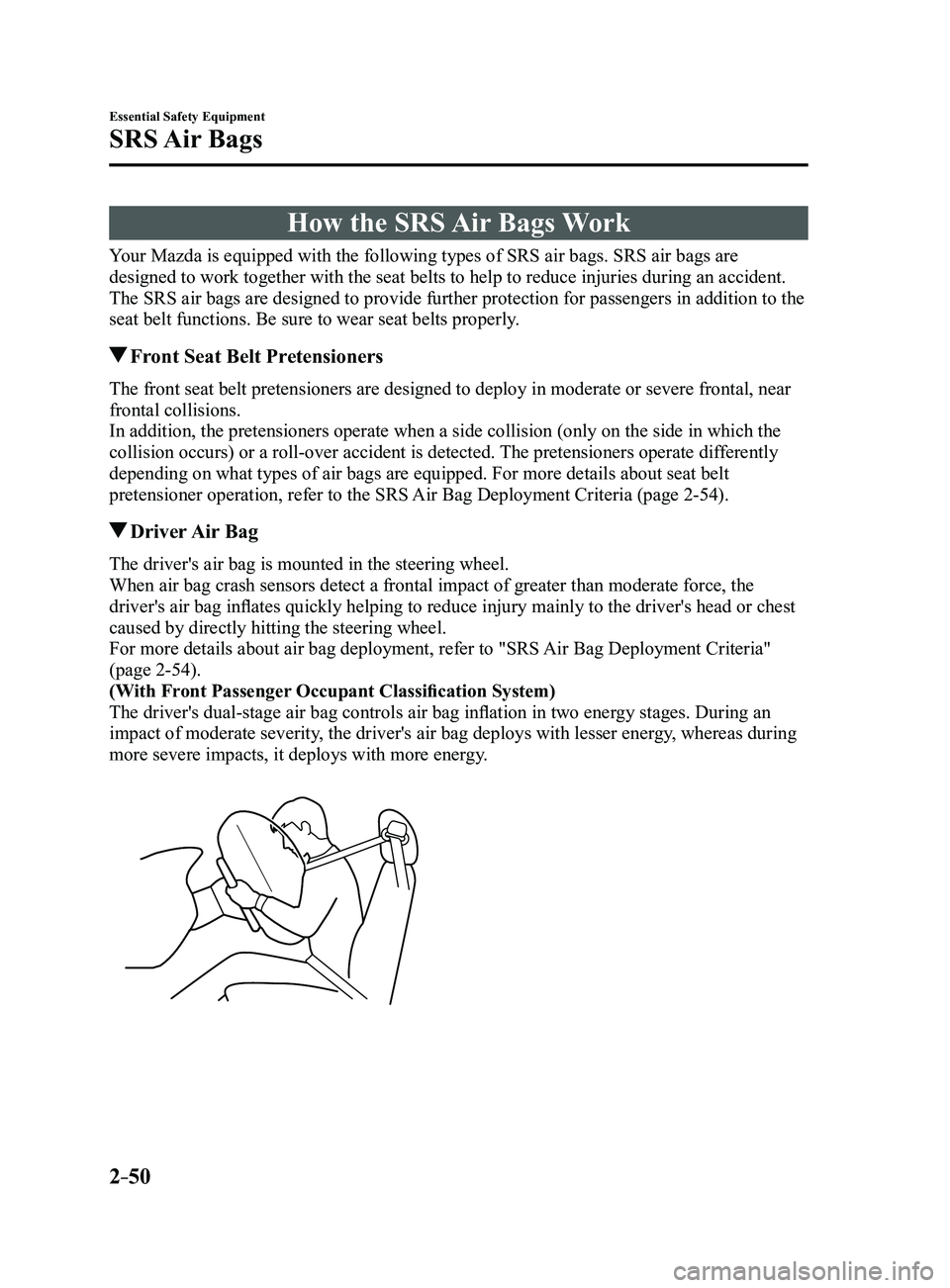
Driver Air Bag
The driver's air bag is mounted in the steering wheel.
When air bag crash sensors detect a frontal impact of greater than moder\
ate force, the
driver's air bag inflates quickly helping to reduce injury mainly to the driver's head or chest
caused by directly hitting the steering wheel.
For more details about air bag deployment, refer to "SRS Air Bag Deployment Criteria"
(page
2-54).
(With Front Passenger Occupant Classification System)
The driver's dual-stage air bag controls air bag inflation in two energy stages. During an
impact of moderate severity, the driver's air bag deploys with lesser energy, whereas during
more severe impacts, it deploys with more energy.
Mazda3_8FL6-EA-16F_Edition2.indb 502016/08/10 17:35:09
Page 65 of 612

2–51
Essential Safety Equipment
SRS Air Bags
*Some models.
Front Passenger Air Bag
The front passenger air bag is mounted in the front passenger dashboard.\
The inflation mechanism for the front passenger air bag is the same as the driver's air bag.
For more details about air bag deployment, refer to "SRS Air Bag Deployment Criteria"
(page
2-54).
(With Front Passenger Occupant Classification System)
In addition, the front passenger air bag is designed to only deploy when\
the front passenger
occupant classification sensor detects a passenger sitting on the front passenger's seat. For
details, refer to the front passenger occupant classification system (page
2-57).
Side Air Bags*
The side air bags are mounted in the outboard sides of the front seatbac\
ks.
When the air bag crash sensors detect a side impact of greater than mode\
rate force, the
system inflates the side air bag only on the side in which the vehicle was hit. The side
air bag inflates quickly to reduce injury to the driver or front passenger's chest caused by
directly hitting interior parts such as a door or window.
For more details about air bag deployment, refer to "SRS Air Bag Deployment Criteria"
(page
2-54).
Mazda3_8FL6-EA-16F_Edition2.indb 512016/08/10 17:35:09
Page 66 of 612

In addition, the front passenger side bag is designed to only deploy whe\
n the fron")
2–52
Essential Safety Equipment
SRS Air Bags
*Some models.
(With Front Passenger Occupant Classification System)
In addition, the front passenger side bag is designed to only deploy whe\
n the front passenger
occupant classification sensor detects a passenger sitting on the front passenger's seat. For
details, refer to the front passenger occupant classification system (page
2-57).
Curtain Air Bags*
The curtain air bags are mounted in the front and rear window pillars, a\
nd the roof edge
along both sides.
When the air bag crash sensors detect a side impact of greater than mode\
rate force, the
curtain air bag inflates quickly and helps to reduce injury mainly to the rear outboard
passenger's head caused by directly hitting interior parts such as a doo\
r or window.
For more details about air bag deployment, refer to "SRS Air Bag Deployment Criteria"
(page
2-54).
In a side impact:
Greater than moderate impact to one side of the vehicle will cause the curtain air bag on that
side only to inflate.
Only one side curtain air bag will deploy on the
side of the vehicle that receives the force of an
impact.
Mazda3_8FL6-EA-16F_Edition2.indb 522016/08/10 17:35:10
Page 67 of 612
2–53
Essential Safety Equipment
SRS Air Bags
(With Front Passenger Occupant Classification System)
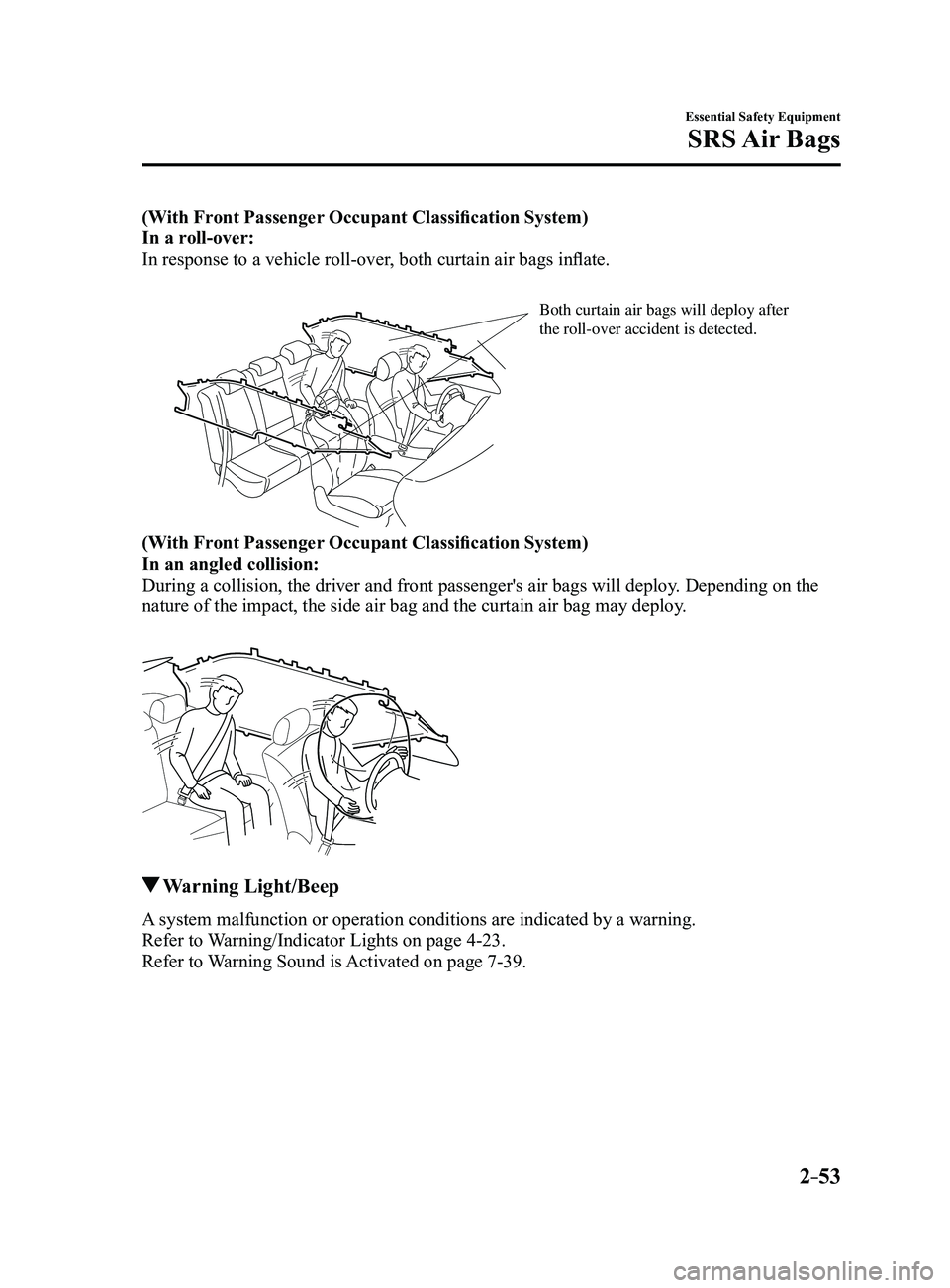
In a roll-over:
In response to a vehicle roll-over, both curtain air bags inflate.
Both curtain air bags will deploy after the roll-over accident is detected.
(With Front Passenger Occupant Classification System)
In an angled collision:
During a collision, the driver and front passenger's air bags will deplo\
y. Depending on the
nature of the impact, the side air bag and the curtain air bag may deplo\
y.
Warning Light/Beep
A system malfunction or operation conditions are indicated by a warning.
Refer to Warning/Indicator Lights on page
4-23.
Refer to Warning Sound is Activated on page
7-39.
Mazda3_8FL6-EA-16F_Edition2.indb 532016/08/10 17:35:10
Page 68 of 612
2–54
Essential Safety Equipment
SRS Air Bags
*Some models.
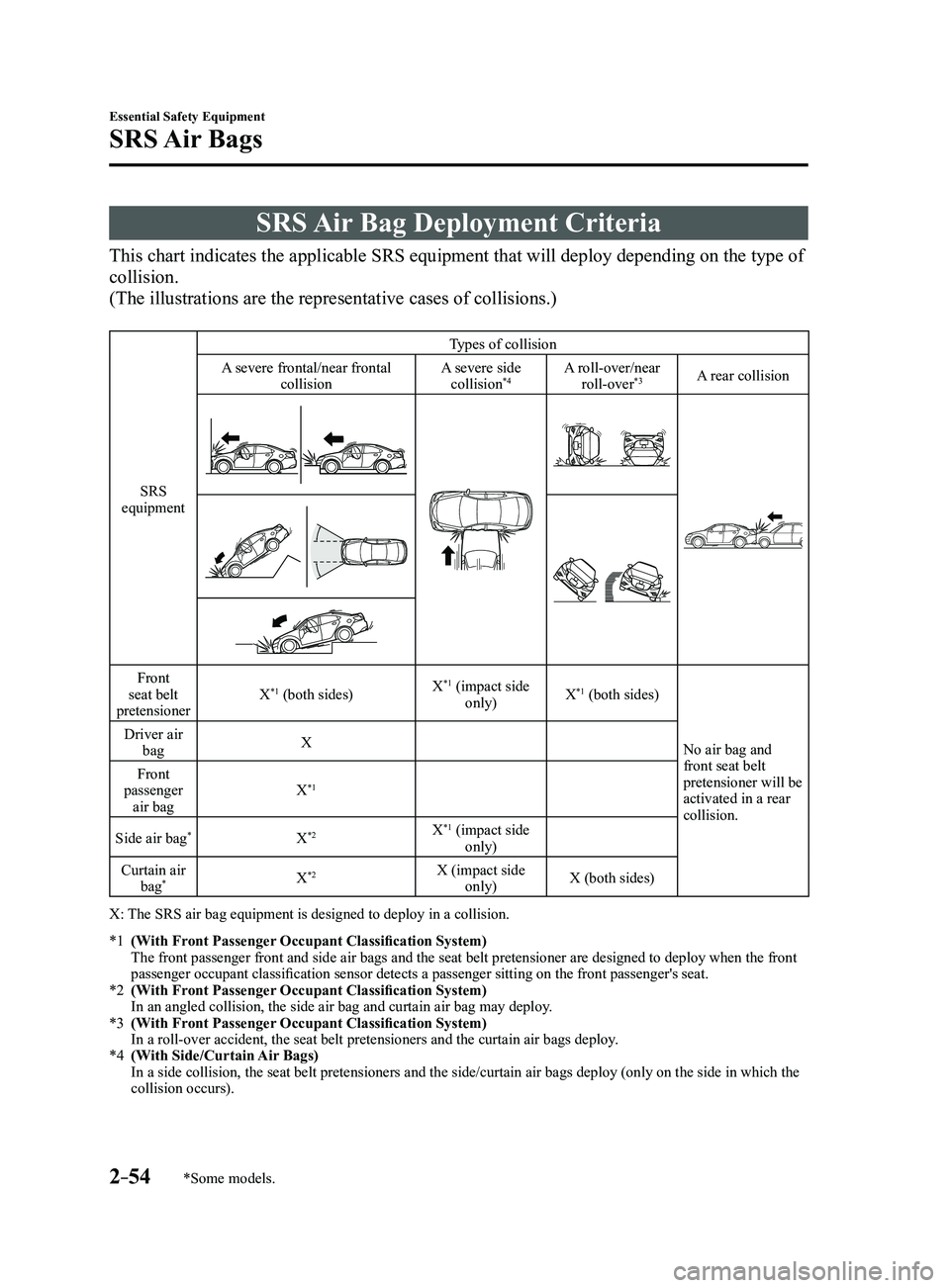
SRS Air Bag Deployment Criteria
This chart indicates the applicable SRS equipment that will deploy depending on the type of
collision.
(The illustrations are the representative cases of collisions.)
SRS
equipment Types of collision
A severe frontal/near frontal collision A severe side
collision
*4A roll-over/near roll-over*3A rear collision
Front seat belt
pretensioner X*1 (both sides)
X*1 (impact side
only) X*1 (both sides)
No air bag and
front seat belt
pretensioner will be
activated in a rear
collision.
Driver air
bag X
Front
passenger air bag X
*1
Side air bag*X*2X*1 (impact side
only)
Curtain air bag
*X*2X (impact side only) X (both sides)
X: The SRS air bag equipment is designed to deploy in a collision.
*1 (With Front Passenger Occupant Classification System) The front passenger front and side air bags and the seat belt pretension\
er are designed to deploy when the front passenger occupant classification sensor detects a passenger sitting on the front passenger's seat.*2 (With Front Passenger Occupant Classification System) In an angled collision, the side air bag and curtain air bag may deploy .*3 (With Front Passenger Occupant Classification System) In a roll-over accident, the seat belt pretensioners and the curtain air\
bags deploy .*4 (With Side/Curtain Air Bags) In a side collision, the seat belt pretensioners and the side/curtain ai\
r bags deploy (only on the side in which the collision occurs).
Mazda3_8FL6-EA-16F_Edition2.indb 542016/08/10 17:35:12
Page 69 of 612
2–55
Essential Safety Equipment
SRS Air Bags
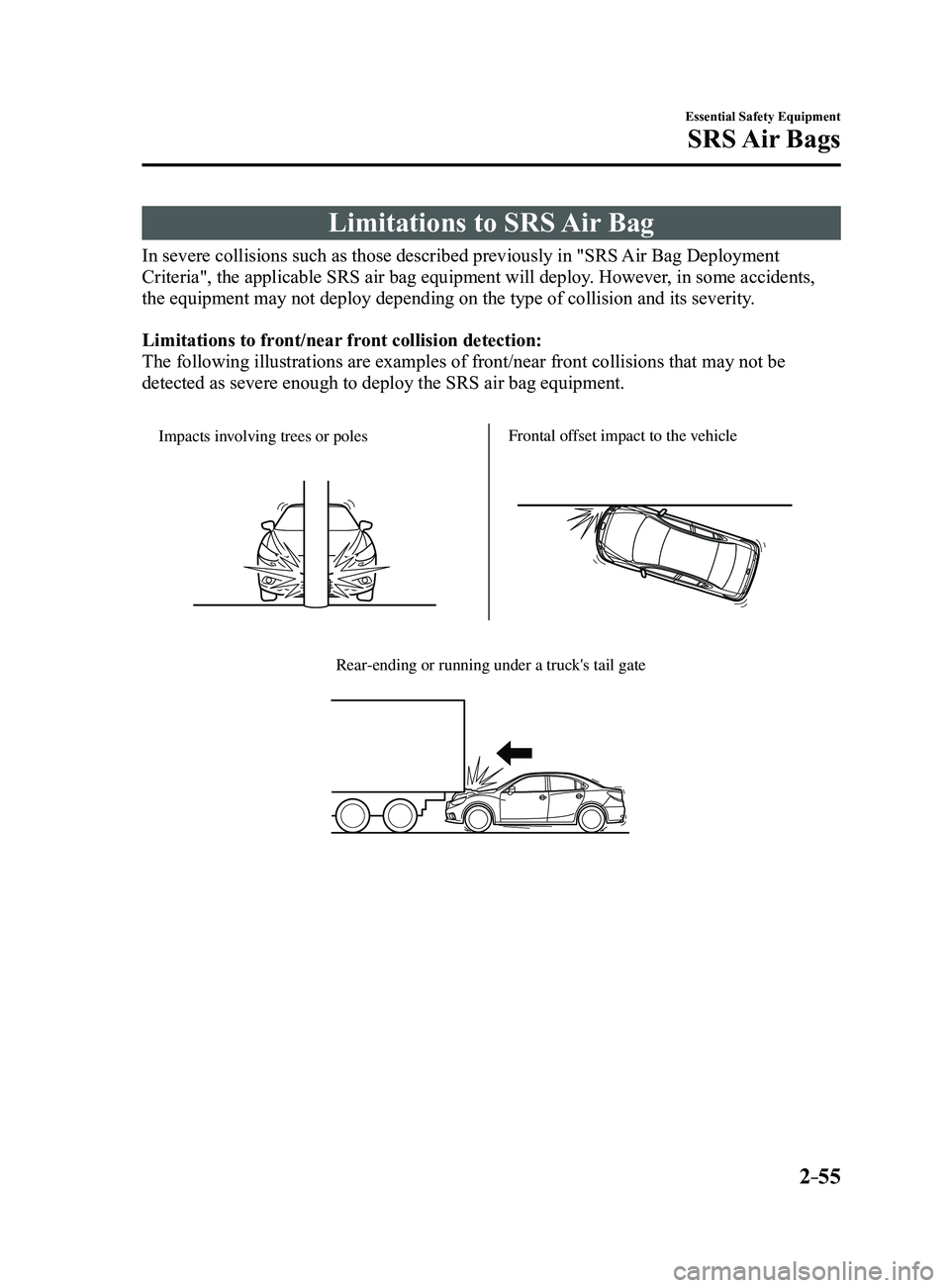
Limitations to SRS Air Bag
In severe collisions such as those described previously in "SRS Air Bag Deployment
Criteria", the applicable SRS air bag equipment will deploy. However, in some accidents,
the equipment may not deploy depending on the type of collision and its severity.
Limitations to front/near front collision detection:
The following illustrations are examples of front/near front collisions \
that may not be
detected as severe enough to deploy the SRS air bag equipment.
Impacts involving trees or polesFrontal offset impact to the vehicle
Rear-ending or running under a truck's tail gate
Mazda3_8FL6-EA-16F_Edition2.indb 552016/08/10 17:35:12
Page 70 of 612

2–56
Essential Safety Equipment
SRS Air Bags
Limitations to side collision detection:
The following illustrations are examples of side collisions that may not\
be detected as severe
enough to deploy the SRS air bag equipment.
Side impacts involving trees or polesSide impacts with two-wheeled vehicles
Roll-over (Without Front Passenger Occupant Classification System)
(With Front Passenger Occupant Classification System)
Limitations to roll-over detection:
The following illustration is an example of an accident that may not be \
detected as a roll-
over accident. Therefore, the front seat belt pretensioners and curtain air bags may no\
t
deploy.
Pitch end over end
Mazda3_8FL6-EA-16F_Edition2.indb 562016/08/10 17:35:13