seats MAZDA MODEL 3 5-DOOR 2008 User Guide
[x] Cancel search | Manufacturer: MAZDA, Model Year: 2008, Model line: MODEL 3 5-DOOR, Model: MAZDA MODEL 3 5-DOOR 2008Pages: 412, PDF Size: 5.26 MB
Page 24 of 412
Black plate (24,1)
Rear Seat
WARNING
Do not stack cargo higher than the
seatbacks or place articles on the rear
package tray or on the luggage
compartment cover:Stacking luggage or other cargo
higher than the seatbacks, and
placing articles on the rear package
tray or on the luggage compartment
cover is dangerous. During sudden
braking or a collision, objects can fly
around and become projectiles that
may hit and injure passengers.
Make sure luggage and cargo is
secured before driving: Not securing cargo while driving is
dangerous as it could move or be
crushed during sudden braking or a
collision and cause injury.
Make sure the adjustable components
of a seat are locked in place: Adjustable seats that are not securely
locked are dangerous. In a sudden
stop or collision, the seat or seatback
could move, causing injury.
Do not drive with the seatback
unlocked: The seatback plays an important role
in your protection in a vehicle.
Leaving the seatback unlocked is
dangerous as it can allow passengers
to be ejected or thrown around and
baggage to strike occupants in a
sudden stop or collision, resulting in
severe injury. After returning the
seatback at any time, even when
there are no other passengers, rock
the seatback to make sure it is locked
in place. Never allow a passenger to sit or stand
on the folded seatback while the
vehicle is moving:
Driving with a passenger on the
folded seatback is dangerous.
Allowing a child to sit up on the
folded seatback while the vehicle is
moving is particularly dangerous. In
a sudden stop or even a minor
collision, a child not in a proper seat
or child-restraint system and seat
belt could be thrown forward, back
or even out of the vehicle resulting in
serious injuries or death. The child in
the baggage area could be thrown
into other occupants and cause
serious injury.
Never give the car keys to children and
do not allow them to play in the
vehicle: Playing with the folding rear seats is
dangerous. The folding rear
seatbacks cannot be folded down
from inside the trunk. Once the
seatbacks are back up, a child in the
trunk would not be able to get out
the way they had entered. If you have
small children, keep the seatbacks
locked (sedan).
2-10
Essential Safety Equipment
Seats
Mazda3_8Y64-EA-08A_Edition1 Page24
Tuesday, November 27 2007 9:0 AM
Form No.8Y64-EA-08A
Page 25 of 412
Black plate (25,1)
Always leave your car locked and keep
the car keys safely away from children:Leaving your car unlocked or the
keys in reach of children is
dangerous. Children who find their
way into the trunk through an
unlocked rear seatback or an open
trunk can become accidentally locked
in the trunk. This could result in
death or brain damage from heat
prostration, particularly in the
summer. Always lock the doors and
the trunk, and as an added measure,
keep the rear seatbacks locked,
whether you have children in your
home or not.
NOTE
When returning a rear seat to its original
position, also replace the seat belt to its
normal position. Verify that the seat belt pulls
out and retracts.
q Split-Folding Rear Seatback
To fold the seatbacks
CAUTION
When operating the rear seatback
knob, make sure you support the
seatback with your hand. If the
seatback is not supported with your
hand, it will flip forward suddenly
and could cause injury to the finger
that pushes the rear seatback knob
down. 1. Unfasten the lap portion of the center-
rear seat belt (page 2-23).
CAUTION
Always unfasten the lap portion of
the belt before folding the rear-left
seatback. Leaving the lap portion of
the belt fastened could cause
damage to the seat belt, buckle and
seatback.
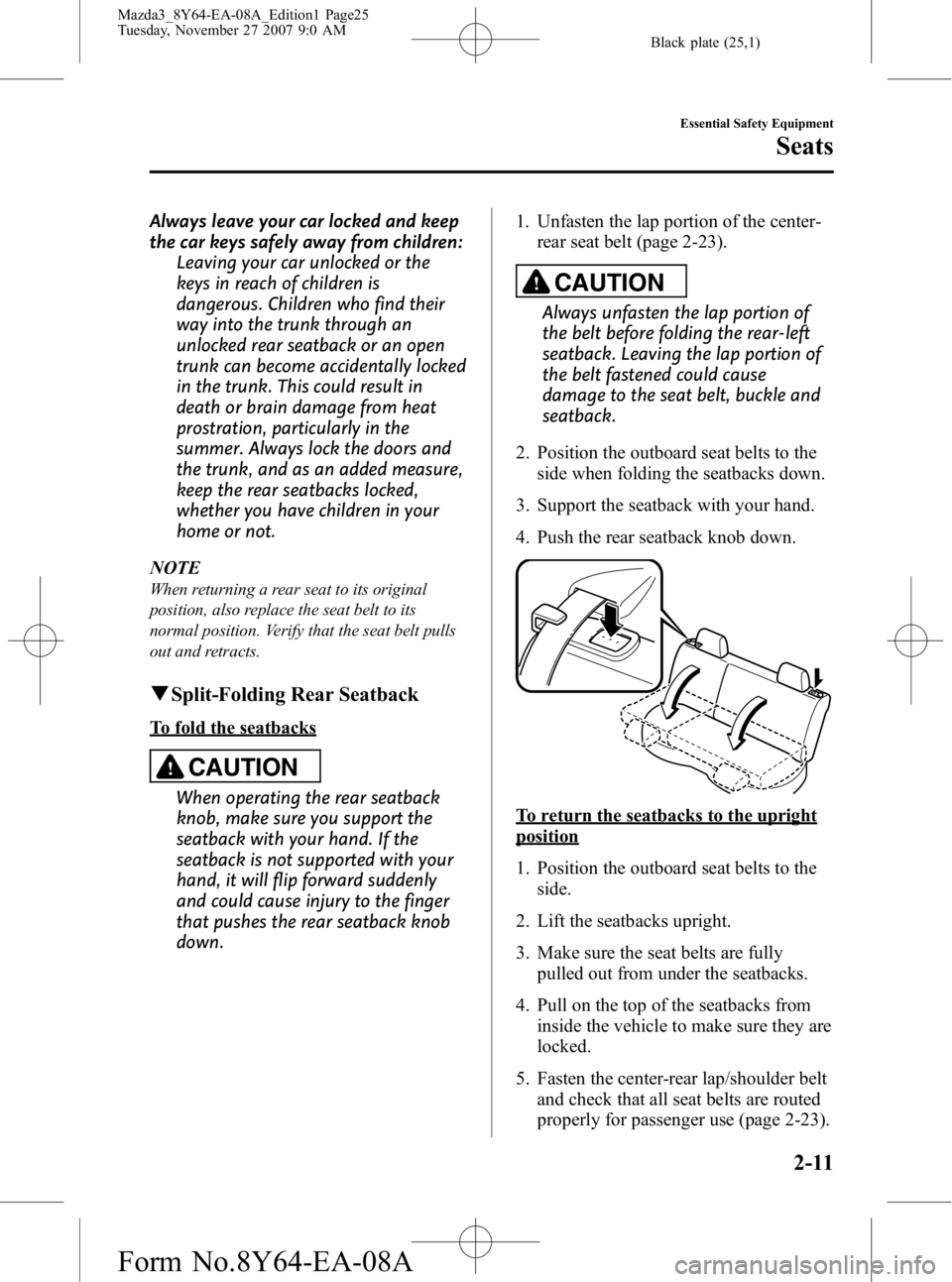
2. Position the outboard seat belts to the side when folding the seatbacks down.
3. Support the seatback with your hand.
4. Push the rear seatback knob down.
To return the seatbacks to the upright
position
1. Position the outboard seat belts to the side.
2. Lift the seatbacks upright.
3. Make sure the seat belts are fully pulled out from under the seatbacks.
4. Pull on the top of the seatbacks from inside the vehicle to make sure they are
locked.
5. Fasten the center-rear lap/shoulder belt and check that all seat belts are routed
properly for passenger use (page 2-23).
Essential Safety Equipment
Seats
2-11
Mazda3_8Y64-EA-08A_Edition1 Page25
Tuesday, November 27 2007 9:0 AM
Form No.8Y64-EA-08A
Page 26 of 412
Black plate (26,1)
WARNING
Always make sure the seat belts are
fully pulled out from under the
seatbacks:A seat belt caught under a seatback
after the seatback is returned to its
upright position is dangerous. In a
collision or sudden stop, the seat belt
cannot provide adequate protection.
When returning the seatback to the
upright position, make sure there is no
red indication: A rear seatback not fully returned
and locked in the upright position is
dangerous. Sudden stops or
maneuvering could cause a seatback
to flip forward suddenly resulting in
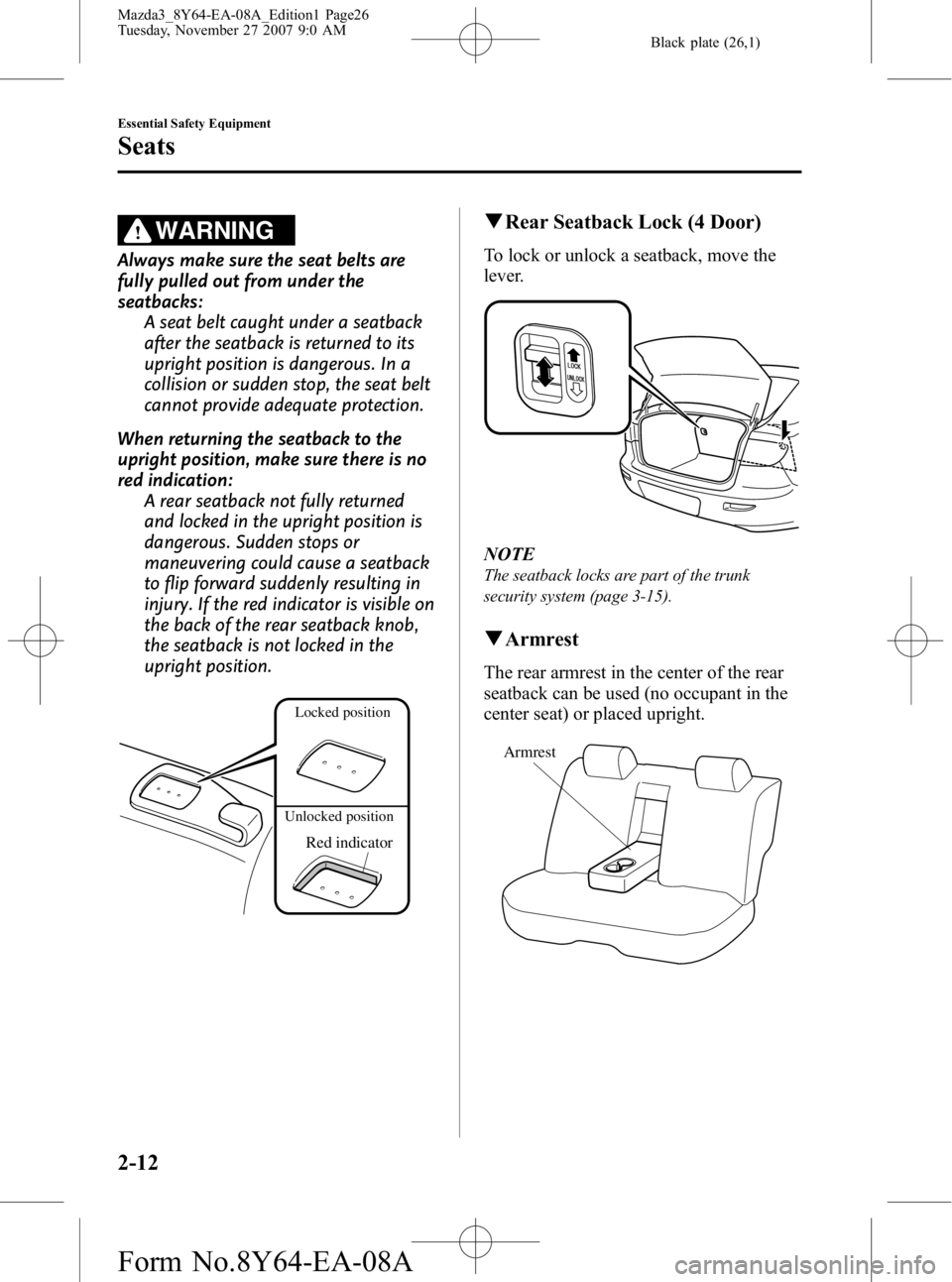
injury. If the red indicator is visible on
the back of the rear seatback knob,
the seatback is not locked in the
upright position.
Locked position
Unlocked position
Red indicator
q Rear Seatback Lock (4 Door)
To lock or unlock a seatback, move the
lever.
NOTE
The seatback locks are part of the trunk
security system (page 3-15).
qArmrest
The rear armrest in the center of the rear
seatback can be used (no occupant in the
center seat) or placed upright.
Armrest
2-12
Essential Safety Equipment
Seats
Mazda3_8Y64-EA-08A_Edition1 Page26
Tuesday, November 27 2007 9:0 AM
Form No.8Y64-EA-08A
Page 27 of 412
Black plate (27,1)
Head Restraints
Your vehicle is equipped with head
restraints in all seating positions except
the Rear center seat to protect you and
other passengers from neck injury.
WARNING
Always drive with the head restraints
installed when seats are being used
and make sure they are properly
adjusted:Driving with the head restraints
adjusted too low or removed is
dangerous. With no support behind
your head, your neck could be
seriously injured in a collision.
Height adjustment
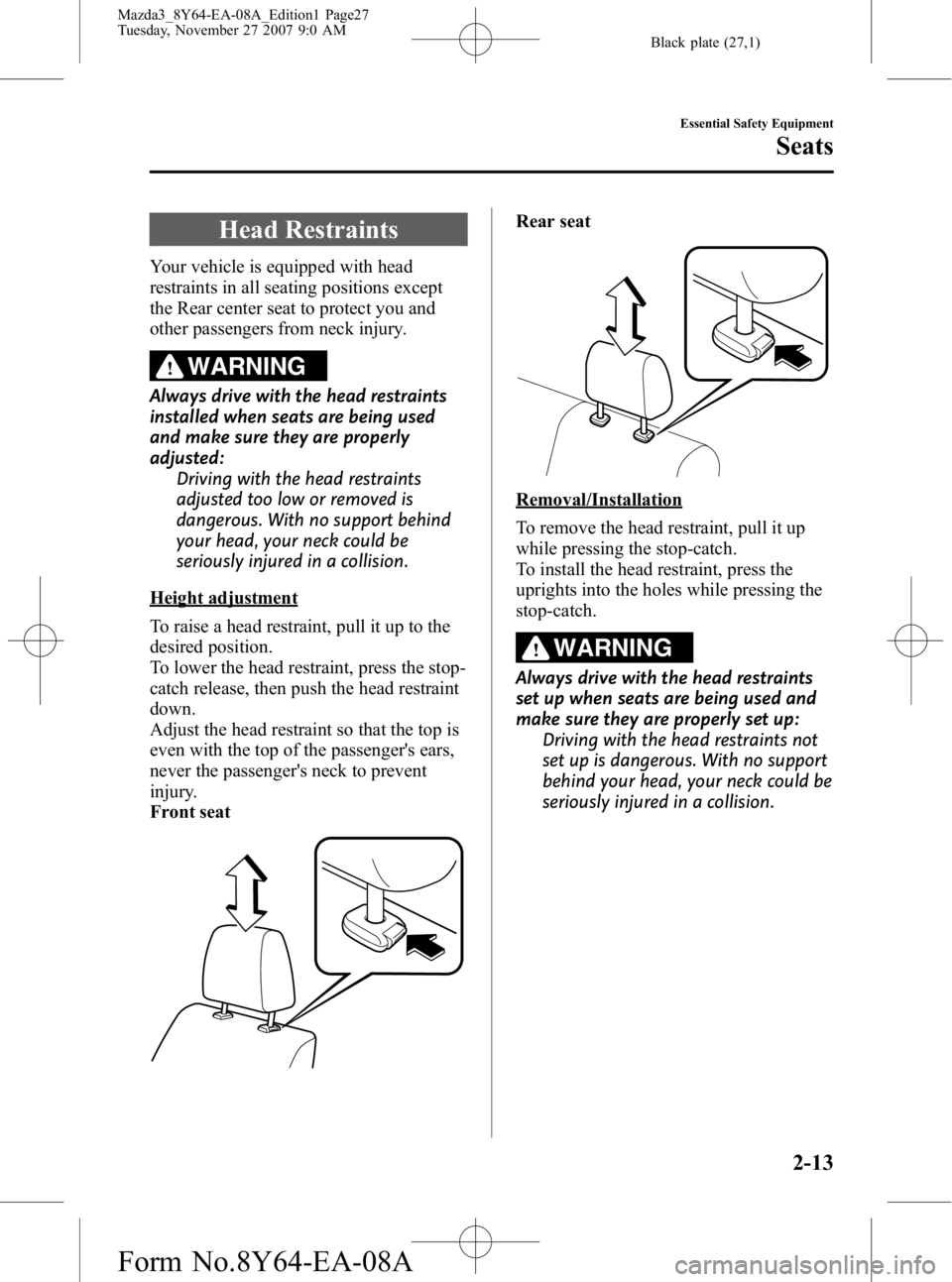
To raise a head restraint, pull it up to the
desired position.
To lower the head restraint, press the stop-
catch release, then push the head restraint
down.
Adjust the head restraint so that the top is
even with the top of the passenger's ears,
never the passenger's neck to prevent
injury.
Front seat
Rear seat
Removal/Installation
To remove the head restraint, pull it up
while pressing the stop-catch.
To install the head restraint, press the
uprights into the holes while pressing the
stop-catch.
WARNING
Always drive with the head restraints
set up when seats are being used and
make sure they are properly set up:Driving with the head restraints not
set up is dangerous. With no support
behind your head, your neck could be
seriously injured in a collision.
Essential Safety Equipment
Seats
2-13
Mazda3_8Y64-EA-08A_Edition1 Page27
Tuesday, November 27 2007 9:0 AM
Form No.8Y64-EA-08A
Page 28 of 412
Black plate (28,1)
Seat Belt Precautions
Seat belts help to decrease the possibility of severe injury during accidents and sudden
stops. Mazda recommends that the driver and all passengers always wear seat belts.
All of the seat belt retractors are designed to keep the lap/shoulder belts out of the way
when not in use.
The driver's seat belt has no provisions for child-restraint systems and has only an
emergency locking mode. The driver may wear it comfortably, and it will lock during a
collision.
However, the front passenger's seat and all rear lap/shoulder belt retractors operate in two
modes: emergency locking mode, and for child-restraint systems, automatic locking mode.
While we recommend you put all children in the rear seats, if you must use the front
passenger seat for a child, slide the front passenger seat as far back as possible and make
sure any child-restraint system is secured properly.
2-14
Essential Safety Equipment
Seat Belt Systems
Mazda3_8Y64-EA-08A_Edition1 Page28
Tuesday, November 27 2007 9:0 AM
Form No.8Y64-EA-08A
Page 38 of 412
Black plate (38,1)
qUnfastening the Seat Belt
Depress the button on the buckle. If the
belt does not fully retract, pull it out and
check for kinks or twists. Then make sure
it remains untwisted as it retracts.
Button
NOTE
If a belt does not fully retract, inspect it for
kinks and twists. If it is still not retracting
properly, have it inspected at an Authorized
Mazda Dealer.
qUnfastening the Lap Portion of
the Seat Belt
Insert a small object such as a key in the
anchor buckle (B) slot.
(A)
(B)
CAUTION
Always unfasten the lap portion of
the belt before folding the left-rear
seatback. Leaving the lap portion of
the belt fastened could cause
damage to the seat belt, buckle and
seatback.
NOTE
To encourage rear seat passengers to wear
their seat belts, we suggest leaving the center-
rear lap position of the belt fastened at all
times except when folding the rear seat
forward.
q Fastening the Lap Portion of the
Seat Belt
Grasp tongue (A) and insert it into the
anchor buckle (B) until you hear a click. It
is now secure for passenger use.
NOTE
After returning the left-rear seatback to its
upright position, fasten the lap portion of the
belt.
qStowing and pulling out the
Center-Rear Position Seat Belt
The center-rear position seat belt can be
stowed using the following procedure.
CAUTION
When stowing the seat belt, make
sure the belt is locked securely into
the recess. If the seat belt is not
properly stowed, it might get caught
in the seats and be damaged.
To stow the seat belt, retract the belt, put
tongues (A) and (C) together and insert
them into the recess.
2-24
Essential Safety Equipment
Seat Belt Systems
Mazda3_8Y64-EA-08A_Edition1 Page38
Tuesday, November 27 2007 9:0 AM
Form No.8Y64-EA-08A
Page 43 of 412
Black plate (43,1)
Child Restraint Precautions
Mazda strongly urges the use of child-restraint systems for children small enough to use
them.
You are required by law to use a child-restraint system for children in the U.S. and Canada.
Check your local and state or provincial laws for specific requirements regarding the safety
of children riding in your vehicle.
Whatever child-restraint system you consider, please pick the appropriate one for the age
and size of the child, obey the law and follow the instructions that come with the individual
child-restraint system.
A child who has outgrown child-restraint systems should sit in the rear and use seat belts,
both lap and shoulder. If the shoulder belt crosses the neck or face, move the child closer to
the center of the vehicle in the outboard seats, and towards the buckle on the right if the
child is seated on the center seat.
Statistics confirm that the rear seat is the best place for all children up to 12 years of age,
and more so with a supplemental restraint system (air bags).
A rear-facing child-restraint system shouldNEVERbe used on the front seat with the air
bag system activated. The front passenger's seat is also the least preferred seat for other
child-restraint systems.
To reduce the chance of injuries caused by deployment of the front passenger air bag, the
front passenger seat weight sensors work as a part of the supplemental restraint system.
This system deactivates the front passenger front and side air bags and also the front
passenger seat belt pretensioner system when the total seated weight on the front passenger
seat is less than approximately 30 kg (66 lb).
When an infant or small child sits on the front passenger seat, the system shuts off the front
passenger front and side air bags and seat belt pretensioner system, so make sure the front
passenger air bag deactivation indicator light illuminates.
Even if the front passenger air bag is shut off, Mazda strongly recommends that children be
properly restrained and child-restraint systems of all kinds are properly secured on the rear
seats which are the best place for children.
For more details, refer to “Front passenger seat weight sensors ”(page 2-50).
Essential Safety Equipment
Child Restraint
2-29
Mazda3_8Y64-EA-08A_Edition1 Page43
Tuesday, November 27 2007 9:0 AM
Form No.8Y64-EA-08A
Page 45 of 412
Black plate (45,1)
Seating a child in a child-restraint system on the front passenger seat is dangerous:Vehicles equipped with front passenger seat weight sensors are also equipped with a
front passenger air bag deactivation indicator light (page 2-37). Even with the front
passenger seat weight sensors, if you must use the front passenger seat for children,
seating a child in a child-restraint system on the front passenger seat under the
following conditions increases the danger of the front passenger air bag deploying
and could result in serious injury or death to the child.
ØThe total seated weight of the child with the child-restraint system on the front
passenger seat is approximately 30 kg (66 lb) or more with a child in the child-
restraint system.
Ø Luggage or other items are placed on the seat with the child in the child-restraint
system.
Ø A rear passenger or luggage push or pull down on the front passenger seatback.
Ø A rear passenger puts their feet on the front seat rails.
Ø Luggage or other items are placed on the seatback or hung on the head restraint.
Ø The seat is washed.
Ø Liquids are spilled on the seat.
Ø The front passenger seat is moved backward, pushing into luggage or other items
placed behind it.
Ø The front passenger seatback contacts the rear seat.
Ø Luggage or other items are placed between the front passenger seat and driver
seat.
Ø Any accessories, which might increase the total seated weight on the front
passenger seat, are attached to the front passenger seat.
The designated positions with seat belts on the rear seats are the safest places for
children. Always use seat belts and child restraints.
Do not allow a child to lean over or against the side window of a vehicle with side
and curtain air bags: It is dangerous to allow anyone to lean over or against the side window, the area of
the front passenger seat, the front and rear window pillars and the roof edge along
both sides from which the side and curtain air bags deploy, even if a child-restraint
system is used. If the vehicle is equipped with side and curtain air bags, the impact of
inflation could cause serious injury or death to the child. Furthermore, leaning over
or against the front door could block the side and curtain air bags and eliminate the
advantages of supplemental protection. With the front air bag and the additional
side air bag that comes out of the front seat, the rear seat is always a better location
for children. Do not allow a child to lean over or against the side window, even if the
child is seated in a child-restraint system.
Essential Safety Equipment
Child Restraint
2-31
Mazda3_8Y64-EA-08A_Edition1 Page45
Tuesday, November 27 2007 9:0 AM
Form No.8Y64-EA-08A
Page 47 of 412
Black plate (47,1)
Installing Child-Restraint
Systems
Accident statistics reveal that a child is
safer in the rear seat. The front passenger's
seat is clearly the worst choice for any
child under 12, and with rear-facing child-
restraint systems it is clearly unsafe due to
air bags.
Some child-restraint systems now come
with tethers and therefore must be
installed on the seats that take tethers to
be effective. In your Mazda, tethered
child-restraint systems can only be
accommodated in the three positions on
the rear seat.
Even if your vehicle is equipped with
front passenger seat weight sensors (page
2-50), which automatically deactivates the
front passenger air bag, a rear seat is the
safest place for a child of any age or size.
Some child-restraint systems also employ
specially designed LATCH attachments;
refer to“LATCH Child-Restraint
Systems ”(page 2-39).
WARNING
Tethered Child-Restraint Systems Work
Only on Tether-Equipped Rear Seats:
Installation of a tether equipped
child-restraint system in the front
passenger's seat defeats the safety
design of the system and will result in
an increased chance of serious injury
if the child-restraint system goes
forward without benefit of being
tethered.
Place tether equipped child-restraint
systems where there are tether
anchors.
qRear Seat Child-Restraint System
Installation
Follow these instructions when using a
child-restraint system, unless you are
attaching a LATCH-equipped child-
restraint system to the rear LATCH lower
anchors. Refer to “LATCH Child-
Restraint Systems ”(page 2-39).
NOTE
Follow the child-restraint system
manufacturer's instructions carefully. If you
are not sure whether you have a LATCH
system or tether, check in the child-restraint
system manufacturer's instructions and follow
them accordingly. Depending on the type of
child-restraint system, it may not employ seat
belts which are in automatic locking mode.
1. Make sure the seatback is securely latched by pushing it back until it is
fully locked.
2. Secure the child-restraint system with the lap portion of the lap/shoulder belt.
See the manufacturer's instructions on
the child-restraint system for belt
routing instructions.
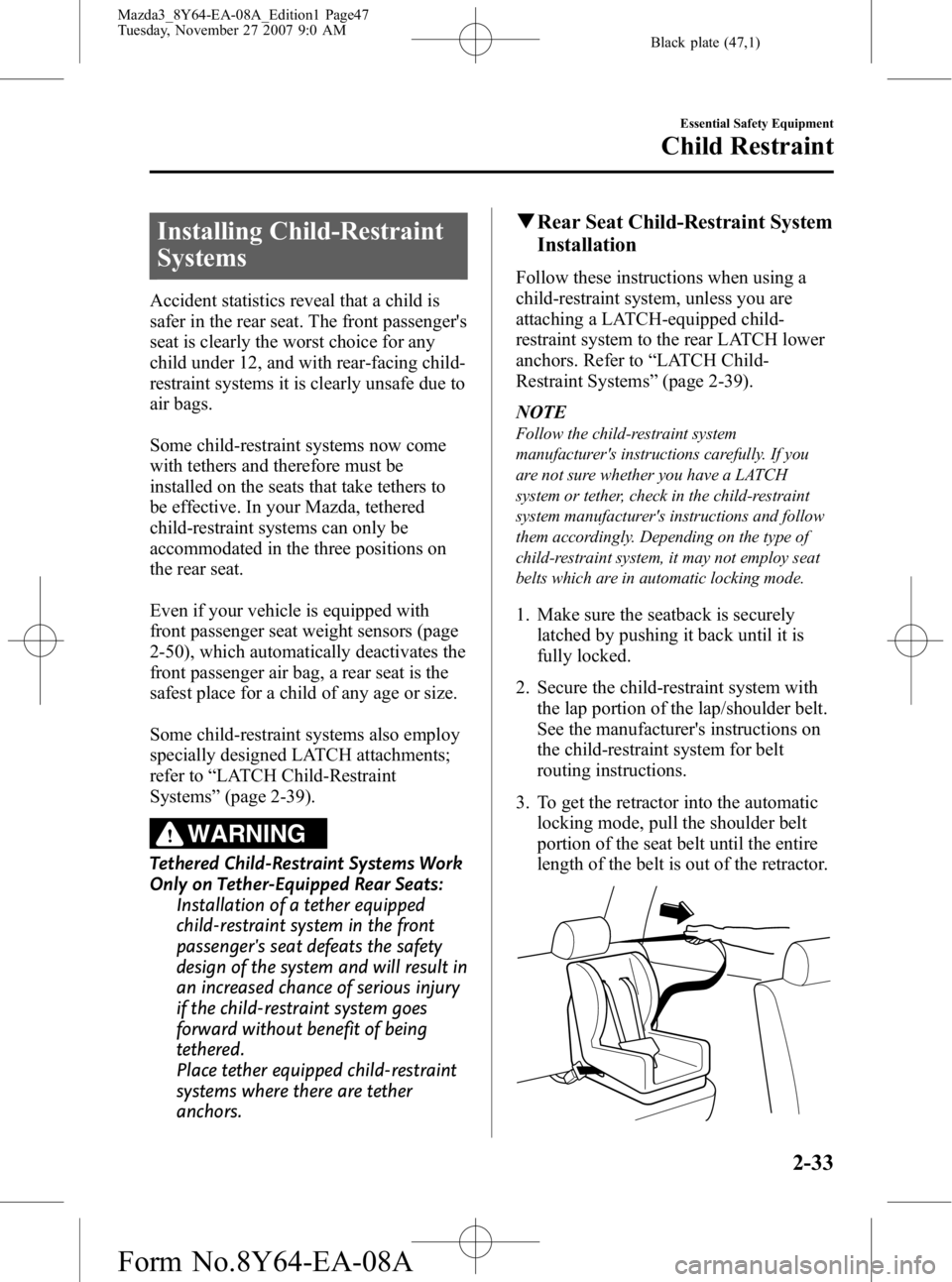
3. To get the retractor into the automatic locking mode, pull the shoulder belt
portion of the seat belt until the entire
length of the belt is out of the retractor.
Essential Safety Equipment
Child Restraint
2-33
Mazda3_8Y64-EA-08A_Edition1 Page47
Tuesday, November 27 2007 9:0 AM
Form No.8Y64-EA-08A
Page 50 of 412
Black plate (50,1)
qIf You Must Use the Front Seat
for Children
If you cannot put all children in the rear
seat, at least put the smallest children in
the rear and be sure the largest child up
front uses the shoulder belt over the
shoulder.
NEVER put a rear-facing child-restraint
system on the front passenger seat, even
with a seat weight sensor equipped
vehicle.
This seat is also not set up for tethered
child-restraint systems, put them in one of
the rear seat positions set up with tether
anchors.
Likewise the LATCH child-restraint
system cannot be secured in the front
passenger's seat and should be used in the
rear seat.
Don't allow anyone to sleep against the
side window if you have an optional side
and curtain air bag, it could cause serious
injuries to an out of position occupant. As
children more often sleep in cars, it is
better to put them in the rear seat. If
installing the child-restraint system on the
front seat is unavoidable, follow these
instructions when using a front-facing
child-restraint system in the front
passenger's seat.
NOTE
lTo check if your front seats have side air
bags:
Mazda vehicles equipped with side air bag
will have a “SRS AIRBAG ”tag on the
outboard shoulder of the front seats.
lTo check if your vehicle has curtain air
bags:
Mazda vehicles equipped with curtain air
bag will have an “SRS AIRBAG ”marking
on the window pillars along the roof edge.
WARNING
Always move the front passenger seat
as far back as possible if installing a
front-facing child-restraint system on it
is unavoidable: As your vehicle has front air bags
and doubly so if your vehicle has side
air bags, a front-facing child-
restraint system should be put on the
front passenger seat only when it is
unavoidable.
Even if the front passenger air bag
deactivation indicator light
illuminates, always move the seat as
far back as possible, because the
force of a deploying air bag could
cause serious injury or death to the
child.
Never use a rear-facing child-restraint
system in the front seat with an air bag
that could deploy: Rear-facing child-restraint systems
on the front seat are particularly
dangerous.
Even in a moderate collision, the
child-restraint system can be hit by a
deploying air bag and moved
violently backward resulting in
serious injury or death to the child.
Even though you may feel assured
that the front passenger air bag will
not deploy based on the fact that the
front passenger air bag deactivation
indicator light illuminates.
2-36
Essential Safety Equipment
Child Restraint
Mazda3_8Y64-EA-08A_Edition1 Page50
Tuesday, November 27 2007 9:0 AM
Form No.8Y64-EA-08A