snow chains MAZDA MODEL 3 5-DOOR 2017 Owners Manual
[x] Cancel search | Manufacturer: MAZDA, Model Year: 2017, Model line: MODEL 3 5-DOOR, Model: MAZDA MODEL 3 5-DOOR 2017Pages: 612
Page 123 of 612
3–47
Before Driving
Driving Tips
Hazardous Driving
WARNING
Be extremely careful if it is necessary to
downshift on slippery surfaces:Downshifting into lower gear
while driving on slippery surfaces is
dangerous. The sudden change in tire
speed could cause the tires to skid. This
could lead to loss of vehicle control
and an accident.
When driving on ice or in water, snow,
mud, sand, or similar hazards:
Be cautious and allow extra distance for
braking. Avoid sudden braking and sudden
maneuvering. Do not pump the brakes. Continue to
press down on the brake pedal.
Refer to Antilock Brake System (ABS)
on page 4-68. If you get stuck, select a lower gear and
accelerate slowly. Do not spin the front
wheels.
For more traction in starting on slippery
surfaces such as ice or packed snow,
use sand, rock salt, chains, carpeting, or
other nonslip material under the front
wheels.
NOTE
Use snow chains only on the front wheels.
Floor Mat
We recommend the use of Genuine
Mazda floor mats.
WARNING
Make sure the floor mats are secured
with the grommets or the retainers to
prevent them from bunching up under
the foot pedals (Driver's side): Using a floor mat that is not secured is
dangerous as it will interfere with the
accelerator and brake pedal operation
(driver's side), which could result in an
accident.
Only use a floor mat which conforms
to the shape of the floor on the driver's
side and make sure it is oriented
correctly.
Secure the floor mat using the
grommets or retainers.
There are various ways to secure floor
mats depending on the type used,
therefore secure the mat according to
the type.
After installing the floor mat, make
sure that it does not slide from side
to side or back and forth, and that
there is sufficient clearance with the
accelerator and brake pedals on the
driver's side.
After removing the floor mat for
cleaning or some other reason, always
securely reinstall it while paying
attention to the precautions just
mentioned.
Mazda3_8FL6-EA-16F_Edition2.indb 472016/08/10 17:35:38
Page 125 of 612
3–49
Before Driving
Driving Tips
Winter Driving
Carry emergency gear, including tire
chains, window scraper, flares, a small
shovel, jumper cables, and a small bag of
sand or salt.
Ask an Authorized Mazda Dealer to check
the following:
Have the proper ratio of antifreeze in the
radiator.
Refer to Engine Coolant on page
6-28. Inspect the battery and its cables. Cold
reduces battery capacity. Use an engine oil appropriate for the
lowest ambient temperatures that the
vehicle will be driven in (page
6-25). Inspect the ignition system for damage
and loose connections. Use washer fluid made with antifreeze—
but do not use engine coolant antifreeze
for washer fluid (page
6-30).
NOTE
(Without electric parking brake)
Do not use the parking brake in freezing
weather as it may freeze. Instead, shift
to P with an automatic transaxle and to
1 or R with a manual transaxle. Block
the rear wheels.
Remove snow before driving. Snow left
on the windshield is dangerous as it
could obstruct vision.
Do not apply excessive for ce to a
window scraper when removing ice or
frozen snow on the mirror glass and
windshield.
Never use warm or hot water for
removing snow or ice from windows and
mirrors as it could result in the glass
cracking.
Drive slowly. Braking performance
can be adversely affected if snow or
ice adheres to the brake components. If
this situation occurs, drive the vehicle
slowly, releasing the accelerator pedal
and lightly applying the brakes several
times until the brake performance
returns to normal.
Snow Tires
Use snow tires on all four wheels
Do not go faster than 120 km/h (75 mph)
while driving with snow tires. Inflate snow
tires 30 kPa (0.3 kgf/cm
2, 4.3 psi) more
than recommended on the tire pressure
label (driver's door frame), but never
more than the maximum cold-tire pressure
shown on the tires.
Mazda3_8FL6-EA-16F_Edition2.indb 492016/08/10 17:35:38
Page 126 of 612
3–50
Before Driving
Driving Tips
Except Mexico (18–inch wheel vehicle)
The vehicle is originally equipped with
all season radials designed to be used all
year around. In some extreme climates you
may find it necessary to replace them with
snow tires during the winter months to
further improve traction on snow and ice
covered roads.
Mexico (18–inch wheel vehicle)
The vehicle is originally equipped with
summer tires designed for optimum
traction on wet and dry roads. If your
vehicle is to be used on snow and ice
covered roads, Mazda recommends that
you replace the tires originally equipped
on your vehicle with snow tires during the
winter months.
WARNING
Use only the same size and type tires
(snow, radial, or non-radial) on all four
wheels:Using tires different in size or type is
dangerous. Your vehicle's handling
could be greatly affected and result in
an accident.
CAUTION
Check local regulations before using
studded tires.
Tire Chains
Check local regulations before using tire
chains.
CAUTION
Chains may a ffect handling. Do not go faster than 50 km/h (30 mph)
or the chain manufacturer's
recommended limit, whichever is lower.
Drive carefully and avoid bumps, holes,
and sharp turns. Avoid locked-wheel braking. Do not use chains on a temporary spare
tire; it may result in damage to the
vehicle and to the tire.
Do not use chains on roads that are free
of snow or ice. The tires and chains could
be damaged.
Chains may scr atch or chip aluminum
wheels.
NOTE
The tire pressure monitoring system may
not function correctly when using tire
chains.
Install the chains on the front tires only.
Do not use chains on the rear tires.
Please consult an Authorized Mazda
Dealer.
Installing the chains
1. If your vehicle is equipped with wheel
covers remove them, otherwise the
chain bands will scratch them.
2. Secure the chains on the front tires as
tightly as possible.
Always follow the chain manufacturer's
instructions.
3. Retighten the chains after driving
1/2—1 km (1/4—1/2 mile).
Mazda3_8FL6-EA-16F_Edition2.indb 502016/08/10 17:35:39
Page 199 of 612
4–69
When Driving
ABS/TCS/DSC
Traction Control System
(TCS)
The Traction Control System (TCS)
enhances traction and safety by controlling
engine torque and braking. When the TCS
detects driving wheel slippage, it lowers
engine torque and operates the brakes to
prevent loss of traction.
This means that on a slick surface, the
engine adjusts automatically to provide
optimum power to the drive wheels,
limiting wheel spin and loss of traction.
The warning light turns on when the
system has a malfunction.
Refer to Warning Lights on page
4-24.
WARNING
Do not rely on the Traction Control
System (TCS) as a substitute for safe
driving:The Traction Control System (TCS)
cannot compensate for unsafe and
reckless driving, excessive speed,
tailgating (following another vehicle
too closely), and hydroplaning
(reduced tire friction and road contact
because of water on the road surface).
You can still have an accident.
Use snow tires or tire chains and drive at
reduced speeds when roads are covered
with ice and/or snow: Driving without proper traction devices
on snow and/or ice-covered roads
is dangerous. The Traction Control
System (TCS) alone cannot provide
adequate traction and you could still
have an accident.
NOTE
To turn off the TCS, press the DSC OFF
switch (page
4-71).
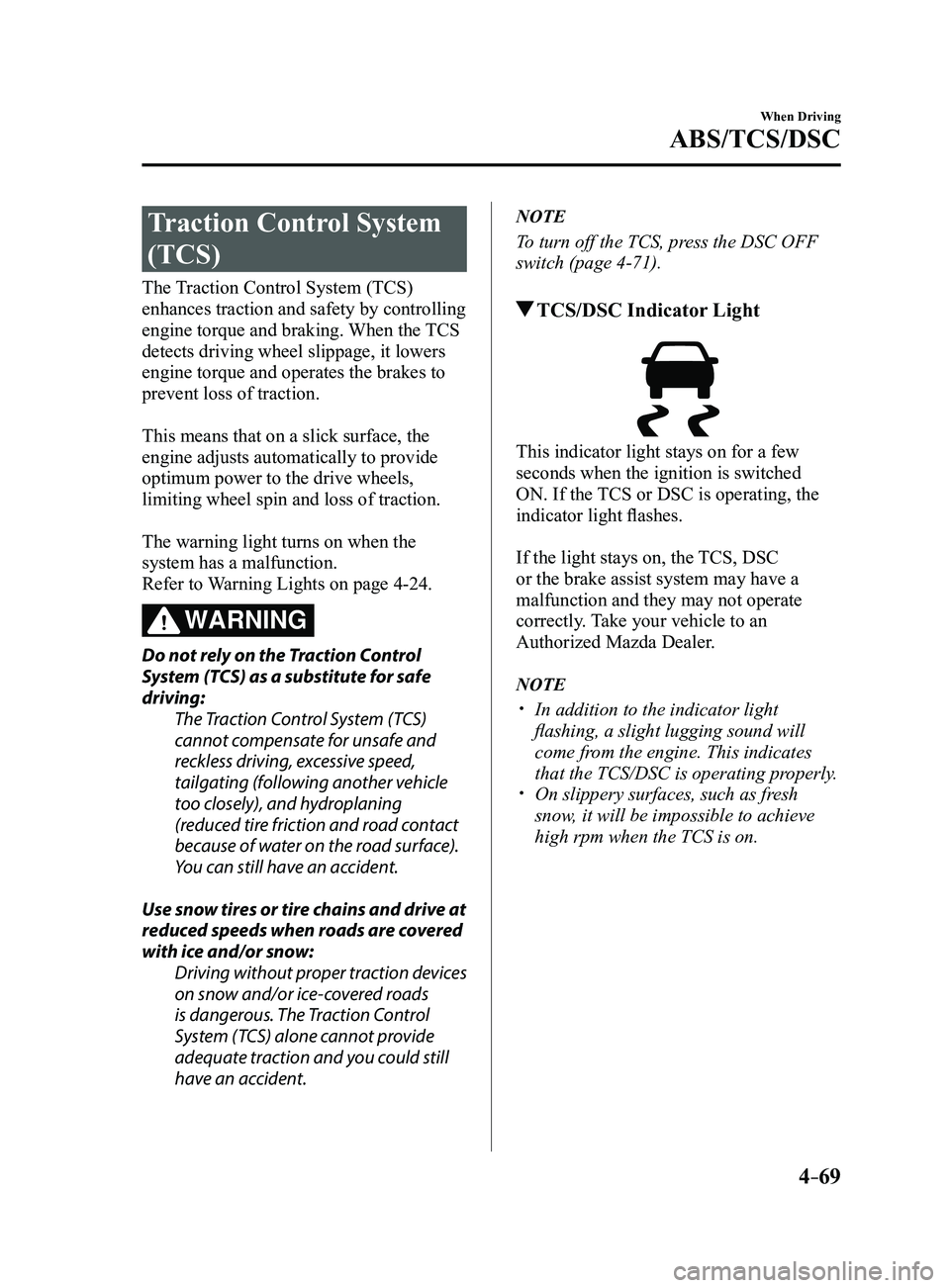
TCS/DSC Indicator Light
This indicator light stays on for a few
seconds when the ignition is switched
ON. If the TCS or DSC is operating, the
indicator light flashes.
If the light stays on, the TCS, DSC
or the brake assist system may have a
malfunction and they may not operate
correctly. Take your vehicle to an
Authorized Mazda Dealer.
NOTE
In addition to the indicator light
flashing, a slight lugging sound will
come from the engine. This indicates
that the TCS/DSC is operating properly.
On slippery surfaces, such as fr esh
snow, it will be impossible to achieve
high rpm when the TCS is on.
Mazda3_8FL6-EA-16F_Edition2.indb 692016/08/10 17:36:29
Page 269 of 612
4–139
When Driving
i-ACTIVSENSE
In the following cases, the Forward Sensing Camera (FSC) may not be able to detect
target objects correctly.
Under bad weather condition, such as rain, fog and snow . The window washer is being used or the windshield wipers ar e not used when it's
raining. Ice, fog, snow, frost, rainfall, dirt, or foreign matter such as a plastic bag is stuck on
the windshield. Trucks with low loading platforms and vehicles with an extremely low or high profile. When driving next to walls with no patterning (including fences and lon\
gitudinally
striped walls). The taillights of the vehicle ahead ar e turned off. A vehicle is outside the illumination range of the headlights. The vehicle is making a sharp turn, or ascending or descending a steep s\
lope. Entering or exiting a tunnel. Heavy luggage is loaded causing the vehicle to tilt. Strong light is shone at the front of the vehicle (back light or high-beam light from on-
coming vehicles). There are many light emitters on the vehicle ahead. When the vehicle ahead is not equipped with taillights or the taillights\
ar e turned off at
nighttime. Elongated luggage or cargo is loaded onto installed roof rails and covers the Forward
Sensing Camera (FSC). Exhaust gas from the vehicle in front, sand, snow, and water vapor rising from
manholes and grating, and water splashed into the air. When towing a malfunctioning vehicle. The vehicle is driven with tir es having significantly different wear. The vehicle is driven on down slopes or bumpy r oads. There are water puddles on the road. The surroundings are dark such as during the night, early evening, or early morning,
or in a tunnel or indoor parking lot. The illumination brightness of the headlights is r educed or the headlight illumination
is weakened due to dirt or a deviated optical axis. The target object enters the blind spot of the Forward Sensing Camera (FSC). A person or object bursts onto the road from the shoulder or cuts right in front of you. You change lanes and approach a vehicle ahead. When driving extremely close to the target object. Tire chains or a temporary spare tire is installed. The vehicle ahead has a special shape. For example, a vehicle towing a t\
railer house
or a boat, or a vehicle carrier carrying a vehicle with its front pointed rearward.
Mazda3_8FL6-EA-16F_Edition2.indb 1392016/08/10 17:36:59
Page 283 of 612
4–153
When Driving
Tire Pressure Monitoring System
NOTE
Because this system detects slight changes in tire conditions, the timing of the warning may
be faster or slower in the following cases:
The size, manufacturer, or the type of tires is different from the specification. The size, manufacturer, or the type of a tire is different from the others, or the level of tire
wear is excessively different between them. A run-flat tire, studless tire, snow tire, or tire chains are used. An emergency tire is used (The tire pressure monitoring system warning light may flash
and then continue illuminating). A tire is repaired using the emergency flat tire repair kit. The tire pressure is excessively higher than the specified pressure, or the tire pressure is
suddenly lowered for some reason such as a tire burst during driving. The vehicle speed is lower than about 15 km/h (9.3 mph) (including wh\
en the vehicle is
stopped), or the drive period is shorter than 5 minutes. The vehicle is driven on an extr emely rough road or a slippery, icy road. Hard steering and rapid acceleration/deceleration are repeated such as during aggressive
driving on a winding road. Load on the vehicle is applied to a tir e such as by loading heavy luggage to one side of
the vehicle. System initialization has not been implemented with the specifie d tire pressure.
Mazda3_8FL6-EA-16F_Edition2.indb 1532016/08/10 17:37:04
Page 285 of 612

4–155
When Driving
Rear View Monitor
*Some models.
Rear View Monitor*
The rear view monitor provides visual images of the rear of the vehicle \
when reversing.
WARNING
Always drive carefully confirming the safety of the rear and the surrounding conditions
by looking directly with your eyes:Reversing the vehicle by only looking at the screen is dangerous as it may cause an
accident or a collision with an object. The rear view monitor is only a visual assist device
when reversing the vehicle. The images on the screen may be different from the actual
conditions.
CAUTION
Do not use the rear view monitor under the following conditions: Using the rear view
monitor under the following conditions is dangerous and could result in injury or vehicle
damage or both.
Icy or snow-covered roads. Tire chains or a temporary spare tire is installed. The liftgate/trunk lid is not fully closed. The vehicle is on a road incline.
When the display is cold, images may course across the monitor or the screen and may be
dimmer than usual, which could cause difficulty in confirming the surrounding conditions
of the vehicle. Always drive carefully confirming the safety of the rear and the surrounding
conditions by looking directly with your eyes.
Do not apply excessive force to the camera. The camera position and angle may deviate. Do not disassemble, modify, or remove it as it may no longer be waterproof. The camera cover is made of plastic. Do not apply degreasing agents, organic solvents,
wax, or glass coating agents to the camera cover. If any are spilled on the cover, wipe off
with a soft cloth immediately.
Do not rub the camera cover forcefully with an abrasive or hard brush. The camera cover or
lens may be scratched which might affect the images.
Mazda3_8FL6-EA-16F_Edition2.indb 1552016/08/10 17:37:05
Page 610 of 612
10–8
Spare Tire ..............................................7-5
Specifications
........................................9-4
Speed Unit Selector
.............................4-14
Speedometer
........................................4-14
Starting the Engine
................................4-5
Steering Wheel
....................................3-33
Horn ............................................... 4-56
Storage Compartments
......................5-117
Center console
.............................5-118
Glove compartment
.....................5-117
Overhead console
........................5-117
Rear coat hooks
...........................5-119
Sunshade
.............................................3-41
Sunvisors
...........................................5-110
T
Tachometer ..........................................4-16
Theft-Deterrent System
.......................3-44
Tiedown Hook
..............................................7-23
Tire Information
..................................8-25
Tire Pressure Monitoring System
.....4-151
Tire inflation pressure warning beep
...7-41
Tires
....................................................6-41
Flat Tire
...........................................7-3
Replacing a Tire
............................6-43
Replacing a Wheel
........................6-44
Snow tires
......................................3-49
Specifications
................................9-10
Temporary Spare Tire
....................6-43
Tire Inflation Pressure
...................6-41
Tire Rotation
.................................6-42
Tire chains
.....................................3-50
Uniform tire quality grading system
(UTQGS)
.......................................8-23
Towing Recreational towing
......................3-53
Trailer Towing
...............................3-53
Towing Description
.............................7-22
Traction Control System (TCS)
..........4-69
TCS/DSC Indicator Light
.............4-69 Traffic Sign Recognition System
(TSR)................................................... 4-94
Transmitter
............................................3-5
Trip Computer
.....................................4-19
Trip Meter
...........................................4-14
Trouble Battery runs out
.............................7-16
Emergency Starting
.......................7-19
Emergency Towing ........................7-22
Flat Tire
...........................................7-3
Overheating
...................................7-20
Parking in an Emergency
................7-2
When liftgate/trunk lid cannot be
opened
...........................................7-44
Trunk Lid
............................................3-21
Inside trunk release lever
..............3-26
When liftgate/trunk lid cannot be
opened
...........................................7-44
V
Vanity Mirrors ...................................5-110
Vehicle Information Labels
...................9-2
Index
Mazda3_8FL6-EA-16F_Edition2.indb 82016/08/10 17:39:58