deactivate MAZDA MODEL 3 5-DOOR 2018 Owners Manual
[x] Cancel search | Manufacturer: MAZDA, Model Year: 2018, Model line: MODEL 3 5-DOOR, Model: MAZDA MODEL 3 5-DOOR 2018Pages: 624, PDF Size: 59.23 MB
Page 31 of 624
(With Front Passenger Occupant
Classification System)
In addition, the pretensioner system for the
front passenger, like the front and side
passenger air bag, is designed to only
deploy when the front passenger occupant
classification sensor detects a passenger
sitting on the front passenger's seat.
For details, refer to the front passenger
occupant classification sensor (page 2-
61).
Load limiter:
The load limiting system releases belt
webbing in a controlled manner to reduce
belt force on the occupant's chest. While
the most severe load on a seat belt occurs
in frontal collisions, the load limiter has an
automatic mechanical function and can
activate in any accident mode with
sufficient occupant movement.
Even if the pretensioners have not fired,
the load limiting function must be checked
by an Authorized Mazda Dealer.
WA R N I N G
Wear seat belts only as recommended in
this owner's manual:
Incorrect positioning of the driver and front
passenger seat belts is dangerous. Without
proper positioning, the pretensioner and
load limiting systems cannot provide
adequate protection in an accident and
this could result in serious injury. For more
details about wearing seat belts, refer to
"Fastening the seat belts" (page 2-15).
Have your seat belts changed immediately
if the pretensioner or load limiter has been
expended:
Always have an Authorized Mazda Dealer
immediately inspect the seat belt
pretensioners and air bags after any
collision. Like the air bags, the seat belt
pretensioners and load limiters will only
function once and must be replaced after
any collision that caused them to deploy. A
seat belt with an expended pretensioner or
load limiter is still better than wearing no
seat belt at all; however, if the seat belt
pretensioners and load limiters are not
replaced, the risk of injury in a collision will
increase.
Do not modify the components or wiring,
or use electronic testing devices on the
pretensioner system:
Modifying the components or wiring of the
pretensioner system, including the use of
electronic testing devices is dangerous. You
could accidentally activate it or make it
inoperable which would prevent it from
activating in an accident. The occupants or
repairers could be seriously injured.
Properly dispose of the pretensioner
system:
Improper disposal of the pretensioner
system or a vehicle with non-deactivated
pretensioners is dangerous. Unless all
safety procedures are followed, injury could
result. Have an Authorized Mazda Dealer
safely dispose of the pretensioner system or
scrap a pretensioner system equipped
vehicle.
Essential Safety Equipment
Seat Belt Systems
2-17
Mazda3_8GE4-EA-17F_Edition1 2017-4-7 11:59:21
Page 34 of 624

Child-Restraint Precautions
Mazda strongly urges the use of child-restraint systems for children small enough to use
them.
You are required by law to use a child-restraint system for children in the U.S. and Canada.
Check your local and state or provincial laws for specific requ irements regarding the safety
of children riding in your vehicle.
Whatever child-restraint system you consider, please pick the a ppropriate one for the age
and size of the child, obey the law and follow the instructions that come with the individual
child-restraint system.
A child who has outgrown child-r estraint systems should sit in the rear and use seat belts,
both lap and shoulder. If the shoulder belt crosses the neck or face, move the child closer to
the center of the vehicle in the outboard seats, and towards the buckle on the right if the
child is seated on the center seat.
Statistics confirm that the rear seat is the best place for all children up to 12 years of age,
and more so with a supplemental restraint system (air bags).
A rear-facing child-restraint system should NEVER be used on the front seat with the air
bag system activated. The front passenger's seat is also the le ast preferred seat for other
child-restraint systems.
(With Front Passenger Occupa nt Classification System)
To reduce the chance of injuries caused by deployment of the fr ont passenger air bag, the
front passenger occupant classification sensor works as a part of the supplemental restraint
system. This system deactivates the front passenger front and side air bags and also the front
passenger seat belt pretensioner system when the front passenge r air bag deactivation
indicator light illuminates.
When an infant or small child sits on the front passenger seat, the system shuts off the front
passenger front and side air bags and seat belt pretensioner sy stem, so make sure the front
passenger air bag deactivation indicator light illuminates.
Even if the front passenger air bag is shut off, Mazda strongly recommends that children be
properly restrained and child-rest raint systems of all kinds are properly secured on the rear
seats which are the best place for children.
For more details, refer to "Front passenger occupant classification sensor" (page 2-61).
Essential Safety Equipment
Child-Restraint
2-20
Mazda3_8GE4-EA-17F_Edition1 2017-4-7 11:59:21
Page 45 of 624

Installing Child-RestraintSystems
Accident statistics reveal that a child is
safer in the rear seat . The front passenger's
seat is clearly the worst choice for any
child under 12, and with rear-facing
child-restraint systems it is clearly unsafe
due to air bags.
NOTE
Even if your vehicle is equipped with front
passenger occupant classification sensor
(page 2-61), which automatically
deactivates the front passenger air bag, a
rear seat is the safest place for a child of
any age or size.
Some child-restraint systems now come
with tethers and therefore must be
installed on the seats that take tethers to be
effective. In your Mazda, tethered
child-restraint systems can only be
accommodated in the three positions on
the rear seat.
Some child-restraint systems also employ
specially designed LATCH attachments;
refer to "Using LATCH Lower Anchor"
(page 2-40).
WA R N I N G
Tethered Child-Restraint Systems Work
Only on Tether-Equipped Rear Seats:
Installation of a tether equipped
child-restraint system in the front
passenger's seat defeats the safety design
of the system and will result in an increased
chance of serious injury if the
child-restraint system goes forward
without benefit of being tethered.
Place tether equipped child-restraint
systems where there are tether anchors.
Essential Safety Equipment
Child-Restraint
2-31
Mazda3_8GE4-EA-17F_Edition1 2017-4-7 11:59:21
Page 75 of 624

Front Passenger Occupant Classification System*
First, please read "Supplemental Restraint System (SRS) Precautions" (page 2-44) carefully.
▼Front Passenger Occupant Classification Sensor
Your vehicle is equipped with a front passenger occupant classi
fication sensor as a part of
the supplemental restraint system. This sensor is equipped in t he front passenger's seat
cushion. This sensor measures th e electrostatic capacity of the front passenger's seat. The
SAS unit is designed to prevent the front passenger front and s ide air bags and seat belt
pretensioner system from deployi ng if the front passenger air bag deactivation indicator
light turns on.
To reduce the chance of injuries caused by deployment of the front passenger air bag, the
system deactivates the front passenger front and side air bags and also the seat belt
pretensioner system when the front passenger air bag deactivati on indicator light turns on.
Refer to the following table for the front passenger air bag deactivation indicator light
illumination conditions.
This system shuts off the front passenger front and side air ba gs and seat belt pretensioner
system, so make sure the front passenger air bag deactivation indicator light turns on
according to the following table.
The air bag/front seat belt pretensioner system warning light f lashes and the front passenger
air bag deactivation indicator light illuminates if the sensors have a possible malfunction. If
this happens, the front passenger front and side air bags and s eat belt pretensioner system
will not deploy.
Front passenger air bag deactivation indicator light
This indicator light turns on to r emind you that the front passenger front and side air bags
and seat belt pretensioner will not deploy during a collision.
If the front passenger occupant classification sensor is normal, the indicator light turns on
when the ignition is switched ON. The light turns off after a f ew seconds. Then, the
indicator light turns on or is off under the following conditio ns:
Essential Safety Equipment
SRS Air Bags
*Some models.2-61
Mazda3_8GE4-EA-17F_Edition1 2017-4-7 11:59:21
Page 76 of 624

Front passenger air bag deactivation indicator light on/off condition chart
Condition detected by the front
passenger occupant classifica- tion system Front passenger air
bag deactivation indi- cator light Front passenger front
and side air bags Front passenger seat
belt pretensioner sys- tem
Empty (Not occupied) On Deactivated Deactivated
A child less than 1 year old is
seated in a child-restraint system On Deactivated Deactivated
Child
*1On or off Deactivated or ready Deactivated or ready
Adult
*2Off Ready Ready
*1 The occupant classification sens or may not detect a child seated on the seat, in a child-restraint system, or a
junior seat depending on the ch ild's physical size and seated posture.
*2 If a smaller adult sits on the front passenger seat, the sensors might detect the person as being a child
depending on the person's physique.
The curtain air bag is ready for inflating regardless of what the front passenger air bag
deactivation indicator light on/off condition chart indicates.
If the front passenger air bag deactivation indicator light doe s not turn on when the ignition
is switched ON and does not turn on as indicated in the front p assenger air bag deactivation
indicator light on/off condition chart, do not allow an occupan t to sit in the front passenger
seat and consult an Authorized M azda Dealer as soon as possible. The system may not work
properly in an accident.
WA R N I N G
Do not allow an occupant in the front passenger's seat to sit with a posture which makes it
difficult for the front passenger occupant classification sensor to detect the occupant
correctly:
Sitting in the front passenger's seat with a posture which makes it difficult for the front
passenger occupant classification sensor to detect the occupant correctly is dangerous. If the
front passenger occupant classification sensor cann ot detect the occupant sitting on the front
passenger's seat correctly, the front passenger front and side air bags and pretensioner system
may not operate (non-deploy) or they may oper ate (deploy) accidentally. The front passenger
will not have the supplementary protection of the air bags or the accidental operation
(deployment) of the air bags could result in serious injury or death.
Under the following conditions, the front passe nger occupant classification sensor cannot
detect a passenger sitting on the front pa ssenger's seat correctly and the deployment/
non-deployment of the air bags cannot be controlled as indicated in the front passenger air
bag deactivation indicator light on/off condition chart. For example:
Essential Safety Equipment
SRS Air Bags
2-62
Mazda3_8GE4-EA-17F_Edition1 2017-4-7 11:59:21
Page 78 of 624
The front passenger front and side air bags and seat belt pretensioner systems will deactivate
if the front passenger air bag deactivation indicator light turns on.
CAUTION
To assure proper deployment of the front air bag and to prevent damage to the sensor in
the front seat cushion:
Do not place sharp objects on the front seat cushion or leave heavy luggage on them.
Do not spill any liquids on the front seats or under the front seats.
To allow the sensors to function pr operly, always perform the following:
Adjust the front seats as far back as possibl e and always sit upright against the seatbacks
with seat belts worn properly.
If you place your child on the front passenger seat, secure the child-restraint system
properly and slide the fron t passenger seat as far back as possible (page 2-33).
NOTE
The system requires about 10 seconds to alte rnate between turning the front passenger
front and side air bags and seat belt pretensioner system on or off.
The front passenger air bag deactivation indicato r light may turn on repeatedly if luggage
or other items are put on the front passenger seat, or if the temperature of the vehicle's
interior changes suddenly.
The front passenger air bag deactivation indicato r light may turn on for 10 seconds if the
electrostatic capacity on the front passenger seat changes.
The air bag/front seat belt pretensioner system warning light might turn on if the front
passenger seat receives a severe impact.
If the front passenger air bag deactivation indicator light does not turn on after installing
a child-restraint system on the front passenger seat, first, re-install your child-restraint
system according to the procedure in this owner's manual. Then, if the front passenger air
bag deactivation indicator light still does not tu rn on, install the child-restraint system on
the rear seat and consult an Authorized Mazda Dealer as soon as possible.
If the front passenger air bag deactivation i ndicator light turns on when an occupant is
seated directly in the front passenger seat, have the passenger re-adjust their posture by
sitting with their feet on the floor, and th en re-fastening the seat belt. If the front
passenger air bag deactivation i ndicator light remains turned on, move the passenger to
the rear seat. If sitting in the rear seat is no t possible, slide the front passenger seat as far
back as possible. Consult an Authorized Mazda Dealer as soon as possible.
Essential Safety Equipment
SRS Air Bags
2-64
Mazda3_8GE4-EA-17F_Edition1 2017-4-7 11:59:21
Page 89 of 624
Advanced Keyless EntrySystem
*
WA R N I N G
Radio waves from the key may affect
medical devices such as pacemakers:
Before using the key near people who use
medical devices, ask the medical device
manufacturer or your physician if radio
waves from the key will affect the device.
The advanced keyless function allows you
to lock/unlock the door and the liftgate, or
open the liftgate/trunk lid while carrying
the key.
System malfunctions or warnings are
indicated by the foll owing warning beeps.
Request switch Inoperable Warning
Beep
Refer to Request Switch Inoperable
Warning Beep (With the advanced
keyless function) on page 7-39.
Key Left-in-luggage Compartment/
Trunk Warning Beep
Refer to Key Left-in-luggage
Compartment/Trunk Warning Beep
(With the advanced keyless function) on
page 7-40.
Key Left-in-vehicle Warning Beep
Refer to Key Left-in-vehicle Warning
Beep (With the advanced keyless
function) on page 7-40.
NOTE
The advanced keyless entry system
functions can be deactivated to prevent
any possible adverse effect on a user
wearing a pacemaker or other medical
device. If the system is deactivated, you
will be unable to start the engine by
carrying the key. Consult an Authorized
Mazda Dealer for details. If the advanced
keyless entry system has been deactivated,
you can start the engine by following the
procedure indicated when the key battery
goes dead.
Refer to Engine Start Function When Key
Battery is Dead on page 4-8.
Before Driving
Advanced Keyless Entry System
*Some models.3-9
Mazda3_8GE4-EA-17F_Edition1 2017-4-7 11:59:21
Page 123 of 624
Theft-Deterrent System*
If the theft-deterrent system detects an
inappropriate entry in to the vehicle, which
could result in the veh icle or its contents
being stolen, the alarm alerts the
surrounding area of an abnormality by
sounding the horn and flashing the hazard
warning lights.
The system will not function unless it's
properly armed. So when you leave the
vehicle, follow the arming procedure
correctly.
▼ Operation
System triggering conditions
The horn sounds intermittently and the
hazard warning lights flash for about 30
seconds when the system is triggered by
any one of the following:
Unlocking a door with the auxiliary key,
door lock switch, or an inside door-lock
knob.
Forcing open a door, the hood or the
liftgate/trunk lid.
Opening the hood by operating the hood
release handle.
Switching the ignition ON without using
the push button start.
If the system is triggered again, the lights
and horn will activat e until the driver's
door is unlocked wit h the transmitter.
(With the advanced keyless function)
The lights and horn can also be
deactivated by pressing the request switch
on a door.
NOTE
If the battery goes dead while the
theft-deterrent system is armed, the horn
will activate and the hazard warning
lights will flash when the battery is
charged or replaced.
▼ How to Arm the System
1. Close the windows and the moonroof*
securely.
2. Switch the ignition OFF.
3. Make sure the hood, the doors, and the liftgate/trunk lid are closed.
4. Press the lock button on the transmitter or lock the driver's door from the
outside with the auxiliary key.
The hazard warning lights will flash
once.
The following method will also arm
the theft-deterrent system:
Press the door-lock switch “
” while
any door is open and then close all of
the doors.
(With the advanced keyless function)
Press a request switch.
The security indicator light in the
instrument cluster flashes twice per
second for 20 seconds.
5. After 20 seconds, the system is fully
armed.
Before Driving
Security System
*Some models.3-43
Mazda3_8GE4-EA-17F_Edition1 2017-4-7 11:59:21
Page 137 of 624

ON
This is the normal running position after
the engine is started. The indicator light
(amber) turns off. (The indicator light
(amber) illuminates when the ignition is
switched ON and the engine is not
running.)
Some indicator lights/warning lights
should be inspected before the engine is
started (page 4-23).
NOTE
When the push button start is pressed to
ON, the sound of the fuel pump motor
operating near the fuel tank can be heard.
This does not indi cate an abnormality.
Starting the Engine
WA R N I N G
Radio waves from the key may affect
medical devices such as pacemakers:
Before using the key near people who use
medical devices, ask the medical device
manufacturer or your physician if radio
waves from the key will affect the device.
NOTE
The key must be carried because the key
carries an immobilizer chip that must
communicate with the engine controls at
short range.
The engine can be started when the push
button start is pressed from off, ACC, or
ON.
The push button start system functions
(function which can start the engine by
only carrying the key) can be
deactivated to prevent any possible
adverse effect on a user wearing a
pacemaker or other medical device. If
the system is deactivated, you will be
unable to start the engine by carrying
the key. Consult an Authorized Mazda
Dealer for details. If the push button
start system functions have been
deactivated, you can start the engine by
following the procedure indicated when
the key battery goes dead.
Refer to Engine Start Function When
Key Battery is Dead on page 4-8.
When Driving
Start/Stop Engine
4-5
Mazda3_8GE4-EA-17F_Edition1 2017-4-7 11:59:21
Page 179 of 624
The headlights turn off if the lever is
pulled again while the headlights are
illuminated.
▼Leaving Home Light
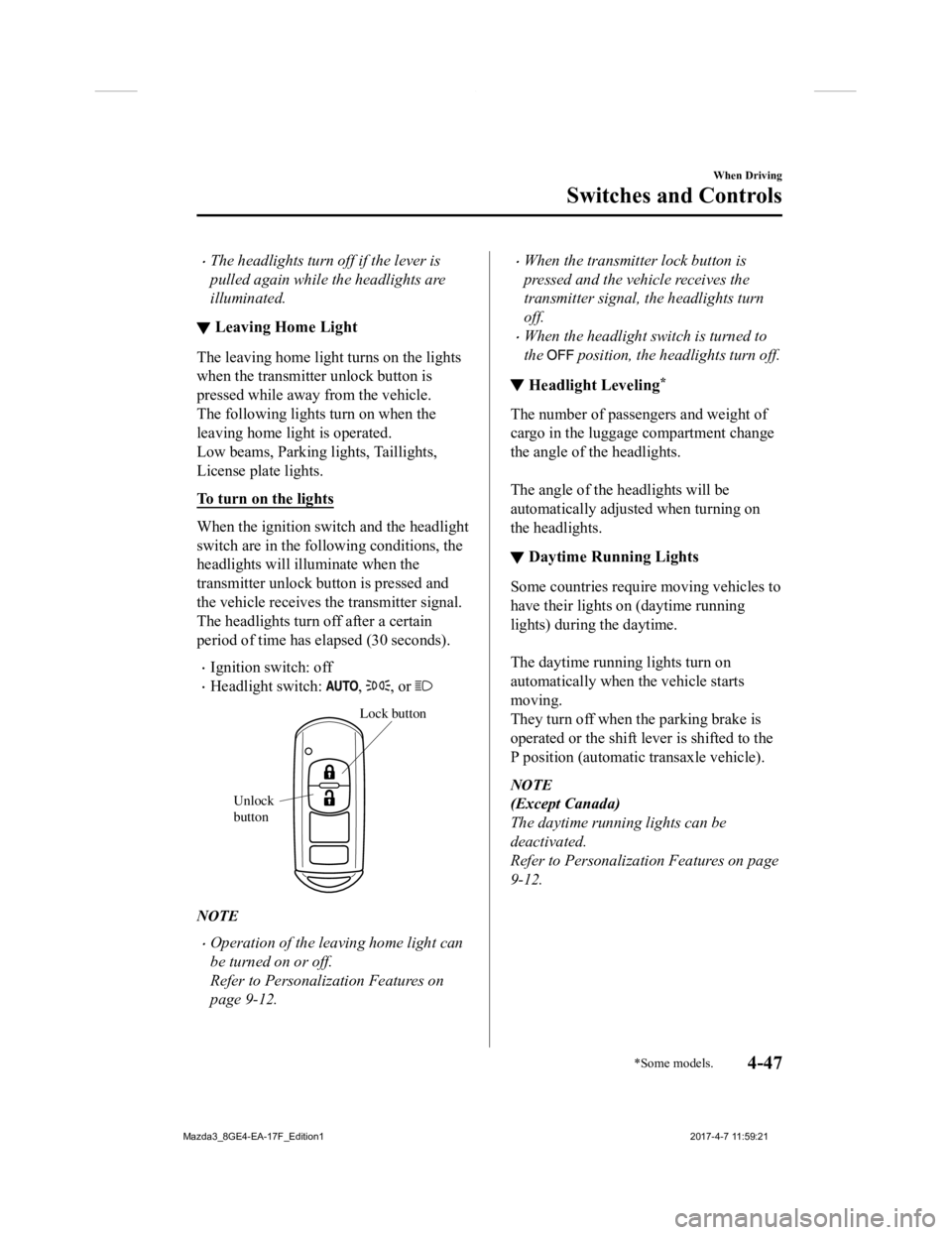
The leaving home light turns on the lights
when the transmitter unlock button is
pressed while away from the vehicle.
The following lights turn on when the
leaving home light is operated.
Low beams, Parking lights, Taillights,
License plate lights.
To turn on the lights
When the ignition swi
tch and the headlight
switch are in the following conditions, the
headlights will illuminate when the
transmitter unlock button is pressed and
the vehicle receives the transmitter signal.
The headlights turn off after a certain
period of time has elapsed (30 seconds).
Ignition switch: off
Headlight switch: , , or
Lock button
Unlock
button
NOTE
Operation of the leaving home light can
be turned on or off.
Refer to Personalization Features on
page 9-12.
When the transmitter lock button is
pressed and the vehicle receives the
transmitter signal, the headlights turn
off.
When the headlight switch is turned to
the
position, the headlights turn off.
▼ Headlight Leveling*
The number of passengers and weight of
cargo in the luggage compartment change
the angle of the headlights.
The angle of the headlights will be
automatically adjusted when turning on
the headlights.
▼Daytime Running Lights
Some countries require moving vehicles to
have their lights on (daytime running
lights) during the daytime.
The daytime running lights turn on
automatically when the vehicle starts
moving.
They turn off when the parking brake is
operated or the shift lever is shifted to the
P position (automatic transaxle vehicle).
NOTE
(Except Canada)
The daytime running lights can be
deactivated.
Refer to Personalization Features on page
9-12.
When Driving
Switches and Controls
*Some models.4-47
Mazda3_8GE4-EA-17F_Edition1
2017-4-7 11:59:21