parking brake MAZDA MODEL 3 HATCHBACK 2009 (in English) User Guide
[x] Cancel search | Manufacturer: MAZDA, Model Year: 2009, Model line: MODEL 3 HATCHBACK, Model: MAZDA MODEL 3 HATCHBACK 2009Pages: 412, PDF Size: 4.87 MB
Page 162 of 412
Black plate (162,1)
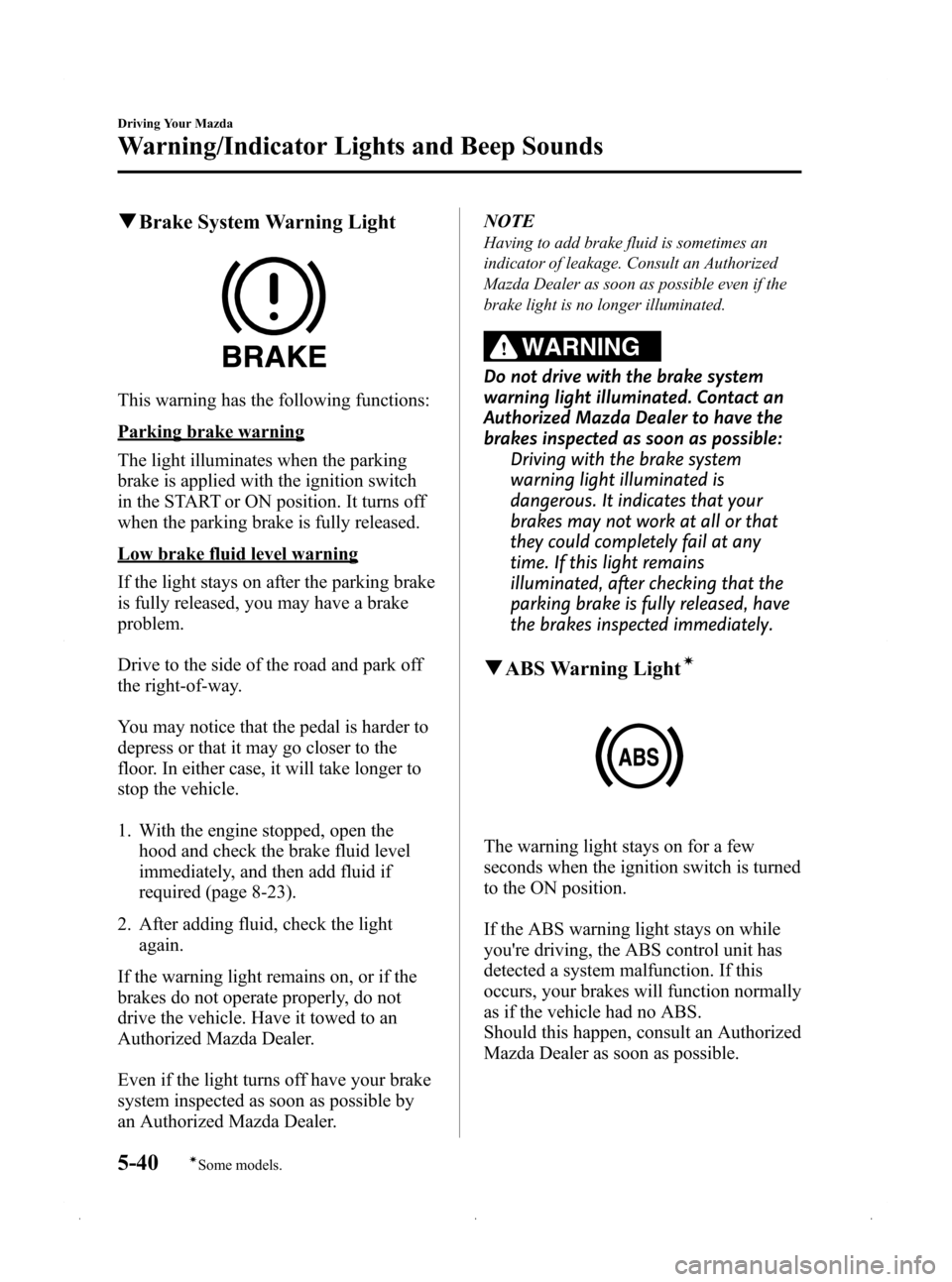
qBrake System Warning Light
This warning has the following functions:
Parking brake warning
The light illuminates when the parking
brake is applied with the ignition switch
in the START or ON position. It turns off
when the parking brake is fully released.
Low brake fluid level warning
If the light stays on after the parking brake
is fully released, you may have a brake
problem.
Drive to the side of the road and park off
the right-of-way.
You may notice that the pedal is harder to
depress or that it may go closer to the
floor. In either case, it will take longer to
stop the vehicle.
1. With the engine stopped, open the
hood and check the brake fluid level
immediately, and then add fluid if
required (page 8-23).
2. After adding fluid, check the light again.
If the warning light remains on, or if the
brakes do not operate properly, do not
drive the vehicle. Have it towed to an
Authorized Mazda Dealer.
Even if the light turns off have your brake
system inspected as soon as possible by
an Authorized Mazda Dealer. NOTE
Having to add brake fluid is sometimes an
indicator of leakage. Consult an Authorized
Mazda Dealer as soon as possible even if the
brake light is no longer illuminated.
WARNING
Do not drive with the brake system
warning light illuminated. Contact an
Authorized Mazda Dealer to have the
brakes inspected as soon as possible:
Driving with the brake system
warning light illuminated is
dangerous. It indicates that your
brakes may not work at all or that
they could completely fail at any
time. If this light remains
illuminated, after checking that the
parking brake is fully released, have
the brakes inspected immediately.
qABS Warning Lightí
The warning light stays on for a few
seconds when the ignition switch is turned
to the ON position.
If the ABS warning light stays on while
you're driving, the ABS control unit has
detected a system malfunction. If this
occurs, your brakes will function normally
as if the vehicle had no ABS.
Should this happen, consult an Authorized
Mazda Dealer as soon as possible.
5-40
Driving Your Mazda
íSome models.
Warning/Indicator Lights and Beep Sounds
Mazda3_8Z87-EA-08F_Edition1 Page162
Monday, May 19 2008 9:57 AM
Form No.8Z87-EA-08F
Page 176 of 412
Black plate (176,1)
Without turbocharger
Front seatRear
seat Load
Switch
Position
Driver Passenger
× ――― 0
×× ――0
×× × ―1
×× ×× 2
× ―― ×3
×: Yes
― :No
With turbocharger
Front seat
Rear
seat LoadSwitch
Position
Driver Passenger
× ――― 0
×× ――0
××× ―1
××××1
× ―― ×2
×: Yes
― :No
qDaytime Running Lights (Canada)
In Canada, vehicles must be driven with
the headlights on during daytime
operation.
For that reason, the daytime running lights
automatically turn on when the ignition
switch is turned to the ON position.
NOTE
The Daytime Running Lights turn off when the
parking brake is applied.
Turn and Lane-Change
Signals
q Turn Signal
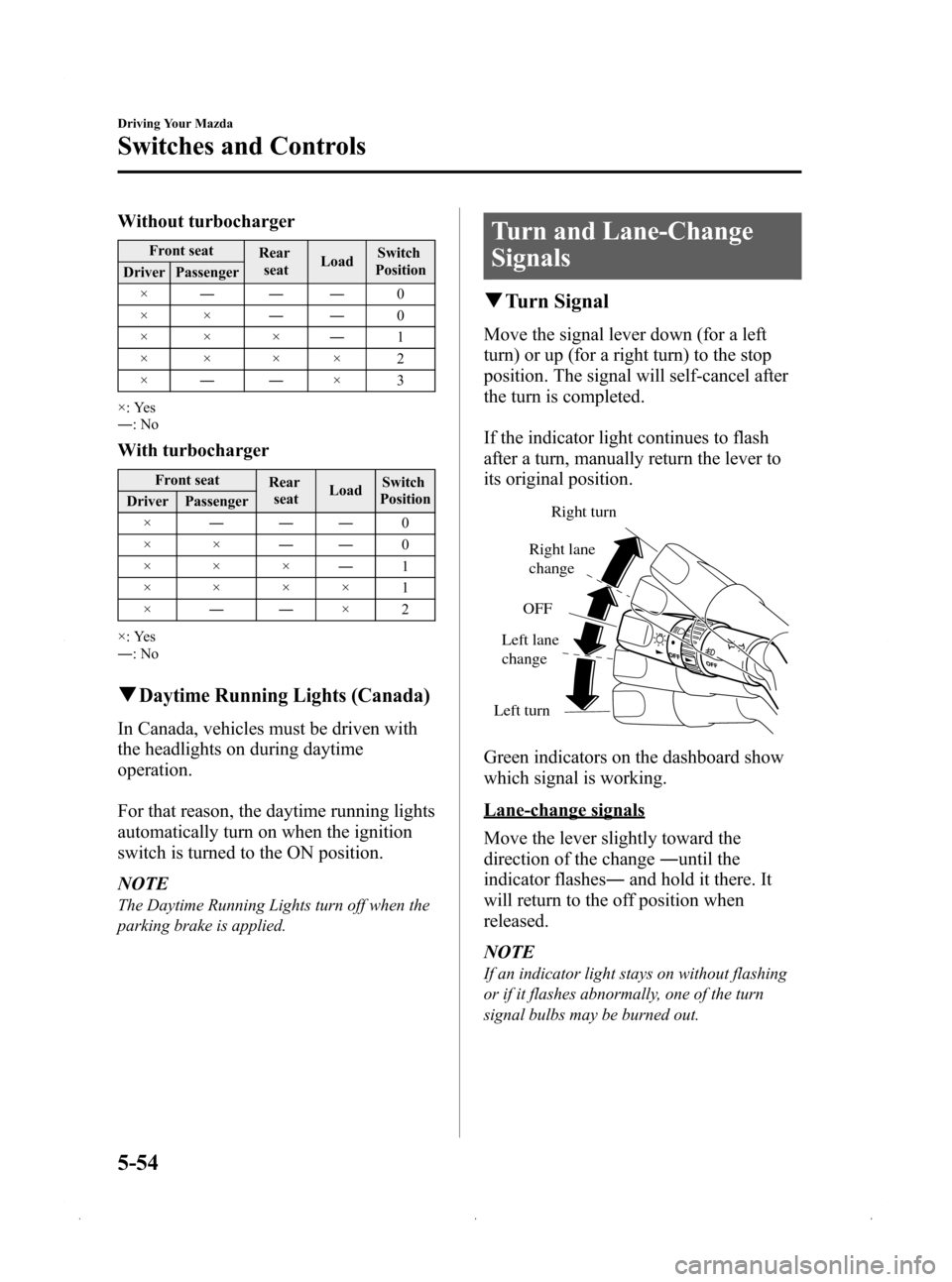
Move the signal lever down (for a left
turn) or up (for a right turn) to the stop
position. The signal will self-cancel after
the turn is completed.
If the indicator light continues to flash
after a turn, manually return the lever to
its original position.
Right turn
Left turn OFF
Right lane
change
Left lane
change
Green indicators on the dashboard show
which signal is working.
Lane-change signals
Move the lever slightly toward the
direction of the change ―until the
indicator flashes ―and hold it there. It
will return to the off position when
released.
NOTE
If an indicator light stays on without flashing
or if it flashes abnormally, one of the turn
signal bulbs may be burned out.
5-54
Driving Your Mazda
Switches and Controls
Mazda3_8Z87-EA-08F_Edition1 Page176
Monday, May 19 2008 9:57 AM
Form No.8Z87-EA-08F
Page 243 of 412
Black plate (243,1)
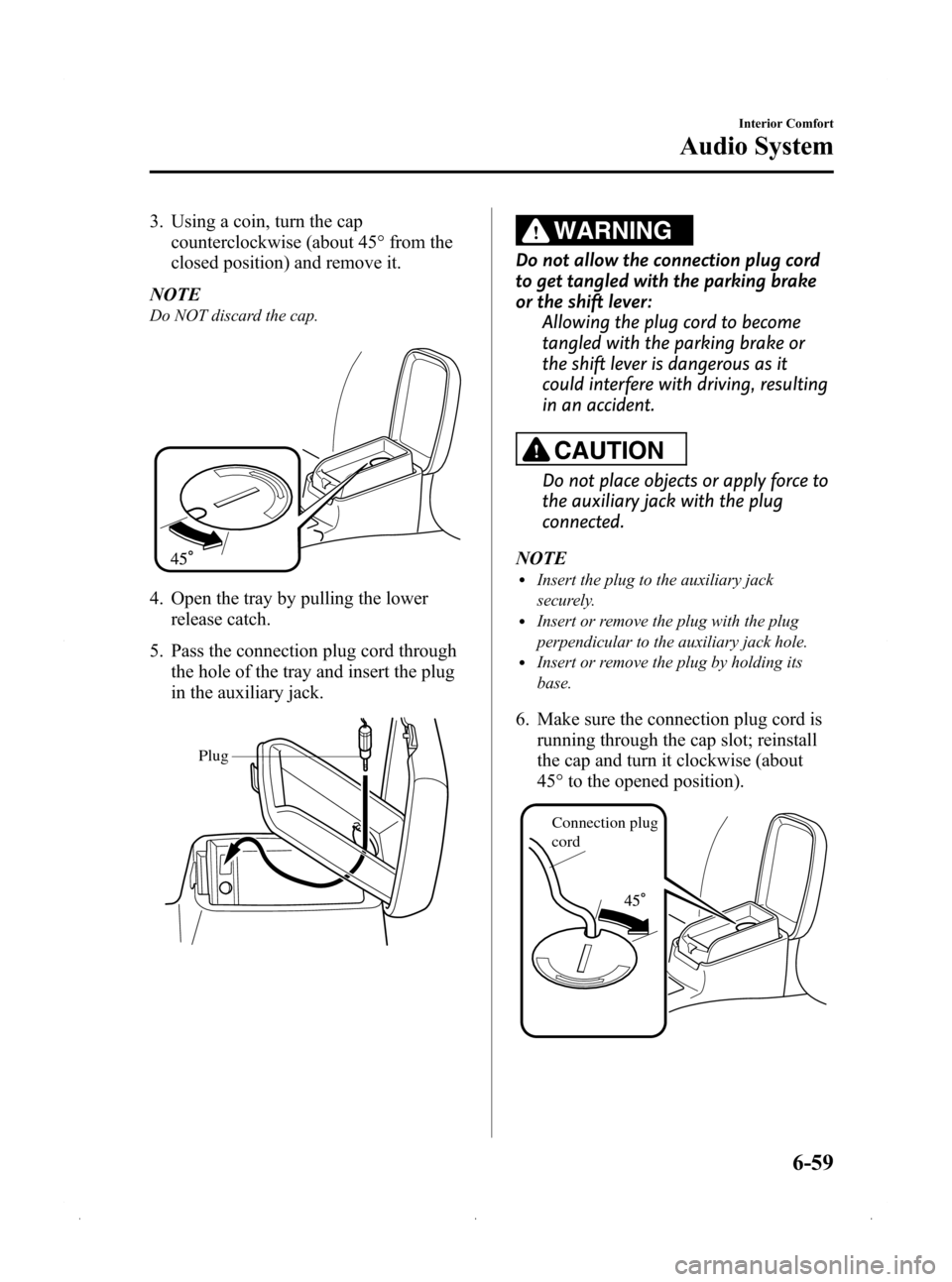
3. Using a coin, turn the capcounterclockwise (about 45° from the
closed position) and remove it.
NOTE
Do NOT discard the cap.
4. Open the tray by pulling the lower release catch.
5. Pass the connection plug cord through the hole of the tray and insert the plug
in the auxiliary jack.
Plug
WARNING
Do not allow the connection plug cord
to get tangled with the parking brake
or the shift lever: Allowing the plug cord to become
tangled with the parking brake or
the shift lever is dangerous as it
could interfere with driving, resulting
in an accident.
CAUTION
Do not place objects or apply force to
the auxiliary jack with the plug
connected.
NOTE
lInsert the plug to the auxiliary jack
securely.
lInsert or remove the plug with the plug
perpendicular to the auxiliary jack hole.
lInsert or remove the plug by holding its
base.
6. Make sure the connection plug cord is running through the cap slot; reinstall
the cap and turn it clockwise (about
45° to the opened position).
Connection plug
cord
Interior Comfort
Audio System
6-59
Mazda3_8Z87-EA-08F_Edition1 Page243
Monday, May 19 2008 9:58 AM
Form No.8Z87-EA-08F
Page 270 of 412
Black plate (270,1)
Changing a Flat Tire
NOTE
If the following occurs while driving, it could
indicate a flat tire.
lSteering becomes difficult.lThe vehicle begins to vibrate excessively.lThe vehicle pulls in one direction.
If you have a flat tire, drive slowly to a
level spot that is well off the road and out
of the way of traffic to change the tire.
Stopping in traffic or on the shoulder of a
busy road is dangerous.
WARNING
Be sure to follow the directions for
changing a tire, and never get under a
vehicle that is supported only by a jack:Changing a tire is dangerous if not
done properly. The vehicle can slip off
the jack and seriously injure
someone.
Never allow anyone inside a vehicle
supported by a jack: Allowing someone to remain in a
vehicle supported by a jack is
dangerous. The occupant could cause
the vehicle to fall resulting in serious
injury.
CAUTION
(With Tire Pressure Monitoring
System)
The wheels equipped on your Mazda
are specially designed for installation
of the tire pressure sensors. Do not
use non-genuine wheels, otherwise it
may not be possible to install the tire
pressure sensors. NOTE
lMake sure the jack is well lubricated before
using it.
(With Tire Pressure Monitoring System)
lBe sure to register the tire pressure sensor
ID signal code whenever tires or wheels are
changed (page 5-31).
1. Park on a level surface off the right-of- way and firmly set the parking brake.
2. Put a vehicle with an automatic transaxle in Park (P), a manual
transaxle in Reverse (R) or 1, and turn
off the engine.
3. Turn on the hazard warning flasher.
4. Have everyone get out of the vehicle and away from the vehicle and traffic.
5. Remove the jack, tool, and spare tire (page 7-3).
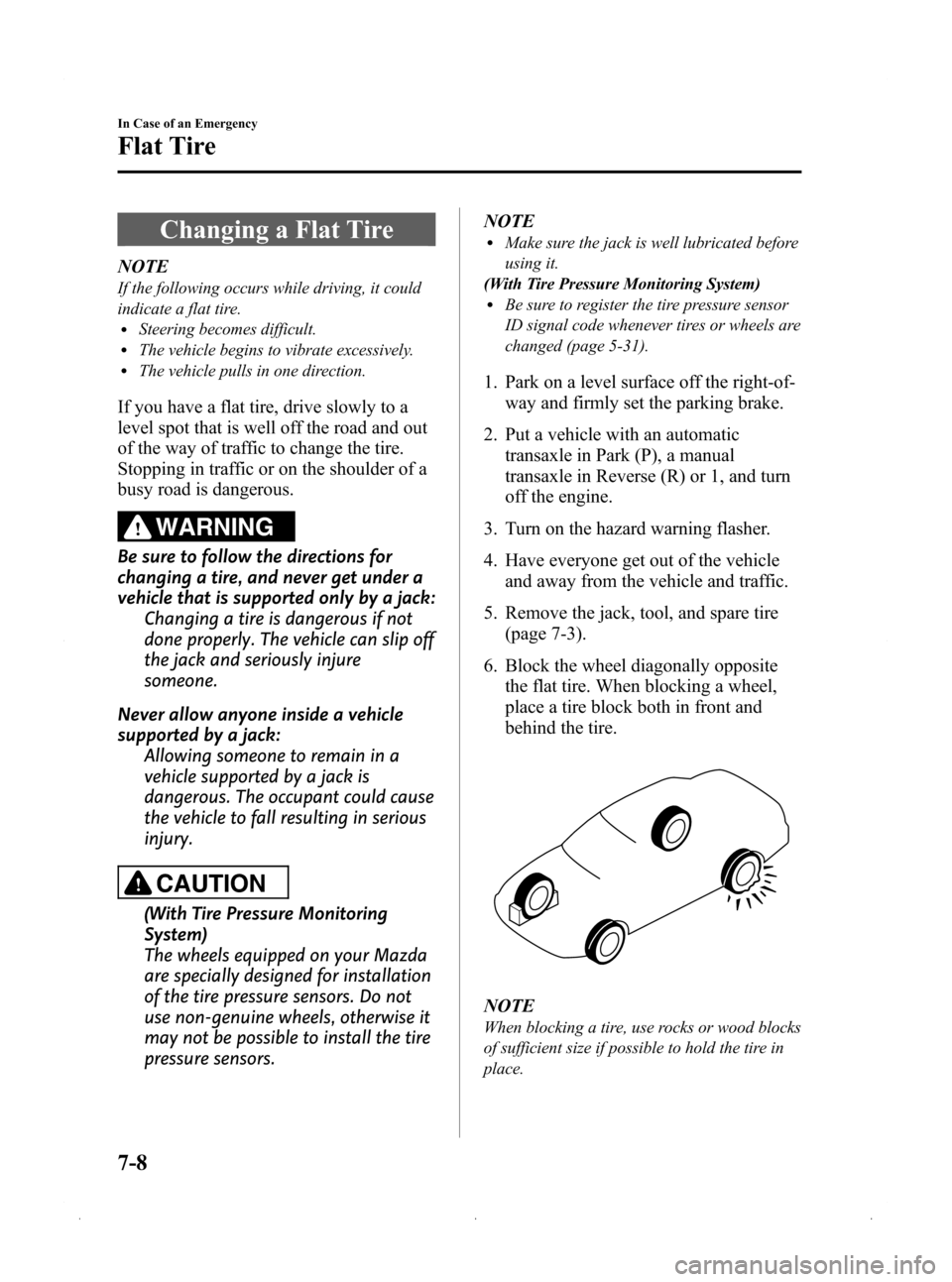
6. Block the wheel diagonally opposite the flat tire. When blocking a wheel,
place a tire block both in front and
behind the tire.
NOTE
When blocking a tire, use rocks or wood blocks
of sufficient size if possible to hold the tire in
place.
7-8
In Case of an Emergency
Flat Tire
Mazda3_8Z87-EA-08F_Edition1 Page270
Monday, May 19 2008 9:58 AM
Form No.8Z87-EA-08F
Page 276 of 412
Black plate (276,1)
Overheating
If the temperature gauge indicates
overheating, the vehicle loses power, or
you hear a loud knocking or pinging
noise, the engine is probably too hot.
WARNING
Turn off the ignition switch and
make sure the fan is not running before
attempting to work near the cooling
fan: Working near the cooling fan when it
is running is dangerous. The fan
could continue running indefinitely
even if the engine has stopped and
the engine compartment temperature
is high. You could be hit by the fan
and seriously injured.
Do not remove the cooling
system cap when the engine and
radiator are hot: When the engine and radiator are
hot, scalding coolant and steam may
shoot out under pressure and cause
serious injury.
Open the hood ONLY after steam is no
longer escaping from the engine: Steam from an overheated engine is
dangerous. The escaping steam could
seriously burn you.
If the temperature gauge indicates
overheating:
1. Drive safely to the side of the road and park off the right-of-way. 2. Put a vehicle with an automatic
transaxle in park (P), a manual
transaxle in neutral.
3. Apply the parking brake.
4. Turn off the air conditioner.
5. Check whether coolant or steam is escaping from under the hood or from
the engine compartment.
If steam is coming from the engine
compartment:
Don't go near the front of the vehicle.
Stop the engine.
Wait until the steam dissipates, then
open the hood and start the engine.
If neither coolant nor steam is
escaping:
Open the hood and idle the engine until
it cools.
CAUTION
If the cooling fan does not operate
while the engine is running, the
engine temperature will increase.
Stop the engine and call an
Authorized Mazda Dealer.
6. Make sure the cooling fan is operating, then turn off the engine after the
temperature has decreased.
7. When cool, check the coolant level. If it's low, look for coolant leaks from
the radiator and hoses.
7-14
In Case of an Emergency
Overheating
Mazda3_8Z87-EA-08F_Edition1 Page276
Monday, May 19 2008 9:58 AM
Form No.8Z87-EA-08F
Page 283 of 412
Black plate (283,1)
Towing Description
We recommend that towing be done only
by an Authorized Mazda Dealer or a
commercial tow-truck service.
Proper lifting and towing are necessary to
prevent damage to the vehicle.
Government and local laws must be
followed.
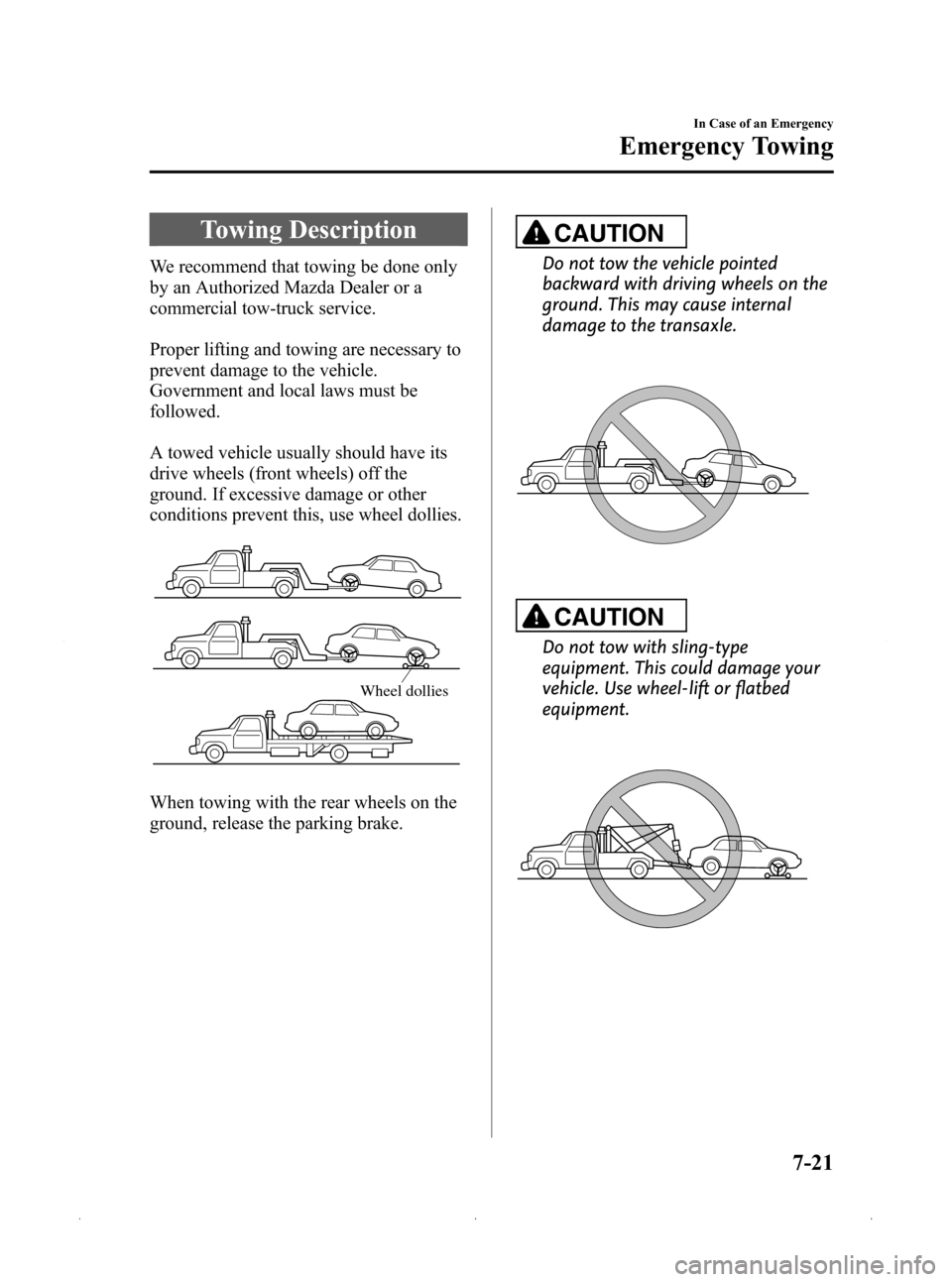
A towed vehicle usually should have its
drive wheels (front wheels) off the
ground. If excessive damage or other
conditions prevent this, use wheel dollies.
Wheel dollies
When towing with the rear wheels on the
ground, release the parking brake.
CAUTION
Do not tow the vehicle pointed
backward with driving wheels on the
ground. This may cause internal
damage to the transaxle.
CAUTION
Do not tow with sling-type
equipment. This could damage your
vehicle. Use wheel-lift or flatbed
equipment.
In Case of an Emergency
Emergency Towing
7-21
Mazda3_8Z87-EA-08F_Edition1 Page283
Monday, May 19 2008 9:58 AM
Form No.8Z87-EA-08F
Page 311 of 412

Black plate (311,1)
Automatic Transaxle Fluid
(ATF)
í
qInspecting Automatic Transaxle
Fluid Level
The automatic transaxle fluid level should
be inspected regularly. Measure it as
described below.
5AT
CAUTION
Ø Always check the automatic
transaxle fluid level according to
the following procedure. If the
procedure is not done correctly,
the automatic transaxle fluid level
cannot be measured accurately
which could lead to automatic
transaxle damage.
Ø A low fluid level can cause
transaxle slippage. Overfilling can
cause foaming, loss of fluid, and
transaxle malfunction.
Ø Use only the specified fluid. A non-
specified fluid could result in
transaxle malfunction and failure.
1. Park on a level surface and set the parking brake firmly.
2. Make sure there is no ATF leakage from the ATF hose or the housing.
3. Shift the shift lever to the park position (P), start the engine and warm it up.
CAUTION
Do not shift the shift lever while the
engine is warming up. If the ATF level
is extremely low, the automatic
transaxle could be damaged. 4. While the engine is still idling, pull out
the dipstick and wipe it clean, and then
put it back.
5. Check the ATF level. If there is no ATF adhering 5 mm from the end of the
dipstick, add ATF.
CAUTION
If there is no ATF adhering to the
dipstick even after the engine has
been warmed up, do not drive the
vehicle. Otherwise, the automatic
transaxle could be damaged.
6. Shift the shift lever to each range and position, and make sure there is no
abnormality.
7. Drive the vehicle on city roads for 5 km (3.1 mile) or more.
8. Park on a level surface and set the parking brake firmly.
9. Shift the shift lever to the park position (P), check the ATF level while the
engine is idling, and make sure that the
ATF level is within the proper level. If
the ATF level is not within the proper
level, add ATF.
The proper fluid level is marked on the
dipstick as follows.
Full
OK
Low
Maintenance and Care
Owner Maintenance
8-25íSome models.
Mazda3_8Z87-EA-08F_Edition1 Page311
Monday, May 19 2008 9:58 AM
Form No.8Z87-EA-08F
Page 312 of 412

Black plate (312,1)
4AT
The volume of fluid changes with
temperature. Fluid must be checked while
idling the engine without driving at
normal operating temperature.
CAUTION
ØLow fluid level causes transaxle
slippage. Overfilling can cause
foaming, loss of fluid, and
transaxle malfunction.
Ø Use specified fluid (page 10-4). A
nonspecified fluid could result in
transaxle malfunction and failure.
1. Park on a level surface and set the parking brake firmly.
2. Start the engine and depress the brake pedal.
3. Move the shift lever through all ranges, then set it at P.
WARNING
Make sure the brake pedal is applied
before shifting the shift lever: Shifting the shift lever without first
depressing the brake pedal is
dangerous. The vehicle could move
suddenly and cause an accident.
4. With the engine still idling, pull out the dipstick, wipe it clean, and put it back. 5. Pull it out again.
The proper fluid level is marked on the
dipstick as follows.
A
Full
Low
B
Full
Fluid hot scale A
When the vehicle has been driven and the
fluid is at normal operating temperature,
about 65°C (150°F), the level must be
between Full and Low.
Fluid cold scale B
When the engine has not been running
and the outside temperature is about 20°C
(70°F), the fluid level should be close to,
but not above, the bottom notch on the
dipstick.
CAUTION
Ø
Use the cold scale only as a
reference.
Ø If outside temperature is lower
than about 20°C (70°F), start the
engine and inspect the fluid level
after the engine reaches operating
temperature.
Ø If the vehicle has been driven for
an extended period at high speeds
or in city traffic in hot weather,
inspect the level only after
stopping the engine and allowing
the fluid to cool for 30 minutes.
8-26
Maintenance and Care
Owner Maintenance
Mazda3_8Z87-EA-08F_Edition1 Page312
Monday, May 19 2008 9:58 AM
Form No.8Z87-EA-08F
Page 406 of 412
Black plate (406,1)
A
Accessory Socket .............................. 6-76
Add-On Non-Genuine Parts and
Accessories ....................................... 9-17
Air Bag Systems ............................... 2-42
Ambient Temperature Display .......... 6-66
Antenna ............................................. 6-16
Anti-Lock Brake System (ABS) ......... 5-7Warning light ............................... 5-8
Appearance Care ............................... 8-58
Ashtray .............................................. 6-70
Audio System ................................... 6-16 Audio control switch .................. 6-56
Audio set .................................... 6-27
AUX mode ................................. 6-58
Operating tips for audio
system ........................................ 6-17
Safety certification ..................... 6-61
Automatic Transaxle Driving tips ................................ 5-18
Fluid ........................................... 8-25
Manual shift mode ..................... 5-14
Shift-lock override ..................... 5-14
Shift-lock system ....................... 5-14
Transaxle ranges ........................ 5-13
B
BatteryEmergency starting .................... 7-16
Maintenance ............................... 8-32
Specifications ............................. 10-4
Beep Sounds Ignition key reminder ................. 5-50
Lights-on reminder ..................... 5-50
Tire inflation pressure warning
beep ............................................ 5-50
Beeps
Seat belt warning beep Sounds ... 5-50
B
Before Starting the Engine .................. 4-6After getting in ............................. 4-6
Before getting in .......................... 4-6
Body Lubrication .............................. 8-28
Bottle Holder ..................................... 6-72
Brake/Clutch Fluid ........................................... 8-23
Brakes Anti-lock brake system (ABS) ..... 5-7
Brakes assist ................................. 5-9
Foot brake .................................... 5-5
Parking brake ............................... 5-6
Warning light ............................... 5-7
Break-In Period ................................... 4-7
Bulb Replacement ............................. 8-39
C
Capacities .......................................... 10-5
Carbon Monoxide ............................... 4-5
Cargo Securing Loops ...................... 6-73
Cargo Sub-Compartment .................. 6-73
Catalytic Converter ............................. 4-4
Cell Phones ....................................... 9-18
Center Console .................................. 6-73
Child Restraint Child restraint precautions ......... 2-27
Installing child-restraint
systems ....................................... 2-31
LATCH child-restraint
systems ....................................... 2-37
Child Safety Locks for Rear Doors ... 3-11
Cigarette Lighter ............................... 6-70
Climate Control System ...................... 6-2 Gas specifications ...................... 10-6
Clock ................................................. 6-66
Cruise Control ................................... 5-20
Cup Holder ........................................ 6-71
11-2
Index
Mazda3_8Z87-EA-08F_Edition1 Page406
Monday, May 19 2008 9:59 AM
Form No.8Z87-EA-08F
Page 409 of 412
Black plate (409,1)
M
MaintenanceIntroduction .................................. 8-2
Owner maintenance
precautions ................................. 8-16
Owner maintenance schedule ..... 8-15
Scheduled ..................................... 8-3
Manual Transaxle Operation ............... 5-9 Recommendations for shifting.... 5-10
Map Lights ........................................ 6-63
Mirror Defroster ................................ 5-60
Mirrors Outside mirrors .......................... 3-30
Rearview mirror ......................... 3-31
Money-Saving Suggestions ................ 4-7
Moonroof .......................................... 3-24
O
Odometer and Trip Meter .................. 5-34
Outside Mirrors ................................. 3-30
Overhead Lights ................................ 6-63
Overheating ....................................... 7-14
Overloading ...................................... 4-12
P
Paint Damage .................................... 8-58
Parking Brake ..................................... 5-6
Parking in an Emergency .................... 7-2
Power Door Locks ............................ 3-10
Power Steering .................................. 5-19 Fluid ........................................... 8-24
Power steering malfunction indicator
light ............................................ 5-19
Power Windows ................................ 3-18
Push-Starting ..................................... 7-20
R
Rear Door Child Safety Locks .......... 3-11
Rear Seat ............................................. 2-7
Rear Window Defroster .................... 5-60
Rear Window Washer ....................... 5-59
Rear Window Wiper .......................... 5-59
Rearview Mirror ................................ 3-31
Recreational Towing ......................... 7-23
Registering Your Vehicle in A Foreign
Country ............................................. 9-16
Rocking the Vehicle ............................ 4-9
S
Safety Defects, Reporting ................. 9-43
Seat Belt System Automatic locking ...................... 2-16
Belt minder ................................. 2-25
Center-rear lap/shoulder ............. 2-21
Emergency locking .................... 2-15
Except center-rear position ......... 2-17
Extender ..................................... 2-24
Pregnant women ........................ 2-15
Pretensioner and load limiting .... 2-19
Seat belt precautions .................. 2-13
Warning light/beep ..................... 2-25
Seats Front seat
(Electrically operated seats) ......... 2-4
Front seat
(Manually operated seats) ............ 2-2
Rear seat ....................................... 2-7
Seat warmer ................................ 2-11
Security System Immobilizer system .................... 3-26
Theft-deterrent system ............... 3-28
Service Publications .......................... 9-45
Spare Tire and Tool Storage ................ 7-3
Specifications .................................... 10-4
Index
11-5
Mazda3_8Z87-EA-08F_Edition1 Page409
Monday, May 19 2008 9:59 AM
Form No.8Z87-EA-08F