tire pressure MAZDA MODEL 3 SEDAN 2019 Owner's Guide
[x] Cancel search | Manufacturer: MAZDA, Model Year: 2019, Model line: MODEL 3 SEDAN, Model: MAZDA MODEL 3 SEDAN 2019Pages: 592, PDF Size: 75.35 MB
Page 550 of 592
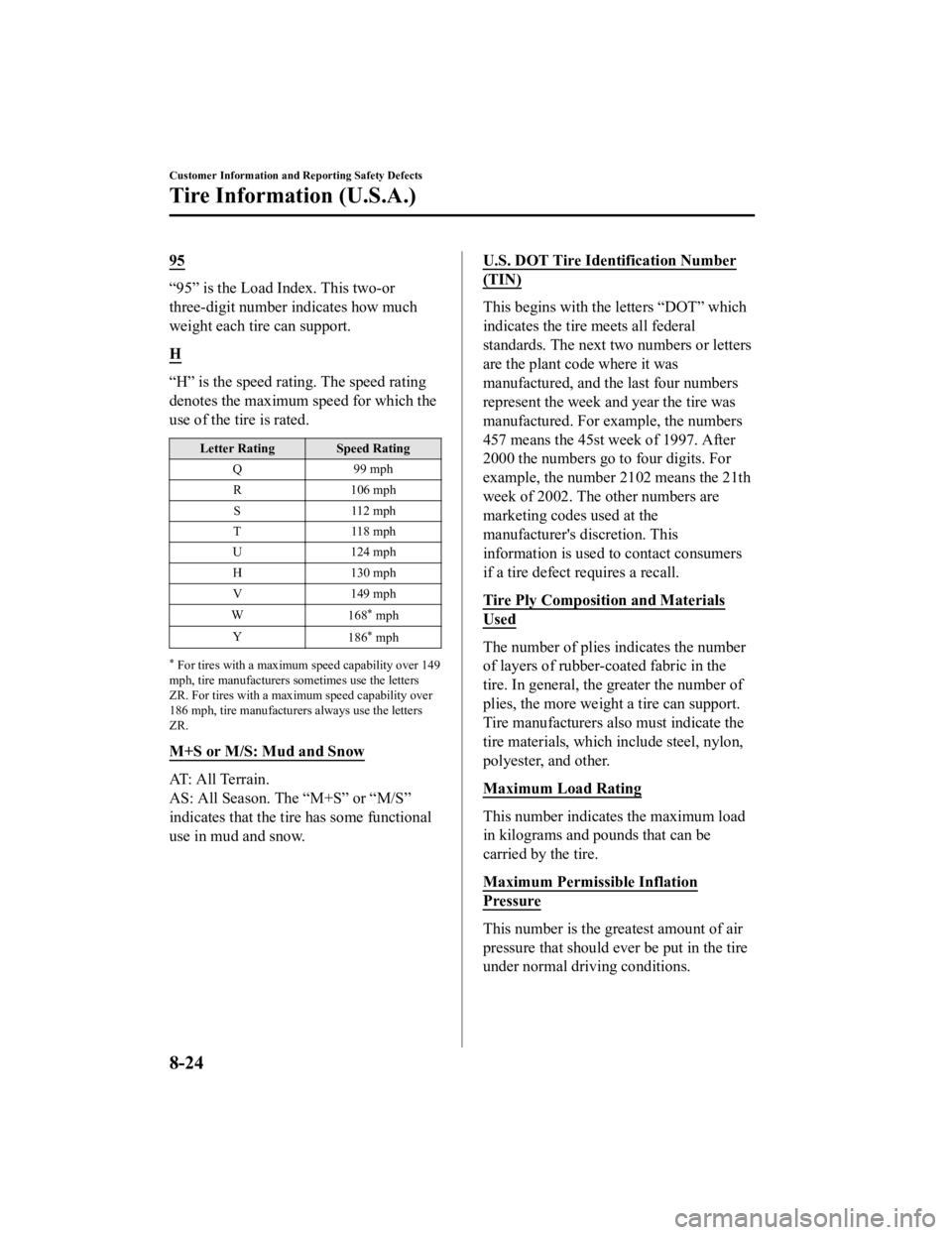
95
“95” is the Load Index. This two-or
three-digit number indicates how much
weight each tire can support.
H
“H” is the speed rating. The speed rating
denotes the maximum speed for which the
use of the tire is rated.
Letter Rating Speed RatingQ9 9 m ph
R1 06 m ph
S1 12 m ph
T1 18 m ph
U1 24 m ph
H1 30 m ph
V1 49 m ph
W 168
* mph
Y 186
* mph
* For tires with a maximum speed capability over 149
mph, tire manufacturers sometimes use the letters
ZR. For tires with a maximum speed capability over
186 mph, tire manufacture rs always use the letters
ZR.
M+S or M/S: Mud and Snow
AT: All Terrain.
AS: All Season. T he “M+S” or “M/S”
indicates that the tire has some functional
use in mud and snow.
U.S. DOT Tire Iden tification Number
(TIN)
This begins with the letters “DOT” which
indicates the tire meets all federal
standards. The next two numbers or letters
are the plant code where it was
manufactured, and the last four numbers
represent the week and year the tire was
manufactured. For example, the numbers
457 means the 45st week of 1997. After
2000 the numbers go to four digits. For
example, the number 2102 means the 21th
week of 2002. The other numbers are
marketing codes used at the
manufacturer's discretion. This
information is used to contact consumers
if a tire defect requires a recall.
Tire Ply Composition and Materials
Used
The number of plies indicates the number
of layers of rubber-coated fabric in the
tire. In general, the greater the number of
plies, the more weight a tire can support.
Tire manufacturers also must indicate the
tire materials, which include steel, nylon,
polyester, and other.
Maximum Load Rating
This number indicates the maximum load
in kilograms and pounds that can be
carried by the tire.
Maximum Permissible Inflation
Pressure
This number is the greatest amount of air
pressure that should e ver be put in the tire
under normal driving conditions.
Customer Information and Reporting Safety Defects
Tire Information (U.S.A.)
8-24
Mazda3_8HE9-EA-18K_Edition3 2018-11-21 14:31:58
Page 551 of 592

Tread Wear, Traction and Temperature
Grades
Tr e a d w e a r : The tread wear grade is a
comparative rating based on the wear rate
of the tire when tested under controlled
conditions on a specified government test
course. For example, a tire graded 150
would wear one and one-half (1 1/2) times
as well on the government course as a tire
graded 100.
Traction: The traction grades, from
highest to lowest are AA, A, B, and C.
The grades represent the tire's ability to
stop on wet pavement as measured under
controlled conditi ons on specified
government test surfaces of asphalt and
concrete. A tire marked C may have poor
traction performance.
Temperature: The temperature grades are
A (the highest), B and C, representing the
tire's resistance to the generation of heat
and its ability to dissipate heat when tested
under controlled conditions on a specified
indoor laboratory test wheel.
Snow Tires
In some heavy snow areas, local
governments may require true snow tires,
those with very deeply cut tread. These
tires should only be used in pairs or placed
on all four wheels. Make sure you
purchase snow tires that are the same size
and construction type a s the other tires on
your vehicle.
SAFETY WARNING
The following safety warning appears on
the tire's sidewall.
SERIOUS INJURY MAY RESULT
FROM:
EXPLOSION OF TIRE/RIM
ASSEMBLY DUE TO IMPROPER
MOUNTING-MATCH TIRE
DIAMETER TO RIM DIAMETER;
NEVER EXCEED 40 psi (275 kPa) TO
SEAT BEADS-ONLY SPECIALLY
TRAINED PERSONS SHOULD
MOUNT TIRES.
TIRE FAILURE DUE TO
UNDER-INFLATION/
OVERLOADING/
DAMAGE-FOLLOW OWNER'S
MANUAL AND PLACARD IN
VEHICLE-FREQUENTLY CHECK
INFLATION PRESSURE AND
INSPECT FOR DAMAGE.
▼ Information on Temporary Tires
Please refer to the sample below.
1. Temporary tires
2. Nominal width of tire in millimeters
3. Ratio of height to width (aspect ratio)
4. Diagonal
5. Rim diameter code
6. Load index & speed symbol
Customer Information and Reporting Safety Defects
Tire Information (U.S.A.)
8-25
Mazda3_8HE9-EA-18K_Edition3
2018-11-21 14:31:58
Page 553 of 592
Location of the Tire Label(Placard)
▼Location of the Tire Label (Placard)
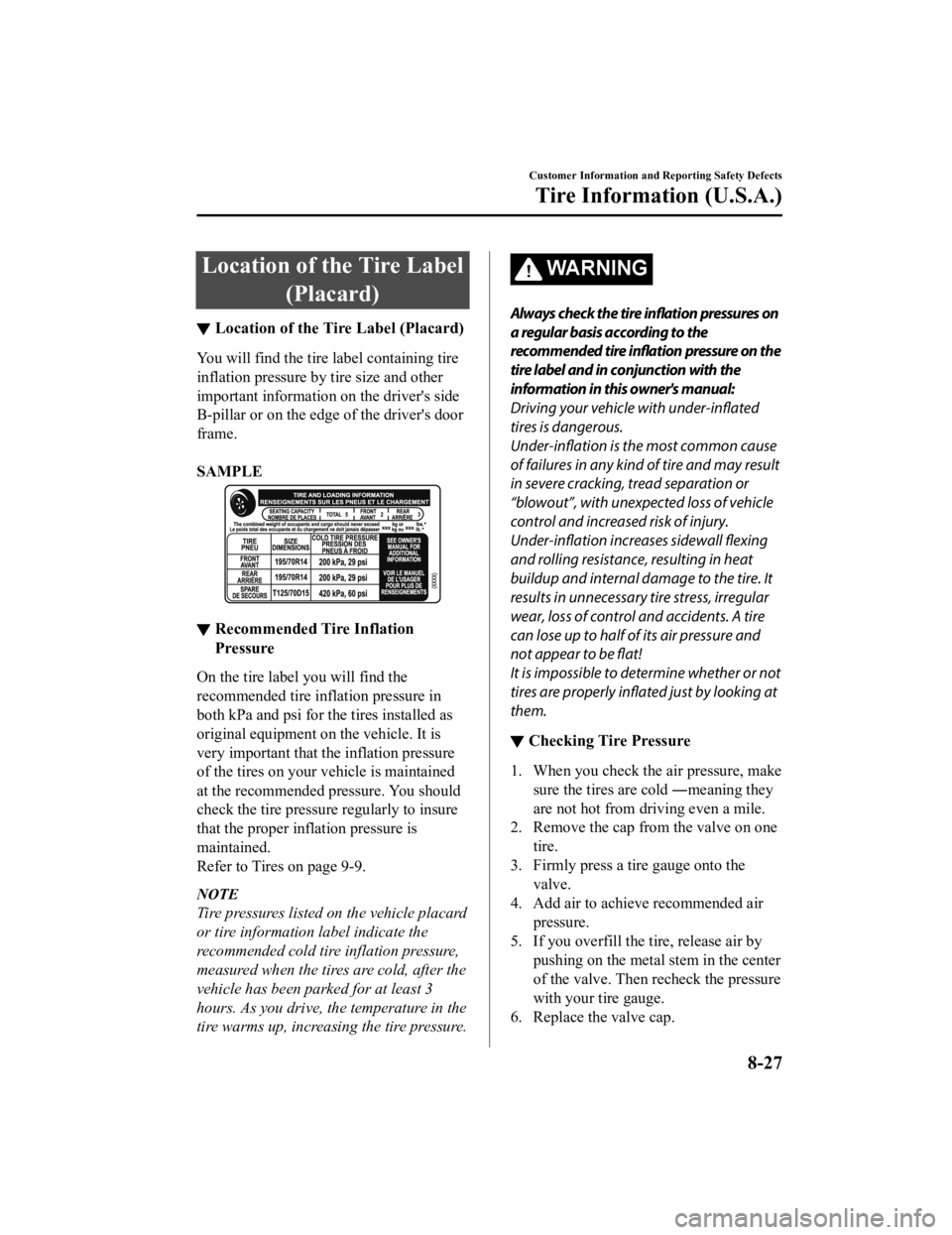
You will find the tire
label containing tire
inflation pressure by tire size and other
important info rmation on the driver's side
B-pillar or on the edge of the driver's door
frame.
SAMPLE
▼ Recommended Tire Inflation
Pressure
On the tire label you will find the
recommended tire inflation pressure in
both kPa and psi for the tires installed as
original equipment on
the vehicle. It is
very important that the inflation pressure
of the tires on your vehicle is maintained
at the recommended pressure. You should
check the tire pressure regularly to insure
that the proper inflation pressure is
maintained.
Refer to Tires on page 9-9.
NOTE
Tire pressures listed on the vehicle placard
or tire information label indicate the
recommended cold tire inflation pressure,
measured when the tires are cold, after the
vehicle has been parked for at least 3
hours. As you drive, the temperature in the
tire warms up, increasing the tire pressure.
WA R N I N G
Always check the tire inflation pressures on
a regular basis according to the
recommended tire inflation pressure on the
tire label and in conjunction with the
information in this owner's manual:
Driving your vehicle with under-inflated
tires is dangerous.
Under-inflation is the most common cause
of failures in any kind of tire and may result
in severe cracking, tread separation or
“blowout”, with unexpected loss of vehicle
control and increased risk of injury.
Under-inflation increases sidewall
flexing
and rolling resistance, resulting in heat
buildup and internal damage to the tire. It
results in unnecessary tire stress, irregular
wear, loss of control and accidents. A tire
can lose up to half of its air pressure and
not appear to be flat!
It is impossible to determine whether or not
tires are properly inflated just by looking at
them.
▼ Checking Tire Pressure
1. When you check the air pressure, make
sure the tires are cold ―meaning they
are not hot from driving even a mile.
2. Remove the cap from the valve on one
tire.
3. Firmly press a tire gauge onto the
valve.
4. Add air to achieve recommended air pressure.
5. If you overfill the tire, release air by
pushing on the metal stem in the center
of the valve. Then recheck the pressure
with your tire gauge.
6. Replace the valve cap.
Customer Information and Reporting Safety Defects
Tire Information (U.S.A.)
8-27
Mazda3_8HE9-EA-18K_Edition3 2018-11-21 14:31:58
Page 554 of 592

7. Repeat with each tire, including thespare.
NOTE
Some spare tires require higher
inflation pressure.
8. Visually inspect the tires to make sure
there are no nails or other objects
embedded that could poke a hole in the
tire and cause an air leak.
9. Check the sidewalls to make sure there are no gouges, cuts, bulges, cracks or
other irregularities.
▼Glossary of Terms
Tire Placard:
A label indicating the OE
tire sizes, recommended inflation pressure,
and the maximum weight the vehicle can
carry.
Tire Identification Number (TIN): A
number on the sidewall of each tire
providing information about the tire brand
and manufacturing plant, tire size, and
date of manufacture.
Inflation Pressure: A measure of the
amount of air in a tire.
kPa: Kilopascal, the metric unit for air
pressure.
psi: Pounds per square inch, the English
unit for air pressure.
B-pillar: The structural member at the
side of the vehicle behind the front door.
Original Equipment (OE): Describes
components originally equipped on the
vehicle.
Vehicle Load Limit: The maximum value
of the combination weight of occupants
and cargo.
Bead Area of the Tire: Area of the tire
next to the rim.
Sidewall Area of the Tire: Area between
the bead area and the tread.
Tread Area of the Tire: Area on the
perimeter of the tire t hat contacts the road
when it's mounted on the vehicle.
Seating capacity means the total
allowable number of vehicle occupants.
Seating capacity is described on the tire
label.
Production options weight is the
combination weight of installed regular
production options weighing over 2.3
kilograms in excess of the standard items
which they replace, and not previously
considered in the curb weight or accessory
weight, including heavy duty brakes, ride
levelers, roof rack, heavy duty battery, and
special trim.
Rim is the metal support (wheel) for a tire
or a tire and tube assembly upon which the
tire beads are seated.
Customer Information and Reporting Safety Defects
Tire Information (U.S.A.)
8-28
Mazda3_8HE9-EA-18K_Edition3 2018-11-21 14:31:58
Page 555 of 592
Tire Maintenance
▼Tire Maintenance
Improper or inad
equate vehicle
maintenance can cause tires to wear
abnormally. Here are some important
maintenance points:
▼ Tire Inflation Pressure
Inspect all tire p
ressure monthly
(including the spare) when the tires are
cold. Maintain recommended pressures for
the best ride, top handling, and minimum
tire wear. Use the pressures specified on
the vehicle tire inform ation placard or tire
label for optimum service.
▼ Tire Rotation
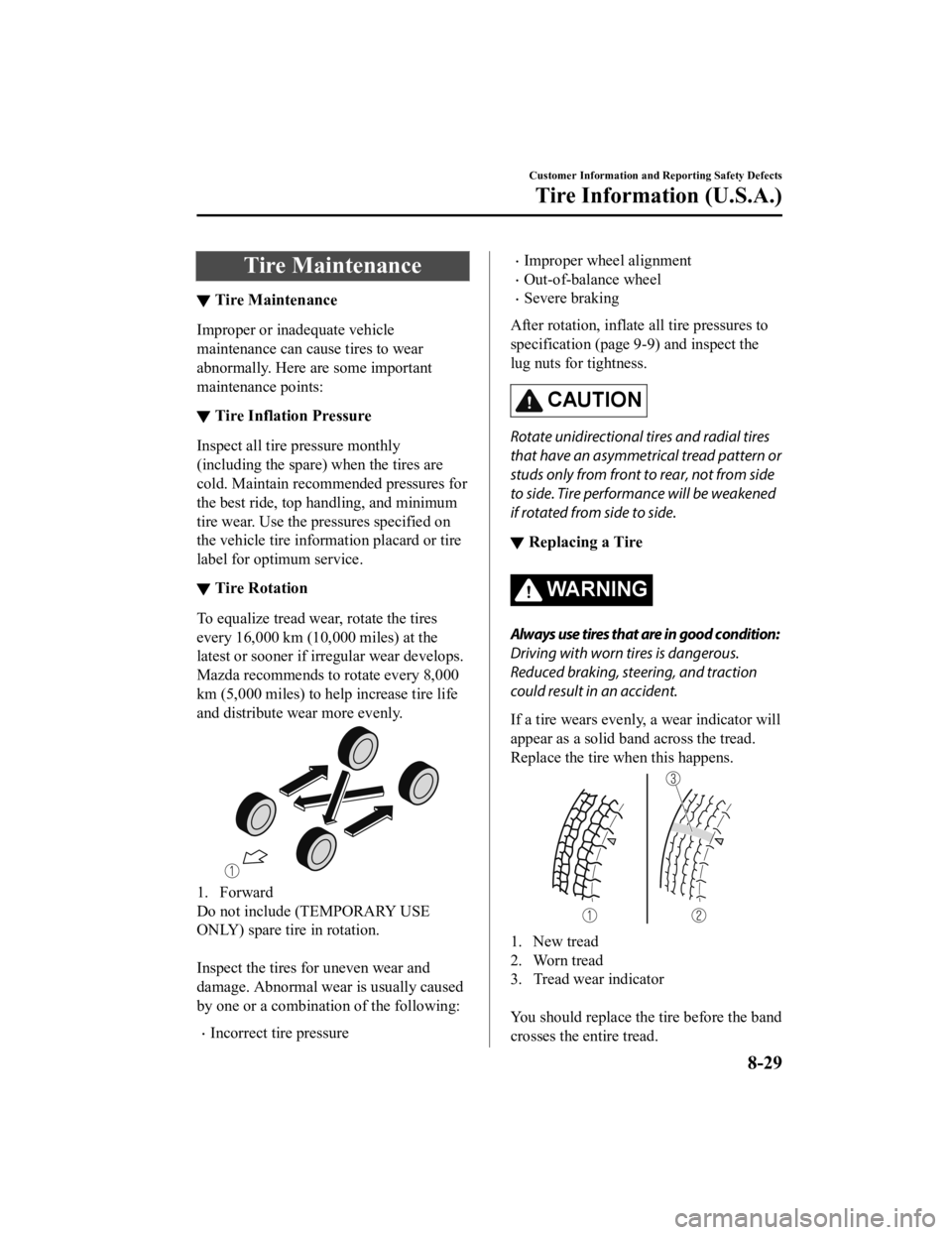
To equalize tread wear, rotate the tires
every 16,000 km (10,000 miles) at the
latest or sooner if irregular wear develops.
Mazda recommends to rotate every 8,000
km (5,000 miles) to help increase tire life
and distribute wear more evenly.
1. Forward
Do not include (TEMPORARY USE
ONLY) spare tire in rotation.
Inspect the tires for uneven wear and
damage. Abnormal wear is usually caused
by one or a combination of the following:
Incorrect tire pressure
Improper wheel alignment
Out-of-balance wheel
Severe braking
After rotation, inflate all tire pressures to
specification (page 9-9) and inspect the
lug nuts for tightness.
CAUTION
Rotate unidirectional tires and radial tires
that have an asymmetrical tread pattern or
studs only from front to rear, not from side
to side. Tire performance will be weakened
if rotated from side to side.
▼ Replacing a Tire
WA R N I N G
Always use tires that are in good condition:
Driving with worn tires is dangerous.
Reduced braking, steering, and traction
could result in an accident.
If a tire wears evenly, a wear indicator will
appear as a solid band across the tread.
Replace the tire when this happens.
1. New tread
2. Worn tread
3. Tread wear indicator
You should replace the tire before the band
crosses the entire tread.
Customer Information and Reporting Safety Defects
Tire Information (U.S.A.)
8-29
Mazda3_8HE9-EA-18K_Edition3
2018-11-21 14:31:58
Page 557 of 592
Vehicle Loading
▼Vehicle Loading
WA R N I N G
Do not tow a trailer with this vehicle:
Towing a trailer wi
th this vehicle is
dangerous because it has not been
designed to tow a trailer and doing so will
affect the drive system which could result in
vehicle damage.
This section will guide you in the proper
loading of your vehicle, to keep your
loaded vehicle weight within its design
rating capability. Properly loading your
vehicle will provide maximum return of
vehicle design performance. Before
loading your vehicle, familiarize yourself
with the following terms for determining
your vehicle's weight ratings, from the
vehicle's Safety Certification Label and
Tire and Load Information Label:
WA R N I N G
Overloaded Vehicle:
Overloading a vehicle is dangerous. The
results of overloading can have serious
consequences in terms of passenger safety.
Too much weight on a vehicle's suspension
system can cause spring or shock absorber
failure, brake failure, handling or steering
problems, irregular tire wear, tire failure or
other damage.
Overloading makes a vehicle harder to
drive and control. It also increases the
distance required for stopping. In cases of
serious overloading, brakes can fail
completely, particularly on steep grades.
The load a tire will carry safely is a
combination of the size of the tire, its load
range, and corresponding inflation
pressure.
Never overload the vehicle and always
observe the vehicle's weight ratings from
the vehicle's Safety Certification and Tire
and Load Information labels.
Base Curb Weight is the weight of the
vehicle including a f ull tank of fuel and
all standard equip ment. It does not
include passengers, cargo, or optional
equipment.
Vehicle Curb Weight is the weight of
your new vehicle when you picked it up
from your dealer plus any aftermarket
equipment.
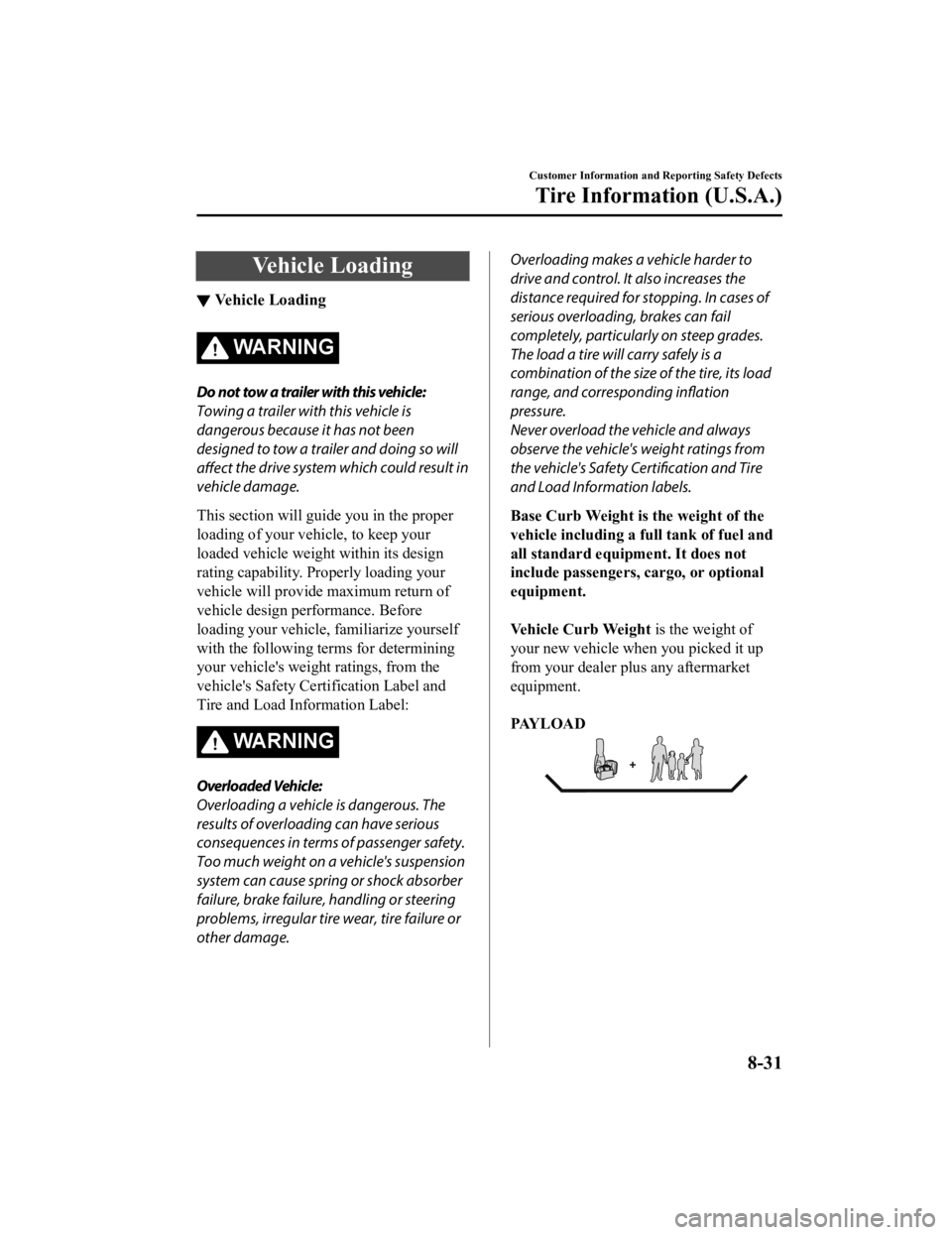
PAYLOAD
Customer Information and Reporting Safety Defects
Tire Information (U.S.A.)
8-31
Mazda3_8HE9-EA-18K_Edition3 2018-11-21 14:31:58
Page 562 of 592
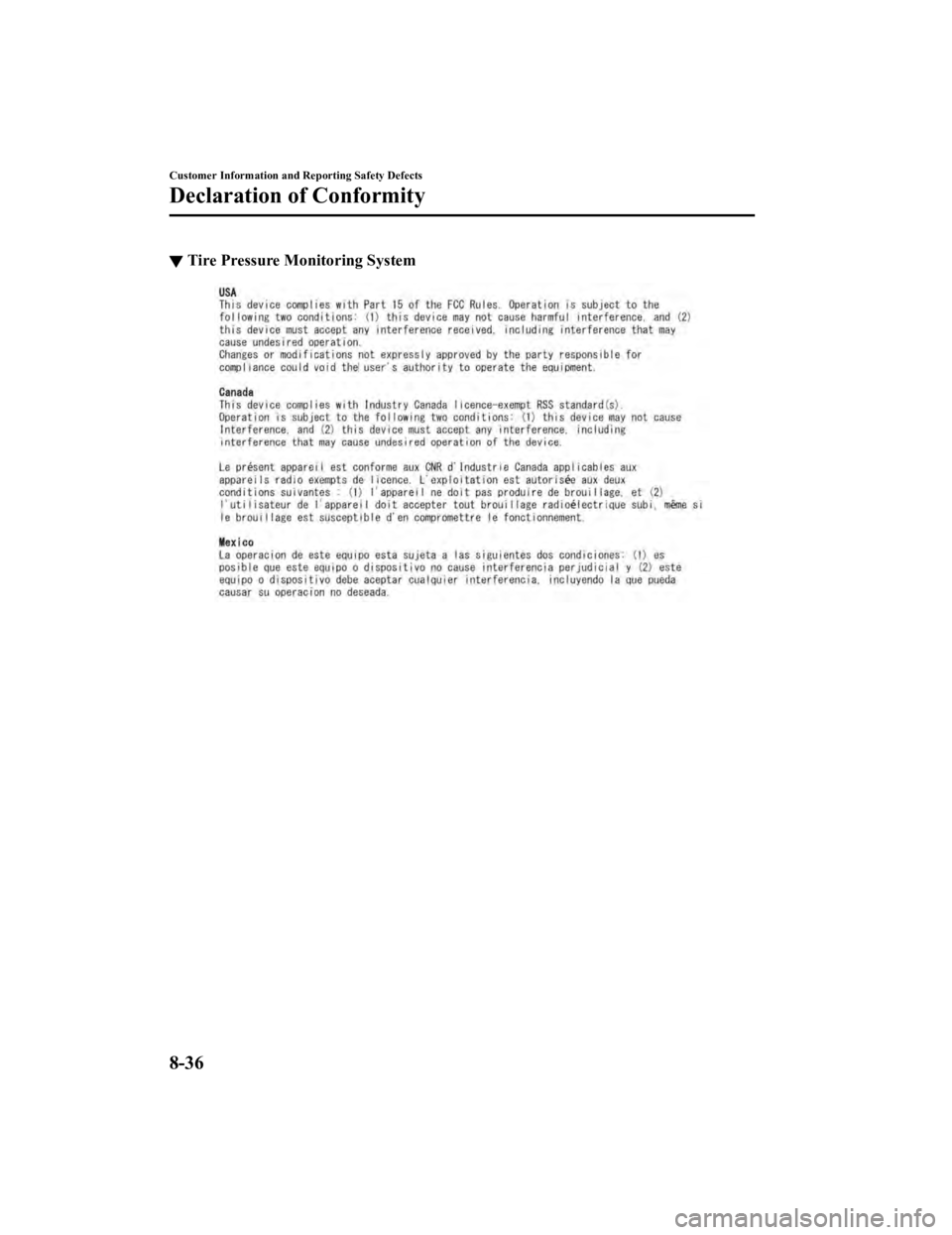
▼Tire Pressure Monitoring System
Customer Information and Reporting Safety Defects
Declaration of Conformity
8-36
Mazda3_8HE9-EA-18K_Edition3
2018-11-21 14:31:58
Page 572 of 592
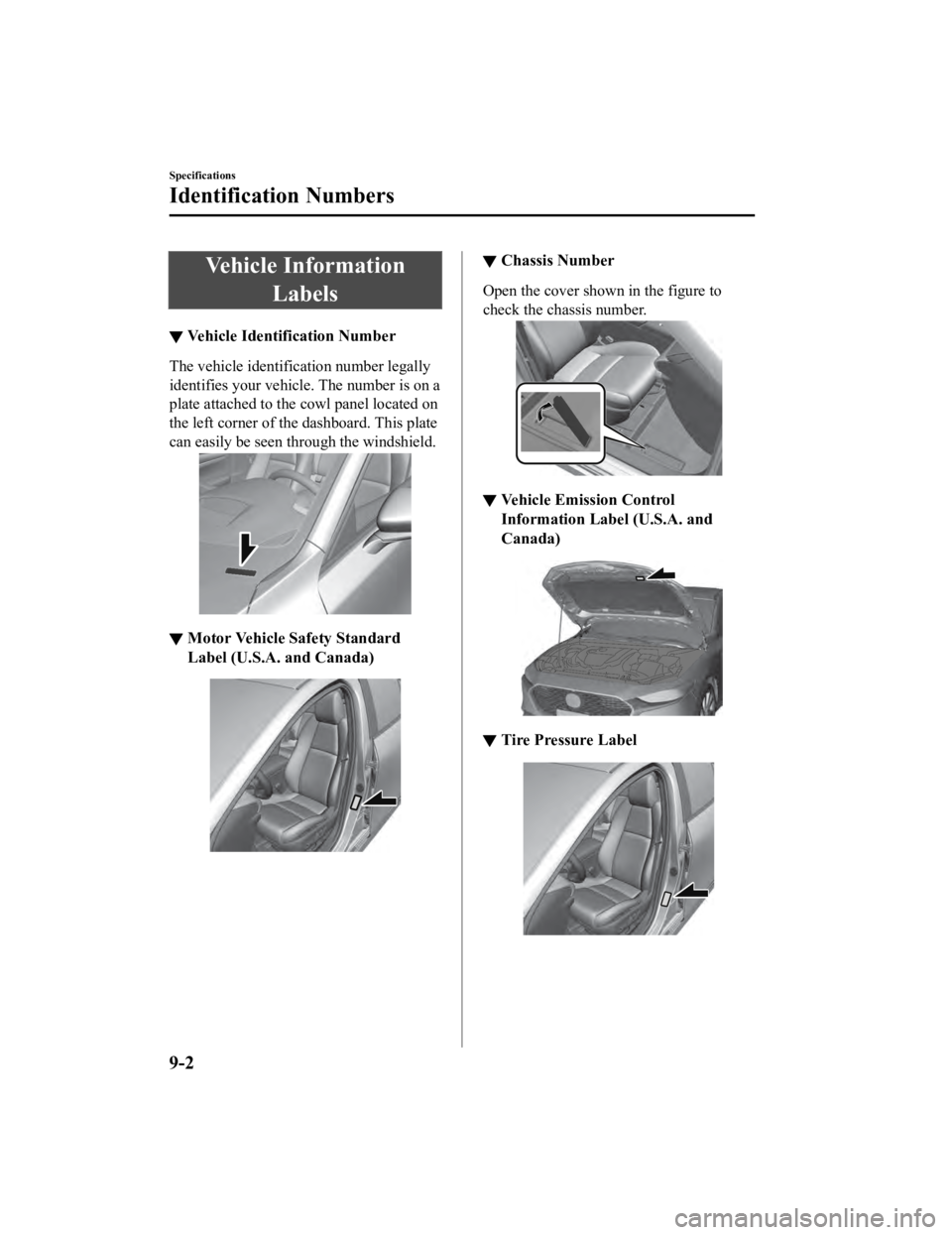
Vehicle InformationLabels
▼Vehicle Identification Number
The vehicle identification number legally
identifies your vehicle. The number is on a
plate attached to the cowl panel located on
the left corner of the dashboard. This plate
can easily be seen through the windshield.
▼Motor Vehicle Safety Standard
Label (U.S.A. and Canada)
▼ Chassis Number
Open the cover shown in the figure to
check the chassis number.
▼Vehicle Emission Control
Information Label (U.S.A. and
Canada)
▼Tire Pressure Label
Specifications
Identification Numbers
9-2
Mazda3_8HE9-EA-18K_Edition3
2018-11-21 14:31:58
Page 579 of 592
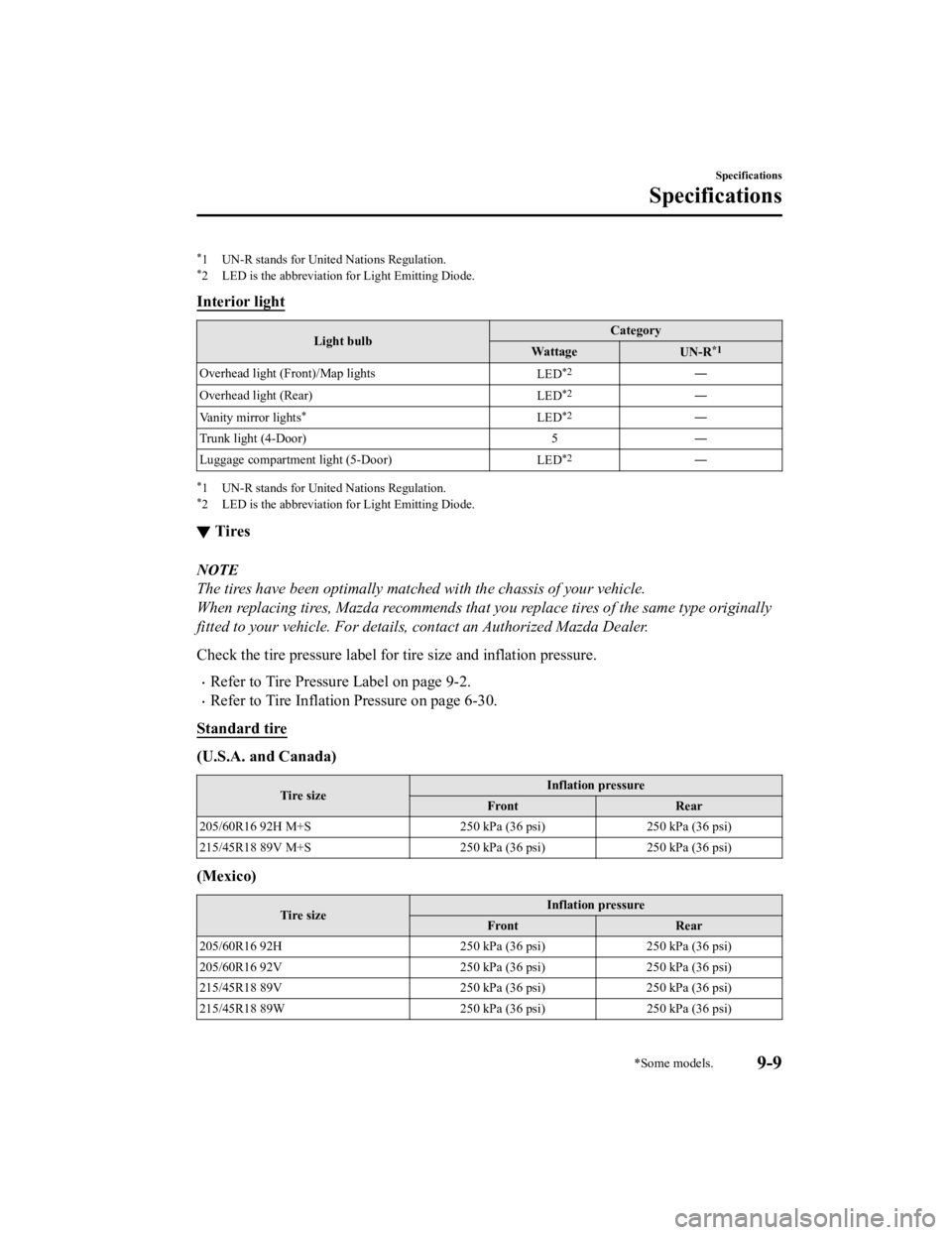
*1 UN-R stands for United Nations Regulation.*2 LED is the abbreviation for Light Emitting Diode.
Interior light
Light bulb Category
Wa t t ag e UN-R*1
Overhead light (Front)/Map lights
LED*2―
Overhead light (Rear) LED
*2―
Vanity mirror lights
*LED*2―
Trunk light (4-Door) 5 ―
Luggage compartmen t light (5-Door)
LED
*2―
*1 UN-R stands for United Nations Regulation.*2 LED is the abbreviation for Light Emitting Diode.
▼Tires
NOTE
The tires have been optimally matched with the chassis of your vehicle.
When replacing tires, Mazda recommends that you replace tires of the same type originally
fitted to your vehicle. For details, contact an Authorized Mazda Dealer.
Check the tire pressure label for tire size and inflation press
ure.
Refer to Tire Pressure Label on page 9-2.
Refer to Tire Inflation Pressure on page 6-30.
Standard tire
(U.S.A. and Canada)
Tire size Inflation pressure
Front Rear
205/60R16 92H M+S 250 kPa (36 psi)250 kPa (36 psi)
215/45R18 89V M+S 250 kPa (36 psi)250 kPa (36 psi)
(Mexico)
Tire size Inflation pressure
Front Rear
205/60R16 92H 250 kPa (36 psi)250 kPa (36 psi)
205/60R16 92V 250 kPa (36 psi)250 kPa (36 psi)
215/45R18 89V 250 kPa (36 psi)250 kPa (36 psi)
215/45R18 89W 250 kPa (36 psi)250 kPa (36 psi)
Specifications
Specifications
*Some models.9-9
Mazda3_8HE9-EA-18K_Edition3 2018-11-21 14:31:58
Page 580 of 592
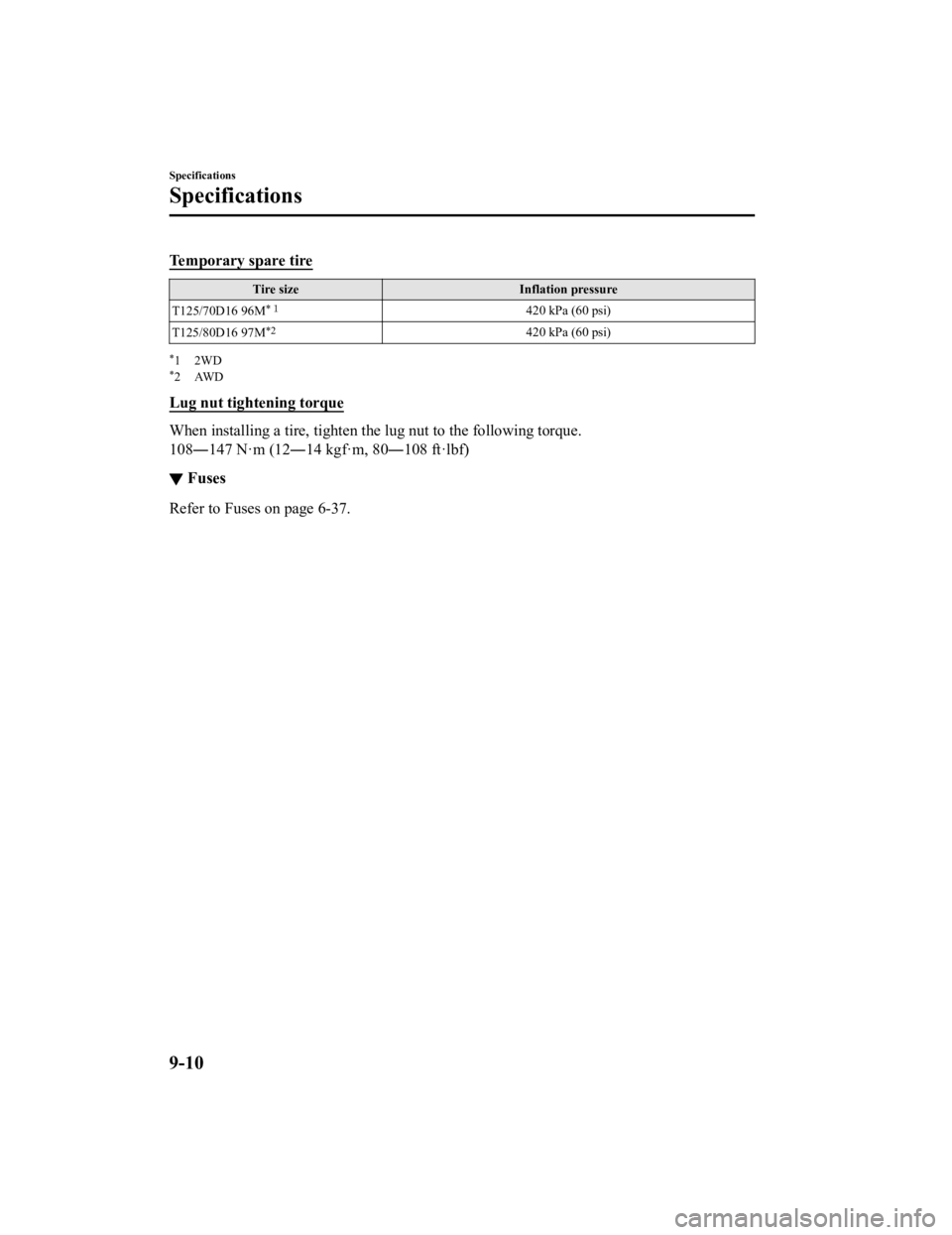
Temporary spare tire
Tire sizeInflation pressure
T125/70D16 96M
* 1420 kPa (60 psi)
T125/80D16 97M
*2420 kPa (60 psi)
*12WD*2AWD
Lug nut tightening torque
When installing a tire, tighten the lug nut to the following to rque.
108―147 N·m (12―14 kgf·m, 80―108 ft·lbf)
▼ Fuses
Refer to Fuses on page 6-37.
Specifications
Specifications
9-10
Mazda3_8HE9-EA-18K_Edition3
2018-11-21 14:31:58