parking brake MAZDA MODEL 3 SEDAN 2019 Service Manual
[x] Cancel search | Manufacturer: MAZDA, Model Year: 2019, Model line: MODEL 3 SEDAN, Model: MAZDA MODEL 3 SEDAN 2019Pages: 592, PDF Size: 75.35 MB
Page 353 of 592

▼To Resume Cruising Speed at More
Than 30 km/h (19 mph)
If the cruise control system is temporarily
canceled (such as by applying the brake
pedal) and the system is still activated, the
most recent set speed will automatically
resume when the RES switch is pressed.
If vehicle speed is below 30 km/h (19
mph), increase the veh
icle speed up to 30
km/h (19 mph) or more and press the RES
switch.
▼ To Temporarily Cancel
To temporarily cancel the system, use one
of these methods:
Slightly depress
the brake pedal.
Press the CANCEL switch.
(Manual transmission)
Depress the clutch pedal.
If the RES switch i s pressed when the
vehicle speed is 30 km/h (19 mph) or
higher, the system reverts to the previously
set speed.
NOTE
If any of the follow ing conditions occur,
the cruise control system is temporarily
canceled.
Even when the brake pedal is slightly
depressed.
The DSC is operating.
There is a problem in the system.
Any of the doors is opened.
The driver's seat belt is unfastened.
The parking brake is applied.
(Automatic transmission)
The selector lever is in the P or N
position.
(Manual transmission)
The shift lever is in the neutral
position.
When the cruise control system is
temporarily canceled by even one of the
applicable cancel conditions, the speed
cannot be re-set.
(Automatic transmission)
The cruise control cannot be canceled
while driving in manual mode (selector
lever shifted from D to M position).
Therefore, engine braking will not be
applied even if the transmission is
shifted down to a lower gear. If
deceleration is required, lower the set
speed or depress the brake pedal.
▼ To Deactivate
Press the cruise switch again.
When Driving
Cruise Control
4-213
Mazda3_8HE9-EA-18K_Edition3
2018-11-21 14:31:58
Page 374 of 592

CAUTION
Do not install any accessories within the detection ranges of the sensors. It may
affect the
system operation.
Depending on the type of obstruction and th e surrounding conditions, the detection range
of a sensor may narrow, or the sensors may not be able to detect obstructions.
NOTE
The system may not operate norma lly under the following conditions:
Mud, ice, or snow is adhering to the sensor area (Returns to normal operation when
removed).
The sensor area is frozen (Returns to normal operation when the ice is thawed).
The sensor is covered by a hand.
The sensor is excessively shocked.
The vehicle is excessively tilted.
Under extremely hot or cold weather conditions.
The vehicle is driven on bumps, inclines, gravel, grating, or grass covered roads.
Anything which generates ultrasonic waves such as another vehicle's horn, the engine
sound of a motorcycle, the air brake sound of a large-sized vehicle, or another vehicle's
sensors approaches the vehicle.
The vehicle is driven in heavy rain or in road conditions causing water-splash.
A commercially-available fender pole or an antenna for a radio transmitter is installed
to the vehicle.
The vehicle is moving towards a tall or square curbstone, or a steep grade.
An obstruction is too close to the sensor.
The vehicle is moving towards an uneven wall or stairs.
There are multiple obstructions.
The vehicle is driven in a place with low ceilings.
Obstructions under the bumper cannot be detected. Obstructions which are lower than the
sensor or thin may not be detected even though they were detected once.
The following types of obstructions may not be detected:
Thin objects such as wire, rope or poles
Things which absorb sonic waves easily such as cotton or snow
Angular shaped objects
Very tall objects, and those which are wide at the top
Small, short objects
Always have the system inspected at an Aut horized Mazda Dealer if any shock is applied
to the bumpers, even in a minor accident. If the sensors are deviated, they cannot detect
obstructions.
When Driving
Parking Sensor System
4-234
Mazda3_8HE9-EA-18K_Edition3 2018-11-21 14:31:58
Page 377 of 592

DisplayDistance between vehicle and obstruction
Without 360° view monitor
With 360° viewmonitor Front ultrasonic sen‐
sor
*/Front corner
ultrasonic sensor*
Rear ultrasonic sen‐ sor/Rear corner ul‐
trasonic sensor/Rear side ultrasonic sen‐
sor
*
Without front ul‐
trasonic sensor and front corner ultra‐ sonic sensor With front ultra‐
sonic sensor and
front corner ultra‐ sonic sensor
Red
Front ultrasonic sen‐ sor:
Within approx. 35.0 cm (13.7 in)
Front corner ultrason‐ ic sensor:
Within approx. 25 cm (9.8 in) Rear ultrasonic sen‐
sor:
Within approx. 35.0 cm (13.7 in)
Rear corner ultrasonic sensor/Rear side ul‐ trasonic sensor:
Within approx. 25 cm (9.8 in)
▼Park Assist Sensor System
Operation
When the parking sensor switch is pressed
with the ignition switched ON, the buzzer
sounds and the indicator light turns on.
When the ignition is switched ON with the
parking sensor activated, the indicator
light turns on.
Press the switch again to stop the
operation.
1. Indicator light
NOTE
When the ignition is
switched OFF, the
system status before it was turned off is
maintained. For exampl e, if the ignition is
switched OFF while the parking sensor is
activated, the system will be activated
when the ignition is switched ON the next
time.
Operation conditions
The parking sensor system can be used
when all of the foll owing conditions are
met:
The ignition is switched ON.
The parking sensor switch is turned on.
NOTE
(Automatic vehicle)
The detection indicator and buzzer of
the front sensors/front corner sensors do
not operate when the selector lever is in
the P position.
The detection indicator and buzzer
sound do not activate when the parking
brake is applied.
When Driving
Parking Sensor System
*Some models.4-237
Mazda3_8HE9-EA-18K_Edition3 2018-11-21 14:31:58
Page 458 of 592
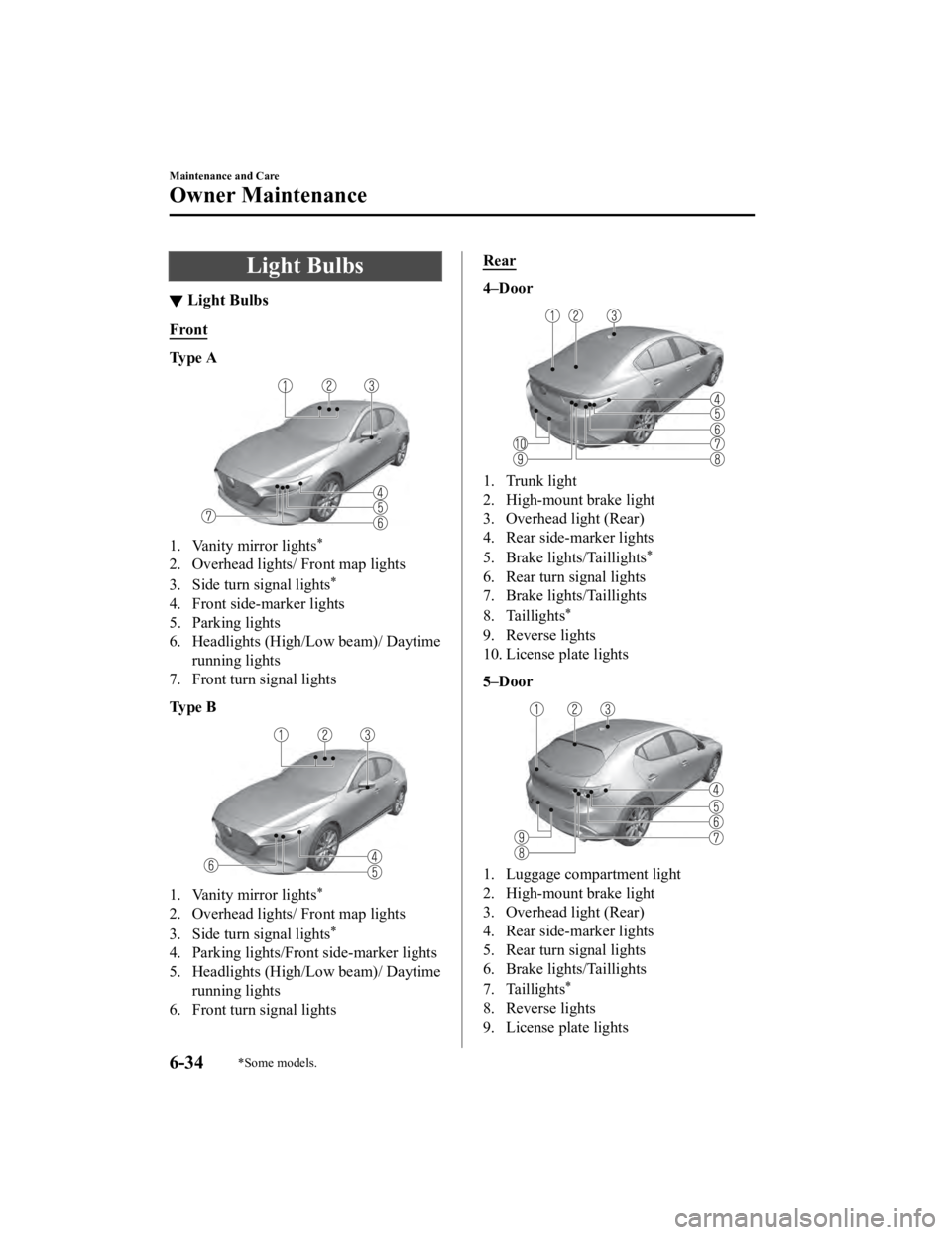
Light Bulbs
▼Light Bulbs
Front
Ty p e A
1. Vanity mirror lights*
2. Overhead lights/ Front map lights
3. Side turn signal lights
*
4. Front side-marker lights
5. Parking lights
6. Headlights (High/Low beam)/ Daytime
running lights
7. Front turn signal lights
Ty p e B
1. Vanity mirror lights*
2. Overhead lights/ Front map lights
3. Side turn signal lights
*
4. Parking lights/Front side-marker lights
5. Headlights (High/Low beam)/ Daytime running lights
6. Front turn signal lights
Rear
4–Door
1. Trunk light
2. High-mount brake light
3. Overhead light (Rear)
4. Rear side-marker lights
5. Brake lights/Taillights
*
6. Rear turn signal lights
7. Brake lights/Taillights
8. Taillights
*
9. Reverse lights
10. License plate lights
5–Door
1. Luggage compartment light
2. High-mount brake light
3. Overhead light (Rear)
4. Rear side-marker lights
5. Rear turn signal lights
6. Brake lights/Taillights
7. Taillights
*
8. Reverse lights
9. License plate lights
Maintenance and Care
Owner Maintenance
6-34*Some models.
Mazda3_8HE9-EA-18K_Edition3 2018-11-21 14:31:58
Page 459 of 592
CAUTION
When removing the lens or lamp unit using
a flathead screwdriver, make sure that the
flathead screwdriver does not contact the
interior terminal. If the flathead screwdriver
contacts the terminal, a short circuit may
occur.
NOTE
When replacing a bulb, contact an
Authorized Mazda Dealer if necessary.
Use the protective cover and carton for
the replacement bulb to dispose of the
old bulb promptly and out of the reach
of children.
For details regarding the installation
positions of the interior lights, refer to
the following:
Vanity mirror lights
Refer to Vanity Mirrors on page 5-33.
Overhead Lights/front map lights,
overhead light (rear), trunk light, and
luggage compartment light
Refer to Interior Lights on page 5-34.
▼ Replacing Exterior Light Bulbs
The exterior lights have either LEDs or
normal bulbs.
Only the bulb for a parking lights/front
side-marker lights (type B) can be
replaced.
LED type
Headlights
Daytime running lights
Parking lights (Type A)
Front turn signal lights
Front side-marker lights (Type A)
Side turn signal lights*
High-mount brake light
Rear turn signal lights
Rear side-marker lights
Brake lights
Taillights
Reverse lights
License plate lights
The LED bulb cannot be replaced as a
single unit because it is an integrated unit.
The LED bulb has to be replaced with the
unit. We recommend an Authorized
Mazda Dealer when the replacement is
necessary.
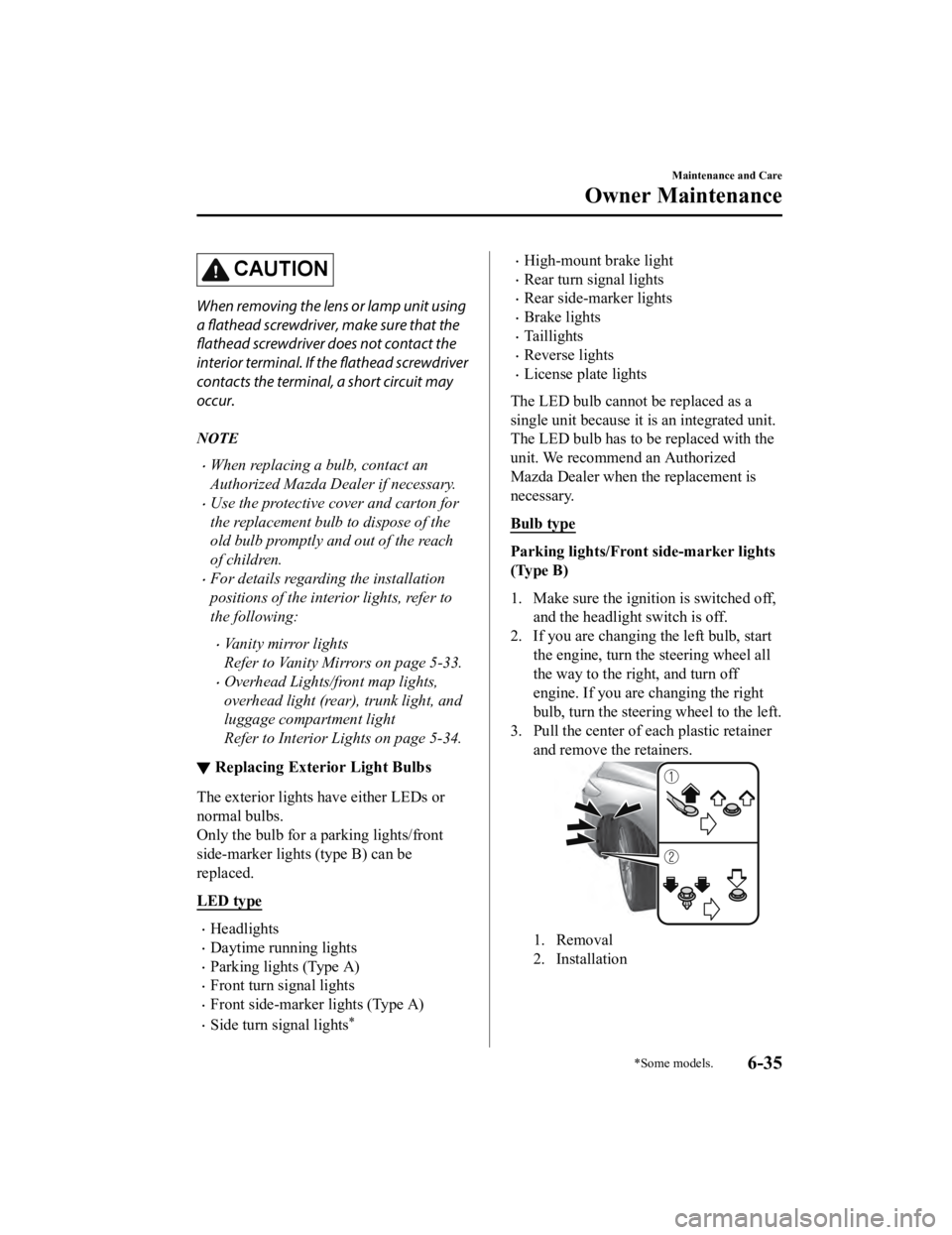
Bulb type
Parking lights/Front side-marker lights
(Type B)
1. Make sure the ignition is switched off, and the headlight switch is off.
2. If you are changing the left bulb, start
the engine, turn the steering wheel all
the way to the right, and turn off
engine. If you are changing the right
bulb, turn the steering wheel to the left.
3. Pull the center of each plastic retainer
and remove the retainers.
1. Removal
2. Installation
Maintenance and Care
Owner Maintenance
*Some models.6-35
Mazda3_8HE9-EA-18K_Edition3 2018-11-21 14:31:58
Page 483 of 592
Changing a Flat Tire
▼Changing a Flat Tire
NOTE
If the following occurs while driving, it
could indicate a flat tire.
Steering becomes difficult.
The vehicle begins to vibrate
excessively.
The vehicle pulls in one direction.
If you have a flat tire , drive slowly to a
level spot that is well off the road and out
of the way of traffic to change the tire.
Stopping in traffic or on the shoulder of a
busy road is dangerous.
WA R N I N G
Be sure to follow the directions for
changing a tire:
Changing a tire is dangerous if not done
properly. The vehicle can slip off the jack
and seriously injure someone.
No person should place any portion of their
body under a vehicle th at is supported by a
jack.
Never allow anyone inside a vehicle
supported by a jack:
Allowing someone to remain in a vehicle
supported by a jack is dangerous. The
occupant could cause the vehicle to fall
resulting in serious injury.
NOTE
Make sure the jack is well lubricated
before using it.
1. Park on a hard, level surface off the right-of-way and firm ly set the parking
brake.
2. Put a vehicle with an automatic transmission in Park (P), a manual
transmission in Reverse (R) or 1, and
turn off the engine.
3. Turn on the hazard warning flasher.
4. Have everyone get out of the vehicle and away from the vehicle and traffic.
5. Remove the jack, tool, and spare tire
(page 7-3).
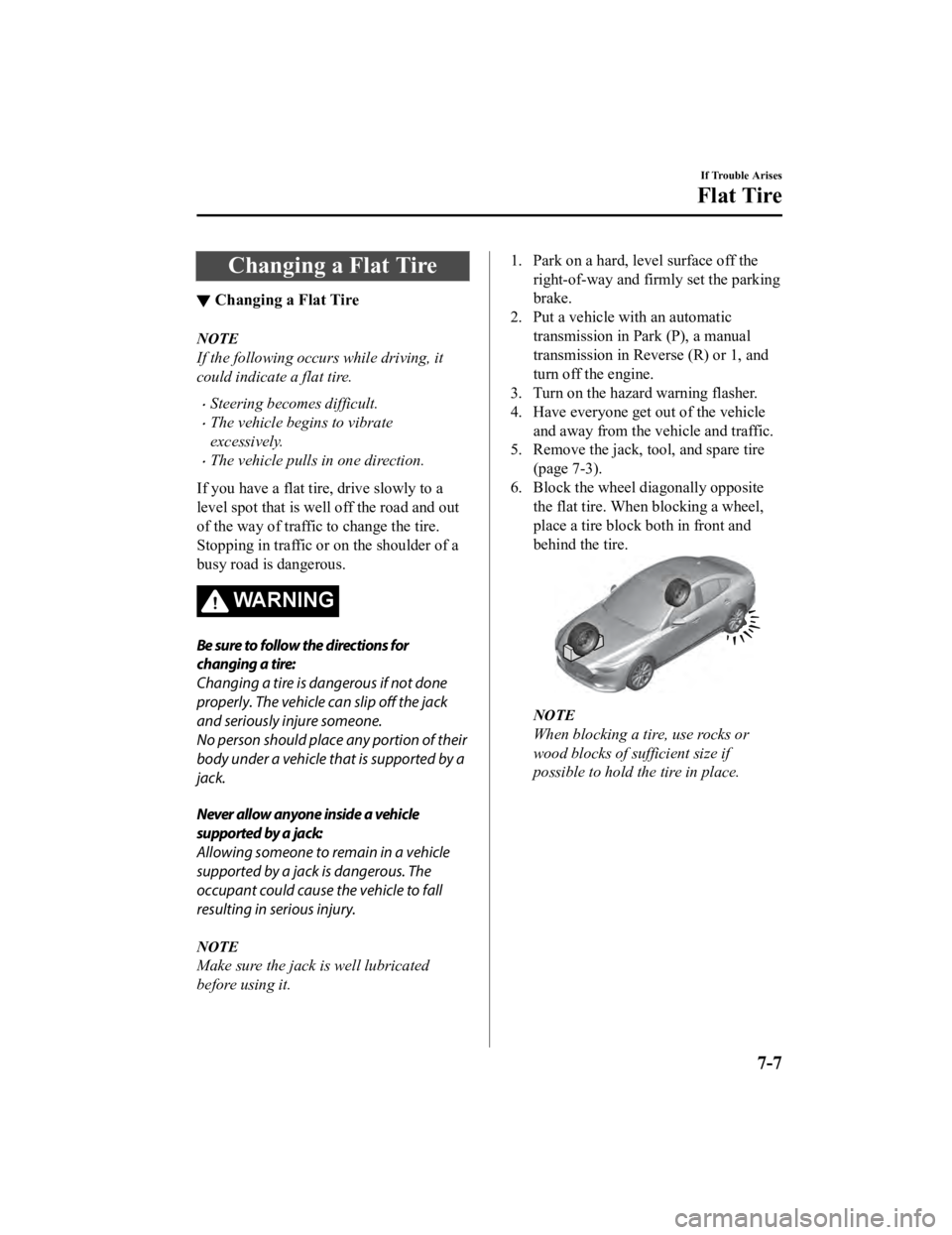
6. Block the wheel diagonally opposite the flat tire. When blocking a wheel,
place a tire block both in front and
behind the tire.
NOTE
When blocking a tire, use rocks or
wood blocks of sufficient size if
possible to hold the tire in place.
If Trouble Arises
Flat Tire
7-7
Mazda3_8HE9-EA-18K_Edition3 2018-11-21 14:31:58
Page 484 of 592
▼Removing a Flat Tire
WA R N I N G
When jacking-up a vehicle, always shift the
shift lever to 1st or R position (manual
transmission vehicle) or shift the selector
lever to P position (automatic transmission
vehicle), apply the parking brake, and place
wheel blocks in the position diagonally
opposed to the jack:
Changing a
flat tire without using wheel
blocks is dangerous because the vehicle
may move and fall off the jack even with
the shift lever in 1st or R position, or the
selector lever is in P position, which could
result in an accident.
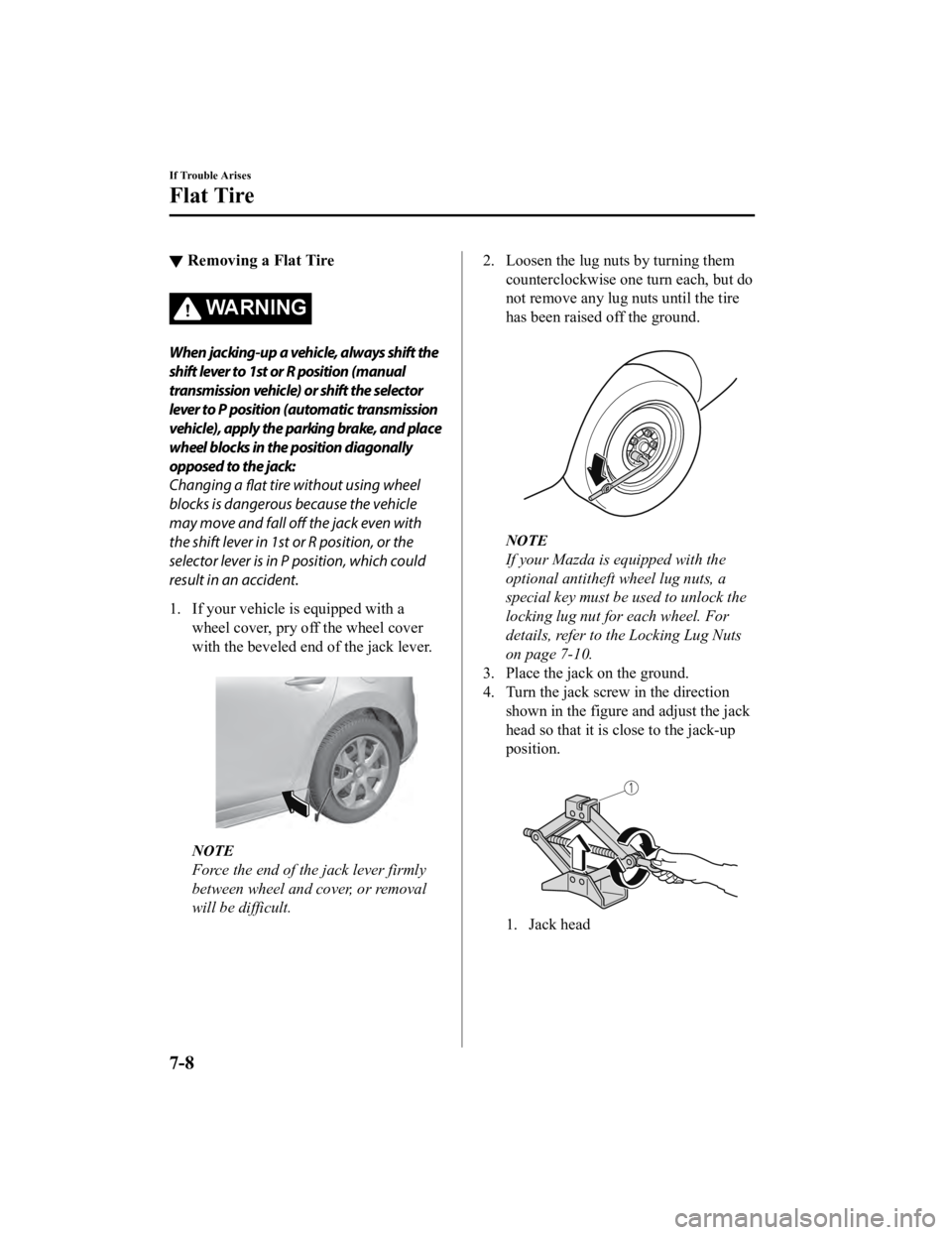
1. If your vehicle is equipped with a wheel cover, pry off the wheel cover
with the beveled end of the jack lever.
NOTE
Force the end of the jack lever firmly
between wheel and cover, or removal
will be difficult.
2. Loosen the lug nuts by turning them counterclockwise one turn each, but do
not remove any lug nuts until the tire
has been raised off the ground.
NOTE
If your Mazda is equipped with the
optional antitheft wheel lug nuts, a
special key must be used to unlock the
locking lug nut for each wheel. For
details, refer to the Locking Lug Nuts
on page 7-10.
3. Place the jack on the ground.
4. Turn the jack screw in the direction shown in the figure and adjust the jack
head so that it is close to the jack-up
position.
1. Jack head
If Trouble Arises
Flat Tire
7-8
Mazda3_8HE9-EA-18K_Edition3 2018-11-21 14:31:58
Page 495 of 592
Starting a Flooded Engine
▼Starting a Flooded Engine
If the engine fails to start, it may be
flooded (excessive fuel in the engine).
Follow this procedure:
1. If the engine does not start within 5
seconds on the first try, wait 10
seconds and try again.
2. Make sure the parking brake is on.
3. Depress the accelerator all the way and hold it there.
4. Depress the clutch pedal (manual
transmission) or the brake pedal
(automatic transmission), then press
the push button start. If the engine
starts, release the accelerator
immediately because the engine will
suddenly rev up.
5. If the engine fails to start, crank it
without depressing the accelerator.
If the engine still does not start using the
previous procedure, have your vehicle
inspected by an Authorized Mazda Dealer.
Push-Starting
▼ Push-Starting
Do not push-start your Mazda.
WA R N I N G
Never tow a vehicle to start it:
Towing a vehicle to start it is dangerous.
The vehicle being towed could surge
forward when its engine starts, causing the
2 vehicles to collide. The occupants could
be injured.
CAUTION
Do not push-start a vehicle that has a
manual transmission. It can damage the
emission control system.
NOTE
You cannot start a vehicle with an
automatic transmission by pushing it.
If Trouble Arises
Emergency Starting
7-19
Mazda3_8HE9-EA-18K_Edition3
2018-11-21 14:31:58
Page 496 of 592
Overheating
▼Overheating
If the engine coolant temperature gauge
indicates overheati
ng and the high engine
coolant temperature warning indication is
displayed, the vehicle loses power or you
hear a loud knocking or pinging noise, the
engine is probably too hot.
WA R N I N G
Pull over to a safe location, then switch
the ignition off and make sure the fan is
not running before attempting to work
near the cooling fan:
Working near the cooling fan when it is
running is dangerous. The fan could
continue running indefinitely even if the
engine has stopped and the engine
compartment temperature is high. You
could be hit by the fan and seriously
injured.
Do not remove either cooling
system cap when the engine and radiator
are hot:
When the engine and radiator are hot,
scalding coolant and steam may shoot out
under pressure and cause serious injury.
Open the hood ONLY after steam is no
longer escaping from the engine:
Steam from an overheated engine is
dangerous. The escaping steam could
seriously burn you.
If the engine coolant temperature gauge
indicates overheating and the high engine
coolant temperature warning indication is
displayed:
1. Drive safely to the side of the road and
park off the right-of-way.
2. Put a vehicle with an automatic
transmission in park (P), a manual
transmission in neutral.
3. Apply the parking brake.
4. Turn off the air conditioner.
5. Check whether coolant or steam is escaping from the engine
compartment.
If steam is coming from the engine
compartment:
Do not go near the front of the vehicle.
Stop the engine.
Wait until the steam dissipates, then
open the hood and start the engine.
If neither coolant nor steam is
escaping:
Open the hood and idle the engine
until it cools.
CAUTION
If the cooling fan does not operate
while the engine is running, the engine
temperature will increase. Stop the
engine and call an Authorized Mazda
Dealer.
If Trouble Arises
Overheating
7-20
Mazda3_8HE9-EA-18K_Edition3 2018-11-21 14:31:58
Page 498 of 592
Towing Description
▼Towing Description
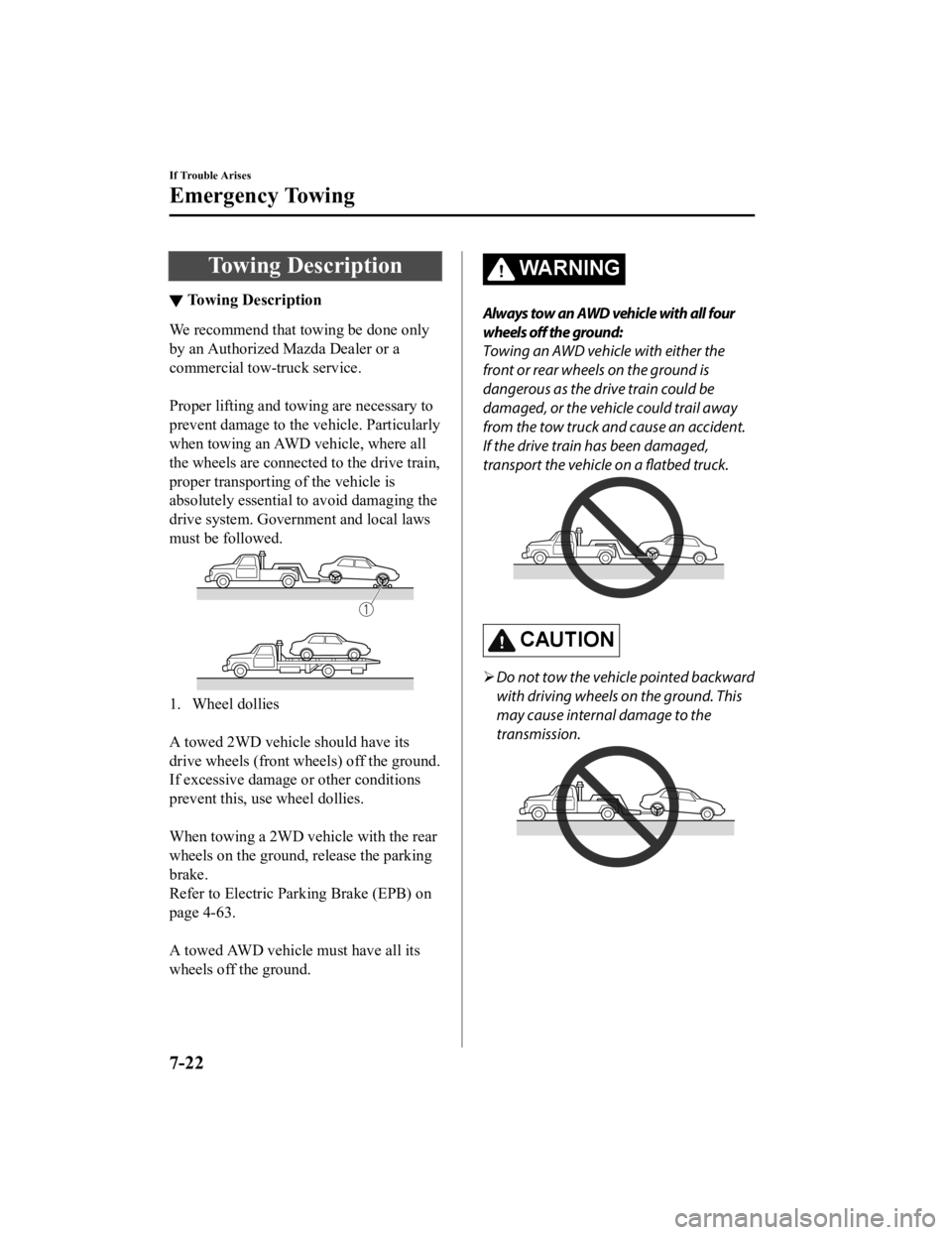
We recommend that towing be done only
by an Authorized Mazda Dealer or a
commercial tow-truck service.
Proper lifting and towing are necessary to
prevent damage to the vehicle. Particularly
when towing an AWD vehicle, where all
the wheels are connected to the drive train,
proper transporting of the vehicle is
absolutely essential to
avoid damaging the
drive system. Government and local laws
must be followed.
1. Wheel dollies
A towed 2WD vehicle should have its
drive wheels (front wheels) off the ground.
If excessive damage or other conditions
prevent this, use wheel dollies.
When towing a 2WD vehicle with the rear
wheels on the ground, release the parking
brake.
Refer to Electric Parking Brake (EPB) on
page 4-63.
A towed AWD vehicle must have all its
wheels off the ground.
WA R N I N G
Always tow an AWD vehicle with all four
wheels off the ground:
Towing an AWD vehicle with either the
front or rear wheels on the ground is
dangerous as the drive train could be
damaged, or the vehicle could trail away
from the tow truck and cause an accident.
If the drive train has been damaged,
transport the vehicle on a flatbed truck.
CAUTION
Do not tow the vehicle pointed backward
with driving wheels on the ground. This
may cause internal damage to the
transmission.
If Trouble Arises
Emergency Towing
7-22
Mazda3_8HE9-EA-18K_Edition3 2018-11-21 14:31:58