warning MAZDA MODEL 5 2008 Owner's Manual
[x] Cancel search | Manufacturer: MAZDA, Model Year: 2008, Model line: MODEL 5, Model: MAZDA MODEL 5 2008Pages: 376, PDF Size: 4.7 MB
Page 42 of 376
Black plate (42,1)
Installing Child-Restraint
Systems
Accident statistics reveal that a child is
safer in the rear seats. The front
passenger's seat is clearly the worst choice
for any child under 12, and with rear-
facing child-restraint systems it is clearly
unsafe due to air bags.
Some child-restraint systems now come
with tethers and therefore must be
installed on the seats that take tethers to
be effective. In your Mazda, tethered
child-restraint systems can only be
accommodated in the four positions on
the rear seats.
Even if your vehicle is equipped with
front passenger seat weight sensors (page
2-46), which automatically deactivates the
front passenger air bag, a rear seat is the
safest place for a child of any age or size.
Some child-restraint systems also employ
specially designed LATCH attachments;
refer to“LATCH Child-Restraint
Systems ”(page 2-36).
WARNING
Tethered Child-Restraint Systems Work
Only on Tether-Equipped Rear Seats:
Installation of a tether equipped
child-restraint system in the front
passenger's seat defeats the safety
design of the system and will result in
an increased chance of serious injury
if the child-restraint system goes
forward without benefit of being
tethered.
Place tether equipped child-restraint
systems where there are tether
anchors.
qRear Seats Child-Restraint
System Installation
Follow these instructions when using a
child-restraint system, unless you are
attaching a LATCH-equipped child-
restraint system to the rear LATCH lower
anchors. Refer to “LATCH Child-
Restraint Systems ”(page 2-36).
NOTE
Follow the child-restraint system
manufacturer's instructions carefully. If you
are not sure whether you have a LATCH
system or tether, check in the child-restraint
system manufacturer's instructions and follow
them accordingly. Depending on the type of
child-restraint system, it may not employ seat
belts which are in automatic locking mode.
1. If the seat in which you install a child- restraint system has a seat slide
function, slide the seat as far back as
possible.
2. Make sure the seatback is securely latched by pushing it back until it is
fully locked.
3. Secure the child-restraint system with the lap portion of the lap/shoulder belt.
See the manufacturer's instructions on
the child-restraint system for belt
routing instructions.
2-30
Essential Safety Equipment
Child Restraint
Mazda5_8X53-EA-07I_Edition3 Page42
Thursday, March 20 2008 4:11 PM
Form No.8X53-EA-07I
Page 44 of 376

Black plate (44,1)
Anchor bracket location (Third-row
seat)
Anchor
bracketMarking
Tether strap position (Third-row seat)
Tether strap
WARNING
Use the tether and tether anchor only
for a child-restraint system:
Using the tether or tether anchor to
secure anything but a child-restraint
system is dangerous. This could
weaken or damage the tether or
tether anchor and result in injury.
Always route the tether strap between
the head restraint and the seatback
(Second-row seats): Routing the tether strap on top of the
head restraint is dangerous. In a
collision the tether strap could slide
off the head restraint and loosen the
child-restraint system. The child-
restraint system could move which
may result in death or injury to the
child.
Always route the tether strap over the
head restraint (Third-row seat): Routing the tether strap between the
head restraint posts is dangerous as
it could damage or weaken the
seatback, resulting in the child-
restraint system not being correctly
secured. In a collision, the child-
restraint system could shift or loosen
which may result in death or injury to
the child.
Always attach the tether strap to the
correct tether anchor position: Attaching the tether strap to the
incorrect tether anchor position is
dangerous. In a collision, the tether
strap could come off and loosen the
child-restraint system. If the child-
restraint system moves it could result
in death or injury to the child.
2-32
Essential Safety Equipment
Child Restraint
Mazda5_8X53-EA-07I_Edition3 Page44
Thursday, March 20 2008 4:11 PM
Form No.8X53-EA-07I
Page 45 of 376
Black plate (45,1)
qIf You Must Use the Front Seat
for Children
If you cannot put all children in the rear
seats, at least put the smallest children in
the rear and be sure the largest child up
front uses the shoulder belt over the
shoulder.
NEVER put a rear-facing child-restraint
system on the front passenger seat, even
with a seat weight sensor equipped
vehicle.
This seat is also not set up for tethered
child-restraint systems, put them in one of
the rear seat positions set up with tether
anchors.
Likewise the LATCH child-restraint
system cannot be secured in the front
passenger's seat and should be used in the
second-row seats.
Don't allow anyone to sleep against the
side window if you have an optional side
and curtain air bag, it could cause serious
injuries to an out of position occupant. As
children more often sleep in cars, it is
better to put them in the rear seat. If
installing the child-restraint system on the
front seat is unavoidable, follow these
instructions when using a front-facing
child-restraint system in the front
passenger's seat.
NOTE
lTo check if your front seats have side air
bags:
Mazda vehicles equipped with side air bag
will have a “SRS AIRBAG ”tag on the
outboard shoulder of the front seats.
lTo check if your vehicle has curtain air
bags:
Mazda vehicles equipped with curtain air
bag will have an “SRS AIRBAG ”marking
on the window pillars along the roof edge.
WARNING
Always move the front passenger seat
as far back as possible if installing a
front-facing child-restraint system on it
is unavoidable: As your vehicle has front air bags
and doubly so if your vehicle has side
air bags, a front-facing child-
restraint system should be put on the
front passenger seat only when it is
unavoidable.
Even if the front passenger air bag
deactivation indicator light
illuminates, always move the seat as
far back as possible, because the
force of a deploying air bag could
cause serious injury or death to the
child.
Never use a rear-facing child-restraint
system in the front seat with an air bag
that could deploy: Rear-facing child-restraint systems
on the front seat are particularly
dangerous.
Even in a moderate collision, the
child-restraint system can be hit by a
deploying air bag and moved
violently backward resulting in
serious injury or death to the child.
Even though you may feel assured
that the front passenger air bag will
not deploy based on the fact that the
front passenger air bag deactivation
indicator light illuminates.
Essential Safety Equipment
Child Restraint
2-33
Mazda5_8X53-EA-07I_Edition3 Page45
Thursday, March 20 2008 4:11 PM
Form No.8X53-EA-07I
Page 47 of 376

Black plate (47,1)
5. Make sure the front passenger air bagdeactivation indicator light illuminates
after installing a child-restraint system
on the front passenger seat.
Refer to Front passenger air bag
deactivation indicator light on page
2-46.WARNING
Do not seat a child in a child-restraint
system on the front passenger seat if
the front passenger air bag
deactivation indicator light does not
illuminated:
While it is always better to install any
child-restraint system on the rear
seat, it is imperative that a child-
restraint system ONLYbe used on the
front passenger seat if the
deactivation indicator light
illuminates when the child is seated
in the child-restraint system (page
2-46). Seating a child in a child-
restraint system installed on the front
passenger seat with the front
passenger air bag deactivation
indicator light not illuminated is
dangerous. If this indicator light does
not illuminate even when the total
seated weight is less than
approximately 30 kg (66 lb), this
means that the front passenger front
and side air bags, and seat belt
pretensioner are ready for
deployment. If an accident were to
deploy an air bag, a child in a child-
restraint system sitting in the front
passenger seat could be seriously
injured or killed. If the indicator light
does not illuminate after seating a
child in a child-restraint system on
the front passenger seat, seat a child
in a child-restraint system on the rear
seat and consult an Authorized
Mazda Dealer as soon as possible.
Essential Safety Equipment
Child Restraint
2-35
Mazda5_8X53-EA-07I_Edition3 Page47
Thursday, March 20 2008 4:11 PM
Form No.8X53-EA-07I
Page 48 of 376

Black plate (48,1)
LATCH Child-Restraint Systems
Your Mazda is equipped with LATCH lower anchors for attachment of specially designed
LATCH child-restraint systems in the rear seats. Both anchors must be used, otherwise the
seat will bounce around and put the child in danger. Most LATCH child-restraint systems
must also be used in conjunction with a tether to be effective. If they have a tether you
must use it to better assure your child's safety.
WARNING
Follow the manufacturer's instructions for the use of the child-restraint system:An unsecured child-restraint system is dangerous. In a sudden stop or a collision it
could move causing serious injury or death to the child or other occupants. Make
sure the child-restraint system is properly secured in place according to the child-
restraint system manufacturer's instructions.
Never attach two child-restraint systems to the same LATCH lower anchor: Attaching two child-restraint systems to the same LATCH lower anchor is dangerous.
In a collision, one anchor may not be strong enough to hold two child-restraint
system attachments, and it may break, causing serious injury or death. If you use the
seat position for another child-restraint system when an outboard LATCH position is
occupied, use the center seat belts instead, and the tether if tether-equipped.
Make sure the child-restraint system is properly secured: An unsecured child-restraint system is dangerous. In a sudden stop or a collision it
could move causing serious injury or death to the child or other occupants. Follow
the child-restraint system manufacturer's instructions on belt routing to secure the
seat just as you would with a child in it so that nobody is tempted to put a child in
an improperly secured seat later on. When not in use, remove it from the vehicle or
fasten it with a seat belt, or latch it down to BOTH LATCH lower anchors for LATCH
child-restraint systems.
Make sure there are no seat belts or foreign objects near or around the LATCH child-
restraint system: Not following the child-restraint system manufacturer's instructions when installing
the child-restraint system is dangerous. If seat belts or a foreign object prevent the
child-restraint system from being securely attached to the LATCH lower anchors and
the child-restraint system is installed improperly, the child-restraint system could
move in a sudden stop or collision causing serious injury or death to the child or
other occupants. When installing the child-restraint system, make sure there are no
seat belts or foreign objects near or around the LATCH lower anchors. Always follow
the child-restraint system manufacturer's instructions.
2-36
Essential Safety Equipment
Child Restraint
Mazda5_8X53-EA-07I_Edition3 Page48
Thursday, March 20 2008 4:11 PM
Form No.8X53-EA-07I
Page 50 of 376

Black plate (50,1)
WARNING
Use the tether and tether anchor only
for a child-restraint system:Using the tether or tether anchor to
secure anything but a child-restraint
system is dangerous. This could
weaken or damage the tether or
tether anchor and result in injury.
Always route the tether strap between
the head restraint and the seatback: Routing the tether strap on top of the
head restraint is dangerous. In a
collision the tether strap could slide
off the head restraint and loosen the
child-restraint system. The child-
restraint system could move which
may result in death or injury to the
child.
Always attach the tether strap to the
correct tether anchor position: Attaching the tether strap to the
incorrect tether anchor position is
dangerous. In a collision, the tether
strap could come off and loosen the
child-restraint system. If the child-
restraint system moves it could result
in death or injury to the child.
2-38
Essential Safety Equipment
Child Restraint
Mazda5_8X53-EA-07I_Edition3 Page50
Thursday, March 20 2008 4:11 PM
Form No.8X53-EA-07I
Page 52 of 376
Black plate (52,1)
WARNING
Seat belts must be worn in air bag equipped vehicles:Depending only on the air bags for protection during an accident is dangerous.
Alone, air bags may not prevent serious injuries. The appropriate air bags can be
expected to inflate only in the first collision with frontal, near frontal or side forces
that are at least moderate. Vehicle occupants should always wear seat belts.
Children should not ride in the front passenger seat: Placing a child, 12 years or under, in the front seat is dangerous. The child could be
hit by a deploying air bag and be seriously injured or even killed. A sleeping child is
more likely to lean against the door and be hit by the side air bag in a moderate,
right-side collision. Whenever possible, always secure a child 12 years and under on
the rear seats with an appropriate child-restraint system for the child's age and size.
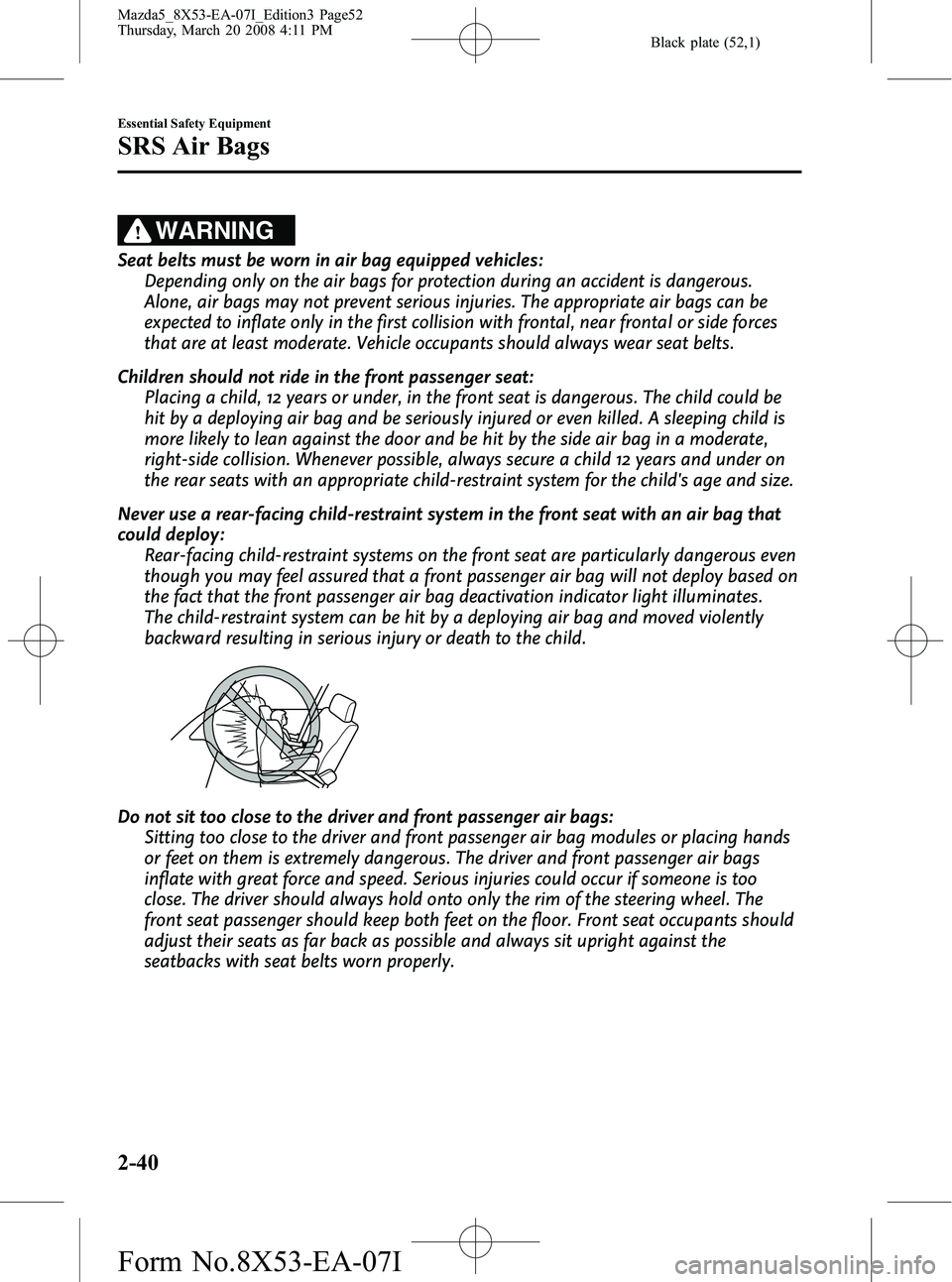
Never use a rear-facing child-restraint system in the front seat with an air bag that
could deploy: Rear-facing child-restraint systems on the front seat are particularly dangerous even
though you may feel assured that a front passenger air bag will not deploy based on
the fact that the front passenger air bag deactivation indicator light illuminates.
The child-restraint system can be hit by a deploying air bag and moved violently
backward resulting in serious injury or death to the child.
Do not sit too close to the driver and front passenger air bags:Sitting too close to the driver and front passenger air bag modules or placing hands
or feet on them is extremely dangerous. The driver and front passenger air bags
inflate with great force and speed. Serious injuries could occur if someone is too
close. The driver should always hold onto only the rim of the steering wheel. The
front seat passenger should keep both feet on the floor. Front seat occupants should
adjust their seats as far back as possible and always sit upright against the
seatbacks with seat belts worn properly.
2-40
Essential Safety Equipment
SRS Air Bags
Mazda5_8X53-EA-07I_Edition3 Page52
Thursday, March 20 2008 4:11 PM
Form No.8X53-EA-07I
Page 57 of 376

Black plate (57,1)
qSide and Curtain Air Bag System Components
(1)
(3)
(4) (2)
(5)
(2)
(4)
(1) Air bag/front seat belt pretensioner system warning light (page 2-54)
(2) Side and curtain inflators and air bags
(3) Front seats
(4) Side crash sensor
(5) Crash sensors and diagnostic module (SAS unit)
Essential Safety Equipment
SRS Air Bags
2-45
Mazda5_8X53-EA-07I_Edition3 Page57
Thursday, March 20 2008 4:11 PM
Form No.8X53-EA-07I
Page 58 of 376

Black plate (58,1)
How the Air Bags Work
qHow the Front Air Bags Work
When air bag crash sensors detect a frontal impact of greater than moderate force, an
electrical current is sent to the inflators.
Gases are produced to inflate the front air bags and after the inflation, the front air bags
quickly deflate.
The front air bags will function only once. After that, the front air bags will not work
again and must be replaced.
Only an Authorized Mazda Dealer can replace the system components.
The front, dual stage air bags control air bag inflation in two energy stages. During an
impact of moderate severity the front air bags deploy with lesser energy, whereas during
more severe impacts, they deploy with more energy. Deployment of the front air bags may
differ between the driver and the front passenger depending on the driver seat position,
front passenger weight and front seat belt usage, all of which provide data from each sensor
to the air bag system.
The front air bags will deploy only
in a frontal or frontal offset impact.
Driver seat slide position sensor
Your vehicle is equipped with a driver seat slide position sensor as a part of the
supplemental restraint system. The sensor is located under the driver seat. The sensor
determines whether the driver seat is fore or aft of a reference position and sends the seat
position to the diagnostic module (SAS unit). The SAS unit is also designed to control the
deployment of the driver air bag depending on how close the driver seat is to the steering
wheel.
The air bag/front seat belt pretensioner system warning light flashes if the sensor has a
possible malfunction (page 2-54).
2-46
Essential Safety Equipment
SRS Air Bags
Mazda5_8X53-EA-07I_Edition3 Page58
Thursday, March 20 2008 4:11 PM
Form No.8X53-EA-07I
Page 59 of 376

Black plate (59,1)
Front passenger seat weight sensors
Your vehicle is equipped with the front passenger seat weight sensors (page 2-34). These
sensors are located under both of the front passenger seat rails. These sensors determine the
total seated weight on the front passenger seat. The SAS unit is designed to prevent the
front passenger front and side air bags and seat belt pretensioner system from deploying if
the total seated weight is less than approximately 30 kg (66 lb).
To reduce the chance of injuries caused by deployment of the front passenger air bag, the
system deactivates the front passenger front and side air bags and also the seat belt
pretensioner system when:
lThere is no passenger in the front passenger seat. (The front passenger air bag
deactivation indicator light does not illuminate.)
lThe total seated weight on the front passenger seat is less than approximately 30 kg (66
lb). (The front passenger air bag deactivation indicator light illuminates.)
This system shuts off the front passenger front and side air bags and seat belt pretensioner
system, so make sure the front passenger air bag deactivation indicator light illuminates
according to the following table.
The air bag/front seat belt pretensioner system warning light flashes and the front
passenger air bag deactivation indicator light illuminates if the sensors have a possible
malfunction. If this happens, the front passenger front and side air bags and seat belt
pretensioner system will not deploy.
Front passenger air bag deactivation indicator light
This indicator light illuminates to remind you that the front passenger front and side air
bags and seat belt pretensioner will not deploy during a collision.
If the front passenger weight sensors are working properly, the indicator light illuminates
when the ignition switch is turned to the ON position. After a specified period of time it
goes out.
Essential Safety Equipment
SRS Air Bags
2-47
Mazda5_8X53-EA-07I_Edition3 Page59
Thursday, March 20 2008 4:11 PM
Form No.8X53-EA-07I