weight MAZDA MODEL 5 2015 Owner's Manual
[x] Cancel search | Manufacturer: MAZDA, Model Year: 2015, Model line: MODEL 5, Model: MAZDA MODEL 5 2015Pages: 458, PDF Size: 5.46 MB
Page 94 of 458

Black plate (94,1)
Liftgate
WARNING
Never allow a person to ride in the
luggage compartment:Allowing a person to ride in the
luggage compartment is dangerous.
The person in the luggage
compartment could be seriously
injured or killed during sudden
braking or a collision.
Do not drive with the liftgate open: Exhaust gas in the cabin of a vehicle
is dangerous. An open liftgate in a
moving vehicle will cause exhaust
gas to be drawn into the cabin. This
gas contains CO (carbon monoxide),
which is colorless, odorless, and
highly poisonous, and it can cause
loss of consciousness and death.
Moreover, an open liftgate could
cause occupants to fall out in an
accident.
Do not stack or leave loaded luggage
unsecured in the luggage
compartment: Otherwise, the luggage may move or
collapse, resulting in injury or an
accident. In addition, do not load
luggage higher than the seatbacks. It
may affect the side or rear field of
view.
CAUTION
ØBefore opening the liftgate,
remove any snow and ice
accumulation on it. Otherwise, the
liftgate could close under the
weight of the snow and ice
resulting in injury.
Ø Be careful when opening/closing
the liftgate during strong winds. If
a strong gust blows against the
liftgate, it could close suddenly
resulting in injury.
Ø Fully open the liftgate and make
sure that it stays open. If the
liftgate is only opened partially, it
could slam shut by vibration or
wind gusts resulting in injury.
Ø When loading or unloading
luggage in the luggage
compartment, turn off the engine.
Otherwise, you could get burned
by the heat of the exhaust gas.
Ø Be careful not to apply excessive
force to the damper stay on the
liftgate such as by putting your
hand on the stay. Otherwise, the
damper stay may bend and affect
the liftgate operation.
Damper stay
3-14
Knowing Your Mazda
Doors and Locks
Mazda5_8DW3-EA-14H_Edition3 Page94
Thursday, December 18 2014 9:26 AM
Form No.8DW3-EA-14H
Page 102 of 458
Black plate (102,1)
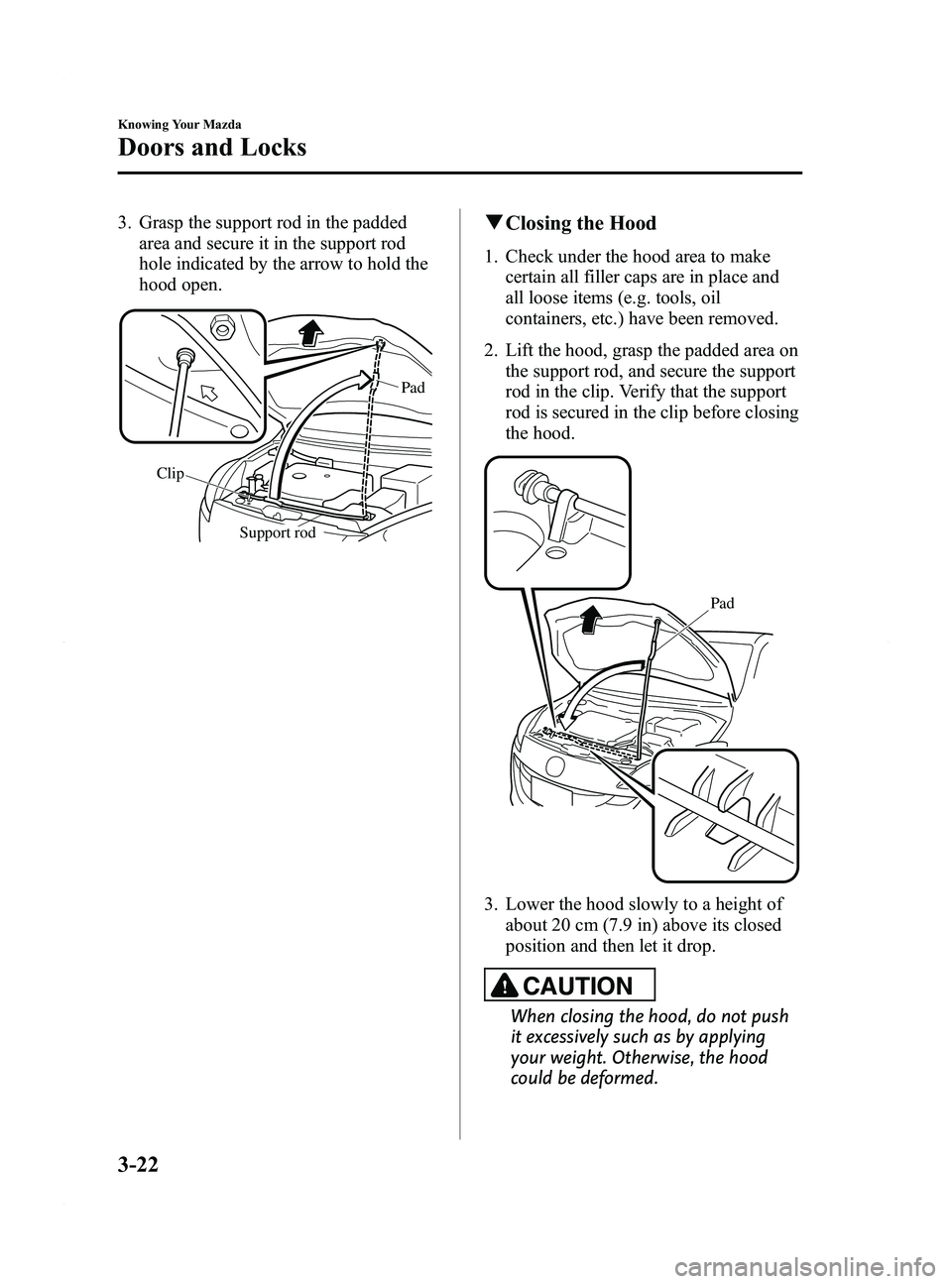
3. Grasp the support rod in the paddedarea and secure it in the support rod
hole indicated by the arrow to hold the
hood open.
Support rod
Clip
Pad
q
Closing the Hood
1. Check under the hood area to make
certain all filler caps are in place and
all loose items (e.g. tools, oil
containers, etc.) have been removed.
2. Lift the hood, grasp the padded area on the support rod, and secure the support
rod in the clip. Verify that the support
rod is secured in the clip before closing
the hood.
Pad
3. Lower the hood slowly to a height ofabout 20 cm (7.9 in) above its closed
position and then let it drop.
CAUTION
When closing the hood, do not push
it excessively such as by applying
your weight. Otherwise, the hood
could be deformed.
3-22
Knowing Your Mazda
Doors and Locks
Mazda5_8DW3-EA-14H_Edition3 Page102
Thursday, December 18 2014 9:26 AM
Form No.8DW3-EA-14H
Page 120 of 458

Black plate (120,1)
Break-In Period
No special break-in is necessary, but a few
precautions in the first 1,000 km (600
miles) may add to the performance,
economy, and life of your Mazda.
lDo not race the engine.lDo not maintain one constant speed,
either slow or fast, for a long period of
time.
lDo not drive constantly at full-throttle
or high engine rpm for extended
periods of time.
lAvoid unnecessary hard stops.lAvoid full-throttle starts.
Saving Fuel and Protection
of the Environment
How you operate your Mazda determines
how far it will travel on a tank of fuel. Use
these suggestions to help save fuel and
reduce CO2.
lAvoid long warm-ups. Once the engine
runs smoothly, begin driving.
lAvoid fast starts.lDrive at lower speeds.lAnticipate when to apply the brakes
(avoid sudden braking).
lKeep the engine tuned. Follow the
maintenance schedule (page 8-4) and
have an Authorized Mazda Dealer
perform inspections and servicing.
lUse the air conditioner only when
necessary.
lSlow down on rough roads.lKeep the tires properly inflated.lDo not carry unnecessary weight.lDo not rest your foot on the brake
pedal while driving.
lKeep the wheels in correct alignment.lKeep windows closed at high speeds.lSlow down when driving in crosswinds
and headwinds.
WARNING
Never stop the engine when going
down a hill:Stopping the engine when going
down a hill is dangerous. This causes
the loss of power steering and power
brake control, and may cause
damage to the drivetrain. Any loss of
steering or braking control could
cause an accident.
4-6
Before Driving Your Mazda
Driving Tips
Mazda5_8DW3-EA-14H_Edition3 Page120
Thursday, December 18 2014 9:26 AM
Form No.8DW3-EA-14H
Page 124 of 458
Black plate (124,1)
Driving In Flooded Area
WARNING
Dry wet brakes by driving very slowly
and applying the brakes lightly until
brake performance returns to normal:Driving with wet brakes is
dangerous. Increased stopping
distance or the vehicle pulling to one
side when braking could result in a
serious accident. Light braking will
indicate whether the brakes have
been affected.
CAUTION
Do not drive the vehicle on flooded
roads as it could cause short
circuiting of electrical/electronic
parts, or engine damage or stalling
from water absorption. If the vehicle
has been immersed in water, consult
an Authorized Mazda Dealer.
Overloading
WARNING
Be careful not to overload your vehicle:The gross axle weight rating (GAWR)
and the gross vehicle weight rating
(GVWR) of your vehicle are on the
Motor Vehicle Safety Standard Label
on the driver's door frame. Exceeding
these ratings can cause an accident
or vehicle damage. You can estimate
the weight of your load by weighing
the items (or people) before putting
them in the vehicle.
4-10
Before Driving Your Mazda
Driving Tips
Mazda5_8DW3-EA-14H_Edition3 Page124
Thursday, December 18 2014 9:26 AM
Form No.8DW3-EA-14H
Page 145 of 458

Black plate (145,1)
Recommendations for shifting
Upshifting
For normal acceleration and cruising, we
recommend these shift points.
GearVehicle speed
M1 to M2 25 km/h (15 mph)
M2 to M3 41 km/h (25 mph)
M3 to M4 65 km/h (40 mph)
M4 to M5 73 km/h (45 mph)
Downshifting
When you must slow down in heavy
traffic or on a steep upgrade, downshift
before the engine starts to overwork. This
gives better acceleration when you need
more speed.
On a steep downgrade , downshifting
helps maintain safe speed and prolongs
brake life.
q Driving Tips
WARNING
Do not allow the vehicle to move in
reverse on an up-slope while the
selector lever is in a forward gear
position, or move forward on a down-
slope while the selector lever is in the
reverse position.
Otherwise, the engine will stop,
causing the loss of the power brake
and power steering functions, and
make it difficult to control the vehicle
which could result in an accident.
Passing
For extra power when passing another
vehicle or climbing steep grades, depress
the accelerator fully. The transaxle will
shift to a lower gear, depending on vehicle
speed.
Climbing steep grades from a stop
To climb a steep grade from a stopped
position:
1. Depress the brake pedal.
2. Shift to D or M1, depending on theload weight and grade steepness.
3. Release the brake pedal while gradually accelerating.
Descending steep grades
When descending a steep grade, shift to
lower gears, depending on load weight
and grade steepness. Descend slowly,
using the brakes only occasionally to
prevent them from overheating.
Driving Your Mazda
Starting and Driving
5-19
Mazda5_8DW3-EA-14H_Edition3 Page145
Thursday, December 18 2014 9:26 AM
Form No.8DW3-EA-14H
Page 188 of 458

Black plate (188,1)
qLights-On Reminder
If lights are on and the key is removed
from the ignition switch, a continuous
beep sound will be heard when the
driver's door is opened.
NOTE
A personalized function is available to change
the sound volume for the lights-on reminder.
Refer to Personalization Features on page
10-8.
qHeadlight High-Low Beam
Press the lever forward to turn on the high
beams.
Pull the lever back to its original position
for the low beams.
High beam
Low beam
qFlashing the Headlights
To flash the headlights, pull the lever fully
towards you (the headlight switch does
not need to be on). The lever will return to
the normal position when released.
OFF
Flashing
q Headlight Levelingí
The number of passengers and weight of
cargo in the luggage compartment change
the angle of the headlights.
The headlight leveling switch is used to
adjust the angle of the headlights
manually.
5-62
Driving Your Mazda
íSome models.
Switches and Controls
Mazda5_8DW3-EA-14H_Edition3 Page188
Thursday, December 18 2014 9:27 AM
Form No.8DW3-EA-14H
Page 368 of 458
Black plate (368,1)
qBattery Replacement
Contact an Authorized Mazda Dealer for a
battery replacement purchase.
Tires
For reasons of proper performance, safety,
and better fuel economy, always maintain
recommended tire inflation pressures and
stay within the recommended load limits
and weight distribution.
WARNING
Using Different Tire Types:
Driving your vehicle with different
types of tires is dangerous. It could
cause poor handling and poor
braking; leading to loss of control.
Except for the limited use of the
temporary spare tire, use only the
same type tires (radial, bias-belted,
bias-type) on all four wheels.
Using Wrong-Sized Tires: Using any other tire size than what is
specified for your Mazda (page 10-6)
is dangerous. It could seriously affect
ride, handling, ground clearance, tire
clearance, and speedometer
calibration. This could cause you to
have an accident. Use only tires that
are the correct size specified for your
Mazda.
8-36
Maintenance and Care
Owner Maintenance
Mazda5_8DW3-EA-14H_Edition3 Page368
Thursday, December 18 2014 9:28 AM
Form No.8DW3-EA-14H
Page 422 of 458

Black plate (422,1)
11. Max. load rating
12. Tread wear, traction and temperature grades
13. Max. permissible inflation pressure
14. SAFETY WARNING
P215/65R15 95H is an example of a tire size and load index rating. Here is an explanation
of the various components of that tire size and load index rating. Note that the tire size and
load index rating may be different from the example.
P
Indicates a tire that may be installed on cars, SUVs, minivans and light trucks as designated
by the Tire and Rim Association (T&RA).
NOTE
If your tire size does not begin with a letter this may mean it is designated by either ETRTO
(European Tire and Rim Technical Organization) or JATMA (Japan Tire Manufacturing Association).
215
“215 ”is the nominal width of the tire in millimeters. This three-digit number gives the
width in millimeters of the tire from sidewall edge to sidewall edge. In general, the larger
the number, the wider the tire.
65
“ 65 ”is the aspect ratio. This two-digit number indicates the tire's ratio of height to width.
R
“R” is the tire construction symbol. R indicates “Radial ply construction ”.
15
“15 ”is the wheel rim diameter in inches.
95
“95 ”is the Load Index. This two-or three-digit number indicates how much weight each
tire can support.
9-24
Customer Information and Reporting Safety Defects
Tire Information (U.S.A.)
Mazda5_8DW3-EA-14H_Edition3 Page422
Thursday, December 18 2014 9:28 AM
Form No.8DW3-EA-14H
Page 423 of 458
Black plate (423,1)
H
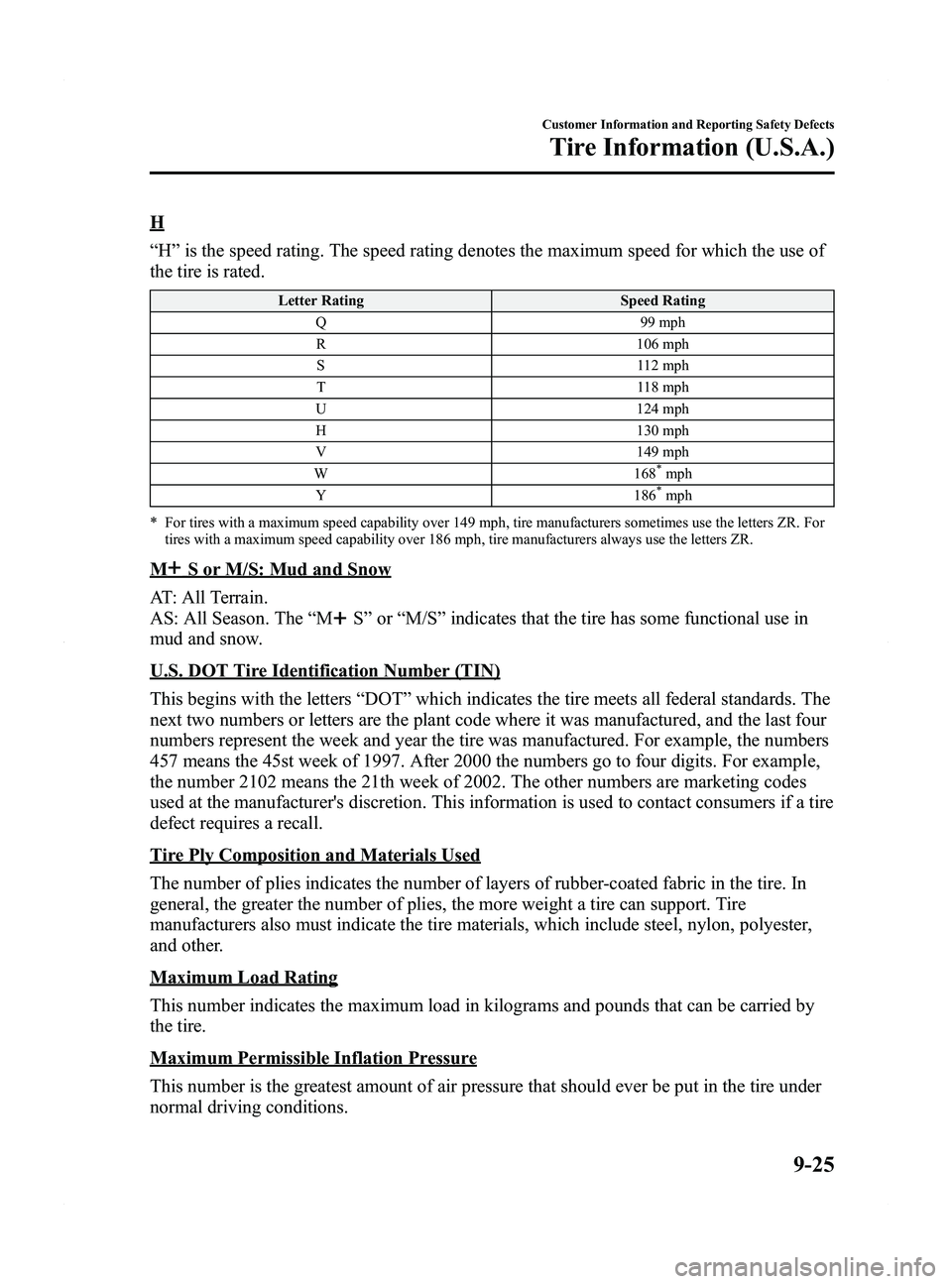
“H ”is the speed rating. The speed rating denotes the maximum speed for which the use of
the tire is rated.
Letter Rating Speed Rating
Q 99 mph
R 106 mph
S 112 mph
T 118 mph
U 124 mph
H 130 mph
V 149 mph
W 168
*mph
Y 186*mph
* For tires with a maximum speed capability over 149 mph, tire manufacturers sometimes use the letters ZR. For tires with a maximum speed capability over 186 mph, tire manufacturers always use the letters ZR.
MS or M/S: Mud and Snow
AT: All Terrain.
AS: All Season. The “M
S” or“M/S ”indicates that the tire has some functional use in
mud and snow.
U.S. DOT Tire Identification Number (TIN)
This begins with the letters “DOT ”which indicates the tire meets all federal standards. The
next two numbers or letters are the plant code where it was manufactured, and the last four
numbers represent the week and year the tire was manufactured. For example, the numbers
457 means the 45st week of 1997. After 2000 the numbers go to four digits. For example,
the number 2102 means the 21th week of 2002. The other numbers are marketing codes
used at the manufacturer's discretion. This information is used to contact consumers if a tire
defect requires a recall.
Tire Ply Composition and Materials Used
The number of plies indicates the number of layers of rubber-coated fabric in the tire. In
general, the greater the number of plies, the more weight a tire can support. Tire
manufacturers also must indicate the tire materials, which include steel, nylon, polyester,
and other.
Maximum Load Rating
This number indicates the maximum load in kilograms and pounds that can be carried by
the tire.
Maximum Permissible Inflation Pressure
This number is the greatest amount of air pressure that should ever be put in the tire under
normal driving conditions.
Customer Information and Reporting Safety Defects
Tire Information (U.S.A.)
9-25
Mazda5_8DW3-EA-14H_Edition3 Page423
Thursday, December 18 2014 9:28 AM
Form No.8DW3-EA-14H
Page 426 of 458

Black plate (426,1)
70
“70 ”is the aspect ratio. This two-digit number indicates the tire's ratio of height to width.
D
“D ”is the tire construction symbol. D indicates “diagonal ply construction ”.
16
“16 ”is the wheel rim diameter in inches.
90
“90 ”is the Load Index. This two-or three-digit number indicates how much weight each
tire can support.
M
“ M ”is the speed rating. The speed rating denotes the maximum speed for which the use of
the tire is rated.
Letter Rating Speed Rating
M 81 mph
9-28
Customer Information and Reporting Safety Defects
Tire Information (U.S.A.)
Mazda5_8DW3-EA-14H_Edition3 Page426
Thursday, December 18 2014 9:28 AM
Form No.8DW3-EA-14H