tire pressure MAZDA MODEL 6 2021 Owner's Manual
[x] Cancel search | Manufacturer: MAZDA, Model Year: 2021, Model line: MODEL 6, Model: MAZDA MODEL 6 2021Pages: 634, PDF Size: 71.37 MB
Page 448 of 634
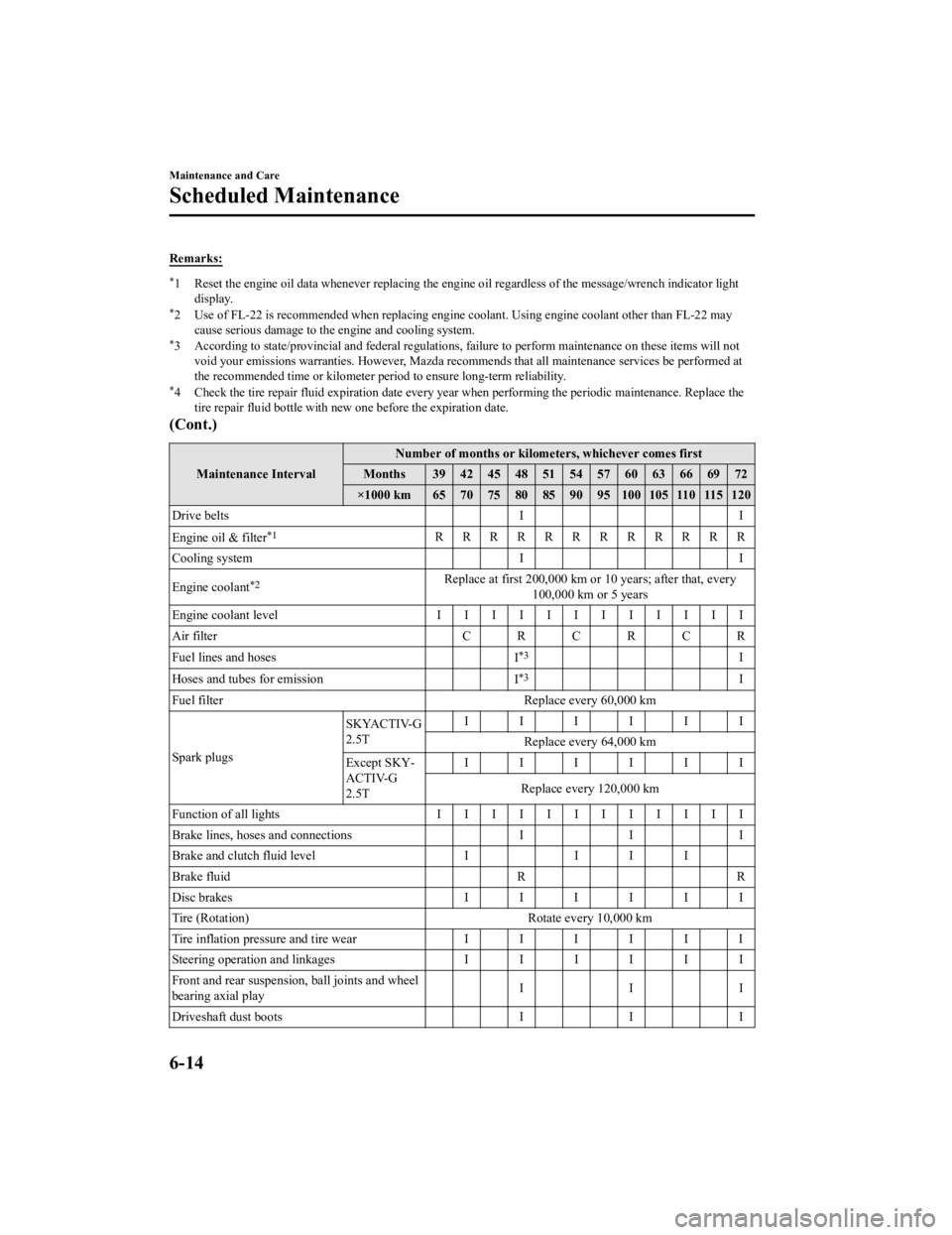
Remarks:
*1 Reset the engine oil data whenever replacing the engine oil regardless of the message/wrench indicator light
display.
*2 Use of FL-22 is recommended when replacing engine coolant. Using engine coolant other than FL-22 may
cause serious damage to the engine and cooling system.
*3 According to state/provincial and federal regulations, failure to perform maintenance on these items will not
void your emissions warranties. H owever, Mazda recommends that all maintenance services be performed at
the recommended time or kilometer period to ensure long-term reliability.
*4 Check the tire repair fluid expiration date every year when pe rforming the periodic maintenance. Replace the
tire repair fluid bottle with ne w one before the expiration dat e.
(Cont.)
Maintenance Interval Number of months or kilometers, whichever comes first
Months 39 42 45 48 51 54 57 60 63 66 69 72
×1000 km 65707580859095100105110115120
Drive belts II
Engine oil & filter
*1RRRRRRRRRRRR
Cooling system II
Engine coolant
*2Replace at first 200,000 km or 10 years; after that, every 100,000 km or 5 years
Engine coolant level IIIIIIIIIIII
Air filter CRCRCR
Fuel lines and hoses I
*3I
Hoses and tubes for emission I
*3I
Fuel filter Replace every 60,000 km
Spark plugs SKYACTIV-G
2.5T
IIIIII
Replace every 64,000 km
Except SKY‐
ACTIV-G
2.5T IIIIII
Replace every 120,000 km
Function of all lights IIIIIIIIIIII
Brake lines, hoses and connections II I
Brake and clutch fluid level II I I
Brake fluid RR
Disc brakes IIIIII
Tire (Rotation) Rotate every 10,000 km
Tire inflation pressure and tire wear IIIIII
Steering operation and linkages IIIIII
Front and rear suspensi on, ball joints and wheel
bearing axial play III
Driveshaft dust boots II I
Maintenance and Care
Scheduled Maintenance
6-14
Mazda6_8JN3-EA-20H_Edition1_old 2020-6-18 17:31:27
Page 450 of 634

Owner Maintenance Precautions
The owner or a qualified service technician should make these vehicle inspections at the
indicated intervals to ensure safe and dependable operation.
Bring any problem to the attention of an Authorized Mazda Deale r or qualified service
technician as soon as possible.
When Refueling
Brake fluid level (page 6-28)
Engine coolant level (page 6-26)
Engine oil level (page 6-25)
Washer fluid level (page 6-29)
At Least Monthly
Tire inflation pressures (page 6-44)
At Least Twice a Year (For Example, Every Spring and Fall)
You can do the following schedu led maintenance items if you hav e some mechanical ability
and a few basic tools and if you closely follow the directions in this manual.
Engine coolant (page 6-26)
Engine oil (page 6-22)
Improper or incomplete service may result in problems. This sec tion gives instructions only
for items that are easy to perform.
As explained in the Introduction (page 6-2), several procedures can be done only by a
qualified service technician with special tools.
Improper owner maintenance during the warranty period may affec t warranty coverage.
Refer to Introduction (page 6-2) for owner's responsibility in protecting your investment.
For details, read the separate Mazda Warranty statement provide d with the vehicle. If you
are unsure about any servicing or maintenance procedure, have i t done by an Authorized
Mazda Dealer.
There are strict environmental laws regarding the disposal of w aste oil and fluids. Please
dispose of your waste properly and with due regard to the envir onment.
We recommend that you entrust the oil and fluid changes of your vehicle to an Authorized
Mazda Dealer.
Maintenance and Care
Owner Maintenance
6-16
Mazda6_8JN3-EA-20H_Edition1_old 2020-6-18 17:31:27
Page 478 of 634

Tires
For reasons of proper performance, safety,
and better fuel economy, always maintain
recommended tire inflation pressures and
stay within the recommended load limits
and weight distribution.
WA R N I N G
Using Different Tire Types:
Driving your vehicle with different types of
tires is dangerous. It could cause poor
handling and poor braking; leading to loss
of control.
Except for the limited use of the temporary
spare tire, use only the same type tires
(radial, bias-belted, bias-type) on all four
wheels.
Using Wrong-Sized Tires:
Using any other tire size than what is
specified for the vehicle (page 9-8) is
dangerous. It could seriously affect ride,
handling, ground clearance, tire clearance,
and speedometer calibration. This could
cause you to have an accident. Use only
tires that are the correct size specified for
the vehicle.
▼ Tire Inflation Pressure
WA R N I N G
Always inflate the tires to the correct
pressure:
Overinflation or underinflation of tires is
dangerous. Adverse handling or
unexpected tire failure could result in a
serious accident.
Refer to Tires on page 9-8.
Use only a Mazda-genuine tire valve cap:
Use of a non-genuine part is dangerous as
the correct tire air pressure cannot be
maintained if the tire valve becomes
damaged. If the vehicle is driven under this
condition, the tire air pressure will decrease
which could result in a serious accident. Do
not use any part for the tire valve cap that
is not a Mazda-genuine part.
Inspect all tire pressures monthly
(including the spare) when the tires are
cold. Maintain recom
mended pressures for
the best ride, handling, and minimum tire
wear.
Refer to the specification charts (page
9-8).
NOTE
Always check tire pressure when tires
are cold.
Warm tires normally exceed
recommended pressures. Do not release
air from warm tires to adjust the
pressure.
Underinflation can cause reduced fuel
economy, uneven and accelerated tire
wear, and poor sealing of the tire bead,
which will deform the wheel and cause
separation of tire from rim.
Overinflation can produce a harsh ride,
uneven and accelerated tire wear, and a
greater possibility of damage from road
hazards.
Keep your tire pressure at the correct
levels. If one frequen tly needs inflating,
have it inspected.
Maintenance and Care
Owner Maintenance
6-44
Mazda6_8JN3-EA-20H_Edition1_old 2020-6-18 17:31:27
Page 479 of 634

▼Tire Rotation
WARNING
Rotate tires periodically:
Irregular tire wear is dangerous. To
equalize tread wear for maintaining good
performance in handling and braking,
rotate the tires every 12,000 km (7,500
miles). However Mazda recommends to
rotate every 8,000 km (5,000 miles) to help
increase tire life and distribute wear more
evenly.
Refer to Scheduled Maintenance on page
6-4.
During rotation, inspect them for correct
balance.
Do not include (TEMPORARY USE
ONLY) spare tire in rotation.
Forward
Also, inspect them for uneven wear and
damage. Abnormal wear is usually caused
by one or a combination of the following:
Incorrect tire pressure
Improper wheel alignment
Out-of-balance wheel
Severe braking
After rotation, inflate all tire pressures to
specification (page 9-8) and inspect the
lug nuts for tightness.
CAUTION
Rotate unidirectional tires and radial tires
that have an asymmetrical tread pattern or
studs only from front to rear, not from side
to side. Tire performance will be reduced if
rotated from side to side.
▼ Replacing a Tire
WA R N I N G
Always use tires that are in good condition:
Driving with worn tires is dangerous.
Reduced braking, steering, and traction
could result in an accident.
Replace all four tires at the same time:
Replacing just one tire is dangerous. It
could cause poor handling and poor
braking resulting in loss of vehicle control.
Mazda strongly recommends that you
replace all four tires at the same time.
If a tire wears evenly, a wear indicator will
appear as a solid band across the tread.
Replace the tire when this happens.
New tread
Tread wear
indicator
Worn tread
Maintenance and Care
Owner Maintenance
6-45
Mazda6_8JN3-EA-20H_Edition1_old
2020-6-18 17:31:27
Page 481 of 634

▼Replacing a Wheel
WARNING
Always use wheels of the correct size on
your vehicle:
Using a wrong-sized wheel is dangerous.
Braking and handling could be
affected,
leading to loss of control and an accident.
CAUTION
A wrong-sized wheel may adversely affect:
Tire fit
Wheel and bearing life
Ground clearance
Snow-chain clearance
Speedometer calibration
Headlight aim
Bumper height
Tire Pressure Monitoring System
NOTE
When replacing a wheel, make sure the
new one is the same as the original
factory wheel in diameter, rim width,
and offset (inset/outset).
For details, contact an Authorized
Mazda Dealer.
Proper tire balancing provides the best
riding comfort and helps reduce tread
wear. Out-of-balance tires can cause
vibration and uneven wear, such as
cupping and flat spots.
Maintenance and Care
Owner Maintenance
6-47
Mazda6_8JN3-EA-20H_Edition1_old 2020-6-18 17:31:27
Page 513 of 634

▼Locking Lug Nuts
If your Mazda is equipped with the
optional antitheft whe
el lug nuts, a special
key must be used to unlock the locking lug
nut for each wheel. The key is stored in
the glove compartmen t, center console
storage, storage box, or trunk. Register the
key and lug nuts with the lock
manufacturer by filling out the registration
card and mailing it in using the
accompanying envelope. If the key is lost,
consult an Authorized Mazda Dealer or
use the lock manufacturer’s order form to
order a new key.
Antitheft wheel lug nuts cannot be
installed on a steel wheel spare tire. When
installing a temporary spare tire, use one
of the original lug nuts in place of the
locking lug nut. The original lug nuts are
stored inside your Mazda.
Special key
Antitheft lug nut
To remove an antitheft lug nut
1. Obtain the special key for the antitheft
lug nut.
2. Place the special key on top of the antitheft lug nut, and be sure to hold
the key square to it. If you hold the key
at an angle, you may damage both key
and nut. Do not use a power impact
wrench.
3. Place the lug wrench on top of the key and apply pressure. Turn the wrench
counterclockwise.
To install the antitheft lug nut
1. Place the special key on top of the nut, and be sure to hold the key square to it.
If you hold the key at an angle, you
may damage both key and nut. Do not
use a power impact wrench.
2. Place the lug wrench on top of the
special key, apply pressure, and turn it
clockwise.
Nut tightening torque
N·m (kgf·m, ft·lbf) 108―147 (12―14,
80―108)
If Trouble Arises
Flat Tire
7-11
Mazda6_8JN3-EA-20H_Edition1_old 2020-6-18 17:31:27
Page 516 of 634

12. Thread the belt through the buckle,then pull the belt end to secure the flat
tire.
13. Return the seat back on the right sideof the rear seat to it s original position.
14. Remove the tire blocks and store the
tools and jack.
15. Check the inflation pressure. Refer to Tires on page 9-8.
16. Have the flat tire repaired or replaced as soon as possible.
WA R N I N G
Do not drive with any tires that have
incorrect air pressure:
Driving on tires with incorrect air pressure
is dangerous. Tires with incorrect pressure
could affect handling and result in an
accident. When you check the regular tires'
air pressure, check the spare tire, too.
NOTE
To prevent the jack and tool from rattling,
store them properly.
If Trouble Arises
Flat Tire
7-14
Mazda6_8JN3-EA-20H_Edition1_old 2020-6-18 17:31:27
Page 534 of 634

SignalWarning
Air Bag/Front Seat
Belt Pretensioner
System Warning
Light A system malfunction is indicated if the warning light constant
ly flashes, constantly illu‐
minates or does not illuminate a t all when the ignition is switched ON. If any of these oc‐
cur, consult an Authorized Mazda Dealer as soon as possible. The system may not operate
in an accident.WARNING
Never tamper with the air bag/pretensioner systems and always have an Authorized Mazda
Dealer perform all servicing and repairs:
Self-servicing or tampering with the systems is dangerous. An air bag/pretensioner could
accidentally activate or become disabled causing serious injury or death.
(Flashing)
Tire Pressure Moni‐ toring System
Warning Light If the tire pressure monitoring s
ystem has a malfunction, the tire pressure warning light
flashes. Have your vehicle check ed by an Authorized Mazda Deale r as soon as possible.
WARNING
If the tire pressure monitoring system warning light illuminates or
flashes, or the tire pres‐
sure warning beep sound is heard, decrease vehicle speed immediately and avoid sudden
maneuvering and braking:
If the tire pressure monitoring system warning light illuminates or flashes, or the tire pres‐
sure warning beep sound is heard, it is dang erous to drive the vehicle at high speeds, or
perform sudden maneuver ing or braking. Vehicle drivabilit y could worsen and result in an
accident.
To determine if you have a slow leak or a flat, pull over to a safe position where you can
check the visual condition of the tire and determine if you have enough air to proceed to a
place where air may be added and the system monitored again by an Authorized Mazda
Dealer or a tire repair station.
Do not ignore the TPMS Warning Light:
Ignoring the TPMS warning light is dangerous, even if you know why it is illuminated. Have
the problem taken care of as soon as possible before it develops into a more serious situa‐
tion that could lead to tire failure and a dangerous accident.
If Trouble Arises
Warning/Indicator Lights and Warning Sounds
7-32
Mazda6_8JN3-EA-20H_Edition1_old 2020-6-18 17:31:27
Page 540 of 634

SignalWarning Action to be taken
Door-Ajar/Trunk
lid-Ajar Warning Indi‐ cation/Warning Light The light turns on if any door/trunk lid is
not closed securely.
Close the door/trunk lid securely.
Tire Pressure Monitoring Sys
tem Warning Light (Turns on)
Take the appropriate action and verify that the warning light t urns off.
Wa r n i n g
When the warning light illuminate s, and the warning beep sound is heard when tire pressu re is too low in one or
more tires.
WA R N I N G
If the tire pressure monitoring system warning light illuminates or flashes, or the tire pressure warning beep sound
is heard, decrease vehicle speed immediately and avoid sudden maneuvering and braking:
If the tire pressure monitoring system warning light illumin ates or flashes, or the tire pressure warning beep sound
is heard, it is dangerous to drive the vehicle at high speeds, or perform sudden maneuvering or braking. Vehicle
drivability could worsen and result in an accident.
To determine if you have a slow leak or a flat, pull over to a safe position where you can check the visual condition
of the tire and determine if you have enough air to proceed to a place where air may be added and the system
monitored again by an Authorized Mazda Dealer or a tire repair station.
Do not ignore the TPMS Warning Light:
Ignoring the TPMS warning light is da ngerous, even if you know why it is illuminated. Have the problem taken
care of as soon as possible before it develops into a more serious situation that could lead to tire failure and a
dangerous accident.
If Trouble Arises
Warning/Indicator Lights and Warning Sounds
7-38
Mazda6_8JN3-EA-20H_Edition1_old 2020-6-18 17:31:27
Page 541 of 634

Action to be taken
Inspect the tires and adjust to the specified inflation pressur e (page 6-44).
CAUTION
When replacing/repairing the tires or wheels or both, have the work done by an Authorized Mazda Dealer, or the
tire pressure sens ors may be damaged.
NOTE
Perform tire pressure adjustment when the tires are cold . Tire pressure will vary according to the tire temper‐
ature, therefore let the vehicle stand for 1 hour or only drive it 1.6 km (1 mile) or less before adjusting the
tire pressures. When pressure is adjusted on hot tires to the cold inflation pressure, the TPMS warning light/
beep may turn on after the tires cool and pressure drops below specification.
Also, an illuminated TPMS warning light, resulting from the tire air pressure dropping due to cold ambient
temperature, may turn off if the ambient temperature rises. In this case, it will also be necessary to adjust the
tire air pressures. If the TPMS warnin g light illuminates due to a drop in tire air pressure, make sure to check
and adjust the tire air pressures.
After adjusting the tire air pressures, it may require some time for the TPMS warning light to turn off. If the
TPMS warning light remains illuminate d, drive the vehicle at a speed of at least 25 km/h (16 mph) for 10
minutes, and then verify that it turns off.
Tires lose air naturally over time and the TPMS cannot tell if the tires are getting too soft over time or you
have a flat. However, when you find one low tire in a set of four-that is an indication of trouble; you should
have someone drive the vehicle slowly forward so you can inspect any low tire for cuts and any metal objects
sticking through tread or sidewall. Put a few drops of water in the valve stem to see if it bubbles indicating a
bad valve. Leaks need to be addr essed by more than simply refilling the trouble tire as leaks are dangerous
― take it to an Authorized Mazda Dealer which has all the equipment to fix tires, TPMS systems and order
the best replacement tire for your vehicle.
If the warning light illuminates again even after the tire pressures are adjusted, there may be a tire puncture.
If Trouble Arises
Warning/Indicator Lights and Warning Sounds
7-39
Mazda6_8JN3-EA-20H_Edition1_old 2020-6-18 17:31:27