wheel MAZDA MODEL 6 WAGON 2007 Workshop Manual
[x] Cancel search | Manufacturer: MAZDA, Model Year: 2007, Model line: MODEL 6 WAGON, Model: MAZDA MODEL 6 WAGON 2007Pages: 384, PDF Size: 3.81 MB
Page 305 of 384

Black plate (305,1)
5. Disconnect the socket and bulbassembly from the electrical connector
by pressing the tab on the connector
with your finger and pulling it.
NOTE
lIf the halogen bulb is accidentally
touched, it should be cleaned with
rubbing alcohol before being used.
lTo replace the bulb, contact an
Authorized Mazda Dealer.
lUse the protective cover and carton
for the replacement bulb to dispose
of the old bulb promptly and out of
the reach of children.
6. Install the new socket and bulb assembly in the reverse order of
removal.
Front turn signal lights
1. Turn the socket and bulb assemblycounterclockwise and remove it. 2. Remove the bulb by pushing it in
slightly and turning it
counterclockwise.
3. Install the new bulb in the reverse orderof removal.
Side-marker lights
1. If you are changing the left side-maker
light, start the engine, turn the steering
wheel all the way to the right, and turn
off the engine. If you are changing the
right side-maker light, turn the steering
wheel to the left.
2. Turn the screws counterclockwise and remove them.
Maintenance and Care
Owner Maintenance
8-41
Mazda6_8W89-EA-06K_Edition1 Page305
Tuesday, November 14 2006 1:25 PM
Form No.8W89-EA-06K
Page 322 of 384

Black plate (322,1)
CAUTION
Don't use steel wool, abrasive cleaners,
or strong detergents containing highly
alkaline or caustic agents on chrome-
plated or anodized aluminum parts.
This may result in damage to the
protective coating and cause
discoloration or paint deterioration.
qUnderbody Maintenance
Road chemicals and salt used for ice and
snow removal and solvents used for dust
control may collect on the underbody. If
not removed, they will speed up rusting
and deterioration of such underbody parts
as fuel lines, frame, floor pan, and exhaust
system, even though these parts may be
coated with anti-corrosive material.
Thoroughly flush the underbody and
wheel housings with lukewarm or cold
water at the end of each winter. Try also
to do this every month.
Pay special attention to these areas
because they easily hide mud and dirt. It
will do more harm than good to wet
down the road grime without removing
it.
The lower edges of doors, rocker panels,
and frame members have drain holes that
should not be clogged. Water trapped
there will cause rusting.
WARNING
Driving with Wet Brakes:
Driving with wet brakes is dangerous.
Increased stopping distance or the
vehicle pulling to one side when
braking could result in a serious
accident. Light braking will indicate
whether the brakes have been affected.
Dry the brakes by driving very slowly
and applying the brakes lightly until
brake performance is normal.
q Aluminum Wheel Maintenance
A protective coating is provided over the
aluminum wheels. Special care is needed
to protect this coating.
NOTE
lDon't use a wire brush or any
abrasive cleaner, polishing
compound, or solvent on aluminum
wheels. They may damage the
coating.
lOnly use a mild soap or neutral
detergent and always use a sponge or
soft cloth to clean the wheels.
Rinse thoroughly with lukewarm or
cold water. Also, be sure to clean the
wheels after driving on dusty or
salted roads. This helps prevent
corrosion.
lAvoid washing your vehicle in an
automatic car wash that uses high-
speed or hard brushes.
lIf your aluminum wheels lose luster,
wax the wheels.
8-58
Maintenance and Care
Appearance Care
Mazda6_8W89-EA-06K_Edition1 Page322
Tuesday, November 14 2006 1:25 PM
Form No.8W89-EA-06K
Page 344 of 384
Black plate (344,1)
Uniform Tire Quality Grading System (UTQGS)
This information relates to the tire grading system developed by the U.S. National
Highway Traffic Safety Administration for grading tires by tread wear, traction, and
temperature performance.
qTread Wear
The tread wear grade is a comparative rating based on the wear rate of the tire when tested
under controlled conditions on a specified government test course.
For example, a tire graded 150 would wear one-and-a-half times as well on the government
course as a tire graded 100.
The relative performance of tires depends upon the actual conditions of their use, however,
and may depart significantly from the norm because of variations in driving habits, service
practices and differences in road characteristics and climate.
qTraction-AA, A, B, C
The traction grades, from highest to lowest, are AA, A, B, and C. These grades represent
the tire's ability to stop on wet pavement as measured under controlled conditions on
specified government test surfaces of asphalt and concrete. A tire marked C may have poor
traction performance.
WARNING
The traction grade assigned to this tire is based on braking (straight ahead) traction
tests and does not include acceleration cornering (turning), hydroplaning, or peak
traction characteristics.
qTemperature-A, B, C
The temperature grades A (the highest), B, and C, represent the tire's resistance to the
generation of heat and its ability to dissipate heat when tested under controlled conditions
on a specified indoor laboratory test wheel.
Sustained high temperature can cause the material of the tire to degenerate and reduce tire
life, and excessive temperatures can lead to sudden tire failure.
Grade C corresponds to a level of performance which all passenger vehicle tires must meet
under the Federal Motor Vehicle Safety Standard No. 109. Grades B and A represent
higher levels of performance on the laboratory test wheel than the minimum required by
law.
9-20
Customer Information and Reporting Safety Defects
Uniform Tire Quality Grading System (UTQGS)
Mazda6_8W89-EA-06K_Edition1 Page344
Tuesday, November 14 2006 1:25 PM
Form No.8W89-EA-06K
Page 347 of 384
Black plate (347,1)
11. Tread wear, traction and temperature grades
12. Max. permissible inflation pressure
13. SAFETY WARNING
P215/65R15 95H is an example of a tire size and load index rating. Here is an explanation
of the various components of that tire size and load index rating. Note that the tire size and
load index rating may be different from the example.
P
Indicates a tire that may be installed on cars, SUVs, minivans and light trucks as designated
by the Tire and Rim Association (T&RA).
NOTE
If your tire size does not begin with a letter this may mean it is designated by either
ETRTO (European Tire and Rim Technical Organization) or JATMA (Japan Tire
Manufacturing Association).
215
“215 ”is the nominal width of the tire in millimeters. This three-digit number gives the
width in millimeters of the tire from sidewall edge to sidewall edge. In general, the larger
the number, the wider the tire.
65
“ 65 ”is the aspect ratio. This two-digit number indicates the tire's ratio of height to width.
R
“R” is the tire construction symbol. R indicates “Radial ply construction ”.
15
“15 ”is the wheel rim diameter in inches.
95
“95 ”is the Load Index. This two-or three-digit number indicates how much weight each
tire can support.
Customer Information and Reporting Safety Defects
Tire Information (U.S.A.)
9-23
Mazda6_8W89-EA-06K_Edition1 Page347
Tuesday, November 14 2006 1:25 PM
Form No.8W89-EA-06K
Page 349 of 384
Black plate (349,1)
Tread Wear, Traction and Temperature Grades
Tread wear:The tread wear grade is a comparative rating based on the wear rate of the tire
when tested under controlled conditions on a specified government test course. For
example, a tire graded 150 would wear one and one-half (1 1/2) times as well on the
government course as a tire graded 100.
Traction: The traction grades, from highest to lowest are AA, A, B, and C. The grades
represent the tire's ability to stop on wet pavement as measured under controlled conditions
on specified government test surfaces of asphalt and concrete. A tire marked C may have
poor traction performance.
Temperature: The temperature grades are A (the highest), B and C, representing the tire's
resistance to the generation of heat and its ability to dissipate heat when tested under
controlled conditions on a specified indoor laboratory test wheel.
Snow Tires
In some heavy snow areas, local governments may require true snow tires, those with very
deeply cut tread. These tires should only be used in pairs or placed on all four wheels.
Make sure you purchase snow tires that are the same size and construction type as the other
tires on your vehicle.
SAFETY WARNING
The following safety warning appears on the tire's sidewall.
SERIOUS INJURY MAY RESULT FROM:
lEXPLOSION OF TIRE/RIM ASSEMBLY DUE TO IMPROPER MOUNTING-
MATCH TIRE DIAMETER TO RIM DIAMETER; NEVER EXCEED 40 psi (275 kPa)
TO SEAT BEADS-ONLY SPECIALLY TRAINED PERSONS SHOULD MOUNT
TIRES.
lTIRE FAILURE DUE TO UNDER-INFLATION/OVERLOADING/DAMAGE-
FOLLOW OWNER'S MANUAL AND PLACARD IN VEHICLE-FREQUENTLY
CHECK INFLATION PRESSURE AND INSPECT FOR DAMAGE.
Customer Information and Reporting Safety Defects
Tire Information (U.S.A.)
9-25
Mazda6_8W89-EA-06K_Edition1 Page349
Tuesday, November 14 2006 1:25 PM
Form No.8W89-EA-06K
Page 351 of 384

Black plate (351,1)
70
“70 ”is the aspect ratio. This two-digit number indicates the tire's ratio of height to width.
D
“D ”is the tire construction symbol. D indicates “diagonal ply construction ”.
16
“16 ”is the wheel rim diameter in inches.
90
“90 ”is the Load Index. This two-or three-digit number indicates how much weight each
tire can support.
M
“ M ”is the speed rating. The speed rating denotes the maximum speed for which the use of
the tire is rated.
Letter Rating Speed Rating
M 81 mph
Customer Information and Reporting Safety Defects
Tire Information (U.S.A.)
9-27
Mazda6_8W89-EA-06K_Edition1 Page351
Tuesday, November 14 2006 1:25 PM
Form No.8W89-EA-06K
Page 354 of 384

Black plate (354,1)
NOTE
Warm tires normally exceed recommended pressures. Don't release air from warm tires
to adjust the pressure.
Under-inflation can cause serious failures and accidents.
Over-inflation can produce a harsh ride and the greater possibility of damage from road
hazards.
qGlossary of Terms
Tire Placard: A label indicating the OE tire sizes, recommended inflation pressure, and
the maximum weight the vehicle can carry.
Tire Identification Number (TIN): A number on the sidewall of each tire providing
information about the tire brand and manufacturing plant, tire size, and date of
manufacture.
Inflation Pressure: A measure of the amount of air in a tire.
kPa: Kilopascal, the metric unit for air pressure.
psi: Pounds per square inch, the English unit for air pressure.
B-pillar: The structural member at the side of the vehicle behind the front door.
Original Equipment (OE): Describes components originally equipped on the vehicle.
Vehicle Load Limit: The maximum value of the combination weight of occupants and
cargo.
Bead Area of the Tire: Area of the tire next to the rim.
Sidewall Area of the Tire: Area between the bead area and the tread.
Tread Area of the Tire: Area on the perimeter of the tire that contacts the road when it's
mounted on the vehicle.
Seating capacity means the total allowable number of vehicle occupants. Seating capacity
is described on the tire label.
Production options weight is the combination weight of installed regular production
options weighing over 2.3 kilograms in excess of the standard items which they replace,
and not previously considered in the curb weight or accessory weight, including heavy
duty brakes, ride levelers, roof rack, heavy duty battery, and special trim.
Rim is the metal support (wheel) for a tire or a tire and tube assembly upon which the tire
beads are seated.
9-30
Customer Information and Reporting Safety Defects
Tire Information (U.S.A.)
Mazda6_8W89-EA-06K_Edition1 Page354
Tuesday, November 14 2006 1:25 PM
Form No.8W89-EA-06K
Page 355 of 384

Black plate (355,1)
Tire Maintenance
Improper or inadequate vehicle maintenance can cause tires to wear abnormally. Here are
some important maintenance points:
qTire Inflation Pressure
Inspect all tire pressure monthly (including the spare) when the tires are cold. Maintain
recommended pressures for the best ride, top handling, and minimum tire wear. Use the
pressures specified on the vehicle tire information placard or tire label for optimum service.
qTire Rotation
To equalize tread wear, rotate the tires every 12,000 km (7,500 miles) or sooner if irregular
wear develops. During rotation, inspect them for correct balance.
Forward
Inspect the tires for uneven wear and damage. Abnormal wear is usually caused by one or a
combination of the following:
lIncorrect tire pressure
lImproper wheel alignment
lOut-of-balance wheel
lSevere braking
After rotation, inflate all tire pressures to specification (page 10-8) and inspect the lug nuts
for tightness.
Customer Information and Reporting Safety Defects
Tire Information (U.S.A.)
9-31
Mazda6_8W89-EA-06K_Edition1 Page355
Tuesday, November 14 2006 1:25 PM
Form No.8W89-EA-06K
Page 356 of 384

Black plate (356,1)
CAUTION
Rotate unidirectional tires and radial tires that have an asymmetrical tread pattern or
studs only from front to rear, not from side to side. Tire performance will be weakened if
rotated from side to side.
(With limited-slip differential)
Don't use the following:
lTires not of the designated size
lTires of different sizes or types at the same time
lTires not sufficiently inflated
If these instructions aren't followed, the rotation of the left and right wheels will be
different and will thus apply a constant load on the limited-slip differential.
This will cause a malfunction.
q Replacing a Tire
WARNING
Worn Tires:
Driving with worn tires is dangerous. Reduced braking, steering, and traction could
result in an accident. Always use tires that are in good condition.
If a tire wears evenly, a wear indicator will appear as a solid band across the tread. Replace
the tire when this happens.
New tread Tread wear indicator
Worn tread
You should replace it before the band is across the entire tread.
9-32
Customer Information and Reporting Safety Defects
Tire Information (U.S.A.)
Mazda6_8W89-EA-06K_Edition1 Page356
Tuesday, November 14 2006 1:25 PM
Form No.8W89-EA-06K
Page 363 of 384
Black plate (363,1)
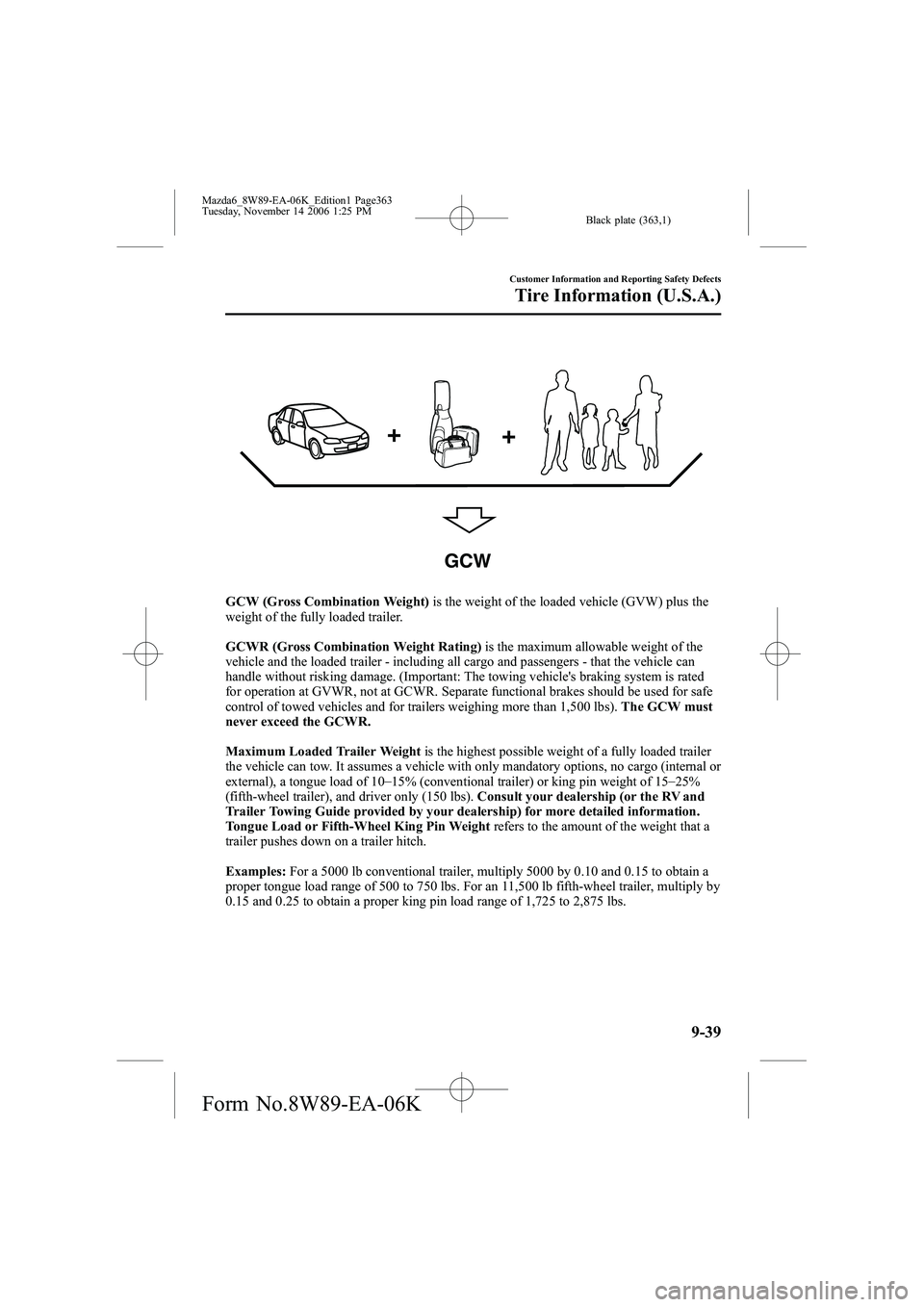
GCW
GCW (Gross Combination Weight)is the weight of the loaded vehicle (GVW) plus the
weight of the fully loaded trailer.
GCWR (Gross Combination Weight Rating) is the maximum allowable weight of the
vehicle and the loaded trailer - including all cargo and passengers - that the vehicle can
handle without risking damage. (Important: The towing vehicle's braking system is rated
for operation at GVWR, not at GCWR. Separate functional brakes should be used for safe
control of towed vehicles and for trailers weighing more than 1,500 lbs). The GCW must
never exceed the GCWR.
Maximum Loaded Trailer Weight is the highest possible weight of a fully loaded trailer
the vehicle can tow. It assumes a vehicle with only mandatory options, no cargo (internal or
external), a tongue load of 10 _
15% (conventional trailer) or king pin weight of 15 _
25%
(fifth-wheel trailer), and driver only (150 lbs). Consult your dealership (or the RV and
Trailer Towing Guide provided by your dealership) for more detailed information.
Tongue Load or Fifth-Wheel King Pin Weight refers to the amount of the weight that a
trailer pushes down on a trailer hitch.
Examples: For a 5000 lb conventional trailer, multiply 5000 by 0.10 and 0.15 to obtain a
proper tongue load range of 500 to 750 lbs. For an 11,500 lb fifth-wheel trailer, multiply by
0.15 and 0.25 to obtain a proper king pin load range of 1,725 to 2,875 lbs.
Customer Information and Reporting Safety Defects
Tire Information (U.S.A.)
9-39
Mazda6_8W89-EA-06K_Edition1 Page363
Tuesday, November 14 2006 1:25 PM
Form No.8W89-EA-06K