trailer MAZDA MODEL B-SERIES 2005 (in English) User Guide
[x] Cancel search | Manufacturer: MAZDA, Model Year: 2005, Model line: MODEL B-SERIES, Model: MAZDA MODEL B-SERIES 2005Pages: 254, PDF Size: 2.13 MB
Page 133 of 254
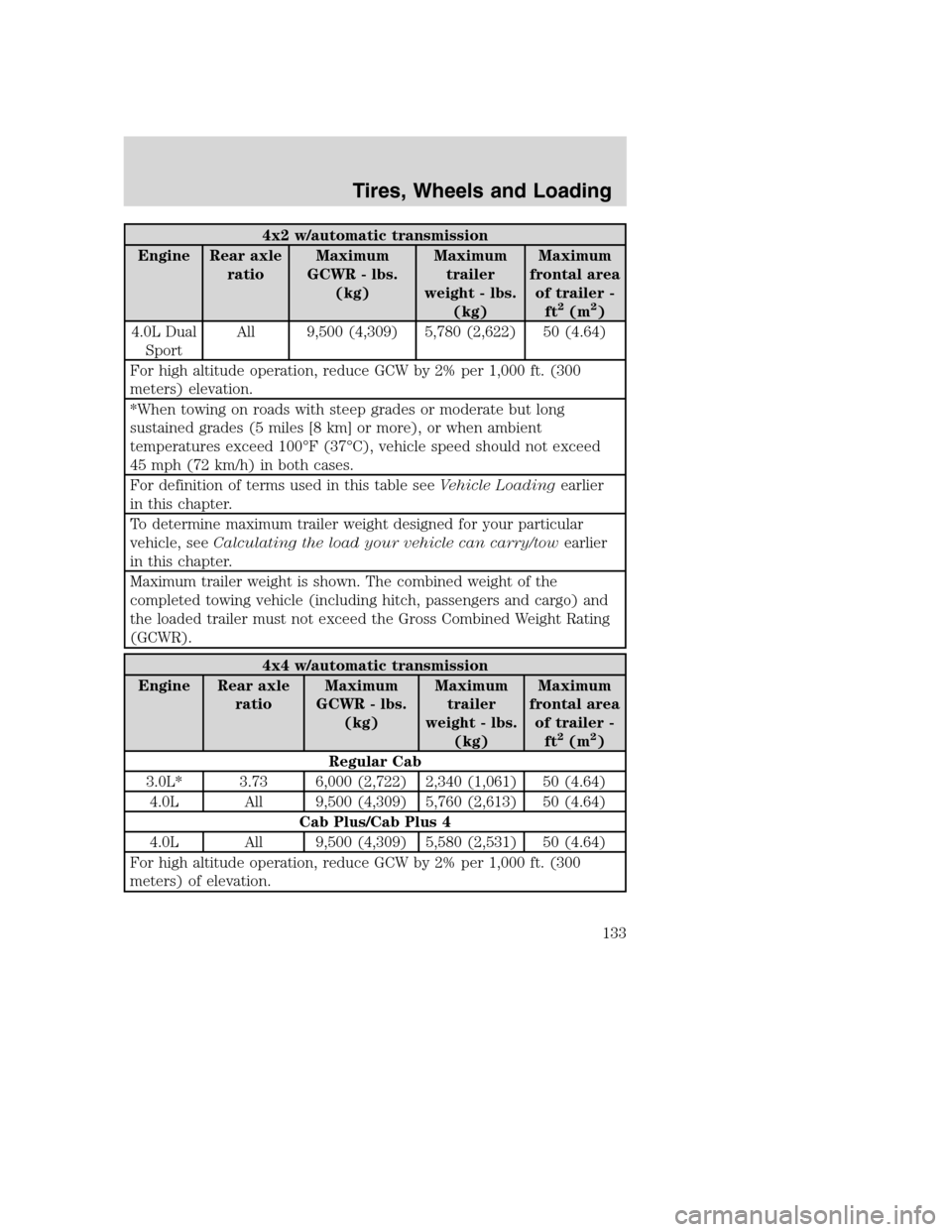
4x2 w/automatic transmission
Engine Rear axle
ratioMaximum
GCWR - lbs.
(kg)Maximum
trailer
weight - lbs.
(kg)Maximum
frontal area
of trailer -
ft
2(m2)
4.0L Dual
SportAll 9,500 (4,309) 5,780 (2,622) 50 (4.64)
For high altitude operation, reduce GCW by 2% per 1,000 ft. (300
meters) elevation.
*When towing on roads with steep grades or moderate but long
sustained grades (5 miles [8 km] or more), or when ambient
temperatures exceed 100°F (37°C), vehicle speed should not exceed
45 mph (72 km/h) in both cases.
For definition of terms used in this table seeVehicle Loadingearlier
in this chapter.
To determine maximum trailer weight designed for your particular
vehicle, seeCalculating the load your vehicle can carry/towearlier
in this chapter.
Maximum trailer weight is shown. The combined weight of the
completed towing vehicle (including hitch, passengers and cargo) and
the loaded trailer must not exceed the Gross Combined Weight Rating
(GCWR).
4x4 w/automatic transmission
Engine Rear axle
ratioMaximum
GCWR - lbs.
(kg)Maximum
trailer
weight - lbs.
(kg)Maximum
frontal area
of trailer -
ft
2(m2)
Regular Cab
3.0L* 3.73 6,000 (2,722) 2,340 (1,061) 50 (4.64)
4.0L All 9,500 (4,309) 5,760 (2,613) 50 (4.64)
Cab Plus/Cab Plus 4
4.0L All 9,500 (4,309) 5,580 (2,531) 50 (4.64)
For high altitude operation, reduce GCW by 2% per 1,000 ft. (300
meters) of elevation.
REVIEW COPY
2005 Mazda B Series(mbs), Owners Guide (post-2002-fmt)(own2002),
Market:Canadian_French(fr_can)
Tires, Wheels and Loading
133
Page 134 of 254

4x4 w/automatic transmission
Engine Rear axle
ratioMaximum
GCWR - lbs.
(kg)Maximum
trailer
weight - lbs.
(kg)Maximum
frontal area
of trailer -
ft
2(m2)
*When towing on roads with steep grades or moderate but long
sustained grades (5 miles [8 km] or more), or when ambient
temperatures exceed 100°F (37°C), vehicle speed should not exceed
45 mph (72 km/h) in both cases.
For definition of terms used in this table, seeVehicle loadingearlier
in this chapter.
To determine maximum trailer weight designed for your vehicle, see
Calculating the load your vehicle can carry/towearlier in this
chapter.
Maximum trailer weight is shown. The combined weight of the
completed towing vehicle (including hitch, passengers and cargo) and
the loaded trailer must not exceed the Gross Combined Weight Rating
(GCWR).
WARNING: Do not exceed the GVWR or the GAWR specified on
the certification label.
The certification label is found on the driver’s door latch pillar.
WARNING: Towing trailers beyond the maximum recommended
gross trailer weight exceeds the limit of the vehicle and could
result in engine damage, transmission damage, structural
damage, loss of vehicle control, vehicle rollover and personal
injury.
Preparing to tow
Use the proper equipment for towing a trailer and make sure it is
properly attached to your vehicle. See your dealer or a reliable trailer
dealer if you require assistance.
Hitches
For towing trailers up to 2,000 lbs (907 kg), use a weight carrying hitch
and ball which uniformly distributes the trailer tongue loads through the
REVIEW COPY
2005 Mazda B Series(mbs), Owners Guide (post-2002-fmt)(own2002),
Market:Canadian_French(fr_can)
Tires, Wheels and Loading
134
Page 135 of 254
underbody structure. Use a frame-mounted weight distributing hitch for
trailers over 2,000 lbs (907 kg).
Do not install a single or multi-clamp type bumper hitch, or a hitch
which attaches to the axle. Underbody mounted hitches are acceptable if
they are installed properly. Follow the towing instructions of a reputable
rental agency.
Whenever a trailer hitch and hardware are removed, make sure all
mounting holes in the underbody are properly sealed to prevent noxious
gases or water from entering.
Safety chains
Always connect the trailer’s safety chains to the frame or hook retainers
of the vehicle hitch. To connect the trailer’s safety chains, cross the
chains under the trailer tongue and allow slack for turning corners.
If you use a rental trailer, follow the instructions that the rental agency
gives to you.
Do not attach safety chains to the bumper.
Trailer brakes
Electric brakes and manual, automatic or surge-type trailer brakes are
safe if installed properly and adjusted to the manufacturer’s
specifications. The trailer brakes must meet local and Federal
regulations.
WARNING: Do not connect a trailer’s hydraulic brake system
directly to your vehicle’s brake system. Your vehicle may not
have enough braking power and your chances of having a
collision greatly increase.
The braking system of the tow vehicle is rated for operation at the
GVWR not GCWR.
Trailer lamps
Trailer lamps are required on most towed vehicles. Make sure all running
lights, brake lights, turn signals and hazard lights are working. See your
dealer or trailer rental agency for proper instructions and equipment for
hooking up trailer lamps.
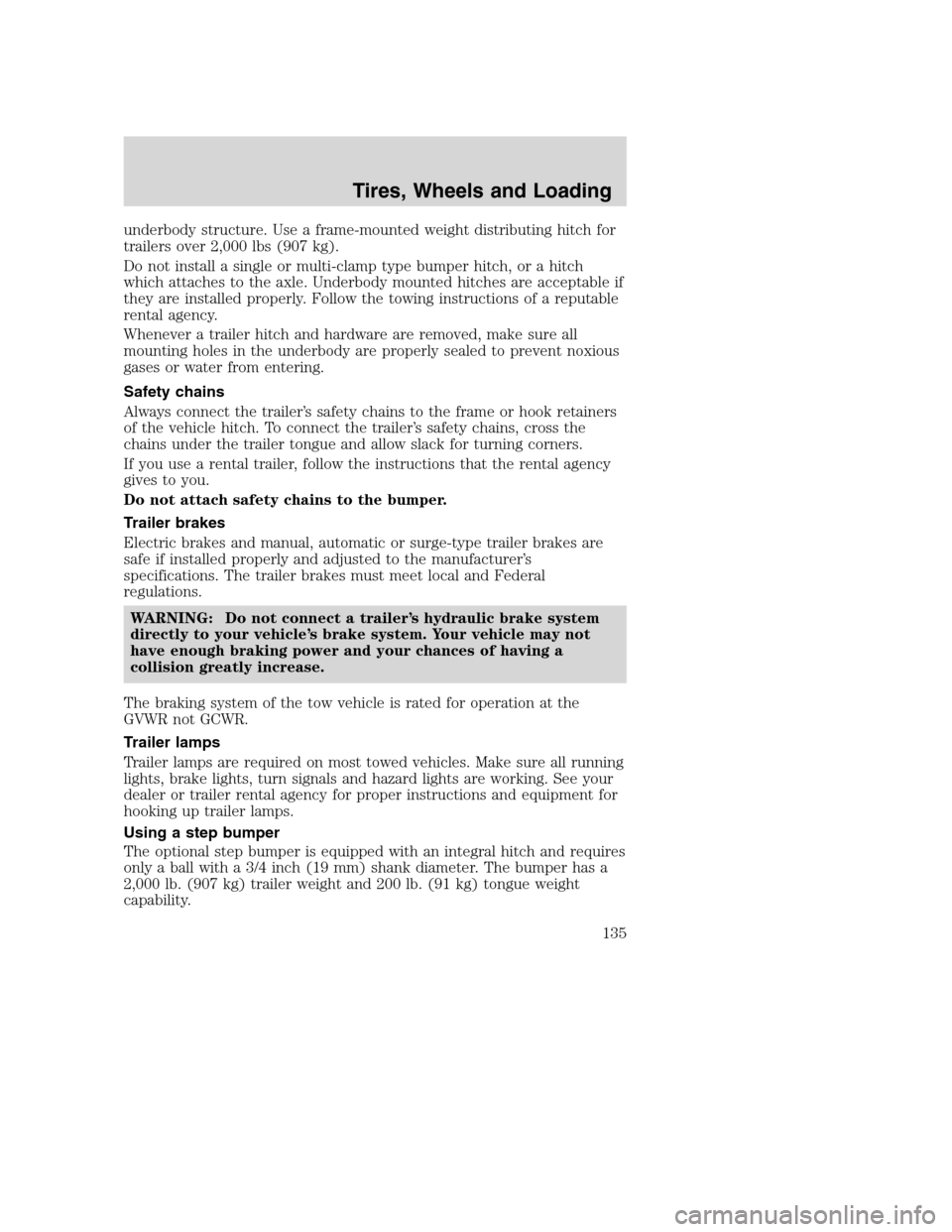
Using a step bumper
The optional step bumper is equipped with an integral hitch and requires
only a ball with a 3/4 inch (19 mm) shank diameter. The bumper has a
2,000 lb. (907 kg) trailer weight and 200 lb. (91 kg) tongue weight
capability.
REVIEW COPY
2005 Mazda B Series(mbs), Owners Guide (post-2002-fmt)(own2002),
Market:Canadian_French(fr_can)
Tires, Wheels and Loading
135
Page 136 of 254

The rated capacities (as shown in this guide) for trailer towing with the
factory bumper are only valid when the trailer hitch ball is installed
directly into the ball hole in the bumper. Addition of bracketry to either
lower the ball hitch position or extend the ball hitch rearward will
significantly increase the loads on the bumper and its attachments. This
can result in the failure of the bumper or the bumper attachments. Use
of any type of hitch extensions should be considered abuse.
Trailer tow connector
The trailer tow connector is located
under the rear bumper, on the
driver’s side of the vehicle.
Refer to the following chart for information regarding the
factory-equipped trailer tow connector:
Trailer tow connector
Color Function Comment
1. Dark Green Trailer right-hand
turn signalCircuit activated when brake
pedal is depressed or when
ignition is on and right-hand
turn signal is applied.
2. Yellow Trailer left-hand turn
signalCircuit activated when brake
pedal is depressed or when
ignition is on and left-hand
turn signal is applied.
3. Tan/White Tail lamp Relay controlled circuit
activated when the park
lamps/headlamps are on.
4. White Ground Matching vehicle circuit
returns to battery’s negative
ground.
1
2
34
REVIEW COPY
2005 Mazda B Series(mbs), Owners Guide (post-2002-fmt)(own2002),
Market:Canadian_French(fr_can)
Tires, Wheels and Loading
136
Page 137 of 254
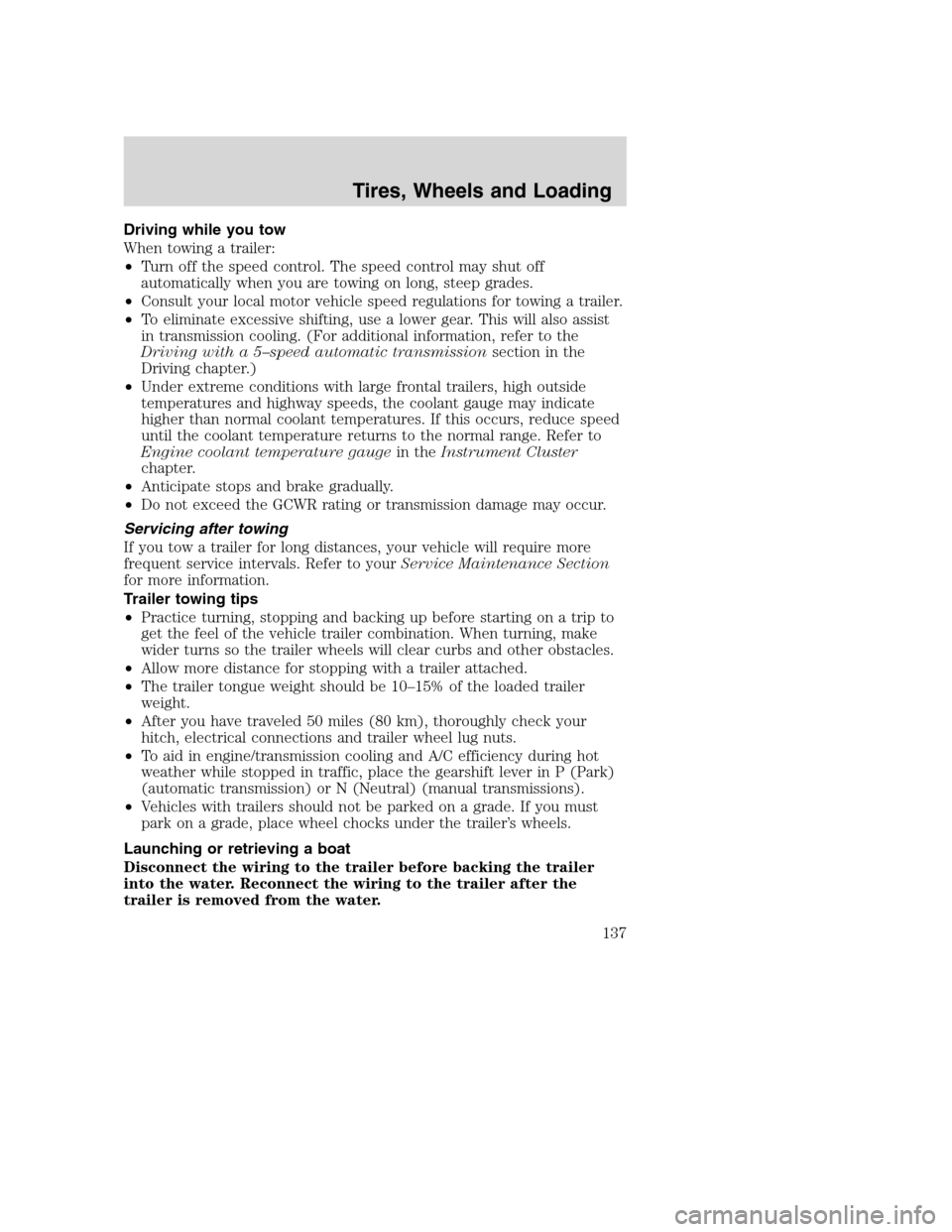
Driving while you tow
When towing a trailer:
•Turn off the speed control. The speed control may shut off
automatically when you are towing on long, steep grades.
•Consult your local motor vehicle speed regulations for towing a trailer.
•To eliminate excessive shifting, use a lower gear. This will also assist
in transmission cooling. (For additional information, refer to the
Driving with a 5–speed automatic transmissionsection in the
Driving chapter.)
•Under extreme conditions with large frontal trailers, high outside
temperatures and highway speeds, the coolant gauge may indicate
higher than normal coolant temperatures. If this occurs, reduce speed
until the coolant temperature returns to the normal range. Refer to
Engine coolant temperature gaugein theInstrument Cluster
chapter.
•Anticipate stops and brake gradually.
•Do not exceed the GCWR rating or transmission damage may occur.
Servicing after towing
If you tow a trailer for long distances, your vehicle will require more
frequent service intervals. Refer to yourService Maintenance Section
for more information.
Trailer towing tips
•Practice turning, stopping and backing up before starting on a trip to
get the feel of the vehicle trailer combination. When turning, make
wider turns so the trailer wheels will clear curbs and other obstacles.
•Allow more distance for stopping with a trailer attached.
•The trailer tongue weight should be 10–15% of the loaded trailer
weight.
•After you have traveled 50 miles (80 km), thoroughly check your
hitch, electrical connections and trailer wheel lug nuts.
•To aid in engine/transmission cooling and A/C efficiency during hot
weather while stopped in traffic, place the gearshift lever in P (Park)
(automatic transmission) or N (Neutral) (manual transmissions).
•Vehicles with trailers should not be parked on a grade. If you must
park on a grade, place wheel chocks under the trailer’s wheels.
Launching or retrieving a boat
Disconnect the wiring to the trailer before backing the trailer
into the water. Reconnect the wiring to the trailer after the
trailer is removed from the water.
REVIEW COPY
2005 Mazda B Series(mbs), Owners Guide (post-2002-fmt)(own2002),
Market:Canadian_French(fr_can)
Tires, Wheels and Loading
137
Page 152 of 254

•O/D OFF lamp is illuminated.
•Provides engine braking.
•Use when driving conditions cause excessive shifting from O/D to
other gears. Examples: city traffic, hilly terrain, heavy loads, trailer
towing and when engine braking is required.
•To return to O/D (overdrive mode), press the transmission control
switch. The O/D OFF lamp will not be illuminated.
•O/D (Overdrive) is automatically returned each time the key is turned
off.
2 (Second)
Use 2 (Second) to start-up on slippery roads or to provide additional
engine braking on downgrades.
1 (First)
•Provides maximum engine braking.
•Allows upshifts by moving gearshift lever.
•Will not downshift into 1 (First) at high speeds; allows for 1 (First)
when vehicle reaches slower speeds.
Forced downshifts
•Allowed in
(Overdrive) or Drive.
•Depress the accelerator to the floor.
•Allows transmission to select an appropriate gear.
MANUAL TRANSMISSION OPERATION (IF EQUIPPED)
Using the clutch
The manual transmission has a starter interlock that prevents cranking
the engine unless the clutch pedal is fully depressed.
To start the vehicle:
1. Make sure the parking brake is fully set.
135
24
R
REVIEW COPY
2005 Mazda B Series(mbs), Owners Guide (post-2002-fmt)(own2002),
Market:Canadian_French(fr_can)
Driving
152
Page 162 of 254

The fuses are coded as follows:
Fuse/Relay
LocationFuse Amp
RatingPassenger Compartment Fuse
Panel Description
1 5A Instrument panel dimmer switch
2 10A Trailer tow park lamps
3 10A Right low beam headlamp
4 10A Left low beam headlamp
5 30A Windshield wipers/washer
6 10A Radio (RUN/ACCY)
7 5A Headlamp illumination indicator
8 10A Restraints Control Module (RCM),
PADI (Passenger Air bag
Deactivation Indicator)
9 5A Cluster air bag indicator
10 10A Cluster (RUN/START), 4x4
module (RUN/START)
11 10A Smart Junction Box (SJB) (Logic
power)
12 — Not used
13 15A Horn, Interior lamps
14 15A High beam headlamp, High beam
indicator (cluster)
15 — One-touch down relay
16 30A cartridge
fusePower windows
17 15A Turn signals/Hazards
18 — Not used
19 20A Center High-Mounted Stop Lamp
(CHMSL)/Stop lamps
20 10A Anti-lock Brake System (ABS)
module, Brake-shift interlock,
Speed control module, Back-up
lamps, Overdrive cancel switch,
Electronic flasher (turn/hazard)
REVIEW COPY
2005 Mazda B Series(mbs), Owners Guide (post-2002-fmt)(own2002),
Market:Canadian_French(fr_can)
Roadside Emergencies
162
Page 166 of 254

Fuse/Relay
LocationFuse Amp
RatingPower Distribution Box
Description
36 — Not used
37 — Not used
38 7.5A* Trailer tow (right turn)
39 — Not used
40 — Not used
41 15A* HEGOs
42 7.5A* Trailer tow (left turn)
43 — Not used
44 — Not used
45A — Wiper HI/LO relay
45B — Wiper Park/Run relay
46A — Fuel pump relay
46B — Washer pump relay
47 — Engine fan relay
48 — Starter relay
49 — Not used
50 — Not used
51 — Not used
52 — Not used
53 — Not used
54 — PCM relay
55 — Blower relay
56A — A/C clutch solenoid relay
56B — Not used
* Mini Fuses ** Maxi Fuses
REVIEW COPY
2005 Mazda B Series(mbs), Owners Guide (post-2002-fmt)(own2002),
Market:Canadian_French(fr_can)
Roadside Emergencies
166
Page 168 of 254

Fuse/Relay
LocationFuse Amp
RatingPower Distribution Box
Description
12 — Not used
13 30A** Blower motor (climate control)
14 — Not used
15 — Not used
16 — Not used
17 40A** ABS (motor)
18 — Not used
19 — Not used
20 — Not used
21 10A* PCM
22 — Not used
23 20A* Fuel pump
24 — Not used
25 10A* A/C clutch solenoid
26 — Not used
27 20A* 4x4 module
28 — Not used
29 — Not used
30 — Not used
31 15A* Foglamps
32 — Not used
33 30A* Anti-lock Brake System (ABS)
(solenoids)
34 — Not used
35 — Not used
36 — Not used
37 — Not used
38 7.5A* Trailer tow (right turn)
39 — Not used
40 — Not used
41 15A* HEGOs
REVIEW COPY
2005 Mazda B Series(mbs), Owners Guide (post-2002-fmt)(own2002),
Market:Canadian_French(fr_can)
Roadside Emergencies
168
Page 169 of 254

Fuse/Relay
LocationFuse Amp
RatingPower Distribution Box
Description
42 7.5A* Trailer tow (left turn)
43 — Not used
44 — Not used
45A — Wiper HI/LO relay
45B — Wiper Park/Run relay
46A — A/C clutch solenoid
46B — Washer pump relay
47 — PCM relay
48A — Fuel pump relay
48B — Fog lamp relay
51 — Not used
52 — Not used
53 — Not used
54 — Not used
55 — Blower relay
56 — Starter relay
* Mini Fuses ** Maxi Fuses
OVERHEATING
If the temperature gauge indicates overheating and you experience
power loss, you hear a loud knocking or pinging noise, the engine is
probably too hot.
If this happens:
1. Drive safely to the side of the road and park off the right-of-way.
2. Shift the automatic transmission into P (Park) or the manual
transmission into the neutral position, and apply the parking brake.
3. Turn off the air conditioner.
WARNING: Steam from an overheated engine is dangerous. The
escaping steam could seriously burn you. Open the hood ONLY
after steam is no longer escaping from the engine.
4. Check whether coolant or steam is escaping from under the hood or
from the engine compartment.
REVIEW COPY
2005 Mazda B Series(mbs), Owners Guide (post-2002-fmt)(own2002),
Market:Canadian_French(fr_can)
Roadside Emergencies
169