trailer MAZDA MODEL B-SERIES 2008 (in English) Owner's Manual
[x] Cancel search | Manufacturer: MAZDA, Model Year: 2008, Model line: MODEL B-SERIES, Model: MAZDA MODEL B-SERIES 2008Pages: 272, PDF Size: 2.11 MB
Page 175 of 272

Fuse/Relay
LocationFuse Amp
RatingPower Distribution Box
Description
14 — Not used
15 — Not used
16 — Not used
17 40A** Anti-lock Brake System (ABS)
module
18 — Not used
19 20A** Engine fan
20 — Not used
21 10A* PCM keep alive power, Canister
purge valve solenoid
22 — Not used
23 30A* Fuel pump motor, Fuel injectors
24 — Not used
25 10A* A/C clutch solenoid
26 — Not used
27 — Not used
28 — Not used
29 30A* Wipers/washer
30 — Not used
31 — Not used
32 — Not used
33 30A* Anti-lock Brake System (ABS)
module
34 — Not used
35 — Not used
36 — Not used
37 — Not used
38 7.5A* Trailer tow (right turn)
39 15A* PCM power
40 — Not used
41 10A* Automatic transmission
2008 B-Series(mbs)
Owners Guide (post-2002-fmt)
USA(fus)
Roadside Emergencies
175
Page 176 of 272

Fuse/Relay
LocationFuse Amp
RatingPower Distribution Box
Description
42 7.5A* Trailer tow (left turn)
43 20A* Engine fan relay coil, A/C relay,
Engine sensors, VMV solenoid
44 15A* Ignition coil, Capacitor
45A — Not used
45B — Not used
46A — Fuel pump relay, Fuel injectors
relay
46B — Not used
47 — Engine fan relay
48 — Starter relay
49 — Not used
50 — Not used
51 — Not used
52 — Not used
53 — Not used
54 — PCM relay
55 — Blower relay
56A — A/C clutch solenoid relay
56B — Not used
* Mini Fuses ** Maxi Fuses
2008 B-Series(mbs)
Owners Guide (post-2002-fmt)
USA(fus)
Roadside Emergencies
176
Page 178 of 272

Fuse/Relay
LocationFuse Amp
RatingPower Distribution Box
Description
15 — Not used
16 — Not used
17 40A** Anti-lock Brake System (ABS)
module
18 — Not used
19 — Not used
20 — Not used
21 10A* PCM keep alive power, Canister
purge valve solenoid
22 — Not used
23 30A* Fuel pump motor, Fuel injectors
24 — Not used
25 10A* A/C clutch solenoid
26 — Not used
27 20A* 4x4 module
28 — Not used
29 30A* Wipers/washer
30 — Not used
31 15A* Foglamps
32 — Not used
33 30A* Anti-lock Brake System (ABS)
module
34 — Not used
35 — Not used
36 — Not used
37 — Not used
38 7.5A* Trailer tow (right turn)
39 15A* PCM power
40 — Not used
41 10A* Automatic transmission
42 7.5A* Trailer tow (left turn)
2008 B-Series(mbs)
Owners Guide (post-2002-fmt)
USA(fus)
Roadside Emergencies
178
Page 180 of 272

WARNING: The use of tire sealants may damage your Tire
Pressure Monitoring System and should not be used.
WARNING: Refer toTire Pressure Monitoring System (TPMS)
in theTires, Wheels and Loadingchapter for important
information. If the tire pressure monitor sensor becomes
damaged, it will no longer function.
Dissimilar spare tire/wheel information
WARNING: Failure to follow these guidelines could result in an
increased risk of loss of vehicle control, injury or death.
If you have a dissimilar spare tire/wheel, then it is intended for
temporary use only. This means that if you need to use it, you should
replace it as soon as possible with a road tire/wheel that is the same size
and type as the road tires and wheels that were originally provided by
Mazda. If the dissimilar spare tire or wheel is damaged, it should be
replaced rather than repaired.
A dissimilar spare tire/wheel is defined as a spare tire and/or wheel that
is different in brand, size or appearance from the road tires and wheels
and can be one of three types:
1.T-type mini-spare:This spare tire begins with the letter “T” for tire
size and may have “Temporary Use Only” molded in the sidewall
2.Full-size dissimilar spare with label on wheel:This spare tire
has a label on the wheel that states: “THIS TIRE AND WHEEL FOR
TEMPORARY USE ONLY”
When driving with one of the dissimilar spare tires listed above,do not:
•Exceed 50 mph (80 km/h)
•Load the vehicle beyond maximum vehicle load rating listed on the
Safety Compliance Label
•Tow a trailer
•Use snow chains on the end of the vehicle with the dissimilar spare
tire
•Use more than one dissimilar spare tire at a time
•Use commercial car washing equipment
•Try to repair the dissimilar spare tire
2008 B-Series(mbs)
Owners Guide (post-2002-fmt)
USA(fus)
Roadside Emergencies
180
Page 181 of 272

Use of one of the dissimilar spare tires listed above at any one wheel
location can lead to impairment of the following:
•Handling, stability and braking performance
•Comfort and noise
•Ground clearance and parking at curbs
•Winter weather driving capability
•Wet weather driving capability
For vehicles equipped with 4WD, it is not recommended that the vehicle
be operated in 4WD modes with a temporary emergency spare tire. If
4WD operation is necessary, do not operate above speeds of 10 mph
(16 km/h) or for distances above 50 miles (80 km).
3.Full-size dissimilar spare without label on wheel
When driving with the full-size dissimilar spare tire/wheel,do not:
•Exceed 70 mph (113 km/h)
•Use more than one dissimilar spare tire/wheel at a time
•Use commercial car washing equipment
•Use snow chains on the end of the vehicle with the dissimilar spare
tire/wheel
The usage of a full-size dissimilar spare tire/wheel can lead to
impairment of the following:
•Handling, stability and braking performance
•Comfort and noise
•Ground clearance and parking at curbs
•Winter weather driving capability
•Wet weather driving capability
•All-Wheel driving capability (if applicable)
•Load leveling adjustment (if applicable)
When driving with the full-size dissimilar spare tire/wheel additional
caution should be given to:
•Towing a trailer
•Driving vehicles equipped with a camper body
•Driving vehicles with a load on the cargo rack
Drive cautiously when using a full-size dissimilar spare tire/wheel and
seek service as soon as possible.
2008 B-Series(mbs)
Owners Guide (post-2002-fmt)
USA(fus)
Roadside Emergencies
181
Page 212 of 272

INTRODUCTION
Be extremely careful to prevent injury to yourself and others or damage
to your vehicle when using this manual for inspection and maintenance.
If you’re unsure about any procedure it describes, we strongly urge you
to have a reliable and qualified service shop perform the work, preferably
an authorized Mazda Dealer.
Factory-trained Mazda technicians and genuine Mazda parts are best for
your vehicle. Without this expertise and the parts that have been
designed and made especially for your Mazda, inadequate, incomplete,
and insufficient servicing may result in problems. This could lead to
vehicle damage or an accident and injuries.
For expert advice and quality service, consult an authorized Mazda
Dealer.
The owner should retain evidence that proper maintenance has been
performed as prescribed.
Claims against the warranty resulting from lack of maintenance, as
opposed to defective materials or authorized Mazda workmanship, will
not be honored.
Any auto repair shop using parts equivalent to your Mazda’s original
equipment may perform maintenance.But we recommend that it
always be done by an authorized Mazda Dealer using genuine
Mazda parts.
SCHEDULED MAINTENANCE
Schedule 1 — Normal Driving Conditions/Emission Control
Systems
Follow Schedule 1 if the vehicle is operated mainly where none of the
following conditions apply. If any do apply, follow Schedule 2.
•Repeated short-distance driving.
•Driving in dusty conditions.
•Towing a trailer.
•Operating in hot weather in stop-and-go “rush hour” traffic.
•Extended periods of idling or low-speed operation.
•High-speed operation with a fully loaded vehicle.
•Off-road operation.
NOTE:After the described period, continue to follow the described
maintenance at the recommended intervals.
2008 B-Series(mbs)
Owners Guide (post-2002-fmt)
USA(fus)
Maintenance and Specifications
212
Page 217 of 272

*5 The California Air Resources Board has determined that the failure to
perform this maintenance item will not nullify the emission warranty nor
limit recall liability prior to completion of the vehicle’s useful life.
SCHEDULE 2 — SPECIAL OPERATING CONDITIONS
If your driving habitsFREQUENTLYinclude one or more of the
following conditions:
•Short trips of less than 10 miles (16 km) when outside temperatures
remain below freezing.
•Towing a trailer, or carrying maximum loads.
•Operating in severe dust conditions.
•Operating duringhot weatherin stop-and-go “rush hour” traffic.
•Extensive idling, such as police, taxi or door-to-door delivery service.
•High speed operation with a fully loaded vehicle (max. GVW).
•Off-road operation
Change ENGINE OIL AND OIL FILTER every 3 months or 3,000 miles
(4,800 km) whichever occurs first.
NOTE:Idling the engine for extended periods will accumulate more
hours of use on your vehicle than is actually indicated by the mileage
odometer. Consequently, the odometer reading can be often misleading
when determining the right time to change your engine oil and filter. If
you are using your vehicle in a manner which allows it to remain
stationary while the engine is running for long periods (door-to-door
delivery, taxi, police, power/utility company trucks, or similar duty), then
Mazda recommends you increase the frequency of oil and filter changes
to an interval equivalent to 200 ENGINE HOURS or use. Since most
vehicles are not equipped with hour-meters, it may be necessary for you
to approximate your idle time and plan oil/filter changes accordingly.
2008 B-Series(mbs)
Owners Guide (post-2002-fmt)
USA(fus)
Maintenance and Specifications
217
Page 218 of 272
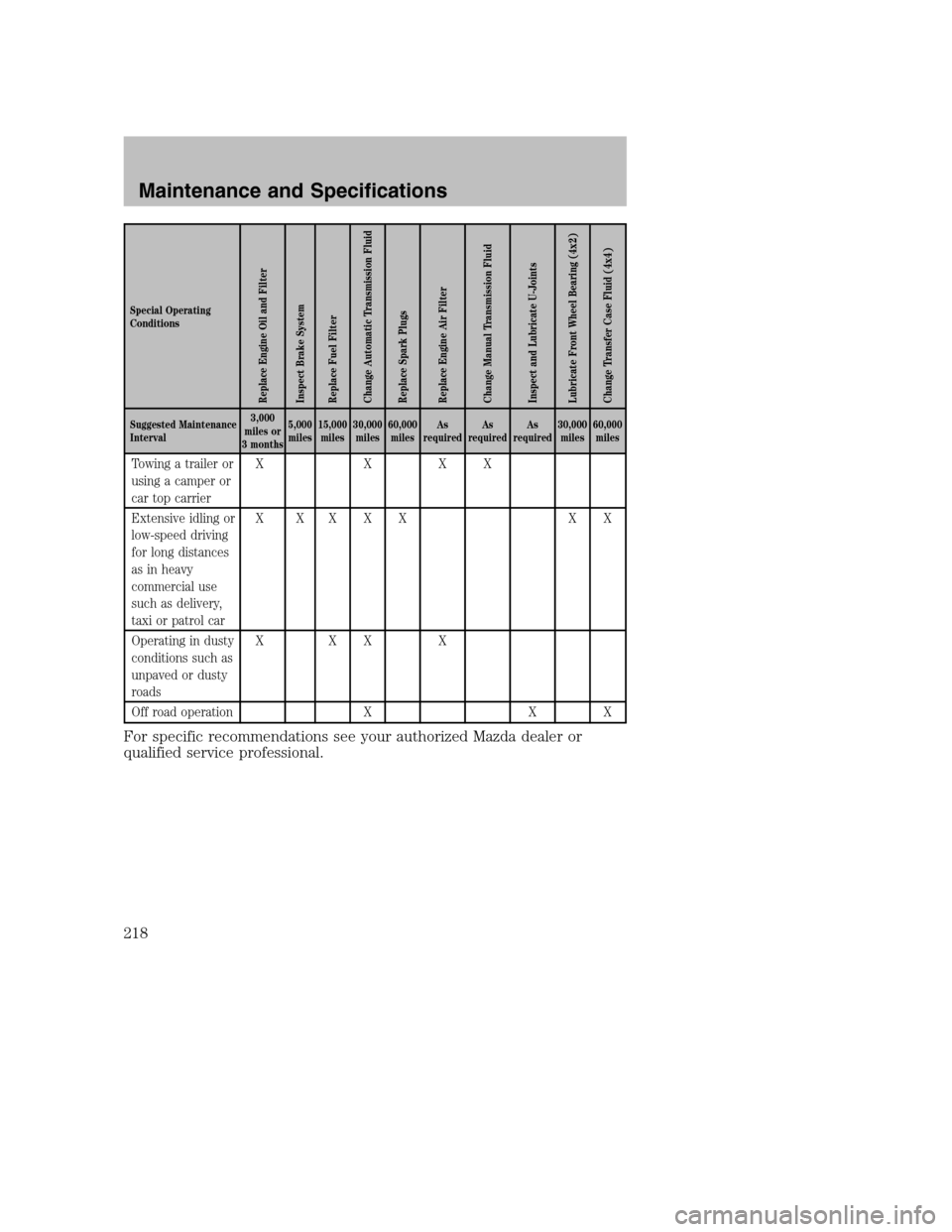
Special Operating
Conditions
Replace Engine Oil and Filter
Inspect Brake System
Replace Fuel Filter
Change Automatic Transmission Fluid
Replace Spark Plugs
Replace Engine Air Filter
Change Manual Transmission Fluid
Inspect and Lubricate U-Joints
Lubricate Front Wheel Bearing (4x2)
Change Transfer Case Fluid (4x4)
Suggested Maintenance
Interval3,000
miles or
3 months5,000
miles15,000
miles30,000
miles60,000
milesAs
requiredAs
requiredAs
required30,000
miles60,000
miles
Towing a trailer or
using a camper or
car top carrierXXXX
Extensive idling or
low-speed driving
for long distances
as in heavy
commercial use
such as delivery,
taxi or patrol carXXXXX XX
Operating in dusty
conditions such as
unpaved or dusty
roadsXXX X
Off road operation X X X
For specific recommendations see your authorized Mazda dealer or
qualified service professional.
2008 B-Series(mbs)
Owners Guide (post-2002-fmt)
USA(fus)
Maintenance and Specifications
218
Page 247 of 272

•Warming up a vehicle on cold mornings is not required and may
reduce fuel economy.
•Resting your foot on the brake pedal while driving may reduce fuel
economy.
•Combine errands and minimize stop-and-go driving.
Maintenance
•Keep tires properly inflated and use only recommended size.
•Operating a vehicle with the wheels out of alignment will reduce fuel
economy.
•Use recommended engine oil. Refer to theMaintenance product
specifications and capacitiessection of this chapter.
•Perform all regularly scheduled maintenance items. Follow the
recommended maintenance schedule and owner maintenance checks
found inscheduled maintenance.
Conditions
•Heavily loading a vehicle or towing a trailer may reduce fuel economy
at any speed.
•Carrying unnecessary weight may reduce fuel economy (approximately
1 mpg [0.4 km/L] is lost for every 400 lb [180 kg] of weight carried).
•Adding certain accessories to your vehicle (for example bug
deflectors, rollbars/light bars, running boards, ski/luggage racks) may
reduce fuel economy.
•Using fuel blended with alcohol may lower fuel economy.
•Fuel economy may decrease with lower temperatures during the first
8–10 miles (12–16 km) of driving.
•Driving on flat terrain offers improved fuel economy as compared to
driving on hilly terrain.
•Transmissions give their best fuel economy when operated in the top
cruise gear and with steady pressure on the gas pedal.
•Four-wheel-drive operation (if equipped) is less fuel efficient than
two-wheel-drive operation.
•Close windows for high speed driving.
EPA window sticker
Every new vehicle should have the EPA window sticker. Contact your
authorized dealer if the window sticker is not supplied with your vehicle.
2008 B-Series(mbs)
Owners Guide (post-2002-fmt)
USA(fus)
Maintenance and Specifications
247
Page 253 of 272

1. Clean the reservoir cap before
removal to prevent dirt and
water from entering the
reservoir.
2. Remove cap and rubber
diaphragm from reservoir.
3. Add fluid until the level reaches
the step in the reservoir.
4. Reinstall rubber diaphragm and
cap onto reservoir.
TRANSMISSION FLUID
Checking automatic transmission fluid
•Refer toscheduled maintenance informationfor scheduled check
and change intervals.
•Transmission does not consume fluid.
•Check fluid when transmission is not operating properly or if you see
a leak.
•Fluid level must be checked at normal operating temperature, 20 miles
(30 km) of driving.
To check and add fluid:
1. Drive the vehicle 20 miles (30 km) to reach normal operating
temperatures.
2. If driven in hot weather, city traffic, pulling a trailer, allow
transmission to cool for 30 minutes before checking.
3. Engage parking brake, start engine.
4. Put your foot on the brake pedal and move the gearshift lever slowly
through all of the gear ranges.
5. Shift to P (Park) and leave the engine running.
6. Remove the dipstick, wipe clean with a dry lint free rag.
7. Install and fully seat the dipstick into the filler tube.
8. Remove the dipstick and inspect
the fluid level. Level should be
in the cross-hatched area.
2008 B-Series(mbs)
Owners Guide (post-2002-fmt)
USA(fus)
Maintenance and Specifications
253