TPMS MAZDA MODEL B2300 TRUCK 2007 Owners Manual (in English)
[x] Cancel search | Manufacturer: MAZDA, Model Year: 2007, Model line: MODEL B2300 TRUCK, Model: MAZDA MODEL B2300 TRUCK 2007Pages: 279, PDF Size: 2.4 MB
Page 2 of 279
JOBNAME: No Job Name PAGE: 2 SESS: 8 OUTPUT: Thu Aug 3 11:45:36 2006
/ford_pdm/ford/own2002/mbs/og
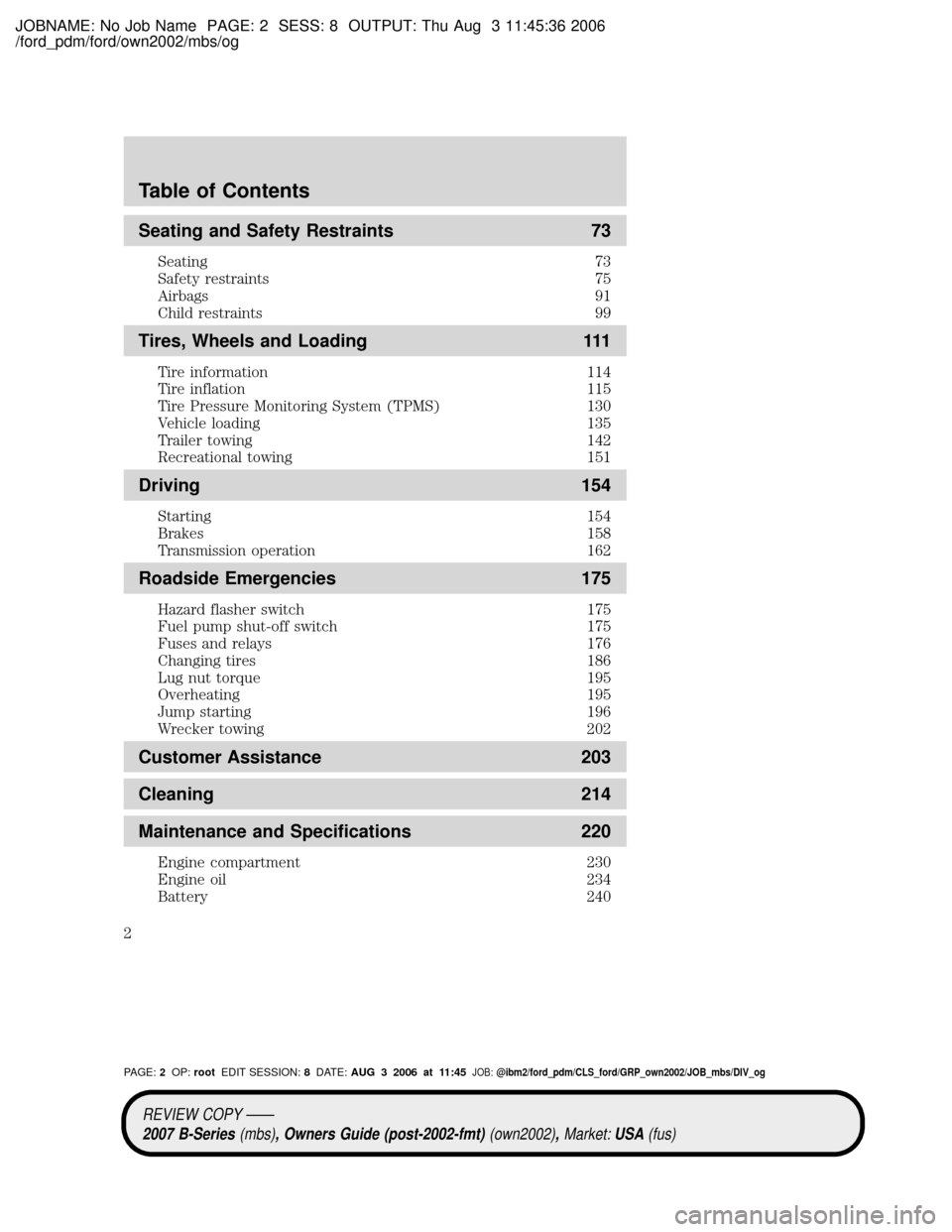
Seating and Safety Restraints 73
Seating 73
Safety restraints 75
Airbags 91
Child restraints 99
Tires, Wheels and Loading 111
Tire information 114
Tire inflation 115
Tire Pressure Monitoring System (TPMS) 130
Vehicle loading 135
Trailer towing 142
Recreational towing 151
Driving 154
Starting 154
Brakes 158
Transmission operation 162
Roadside Emergencies 175
Hazard flasher switch 175
Fuel pump shut-off switch 175
Fuses and relays 176
Changing tires 186
Lug nut torque 195
Overheating 195
Jump starting 196
Wrecker towing 202
Customer Assistance 203
Cleaning 214
Maintenance and Specifications 220
Engine compartment 230
Engine oil 234
Battery 240
Table of Contents
2
PAGE:2OP:rootEDIT SESSION:8DATE:AUG 3 2006 at 11:45JOB:@ibm2/ford_pdm/CLS_ford/GRP_own2002/JOB_mbs/DIV_og
REVIEW COPY ÐÐ
2007 B-Series(mbs), Owners Guide (post-2002-fmt)(own2002),Market:USA(fus)
Page 115 of 279
JOBNAME: No Job Name PAGE: 115 SESS: 1 OUTPUT: Thu Aug 3 11:45:36 2006
/ford_pdm/ford/own2002/mbs/og
²Tire Identification Number (TIN):A number on the sidewall of
each tire providing information about the tire brand and
manufacturing plant, tire size and date of manufacture. Also referred
to as DOT code.
²Inflation pressure:A measure of the amount of air in a tire.
²Standard load:A class of P-metric or Metric tires designed to carry a
maximum load at 35 psi [37 psi (2.5 bar) for Metric tires]. Increasing
the inflation pressure beyond this pressure will not increase the tire's
load carrying capability.
²Extra load:A class of P-metric or Metric tires designed to carry a
heavier maximum load at 41 psi [43 psi (2.9 bar) for Metric tires].
Increasing the inflation pressure beyond this pressure will not increase
the tire's load carrying capability.
²kPa:Kilopascal, a metric unit of air pressure.
²PSI:Pounds per square inch, a standard unit of air pressure.
²Cold inflation pressure:The tire pressure when the vehicle has
been stationary and out of direct sunlight for an hour or more and
prior to the vehicle being driven for 1 mile (1.6 km).
²Recommended inflation pressure:The cold inflation pressure found
on the Safety Compliance Certification Label or Tire Label located on
the B-Pillar or the edge of the driver's door.
²B-pillar:The structural member at the side of the vehicle behind the
front door.
²Bead area of the tire:Area of the tire next to the rim.
²Sidewall of the tire:Area between the bead area and the tread.
²Tread area of the tire:Area of the perimeter of the tire that
contacts the road when mounted on the vehicle.
²Rim:The metal support (wheel) for a tire or a tire and tube assembly
upon which the tire beads are seated.
INFLATING YOUR TIRES
Safe operation of your vehicle requires that your tires are properly
inflated. Remember that a tire can lose up to half of its air pressure
without appearing flat.
Every day before you drive, check your tires. If one looks lower than the
others, use a tire gauge to check pressure of all tires and adjust if
required.
CIMS #1513806
com_gen-tire-in.tpms.mazda
itdseq=144
REVIEW COPY ÐÐ
2007 B-Series(mbs), Owners Guide (post-2002-fmt)(own2002),Market:USA(fus)
PAGE:11 5OP:rootEDIT SESSION:1DATE:AUG 3 2006 at 11:45JOB:@ibm2/ford_pdm/CLS_ford/GRP_own2002/JOB_mbs/DIV_og
Tires, Wheels and Loading
115
Page 116 of 279
JOBNAME: No Job Name PAGE: 116 SESS: 1 OUTPUT: Thu Aug 3 11:45:36 2006
/ford_pdm/ford/own2002/mbs/og
At least once a month and before long trips, inspect each tire and check
the tire pressure with a tire gauge (including spare, if equipped). Inflate
all tires to the inflation pressure recommended by Mazda.
Use a tire gauge to check the tire inflation pressure, including the spare
(if equipped), at least monthly and before long trips. You are strongly
urged to buy a reliable tire pressure gauge, as automatic service station
gauges may be inaccurate. Mazda recommends the use of a digital or dial
type tire pressure gauge rather than a stick type tire pressure gauge.
Use the recommended cold inflation pressure for optimum tire
performance and wear. Under-inflation or over-inflation may cause
uneven treadwear patterns.
NOTE:If you are driving the vehicle at its maximum weight load, make
sure the tire inflation pressure is correct for the weight load on the tires.
WARNING: Under-inflation is the most common cause of tire
failures and may result in severe tire cracking, tread separation
or(blowout(, with unexpected loss of vehicle control and
increased risk of injury. Under-inflation increases sidewall
flexing and rolling resistance, resulting in heat buildup and
internal damage to the tire. It also may result in unnecessary
tire stress, irregular wear, loss of vehicle control and accidents.
A tire can lose up to half of its air pressure and not appear to
be flat!
Always inflate your tires to the Mazda recommended inflation pressure
even if it is less than the maximum inflation pressure information found
on the tire. The Mazda recommended tire inflation pressure is found on
the Safety Compliance Certification Label or Tire Label which is located
on the B-Pillar or the edge of the driver's door. Failure to follow the tire
pressure recommendations can cause uneven treadwear patterns and
adversely affect the way your vehicle handles.
Maximum Permissible Inflation Pressureis the tire manufactures'
maximum permissible pressure and/or the pressure at which the
maximum load can be carried by the tire. This pressure is normally
higher than the manufacturer's recommended cold inflation pressure
which can be found on either the Safety Compliance Certification Label
or Tire Label which is located on the B-Pillar or the edge of the driver's
door. The cold inflation pressure should never be set lower than the
recommended pressure on the Safety Compliance Certification Label or
Tire Label.
When weather temperature changes occur, tire inflation pressures also
change. A 10É F (6É C) temperature drop can cause a corresponding
CIMS #1513866
com_tire-inf.tpms.mazda
itdseq=145
REVIEW COPY ÐÐ
2007 B-Series(mbs), Owners Guide (post-2002-fmt)(own2002),Market:USA(fus)
PAGE:11 6OP:rootEDIT SESSION:1DATE:AUG 3 2006 at 11:45JOB:@ibm2/ford_pdm/CLS_ford/GRP_own2002/JOB_mbs/DIV_og
Tires, Wheels and Loading
116
Page 119 of 279
JOBNAME: No Job Name PAGE: 119 SESS: 1 OUTPUT: Thu Aug 3 11:45:36 2006
/ford_pdm/ford/own2002/mbs/og
WARNING: Age
Tires degrade over time depending on many factors such as
weather, storage conditions, and conditions of use (load, speed,
inflation pressure, etc.) the tires experience throughout their
lives.
In general, tires should be replaced after six years regardless of
tread wear. However, heat caused by hot climates or frequent
high loading conditions can accelerate the aging process and
may require tires to be replaced more frequently.
You should replace your spare tire when you replace the road
tires or after six years due to aging even if it has not been
used.
U.S. DOT Tire Identification Number (TIN)
Both U.S. and Canada Federal regulations require tire manufacturers to
place standardized information on the sidewall of all tires. This
information identifies and describes the fundamental characteristics of
the tire and also provides a U.S. DOT Tire Identification Number for
safety standard certification and in case of a recall.
This begins with the letters ªDOTº and indicates that the tire meets all
federal standards. The next two numbers or letters are the plant code
designating where it was manufactured, the next two are the tire size
code and the last four numbers represent the week and year the tire was
built. For example, the numbers 317 mean the 31st week of 1997. After
2000 the numbers go to four digits. For example, 2501 means the 25th
week of 2001. The numbers in between are identification codes used for
traceability. This information is used to contact customers if a tire defect
requires a recall.
Tire Replacement Requirements
Your vehicle is equipped with tires designed to provide a safe ride and
handling capability.CIMS #1512512 com_tire-age
itdseq=150
CIMS #1519956 com_usdot
itdseq=151
CIMS #1497287
com_tire-rpl-06tpms
itdseq=152
REVIEW COPY ÐÐ
2007 B-Series(mbs), Owners Guide (post-2002-fmt)(own2002),Market:USA(fus)
PAGE:11 9OP:rootEDIT SESSION:1DATE:AUG 3 2006 at 11:45JOB:@ibm2/ford_pdm/CLS_ford/GRP_own2002/JOB_mbs/DIV_og
Tires, Wheels and Loading
119
Page 121 of 279
JOBNAME: No Job Name PAGE: 121 SESS: 1 OUTPUT: Thu Aug 3 11:45:36 2006
/ford_pdm/ford/own2002/mbs/og
It is recommended that the two front tires or two rear tires generally be
replaced as a pair.
The tire pressure sensors mounted in the wheels (originally installed on
your vehicle) are not designed to be used in aftermarket wheels.
The use of wheels or tires not recommended by Mazda Motor
Corporation may affect the operation of your Tire Pressure Monitoring
System.
If the TPMS indicator is flashing, your TPMS is malfunctioning. Your
replacement tire might be incompatible with your TPMS, or some
component of the TPMS may be damaged.
Safety practices
Driving habits have a great deal to do with your tire mileage and safety.
²Observe posted speed limits
²Avoid fast starts, stops and turns
²Avoid potholes and objects on the road
²Do not run over curbs or hit the tire against a curb when parking
WARNING: If your vehicle is stuck in snow, mud, sand, etc., do
not rapidly spin the tires; spinning the tires can tear the tire
and cause an explosion. A tire can explode in as little as three
to five seconds.
WARNING: Do not spin the wheels at over 35 mph (56 km/h).
The tires may fail and injure a passenger or bystander.
Highway hazards
No matter how carefully you drive there's always the possibility that you
may eventually have a flat tire on the highway. Drive slowly to the
closest safe area out of traffic. This may further damage the flat tire, but
your safety is more important.
If you feel a sudden vibration or ride disturbance while driving, or you
suspect your tire or vehicle has been damaged, immediately reduce your
speed. Drive with caution until you can safely pull off the road. Stop and
inspect the tires for damage. If a tire is under-inflated or damaged,
deflate it, remove wheel and replace it with your spare tire and wheel. If
you cannot detect a cause, have the vehicle towed to the nearest repair
facility or tire dealer to have the vehicle inspected.
CIMS #1272513
com_tire-safety-practices
itdseq=153
REVIEW COPY ÐÐ
2007 B-Series(mbs), Owners Guide (post-2002-fmt)(own2002),Market:USA(fus)
PAGE:121OP:rootEDIT SESSION:1DATE:AUG 3 2006 at 11:45JOB:@ibm2/ford_pdm/CLS_ford/GRP_own2002/JOB_mbs/DIV_og
Tires, Wheels and Loading
121
Page 130 of 279
JOBNAME: No Job Name PAGE: 130 SESS: 1 OUTPUT: Thu Aug 3 11:45:36 2006
/ford_pdm/ford/own2002/mbs/og
TIRE PRESSURE MONITORING SYSTEM (TPMS)
Each tire, including the spare (if
provided), should be checked
monthly when cold and inflated to
the inflation pressure recommended
by the vehicle manufacturer on the
vehicle placard or tire inflation pressure label. (If your vehicle has tires
of a different size than the size indicated on the vehicle placard or tire
inflation pressure label, you should determine the proper tire inflation
pressure for those tires.)
As an added safety feature, your vehicle has been equipped with a tire
pressure monitoring system (TPMS) that illuminates a low tire pressure
telltale when one or more of your tires is significantly under-inflated.
Accordingly, when the low tire pressure telltale illuminates, you should
stop and check your tires as soon as possible, and inflate them to the
proper pressure. Driving on a significantly under-inflated tire causes the
tire to overheat and can lead to tire failure. Under-inflation also reduces
fuel efficiency and tire tread life, and may affect the vehicle's handling
and stopping ability.
Please note that the TPMS is not a substitute for proper tire
maintenance, and it is the driver's responsibility to maintain correct tire
pressure, even if under-inflation has not reached the level to trigger
illumination of the TPMS low tire pressure telltale.
The Tire Pressure Monitoring System complies with part 15 of the FCC
rules and with RSS-210 of Industry Canada. Operation is subject to the
following two conditions: (1) This device may not cause harmful
interference, and (2) This device must accept any interference received,
including interference that may cause undesired operation.
WARNING: The Tire Pressure Monitoring System is NOT a
substitute for manually checking tire pressure. The tire
pressure should be checked periodically (at least monthly)
using a tire gauge, seeInflating your tiresin this chapter.
Failure to properly maintain your tire pressure could increase
the risk of tire failure, loss of control, vehicle rollover and
personal injury.CIMS #1298876
com_tpms-title itdseq=161
CIMS #1497798 com_tpms.06
itdseq=162
art=winis320_a
REVIEW COPY ÐÐ
2007 B-Series(mbs), Owners Guide (post-2002-fmt)(own2002),Market:USA(fus)
PAGE:130OP:rootEDIT SESSION:1DATE:AUG 3 2006 at 11:45JOB:@ibm2/ford_pdm/CLS_ford/GRP_own2002/JOB_mbs/DIV_og
Tires, Wheels and Loading
130
Page 131 of 279
JOBNAME: No Job Name PAGE: 131 SESS: 1 OUTPUT: Thu Aug 3 11:45:36 2006
/ford_pdm/ford/own2002/mbs/og
Changing tires with TPMS
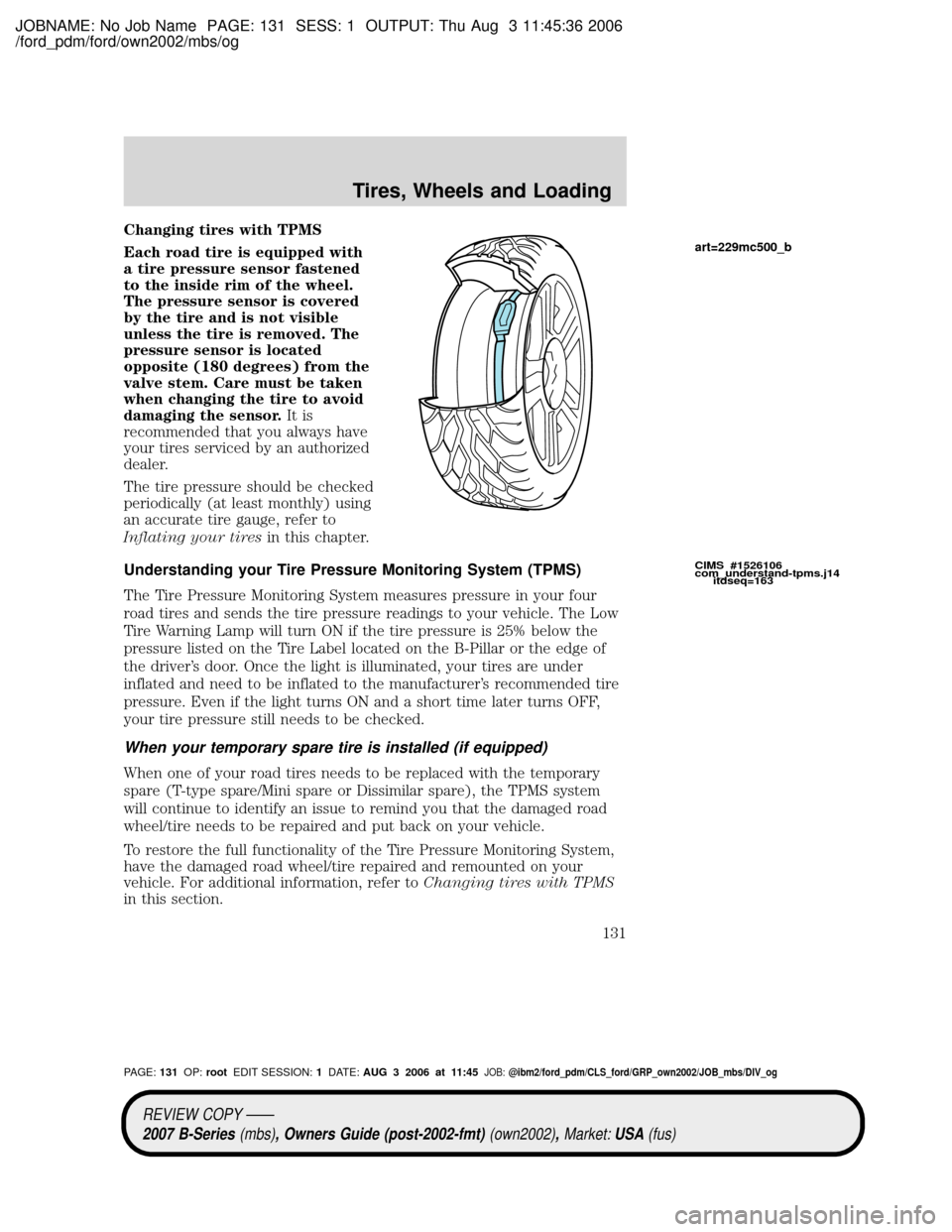
Each road tire is equipped with
a tire pressure sensor fastened
to the inside rim of the wheel.
The pressure sensor is covered
by the tire and is not visible
unless the tire is removed. The
pressure sensor is located
opposite (180 degrees) from the
valve stem. Care must be taken
when changing the tire to avoid
damaging the sensor.It is
recommended that you always have
your tires serviced by an authorized
dealer.
The tire pressure should be checked
periodically (at least monthly) using
an accurate tire gauge, refer to
Inflating your tiresin this chapter.
Understanding your Tire Pressure Monitoring System (TPMS)
The Tire Pressure Monitoring System measures pressure in your four
road tires and sends the tire pressure readings to your vehicle. The Low
Tire Warning Lamp will turn ON if the tire pressure is 25% below the
pressure listed on the Tire Label located on the B-Pillar or the edge of
the driver's door. Once the light is illuminated, your tires are under
inflated and need to be inflated to the manufacturer's recommended tire
pressure. Even if the light turns ON and a short time later turns OFF,
your tire pressure still needs to be checked.
When your temporary spare tire is installed (if equipped)
When one of your road tires needs to be replaced with the temporary
spare (T-type spare/Mini spare or Dissimilar spare), the TPMS system
will continue to identify an issue to remind you that the damaged road
wheel/tire needs to be repaired and put back on your vehicle.
To restore the full functionality of the Tire Pressure Monitoring System,
have the damaged road wheel/tire repaired and remounted on your
vehicle. For additional information, refer toChanging tires with TPMS
in this section.
CIMS #1526106
com_understand-tpms.j14
itdseq=163
art=229mc500_b
REVIEW COPY ÐÐ
2007 B-Series(mbs), Owners Guide (post-2002-fmt)(own2002),Market:USA(fus)
PAGE:131OP:rootEDIT SESSION:1DATE:AUG 3 2006 at 11:45JOB:@ibm2/ford_pdm/CLS_ford/GRP_own2002/JOB_mbs/DIV_og
Tires, Wheels and Loading
131
Page 133 of 279
JOBNAME: No Job Name PAGE: 133 SESS: 1 OUTPUT: Thu Aug 3 11:45:36 2006
/ford_pdm/ford/own2002/mbs/og
Low Tire Pressure
Warning LightPossible cause Customer Action Required
Solid Warning Light Tire(s)
under-inflated1. Check your tire pressure to
ensure tires are properly
inflated; refer toInflating
your tiresin this chapter.
2. After inflating your tires to
the manufacturer's
recommended inflation
pressure as shown on the Tire
Label (located on the edge of
driver's door or the B-Pillar)
the vehicle must be driven for
at least two minutes over 20
mph (32 km/h) before the light
will turn OFF.
Spare tire in use Your temporary spare tire is in
use. Repair the damaged road
wheel/tire and reinstall it on
the vehicle to restore system
functionality. For a description
on how the system functions,
refer toWhen your temporary
spare tire is installedin this
section.
TPMS
malfunctionIf your tires are properly
inflated and your spare tire is
not in use and the light
remains ON, have the system
inspected by your authorized
dealer.
REVIEW COPY ÐÐ
2007 B-Series(mbs), Owners Guide (post-2002-fmt)(own2002),Market:USA(fus)
PAGE:133OP:rootEDIT SESSION:1DATE:AUG 3 2006 at 11:45JOB:@ibm2/ford_pdm/CLS_ford/GRP_own2002/JOB_mbs/DIV_og
Tires, Wheels and Loading
133
Page 134 of 279
JOBNAME: No Job Name PAGE: 134 SESS: 1 OUTPUT: Thu Aug 3 11:45:36 2006
/ford_pdm/ford/own2002/mbs/og
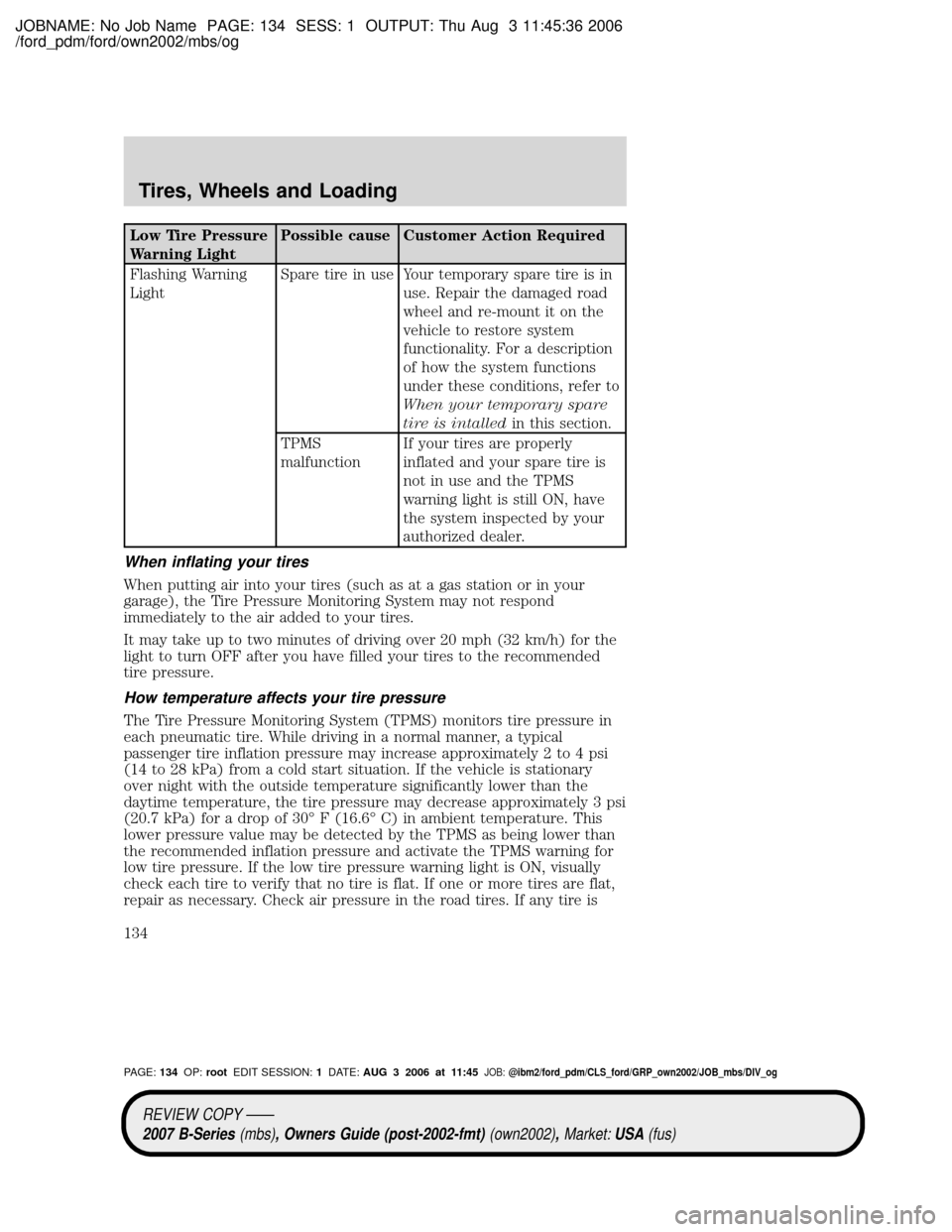
Low Tire Pressure
Warning LightPossible cause Customer Action Required
Flashing Warning
LightSpare tire in use Your temporary spare tire is in
use. Repair the damaged road
wheel and re-mount it on the
vehicle to restore system
functionality. For a description
of how the system functions
under these conditions, refer to
When your temporary spare
tire is intalledin this section.
TPMS
malfunctionIf your tires are properly
inflated and your spare tire is
not in use and the TPMS
warning light is still ON, have
the system inspected by your
authorized dealer.
When inflating your tires
When putting air into your tires (such as at a gas station or in your
garage), the Tire Pressure Monitoring System may not respond
immediately to the air added to your tires.
It may take up to two minutes of driving over 20 mph (32 km/h) for the
light to turn OFF after you have filled your tires to the recommended
tire pressure.
How temperature affects your tire pressure
The Tire Pressure Monitoring System (TPMS) monitors tire pressure in
each pneumatic tire. While driving in a normal manner, a typical
passenger tire inflation pressure may increase approximately 2 to 4 psi
(14 to 28 kPa) from a cold start situation. If the vehicle is stationary
over night with the outside temperature significantly lower than the
daytime temperature, the tire pressure may decrease approximately 3 psi
(20.7 kPa) for a drop of 30É F (16.6É C) in ambient temperature. This
lower pressure value may be detected by the TPMS as being lower than
the recommended inflation pressure and activate the TPMS warning for
low tire pressure. If the low tire pressure warning light is ON, visually
check each tire to verify that no tire is flat. If one or more tires are flat,
repair as necessary. Check air pressure in the road tires. If any tire is
REVIEW COPY ÐÐ
2007 B-Series(mbs), Owners Guide (post-2002-fmt)(own2002),Market:USA(fus)
PAGE:134OP:rootEDIT SESSION:1DATE:AUG 3 2006 at 11:45JOB:@ibm2/ford_pdm/CLS_ford/GRP_own2002/JOB_mbs/DIV_og
Tires, Wheels and Loading
134
Page 186 of 279
JOBNAME: No Job Name PAGE: 186 SESS: 1 OUTPUT: Thu Aug 3 11:45:36 2006
/ford_pdm/ford/own2002/mbs/og
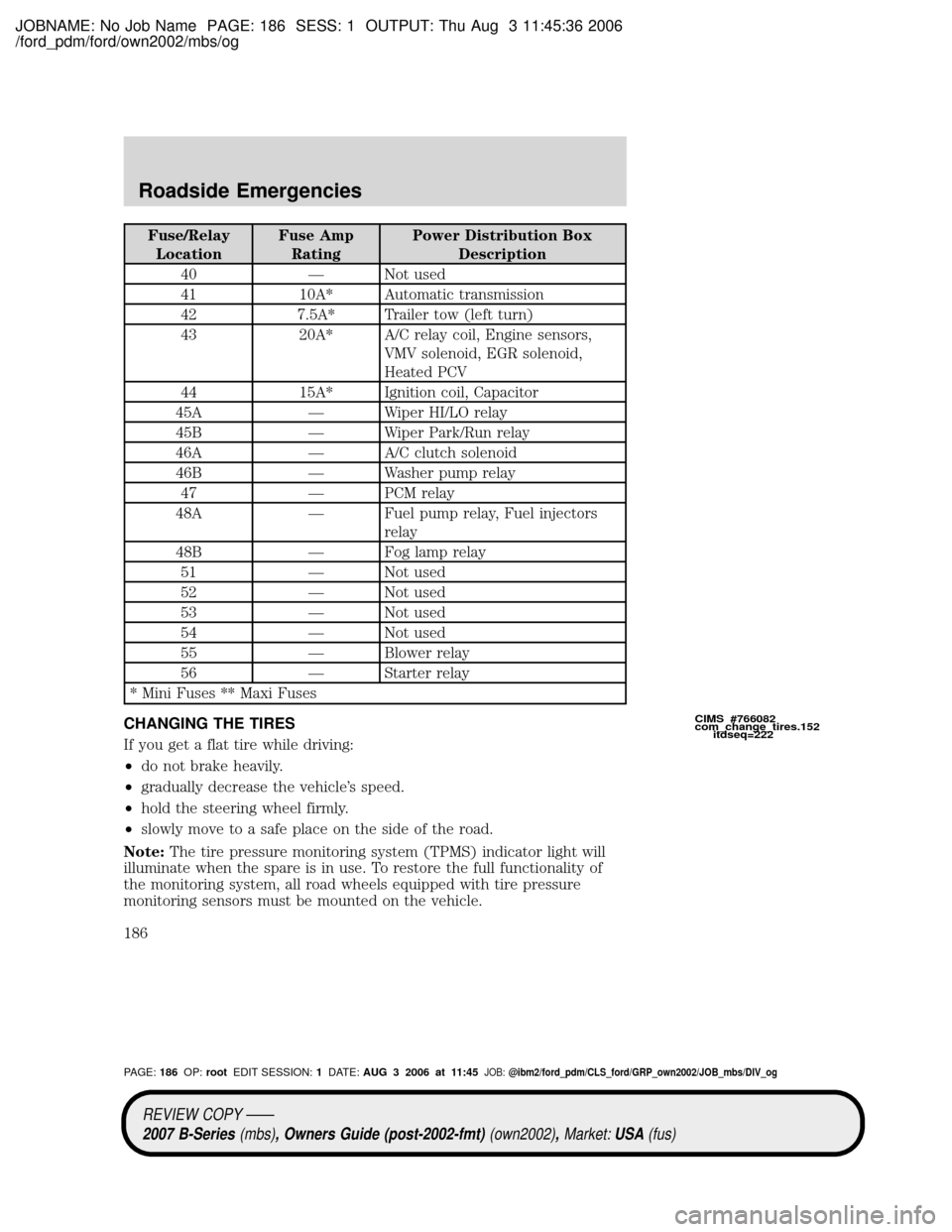
Fuse/Relay
LocationFuse Amp
RatingPower Distribution Box
Description
40 Ð Not used
41 10A* Automatic transmission
42 7.5A* Trailer tow (left turn)
43 20A* A/C relay coil, Engine sensors,
VMV solenoid, EGR solenoid,
Heated PCV
44 15A* Ignition coil, Capacitor
45A Ð Wiper HI/LO relay
45B Ð Wiper Park/Run relay
46A Ð A/C clutch solenoid
46B Ð Washer pump relay
47 Ð PCM relay
48A Ð Fuel pump relay, Fuel injectors
relay
48B Ð Fog lamp relay
51 Ð Not used
52 Ð Not used
53 Ð Not used
54 Ð Not used
55 Ð Blower relay
56 Ð Starter relay
* Mini Fuses ** Maxi Fuses
CHANGING THE TIRES
If you get a flat tire while driving:
²do not brake heavily.
²gradually decrease the vehicle's speed.
²hold the steering wheel firmly.
²slowly move to a safe place on the side of the road.
Note:The tire pressure monitoring system (TPMS) indicator light will
illuminate when the spare is in use. To restore the full functionality of
the monitoring system, all road wheels equipped with tire pressure
monitoring sensors must be mounted on the vehicle.
CIMS #766082
com_change_tires.152
itdseq=222
REVIEW COPY ÐÐ
2007 B-Series(mbs), Owners Guide (post-2002-fmt)(own2002),Market:USA(fus)
PAGE:186OP:rootEDIT SESSION:1DATE:AUG 3 2006 at 11:45JOB:@ibm2/ford_pdm/CLS_ford/GRP_own2002/JOB_mbs/DIV_og
Roadside Emergencies
186