motor MAZDA MODEL B3000 2002 Owners Manual (in English)
[x] Cancel search | Manufacturer: MAZDA, Model Year: 2002, Model line: MODEL B3000, Model: MAZDA MODEL B3000 2002Pages: 288, PDF Size: 2.94 MB
Page 3 of 288
Maintenance and Specifications 224
Engine compartment 234
Engine oil 238
Battery 243
Fuel information 250
Refill capacities 272
Lubricant specifications 275
Engine data 276
Accessories 279
Index 280
All rights reserved. Reproduction by any means, electronic or mechanical
including photocopying, recording or by any information storage and retrieval
system or translation in whole or part is not permitted without written
authorization from Mazda Motor Corporation. Mazda may change the contents
without notice and without incurring obligation.
Copyright 2002 Mazda Motor Corporation
Table of Contents
3
Page 4 of 288
The following warning may be required by California law:
CALIFORNIA Proposition 65 Warning
WARNING: Engine exhaust, some of its constituents, and
certain vehicle components contain or emit chemicals known to
the State of California to cause cancer and birth defects or
other reproductive harm. In addition, certain fluids contained in
vehicles and certain products of component wear contain or
emit chemicals known to the State of California to cause cancer
and birth defects or other reproductive harm.
CONGRATULATIONS
Congratulations on acquiring your new Mazda Motor Corporation
product. Please take the time to get well acquainted with your vehicle by
reading this handbook. The more you know and understand about your
vehicle the greater the safety and pleasure you will derive from driving
it.
For more information on Mazda Motor Corporation and its products visit
the following website:
²In the United States: www.mazdausa.com
²In Canada: www.mazda.ca
Additional owner information is given in separate publications.
This Owner's Guide describes every option and model variant available
and therefore some of the items covered may not apply to your
particular vehicle. Furthermore, due to printing cycles it may describe
options before they are generally available.
Remember to pass on the Owner's Guide when reselling the vehicle. It is
an integral part of the vehicle.
WARNING: In the event of an accident the Fuel pump shut-off
switch will automatically cut off the fuel supply to the engine.
The switch can also be activated through sudden vibration (e.g.
collision when parking). To reset the switch, refer to theFuel
pump shut-off switchin theRoadside emergencieschapter.
Introduction
4
Page 154 of 288

squeal or groan noises when the brakes are applied. Such noises are
usually heard during the first few brake applications in the morning;
however, they may be heard at any time while braking and can be
aggravated by environmental conditions such as cold, heat, moisture,
road dust, salt or mud. If a ªmetal-to-metal,º ªcontinuous grindingº or
ªcontinuous squealº sound is present while braking, the brake linings
may be worn-out and should be inspected by an authorized Mazda
dealership.
Four-wheel anti-lock brake system (ABS)
This vehicle is equipped with an anti-lock braking system (ABS), a noise
from the hydraulic pump motor and pulsation in the pedal may be
observed during ABS braking events. Pedal pulsation coupled with noise
while braking under panic conditions or on loose gravel, bumps, wet or
snowy roads is normal and indicates proper functioning of the vehicle's
anti-lock brake system.
NOTE:The ABS performs a self-check after you start the engine and
begin to drive away.
A brief mechanical noise may be heard during this test. This is normal. If
a malfunction is found, the ABS warning light will come on. If the vehicle
has continuous vibration or shudder in the steering wheel while braking,
the vehicle should be inspected by an authorized Mazda dealership.
The ABS operates by detecting the
onset of wheel lockup during brake
applications and compensates for
this tendency. The wheels are
prevented from locking even when
the brakes are firmly applied. The
accompanying illustration depicts
the advantage of an ABS equipped
vehicle (on bottom) to a non-ABS
equipped vehicle (on top) during hard braking with loss of front braking
traction.
WARNING: The Anti-Lock system does not decrease the time
necessary to apply the brakes or always reduce stopping
distance. Always leave enough room between your vehicle and
the vehicle in front of you to stop.
Driving
154
Page 178 of 288
Driving while you tow
When towing a trailer:
²Turn off the speed control. The speed control may shut off
automatically when you are towing on long, steep grades.
²Consult your local motor vehicle speed regulations for towing a trailer.
²To eliminate excessive shifting, use a lower gear. This will also assist
in transmission cooling. (For additional information, refer to the
Driving with a 4±speed automatic transmissionsection in this
chapter.
²Anticipate stops and brake gradually.
²Do not exceed the GCWR rating or transmission damage may occur.
Servicing after towing
If you tow a trailer for long distances, your vehicle will require more
frequent service intervals. Refer to your service maintenance section for
more information.
Trailer towing tips
²Practice turning, stopping and backing up before starting on a trip to
get the feel of the vehicle trailer combination. When turning, make
wider turns so the trailer wheels will clear curbs and other obstacles.
²Allow more distance for stopping with a trailer attached.
²The trailer tongue weight should be 10±15% of the loaded trailer
weight.
²After you have traveled 80 km (50 miles), thoroughly check your
hitch, electrical connections and trailer wheel lug nuts.
²To aid in engine/transmission cooling and A/C efficiency during hot
weather while stopped in traffic, place the gearshift lever in P (Park)
(automatic transmission) or N (Neutral) (manual transmissions).
²Vehicles with trailers should not be parked on a grade. If you must
park on a grade, place wheel chocks under the trailer's wheels.
Driving
178
Page 179 of 288
Launching or retrieving a boat
Disconnect the wiring to the trailer before backing the trailer
into the water. Reconnect the wiring to the trailer after the
trailer is removed from the water.
When backing down a ramp during boat launching or retrieval:
²do not allow the static water level to rise above the bottom edge of
the rear bumper.
²do not allow waves to break higher than 15 cm (6 inches) above the
bottom edge of the rear bumper.
Exceeding these limits may allow water to enter vehicle components:
²causing internal damage to the components.
²affecting driveability, emissions and reliability.
Replace the rear axle lubricant any time the axle has been submerged in
water. Rear axle lubricant quantities are not to be checked or changed
unless a leak is suspected or repair required.
RECREATIONAL TOWING
Follow these guidelines if you have a need for recreational towing. An
example of recreational towing would be towing your vehicle behind a
motorhome. These guidelines are designed to ensure that your
transmission is not damaged.
4x2 and 4x4 vehicles equipped with manual transmissions:
Before you have your vehicle towed:
²Release the parking brake.
²Move the gearshift to the neutral position.
²Turn the key in the ignition to the OFF/UNLOCKED position.
²The maximum recommended speed is 88 km/h (55 mph).
²The maximum recommended distance is unlimited.
In addition, it is recommended that you follow the instructions
provided by the after market manufacturer of the towing
apparatus if one has been installed.
Driving
179
Page 181 of 288

GETTING ROADSIDE ASSISTANCE
To fully assist you should you have a vehicle concern, Mazda Motor
Corporation offers a complimentary roadside assistance program. This
program is separate from the New Vehicle Limited Warranty. The service
is available:
²24±hours, seven days a week
²for the New Vehicle Limited Warranty period of three years or 60,000
km (36,000 miles), whichever occurs first on Mazda vehicles, and four
years or 80,000 km (50,000 miles) on Mazda vehicles.
Roadside assistance will cover:
²changing a flat tire
²jump-starts
²lock-out assistance
²limited fuel delivery
²towing of your disabled vehicle to the nearest Mazda Motor
Corporation dealership, or your selling dealer if within 56.3 km (35
miles) of the nearest Mazda Motor Corporation dealership (one tow
per disablement). Even non-warranty related tows, like accidents or
getting stuck in the mud or snow, are covered (some exclusions apply,
such as impound towing or repossession).
Canadian customers refer to your Owner Information Guide for
information on:
²Coverage period
²Exact fuel amounts
²Towing of your disabled vehicle
²Emergency travel expense reimbursement
²Travel planning benefits
USING ROADSIDE ASSISTANCE
Complete the roadside assistance identification card and place it in your
wallet for quick reference. In the United States, this card is found in the
Owner Guide portfolio in the glove compartment. In Canada, the card is
found in the Roadside Assistance book in the glove compartment.
U.S. Mazda vehicle customers who require roadside assistance, call
1±800±241±3673.
Canadian customers who require roadside assistance, call
1±800±665±2006.
Roadside Emergencies
181
Page 186 of 288
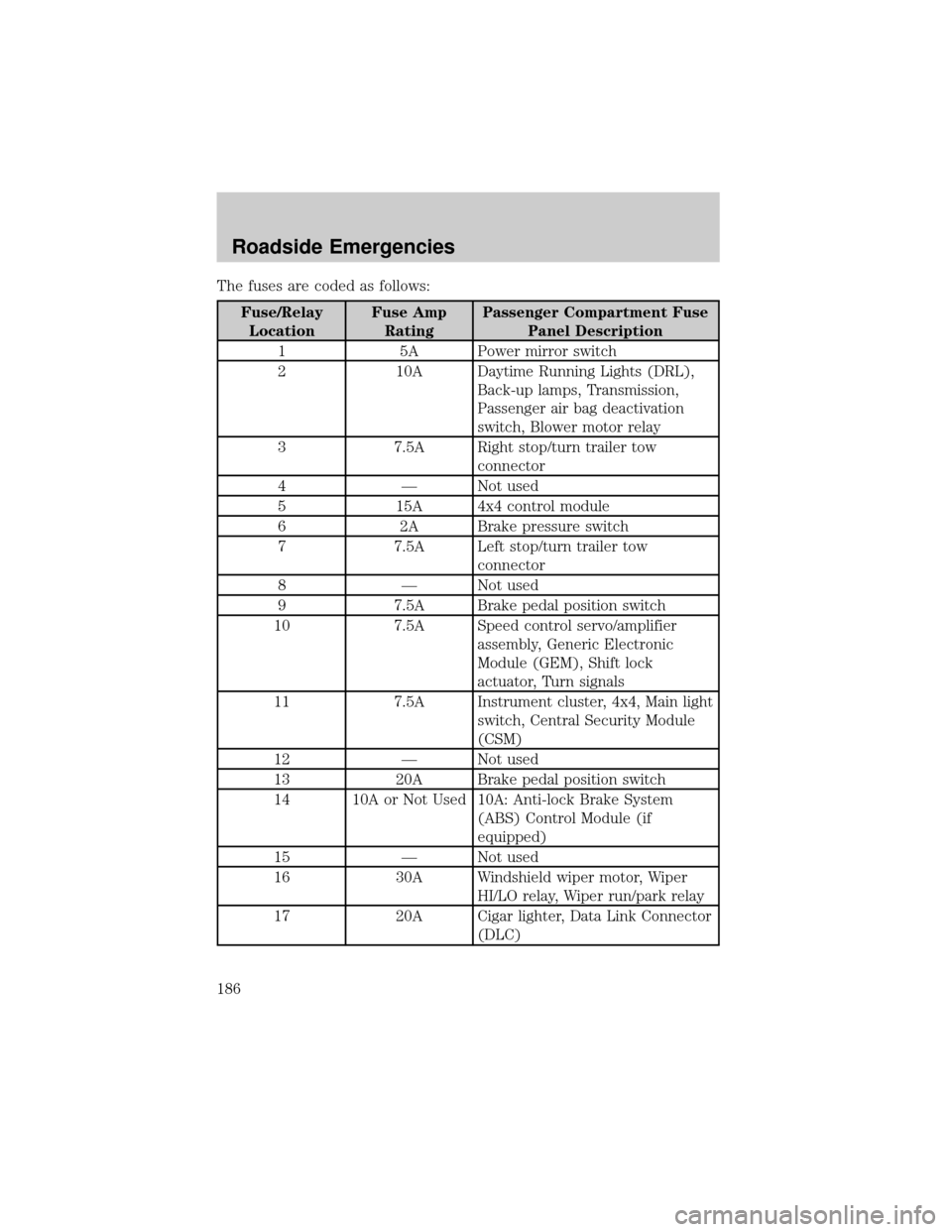
The fuses are coded as follows:
Fuse/Relay
LocationFuse Amp
RatingPassenger Compartment Fuse
Panel Description
1 5A Power mirror switch
2 10A Daytime Running Lights (DRL),
Back-up lamps, Transmission,
Passenger air bag deactivation
switch, Blower motor relay
3 7.5A Right stop/turn trailer tow
connector
4 Ð Not used
5 15A 4x4 control module
6 2A Brake pressure switch
7 7.5A Left stop/turn trailer tow
connector
8 Ð Not used
9 7.5A Brake pedal position switch
10 7.5A Speed control servo/amplifier
assembly, Generic Electronic
Module (GEM), Shift lock
actuator, Turn signals
11 7.5A Instrument cluster, 4x4, Main light
switch, Central Security Module
(CSM)
12 Ð Not used
13 20A Brake pedal position switch
14 10A or Not Used 10A: Anti-lock Brake System
(ABS) Control Module (if
equipped)
15 Ð Not used
16 30A Windshield wiper motor, Wiper
HI/LO relay, Wiper run/park relay
17 20A Cigar lighter, Data Link Connector
(DLC)
Roadside Emergencies
186
Page 189 of 288
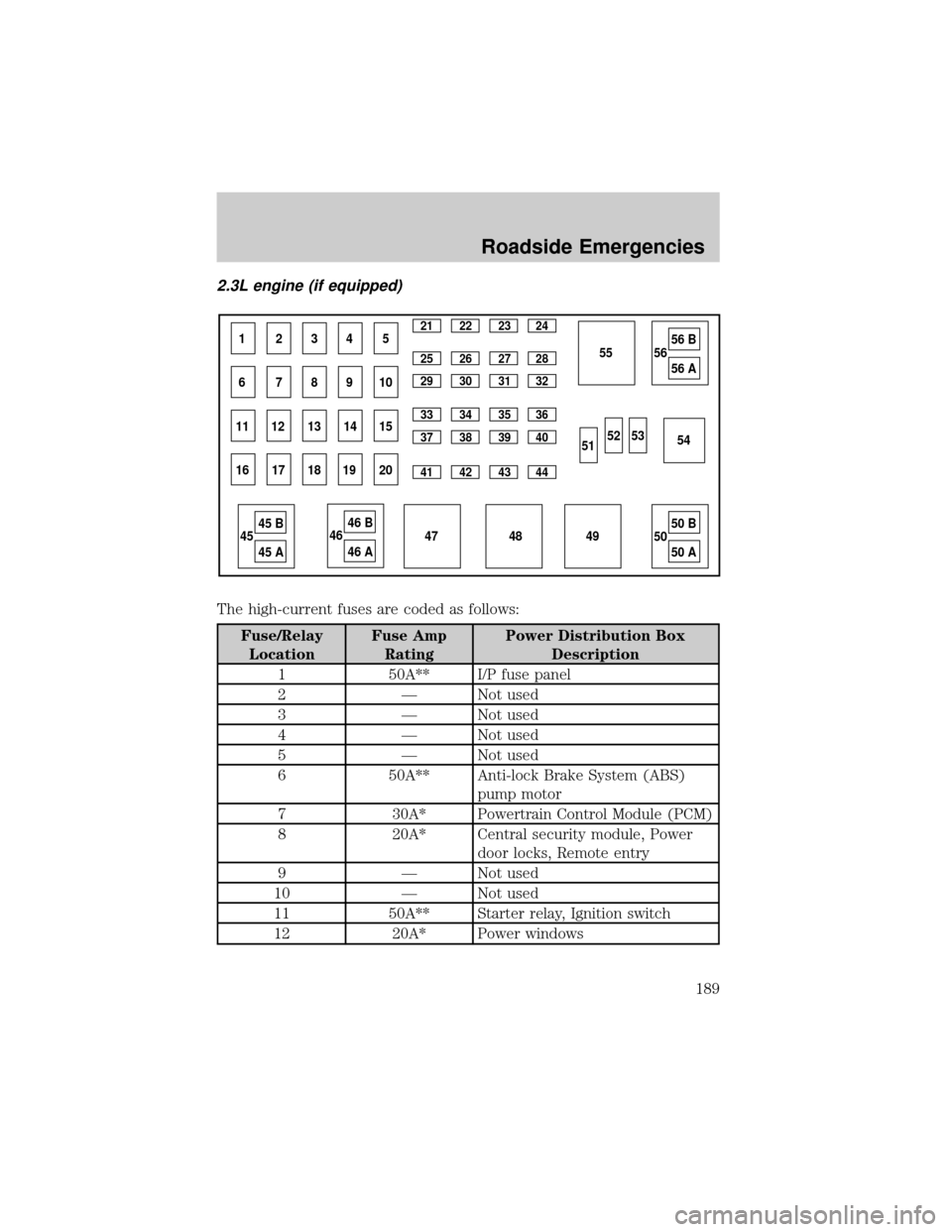
2.3L engine (if equipped)
The high-current fuses are coded as follows:
Fuse/Relay
LocationFuse Amp
RatingPower Distribution Box
Description
1 50A** I/P fuse panel
2 Ð Not used
3 Ð Not used
4 Ð Not used
5 Ð Not used
6 50A** Anti-lock Brake System (ABS)
pump motor
7 30A* Powertrain Control Module (PCM)
8 20A* Central security module, Power
door locks, Remote entry
9 Ð Not used
10 Ð Not used
11 50A** Starter relay, Ignition switch
12 20A* Power windows
1234521 22 23 24
25 26 27 28
29 30 31 32
33 34 35 36
37 38 39 40
41 42 43 44
67891055
49 4854 53 52
515656 B
56 A
5050 B
50 A 47 4545 B
45 A
4646 B
46 A 11 12 13 14 15
16 17 18 19 20
Roadside Emergencies
189
Page 190 of 288

Fuse/Relay
LocationFuse Amp
RatingPower Distribution Box
Description
13 Ð Not used
14 Ð Not used
15 Ð Not used
16 40A** Blower motor
17 20A** Auxiliary cooling fan
18 Ð Not used
19 Ð Not used
20 Ð Not used
21 10A* PCM memory
22 Ð Not used
23 20A* Fuel pump motor
24 30A* Headlamps
25 10A* A/C clutch relay
26 Ð Not used
27 Ð Not used
28 30A* ABS module
29 Ð Not used
30 15A* Trailer Tow
31 20A* Foglamp, Daytime Running Lamps
(DRL)
32 Ð Not used
33 15A* Park lamp, Central security
module
34 Ð Not used
35 Ð Not used
36 Ð Not used
37 Ð Not used
38 10A* Left headlamp low beam
39 Ð Not used
40 Ð Not used
41 20A* Heated oxygen sensors
Roadside Emergencies
190
Page 191 of 288
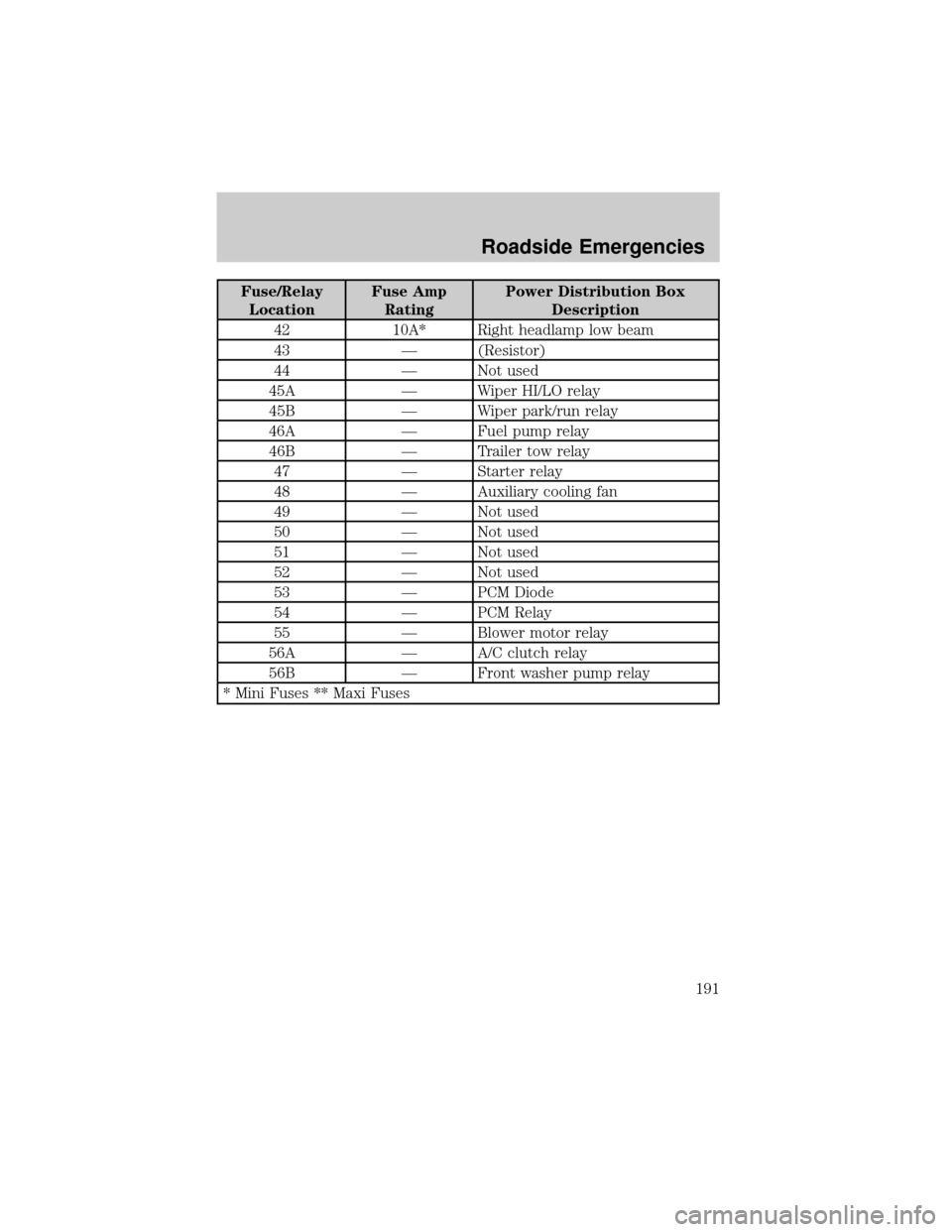
Fuse/Relay
LocationFuse Amp
RatingPower Distribution Box
Description
42 10A* Right headlamp low beam
43 Ð (Resistor)
44 Ð Not used
45A Ð Wiper HI/LO relay
45B Ð Wiper park/run relay
46A Ð Fuel pump relay
46B Ð Trailer tow relay
47 Ð Starter relay
48 Ð Auxiliary cooling fan
49 Ð Not used
50 Ð Not used
51 Ð Not used
52 Ð Not used
53 Ð PCM Diode
54 Ð PCM Relay
55 Ð Blower motor relay
56A Ð A/C clutch relay
56B Ð Front washer pump relay
* Mini Fuses ** Maxi Fuses
Roadside Emergencies
191