air condition MAZDA MODEL B3000 4WD 2002 User Guide
[x] Cancel search | Manufacturer: MAZDA, Model Year: 2002, Model line: MODEL B3000 4WD, Model: MAZDA MODEL B3000 4WD 2002Pages: 288, PDF Size: 1.87 MB
Page 130 of 288
Transport Canada air bag deactivation criteria (Canada Only)1. Infant: An infant (less than 1 year old) must ride in the front seat
because:
• my vehicle has no rear seat;
• the rear seat in my vehicle cannot accommodate a rear-facing infant
seat; or
• the infant has a medical condition which, according to the infant’s
physician, makes it necessary for the infant to ride in the front seat so
that the driver can monitor the infant’s condition.
2. Child age 12 or under: A child age 12 or under must ride in the
front seat because:
• my vehicle has no rear seat;
• although children age 12 and under ride in the rear seat whenever
possible, children age 12 and under have no option but to sometimes
ride in the front seat because rear seat space is insufficient; or
• the child has a medical condition that, according to the child’s
physician, makes it necessary for the child to ride in the front seat so
that the driver can monitor the child’s condition.
3. Medical condition: A passenger has a medical condition that,
according to his or her physician:
• poses a special risk for the passenger if the air bag deploys; and
• makes the potential harm from the passenger air bag deployment
greater than the potential harm from turning OFF the air bag and
experiencing a crash without the protection offered by the air bag
Transport Canada air bag deactivation criteria (continued)
Seating and Safety Restraints
130
Page 153 of 288
WARNING: If you ever smell exhaust fumes of any kind inside
your vehicle, have your authorized Mazda dealer inspect and fix
your vehicle immediately. Do not drive if you smell exhaust
fumes. These fumes are harmful and result in accident or death.
Have the exhaust and body ventilation systems checked whenever:
• the vehicle is raised for service.
• the sound of the exhaust system changes.
• the vehicle has been damaged in a collision.
WARNING: Engine exhaust, some of its constituents, and
certain vehicle components contain or emit chemicals known to
the State of California to cause cancer and birth defects or
other reproductive harm. In addition, certain fluids contained in
vehicles and certain products of component wear contain or
emit chemicals known to the State of California to cause cancer
and birth defects or other reproductive harm.
Important ventilating information
If the engine is idling while the vehicle is stopped in an open area for
long periods of time, open the windows at least 2.5 cm (one inch).
Adjust the heating or air conditioning (if equipped) to bring in fresh air.
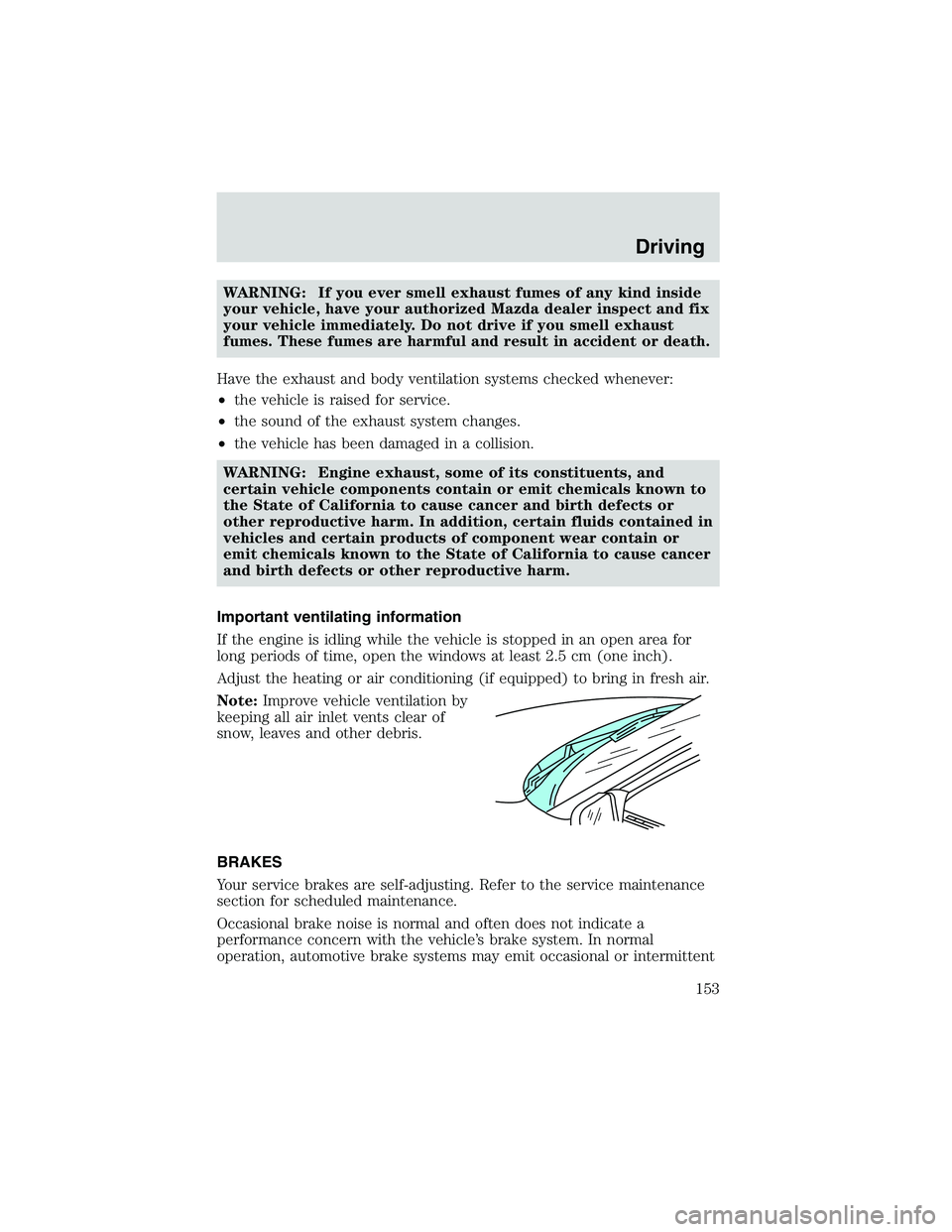
Note: Improve vehicle ventilation by
keeping all air inlet vents clear of
snow, leaves and other debris.
BRAKES
Your service brakes are self-adjusting. Refer to the service maintenance
section for scheduled maintenance.
Occasional brake noise is normal and often does not indicate a
performance concern with the vehicle’s brake system. In normal
operation, automotive brake systems may emit occasional or intermittent
Driving
153
Page 169 of 288

Driving through deep water may damage the transmission.
Replace rear axle lubricant any time the axle has been submerged in
water. The rear axle does not normally require a lubricant change for the
life of the vehicle. Rear axle lubricant quantities are not to be checked or
changed unless a leak is suspected or repair is required.
Driving on hilly or sloping terrain
When driving on a hill, avoid driving crosswise or turning on steep
slopes. You could lose traction and slip sideways. Drive straight up,
straight down or avoid the hill completely. Know the conditions on the
other side of a hill before driving over the crest.
When climbing a steep hill, start in a lower gear rather than downshifting
to a lower gear from a higher gear once the ascent has started. This
reduces strain on the engine and the possibility of stalling.
When descending a steep hill, avoid sudden braking. Shift to a lower gear
when added engine braking is desired.
When speed control is on and you are driving uphill, your vehicle speed
may drop considerably, especially if you are carrying a heavy load.
If vehicle speed drops more than 16 km/h (10 mph), the speed control
will cancel automatically. Resume speed with accelerator pedal.
If speed control cancels after climbing the hill, reset speed by pressing
and holding the SET ACCEL button (to resume speeds over 50 km/h [30
mph]).
Automatic transmissions may shift frequently while driving up steep
grades. Eliminate frequent shifting by shifting out of
(Overdrive) into
a lower gear.
Driving on snow and ice
A 4WD vehicle has advantages over 2WD vehicles in snow and ice but
can skid like any other vehicle.
Avoid sudden applications of power and quick changes of direction on
snow and ice. Apply the accelerator slowly and steadily when starting
from a full stop.
When braking, apply the brakes as you normally would. In order to allow
the anti-lock brake system (ABS) to operate properly, keep steady
pressure on the brake pedal.
Allow more stopping distance and drive slower than usual. Consider
using one of the lower gears.
Driving
169
Page 216 of 288

IN CALIFORNIA (U.S. ONLY)
California Civil Code Section 1793.2(d) requires that, if a manufacturer
or its representative is unable to repair a motor vehicle to conform to the
vehicle’s applicable express warranty after a reasonable number of
attempts, the manufacturer shall be required to either replace the
vehicle with one substantially identical or repurchase the vehicle and
reimburse the buyer in an amount equal to the actual price paid or
payable by the consumer (less a reasonable allowance for consumer
use). The consumer has the right to choose whether to receive a refund
or replacement vehicle.
California Civil Code Section 1793.22(b) presumes that the manufacturer
has had a reasonable number of attempts to conform the vehicle to its
applicable express warranties if, within the first 18 months of ownership
of a new vehicle or the first 29 000 km (18 000 miles), whichever occurs
first:1. Two or more repair attempts are made on the same nonconformity likely to cause death or serious bodily injury OR
2. Four or more repair attempts are made on the same nonconformity (a defect or condition that substantially impairs the use, value or
safety of the vehicle) OR
3. The vehicle is out of service for repair of nonconformities for a total of more than 30 calendar days (not necessarily all at one time)
In the case of 1 or 2 above, the consumer must also notify the
manufacturer of the need for the repair of the nonconformity at the
following address:
Mazda North American Operations
7755, Irvine Center Drive
Irvine, CA 92618–2922
Customer Assistance
216
Page 223 of 288
WARNING: Do not use chemical solvents or strong detergents
when cleaning the seat where the side air bag is mounted. Such
products may contaminate the side air bag system and affect
performance of the side air bag in a collision. The air bag may
not function correctly and not provide any injury reduction
benefits.
LEATHER SEATS (IF EQUIPPED)
Your leather seating surfaces have a clear, protective coating over the
leather.
• To clean, use a soft cloth with Deluxe Leather and Vinyl Cleaner. Dry
the area with a soft cloth.
• To help maintain its resiliency and color, use the Deluxe Leather Care
Kit, available at your local Mazda dealer.
• Do not use household cleaning products, alcohol solutions, solvents or
cleaners intended for rubber, vinyl and plastics, or oil/petroleum-based
leather conditioners. These products may cause premature wearing of
the clear, protective coating.
UNDERBODY
Flush the complete underside of vehicle frequently. Keep body drain
holes unplugged. Inspect for road damage.
MAZDA CAR CARE PRODUCTS
Your Mazda dealer has many quality products available to clean your
vehicle and protect its finishes. These quality products have been
specifically engineered to fulfill your automotive needs; they are custom
designed to complement the style and appearance of your vehicle. Each
product is made from high quality materials that meet or exceed rigid
specifications. For best results, use these products or products of
equivalent quality. These products are available at your local Mazda
dealer.
Cleaning
223
Page 224 of 288

INTRODUCTION
Be extremely careful to prevent injury to yourself and others and
damage to your vehicle when using this manual for inspection and
maintenance.
If you’re unsure about any procedure it describes, we strongly urge you
to have a reliable and qualified service shop perform the work, preferably
an Authorized Mazda Dealer.
Factory-trained Mazda technicians and genuine Mazda parts are best for
your vehicle. Without this expertise and the parts that have been
designed and made especially for your Mazda, inadequate, incomplete,
and insufficient servicing may result in problems. This could lead to
vehicle damage or an accident and injuries.
For expert advice and quality service, consult an Authorized Mazda
Dealer.
The owner should retain evidence that proper maintenance has been
performed as prescribed.
A claim against a warranty will not qualify if it results from lack of
maintenance and not from defective material or authorized Mazda
workmanship.
Any auto repair shop using parts equivalent to your Mazda’s original
equipment may perform maintenance.But we recommend that it
always be done by an Authorized Mazda Dealer using genuine
Mazda parts.
SCHEDULED MAINTENANCE
Schedule I – Normal Driving Conditions/Emission Control
Systems
Follow Schedule I if the vehicle is operated mainly where none of the
following conditions apply. If any do apply follow Schedule II.
• Repeated short-distance driving.
• Driving in dusty conditions.
• Towing a trailer.
• Operating in hot weather in stop-and-go “rush hour” traffic.
• Extended periods of idling or low-speed operation.
• High-speed operation with a fully loaded vehicle.
• Off-road operation.
NOTE:After the described period, continue to follow the described
maintenance at the recommended intervals.
Maintenance and Specifications
224
Page 225 of 288
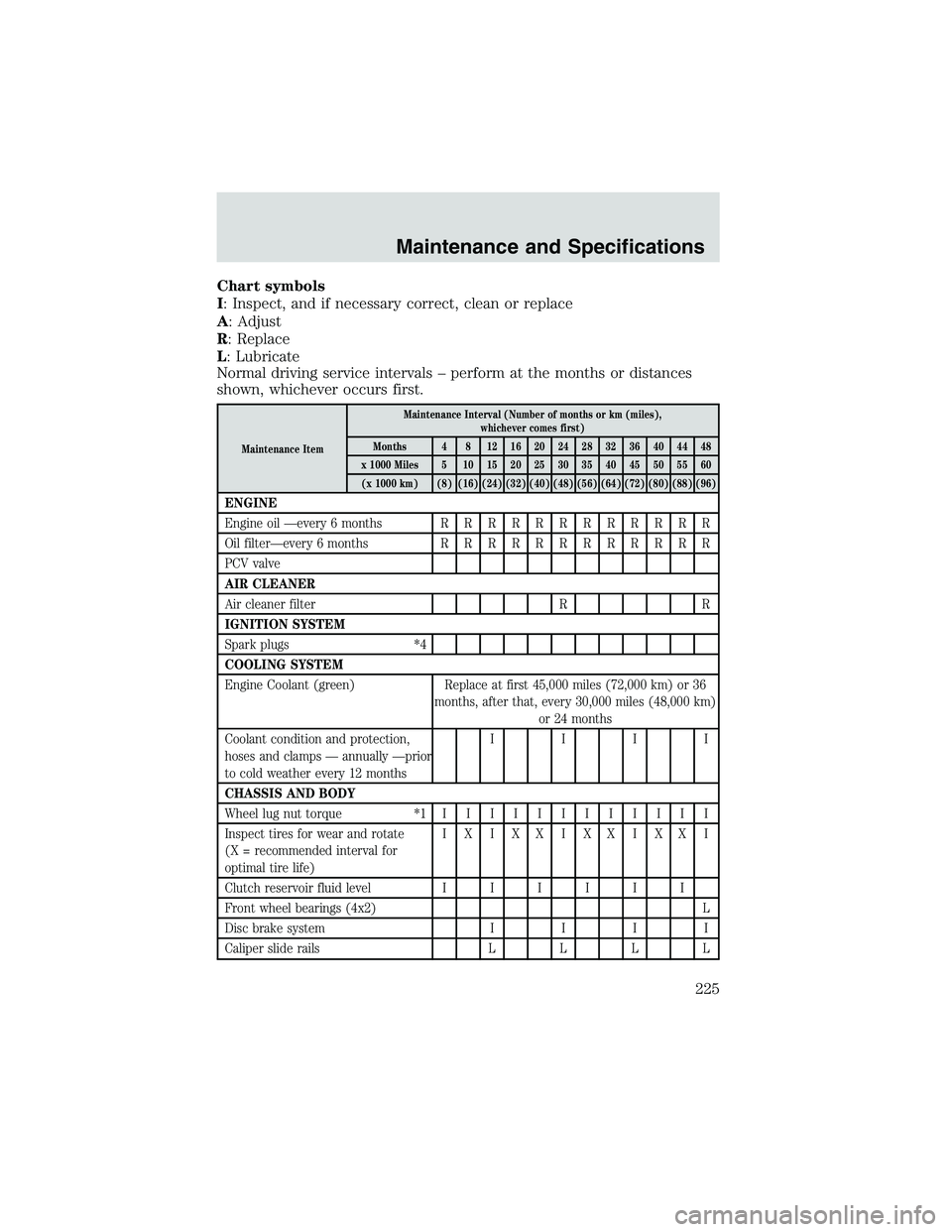
Chart symbols
I: Inspect, and if necessary correct, clean or replace
A: Adjust
R: Replace
L: Lubricate
Normal driving service intervals – perform at the months or distances
shown, whichever occurs first.
Maintenance ItemMaintenance Interval (Number of months or km (miles),
whichever comes first)
Months 4 8 12 16 20 24 28 32 36 40 44 48
x 1000 Miles 5 10 15 20 25 30 35 40 45 50 55 60 (x 1000 km) (8) (16) (24) (32) (40) (48) (56) (64) (72) (80) (88) (96)
ENGINE
Engine oil —every 6 months RRRRRRRRRRRR
Oil filter—every 6 months RRRRRRRRRRRR
PCV valve
AIR CLEANER
Air cleaner filter RR
IGNITION SYSTEM
Spark plugs *4
COOLING SYSTEM
Engine Coolant (green) Replace at first 45,000 miles (72,000 km) or 36
months, after that, every 30,000 miles (48,000 km) or 24 months
Coolant condition and protection,
hoses and clamps — annually —prior
to cold weather every 12 months IIII
CHASSIS AND BODY
Wheel lug nut torque *1IIIIIIIIIIII
Inspect tires for wear and rotate
(X = recommended interval for
optimal tire life) IXIXXIXXIXXI
Clutch reservoir fluid level IIIIII
Front wheel bearings (4x2) L
Disc brake system IIII
Caliper slide rails LLLL
Maintenance and Specifications
225
Page 227 of 288
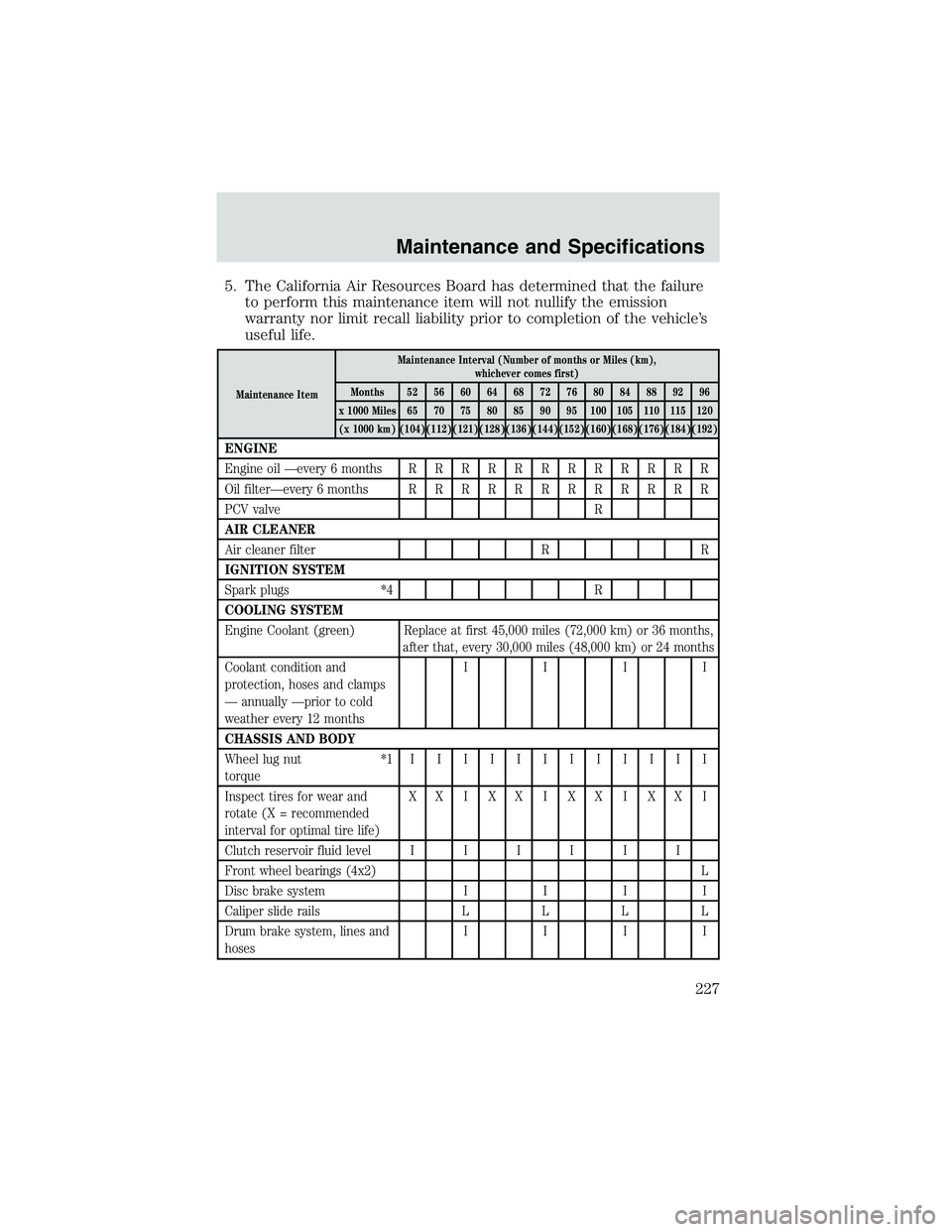
5. The California Air Resources Board has determined that the failureto perform this maintenance item will not nullify the emission
warranty nor limit recall liability prior to completion of the vehicle’s
useful life.
Maintenance Item Maintenance Interval (Number of months or Miles (km),
whichever comes first)
Months 52 56 60 64 68 72 76 80 84 88 92 96
x 1000 Miles 65 70 75 80 85 90 95 100 105 110 115 120 (x 1000 km) (104) (112) (121) (128) (136) (144) (152) (160) (168) (176) (184) (192)
ENGINE
Engine oil —every 6 months RRRRRRRRRRRR
Oil filter—every 6 months RRRRRRRRRRRR
PCV valve R
AIR CLEANER
Air cleaner filter RR
IGNITION SYSTEM
Spark plugs *4 R
COOLING SYSTEM
Engine Coolant (green) Replace at first 45,000 miles (72,000 km) or 36 months, after that, every 30,000 miles (48,000 km) or 24 months
Coolant condition and
protection, hoses and clamps
— annually —prior to cold
weather every 12 months IIII
CHASSIS AND BODY
Wheel lug nut
torque *1IIIIIIIIIIII
Inspect tires for wear and
rotate (X = recommended
interval for optimal tire life) XXIXXIXXIXXI
Clutch reservoir fluid level IIIIII
Front wheel bearings (4x2) L
Disc brake system IIII
Caliper slide rails LLLL
Drum brake system, lines and
hoses IIII
Maintenance and Specifications
227
Page 229 of 288

5. The California Air Resources Board has determined that the failureto perform this maintenance item will not nullify the emission
warranty nor limit recall liability prior to completion of the vehicle’s
useful life.
SCHEDULE II – SPECIAL OPERATING CONDITIONS
If your driving habits FREQUENTLYinclude one or more of the
following conditions:
• Short trips of lessthan 16 km (10 miles) when outside temperatures
remain below freezing.
• Towing a trailer, or carrying maximum loads.
• Operating in severe dust conditions.
• Operating during hot weatherin stop-and-go “rush-hour” traffic.
• Extensive idling, such as police, taxi or door-to-door delivery service.
• High speed operation with a fully loaded vehicle (max. GVW).
• Off-road operation.
Change ENGINE OIL AND OIL FILTER every 3 months or 4,800 km
(3,000 miles) whichever occurs first.
NOTE: Idling the engine for extended periods will accumulate more
hours of use on your vehicle than is actually indicated by the mileage
odometer. Consequently, the odometer reading can be often misleading
when determining the right time to change your engine oil and filter. If
you are using your vehicle in a manner which allows it to remain
stationary while the engine is running for long periods (door-to-door
delivery, taxi, police, power/utility company trucks, or similar duty), then
Mazda recommends you increase the frequency of oil and filter changes
to an interval equivalent to 200 ENGINE HOURS of use. Since most
vehicles are not equipped with hour-meters, it may be necessary for you
to approximate your idle time and plan oil/filter changes accordingly.
Maintenance and Specifications
229
Page 230 of 288
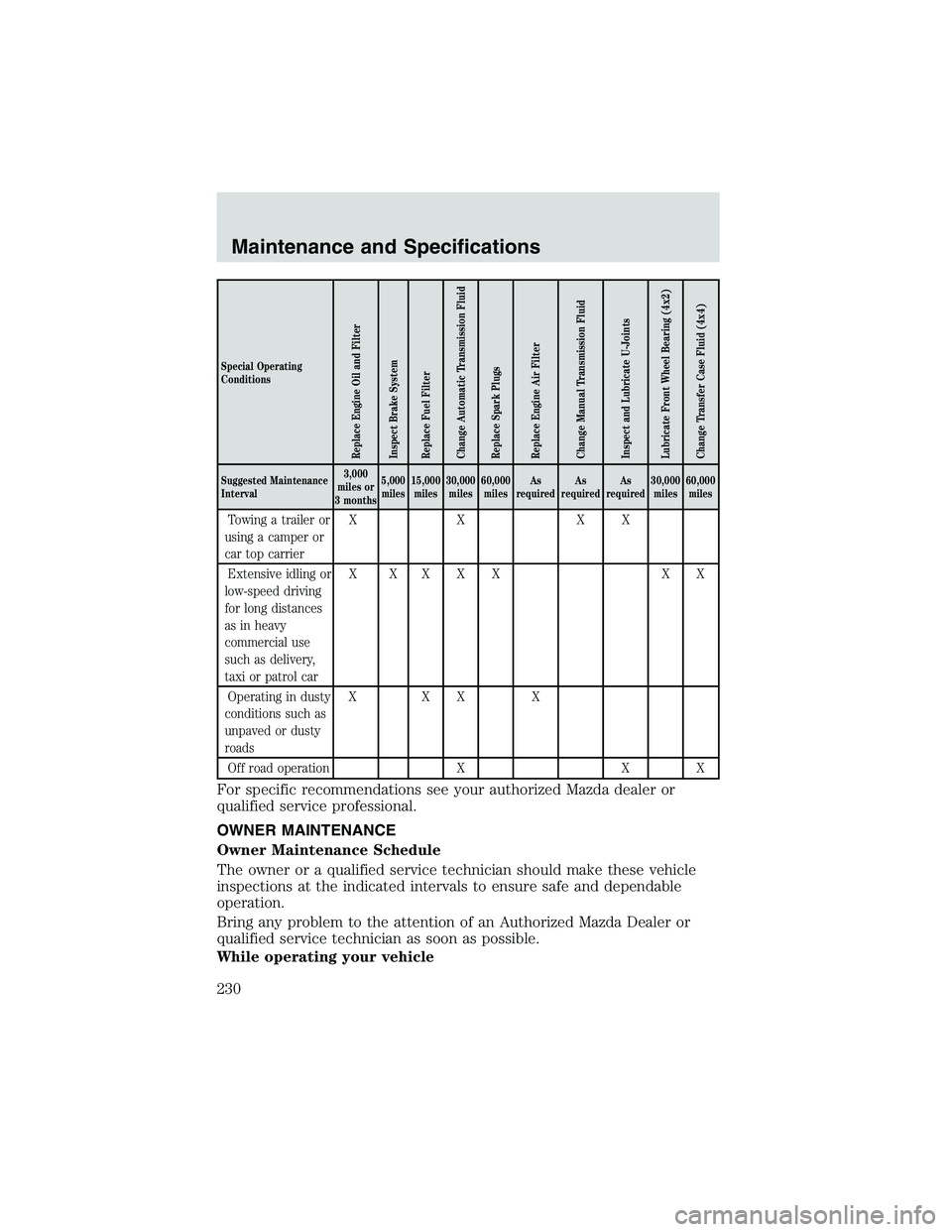
Special Operating
Conditions
Replace Engine Oil and Filter
Inspect Brake System
Replace Fuel Filter
Change Automatic Transmission Fluid
Replace Spark Plugs
Replace Engine Air Filter
Change Manual Transmission Fluid
Inspect and Lubricate U-Joints
Lubricate Front Wheel Bearing (4x2)
Change Transfer Case Fluid (4x4)
Suggested Maintenance
Interval3,000
miles or
3 months 5,000
miles 15,000
miles 30,000
miles 60,000
miles As
required As
required As
required 30,000
miles 60,000
miles
Towing a trailer or
using a camper or
car top carrier X
X XX
Extensive idling or
low-speed driving
for long distances
as in heavy
commercial use
such as delivery,
taxi or patrol car X XXXX
XX
Operating in dusty
conditions such as
unpaved or dusty
roads X XX X
Off road operation XXX
For specific recommendations see your authorized Mazda dealer or
qualified service professional.
OWNER MAINTENANCE
Owner Maintenance Schedule
The owner or a qualified service technician should make these vehicle
inspections at the indicated intervals to ensure safe and dependable
operation.
Bring any problem to the attention of an Authorized Mazda Dealer or
qualified service technician as soon as possible.
While operating your vehicle
Maintenance and Specifications
230