engine oil MAZDA MODEL B3000 4WD 2002 User Guide
[x] Cancel search | Manufacturer: MAZDA, Model Year: 2002, Model line: MODEL B3000 4WD, Model: MAZDA MODEL B3000 4WD 2002Pages: 288, PDF Size: 1.87 MB
Page 230 of 288
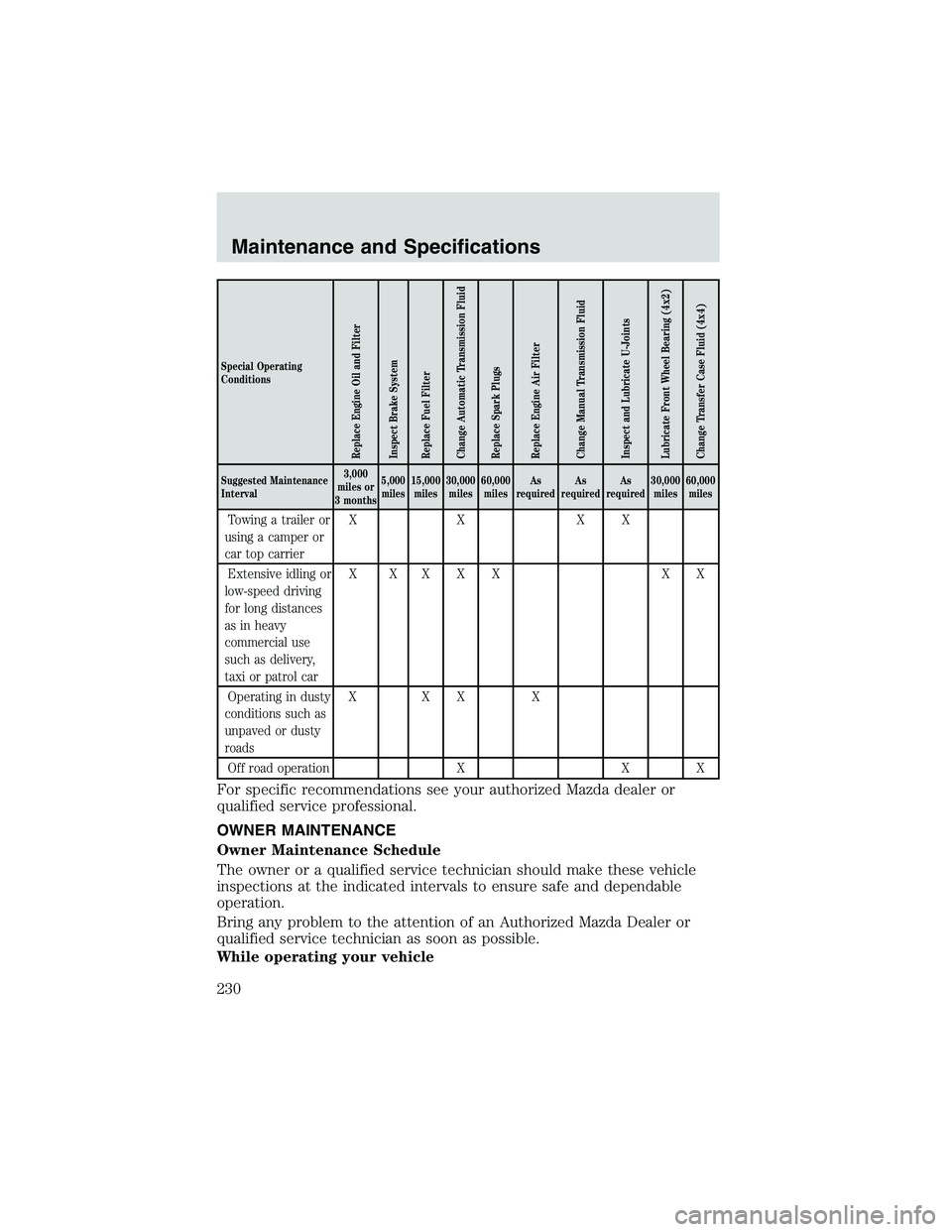
Special Operating
Conditions
Replace Engine Oil and Filter
Inspect Brake System
Replace Fuel Filter
Change Automatic Transmission Fluid
Replace Spark Plugs
Replace Engine Air Filter
Change Manual Transmission Fluid
Inspect and Lubricate U-Joints
Lubricate Front Wheel Bearing (4x2)
Change Transfer Case Fluid (4x4)
Suggested Maintenance
Interval3,000
miles or
3 months 5,000
miles 15,000
miles 30,000
miles 60,000
miles As
required As
required As
required 30,000
miles 60,000
miles
Towing a trailer or
using a camper or
car top carrier X
X XX
Extensive idling or
low-speed driving
for long distances
as in heavy
commercial use
such as delivery,
taxi or patrol car X XXXX
XX
Operating in dusty
conditions such as
unpaved or dusty
roads X XX X
Off road operation XXX
For specific recommendations see your authorized Mazda dealer or
qualified service professional.
OWNER MAINTENANCE
Owner Maintenance Schedule
The owner or a qualified service technician should make these vehicle
inspections at the indicated intervals to ensure safe and dependable
operation.
Bring any problem to the attention of an Authorized Mazda Dealer or
qualified service technician as soon as possible.
While operating your vehicle
Maintenance and Specifications
230
Page 231 of 288
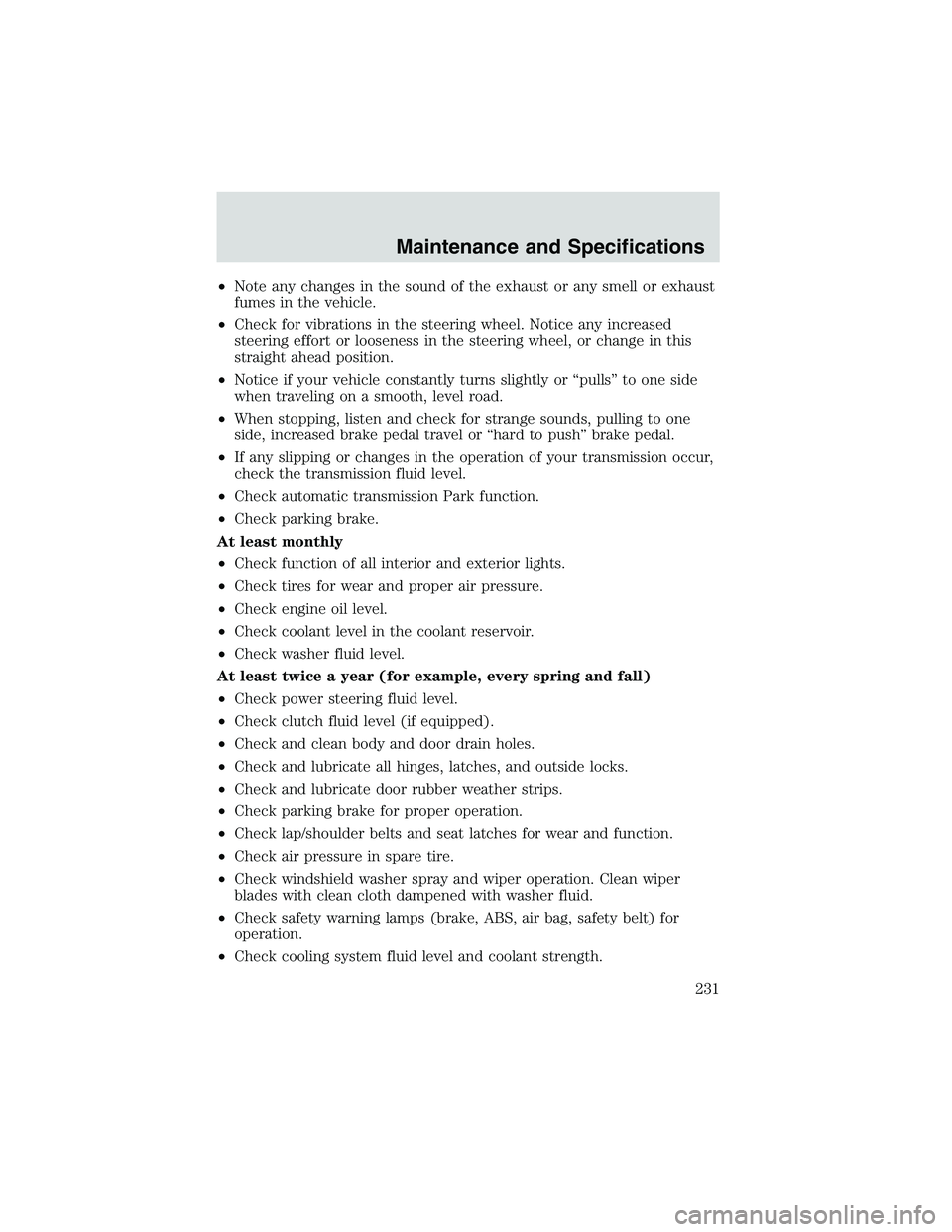
•Note any changes in the sound of the exhaust or any smell or exhaust
fumes in the vehicle.
• Check for vibrations in the steering wheel. Notice any increased
steering effort or looseness in the steering wheel, or change in this
straight ahead position.
• Notice if your vehicle constantly turns slightly or “pulls” to one side
when traveling on a smooth, level road.
• When stopping, listen and check for strange sounds, pulling to one
side, increased brake pedal travel or “hard to push” brake pedal.
• If any slipping or changes in the operation of your transmission occur,
check the transmission fluid level.
• Check automatic transmission Park function.
• Check parking brake.
At least monthly
• Check function of all interior and exterior lights.
• Check tires for wear and proper air pressure.
• Check engine oil level.
• Check coolant level in the coolant reservoir.
• Check washer fluid level.
At least twice a year (for example, every spring and fall)
• Check power steering fluid level.
• Check clutch fluid level (if equipped).
• Check and clean body and door drain holes.
• Check and lubricate all hinges, latches, and outside locks.
• Check and lubricate door rubber weather strips.
• Check parking brake for proper operation.
• Check lap/shoulder belts and seat latches for wear and function.
• Check air pressure in spare tire.
• Check windshield washer spray and wiper operation. Clean wiper
blades with clean cloth dampened with washer fluid.
• Check safety warning lamps (brake, ABS, air bag, safety belt) for
operation.
• Check cooling system fluid level and coolant strength.
Maintenance and Specifications
231
Page 234 of 288
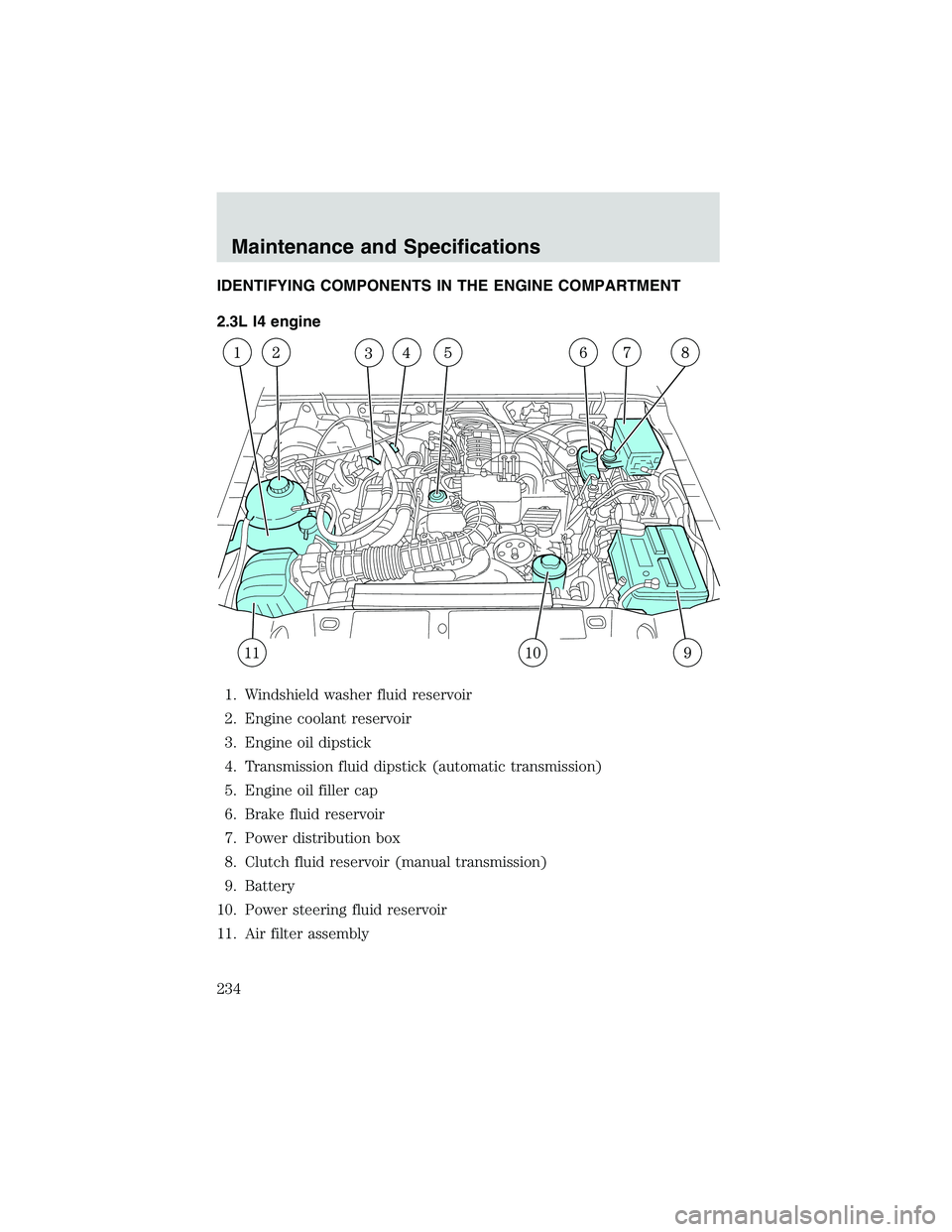
IDENTIFYING COMPONENTS IN THE ENGINE COMPARTMENT
2.3L I4 engine1. Windshield washer fluid reservoir
2. Engine coolant reservoir
3. Engine oil dipstick
4. Transmission fluid dipstick (automatic transmission)
5. Engine oil filler cap
6. Brake fluid reservoir
7. Power distribution box
8. Clutch fluid reservoir (manual transmission)
9. Battery
10. Power steering fluid reservoir
11. Air filter assembly
Maintenance and Specifications
234
Page 235 of 288
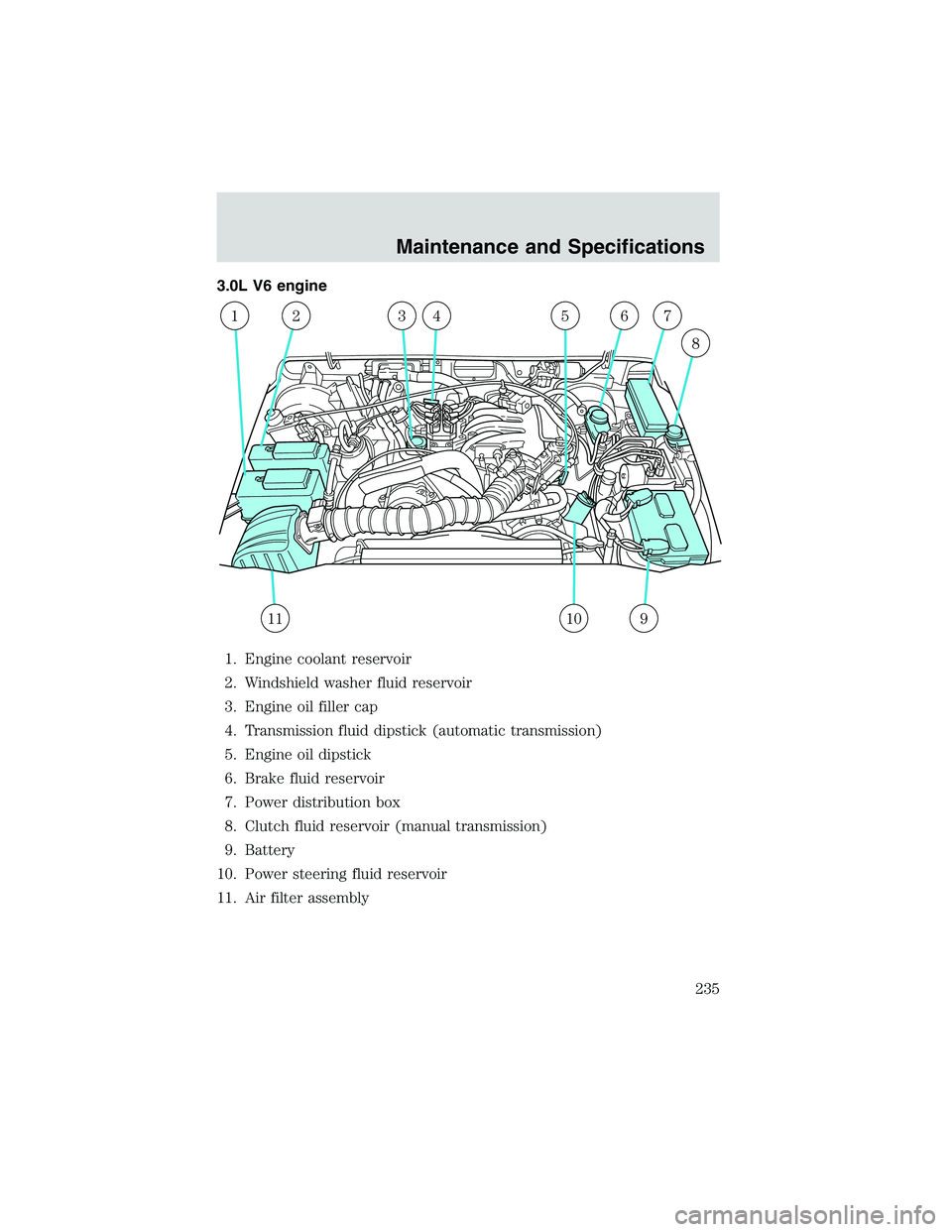
3.0L V6 engine1. Engine coolant reservoir
2. Windshield washer fluid reservoir
3. Engine oil filler cap
4. Transmission fluid dipstick (automatic transmission)
5. Engine oil dipstick
6. Brake fluid reservoir
7. Power distribution box
8. Clutch fluid reservoir (manual transmission)
9. Battery
10. Power steering fluid reservoir
11. Air filter assembly
11109
1234567
8
Maintenance and Specifications
235
Page 236 of 288
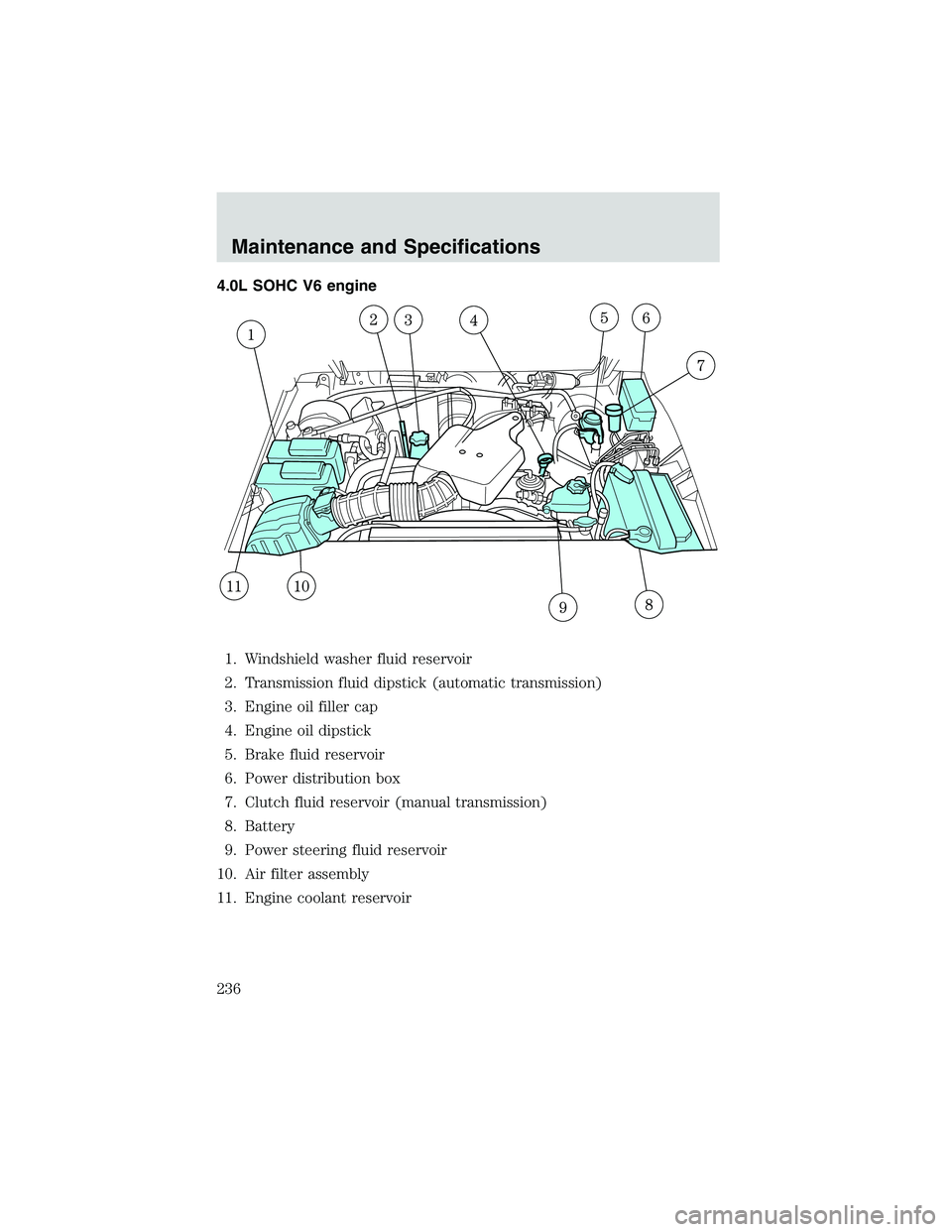
4.0L SOHC V6 engine1. Windshield washer fluid reservoir
2. Transmission fluid dipstick (automatic transmission)
3. Engine oil filler cap
4. Engine oil dipstick
5. Brake fluid reservoir
6. Power distribution box
7. Clutch fluid reservoir (manual transmission)
8. Battery
9. Power steering fluid reservoir
10. Air filter assembly
11. Engine coolant reservoir
Maintenance and Specifications
236
Page 238 of 288
ENGINE OIL
Checking the engine oil
Refer to the service maintenance section for the appropriate intervals for
checking the engine oil.1. Make sure the vehicle is on level ground.
2. Turn the engine off and wait a few minutes for the oil to drain into the oil pan.
3. Set the parking brake and ensure the gearshift is securely latched in P (Park) (automatic transmission) or 1 (First) (manual
transmission).
4. Open the hood. Protect yourself from engine heat.
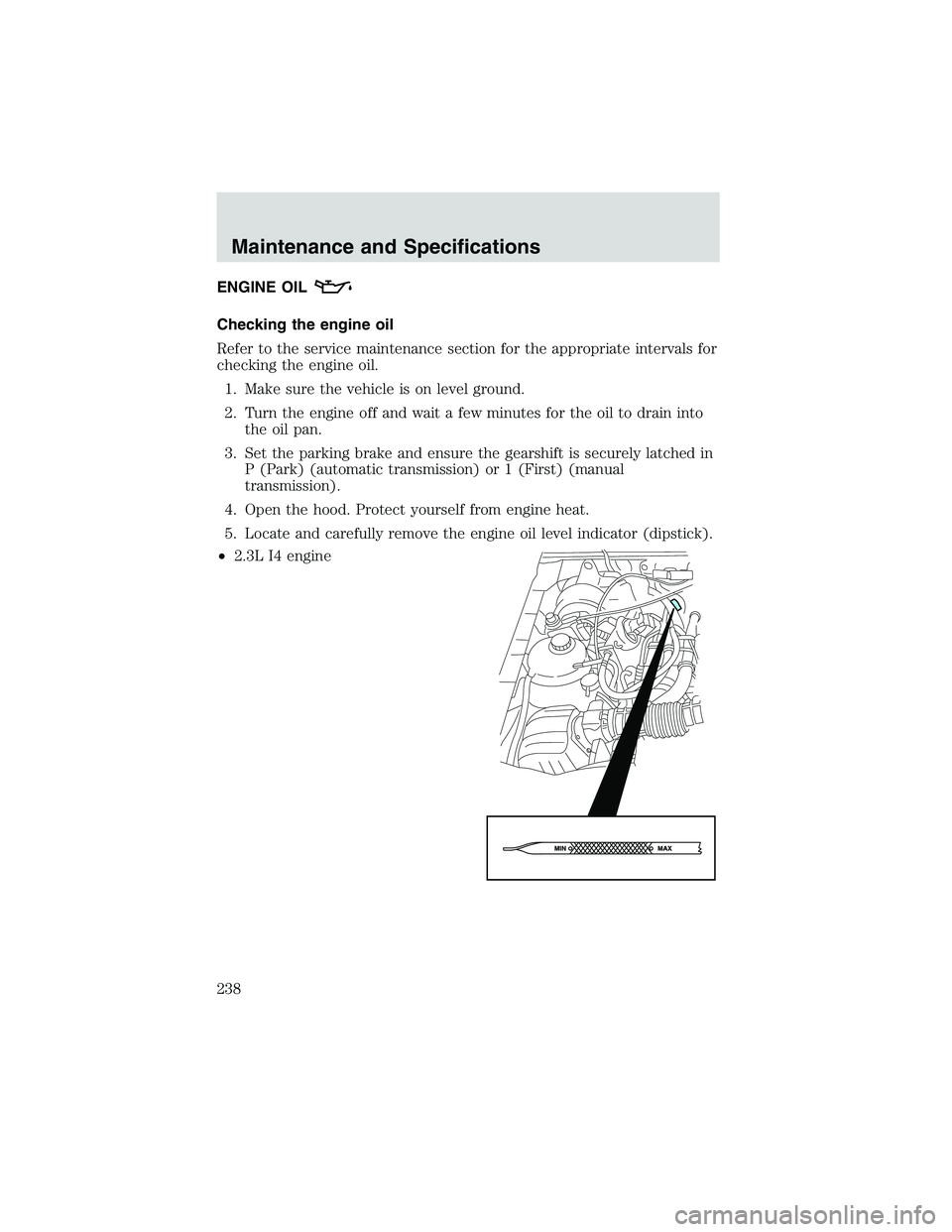
5. Locate and carefully remove the engine oil level indicator (dipstick).
• 2.3L I4 engine
Maintenance and Specifications
238
Page 240 of 288

6. Wipe the indicator clean. Insert the indicator fully, then remove itagain.
• If the oil level is between the MIN and MAX marks, the oil level is
acceptable, DO NOT ADD OIL.
• If the oil level is below the MIN mark, add enough oil to raise the level
within the MIN-MAX range.
• 2.3L I4 engine
• 3.0L V6 engine
Maintenance and Specifications
240
Page 241 of 288
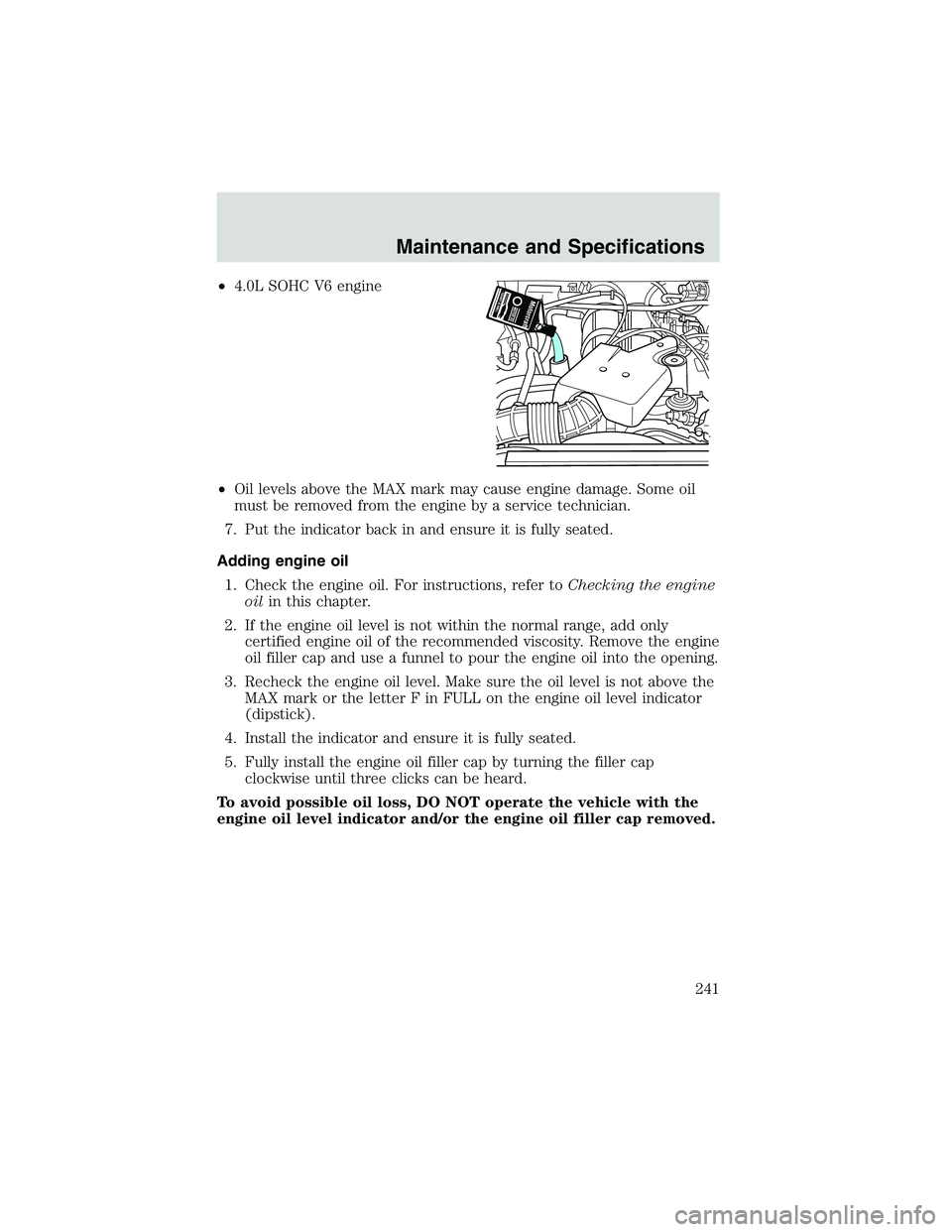
•4.0L SOHC V6 engine
• Oil levels above the MAX mark may cause engine damage. Some oil
must be removed from the engine by a service technician.
7. Put the indicator back in and ensure it is fully seated.
Adding engine oil 1. Check the engine oil. For instructions, refer to Checking the engine
oil in this chapter.
2. If the engine oil level is not within the normal range, add only certified engine oil of the recommended viscosity. Remove the engine
oil filler cap and use a funnel to pour the engine oil into the opening.
3. Recheck the engine oil level. Make sure the oil level is not above the MAX mark or the letter F in FULL on the engine oil level indicator
(dipstick).
4. Install the indicator and ensure it is fully seated.
5. Fully install the engine oil filler cap by turning the filler cap clockwise until three clicks can be heard.
To avoid possible oil loss, DO NOT operate the vehicle with the
engine oil level indicator and/or the engine oil filler cap removed.
Maintenance and Specifications
241
Page 242 of 288
Engine Oil Recommendations
2.3L & 3.0L Engines
Look for this certification
trademark.
SAE 5W-20 engine oil is recommended.
Only use oils “Certified For Gasoline Engines” by the American
Petroleum Institute (API). Use an equivalent oil Mazda specification.
SAE 5W-20 oil provides optimum fuel economy and durability
performance meeting all requirements for your vehicle’s engine.
Change your engine oil and filter according to the appropriate schedule
listed in the service maintenance section.
Do not use supplemental engine oil additives, oil treatments or engine
treatments. They are unnecessary and could, under certain conditions,
lead to engine damage which is not covered by your warranty.
4.0L Engine
Look for this certification
trademark.
Maintenance and Specifications
242
Page 243 of 288
SAE 5W-30 engine oil is recommended.
Only use oils “Certified For Gasoline Engines” by the American
Petroleum Institute (API). Use an equivalent Mazda Specification.
Do not use supplemental engine oil additives, oil treatments or engine
treatments. They are unnecessary and could, under certain conditions,
lead to engine damage which is not covered by your warranty.
Change your engine oil according to the appropriate schedule listed in
the service maintenance section.
Engine Oil Filter Recommendation
Change your engine oil filter according to the appropriate schedule listed
in the service maintenance section. Mazda production and aftermarket
(Mazda) oil filters are designed for added engine protection and long life.
If a replacement oil filter is used that does not meet Mazda Material and
design specifications, start-up engine noises or knock may be
experienced.
It is recommended you use the appropriate Mazda oil filter (or another
brand meeting Mazda specifications) for your engine.
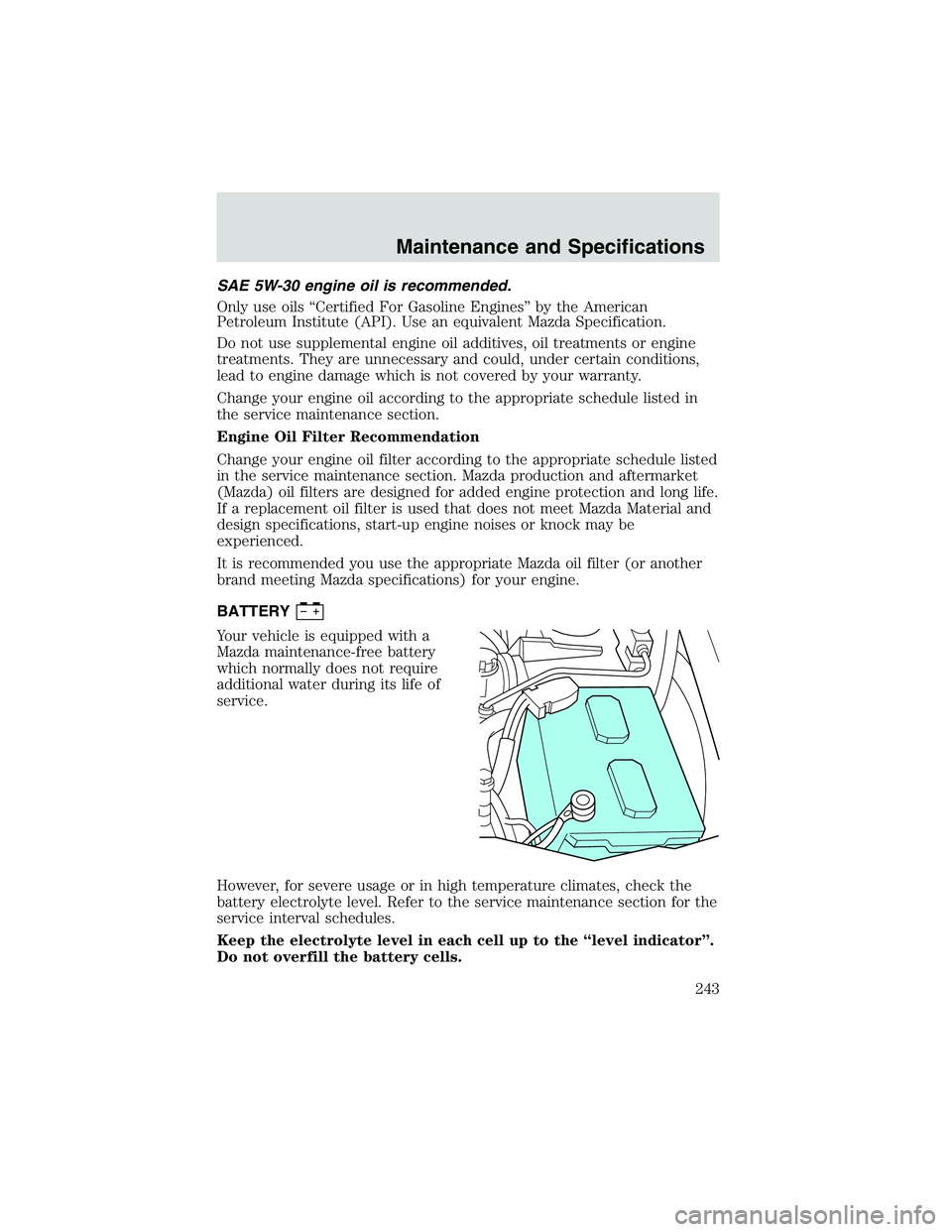
BATTERY
Your vehicle is equipped with a
Mazda maintenance-free battery
which normally does not require
additional water during its life of
service.
However, for severe usage or in high temperature climates, check the
battery electrolyte level. Refer to the service maintenance section for the
service interval schedules.
Keep the electrolyte level in each cell up to the “level indicator”.
Do not overfill the battery cells.
Maintenance and Specifications
243