trailer MAZDA MODEL B3000 4WD 2002 Owner's Manual
[x] Cancel search | Manufacturer: MAZDA, Model Year: 2002, Model line: MODEL B3000 4WD, Model: MAZDA MODEL B3000 4WD 2002Pages: 288, PDF Size: 1.87 MB
Page 230 of 288
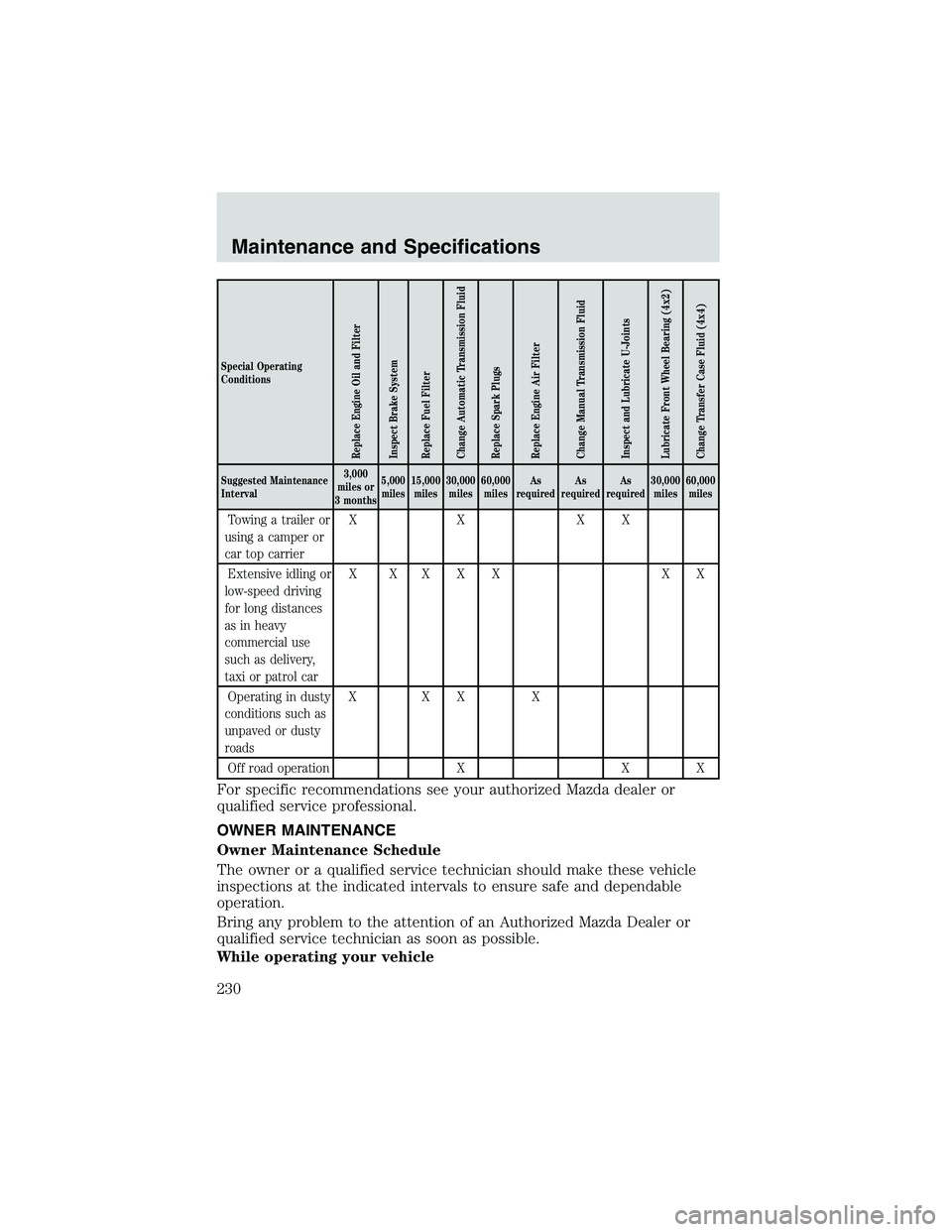
Special Operating
Conditions
Replace Engine Oil and Filter
Inspect Brake System
Replace Fuel Filter
Change Automatic Transmission Fluid
Replace Spark Plugs
Replace Engine Air Filter
Change Manual Transmission Fluid
Inspect and Lubricate U-Joints
Lubricate Front Wheel Bearing (4x2)
Change Transfer Case Fluid (4x4)
Suggested Maintenance
Interval3,000
miles or
3 months 5,000
miles 15,000
miles 30,000
miles 60,000
miles As
required As
required As
required 30,000
miles 60,000
miles
Towing a trailer or
using a camper or
car top carrier X
X XX
Extensive idling or
low-speed driving
for long distances
as in heavy
commercial use
such as delivery,
taxi or patrol car X XXXX
XX
Operating in dusty
conditions such as
unpaved or dusty
roads X XX X
Off road operation XXX
For specific recommendations see your authorized Mazda dealer or
qualified service professional.
OWNER MAINTENANCE
Owner Maintenance Schedule
The owner or a qualified service technician should make these vehicle
inspections at the indicated intervals to ensure safe and dependable
operation.
Bring any problem to the attention of an Authorized Mazda Dealer or
qualified service technician as soon as possible.
While operating your vehicle
Maintenance and Specifications
230
Page 258 of 288
![MAZDA MODEL B3000 4WD 2002 Owners Manual •Slow down gradually.
• Driving at reasonable speeds (traveling at 88 km/h [55 mph] uses 15%
less fuel than traveling at 105 km/h [65 mph]).
• Revving the engine before turning it off may reduce](/img/28/41052/w960_41052-257.png "MAZDA MODEL B3000 4WD 2002 Owners Manual •Slow down gradually.
• Driving at reasonable speeds (traveling at 88 km/h [55 mph] uses 15%
less fuel than traveling at 105 km/h [65 mph]).
• Revving the engine before turning it off may reduce")
•Slow down gradually.
• Driving at reasonable speeds (traveling at 88 km/h [55 mph] uses 15%
less fuel than traveling at 105 km/h [65 mph]).
• Revving the engine before turning it off may reduce fuel economy.
• Using the air conditioner or defroster may reduce fuel economy.
• You may want to turn off the speed control in hilly terrain if
unnecessary shifting between third and fourth gear occurs.
Unnecessary shifting of this type could result in reduced fuel
economy.
• Warming up a vehicle on cold mornings is not required and may
reduce fuel economy.
• Resting your foot on the brake pedal while driving may reduce fuel
economy.
• Combine errands and minimize stop-and-go driving.
Maintenance
• Keep tires properly inflated and use only recommended size.
• Operating a vehicle with the wheels out of alignment will reduce fuel
economy.
• Use recommended engine oil. Refer to Lubricant specificationsin
this chapter.
• Perform all regularly scheduled maintenance items. Follow the
recommended maintenance schedule and owner maintenance checks
found in your vehicle service maintenance section.
Conditions
• Heavily loading a vehicle or towing a trailer may reduce fuel economy
at any speed.
• Carrying unnecessary weight may reduce fuel economy (approximately
0.4 km/L [1 mpg] is lost for every 180 kg [400 lb] of weight carried).
• Adding certain accessories to your vehicle (for example bug
deflectors, rollbars/light bars, running boards, ski/luggage racks) may
reduce fuel economy.
• Using fuel blended with alcohol may lower fuel economy.
• Fuel economy may decrease with lower temperatures during the first
12–16 km (8–10 miles) of driving.
• Driving on flat terrain offers improved fuel economy as compared to
driving on hilly terrain.
Maintenance and Specifications
258
Page 264 of 288
![MAZDA MODEL B3000 4WD 2002 Owners Manual temperature (approximately 30 km [20 miles]). If your vehicle has been
operated for an extended period at high speeds, in city traffic during hot
weather or pulling a trailer, the vehicle should be tu](/img/28/41052/w960_41052-263.png "MAZDA MODEL B3000 4WD 2002 Owners Manual temperature (approximately 30 km [20 miles]). If your vehicle has been
operated for an extended period at high speeds, in city traffic during hot
weather or pulling a trailer, the vehicle should be tu")
temperature (approximately 30 km [20 miles]). If your vehicle has been
operated for an extended period at high speeds, in city traffic during hot
weather or pulling a trailer, the vehicle should be turned off for about 30
minutes to allow fluid to cool before checking.1. Drive the vehicle 30 km (20 miles) or until it reaches normal operating temperature.
2. Park the vehicle on a level surface and engage the parking brake.
3. With the parking brake engaged and your foot on the brake pedal, start the engine and move the gearshift lever through all of the gear
ranges. Allow sufficient time for each gear to engage.
4. Latch the gearshift lever in P (Park) and leave the engine running.
5. Remove the dipstick, wiping it clean with a clean, dry lint free rag. If necessary, refer to Identifying components in the engine
compartment in this chapter for the location of the dipstick.
6. Install the dipstick making sure it is fully seated in the filler tube.
7. Remove the dipstick and inspect the fluid level. The fluid should be in the designated area for normal operating temperature or ambient
temperature.
Low fluid level
Do not drive the vehicle if the fluid
level is at the bottom of the dipstick
and the ambient temperature is
above 10°C (50°F).
Correct fluid level
The transmission fluid should be checked at normal operating
temperature 66°C-77°C (150°F-170°F) on a level surface. The normal
operating temperature can be reached after approximately 30 km (20
miles) of driving.
You can check the fluid without driving if the ambient temperature is
above 10°C (50°F). However, if fluid is added at this time, an overfill
condition could result when the vehicle reaches normal operating
temperature.
The transmission fluid should be in
this range if at normal operating
temperature (66°C-77°C
[150°F-170°F]).
Maintenance and Specifications
264
Page 283 of 288

warning chime ..........................17
Heating heater only system ...................68
heating and air conditioning
system .......................................69
Hood ..........................................233
I
Ignition ...............................148, 276
Infant seats (see Safety seats)..135
Inspection/maintenance (I/M)
testing ........................................260
Instrument panel cleaning ...................................222
cluster ................................12, 222
lighting up panel and interior...74
location of components ............12
J
Jack ............................................194 positioning ...............................194
storage .............................194–197
Jump-starting your vehicle ......201
K
Keys ...................................102–103 key in ignition chime ...............17
positions of the ignition .........148
L
Lamps bulb replacement
specifications chart ..................76
cargo lamps ...............................74
daytime running light ...............73
fog lamps ...................................73 headlamps .................................73
headlamps, flash to pass ..........74
instrument panel, dimming .....74
interior lamps .....................75–76
replacing bulbs.. 75, 77–78, 80–81
Lane change indicator (see
Turn signal) .................................75
LATCH anchors .........................145
Lights, warning and indicator ....12 air bag ..................................14–15
anti-lock brakes (ABS) ....14, 155
anti-theft ...................................16
brake ..........................................13
charging system ........................15
check coolant ............................13
check engine .............................12
cruise indicator .........................15
door ajar ....................................16
fuel cap light .............................15
high beam .................................16
overdrive off ..............................16
safety belt .................................14
speed control ............................93
turn signal indicator .................16
Limited slip axle
(see Traction Loc) ....................157
Load limits .................................170 GAWR ......................................170
GVWR ......................................170
trailer towing ..........................170
Loading instructions .................172
Lubricant specifications ...275–276
Lumbar support, seats .............106
M
Manual transmission .................162 fluid capacities ........................272
lubricant specifications ..........276
reverse .....................................164
Index
283
Page 285 of 288

Special noticeambulance conversions ..............7
utility-type vehicles ....................7
Specification chart,
lubricants ...........................275–276
Speed control ..............................89
Speedometer ...............................20
Starting your vehicle ........148–150 jump starting ..........................201
Steering wheel controls ................................83, 89
tilting .........................................83
T
Tachometer .................................20
Temperature control
(see Climate control) .................68
Tether anchors ..........................140
Tires ...........................194, 268–269 changing ..................194–195, 198
checking the pressure ............269
replacing ..................................270
rotating ....................................269
snow tires and chains ............271
tire grades ...............................269
treadwear ................................268
Towing .......................................172 recreational towing .................179
trailer towing ..........................172
wrecker ....................................206
Traction-lok rear axle ...............157
Transfer case fluid checking .........................267 Transmission
automatic operation ...............158
fluid, checking and adding
(automatic) .............................263
fluid, checking and adding
(manual) .................................266
fluid, refill capacities ..............272
lubricant specifications ..275–276
manual operation ....................162
Trip odometer .............................20
Turn signal ............................16, 75
V
Vehicle dimensions ...................276
Vehicle Identification Number
(VIN) ..........................................278
Vehicle loading ..........................170 camper bodies ........................180
Ventilating your vehicle ...........153
W
Warning chimes ...........................17
Warning lights (see Lights) .......12
Washer fluid ..............................237
Water, Driving through .............170
Windows power .........................................85
Windshield washer fluid and
wipers checking and adding fluid .....237
checking and cleaning ..............82
operation ...................................82
replacing wiper blades .............83
Wrecker towing .........................206
Index
285