lock MAZDA MODEL B3000 4WD 2002 Workshop Manual
[x] Cancel search | Manufacturer: MAZDA, Model Year: 2002, Model line: MODEL B3000 4WD, Model: MAZDA MODEL B3000 4WD 2002Pages: 288, PDF Size: 1.87 MB
Page 179 of 288

Launching or retrieving a boat
Disconnect the wiring to the trailer before backing the trailer
into the water. Reconnect the wiring to the trailer after the
trailer is removed from the water.
When backing down a ramp during boat launching or retrieval:
•do not allow the static water level to rise above the bottom edge of
the rear bumper.
• do not allow waves to break higher than 15 cm (6 inches) above the
bottom edge of the rear bumper.
Exceeding these limits may allow water to enter vehicle components:
• causing internal damage to the components.
• affecting driveability, emissions and reliability.
Replace the rear axle lubricant any time the axle has been submerged in
water. Rear axle lubricant quantities are not to be checked or changed
unless a leak is suspected or repair required.
RECREATIONAL TOWING
Follow these guidelines if you have a need for recreational towing. An
example of recreational towing would be towing your vehicle behind a
motorhome. These guidelines are designed to ensure that your
transmission is not damaged.
4x2 and 4x4 vehicles equipped with manual transmissions:
Before you have your vehicle towed:
• Release the parking brake.
• Move the gearshift to the neutral position.
• Turn the key in the ignition to the OFF/UNLOCKED position.
• The maximum recommended speed is 88 km/h (55 mph).
• The maximum recommended distance is unlimited.
In addition, it is recommended that you follow the instructions
provided by the after market manufacturer of the towing
apparatus if one has been installed.
Driving
179
Page 180 of 288

4x2 and 4x4 vehicles equipped with automatic transmissions:
4x2 vehicles with automatic transmissions or 4x4 vehicles with manual
transfer cases and automatic transmissions, follow these guidelines for
recreational towing:
•Release the parking brake.
• Turn the key in the ignition to the OFF/UNLOCKED position.
• Place the transmission in N (Neutral).
• Do not exceed a distance of 80 km (50 miles).
• Do not exceed 56 km/h (35 mph) vehicle speed.
If a distance of 80 km (50 miles) or a speed of 56 km/h (35 mph) must
be exceeded, you must disconnect the driveshaft. Mazda recommends
the driveshaft be removed/installed only by a qualified technician. See
your local dealer for driveshaft removal/installation.
Improper removal/installation of the driveshaft can cause
transmission fluid loss, damage to the driveshaft and internal
transmission components.
CAMPER BODIES
Your pickup is not recommended for slide–in camper bodies.
Driving
180
Page 181 of 288

GETTING ROADSIDE ASSISTANCE
To fully assist you should you have a vehicle concern, Mazda Motor
Corporation offers a complimentary roadside assistance program. This
program is separate from the New Vehicle Limited Warranty. The service
is available:
•24–hours, seven days a week
• for the New Vehicle Limited Warranty period of three years or 60,000
km (36,000 miles), whichever occurs first on Mazda vehicles, and four
years or 80,000 km (50,000 miles) on Mazda vehicles.
Roadside assistance will cover:
• changing a flat tire
• jump-starts
• lock-out assistance
• limited fuel delivery
• towing of your disabled vehicle to the nearest Mazda Motor
Corporation dealership, or your selling dealer if within 56.3 km (35
miles) of the nearest Mazda Motor Corporation dealership (one tow
per disablement). Even non-warranty related tows, like accidents or
getting stuck in the mud or snow, are covered (some exclusions apply,
such as impound towing or repossession).
Canadian customers refer to your Owner Information Guide for
information on:
• Coverage period
• Exact fuel amounts
• Towing of your disabled vehicle
• Emergency travel expense reimbursement
• Travel planning benefits
USING ROADSIDE ASSISTANCE
Complete the roadside assistance identification card and place it in your
wallet for quick reference. In the United States, this card is found in the
Owner Guide portfolio in the glove compartment. In Canada, the card is
found in the Roadside Assistance book in the glove compartment.
U.S. Mazda vehicle customers who require roadside assistance, call
1–800–241–3673.
Canadian customers who require roadside assistance, call
1–800–665–2006.
Roadside Emergencies
181
Page 186 of 288

The fuses are coded as follows:
Fuse/RelayLocation Fuse Amp
Rating Passenger Compartment Fuse
Panel Description
1 5A Power mirror switch
2 10A Daytime Running Lights (DRL),
Back-up lamps, Transmission,
Passenger air bag deactivation
switch, Blower motor relay
3 7.5A Right stop/turn trailer tow
connector
4 — Not used
5 15A 4x4 control module
6 2A Brake pressure switch
7 7.5A Left stop/turn trailer tow
connector
8 — Not used
9 7.5A Brake pedal position switch
10 7.5A Speed control servo/amplifier
assembly, Generic Electronic
Module (GEM), Shift lock
actuator, Turn signals
11 7.5A Instrument cluster, 4x4, Main light
switch, Central Security Module
(CSM)
12 — Not used
13 20A Brake pedal position switch
14 10A or Not Used 10A: Anti-lock Brake System (ABS) Control Module (if
equipped)
15 — Not used
16 30A Windshield wiper motor, Wiper
HI/LO relay, Wiper run/park relay
17 20A Cigar lighter, Data Link Connector
(DLC)
Roadside Emergencies
186
Page 189 of 288

2.3L engine (if equipped)
The high-current fuses are coded as follows:
Fuse/RelayLocation Fuse Amp
Rating Power Distribution Box
Description
1 50A** I/P fuse panel
2 — Not used
3 — Not used
4 — Not used
5 — Not used
6 50A** Anti-lock Brake System (ABS)
pump motor
7 30A* Powertrain Control Module (PCM)
8 20A* Central security module, Power
door locks, Remote entry
9 — Not used
10 — Not used
11 50A** Starter relay, Ignition switch
12 20A* Power windows
1 234 521 22 23 24
25 26 27 28
29 30 31 32
33 34 35 36
37 38 39 40
41 42 43 44
6 7 8 9 10 55
49
48 54
5352
51 56
56 B
56 A
50 50 B
50 A
47
45 45 B
45 A
4646 B
46 A
11 12 13 14 15
16 17 18 19 20
Roadside Emergencies
189
Page 192 of 288

3.0L and 4.0L engines (if equipped)
The high-current fuses are coded as follows:
Fuse/RelayLocation Fuse Amp
Rating Power Distribution Box
Description
1 50A** I/P fuse panel
2 — Not used
3 — Not used
4 — Not used
5 — Not used
6 50A** Anti-lock Brake System (ABS)
Pump Motor
7 30A* Powertrain Control Module (PCM)
8 20A* Power door locks, Remote entry
9 — Not used
10 — Not used
11 50A** Starter relay, Ignition switch
12 20A* Power windows
13 20A* 4x4 motor
Roadside Emergencies
192
Page 196 of 288

Location of the spare tire and tools
The spare tire and tools for your vehicle are stowed in the following
locations:
ToolLocation
Spare tire Under the vehicle, just forward of
the rear bumper
Jack, jack handle, wheel nut wrench Regular Cab: behind seats and
underneath the jack and tools
cover
SuperCab: stowed in the passenger
side rear cab compartment or
behind the jump seat in a separate
tool bag
Four-door models: stowed behind
the front seats, between jump
seats and underneath jack and
tools cover.
Key, spare tire lock (if equipped) In the glove box
Removing the spare tire 1. Assemble the jack handle to the lug wrench as shown in the illustrations.
When connecting the jack handle, assemble the following:
• one handle extension and one
typical extension. To assemble,
slide parts together. To
disconnect, depress button and
pull apart.
• one wheel nut wrench. Depress
button and slide together.
Roadside Emergencies
196
Page 197 of 288

2. If equipped, unlock and removethe spare tire carrier lock from
the rear access hole located just
above the rear bumper and
below the tailgate.
3. Insert the straight end of the jack handle into the rear access
hole located just above the rear
bumper and below the tailgate.
Forward motion will stop and
resistance to turning will be felt
when properly engaged. 4. Turn the handle counterclockwise until tire is
lowered to the ground and the cable is slightly slack.
5. Remove the retainer from the spare tire.
Stowing the spare tire 1. Lay the tire on the ground with the valve stem facing up.
2. Install the retainer through the wheel center and slide the
wheel under the vehicle.
3. Turn the spare handle clockwise until the tire is raised to its
original position underneath the
vehicle. The spare handle
ratchets when the tire is raised
to the stowed position. It will
not allow you to overtighten.
Roadside Emergencies
197
Page 198 of 288
4. If your vehicle is equipped with P265/75 R15 AT tires, do not stow aflat or inflated full size spare tire in the spare tire carrier. The flat
full size tire should be stowed and tied down in the pickup box bed
until it can be repaired.
5. If removed, install the spare tire carrier lock on the access hole above the bumper.
Tire change procedure WARNING: When one of the front wheels is off the ground, the
transmission alone will not prevent the vehicle from moving or
slipping off the jack, even if the vehicle is in P (Park)
(automatic transmission) or R (Reverse) (manual
transmission).
WARNING: To prevent the vehicle from moving when you
change a tire, be sure the parking brake is set, then block (in
both directions) the wheel that is diagonally opposite (other
side and end of the vehicle) to the tire being changed.
WARNING: If the vehicle slips off the jack, you or someone
else could be seriously injured.
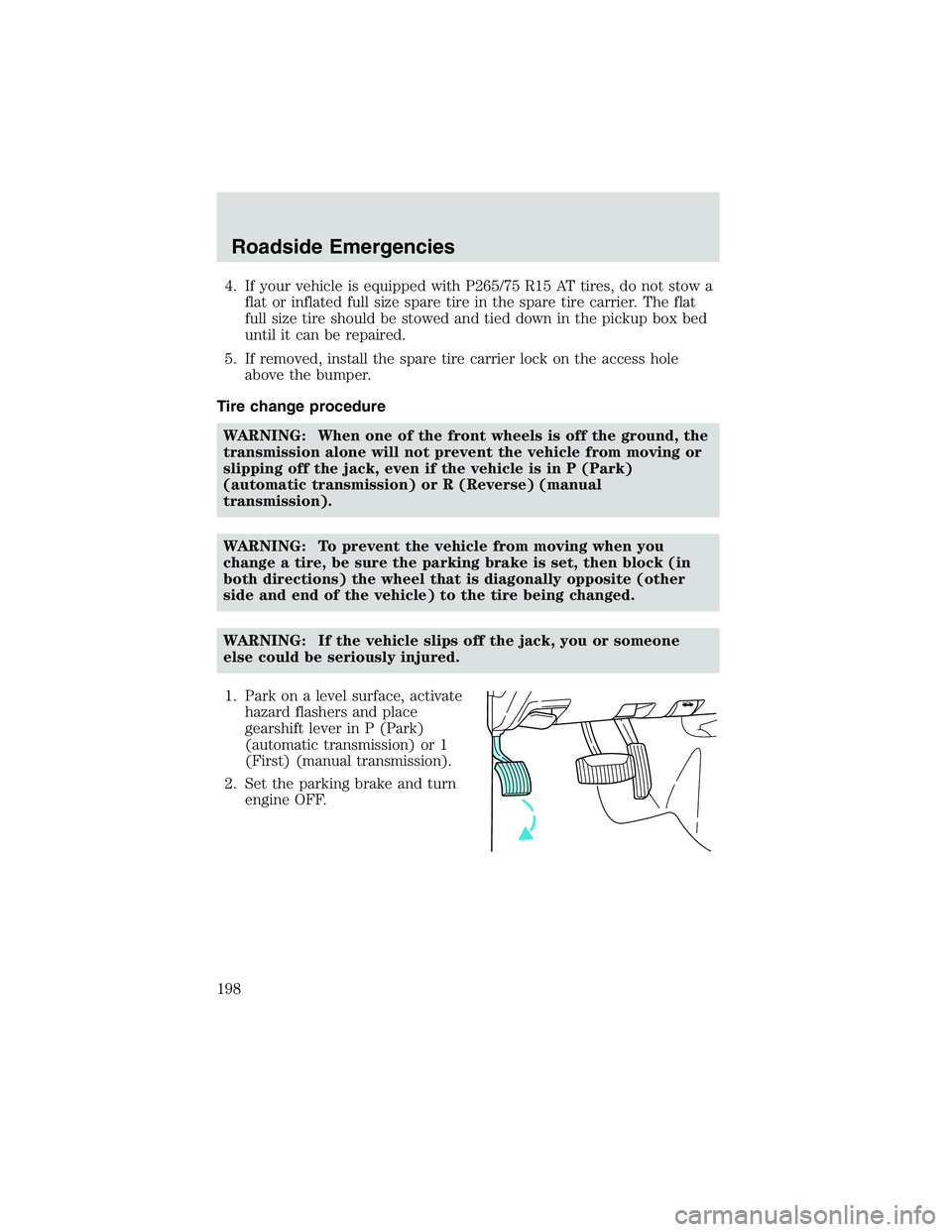
1. Park on a level surface, activate hazard flashers and place
gearshift lever in P (Park)
(automatic transmission) or 1
(First) (manual transmission).
2. Set the parking brake and turn engine OFF.
Roadside Emergencies
198
Page 199 of 288

3. Block the diagonally oppositewheel.
4. Insert tapered end of the lug wrench behind hub caps and
twist them off.
5. Loosen each wheel lug nut one-half turn counterclockwise
but do not remove them until
the wheel is raised off the
ground.
6. Position the jack according to the following guides and turn
the jack handle clockwise until the tire is a maximum of 25 mm (1
inch) off the ground.
• Front
Roadside Emergencies
199