warning light MAZDA MODEL B3000 TRUCK 2004 Owner's Manual
[x] Cancel search | Manufacturer: MAZDA, Model Year: 2004, Model line: MODEL B3000 TRUCK, Model: MAZDA MODEL B3000 TRUCK 2004Pages: 256, PDF Size: 2 MB
Page 85 of 256
WARNING: You must turn the passenger air bag Off if you have
a rear facing child seat in the front seat of the pickup (the
center lapbelt on front split seats or the center facing rear
seats do not accommodate child seats). Statistics show that
children under 12 are more likely to suffer minor injuries in the
front passenger seats than adults. If you must have a child in
the front passenger seat, place the largest child in the front
seat, make sure that the child is belted, the vehicle seat is all
the way back, and the passenger airbag is turned OFF. The front
seat center lap belt and the center facing rear seats do not
accommodate child seats; therefore, you may not be able to put
a larger child in the front passenger seat if a child seat is
involved.
WARNING: If the OFF light fails to illuminate when the
passenger air bag switch is in the OFF position and the ignition
switch is in the ON position, have the passenger air bag switch
serviced at your authorized Mazda dealership.
WARNING: In order to avoid inadvertent activation of the
switch, always remove the ignition key from the passenger air
bag ON/OFF switch.
Turning the passenger air bag back on
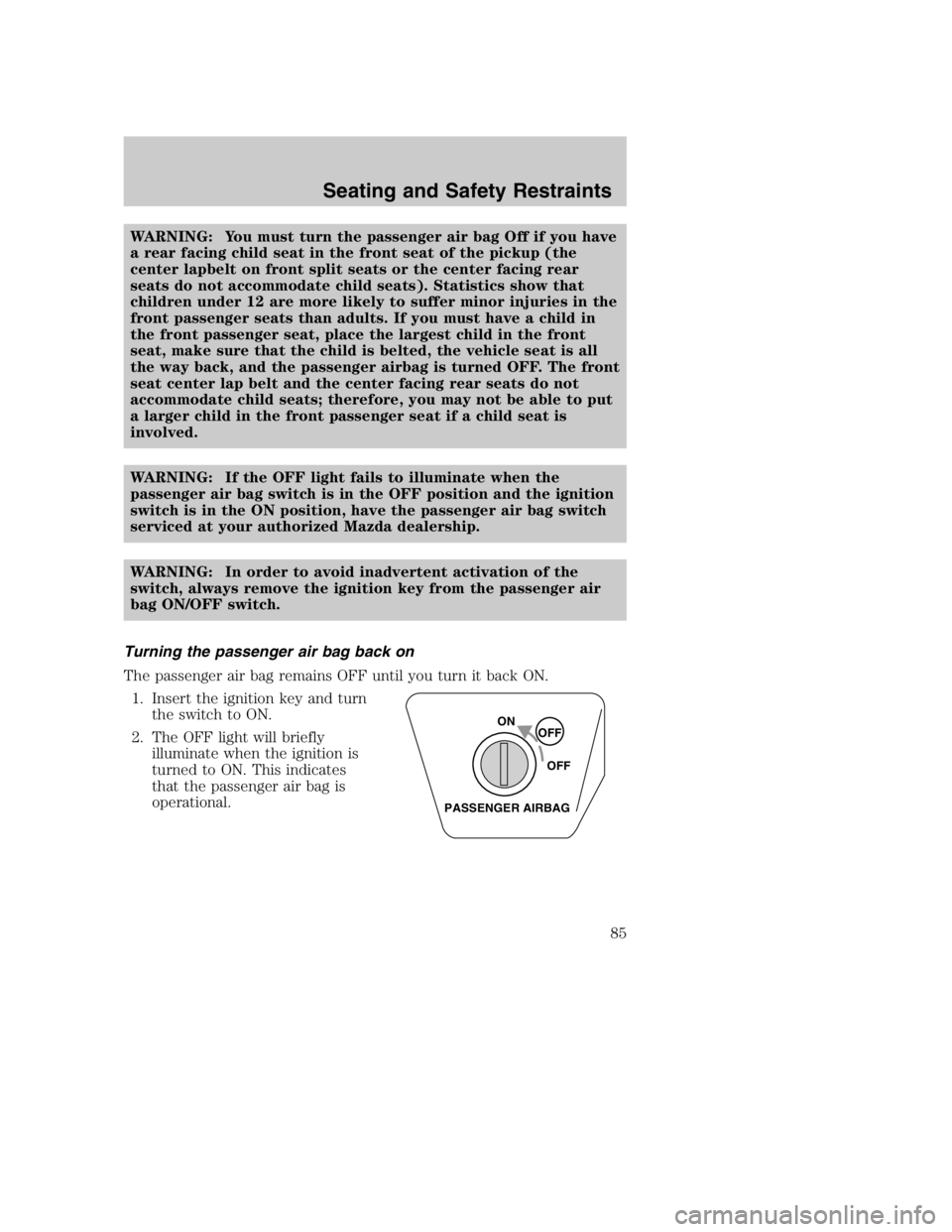
The passenger air bag remains OFF until you turn it back ON. 1. Insert the ignition key and turn the switch to ON.
2. The OFF light will briefly illuminate when the ignition is
turned to ON. This indicates
that the passenger air bag is
operational.
ON OFF
OFF
PASSENGER AIRBAG
2004 Mazda B Series (mbs)
Owners Guide (post-2002-fmt)
USA English (fus)
Seating and Safety Restraints
85
Page 86 of 256
WARNING: If the light is illuminated when the passenger air
bag ON/OFF switch is in the ON position and the ignition switch
is ON, have the passenger air bag ON/OFF switch serviced at
your authorized Mazda dealership immediately.
The passenger side air bag should always be ON (the air bag OFF light
should notbe illuminated) except for certain vulnerable persons. See
guidance on following pages.
WARNING: The safety belts for the driver and right front
passenger seating positions have been specifically designed to
function together with the air bags in certain types of crashes.
When you turn OFF your air bag, you not only lose the
protection of the air bag, you also may reduce the effectiveness
of your safety belt system, which was designed to work with the
air bag. Most vehicles with full back seats do not have cut-off
switches, but NHTSA and Transport Canada will allow a cut-off
switch to be installed on request for a certain category of
persons who must ride up front and there is a concern about
riding there. Please see the guidance below.
WARNING: Always use safety belts and child restraints
properly. If a child in a rear facing infant seat must be
transported in front, the passenger air bag mustbe turned OFF.
This is because the back of the infant seat is too close to the
inflating air bag and the risk of a fatal injury to the infant when
the air bag inflates is substantial.
The vast majority of drivers and passengers over the age of 12 years are
much safer with an air bag than without. To do their job and reduce the
risk of life threatening injuries, air bags must open with great force, and
this force can pose a potentially deadly risk in some situations,
particularly when a front seat occupant is not properly buckled up. The
most effective way to reduce the risk of unnecessary air bag injuries
without reducing the overall safety of the vehicle is to make sure all
occupants are properly restrained in the vehicle, especially in the front
seat. This provides the protection of safety belts and permits the air bags
to provide the additional protection they were designed to provide. If
you choose to deactivate your air bag, you are losing the very significant
risk reducing benefits of the air bag and you are also reducing the
2004 Mazda B Series (mbs)
Owners Guide (post-2002-fmt)
USA English (fus)
Seating and Safety Restraints
86
Page 105 of 256
STARTING
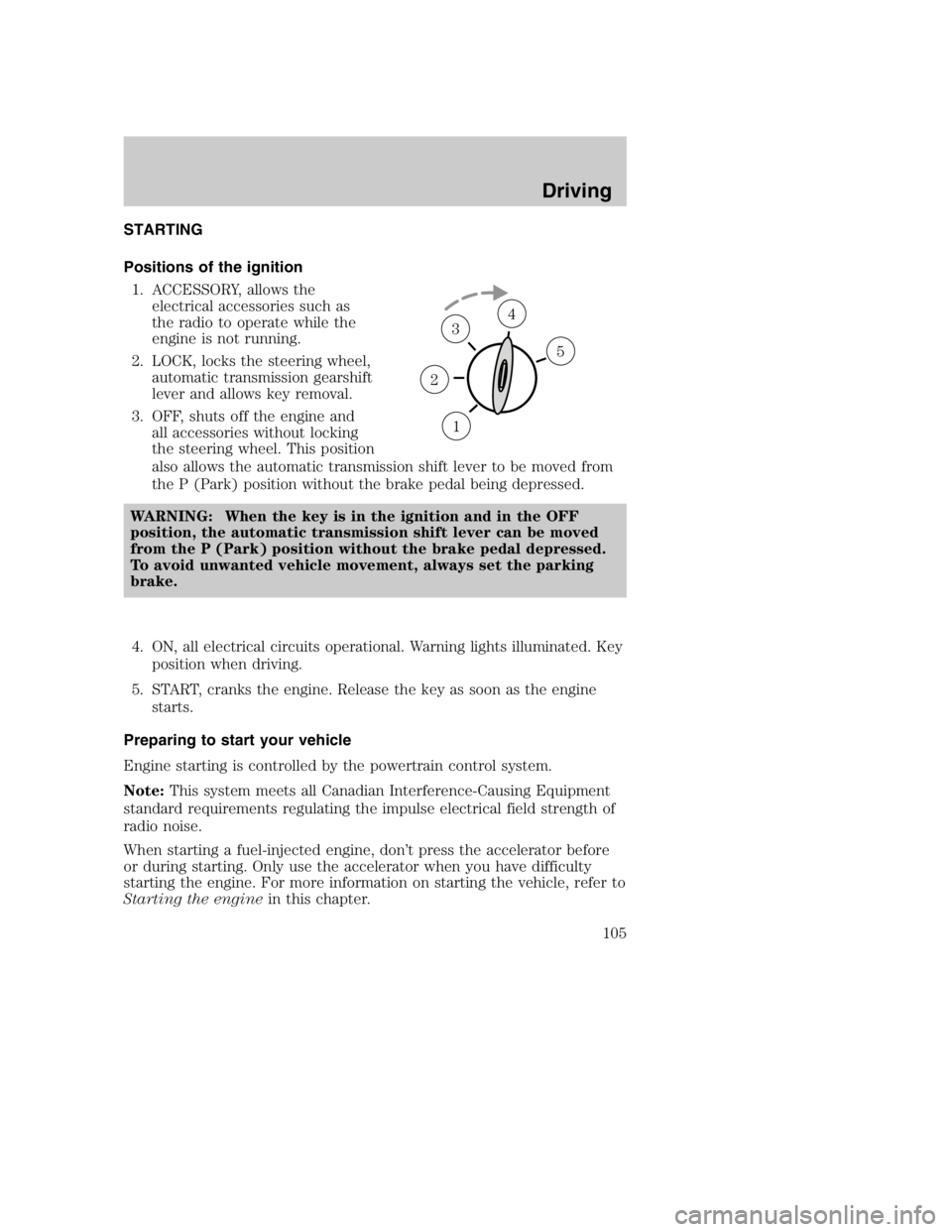
Positions of the ignition1. ACCESSORY, allows the electrical accessories such as
the radio to operate while the
engine is not running.
2. LOCK, locks the steering wheel, automatic transmission gearshift
lever and allows key removal.
3. OFF, shuts off the engine and all accessories without locking
the steering wheel. This position
also allows the automatic transmission shift lever to be moved from
the P (Park) position without the brake pedal being depressed.
WARNING: When the key is in the ignition and in the OFF
position, the automatic transmission shift lever can be moved
from the P (Park) position without the brake pedal depressed.
To avoid unwanted vehicle movement, always set the parking
brake.
4. ON, all electrical circuits operational. Warning lights illuminated. Key position when driving.
5. START, cranks the engine. Release the key as soon as the engine starts.
Preparing to start your vehicle
Engine starting is controlled by the powertrain control system.
Note: This system meets all Canadian Interference-Causing Equipment
standard requirements regulating the impulse electrical field strength of
radio noise.
When starting a fuel-injected engine, don’t press the accelerator before
or during starting. Only use the accelerator when you have difficulty
starting the engine. For more information on starting the vehicle, refer to
Starting the engine in this chapter.
1
2
34
5
2004 Mazda B Series (mbs)
Owners Guide (post-2002-fmt)
USA English (fus)
Driving
Driving
105
Page 110 of 256
Guarding against exhaust fumes
Carbon monoxide is present in exhaust fumes. Take precautions to avoid
its dangerous effects.WARNING: If you smell exhaust fumes inside your vehicle,
have your dealer inspect your vehicle immediately. Do not drive
if you smell exhaust fumes.
Important ventilating information
If the engine is idling while the vehicle is stopped for a long period of
time, open the windows at least 2.5 cm (one inch) or adjust the heating
or air conditioning to bring in fresh air.
BRAKES
Occasional brake noise is normal. If a metal-to-metal, continuous grinding
or continuous squeal sound is present, the brake linings may be worn-out
and should be inspected by a qualified service technician. If the vehicle
has continuous vibration or shudder in the steering wheel while braking,
the vehicle should be inspected by a qualified service technician.
Refer to Brake system warning
light in the Instrument Cluster
chapter for information on the brake
system warning light.
Four-wheel anti-lock brake system (ABS)
This vehicle is equipped with an anti-lock braking system (ABS), a noise
from the hydraulic pump motor and pulsation in the pedal may be
observed during ABS braking events. Pedal pulsation coupled with noise
while braking under panic conditions or on loose gravel, bumps, wet or
snowy roads is normal and indicates proper functioning of the vehicle’s
anti-lock brake system.
NOTE: The ABS performs a self-check after you start the engine and
begin to drive away.
A brief mechanical noise may be heard during this test. This is normal. If
a malfunction is found, the ABS warning light will come on. If the vehicle
has continuous vibration or shudder in the steering wheel while braking,
the vehicle should be inspected by an authorized Mazda dealership.
!
BRAKE
2004 Mazda B Series (mbs)
Owners Guide (post-2002-fmt)
USA English (fus)
Driving
110
Page 111 of 256
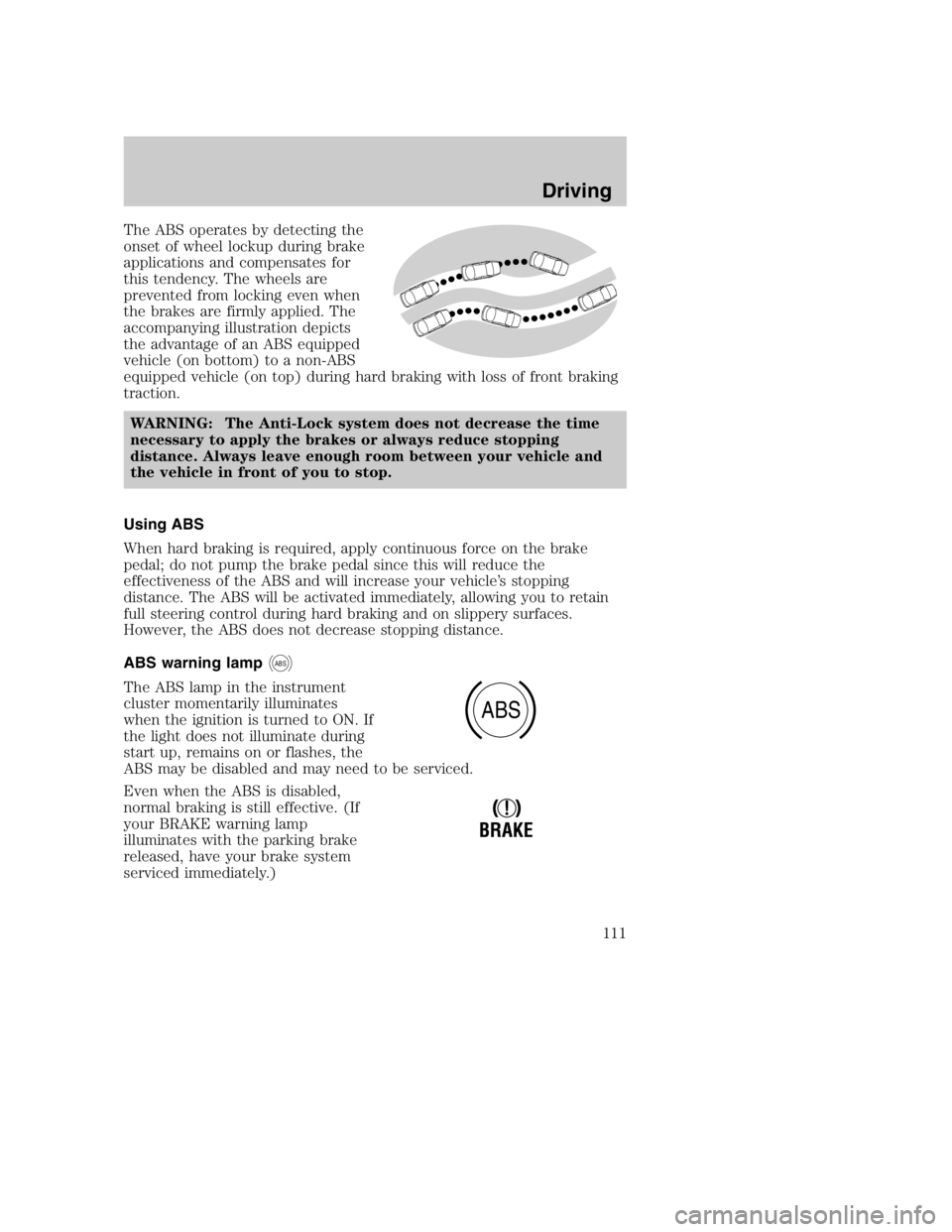
The ABS operates by detecting the
onset of wheel lockup during brake
applications and compensates for
this tendency. The wheels are
prevented from locking even when
the brakes are firmly applied. The
accompanying illustration depicts
the advantage of an ABS equipped
vehicle (on bottom) to a non-ABS
equipped vehicle (on top) during hard braking with loss of front braking
traction.WARNING: The Anti-Lock system does not decrease the time
necessary to apply the brakes or always reduce stopping
distance. Always leave enough room between your vehicle and
the vehicle in front of you to stop.
Using ABS
When hard braking is required, apply continuous force on the brake
pedal; do not pump the brake pedal since this will reduce the
effectiveness of the ABS and will increase your vehicle’s stopping
distance. The ABS will be activated immediately, allowing you to retain
full steering control during hard braking and on slippery surfaces.
However, the ABS does not decrease stopping distance.
ABS warning lamp
ABS
The ABS lamp in the instrument
cluster momentarily illuminates
when the ignition is turned to ON. If
the light does not illuminate during
start up, remains on or flashes, the
ABS may be disabled and may need to be serviced.
Even when the ABS is disabled,
normal braking is still effective. (If
your BRAKE warning lamp
illuminates with the parking brake
released, have your brake system
serviced immediately.)
ABS
!
BRAKE
2004 Mazda B Series (mbs)
Owners Guide (post-2002-fmt)
USA English (fus)
Driving
111
Page 119 of 256
This is a lockout feature that protects the transmission from
accidentally being shifted into R (Reverse) from 5 (Overdrive).
Parking your vehicle 1. Apply the brake and shift into the neutral position.
2. Fully apply the parking brake, then shift into 1 (First).
3. Turn the ignition off.
WARNING: Do not park your vehicle in Neutral, it may move
unexpectedly and injure someone. Use 1 (First) gear and set
the parking brake fully.
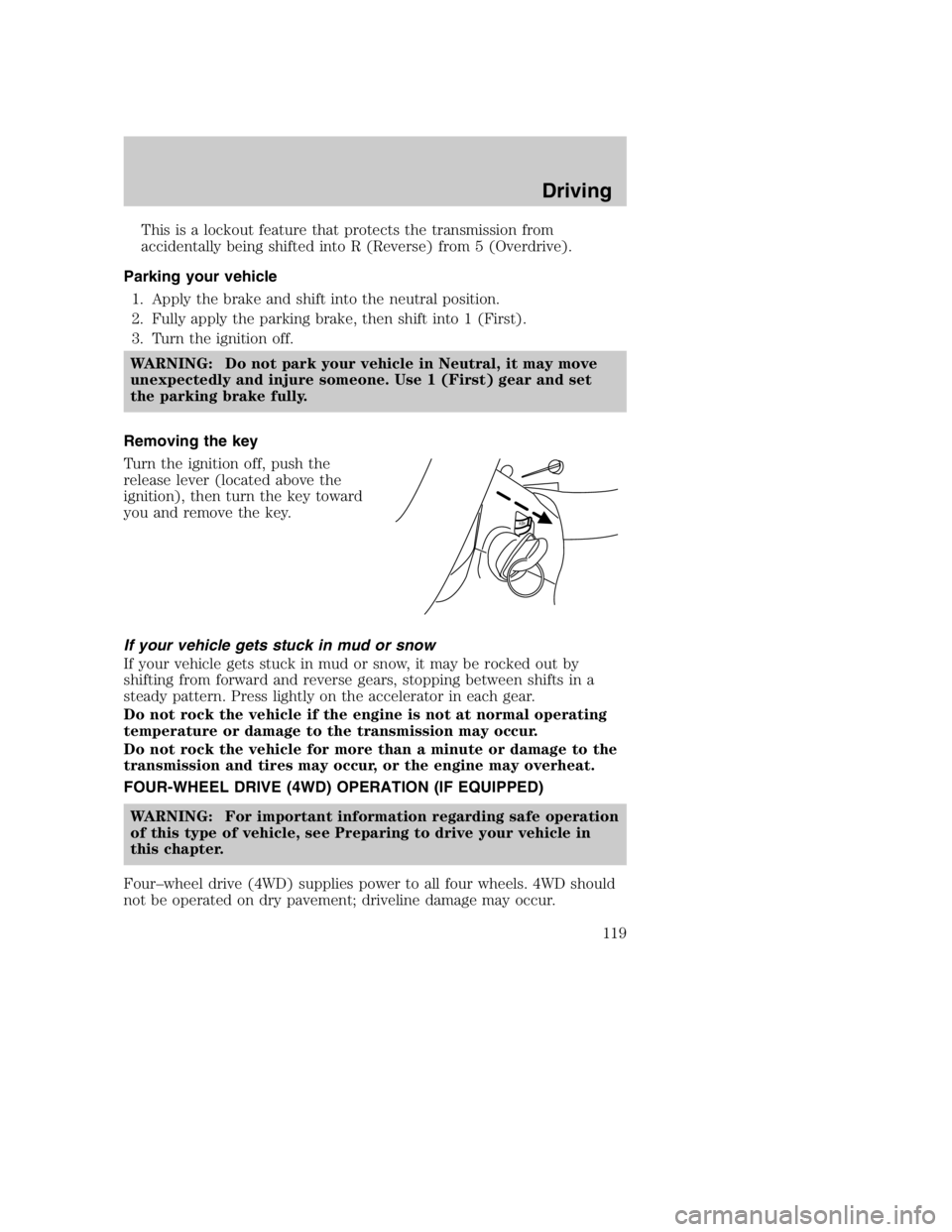
Removing the key
Turn the ignition off, push the
release lever (located above the
ignition), then turn the key toward
you and remove the key.
If your vehicle gets stuck in mud or snow
If your vehicle gets stuck in mud or snow, it may be rocked out by
shifting from forward and reverse gears, stopping between shifts in a
steady pattern. Press lightly on the accelerator in each gear.
Do not rock the vehicle if the engine is not at normal operating
temperature or damage to the transmission may occur.
Do not rock the vehicle for more than a minute or damage to the
transmission and tires may occur, or the engine may overheat.
FOUR-WHEEL DRIVE (4WD) OPERATION (IF EQUIPPED) WARNING: For important information regarding safe operation
of this type of vehicle, see Preparing to drive your vehicle in
this chapter.
Four–wheel drive (4WD) supplies power to all four wheels. 4WD should
not be operated on dry pavement; driveline damage may occur.
PUSH
2004 Mazda B Series (mbs)
Owners Guide (post-2002-fmt)
USA English (fus)
Driving
119
Page 122 of 256
WARNING: Do not spin the wheels at over 56 km/h (35 mph).
The tires may fail and injure a passenger or bystander.
Sand
When driving over sand, try to keep all four wheels on the most solid
area of the trail. Do not reduce the tire pressures but shift to a lower
gear and drive steadily through the terrain. Apply the accelerator slowly
and avoid spinning the wheels.
Mud and water
If you must drive through high water, drive slowly. Traction or brake
capability may be limited.
When driving through water, determine the depth; avoid water higher
than the bottom of the hubs (if possible) and proceed slowly. If the
ignition system gets wet, the vehicle may stall.
Once through water, always try the brakes. Wet brakes do not stop the
vehicle as effectively as dry brakes. Drying can be improved by moving
your vehicle slowly while applying light pressure on the brake pedal.
After driving through mud, clean off residue stuck to the driveshafts and
tires. Excess mud stuck on tires and rotating driveshafts causes an
imbalance that could damage drive components.
If the transmission, transfer case or front axle are submerged in water,
their fluids should be checked and changed, if necessary.
Driving through deep water where the transmission vent tube is
submerged may allow water into the transmission and cause
internal transmission damage.
Replace rear axle lubricant any time the axle has been submerged in
water. The rear axle does not normally require a lubricant change for the
life of the vehicle. Rear axle lubricant quantities are not to be checked or
changed unless a leak is suspected or repair is required.
Driving on hilly or sloping terrain
When driving on a hill, avoid driving crosswise or turning on steep
slopes. You could lose traction and slip sideways. Drive straight up,
straight down or avoid the hill completely. Know the conditions on the
other side of a hill before driving over the crest.
When climbing a steep hill, start in a lower gear rather than downshifting
to a lower gear from a higher gear once the ascent has started. This
reduces strain on the engine and the possibility of stalling.
2004 Mazda B Series (mbs)
Owners Guide (post-2002-fmt)
USA English (fus)
Driving
122
Page 132 of 256
Hitches
For towing trailers up to 907 kg (2,000 lb), use a weight carrying hitch
and ball which uniformly distributes the trailer tongue loads through the
underbody structure. Use a frame-mounted weight distributing hitch for
trailers over 907 kg (2,000 lb).
Do not install a single or multi-clamp type bumper hitch, or a hitch
which attaches to the axle. Underbody mounted hitches are acceptable if
they are installed properly. Follow the towing instructions of a reputable
rental agency.
Whenever a trailer hitch and hardware are removed, make sure all
mounting holes in the underbody are properly sealed to prevent noxious
gases or water from entering.
Safety chains
Always connect the trailer’s safety chains to the frame or hook retainers
of the vehicle hitch. To connect the trailer’s safety chains, cross the
chains under the trailer tongue and allow slack for turning corners.
If you use a rental trailer, follow the instructions that the rental agency
gives to you.
Do not attach safety chains to the bumper.
Trailer brakes
Electric brakes and manual, automatic or surge-type trailer brakes are
safe if installed properly and adjusted to the manufacturer’s
specifications. The trailer brakes must meet local and Federal
regulations.WARNING: Do not connect a trailer’s hydraulic brake system
directly to your vehicle’s brake system. Your vehicle may not
have enough braking power and your chances of having a
collision greatly increase.
The braking system of the tow vehicle is rated for operation at the
GVWR not GCWR.
Trailer lamps
Trailer lamps are required on most towed vehicles. Make sure all running
lights, brake lights, turn signals and hazard lights are working. See your
dealer or trailer rental agency for proper instructions and equipment for
hooking up trailer lamps.
2004 Mazda B Series (mbs)
Owners Guide (post-2002-fmt)
USA English (fus)
Driving
132
Page 178 of 256
INSTRUMENT PANEL AND CLUSTER LENS
Clean the instrument panel with a damp cloth, then dry with a dry cloth.
•Avoid cleaners or polish that increase the gloss of the upper portion of
the instrument panel. The dull finish in this area helps protect the
driver from undesirable windshield reflection.
WARNING: Do not use chemical solvents or strong detergents
when cleaning the steering wheel or instrument panel to avoid
contamination of the air bag system.
• Be certain to wash or wipe your hands clean if you have been in
contact with certain products such as insect repellent and suntan
lotion in order to avoid possible damage to the interior painted
surfaces.
INTERIOR TRIM
• Clean the interior trim areas with a damp cloth, then dry by wiping
with a dry, soft, clean cloth.
• Do not use household or glass cleaners as these may damage the
finish.
INTERIOR
For fabric, carpets, cloth seats, and safety belts:
• Remove dust and loose dirt with a vacuum cleaner.
• Remove light stains and soil with Extra Strength Upholstery Cleaner,
available at your authorized Mazda dealer.
• If grease or tar is present on the material, spot-clean the area first
with Spot and Stain Remover, available at your authorized Mazda
dealer.
• Never saturate the seat covers with cleaning solution.
• Do not use household cleaning products or glass cleaners, which can
stain and discolor the fabric and affect the flame retardant abilities of
the seat materials.
2004 Mazda B Series (mbs)
Owners Guide (post-2002-fmt)
USA English (fus)
Cleaning
178
Page 188 of 256

•Check lap/shoulder belts and seat latches for wear and function.
• Check air pressure in spare tire.
• Check windshield washer spray and wiper operation. Clean wiper
blades with clean cloth dampened with washer fluid.
• Check safety warning lamps (brake, ABS, air bag, safety belt) for
operation.
• Check cooling system fluid level and verify coolant specific gravity is
correct for summer or winter conditions.
• Check battery water level (non-maintenance free).
• Check battery connections and clean if necessary.
SERVICE RECOMMENDATIONS
To help you service your vehicle:
• We highlight do-it-yourself items in the engine compartment for easy
location.
• We provide a Scheduled Maintenance section which makes tracking
routine service easy.
If your vehicle requires professional service, your dealership can provide
necessary parts and service. Check your “Warranty Information” to find
out which parts and services are covered.
Use only recommended fuels, lubricants, fluids and service parts
conforming to specifications. Genuine Mazda parts are designed and built
to provide the best performance in your vehicle.
PRECAUTIONS WHEN SERVICING YOUR VEHICLE
• Do not work on a hot engine.
• Make sure that nothing gets caught in moving parts.
• Do not work on a vehicle with the engine running in an enclosed
space, unless you are sure you have enough ventilation.
• Keep all open flames and other lit material away from the battery and
all fuel related parts.
2004 Mazda B Series (mbs)
Owners Guide (post-2002-fmt)
USA English (fus)
Maintenance and Specifications
188