wheel MAZDA MODEL B3000 TRUCK 2004 Owner's Manual
[x] Cancel search | Manufacturer: MAZDA, Model Year: 2004, Model line: MODEL B3000 TRUCK, Model: MAZDA MODEL B3000 TRUCK 2004Pages: 256, PDF Size: 2 MB
Page 137 of 256
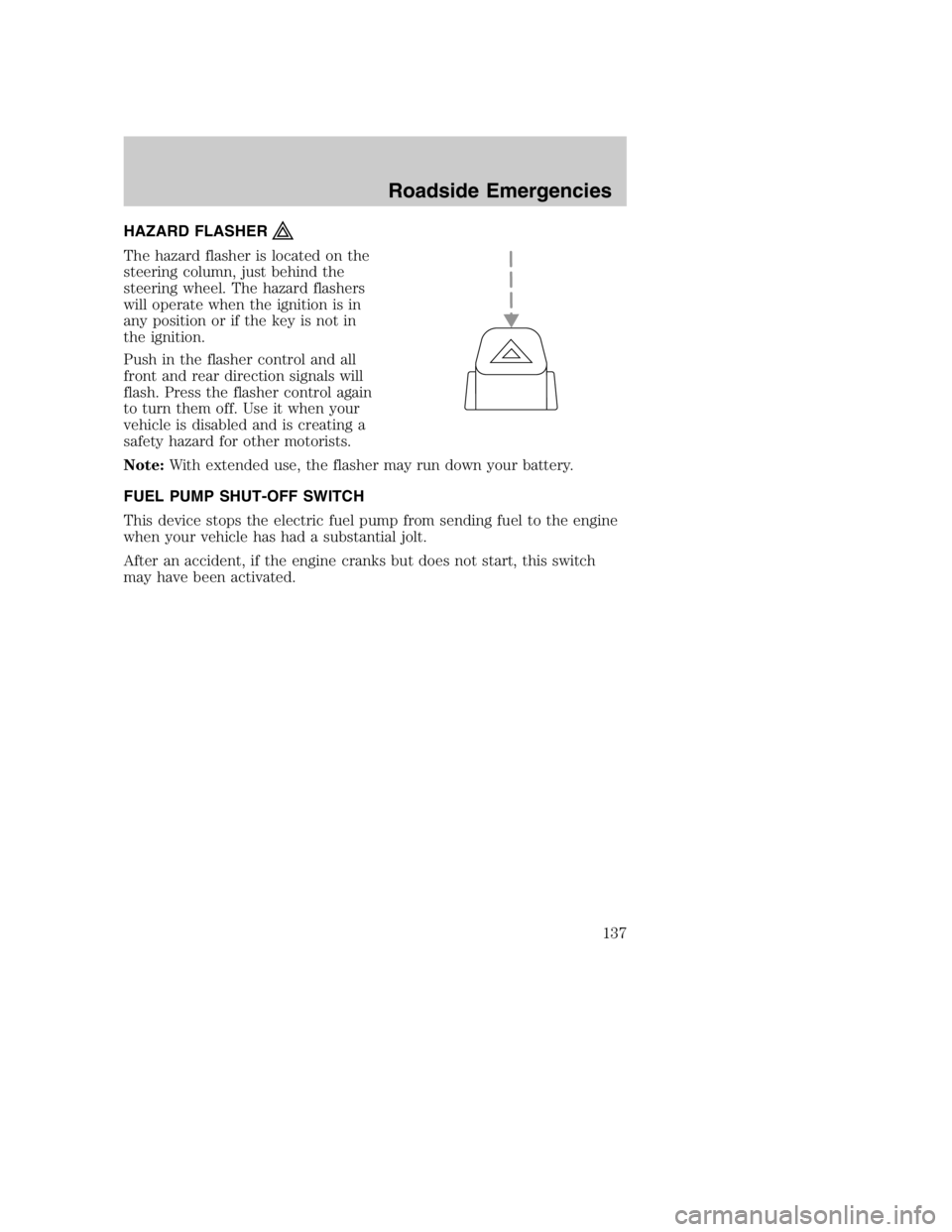
HAZARD FLASHER
The hazard flasher is located on the
steering column, just behind the
steering wheel. The hazard flashers
will operate when the ignition is in
any position or if the key is not in
the ignition.
Push in the flasher control and all
front and rear direction signals will
flash. Press the flasher control again
to turn them off. Use it when your
vehicle is disabled and is creating a
safety hazard for other motorists.
Note:With extended use, the flasher may run down your battery.
FUEL PUMP SHUT-OFF SWITCH
This device stops the electric fuel pump from sending fuel to the engine
when your vehicle has had a substantial jolt.
After an accident, if the engine cranks but does not start, this switch
may have been activated.
2004 Mazda B Series (mbs)
Owners Guide (post-2002-fmt)
USA English (fus)
Roadside Emergencies
Roadside Emergencies
137
Page 149 of 256
•If steam is coming from the engine compartment:do not go near
the front of the vehicle. Stop the engine, then turn the ignition switch
to the ON position without starting the engine. The radiator cooling
fans will start to cool the engine.
• If neither coolant nor steam is escaping: open the hood and idle
the engine until it cools. If this does not lower the temperature, stop
the engine and let it cool.
5. Check the coolant level. If it is low, look for leaks in the radiator hoses and connections, heater hoses and connections, radiator and
water pump.
If you find a leak or other damage, or if coolant is still leaking, stop the
engine and call an Authorized Mazda dealer.
See Adding coolant in theMaintenance and specifications section. If
you find no problems, the engine is cool and no leaks are obvious,
carefully add coolant as required.
WARNING: When the engine and radiator are hot, scalding
coolant and steam may shoot out under pressure and cause
serious injury. Do not remove the cooling system cap when the
engine and radiator are hot.
Note: If the engine continues to overheat or frequently overheats, have
the cooling system inspected. The engine could be seriously damaged
unless repairs are made.
CHANGING THE TIRES
If you get a flat tire while driving, do not apply the brake heavily.
Instead, gradually decrease your speed. Hold the steering wheel firmly
and slowly move to a safe place on the side of the road.
WARNING: The use of tire sealants is not recommended and
may damage your tires.
Temporary spare tire information (if equipped)
Your vehicle may be equipped with a conventional spare tire that may be
different in size (smaller diameter and narrower width) than other tires
on your vehicle. If this is the case, your spare tire is considered
“temporary” and the spare wheel will be labeled as such. Replace this
tire with a tire of the same size, speed rating and load carrying capacity
as the other road tires as soon as possible.
2004 Mazda B Series (mbs)
Owners Guide (post-2002-fmt)
USA English (fus)
Roadside Emergencies
149
Page 150 of 256
It is not recommended that the vehicle be operated in 4WD modes with
a “temporary” (i.e. dissimilar size) spare. If 4WD operation is necessary,
do not operate above speeds of 16 km/h (10 mph) or for distances above
80 km (50 miles).WARNING: If you use the temporary spare tire continuously or
do not follow these precautions, the tire could fail, causing you
to lose control of the vehicle, possibly injuring yourself or
others.
When driving with the temporary spare tire do not:
• exceed 80 km/h (50 mph) or drive further than 3,200 km (2,000
miles) total under any circumstances
• load the vehicle beyond maximum vehicle load rating listed on the
Safety Compliance Label
• tow a trailer
• use more than one temporary spare tire at a time
Use of a temporary spare tire at any one wheel location can lead to
impairment of the following:
• Handling, stability and braking performance
• Comfort and noise
• Ground clearance and parking at curbs
• Winter driving capability
Conventional spare tire information (if equipped)
If you have the conventional spare tire, you can use it as a spare or a
regular tire. The spare is identical to the other tires on your vehicle,
although the wheel may not match.
Location of the spare tire and tools
The spare tire and tools for your vehicle are stowed in the following
locations:
2004 Mazda B Series (mbs)
Owners Guide (post-2002-fmt)
USA English (fus)
Roadside Emergencies
150
Page 151 of 256
ToolLocation
Spare tire Under the vehicle, just forward of
the rear bumper
Jack, jack handle, wheel nut wrench Regular Cab: behind seats and
underneath the jack and tools
cover
Cab Plus: stowed in the passenger
side rear cab compartment or
behind the jump seat in a separate
tool bag
Cab Plus 4–Door: stowed behind
the front seats, between jump
seats and underneath jack and
tools cover.
Key, spare tire lock (if equipped) In the glove box
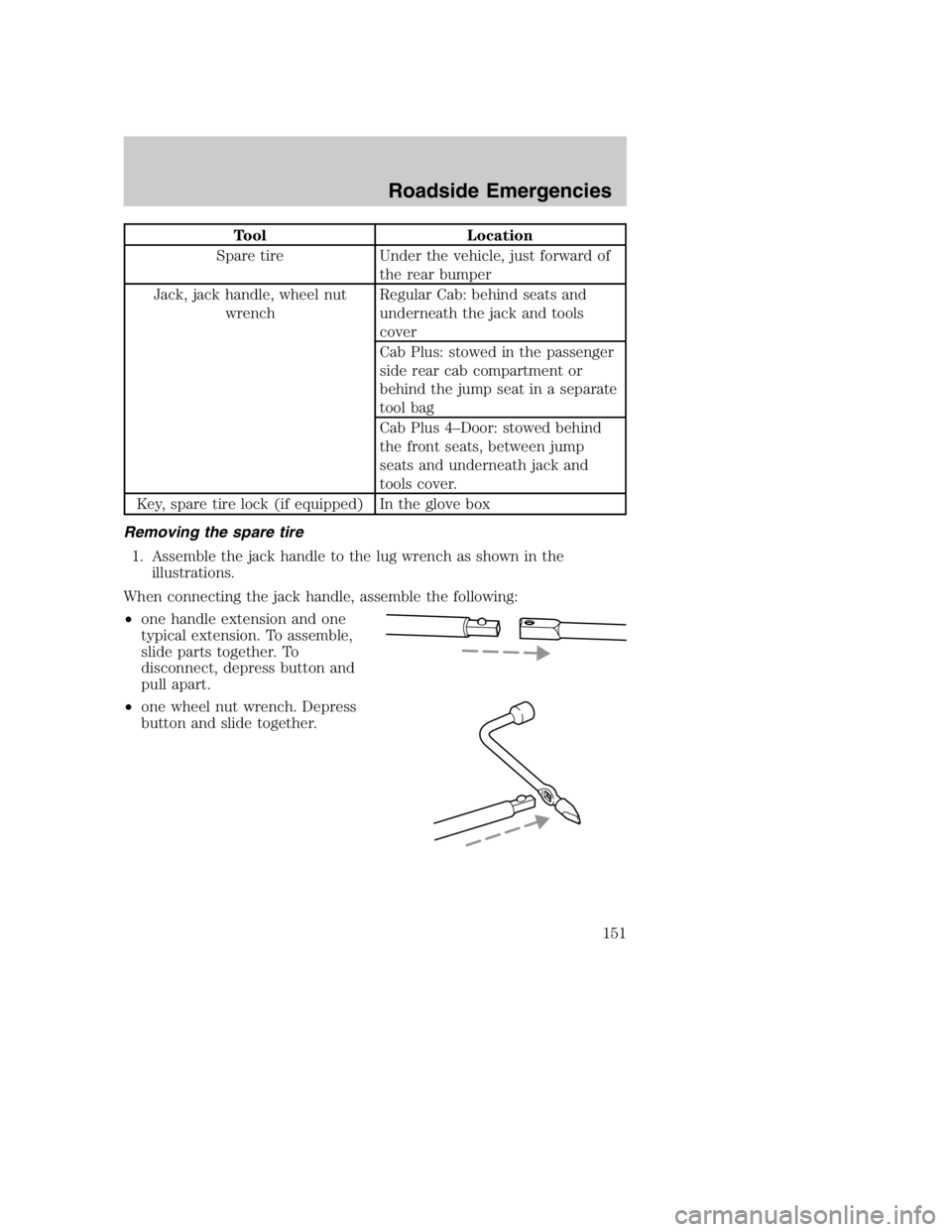
Removing the spare tire 1. Assemble the jack handle to the lug wrench as shown in the illustrations.
When connecting the jack handle, assemble the following:
• one handle extension and one
typical extension. To assemble,
slide parts together. To
disconnect, depress button and
pull apart.
• one wheel nut wrench. Depress
button and slide together.
2004 Mazda B Series (mbs)
Owners Guide (post-2002-fmt)
USA English (fus)
Roadside Emergencies
151
Page 152 of 256
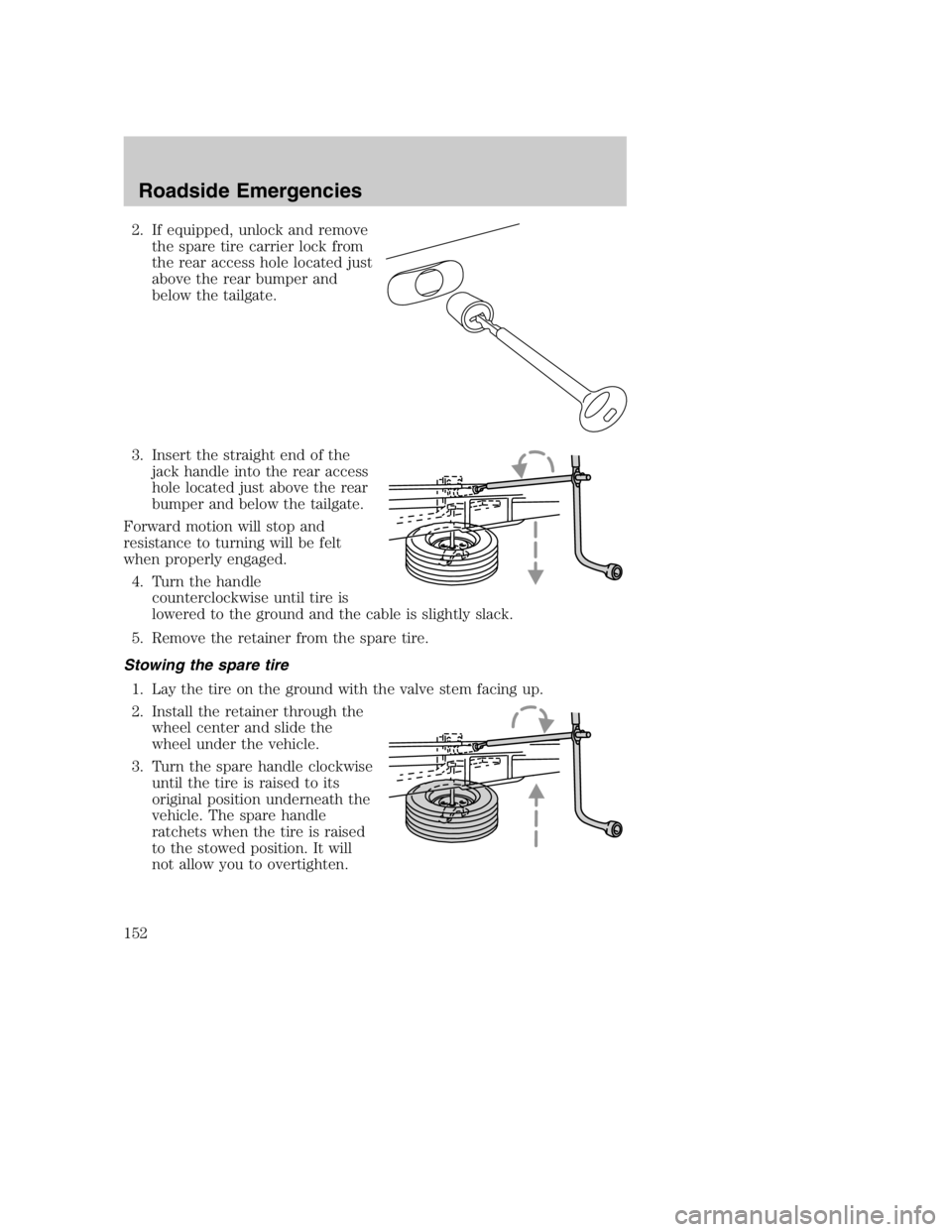
2. If equipped, unlock and removethe spare tire carrier lock from
the rear access hole located just
above the rear bumper and
below the tailgate.
3. Insert the straight end of the jack handle into the rear access
hole located just above the rear
bumper and below the tailgate.
Forward motion will stop and
resistance to turning will be felt
when properly engaged. 4. Turn the handle counterclockwise until tire is
lowered to the ground and the cable is slightly slack.
5. Remove the retainer from the spare tire.
Stowing the spare tire 1. Lay the tire on the ground with the valve stem facing up.
2. Install the retainer through the wheel center and slide the
wheel under the vehicle.
3. Turn the spare handle clockwise until the tire is raised to its
original position underneath the
vehicle. The spare handle
ratchets when the tire is raised
to the stowed position. It will
not allow you to overtighten.
2004 Mazda B Series (mbs)
Owners Guide (post-2002-fmt)
USA English (fus)
Roadside Emergencies
152
Page 153 of 256
4. If your vehicle is equipped with P265/75 R15 AT tires, do not stow aflat or inflated full size spare tire in the spare tire carrier. The flat
full size tire should be stowed and tied down in the pickup box bed
until it can be repaired.
5. If removed, install the spare tire carrier lock on the access hole above the bumper.
Tire change procedure WARNING: When one of the front wheels is off the ground, the
transmission alone will not prevent the vehicle from moving or
slipping off the jack, even if the vehicle is in P (Park)
(automatic transmission) or R (Reverse) (manual
transmission).
WARNING: To help prevent the vehicle from moving when you
change a tire, be sure the parking brake is set, then block (in
both directions) the wheel that is diagonally opposite (other
side and end of the vehicle) to the tire being changed.
WARNING: If the vehicle slips off the jack, you or someone
else could be seriously injured.
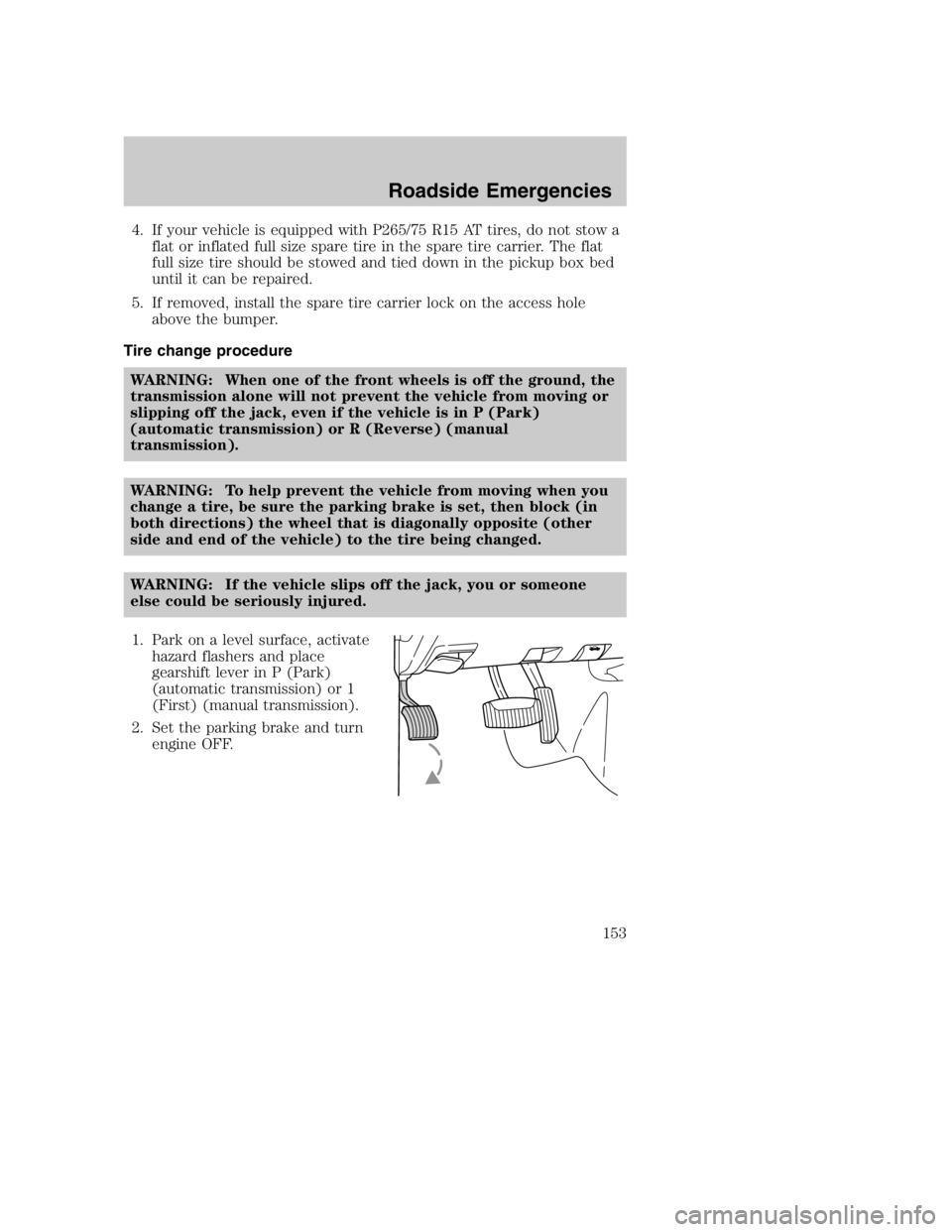
1. Park on a level surface, activate hazard flashers and place
gearshift lever in P (Park)
(automatic transmission) or 1
(First) (manual transmission).
2. Set the parking brake and turn engine OFF.
2004 Mazda B Series (mbs)
Owners Guide (post-2002-fmt)
USA English (fus)
Roadside Emergencies
153
Page 154 of 256
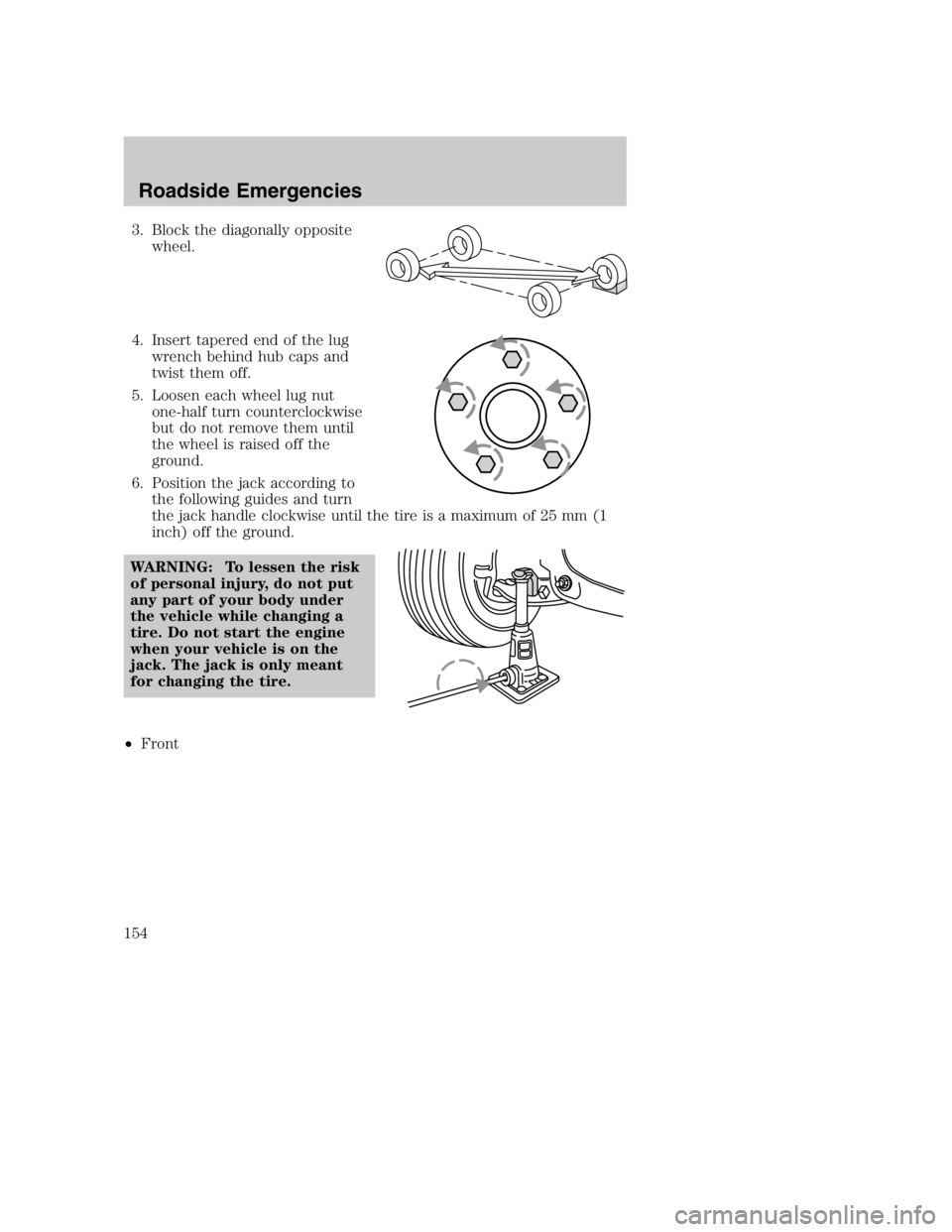
3. Block the diagonally oppositewheel.
4. Insert tapered end of the lug wrench behind hub caps and
twist them off.
5. Loosen each wheel lug nut one-half turn counterclockwise
but do not remove them until
the wheel is raised off the
ground.
6. Position the jack according to the following guides and turn
the jack handle clockwise until the tire is a maximum of 25 mm (1
inch) off the ground.
WARNING: To lessen the risk
of personal injury, do not put
any part of your body under
the vehicle while changing a
tire. Do not start the engine
when your vehicle is on the
jack. The jack is only meant
for changing the tire.
• Front
2004 Mazda B Series (mbs)
Owners Guide (post-2002-fmt)
USA English (fus)
Roadside Emergencies
154
Page 155 of 256
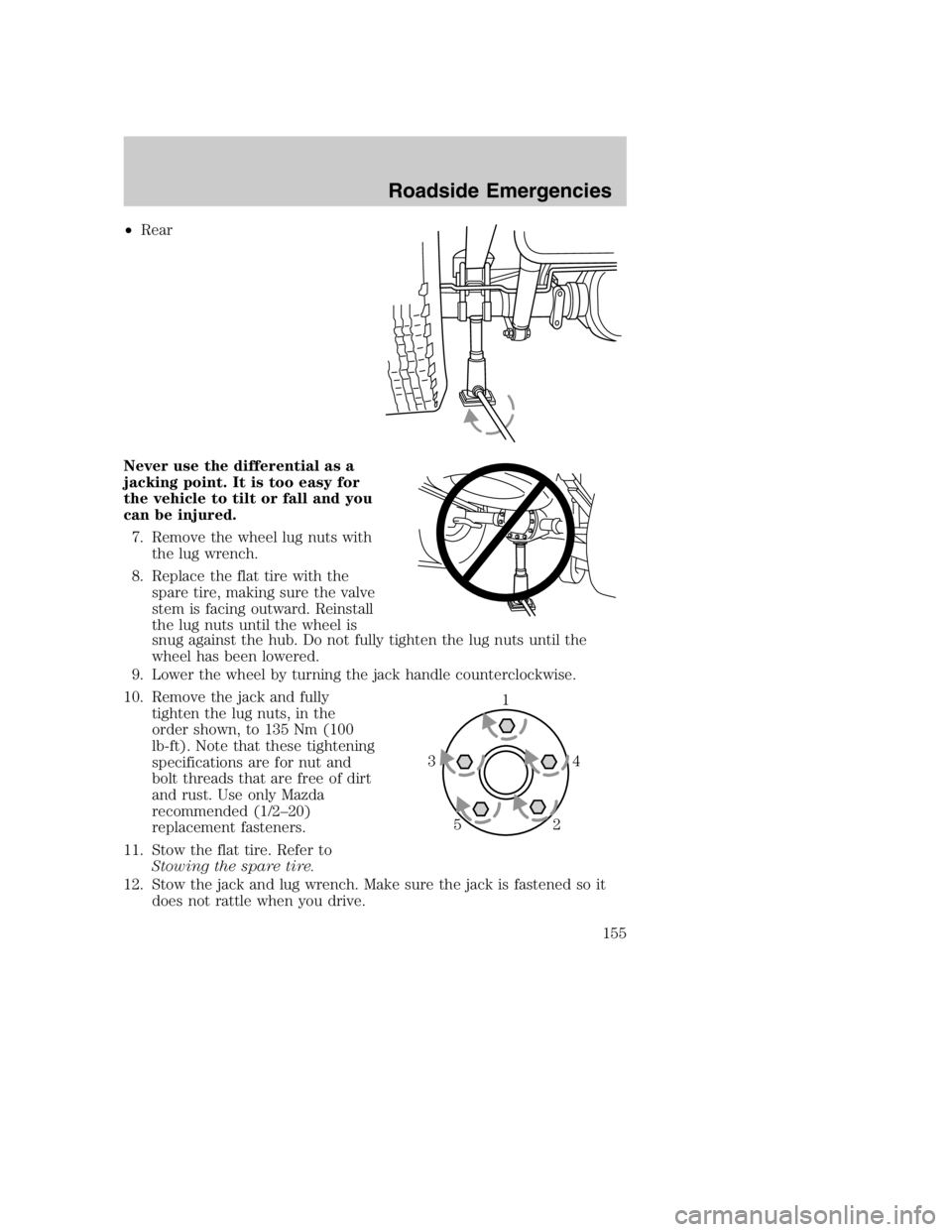
•Rear
Never use the differential as a
jacking point. It is too easy for
the vehicle to tilt or fall and you
can be injured. 7. Remove the wheel lug nuts with the lug wrench.
8. Replace the flat tire with the spare tire, making sure the valve
stem is facing outward. Reinstall
the lug nuts until the wheel is
snug against the hub. Do not fully tighten the lug nuts until the
wheel has been lowered.
9. Lower the wheel by turning the jack handle counterclockwise.
10. Remove the jack and fully tighten the lug nuts, in the
order shown, to 135 Nm (100
lb-ft). Note that these tightening
specifications are for nut and
bolt threads that are free of dirt
and rust. Use only Mazda
recommended (1/2–20)
replacement fasteners.
11. Stow the flat tire. Refer to Stowing the spare tire.
12. Stow the jack and lug wrench. Make sure the jack is fastened so it does not rattle when you drive.
1
4
3
2
5
2004 Mazda B Series (mbs)
Owners Guide (post-2002-fmt)
USA English (fus)
Roadside Emergencies
155
Page 156 of 256
13. Unblock the wheels.
Stowing the flat/spare tire
Note:Failure to follow spare tire stowage instructions may result in
failure of cable or loss of spare tire.
1. Lay the tire on the ground with the valve stem facing up.
2. Slide the wheel partially under the vehicle and install the wire and retainer through the center of the wheel.
3. Turn the jack handle clockwise until the tire is raised to its original position underneath the vehicle. The effort to turn the jack handle
increases significantly as the tire contacts the frame. The spare tire
carrier will ratchet when the tire is in the fully stowed position. The
spare tire carrier has a built-in ratchet feature that will not allow you
to overtighten. If the spare tire carrier ratchets with very little effort,
take the vehicle to your dealer for assistance at your earliest
convenience.
4. Check that the tire lies flat against the frame assembly. Push against the tire to make sure it is tightly sealed under the vehicle. Loosen
and retighten, if necessary. Failure to properly stow the spare tire
may result in failure of the winch cable and loss of the spare tire.
5. Repeat this tightness check procedure when servicing the spare tire pressure (every six months, per service maintenance section), or at
any time that the spare tire is disturbed through service of other
components.
6. Install the spare tire lock (if equipped) into the access hole above the rear bumper with the spare tire lock key (if equipped) and jack
handle.
Wheel lug nut torque specifications
Retighten the lug nuts to the specified torque at 800 km (500 miles)
after any wheel disturbance (rotation, flat tire, wheel removal, etc.).
Bolt size Wheel lug nut torque*
Nm Lb-ft
12x 20 113-153 84-114
* Torque specifications are for nut and bolt threads free of dirt and
rust. Use only Mazda recommended replacement fasteners.
2004 Mazda B Series (mbs)
Owners Guide (post-2002-fmt)
USA English (fus)
Roadside Emergencies
156
Page 157 of 256
WARNING: When a wheel is installed, always remove any
corrosion, dirt or foreign materials present on the mounting
surfaces of the wheel or the surface of the front disc brake hub
and rotor that contacts the wheel. Installing wheels without
correct metal-to-metal contact at the wheel mounting surfaces
can cause the wheel nuts to loosen and the wheel to come off
while the vehicle is in motion, resulting in loss of control.
JUMP STARTING YOUR VEHICLE WARNING: The gases around the battery can explode if
exposed to flames, sparks, or lit cigarettes. An explosion could
result in injury or vehicle damage.
WARNING: Batteries contain sulfuric acid which can burn skin,
eyes and clothing, if contacted.
Do not attempt to push-start your vehicle. Automatic
transmissions do not have push-start capability; doing so may
damage the catalytic converter.
Preparing your vehicle
When the battery is disconnected or a new battery is installed, the
transmission must relearn its shift strategy. As a result, the transmission
may have firm and/or soft shifts. This operation is considered normal and
will not affect function or durability of the transmission. Over time, the
adaptive learning process will fully update transmission operation. 1. Use only a 12–volt supply to start your vehicle.
2. Do not disconnect the battery of the disabled vehicle as this could damage the vehicle’s electrical system.
3. Park the booster vehicle close to the hood of the disabled vehicle making sure the two vehicles do nottouch. Set the parking brake on
both vehicles and stay clear of the engine cooling fan and other
moving parts.
4. Check all battery terminals and remove any excessive corrosion before you attach the battery cables. Ensure that vent caps are tight
and level.
5. Turn the heater fan on in both vehicles to protect any electrical surges. Turn all other accessories off.
2004 Mazda B Series (mbs)
Owners Guide (post-2002-fmt)
USA English (fus)
Roadside Emergencies
157