light MAZDA MODEL B3000 TRUCK 2004 Workshop Manual
[x] Cancel search | Manufacturer: MAZDA, Model Year: 2004, Model line: MODEL B3000 TRUCK, Model: MAZDA MODEL B3000 TRUCK 2004Pages: 256, PDF Size: 2 MB
Page 158 of 256
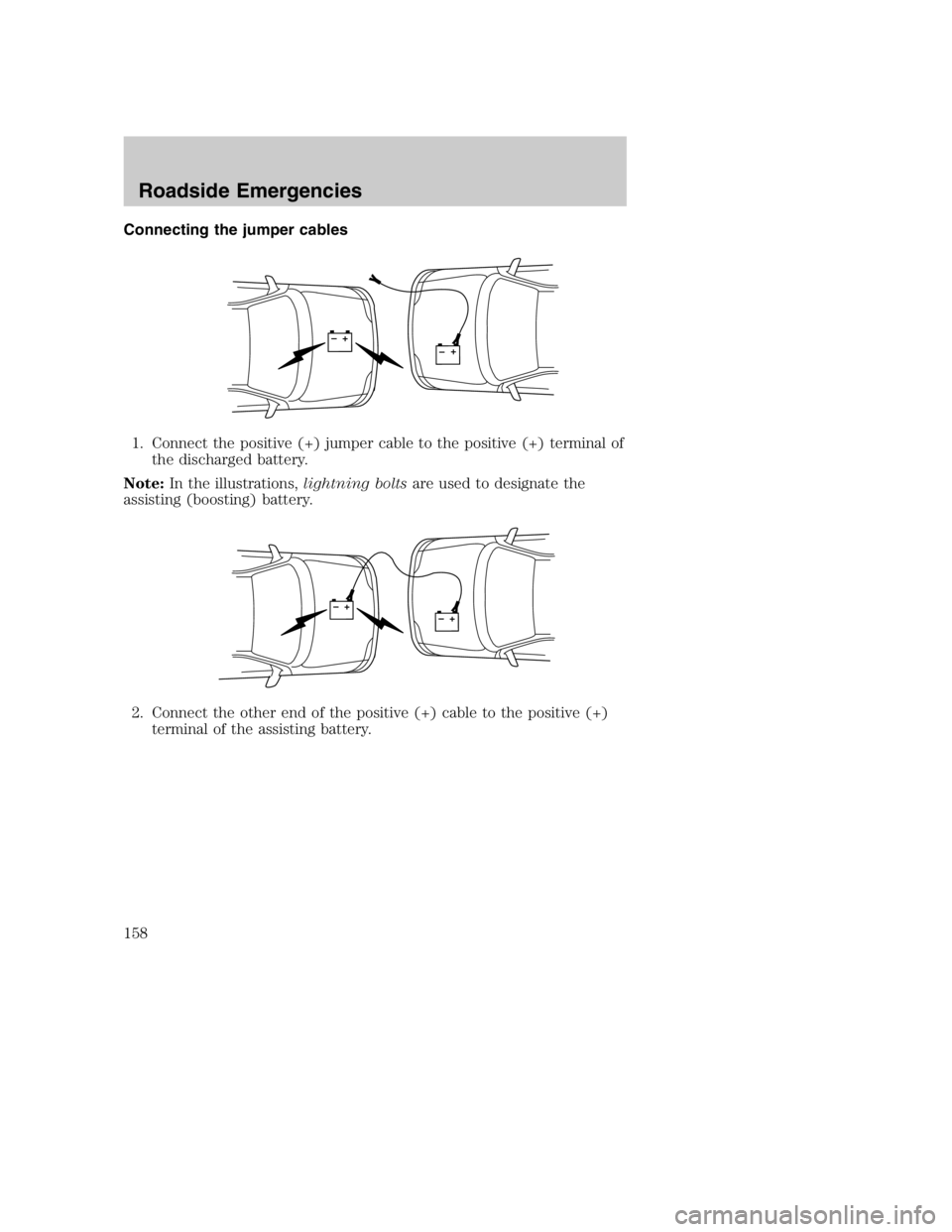
Connecting the jumper cables1. Connect the positive (+) jumper cable to the positive (+) terminal of the discharged battery.
Note: In the illustrations, lightning boltsare used to designate the
assisting (boosting) battery.
2. Connect the other end of the positive (+) cable to the positive (+) terminal of the assisting battery.
+–+–
+–+–
2004 Mazda B Series (mbs)
Owners Guide (post-2002-fmt)
USA English (fus)
Roadside Emergencies
158
Page 160 of 256
Jump starting1. Start the engine of the booster vehicle and run the engine at moderately increased speed.
2. Start the engine of the disabled vehicle.
3. Once the disabled vehicle has been started, run both engines for an additional three minutes before disconnecting the jumper cables.
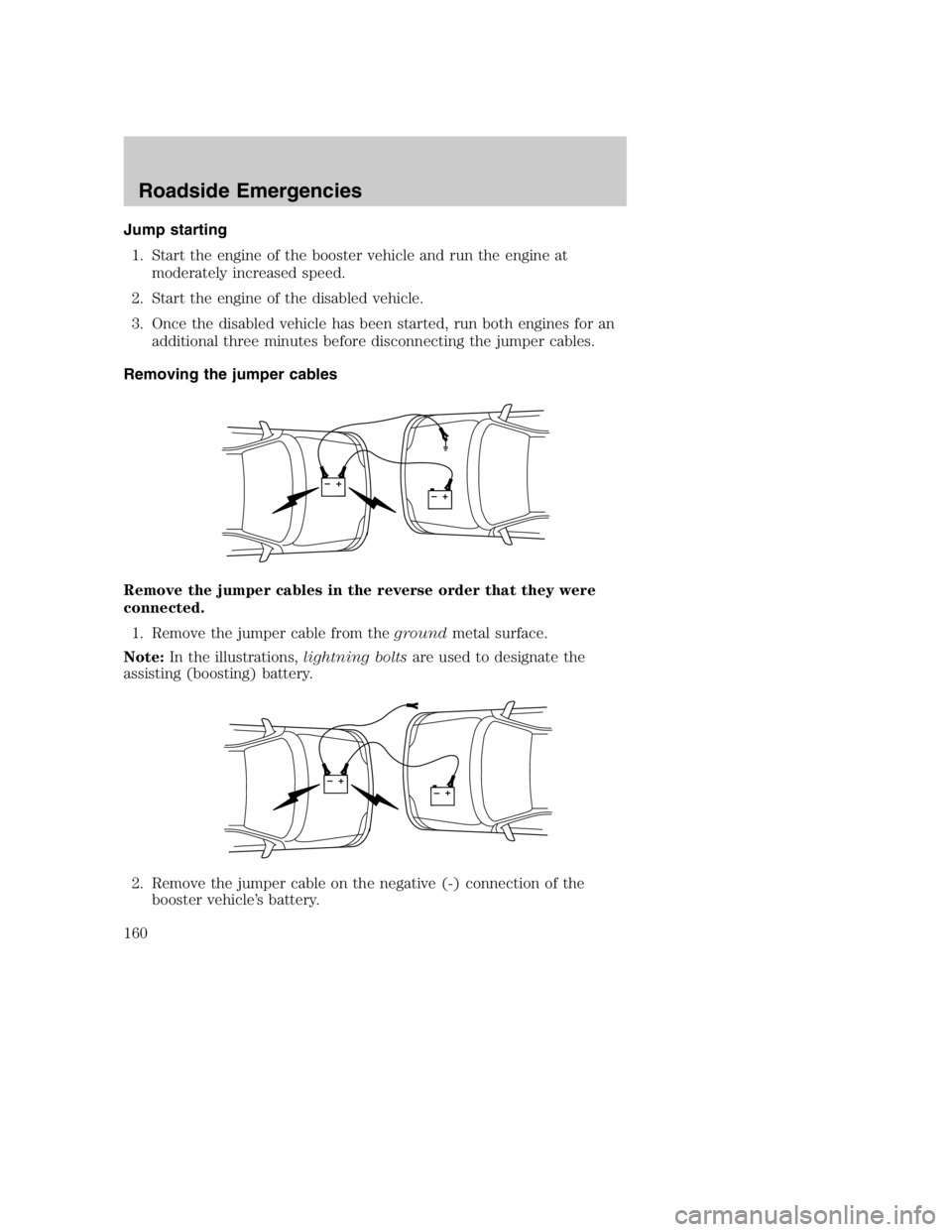
Removing the jumper cables
Remove the jumper cables in the reverse order that they were
connected. 1. Remove the jumper cable from the groundmetal surface.
Note: In the illustrations, lightning boltsare used to designate the
assisting (boosting) battery.
2. Remove the jumper cable on the negative (-) connection of the booster vehicle’s battery.
+–+–
+–+–
2004 Mazda B Series (mbs)
Owners Guide (post-2002-fmt)
USA English (fus)
Roadside Emergencies
160
Page 174 of 256
WASHING THE EXTERIOR
Wash your vehicle regularly with cool or lukewarm water and a neutral
Ph shampoo, such as an approved shampoo available from your Mazda
dealer.
•Never use strong household detergents or soap, such as dish washing
or laundry liquid. These products can discolor and spot painted
surfaces.
• Never wash a vehicle that is “hot to the touch” or during exposure to
strong, direct sunlight.
• Always use a clean sponge or carwash mitt with plenty of water for
best results.
• Dry the vehicle with a chamois or soft terry cloth towel in order to
eliminate water spotting.
• It is especially important to wash the vehicle regularly during the
winter months, as dirt and road salt are difficult to remove and cause
damage to the vehicle.
• Immediately remove items such as gasoline, diesel fuel, bird droppings
and insect deposits because they can cause damage to the vehicle’s
paintwork and trim over time.
• Remove any exterior accessories, such as antennas, before entering a
car wash.
• Suntan lotions and insect repellents can damage any painted
surface; if these substances come in contact with your vehicle,
wash off as soon as possible.
WAXING
Applying a polymer paint sealant to your vehicle every six months will
assist in reducing minor scratches and paint damage.
• Wash the vehicle first.
• Do not use waxes that contain abrasives.
• Do not allow paint sealant to come in contact with any non-body
(low-gloss black) colored trim, such as grained door handles, roof
racks, bumpers, side moldings, mirror housings or the windshield cowl
area. The paint sealant will “gray” or stain the parts over time.
PAINT CHIPS
Your dealer has touch-up paint to match your vehicle’s color. Touch-up
paint can be used to repair minor scratches to painted surfaces.
2004 Mazda B Series (mbs)
Owners Guide (post-2002-fmt)
USA English (fus)
Cleaning
Cleaning
174
Page 175 of 256
•Remove particles such as bird droppings, tree sap, insect deposits, tar
spots, road salt and industrial fallout before repairing paint chips.
• Always read the instructions before using the products.
ALUMINUM WHEELS AND COVERS
Aluminum wheel rims or covers are coated with a clearcoat paint finish.
In order to maintain their shine:
• Clean with One Step Wash and Wax Concentrate, which is available
from your authorized Mazda dealer.
• Never apply any cleaning chemical to hot or warm wheel rims or
covers.
• Some automatic car washes may cause damage to the finish on your
wheel rims or covers. Chemical-strength cleaners, or cleaning
chemicals, in combination with brush agitation to remove brake dust
and dirt, could wear away the clearcoat finish over time.
• Do not use hydrofluoric acid-based or high caustic-based wheel
cleaners, steel wool, fuels or strong household detergent.
• To remove tar and grease, use Extra Strength Tar and Road Oil
Removal, available from your authorized Mazda dealer.
ENGINE
Engines are more efficient when they are clean because grease and dirt
buildup keep the engine warmer than normal. When washing:
• Take care when using a power washer to clean the engine. The
high-pressure fluid could penetrate the sealed parts and cause
damage.
• Never spray the engine or other engine components with water. Water
will damage the engine or other engine components.
• Spray Engine Shampoo and Degreaser, available at your authorized
Mazda dealer, on all parts that require cleaning and pressure rinse
clean.
• Cover the highlighted areas to prevent water damage when cleaning
the engine.
2004 Mazda B Series (mbs)
Owners Guide (post-2002-fmt)
USA English (fus)
Cleaning
175
Page 178 of 256
INSTRUMENT PANEL AND CLUSTER LENS
Clean the instrument panel with a damp cloth, then dry with a dry cloth.
•Avoid cleaners or polish that increase the gloss of the upper portion of
the instrument panel. The dull finish in this area helps protect the
driver from undesirable windshield reflection.
WARNING: Do not use chemical solvents or strong detergents
when cleaning the steering wheel or instrument panel to avoid
contamination of the air bag system.
• Be certain to wash or wipe your hands clean if you have been in
contact with certain products such as insect repellent and suntan
lotion in order to avoid possible damage to the interior painted
surfaces.
INTERIOR TRIM
• Clean the interior trim areas with a damp cloth, then dry by wiping
with a dry, soft, clean cloth.
• Do not use household or glass cleaners as these may damage the
finish.
INTERIOR
For fabric, carpets, cloth seats, and safety belts:
• Remove dust and loose dirt with a vacuum cleaner.
• Remove light stains and soil with Extra Strength Upholstery Cleaner,
available at your authorized Mazda dealer.
• If grease or tar is present on the material, spot-clean the area first
with Spot and Stain Remover, available at your authorized Mazda
dealer.
• Never saturate the seat covers with cleaning solution.
• Do not use household cleaning products or glass cleaners, which can
stain and discolor the fabric and affect the flame retardant abilities of
the seat materials.
2004 Mazda B Series (mbs)
Owners Guide (post-2002-fmt)
USA English (fus)
Cleaning
178
Page 187 of 256
OWNER MAINTENANCE
Owner Maintenance Schedule
The owner or a qualified service technician should make these vehicle
inspections at the indicated intervals to ensure safe and dependable
operation.
Bring any problem to the attention of an Authorized Mazda Dealer or
qualified service technician as soon as possible.
While operating your vehicle
•Note any changes in the sound of the exhaust or any smell or exhaust
fumes in the vehicle.
• Check for vibrations in the steering wheel. Notice any increased
steering effort or looseness in the steering wheel, or change in the
straight ahead position.
• Notice if your vehicle constantly turns slightly or “pulls” to one side
when traveling on a smooth, level road.
• When stopping, listen and check for strange sounds, pulling to one
side, increased brake pedal travel or “hard to push” brake pedal.
• If any slipping or changes in the operation of your transmission occur,
check the transmission fluid level.
• Check automatic transmission Park function.
• Check parking brake.
At least monthly
• Check function of all interior and exterior lights.
• Check tires for wear and proper air pressure.
• Check engine oil level.
• Check coolant level in the coolant reservoir.
• Check washer fluid level.
At least twice a year (for example, every spring and fall)
• Check power steering fluid level.
• Check clutch fluid level (if equipped).
• Check and clean body and door drain holes.
• Check and lubricate all hinges, latches, and outside locks.
• Check and lubricate door rubber weather strips.
• Check parking brake for proper operation.
2004 Mazda B Series (mbs)
Owners Guide (post-2002-fmt)
USA English (fus)
Maintenance and Specifications
187
Page 188 of 256
•Check lap/shoulder belts and seat latches for wear and function.
• Check air pressure in spare tire.
• Check windshield washer spray and wiper operation. Clean wiper
blades with clean cloth dampened with washer fluid.
• Check safety warning lamps (brake, ABS, air bag, safety belt) for
operation.
• Check cooling system fluid level and verify coolant specific gravity is
correct for summer or winter conditions.
• Check battery water level (non-maintenance free).
• Check battery connections and clean if necessary.
SERVICE RECOMMENDATIONS
To help you service your vehicle:
• We highlight do-it-yourself items in the engine compartment for easy
location.
• We provide a Scheduled Maintenance section which makes tracking
routine service easy.
If your vehicle requires professional service, your dealership can provide
necessary parts and service. Check your “Warranty Information” to find
out which parts and services are covered.
Use only recommended fuels, lubricants, fluids and service parts
conforming to specifications. Genuine Mazda parts are designed and built
to provide the best performance in your vehicle.
PRECAUTIONS WHEN SERVICING YOUR VEHICLE
• Do not work on a hot engine.
• Make sure that nothing gets caught in moving parts.
• Do not work on a vehicle with the engine running in an enclosed
space, unless you are sure you have enough ventilation.
• Keep all open flames and other lit material away from the battery and
all fuel related parts.
2004 Mazda B Series (mbs)
Owners Guide (post-2002-fmt)
USA English (fus)
Maintenance and Specifications
188
Page 200 of 256
BATTERY
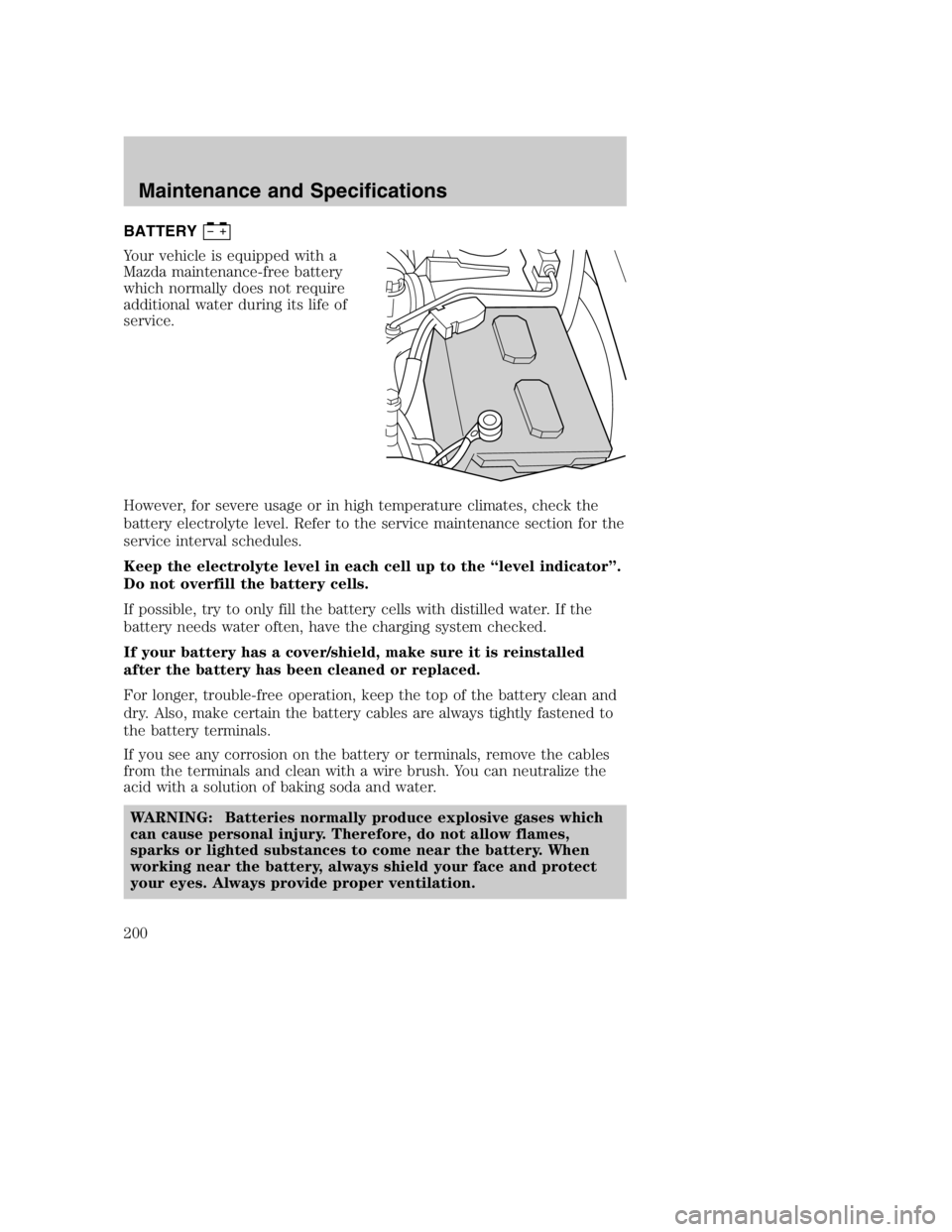
Your vehicle is equipped with a
Mazda maintenance-free battery
which normally does not require
additional water during its life of
service.
However, for severe usage or in high temperature climates, check the
battery electrolyte level. Refer to the service maintenance section for the
service interval schedules.
Keep the electrolyte level in each cell up to the “level indicator”.
Do not overfill the battery cells.
If possible, try to only fill the battery cells with distilled water. If the
battery needs water often, have the charging system checked.
If your battery has a cover/shield, make sure it is reinstalled
after the battery has been cleaned or replaced.
For longer, trouble-free operation, keep the top of the battery clean and
dry. Also, make certain the battery cables are always tightly fastened to
the battery terminals.
If you see any corrosion on the battery or terminals, remove the cables
from the terminals and clean with a wire brush. You can neutralize the
acid with a solution of baking soda and water.WARNING: Batteries normally produce explosive gases which
can cause personal injury. Therefore, do not allow flames,
sparks or lighted substances to come near the battery. When
working near the battery, always shield your face and protect
your eyes. Always provide proper ventilation.
2004 Mazda B Series (mbs)
Owners Guide (post-2002-fmt)
USA English (fus)
Maintenance and Specifications
200
Page 207 of 256
How Limp to Safety works
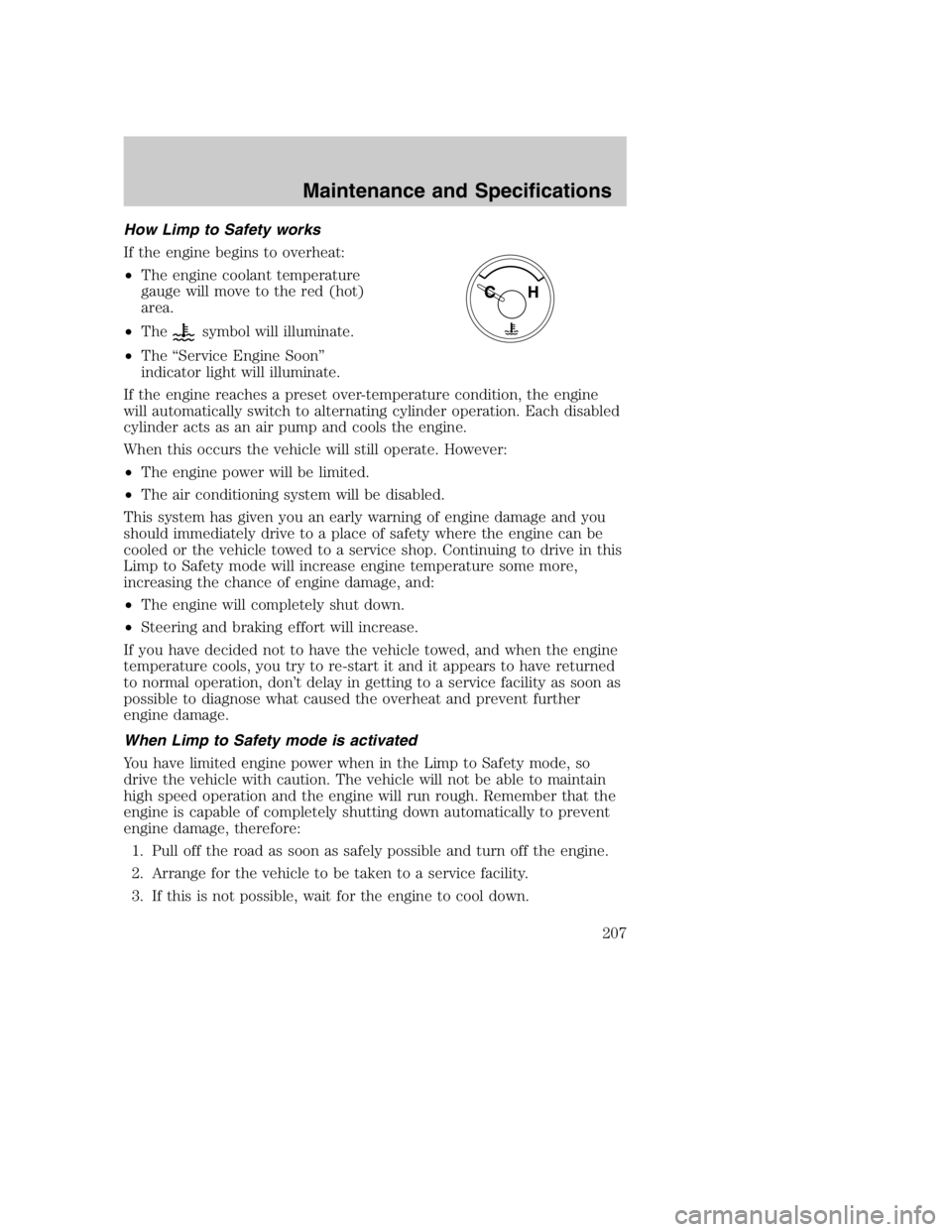
If the engine begins to overheat:
•The engine coolant temperature
gauge will move to the red (hot)
area.
• The
symbol will illuminate.
• The “Service Engine Soon”
indicator light will illuminate.
If the engine reaches a preset over-temperature condition, the engine
will automatically switch to alternating cylinder operation. Each disabled
cylinder acts as an air pump and cools the engine.
When this occurs the vehicle will still operate. However:
• The engine power will be limited.
• The air conditioning system will be disabled.
This system has given you an early warning of engine damage and you
should immediately drive to a place of safety where the engine can be
cooled or the vehicle towed to a service shop. Continuing to drive in this
Limp to Safety mode will increase engine temperature some more,
increasing the chance of engine damage, and:
• The engine will completely shut down.
• Steering and braking effort will increase.
If you have decided not to have the vehicle towed, and when the engine
temperature cools, you try to re-start it and it appears to have returned
to normal operation, don’t delay in getting to a service facility as soon as
possible to diagnose what caused the overheat and prevent further
engine damage.
When Limp to Safety mode is activated
You have limited engine power when in the Limp to Safety mode, so
drive the vehicle with caution. The vehicle will not be able to maintain
high speed operation and the engine will run rough. Remember that the
engine is capable of completely shutting down automatically to prevent
engine damage, therefore: 1. Pull off the road as soon as safely possible and turn off the engine.
2. Arrange for the vehicle to be taken to a service facility.
3. If this is not possible, wait for the engine to cool down.
2004 Mazda B Series (mbs)
Owners Guide (post-2002-fmt)
USA English (fus)
Maintenance and Specifications
207
Page 211 of 256
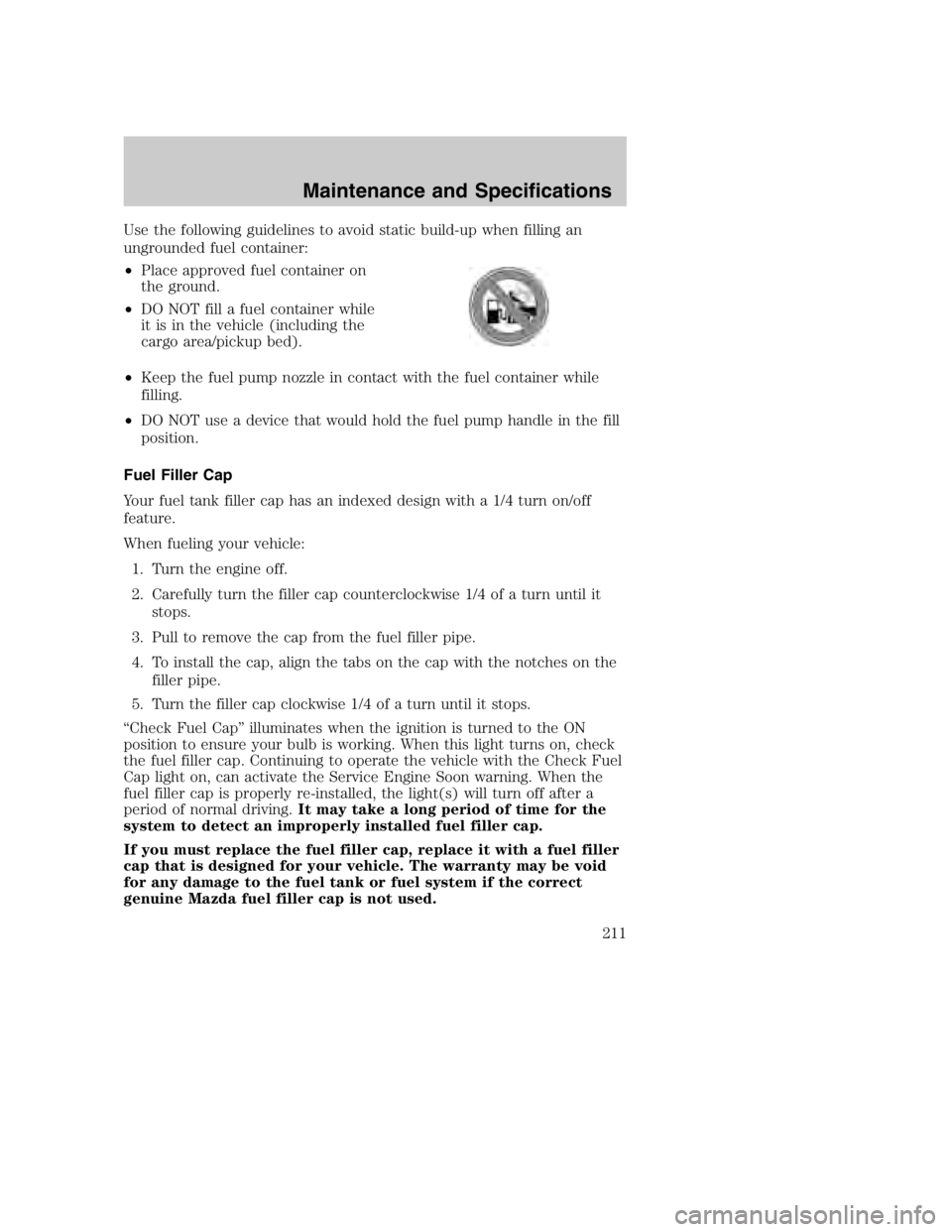
Use the following guidelines to avoid static build-up when filling an
ungrounded fuel container:
•Place approved fuel container on
the ground.
• DO NOT fill a fuel container while
it is in the vehicle (including the
cargo area/pickup bed).
• Keep the fuel pump nozzle in contact with the fuel container while
filling.
• DO NOT use a device that would hold the fuel pump handle in the fill
position.
Fuel Filler Cap
Your fuel tank filler cap has an indexed design with a 1/4 turn on/off
feature.
When fueling your vehicle: 1. Turn the engine off.
2. Carefully turn the filler cap counterclockwise 1/4 of a turn until it stops.
3. Pull to remove the cap from the fuel filler pipe.
4. To install the cap, align the tabs on the cap with the notches on the filler pipe.
5. Turn the filler cap clockwise 1/4 of a turn until it stops.
“Check Fuel Cap” illuminates when the ignition is turned to the ON
position to ensure your bulb is working. When this light turns on, check
the fuel filler cap. Continuing to operate the vehicle with the Check Fuel
Cap light on, can activate the Service Engine Soon warning. When the
fuel filler cap is properly re-installed, the light(s) will turn off after a
period of normal driving. It may take a long period of time for the
system to detect an improperly installed fuel filler cap.
If you must replace the fuel filler cap, replace it with a fuel filler
cap that is designed for your vehicle. The warranty may be void
for any damage to the fuel tank or fuel system if the correct
genuine Mazda fuel filler cap is not used.
2004 Mazda B Series (mbs)
Owners Guide (post-2002-fmt)
USA English (fus)
Maintenance and Specifications
211