ESP MAZDA MODEL B3000 TRUCK 2007 Owner's Manual
[x] Cancel search | Manufacturer: MAZDA, Model Year: 2007, Model line: MODEL B3000 TRUCK, Model: MAZDA MODEL B3000 TRUCK 2007Pages: 280, PDF Size: 1.95 MB
Page 207 of 280
WARNING: Add-On Electrical and Electronic Equipment:
Incorrectly choosing or installing improper add-on equipment or
choosing an improper installer could be dangerous. Essential
systems could be damaged, causing engine stalling, air-bag
(SRS) activation, ABS inactivation, or a fire in the vehicle. Be
very careful in choosing and installing add-on electrical
equipment, such as mobile telephones, two-way radios, stereo
systems, and car alarm systems.
Mazda assumes no responsibility for death, injury, or expenses that may
result from the installation of add-on non-genuine parts or accessories.
SERVICE PUBLICATIONS
Factory-authorized Mazda service publications are available for owners
who wish to do some of their own maintenance and repair.
When requesting any of our publications through an Authorized Mazda
Dealer, refer to the chart below.
If they don’t have what you need in stock, they can order it for you.
PUBLICATION ORDER NUMBER PUBLICATION DESCRIPTION 9999 95 022B 06 WORKSHOP MANUAL
9999 95 020G 06 WIRING DIAGRAM
9999 95 023C 06 OWNER’S MANUAL
WORKSHOP MANUAL:
Covers recommended maintenance and repair procedures of the drive
train, body and chassis.
WIRING DIAGRAM:
Provides electrical schematics as well as component location for the
entire electrical system.
OWNER’S MANUAL:
This booklet contains information regarding the proper care and
operation of your vehicle. This is not a technician’s manual.
Please note that your Authorized Mazda Dealership has trained
personnel and special service tools to correctly and safely
maintain Mazda vehicles.
2007 B-Series (mbs)
Owners Guide (post-2002-fmt)
USA (fus)
Customer Assistance
207
Page 208 of 280
REPORTING SAFETY DEFECTS
If you believe that your vehicle has a defect which could cause a crash or
could cause injury or death, you should immediately inform the National
Highway Traffic Safety Administration (NHTSA) in addition to notifying
your Mazda importer/distributor.
If NHTSA receives similar complaints, it may open an investigation, and
if it finds that a safety defect exists in a group of vehicles, it may order a
recall and remedy campaign. However, NHTSA cannot become involved
in individual problems between you, your dealer, or your Mazda
importer/distributor).
To contact NHTSA, you may call the Vehicle Safety Hotline toll-free at
1–888–327–4236 (TTY: 1–800–424–9153); go tohttp://www.safercar.gov;
or write to:
NHTSA
400 Seventh Street, SW
Washington, D.C. 20590
You can also obtain other information about motor vehicle safety from
http://www.safercar.gov .
(Note)
If you live in the U.S.A., all correspondence to:
Mazda North American Operations
7755, Irvine Center Drive
Irvine, California 92618–2922
P.O. Box 19734
Irvine, CA 92623–9734
Customer Assistance Center
or toll free at 1 (800) 222–5500
If you live outside of the U.S.A., please contact the nearest Mazda
Distributor. See the Mazda importers/distributors section in this
chapter.
2007 B-Series (mbs)
Owners Guide (post-2002-fmt)
USA (fus)
Customer Assistance
208
Page 209 of 280
WASHING THE EXTERIOR
Wash your vehicle regularly with cool or lukewarm water and a neutral
pH shampoo.
•Never use strong household detergents or soap, such as dish washing
or laundry liquid. These products can discolor and spot painted
surfaces.
• Never wash a vehicle that is “hot to the touch” or during exposure to
strong, direct sunlight.
• Always use a clean sponge or car wash mitt with plenty of water for
best results.
• Dry the vehicle with a chamois or soft terry cloth towel in order to
eliminate water spotting.
• It is especially important to wash the vehicle regularly during the
winter months, as dirt and road salt are difficult to remove and cause
damage to the vehicle.
• Immediately remove items such as gasoline, diesel fuel, bird droppings
and insect deposits because they can cause damage to the vehicle’s
paintwork and trim over time.
• Remove any exterior accessories, such as antennas, before entering a
car wash.
• Suntan lotions and insect repellents can damage any painted
surface; if these substances come in contact with your vehicle,
wash off as soon as possible.
WAXING
Applying a premium paint sealant to your vehicle every six months will
assist in reducing minor scratches and paint damage.
• Wash the vehicle first. Refer to Washing the exteriorfor more
detailed information.
• Do not use waxes that contain abrasives; use a premium liquid wax.
• Do not allow paint sealant to come in contact with any non-body
(low-gloss black) colored trim, such as grained door handles, roof
racks, bumpers, side moldings, mirror housings or the windshield cowl
area. The paint sealant will “gray” or stain the parts over time.
2007 B-Series (mbs)
Owners Guide (post-2002-fmt)
USA (fus)
Cleaning
209
Page 215 of 280
INTRODUCTION
Be extremely careful to prevent injury to yourself and others or damage
to your vehicle when using this manual for inspection and maintenance.
If you’re unsure about any procedure it describes, we strongly urge you
to have a reliable and qualified service shop perform the work, preferably
an authorized Mazda Dealer.
Factory-trained Mazda technicians and genuine Mazda parts are best for
your vehicle. Without this expertise and the parts that have been
designed and made especially for your Mazda, inadequate, incomplete,
and insufficient servicing may result in problems. This could lead to
vehicle damage or an accident and injuries.
For expert advice and quality service, consult an authorized Mazda
Dealer.
The owner should retain evidence that proper maintenance has been
performed as prescribed.
Claims against the warranty resulting from lack of maintenance, as
opposed to defective materials or authorized Mazda workmanship, will
not be honored.
Any auto repair shop using parts equivalent to your Mazda’s original
equipment may perform maintenance.But we recommend that it
always be done by an authorized Mazda Dealer using genuine
Mazda parts.
SCHEDULED MAINTENANCE
Schedule 1 — Normal Driving Conditions/Emission Control
Systems
Follow Schedule 1 if the vehicle is operated mainly where none of the
following conditions apply. If any do apply, follow Schedule 2.
• Repeated short-distance driving.
• Driving in dusty conditions.
• Towing a trailer.
• Operating in hot weather in stop-and-go “rush hour” traffic.
• Extended periods of idling or low-speed operation.
• High-speed operation with a fully loaded vehicle.
• Off-road operation.
NOTE: After the described period, continue to follow the described
maintenance at the recommended intervals.
2007 B-Series (mbs)
Owners Guide (post-2002-fmt)
USA (fus)
Maintenance and Specifications
215
Page 237 of 280
will not affect function or durability of the transmission. Over time the
adaptive learning process will fully update transmission operation to its
optimum shift feel.
If the battery has been disconnected or a new battery has been installed,
the clock and the preset radio stations must be reset once the battery is
reconnected.
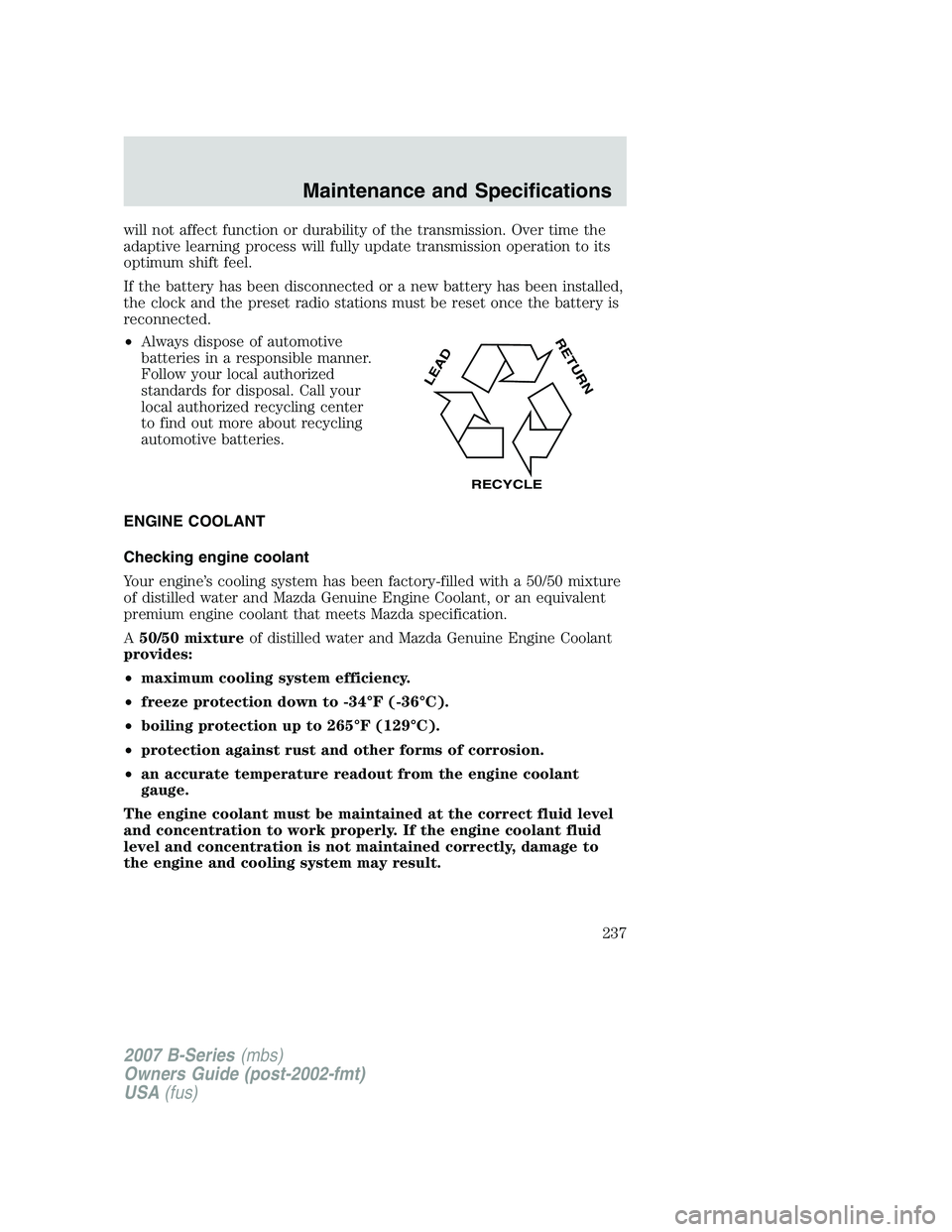
•Always dispose of automotive
batteries in a responsible manner.
Follow your local authorized
standards for disposal. Call your
local authorized recycling center
to find out more about recycling
automotive batteries.
ENGINE COOLANT
Checking engine coolant
Your engine’s cooling system has been factory-filled with a 50/50 mixture
of distilled water and Mazda Genuine Engine Coolant, or an equivalent
premium engine coolant that meets Mazda specification.
A 50/50 mixture of distilled water and Mazda Genuine Engine Coolant
provides:
• maximum cooling system efficiency.
• freeze protection down to -34°F (-36°C).
• boiling protection up to 265°F (129°C).
• protection against rust and other forms of corrosion.
• an accurate temperature readout from the engine coolant
gauge.
The engine coolant must be maintained at the correct fluid level
and concentration to work properly. If the engine coolant fluid
level and concentration is not maintained correctly, damage to
the engine and cooling system may result.
LEAD
RETURN
RECYCLE
2007 B-Series (mbs)
Owners Guide (post-2002-fmt)
USA (fus)
Maintenance and Specifications
237
Page 241 of 280
4. When you are sure that all the pressure has been released, use thecloth to turn it counterclockwise and remove the cap.
5. Fill the coolant reservoir slowly with the proper coolant mixture (see above), to within the “COLD FILL RANGE” or the “FULL COLD”
level on the reservoir. If you removed the radiator cap in an overflow
system, fill the radiator until the coolant is visible and radiator is
almost full.
6. Replace the cap. Turn until tightly installed. (Cap must be tightly installed to prevent coolant loss.)
After any coolant has been added, check the coolant concentration, refer
to Checking engine coolant . If the concentration is not 50/50
(protection to –34° F/–36° C), drain some coolant and adjust the
concentration. It may take several drains and additions to obtain a 50/50
coolant concentration.
Whenever coolant has been added, the coolant level in the coolant
reservoir should be checked the next few times you drive the vehicle. If
necessary, add enough 50/50 concentration of engine coolant and
distilled water to bring the liquid level to the proper level.
If you have to add more than 1.0 quart (1.0 liter) of engine coolant per
month, have your authorized dealer check the engine cooling system.
Your cooling system may have a leak. Operating an engine with a low
level of coolant can result in engine overheating and possible engine
damage.
Recycled engine coolant
Not all coolant recycling processes produce coolant which meets Mazda
specification. Use of a recycled engine coolant which does not meet
Mazda specifications may harm engine and cooling system components.
Always dispose of used automotive fluids in a responsible manner.
Follow your community’s regulations and standards for recycling and
disposing of automotive fluids.
Coolant refill capacity
To find out how much fluid your vehicle’s cooling system can hold, refer
to Maintenance product specifications and capacities in this chapter.
Fill your engine coolant reservoir as outlined in Adding engine coolant
in this section.
2007 B-Series (mbs)
Owners Guide (post-2002-fmt)
USA (fus)
Maintenance and Specifications
241
Page 243 of 280
WHAT YOU SHOULD KNOW ABOUT AUTOMOTIVE FUELS
Important safety precautionsWARNING: Do not overfill the fuel tank. The pressure in an
overfilled tank may cause leakage and lead to fuel spray and
fire.
WARNING: The fuel system may be under pressure. If the fuel
filler cap is venting vapor or if you hear a hissing sound, wait
until it stops before completely removing the fuel filler cap.
Otherwise, fuel may spray out and injure you or others.
WARNING: If you do not use the proper fuel filler cap,
excessive vacuum in the fuel tank may damage the fuel system
or cause the fuel cap to disengage in a collision, which may
result in possible personal injury.
WARNING: Automotive fuels can cause serious injury or death
if misused or mishandled.
WARNING: Gasoline may contain benzene, which is a
cancer-causing agent.
Observe the following guidelines when handling automotive fuel:
• Extinguish all smoking materials
and any open flames before
fueling your vehicle.
• Always turn off the vehicle before
fueling.
• Automotive fuels can be harmful
or fatal if swallowed. Fuel such as gasoline is highly toxic and if
swallowed can cause death or permanent injury. If fuel is swallowed,
call a physician immediately, even if no symptoms are immediately
apparent. The toxic effects of fuel may not be visible for hours.
• Avoid inhaling fuel vapors. Inhaling too much fuel vapor of any kind
can lead to eye and respiratory tract irritation. In severe cases,
excessive or prolonged breathing of fuel vapor can cause serious
illness and permanent injury.
2007 B-Series (mbs)
Owners Guide (post-2002-fmt)
USA (fus)
Maintenance and Specifications
243
Page 251 of 280
•Do not turn off the ignition while your vehicle is moving, especially at
high speeds.
• Have the items listed in the scheduled maintenancesection
performed according to the specified schedule.
The scheduled maintenance items listed in the scheduled maintenance
section are essential to the life and performance of your vehicle and to
its emissions system.
If other than Mazda authorized parts are used for maintenance
replacements or for service of components affecting emission control,
such non-Mazda parts should be equivalent to genuine Mazda parts in
performance and durability.
WARNING: Do not park, idle, or drive your vehicle in dry grass
or other dry ground cover. The emission system heats up the
engine compartment and exhaust system, which can start a fire.
Illumination of the
indicator, charging system warning light or the
temperature warning light, fluid leaks, strange odors, smoke or loss of
engine power, could indicate that the emission control system is not
working properly.
WARNING: Exhaust leaks may result in entry of harmful and
potentially lethal fumes into the passenger compartment.
Do not make any unauthorized changes to your vehicle or engine. By
law, vehicle owners and anyone who manufactures, repairs, services,
sells, leases, trades vehicles, or supervises a fleet of vehicles are not
permitted to intentionally remove an emission control device or prevent
it from working. Information about your vehicle’s emission system is on
the Vehicle Emission Control Information Decal located on or near the
engine. This decal identifies engine displacement and gives some tune up
specifications.
Please consult your “Warranty Information” for complete emission
warranty information.
On board diagnostics (OBD-II)
Your vehicle is equipped with a computer that monitors the engine’s
emission control system. This system is commonly known as the On
Board Diagnostics System (OBD-II). This OBD-II system protects the
environment by ensuring that your vehicle continues to meet
2007 B-Series (mbs)
Owners Guide (post-2002-fmt)
USA (fus)
Maintenance and Specifications
251
Page 268 of 280
CELL PHONES
Use of cell phones and other devices by driver:WARNING: Use of any electrical devices such as cell phones,
computers, portable radios, vehicle navigation or other devices
by the driver while the vehicle is moving is dangerous. Dialing a
number on a cell phone while driving also ties-up the driver’s
hands. Use of these devices will cause the driver to be
distracted and could lead to a serious accident. If a passenger is
unable to use the device, pull off the right-of-way to a safe area
before use. If use of a cell phone is necessary despite this
warning, use a hands-free system to at least allow the hands
free to drive the vehicle. Never use a cell phone or other
electrical device while the vehicle is moving and, instead,
concentrate on the full-time job of driving.
In addition, the gasoline distributors are warning against using
cell phones during refueling procedures, due to their increased
concern about static electricity fires in the self-service pump
environment.
2007 B-Series (mbs)
Owners Guide (post-2002-fmt)
USA (fus)
Accessories
268