lock MAZDA MODEL B3000 TRUCK 2007 Workshop Manual
[x] Cancel search | Manufacturer: MAZDA, Model Year: 2007, Model line: MODEL B3000 TRUCK, Model: MAZDA MODEL B3000 TRUCK 2007Pages: 280, PDF Size: 1.95 MB
Page 175 of 280
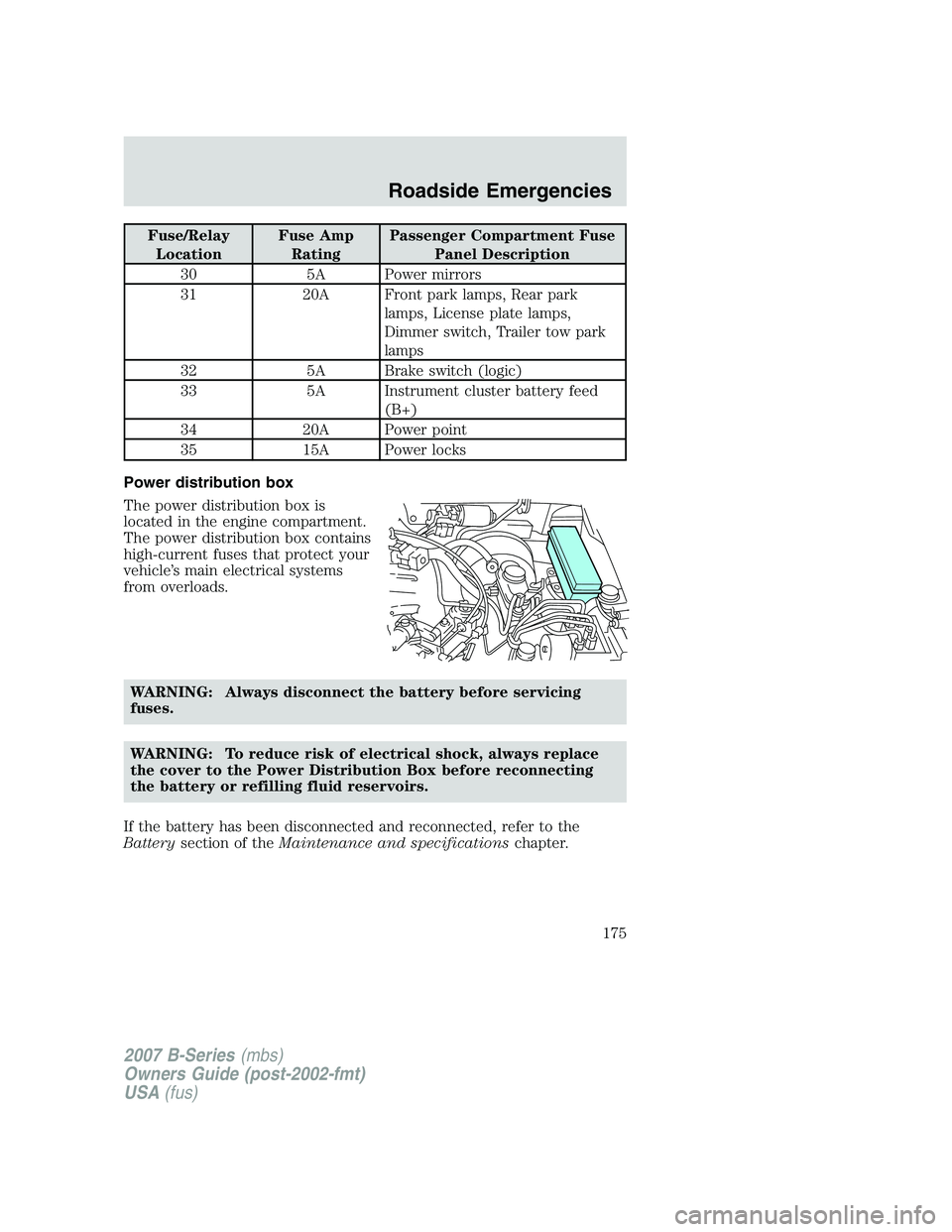
Fuse/RelayLocation Fuse Amp
Rating Passenger Compartment Fuse
Panel Description
30 5A Power mirrors
31 20A Front park lamps, Rear park
lamps, License plate lamps,
Dimmer switch, Trailer tow park
lamps
32 5A Brake switch (logic)
33 5A Instrument cluster battery feed
(B+)
34 20A Power point
35 15A Power locks
Power distribution box
The power distribution box is
located in the engine compartment.
The power distribution box contains
high-current fuses that protect your
vehicle’s main electrical systems
from overloads.
WARNING: Always disconnect the battery before servicing
fuses.
WARNING: To reduce risk of electrical shock, always replace
the cover to the Power Distribution Box before reconnecting
the battery or refilling fluid reservoirs.
If the battery has been disconnected and reconnected, refer to the
Battery section of the Maintenance and specifications chapter.
2007 B-Series(mbs)
Owners Guide (post-2002-fmt)
USA (fus)
Roadside Emergencies
175
Page 177 of 280
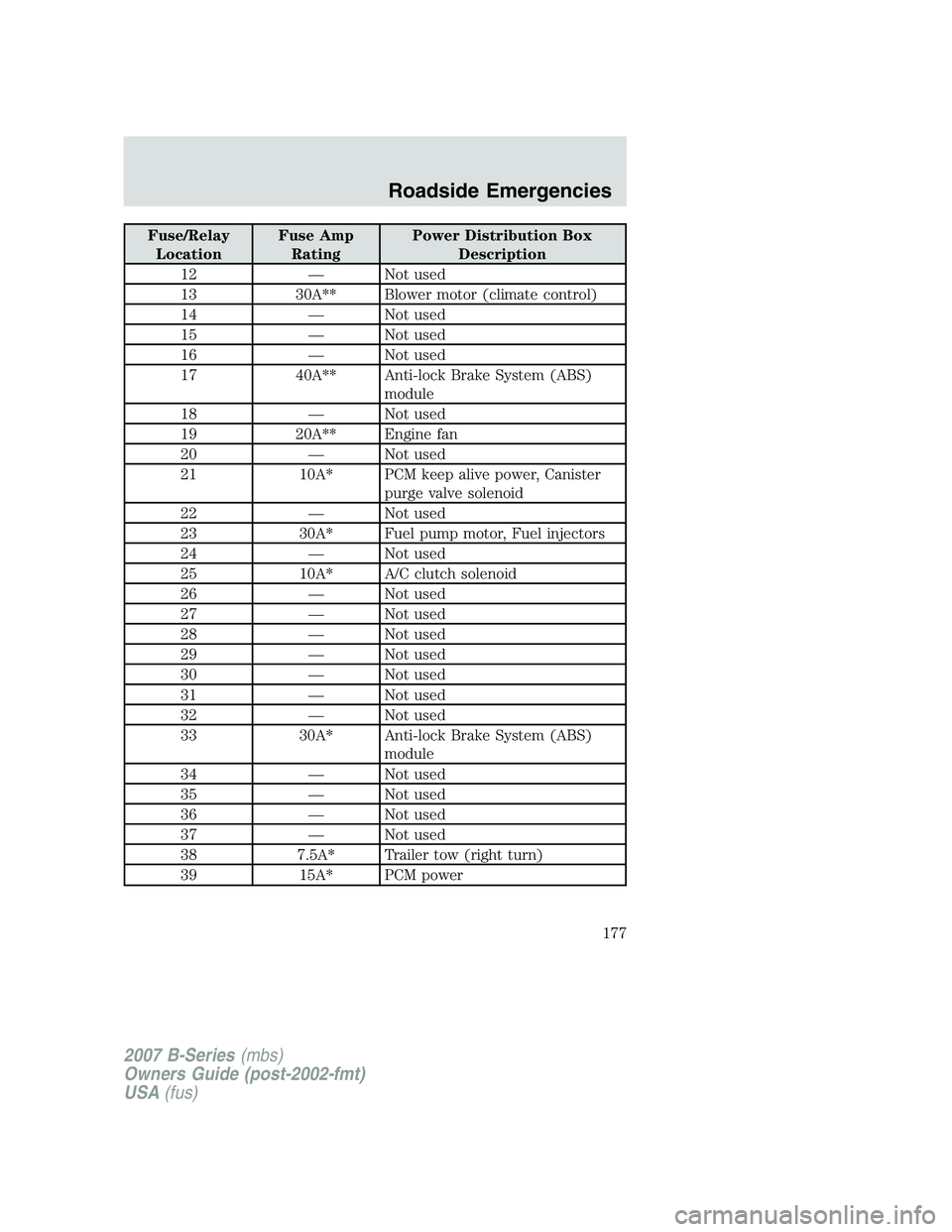
Fuse/RelayLocation Fuse Amp
Rating Power Distribution Box
Description
12 — Not used
13 30A** Blower motor (climate control)
14 — Not used
15 — Not used
16 — Not used
17 40A** Anti-lock Brake System (ABS)
module
18 — Not used
19 20A** Engine fan
20 — Not used
21 10A* PCM keep alive power, Canister
purge valve solenoid
22 — Not used
23 30A* Fuel pump motor, Fuel injectors
24 — Not used
25 10A* A/C clutch solenoid
26 — Not used
27 — Not used
28 — Not used
29 — Not used
30 — Not used
31 — Not used
32 — Not used
33 30A* Anti-lock Brake System (ABS)
module
34 — Not used
35 — Not used
36 — Not used
37 — Not used
38 7.5A* Trailer tow (right turn)
39 15A* PCM power
2007 B-Series(mbs)
Owners Guide (post-2002-fmt)
USA (fus)
Roadside Emergencies
177
Page 180 of 280
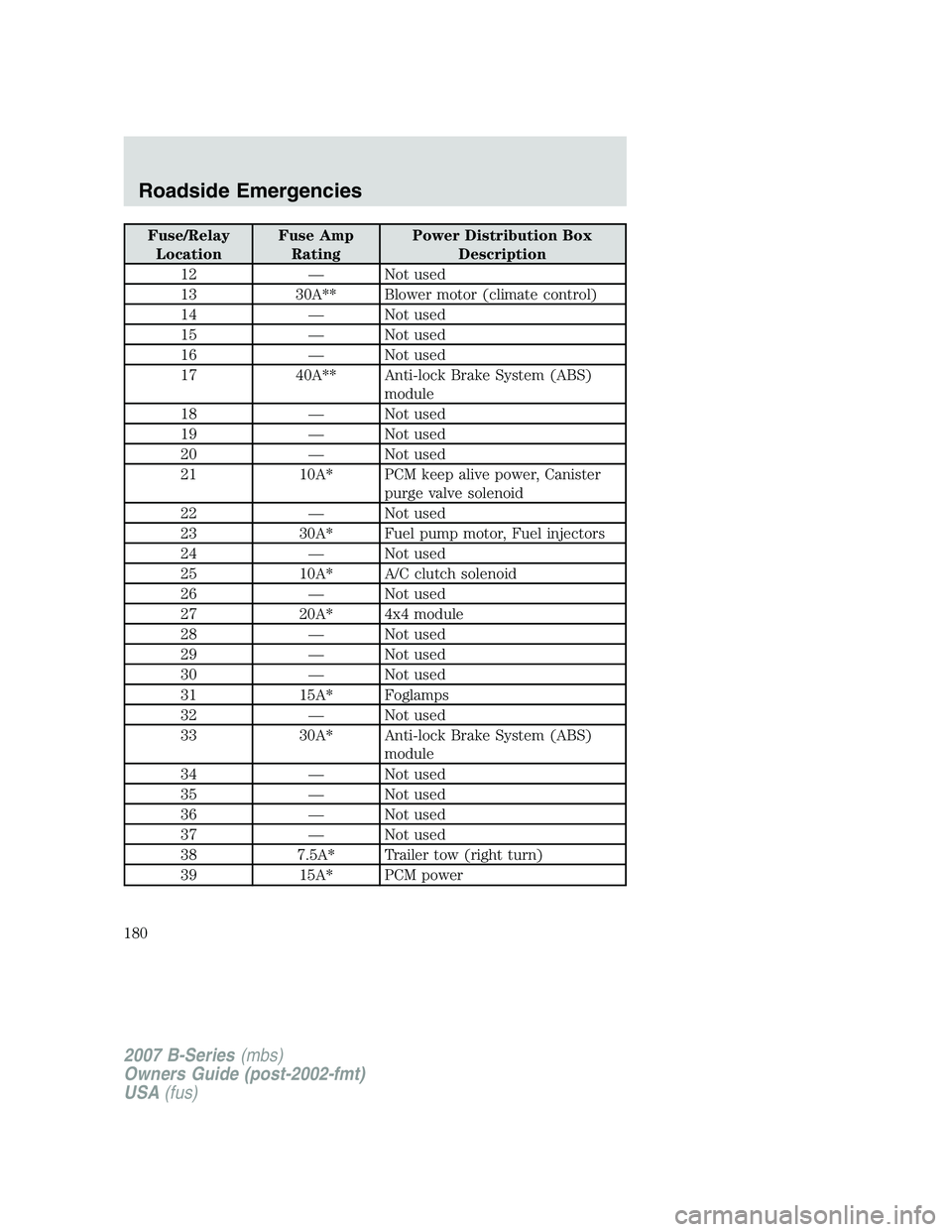
Fuse/RelayLocation Fuse Amp
Rating Power Distribution Box
Description
12 — Not used
13 30A** Blower motor (climate control)
14 — Not used
15 — Not used
16 — Not used
17 40A** Anti-lock Brake System (ABS)
module
18 — Not used
19 — Not used
20 — Not used
21 10A* PCM keep alive power, Canister
purge valve solenoid
22 — Not used
23 30A* Fuel pump motor, Fuel injectors
24 — Not used
25 10A* A/C clutch solenoid
26 — Not used
27 20A* 4x4 module
28 — Not used
29 — Not used
30 — Not used
31 15A* Foglamps
32 — Not used
33 30A* Anti-lock Brake System (ABS)
module
34 — Not used
35 — Not used
36 — Not used
37 — Not used
38 7.5A* Trailer tow (right turn)
39 15A* PCM power
2007 B-Series(mbs)
Owners Guide (post-2002-fmt)
USA (fus)
Roadside Emergencies
180
Page 184 of 280
When driving with the full-size dissimilar spare tire/wheel additional
caution should be given to:
•Towing a trailer
• Driving vehicles equipped with a camper body
• Driving vehicles with a load on the cargo rack
Drive cautiously when using a full-size dissimilar spare tire/wheel and
seek service as soon as possible.
Full-size Matching Spare Tire/Wheel Information
This spare tire/wheel will match the road tire/wheel. When driving with
the full size matching spare tire/wheel, do not exceed 70 mph (113
km/h). It is intended for temporary use only. This means if you need to
use it, you should replace it as soon as possible.
Location of the spare tire and tools
Note: The tire pressure monitoring system (TPMS) indicator light will
illuminate when the spare is in use. To restore the full functionality of
the TPMS system, all road wheels equipped with the tire pressure
monitoring sensors must be mounted on the vehicle.
Have a flat tire serviced by an authorized dealer in order to prevent
damage to the TPMS sensor, refer to Tire Pressure Monitoring System
(TPMS) in theTires, Wheel and Loading chapter. Replace the spare
tire with a road tire as soon as possible.
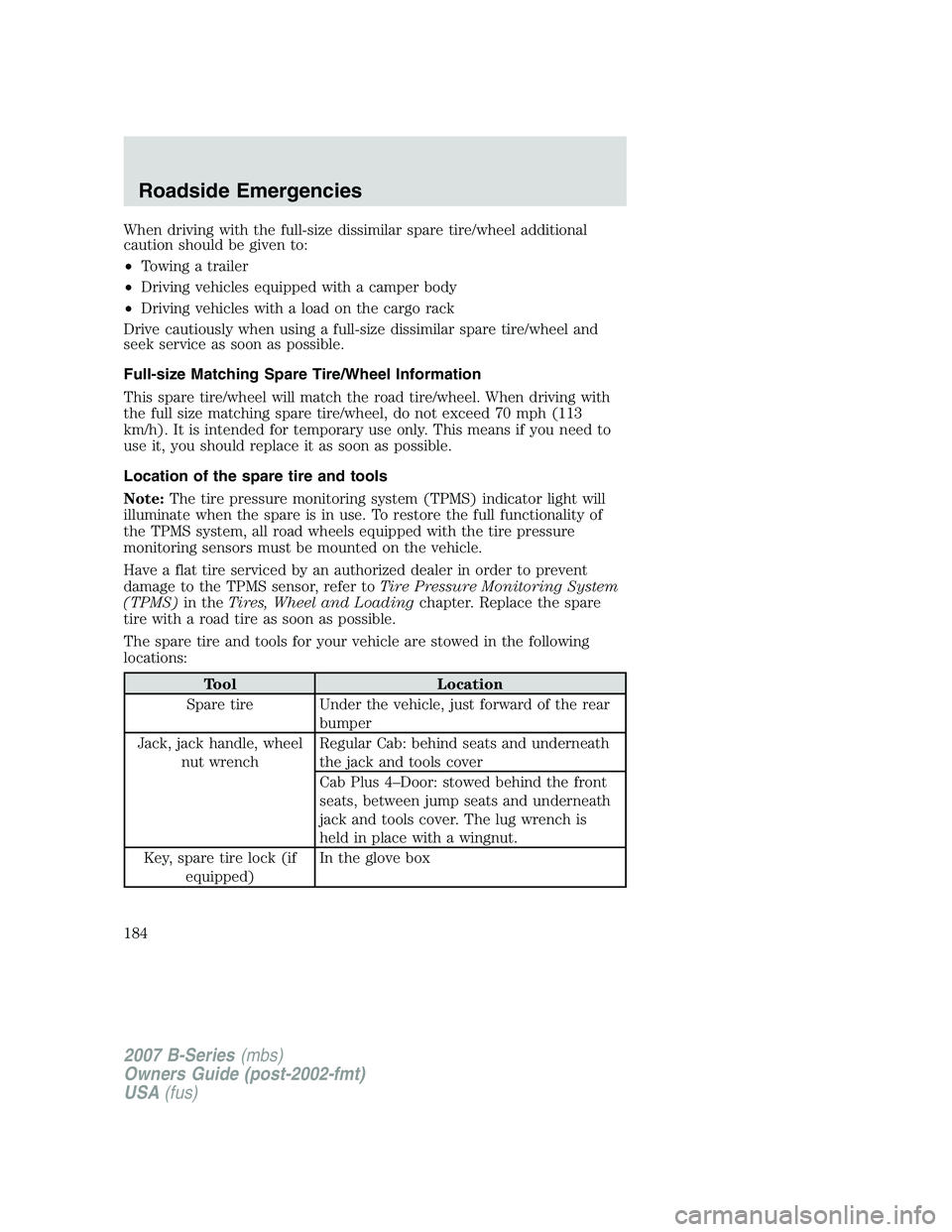
The spare tire and tools for your vehicle are stowed in the following
locations:
Tool Location
Spare tire Under the vehicle, just forward of the rear bumper
Jack, jack handle, wheel nut wrench Regular Cab: behind seats and underneath
the jack and tools cover
Cab Plus 4–Door: stowed behind the front
seats, between jump seats and underneath
jack and tools cover. The lug wrench is
held in place with a wingnut.
Key, spare tire lock (if equipped) In the glove box
2007 B-Series
(mbs)
Owners Guide (post-2002-fmt)
USA (fus)
Roadside Emergencies
184
Page 185 of 280
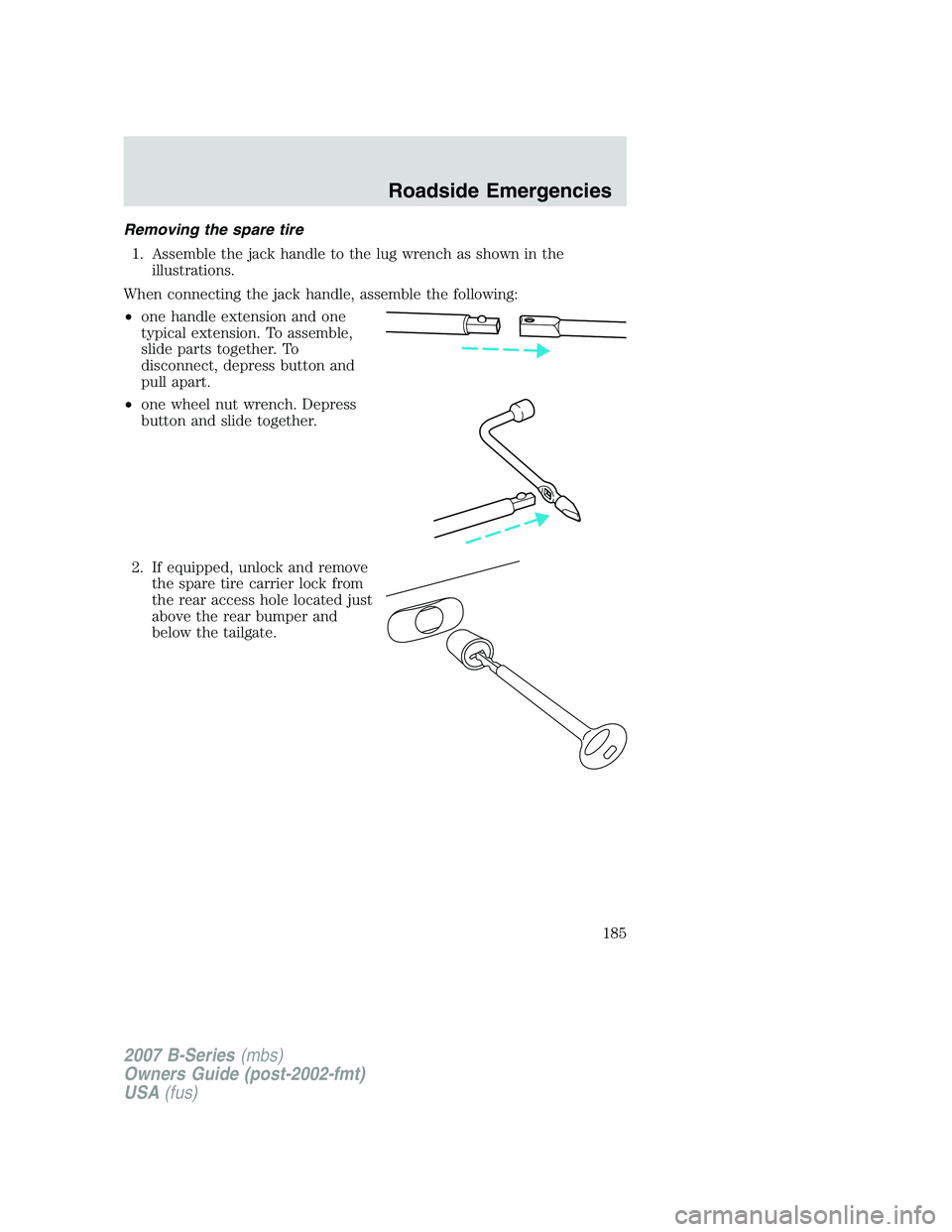
Removing the spare tire1. Assemble the jack handle to the lug wrench as shown in the illustrations.
When connecting the jack handle, assemble the following:
• one handle extension and one
typical extension. To assemble,
slide parts together. To
disconnect, depress button and
pull apart.
• one wheel nut wrench. Depress
button and slide together.
2. If equipped, unlock and remove the spare tire carrier lock from
the rear access hole located just
above the rear bumper and
below the tailgate.
2007 B-Series (mbs)
Owners Guide (post-2002-fmt)
USA (fus)
Roadside Emergencies
185
Page 186 of 280
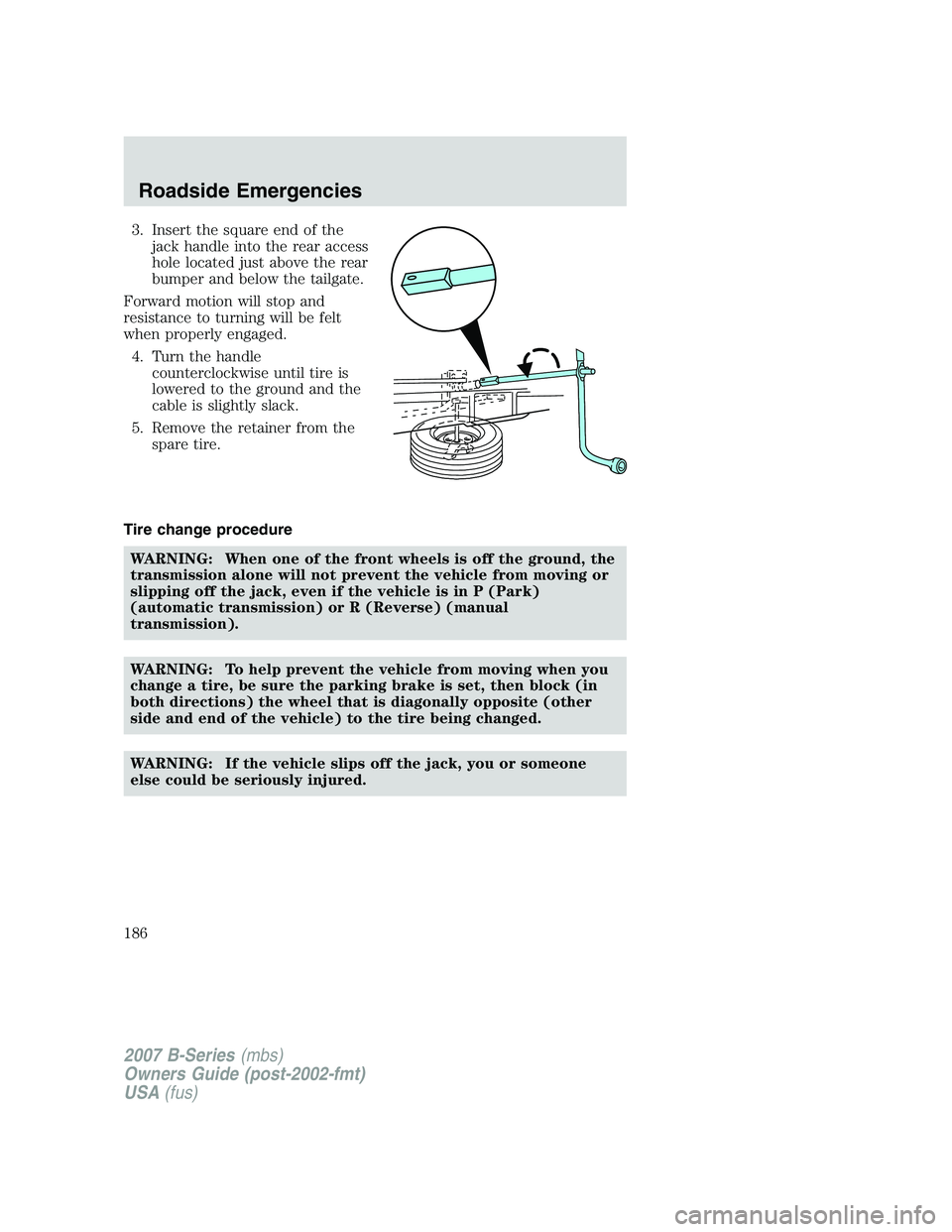
3. Insert the square end of thejack handle into the rear access
hole located just above the rear
bumper and below the tailgate.
Forward motion will stop and
resistance to turning will be felt
when properly engaged. 4. Turn the handle counterclockwise until tire is
lowered to the ground and the
cable is slightly slack.
5. Remove the retainer from the spare tire.
Tire change procedure WARNING: When one of the front wheels is off the ground, the
transmission alone will not prevent the vehicle from moving or
slipping off the jack, even if the vehicle is in P (Park)
(automatic transmission) or R (Reverse) (manual
transmission).
WARNING: To help prevent the vehicle from moving when you
change a tire, be sure the parking brake is set, then block (in
both directions) the wheel that is diagonally opposite (other
side and end of the vehicle) to the tire being changed.
WARNING: If the vehicle slips off the jack, you or someone
else could be seriously injured.
2007 B-Series (mbs)
Owners Guide (post-2002-fmt)
USA (fus)
Roadside Emergencies
186
Page 187 of 280
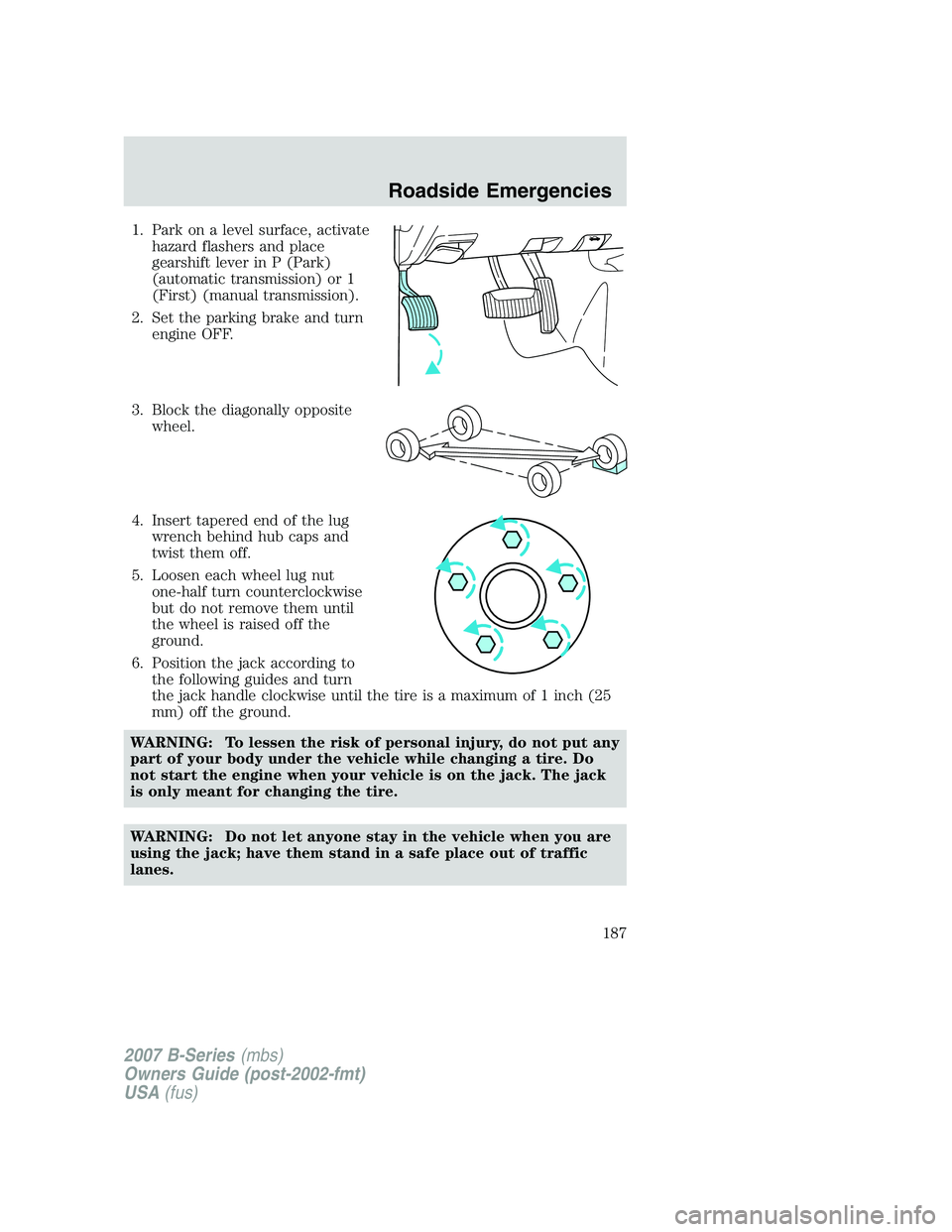
1. Park on a level surface, activatehazard flashers and place
gearshift lever in P (Park)
(automatic transmission) or 1
(First) (manual transmission).
2. Set the parking brake and turn engine OFF.
3. Block the diagonally opposite wheel.
4. Insert tapered end of the lug wrench behind hub caps and
twist them off.
5. Loosen each wheel lug nut one-half turn counterclockwise
but do not remove them until
the wheel is raised off the
ground.
6. Position the jack according to the following guides and turn
the jack handle clockwise until the tire is a maximum of 1 inch (25
mm) off the ground.
WARNING: To lessen the risk of personal injury, do not put any
part of your body under the vehicle while changing a tire. Do
not start the engine when your vehicle is on the jack. The jack
is only meant for changing the tire.
WARNING: Do not let anyone stay in the vehicle when you are
using the jack; have them stand in a safe place out of traffic
lanes.
2007 B-Series (mbs)
Owners Guide (post-2002-fmt)
USA (fus)
Roadside Emergencies
187
Page 188 of 280
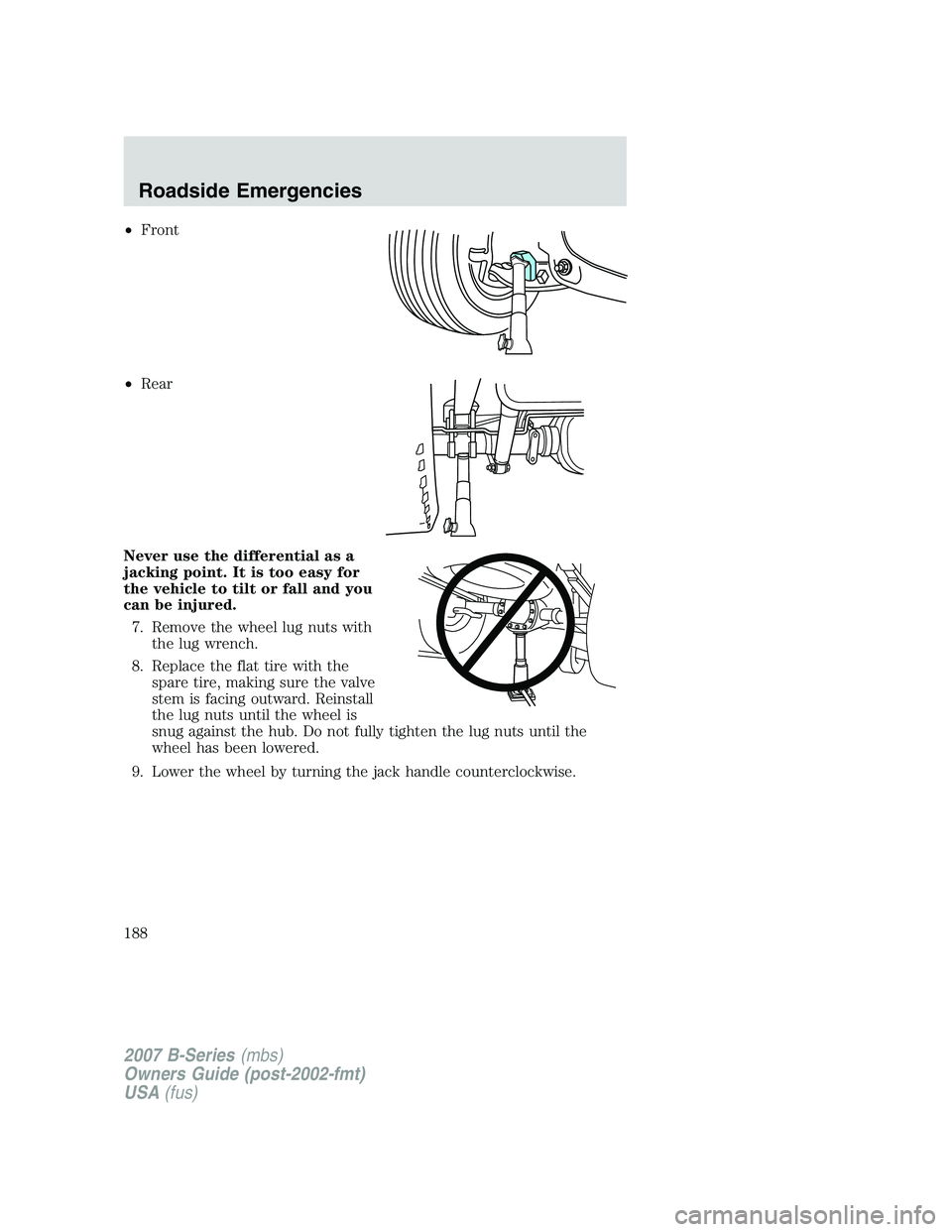
•Front
• Rear
Never use the differential as a
jacking point. It is too easy for
the vehicle to tilt or fall and you
can be injured. 7. Remove the wheel lug nuts with the lug wrench.
8. Replace the flat tire with the spare tire, making sure the valve
stem is facing outward. Reinstall
the lug nuts until the wheel is
snug against the hub. Do not fully tighten the lug nuts until the
wheel has been lowered.
9. Lower the wheel by turning the jack handle counterclockwise.
2007 B-Series (mbs)
Owners Guide (post-2002-fmt)
USA (fus)
Roadside Emergencies
188
Page 189 of 280
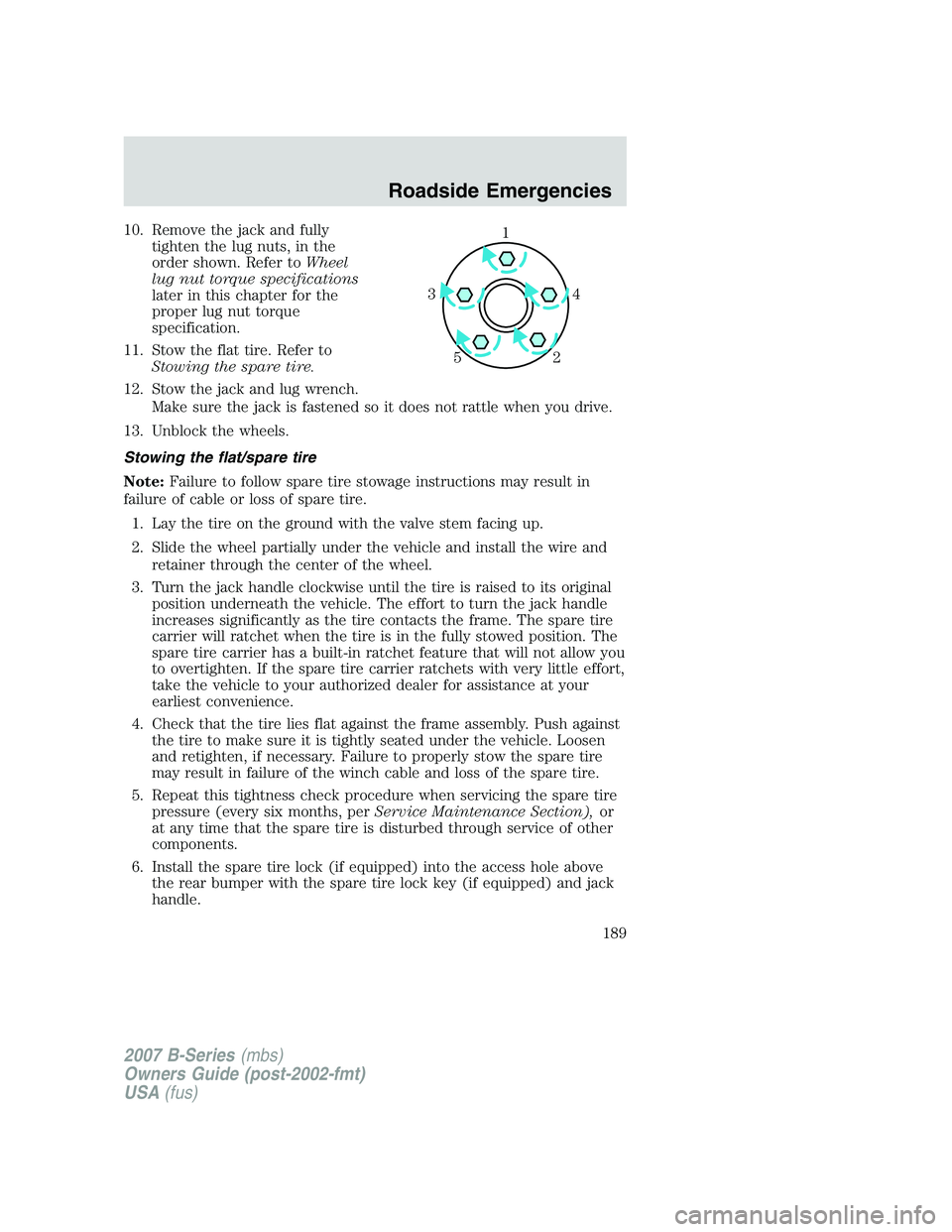
10. Remove the jack and fullytighten the lug nuts, in the
order shown. Refer to Wheel
lug nut torque specifications
later in this chapter for the
proper lug nut torque
specification.
11. Stow the flat tire. Refer to Stowing the spare tire.
12. Stow the jack and lug wrench. Make sure the jack is fastened so it does not rattle when you drive.
13. Unblock the wheels.
Stowing the flat/spare tire
Note: Failure to follow spare tire stowage instructions may result in
failure of cable or loss of spare tire.
1. Lay the tire on the ground with the valve stem facing up.
2. Slide the wheel partially under the vehicle and install the wire and retainer through the center of the wheel.
3. Turn the jack handle clockwise until the tire is raised to its original position underneath the vehicle. The effort to turn the jack handle
increases significantly as the tire contacts the frame. The spare tire
carrier will ratchet when the tire is in the fully stowed position. The
spare tire carrier has a built-in ratchet feature that will not allow you
to overtighten. If the spare tire carrier ratchets with very little effort,
take the vehicle to your authorized dealer for assistance at your
earliest convenience.
4. Check that the tire lies flat against the frame assembly. Push against the tire to make sure it is tightly seated under the vehicle. Loosen
and retighten, if necessary. Failure to properly stow the spare tire
may result in failure of the winch cable and loss of the spare tire.
5. Repeat this tightness check procedure when servicing the spare tire pressure (every six months, per Service Maintenance Section), or
at any time that the spare tire is disturbed through service of other
components.
6. Install the spare tire lock (if equipped) into the access hole above the rear bumper with the spare tire lock key (if equipped) and jack
handle.1
4
3
2
5
2007 B-Series (mbs)
Owners Guide (post-2002-fmt)
USA (fus)
Roadside Emergencies
189
Page 222 of 280
OWNER MAINTENANCE
Owner Maintenance Schedule
The owner or a qualified service technician should make these vehicle
inspections at the indicated intervals to ensure safe and dependable
operation.
Bring any problem to the attention of an Authorized Mazda Dealer or
qualified service technician as soon as possible.
While operating your vehicle
•Note any changes in the sound of the exhaust or any smell or exhaust
fumes in the vehicle.
• Check for vibrations in the steering wheel. Notice any increased
steering effort or looseness in the steering wheel, or change in the
straight ahead position.
• Notice if your vehicle constantly turns slightly or “pulls” to one side
when traveling on a smooth, level road.
• When stopping, listen and check for strange sounds, pulling to one
side, increased brake pedal travel or “hard to push” brake pedal.
• If any slipping or changes in the operation of your transmission occur,
check the transmission fluid level.
• Check automatic transmission Park function.
• Check parking brake.
At least monthly
• Check function of all interior and exterior lights.
• Check tires for wear and proper air pressure.
• Check engine oil level.
• Check coolant level in the coolant reservoir.
• Check washer fluid level.
At least twice a year (for example, every spring and fall)
• Check power steering fluid level.
• Check clutch fluid level (if equipped).
• Check and clean body and door drain holes.
• Check and lubricate all hinges, latches, and outside locks.
• Check and lubricate door rubber weather strips.
• Check parking brake for proper operation.
2007 B-Series (mbs)
Owners Guide (post-2002-fmt)
USA (fus)
Maintenance and Specifications
222