power steering MAZDA MODEL B3000 TRUCK 2007 Owners Manual
[x] Cancel search | Manufacturer: MAZDA, Model Year: 2007, Model line: MODEL B3000 TRUCK, Model: MAZDA MODEL B3000 TRUCK 2007Pages: 280, PDF Size: 1.95 MB
Page 1 of 280
Introduction4
Instrument Cluster 12
Warning lights and chimes 12
Gauges 17
Entertainment Systems19
AM/FM stereo 19
AM/FM Stereo single CD/MP3 system 21
AM/FM stereo with single CD 24
In-dash CD6/MP3 disc Premium Pioneer audio system 29
AM/FM stereo with CD6/MP3 32
Auxiliary input jack 37
Satellite radio information 38
Climate Controls42
Heater only 42
Manual heating and air conditioning 43
Lights45
Headlamps 45
Turn signal control 48
Bulb replacement 49
Driver Controls56
Windshield wiper/washer control 56
Steering wheel adjustment 57
Power windows 58
Mirrors 59
Speed control 59
Locks and Security65
Keys 65
Locks 65
Anti-theft system 69
Table of Contents
1
2007 B-Series(mbs)
Owners Guide (post-2002-fmt)
USA (fus)
Page 9 of 280
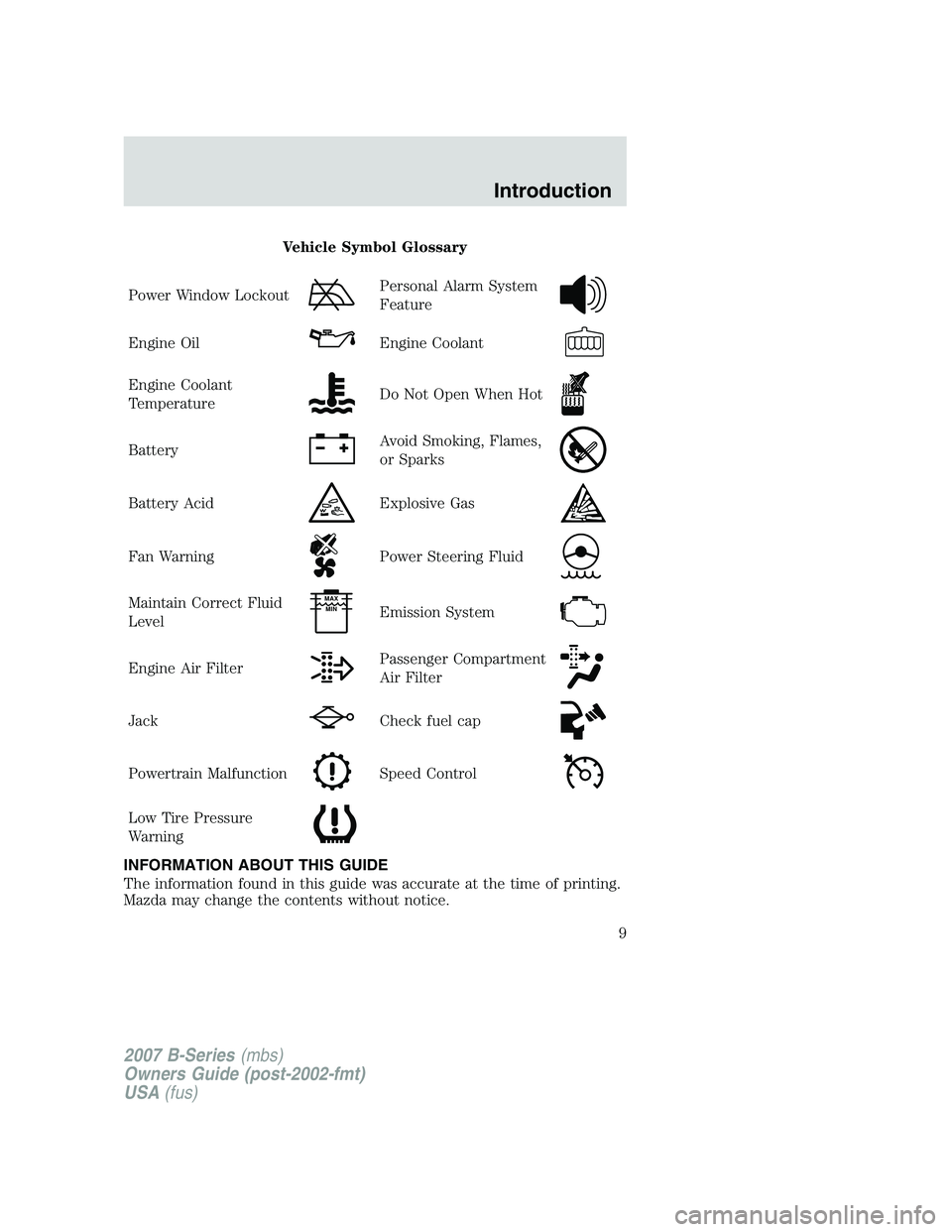
Vehicle Symbol Glossary
Power Window Lockout
Personal Alarm System
Feature
Engine OilEngine Coolant
Engine Coolant
TemperatureDo Not Open When Hot
BatteryAvoid Smoking, Flames,
or Sparks
Battery AcidExplosive Gas
Fan WarningPower Steering Fluid
Maintain Correct Fluid
LevelMAX MIN
Emission System
Engine Air FilterPassenger Compartment
Air Filter
JackCheck fuel cap
Powertrain MalfunctionSpeed Control
Low Tire Pressure
Warning
INFORMATION ABOUT THIS GUIDE
The information found in this guide was accurate at the time of printing.
Mazda may change the contents without notice.
2007 B-Series (mbs)
Owners Guide (post-2002-fmt)
USA (fus)
Introduction
9
Page 57 of 280
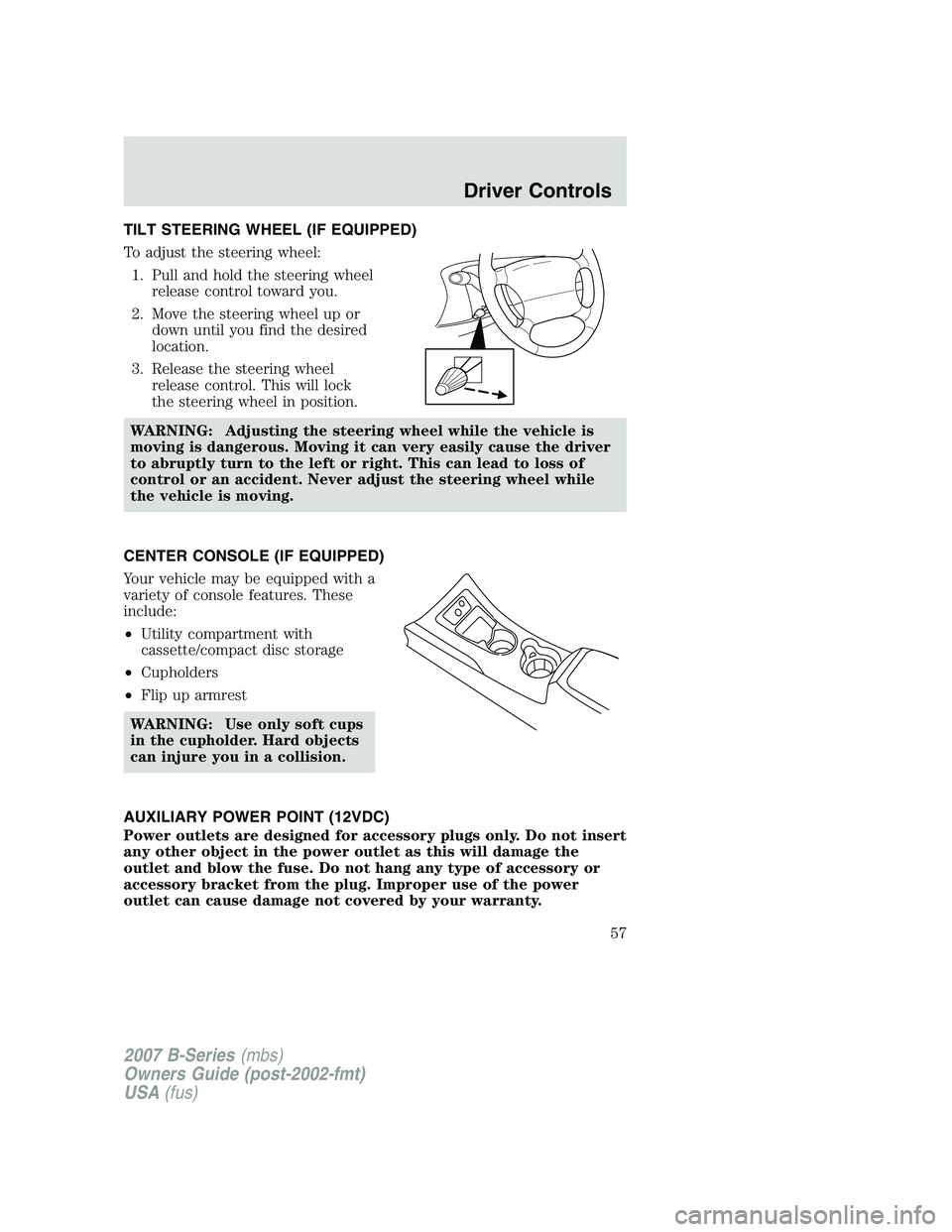
TILT STEERING WHEEL (IF EQUIPPED)
To adjust the steering wheel:1. Pull and hold the steering wheel release control toward you.
2. Move the steering wheel up or down until you find the desired
location.
3. Release the steering wheel release control. This will lock
the steering wheel in position.
WARNING: Adjusting the steering wheel while the vehicle is
moving is dangerous. Moving it can very easily cause the driver
to abruptly turn to the left or right. This can lead to loss of
control or an accident. Never adjust the steering wheel while
the vehicle is moving.
CENTER CONSOLE (IF EQUIPPED)
Your vehicle may be equipped with a
variety of console features. These
include:
• Utility compartment with
cassette/compact disc storage
• Cupholders
• Flip up armrest
WARNING: Use only soft cups
in the cupholder. Hard objects
can injure you in a collision.
AUXILIARY POWER POINT (12VDC)
Power outlets are designed for accessory plugs only. Do not insert
any other object in the power outlet as this will damage the
outlet and blow the fuse. Do not hang any type of accessory or
accessory bracket from the plug. Improper use of the power
outlet can cause damage not covered by your warranty.
2007 B-Series (mbs)
Owners Guide (post-2002-fmt)
USA (fus)
Driver Controls
57
Page 111 of 280
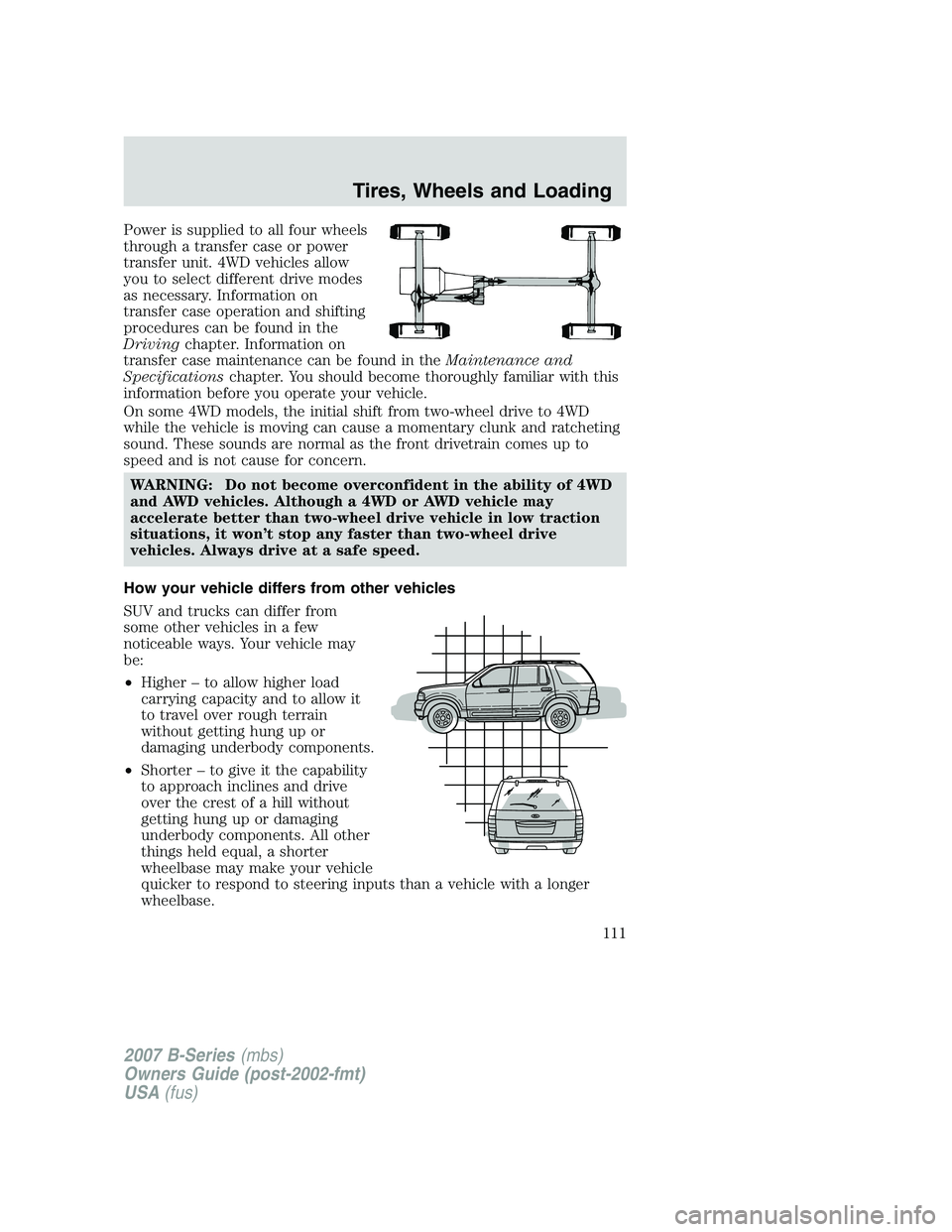
Power is supplied to all four wheels
through a transfer case or power
transfer unit. 4WD vehicles allow
you to select different drive modes
as necessary. Information on
transfer case operation and shifting
procedures can be found in the
Drivingchapter. Information on
transfer case maintenance can be found in the Maintenance and
Specifications chapter. You should become thoroughly familiar with this
information before you operate your vehicle.
On some 4WD models, the initial shift from two-wheel drive to 4WD
while the vehicle is moving can cause a momentary clunk and ratcheting
sound. These sounds are normal as the front drivetrain comes up to
speed and is not cause for concern.
WARNING: Do not become overconfident in the ability of 4WD
and AWD vehicles. Although a 4WD or AWD vehicle may
accelerate better than two-wheel drive vehicle in low traction
situations, it won’t stop any faster than two-wheel drive
vehicles. Always drive at a safe speed.
How your vehicle differs from other vehicles
SUV and trucks can differ from
some other vehicles in a few
noticeable ways. Your vehicle may
be:
• Higher – to allow higher load
carrying capacity and to allow it
to travel over rough terrain
without getting hung up or
damaging underbody components.
• Shorter – to give it the capability
to approach inclines and drive
over the crest of a hill without
getting hung up or damaging
underbody components. All other
things held equal, a shorter
wheelbase may make your vehicle
quicker to respond to steering inputs than a vehicle with a longer
wheelbase.
2007 B-Series (mbs)
Owners Guide (post-2002-fmt)
USA (fus)
Tires, Wheels and Loading
111
Page 118 of 280
WARNING: Age
Tires degrade over time, even when they are not being used. It
is recommended that tires generally be replaced after 6 years of
normal service. Heat caused by hot climates or frequent high
loading conditions can accelerate the aging process.
You should replace the spare tire when you replace the other
road tires due to the aging of the spare tire.
U.S. DOT Tire Identification Number (TIN)
Both U.S. and Canada Federal regulations require tire manufacturers to
place standardized information on the sidewall of all tires. This
information identifies and describes the fundamental characteristics of
the tire and also provides a U.S. DOT Tire Identification Number for
safety standard certification and in case of a recall.
This begins with the letters “DOT” and indicates that the tire meets all
federal standards. The next two numbers or letters are the plant code
designating where it was manufactured, the next two are the tire size
code and the last four numbers represent the week and year the tire was
built. For example, the numbers 317 mean the 31st week of 1997. After
2000 the numbers go to four digits. For example, 2501 means the 25th
week of 2001. The numbers in between are identification codes used for
traceability. This information is used to contact customers if a tire defect
requires a recall.
Tire Replacement Requirements
Your vehicle is equipped with tires designed to provide a safe ride and
handling capability. WARNING: Only use replacement tires and wheels that are the
same size and type (such as P-metric versus LT-metric or
all-season versus all-terrain) as those originally provided by
Mazda. Use of any tire or wheel not recommended by Mazda can
affect the safety and performance of your vehicle, which could
result in an increased risk of loss of vehicle control, vehicle
rollover, personal injury and death. Additionally the use of
non-recommended tires and wheels could cause steering,
suspension, axle or transfer case/power transfer unit failure. If
you have questions regarding tire replacement, see an
authorized dealer.
2007 B-Series (mbs)
Owners Guide (post-2002-fmt)
USA (fus)
Tires, Wheels and Loading
118
Page 149 of 280
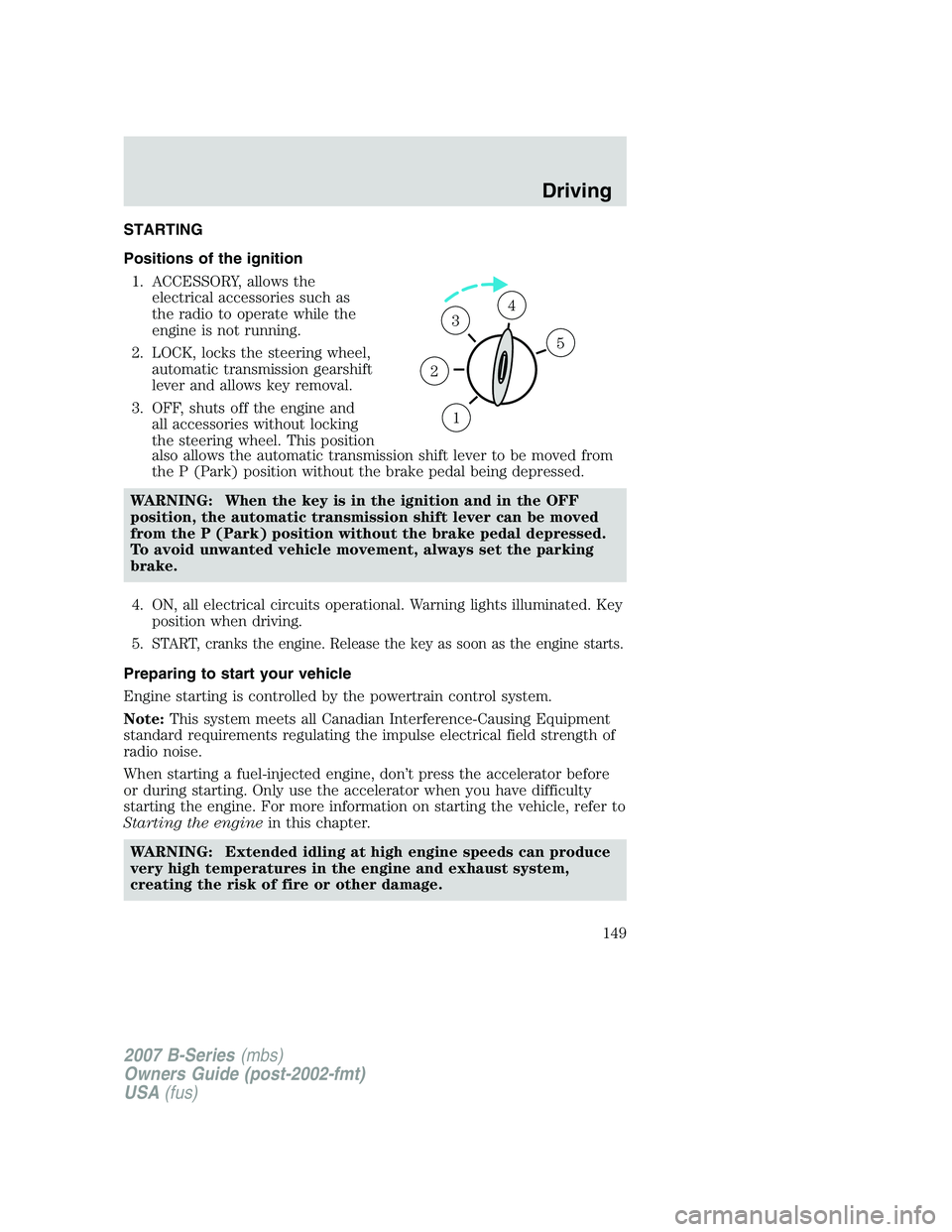
STARTING
Positions of the ignition1. ACCESSORY, allows the electrical accessories such as
the radio to operate while the
engine is not running.
2. LOCK, locks the steering wheel, automatic transmission gearshift
lever and allows key removal.
3. OFF, shuts off the engine and all accessories without locking
the steering wheel. This position
also allows the automatic transmission shift lever to be moved from
the P (Park) position without the brake pedal being depressed.
WARNING: When the key is in the ignition and in the OFF
position, the automatic transmission shift lever can be moved
from the P (Park) position without the brake pedal depressed.
To avoid unwanted vehicle movement, always set the parking
brake.
4. ON, all electrical circuits operational. Warning lights illuminated. Key position when driving.
5.
START, cranks the engine. Release the key as soon as the engine starts.
Preparing to start your vehicle
Engine starting is controlled by the powertrain control system.
Note: This system meets all Canadian Interference-Causing Equipment
standard requirements regulating the impulse electrical field strength of
radio noise.
When starting a fuel-injected engine, don’t press the accelerator before
or during starting. Only use the accelerator when you have difficulty
starting the engine. For more information on starting the vehicle, refer to
Starting the engine in this chapter.
WARNING: Extended idling at high engine speeds can produce
very high temperatures in the engine and exhaust system,
creating the risk of fire or other damage.
1
2
34
5
2007 B-Series (mbs)
Owners Guide (post-2002-fmt)
USA (fus)
Driving
149
Page 155 of 280
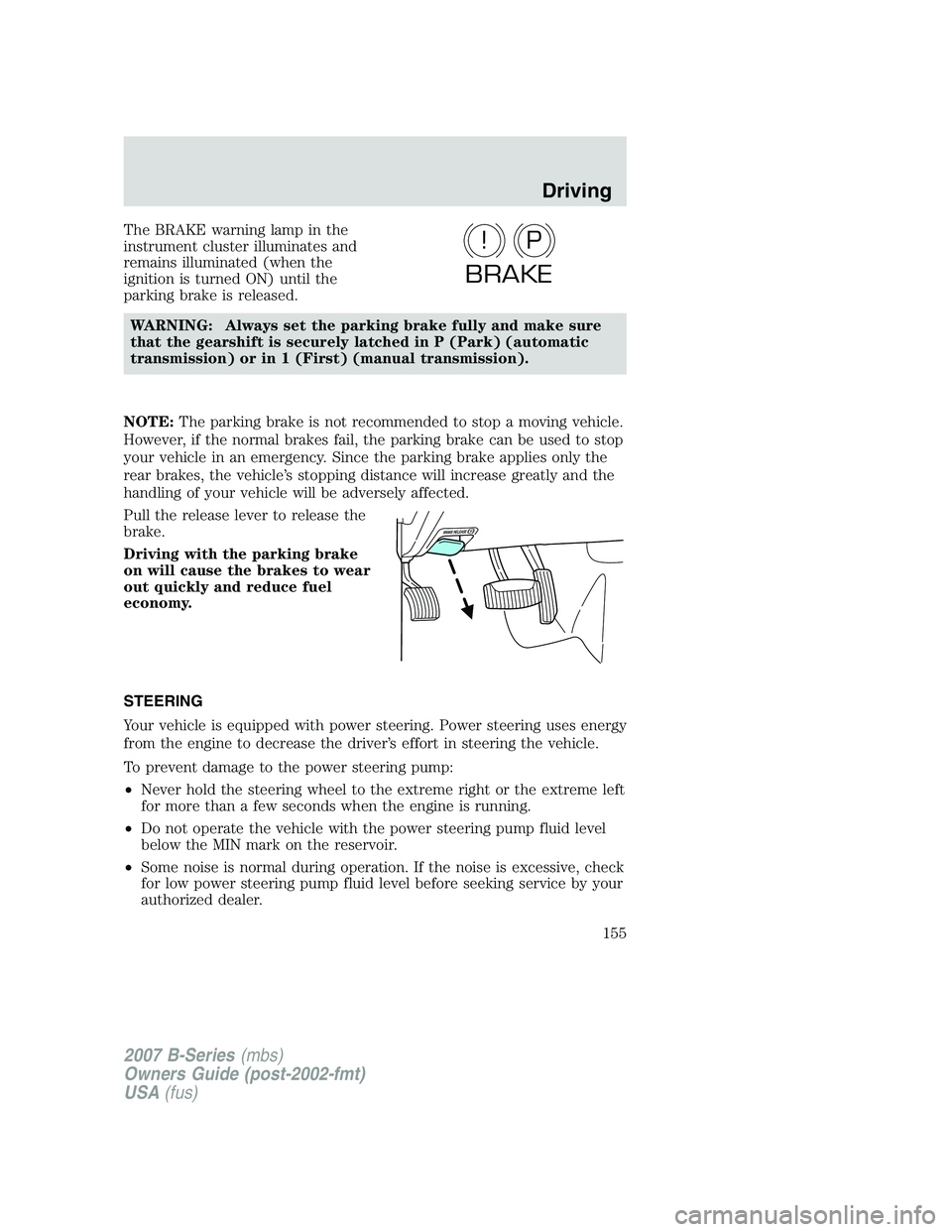
The BRAKE warning lamp in the
instrument cluster illuminates and
remains illuminated (when the
ignition is turned ON) until the
parking brake is released.WARNING: Always set the parking brake fully and make sure
that the gearshift is securely latched in P (Park) (automatic
transmission) or in 1 (First) (manual transmission).
NOTE: The parking brake is not recommended to stop a moving vehicle.
However, if the normal brakes fail, the parking brake can be used to stop
your vehicle in an emergency. Since the parking brake applies only the
rear brakes, the vehicle’s stopping distance will increase greatly and the
handling of your vehicle will be adversely affected.
Pull the release lever to release the
brake.
Driving with the parking brake
on will cause the brakes to wear
out quickly and reduce fuel
economy.
STEERING
Your vehicle is equipped with power steering. Power steering uses energy
from the engine to decrease the driver’s effort in steering the vehicle.
To prevent damage to the power steering pump:
• Never hold the steering wheel to the extreme right or the extreme left
for more than a few seconds when the engine is running.
• Do not operate the vehicle with the power steering pump fluid level
below the MIN mark on the reservoir.
• Some noise is normal during operation. If the noise is excessive, check
for low power steering pump fluid level before seeking service by your
authorized dealer.P!
BRAKE
2007 B-Series (mbs)
Owners Guide (post-2002-fmt)
USA (fus)
Driving
155
Page 156 of 280
•Heavy or uneven steering efforts may be caused by low power steering
pump fluid level. Check for low power steering pump fluid level before
seeking service by your authorized dealer.
• Do not fill the power steering pump reservoir above the MAX mark on
the reservoir, as this may result in leaks from the reservoir.
If the power steering system breaks down (or if the engine is turned
off), you can steer the vehicle manually, but it takes more effort.
If the steering wanders or pulls, check for:
• Underinflated tire(s) on any wheel(s)
• Uneven vehicle loading
• High crown in center of road
• High crosswinds
• Wheels out of alignment
• Loose or worn suspension components
TRACTION-LOK AXLE (IF EQUIPPED)
This axle provides added traction on slippery surfaces, particularly when
one wheel is on a poor traction surface. Under normal conditions, the
Traction-Lok axle functions like a standard rear axle. The axle may
exhibit a slight noise or vibration in tight turns with low vehicle speed.
This is normal behavior and indicates the axle is working.
PREPARING TO DRIVE WARNING: Utility vehicles have a significantly higher rollover
rate than other types of vehicles.
WARNING: In a rollover crash, an unbelted person is
significantly more likely to die than a person wearing a seat
belt.
Your vehicle has larger tires and increased ground clearance, giving the
vehicle a higher center of gravity than a passenger car.
2007 B-Series (mbs)
Owners Guide (post-2002-fmt)
USA (fus)
Driving
156
Page 181 of 280
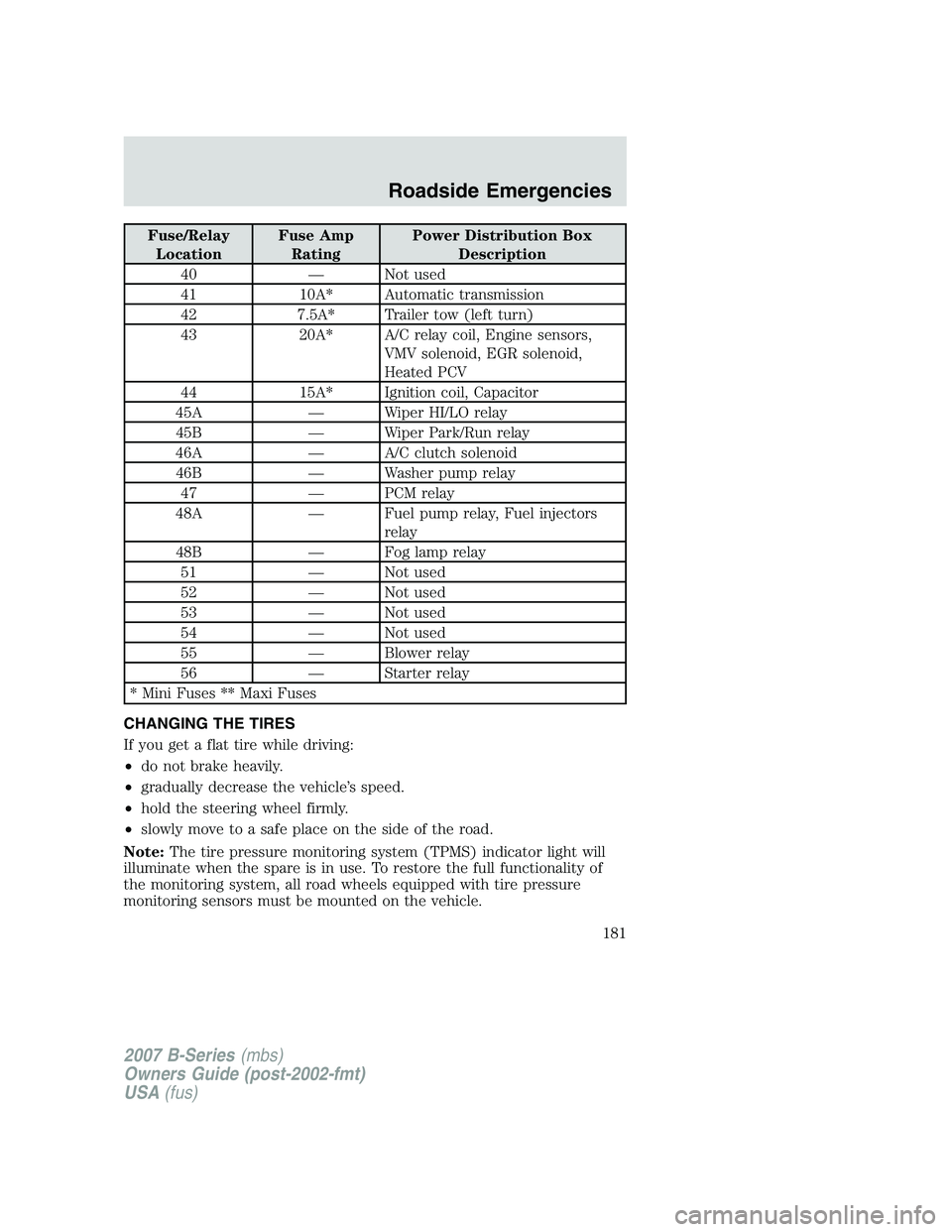
Fuse/RelayLocation Fuse Amp
Rating Power Distribution Box
Description
40 — Not used
41 10A* Automatic transmission
42 7.5A* Trailer tow (left turn)
43 20A* A/C relay coil, Engine sensors,
VMV solenoid, EGR solenoid,
Heated PCV
44 15A* Ignition coil, Capacitor
45A — Wiper HI/LO relay
45B — Wiper Park/Run relay
46A — A/C clutch solenoid
46B — Washer pump relay
47 — PCM relay
48A — Fuel pump relay, Fuel injectors
relay
48B — Fog lamp relay
51 — Not used
52 — Not used
53 — Not used
54 — Not used
55 — Blower relay
56 — Starter relay
* Mini Fuses ** Maxi Fuses
CHANGING THE TIRES
If you get a flat tire while driving:
• do not brake heavily.
• gradually decrease the vehicle’s speed.
• hold the steering wheel firmly.
• slowly move to a safe place on the side of the road.
Note: The tire pressure monitoring system (TPMS) indicator light will
illuminate when the spare is in use. To restore the full functionality of
the monitoring system, all road wheels equipped with tire pressure
monitoring sensors must be mounted on the vehicle.
2007 B-Series (mbs)
Owners Guide (post-2002-fmt)
USA (fus)
Roadside Emergencies
181
Page 222 of 280
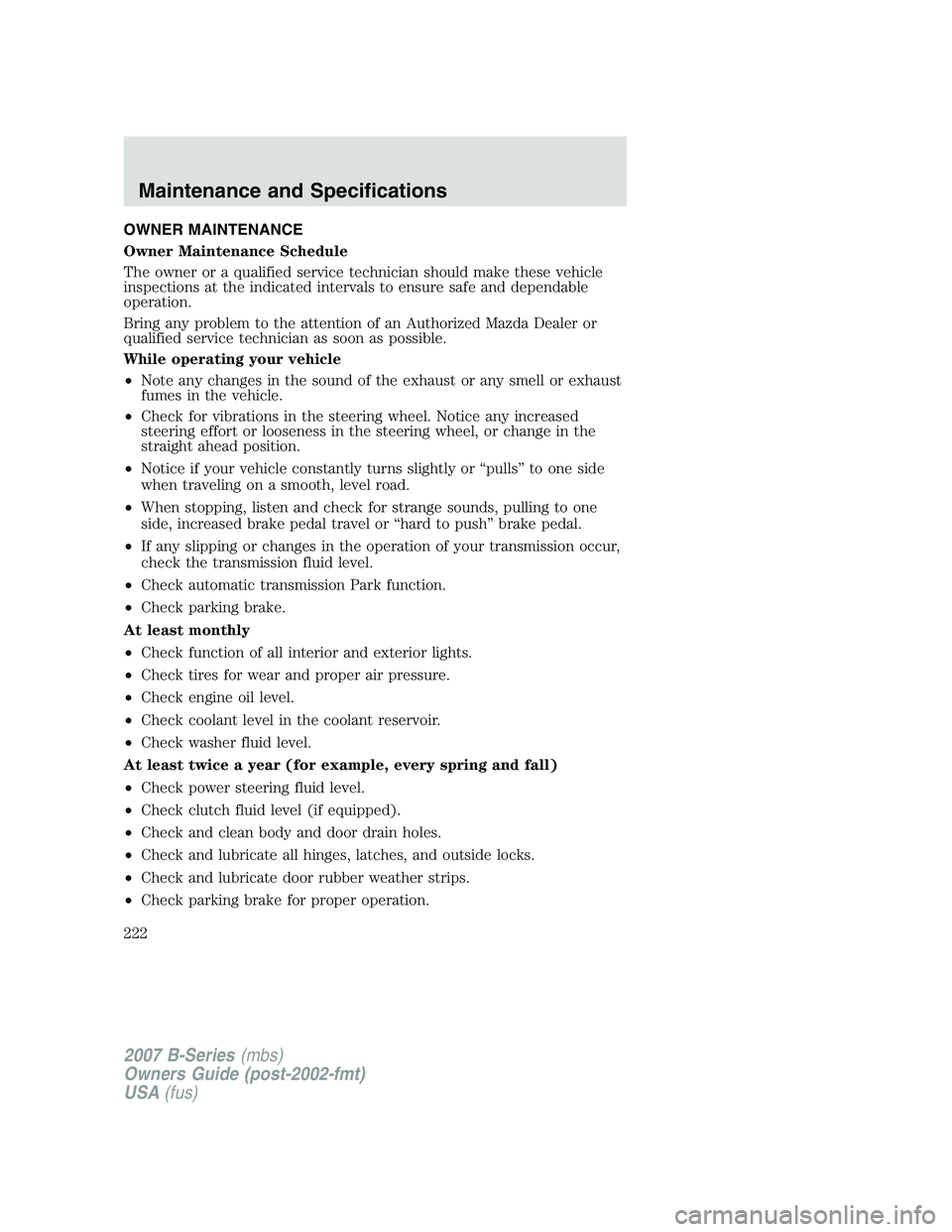
OWNER MAINTENANCE
Owner Maintenance Schedule
The owner or a qualified service technician should make these vehicle
inspections at the indicated intervals to ensure safe and dependable
operation.
Bring any problem to the attention of an Authorized Mazda Dealer or
qualified service technician as soon as possible.
While operating your vehicle
•Note any changes in the sound of the exhaust or any smell or exhaust
fumes in the vehicle.
• Check for vibrations in the steering wheel. Notice any increased
steering effort or looseness in the steering wheel, or change in the
straight ahead position.
• Notice if your vehicle constantly turns slightly or “pulls” to one side
when traveling on a smooth, level road.
• When stopping, listen and check for strange sounds, pulling to one
side, increased brake pedal travel or “hard to push” brake pedal.
• If any slipping or changes in the operation of your transmission occur,
check the transmission fluid level.
• Check automatic transmission Park function.
• Check parking brake.
At least monthly
• Check function of all interior and exterior lights.
• Check tires for wear and proper air pressure.
• Check engine oil level.
• Check coolant level in the coolant reservoir.
• Check washer fluid level.
At least twice a year (for example, every spring and fall)
• Check power steering fluid level.
• Check clutch fluid level (if equipped).
• Check and clean body and door drain holes.
• Check and lubricate all hinges, latches, and outside locks.
• Check and lubricate door rubber weather strips.
• Check parking brake for proper operation.
2007 B-Series (mbs)
Owners Guide (post-2002-fmt)
USA (fus)
Maintenance and Specifications
222