maintenance MAZDA MODEL B4000 2003 User Guide
[x] Cancel search | Manufacturer: MAZDA, Model Year: 2003, Model line: MODEL B4000, Model: MAZDA MODEL B4000 2003Pages: 250, PDF Size: 2.85 MB
Page 158 of 250

10. Remove the jack and fullytighten the lug nuts, in the
order shown, to 135 Nm (100
lb-ft). Note that these tightening
specifications are for nut and
bolt threads that are free of dirt
and rust. Use only Mazda
recommended (1/2–20)
replacement fasteners.
11. Stow the flat tire. Refer to Stowing the spare tire.
12. Stow the jack and lug wrench. Make sure the jack is fastened so it does not rattle when you drive.
13. Unblock the wheels.
Stowing the flat/spare tire 1. Lay the tire on the ground with the valve stem facing up.
2. Slide the wheel partially under the vehicle and install the wire and retainer through the center of the wheel.
3. Turn the jack handle clockwise until the tire is raised to its original position underneath the vehicle. The effort to turn the jack handle
increases significantly as the tire contacts the frame. The spare tire
carrier will ratchet when the tire is in the fully stowed position. The
spare tire carrier has a built-in ratchet feature that will not allow you
to overtighten. If the spare tire carrier ratchets with very little effort,
take the vehicle to your dealer for assistance at your earliest
convenience.
4. Check that the tire lies flat against the frame assembly. Push against the tire to make sure it is tightly sealed under the vehicle. Loosen
and retighten, if necessary. Failure to properly stow the spare tire
may result in failure of the winch cable and loss of the spare tire.
5. Repeat this tightness check procedure when servicing the spare tire pressure (every six months, per service maintenance section), or at
any time that the spare tire is disturbed through service of other
components.
6. Install the spare tire lock (if equipped) into the access hole above the rear bumper with the spare tire lock key (if equipped) and jack
handle.1
4
3
2
5
2003 Mazda B Series (mbs)
New Owners Guide own2002 (own2002)
USA English (fus)
Roadside Emergencies
158
Page 173 of 250

(Note)
If you live in the U.S.A., all correspondence to:
Mazda North American Operations
7755, Irvine Center Drive
Irvine, California 92618–2922
P.O. Box 19734
Irvine, CA 92623–9734
Customer Assistance Center
or toll free at 1 (800) 222–5500
If you live outside of the U.S.A., please contact the nearest Mazda
Distributor. (See theMazda Importers/Distributors section of this
manual).
SERVICE PUBLICATIONS
Factory-authorized Mazda service publication are available for owners
who wish to do some of their own maintenance and repair.
When requesting any of our publications through an Authorized Mazda
Dealer, refer to the chart below.
If they don’t have what you need in stock, they can order it for you.
PUBLICATION ORDER NUMBER PUBLICATION DESCRIPTION
9999 95 022B 03 2003 WORKSHOP MANUAL
9999 95 020G 03 2003 WIRING DIAGRAM 9999 95 023C 03 2003 OWNER’S MANUAL
WORKSHOP MANUAL:
Covers recommended maintenance and repair procedures of the drive
train, body and chassis.
WIRING DIAGRAM:
Provides electrical schematics as well as component location for the
entire electrical system.
OWNER’S MANUAL:
This booklet contains information regarding the proper care and
operation of your vehicle. This is not a technician’s manual.
Please note that your Authorized Mazda Dealership has trained
personnel and special service tools to correctly and safely
maintain Mazda vehicles.
Customer Assistance
173
Page 182 of 250
INTRODUCTION
Be extremely careful to prevent injury to yourself and others and
damage to your vehicle when using this manual for inspection and
maintenance.
If you’re unsure about any procedure it describes, we strongly urge you
to have a reliable and qualified service shop perform the work, preferably
an Authorized Mazda Dealer.
Factory-trained Mazda technicians and genuine Mazda parts are best for
your vehicle. Without this expertise and the parts that have been
designed and made especially for your Mazda, inadequate, incomplete,
and insufficient servicing may result in problems. This could lead to
vehicle damage or an accident and injuries.
For expert advice and quality service, consult an Authorized Mazda
Dealer.
The owner should retain evidence that proper maintenance has been
performed as prescribed.
Claims against the warranty resulting from lack of maintenance, as
opposed to defective materials or authorized Mazda workmanship, will
not be honored.
Any auto repair shop using parts equivalent to your Mazda’s original
equipment may perform maintenance.But we recommend that it
always be done by an Authorized Mazda Dealer using genuine
Mazda parts.
SCHEDULED MAINTENANCE
Schedule I — Normal Driving Conditions/Emission Control
Systems
Follow Schedule I if the vehicle is operated mainly where none of the
following conditions apply. If any do apply follow Schedule II.
• Repeated short-distance driving.
• Driving in dusty conditions.
• Towing a trailer.
• Operating in hot weather in stop-and-go “rush hour” traffic.
• Extended periods of idling or low-speed operation.
• High-speed operation with a fully loaded vehicle.
• Off-road operation.
NOTE: After the described period, continue to follow the described
maintenance at the recommended intervals.
Maintenance and Specifications
182
Page 183 of 250
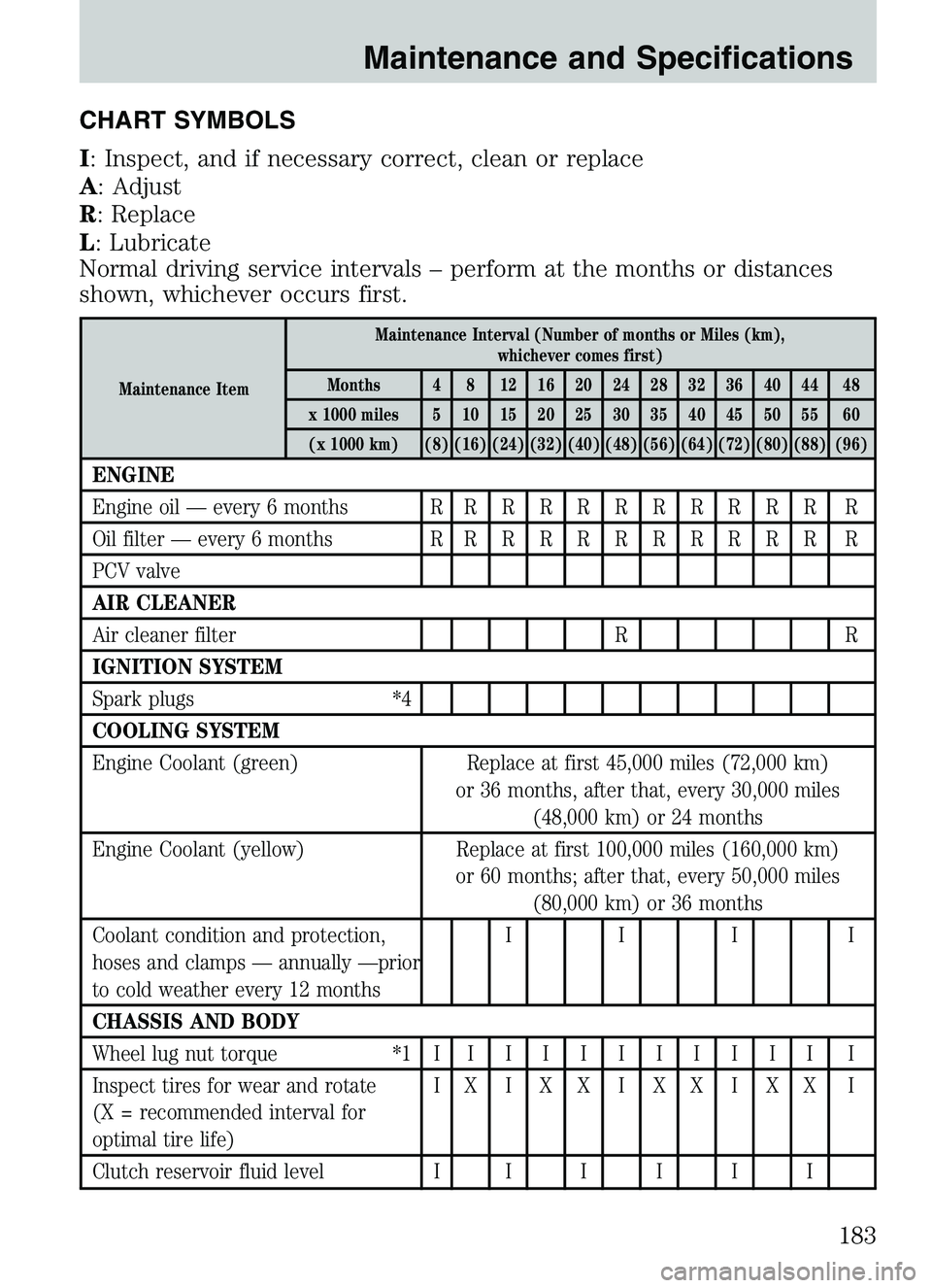
CHART SYMBOLS
I: Inspect, and if necessary correct, clean or replace
A: Adjust
R: Replace
L: Lubricate
Normal driving service intervals – perform at the months or distances
shown, whichever occurs first.
Maintenance ItemMaintenance Interval (Number of months or Miles (km),
whichever comes first)
Months 4 8 12 16 20 24 28 32 36 40 44 48
x 1000 miles 5 10 15 20 25 30 35 40 45 50 55 60 (x 1000 km) (8) (16) (24) (32) (40) (48) (56) (64) (72) (80) (88) (96)
ENGINE
Engine oil — every 6 months R RRRRRRRRRR R
Oil filter — every 6 months R RRRRRRRRRR R
PCV valve
AIR CLEANER
Air cleaner filter R R
IGNITION SYSTEM
Spark plugs *4
COOLING SYSTEM
Engine Coolant (green) Replace at first 45,000 miles (72,000 km) or 36 months, after that, every 30,000 miles(48,000 km) or 24 months
Engine Coolant (yellow) Replace at first 100,000 miles (160,000 km) or 60 months; after that, every 50,000 miles(80,000 km) or 36 months
Coolant condition and protection,
hoses and clamps — annually —prior
to cold weather every 12 months III I
CHASSIS AND BODY
Wheel lug nut torque *1 I IIIIIIIIII I
Inspect tires for wear and rotate
(X = recommended interval for
optimal tire life) IXIXXIXXIXX I
Clutch reservoir fluid level I IIIII
Maintenance and Specifications
183
Page 184 of 250
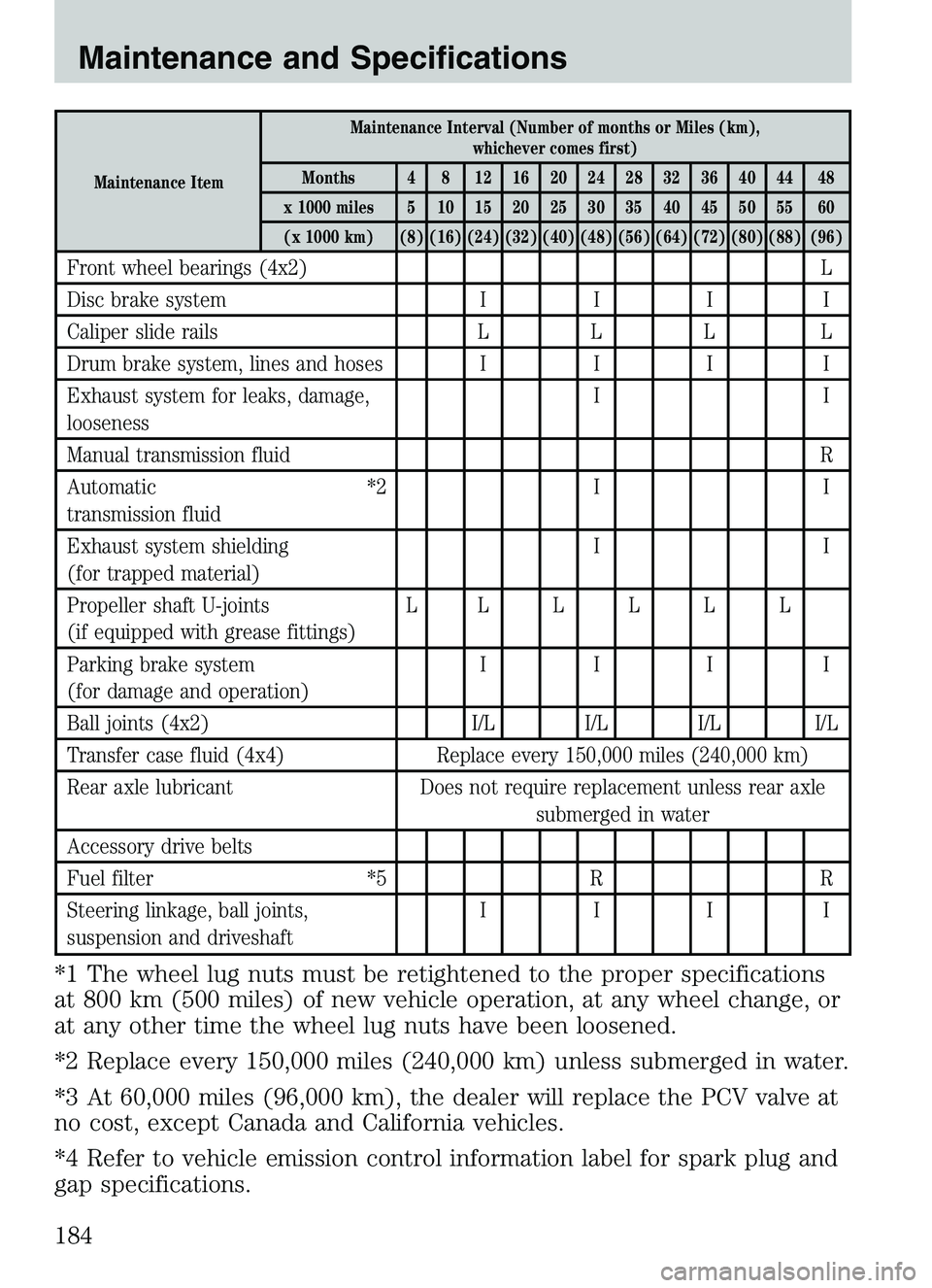
Maintenance ItemMaintenance Interval (Number of months or Miles (km),
whichever comes first)
Months 4 8 12 16 20 24 28 32 36 40 44 48
x 1000 miles 5 10 15 20 25 30 35 40 45 50 55 60 (x 1000 km) (8) (16) (24) (32) (40) (48) (56) (64) (72) (80) (88) (96)
Front wheel bearings (4x2) L
Disc brake system III I
Caliper slide rails LLL L
Drum brake system, lines and hoses I II I
Exhaust system for leaks, damage,
looseness II
Manual transmission fluid R
Automatic
transmission fluid *2
I I
Exhaust system shielding
(for trapped material) II
Propeller shaft U-joints
(if equipped with grease fittings) LLLLLL
Parking brake system
(for damage and operation) III I
Ball joints (4x2) I/L I/L I/L I/L
Transfer case fluid (4x4) Replace every 150,000 miles (240,000 km)
Rear axle lubricant Does not require replacement unless rear axle
submerged in water
Accessory drive belts
Fuel filter *5R R
Steering linkage, ball joints,
suspension and driveshaft III I
*1 The wheel lug nuts must be retightened to the proper specifications
at 800 km (500 miles) of new vehicle operation, at any wheel change, or
at any other time the wheel lug nuts have been loosened.
*2 Replace every 150,000 miles (240,000 km) unless submerged in water.
*3 At 60,000 miles (96,000 km), the dealer will replace the PCV valve at
no cost, except Canada and California vehicles.
*4 Refer to vehicle emission control information label for spark plug and
gap specifications.
Maintenance and Specifications
184
Page 185 of 250
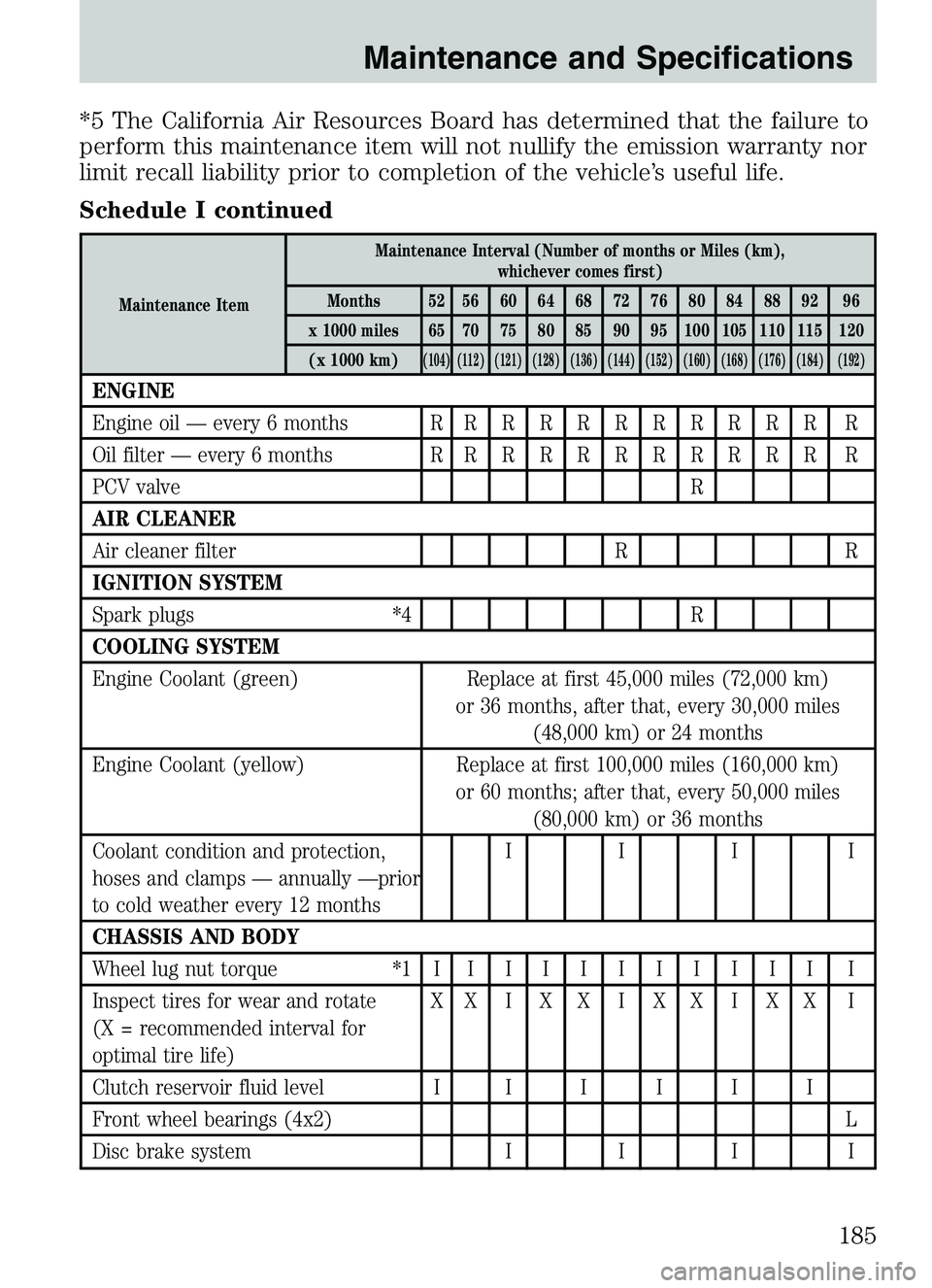
*5 The California Air Resources Board has determined that the failure to
perform this maintenance item will not nullify the emission warranty nor
limit recall liability prior to completion of the vehicle’s useful life.
Schedule I continued
Maintenance ItemMaintenance Interval (Number of months or Miles (km),
whichever comes first)
Months 52 56 60 64 68 72 76 80 84 88 92 96
x 1000 miles 65 70 75 80 85 90 95 100 105 110 115 120 (x 1000 km)
(104) (112) (121) (128) (136) (144) (152) (160) (168) (176) (184) (192)
ENGINE
Engine oil — every 6 months R RRRRRRRRRR R
Oil filter — every 6 months R RRRRRRRRRR R
PCV valve R
AIR CLEANER
Air cleaner filter R R
IGNITION SYSTEM
Spark plugs *4 R
COOLING SYSTEM
Engine Coolant (green) Replace at first 45,000 miles (72,000 km) or 36 months, after that, every 30,000 miles(48,000 km) or 24 months
Engine Coolant (yellow) Replace at first 100,000 miles (160,000 km) or 60 months; after that, every 50,000 miles(80,000 km) or 36 months
Coolant condition and protection,
hoses and clamps — annually —prior
to cold weather every 12 months III I
CHASSIS AND BODY
Wheel lug nut torque *1 I IIIIIIIIII I
Inspect tires for wear and rotate
(X = recommended interval for
optimal tire life) XXIXXIXXIXX I
Clutch reservoir fluid level I IIIII
Front wheel bearings (4x2) L
Disc brake system I I I I
Maintenance and Specifications
185
Page 186 of 250
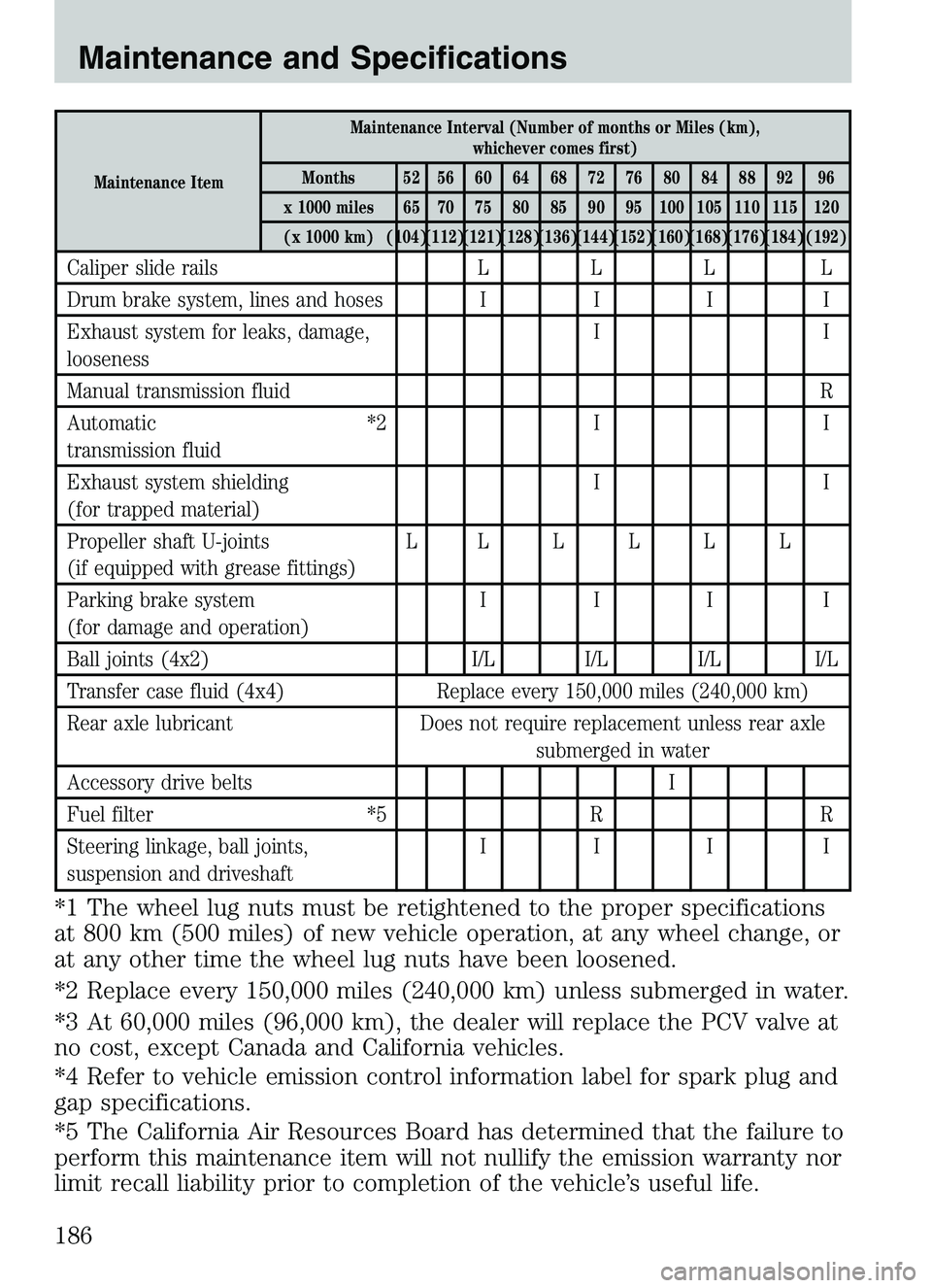
Maintenance ItemMaintenance Interval (Number of months or Miles (km),
whichever comes first)
Months 52 56 60 64 68 72 76 80 84 88 92 96
x 1000 miles 65 70 75 80 85 90 95 100 105 110 115 120 (x 1000 km) (104)(112)(121)(128)(136)(144)(152)(160)(168)(176)(184) (192)
Caliper slide rails LLL L
Drum brake system, lines and hoses I II I
Exhaust system for leaks, damage,
looseness II
Manual transmission fluid R
Automatic
transmission fluid *2
I I
Exhaust system shielding
(for trapped material) II
Propeller shaft U-joints
(if equipped with grease fittings) LLLLLL
Parking brake system
(for damage and operation) III I
Ball joints (4x2) I/L I/L I/L I/L
Transfer case fluid (4x4) Replace every 150,000 miles (240,000 km)
Rear axle lubricant Does not require replacement unless rear axle
submerged in water
Accessory drive belts I
Fuel filter *5R R
Steering linkage, ball joints,
suspension and driveshaft III I
*1 The wheel lug nuts must be retightened to the proper specifications
at 800 km (500 miles) of new vehicle operation, at any wheel change, or
at any other time the wheel lug nuts have been loosened.
*2 Replace every 150,000 miles (240,000 km) unless submerged in water.
*3 At 60,000 miles (96,000 km), the dealer will replace the PCV valve at
no cost, except Canada and California vehicles.
*4 Refer to vehicle emission control information label for spark plug and
gap specifications.
*5 The California Air Resources Board has determined that the failure to
perform this maintenance item will not nullify the emission warranty nor
limit recall liability prior to completion of the vehicle’s useful life.
Maintenance and Specifications
186
Page 187 of 250
SCHEDULE II — SPECIAL OPERATING CONDITIONS
If your driving habitsFREQUENTLYinclude one or more of the
following conditions:
• Short trips of less than 10 miles (16 km) when outside temperatures
remain below freezing.
• Towing a trailer, or carrying maximum loads.
• Operating in severe dust conditions.
• Operating during hot weatherin stop-and-go “rush hour” traffic.
• Extensive idling, such as police, taxi or door-to-door delivery service.
• High speed operation with a fully loaded vehicle (max. GVW).
• Off-road operation
Change ENGINE OIL AND OIL FILTER every 3 months or 3,000 miles
(4,800 km) whichever occurs first.
NOTE: Idling the engine for extended periods will accumulate more
hours of use on your vehicle than is actually indicated by the mileage
odometer. Consequently, the odometer reading can be often misleading
when determining the right time to change your engine oil and filter. If
you are using your vehicle in a manner which allows it to remain
stationary while the engine is running for long periods (door-to-door
delivery, taxi, police, power/utility company trucks, or similar duty), then
Mazda recommends you increase the frequency of oil and filter changes
to an interval equivalent to 200 ENGINE HOURS or use. Since most
vehicles are not equipped with hour-meters, it may be necessary for you
to approximate your idle time and plan oil/filter changes accordingly.
Maintenance and Specifications
187
Page 188 of 250
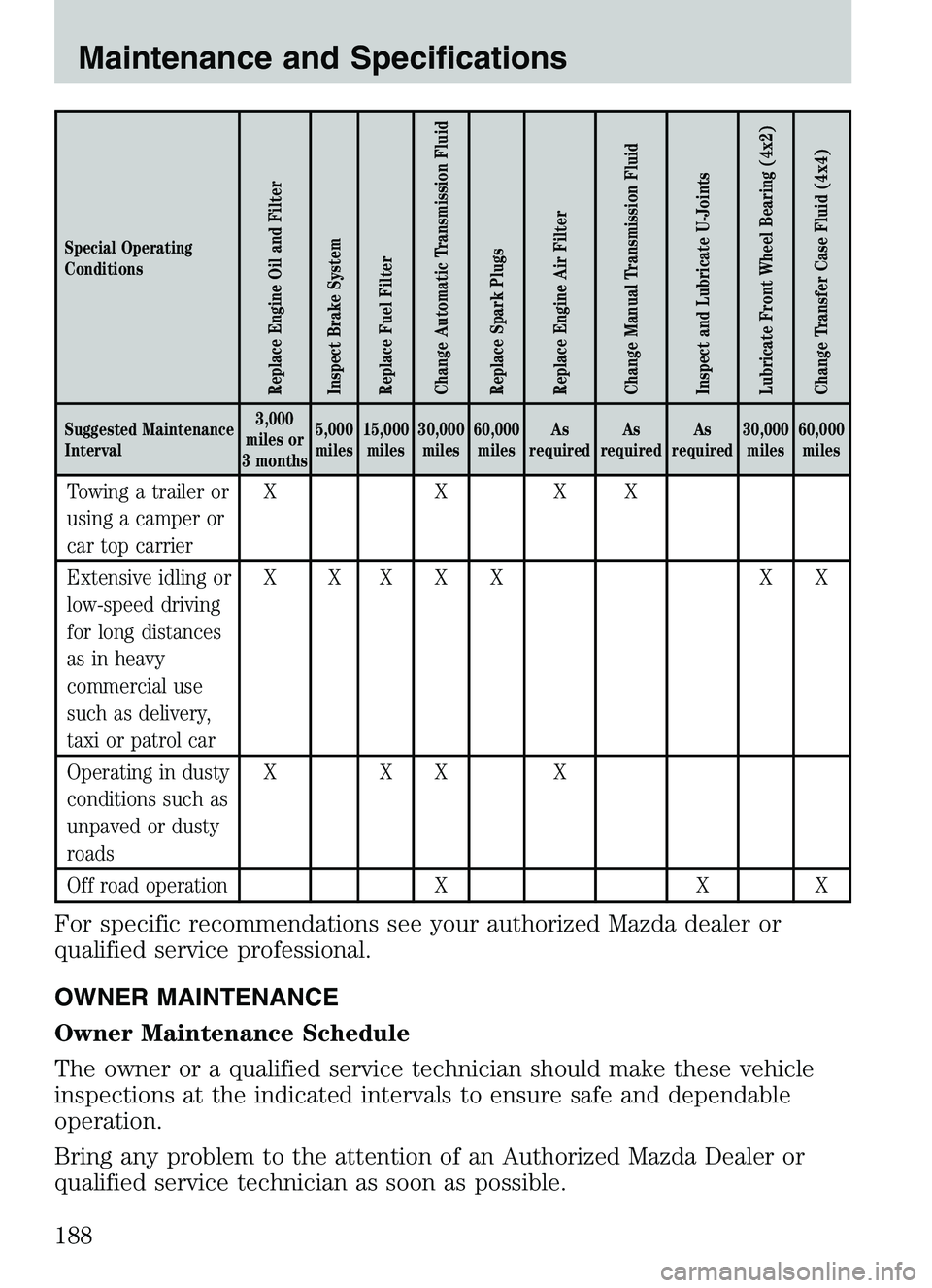
Special Operating
Conditions
Replace Engine Oil and Filter
Inspect Brake System
Replace Fuel Filter
Change Automatic Transmission Fluid
Replace Spark Plugs
Replace Engine Air Filter
Change Manual Transmission Fluid
Inspect and Lubricate U-Joints
Lubricate Front Wheel Bearing (4x2)
Change Transfer Case Fluid (4x4)
Suggested Maintenance
Interval3,000
miles or
3 months 5,000
miles 15,000
miles 30,000
miles 60,000
miles As
required As
required As
required 30,000
miles 60,000
miles
Towing a trailer or
using a camper or
car top carrier XXXX
Extensive idling or
low-speed driving
for long distances
as in heavy
commercial use
such as delivery,
taxi or patrol car X XXXX XX
Operating in dusty
conditions such as
unpaved or dusty
roads XXX X
Off road operation X X X
For specific recommendations see your authorized Mazda dealer or
qualified service professional.
OWNER MAINTENANCE
Owner Maintenance Schedule
The owner or a qualified service technician should make these vehicle
inspections at the indicated intervals to ensure safe and dependable
operation.
Bring any problem to the attention of an Authorized Mazda Dealer or
qualified service technician as soon as possible.
Maintenance and Specifications
188
Page 189 of 250
While operating your vehicle
•Note any changes in the sound of the exhaust or any smell or exhaust
fumes in the vehicle.
• Check for vibrations in the steering wheel. Notice any increased
steering effort or looseness in the steering wheel, or change in the
straight ahead position.
• Notice if your vehicle constantly turns slightly or “pulls” to one side
when traveling on a smooth, level road.
• When stopping, listen and check for strange sounds, pulling to one
side, increased brake pedal travel or “hard to push” brake pedal.
• If any slipping or changes in the operation of your transmission occur,
check the transmission fluid level.
• Check automatic transmission Park function.
• Check parking brake.
At least monthly
• Check function of all interior and exterior lights.
• Check tires for wear and proper air pressure.
• Check engine oil level.
• Check coolant level in the coolant reservoir.
• Check washer fluid level.
At least twice a year (for example, every spring and fall)
• Check power steering fluid level.
• Check clutch fluid level (if equipped).
• Check and clean body and door drain holes.
• Check and lubricate all hinges, latches, and outside locks.
• Check and lubricate door rubber weather strips.
• Check parking brake for proper operation.
• Check lap/shoulder belts and seat latches for wear and function.
• Check air pressure in spare tire.
• Check windshield washer spray and wiper operation. Clean wiper
blades with clean cloth dampened with washer fluid.
• Check safety warning lamps (brake, ABS, air bag, safety belt) for
operation.
Maintenance and Specifications
189