parking brake MAZDA MODEL B4000 2003 User Guide
[x] Cancel search | Manufacturer: MAZDA, Model Year: 2003, Model line: MODEL B4000, Model: MAZDA MODEL B4000 2003Pages: 250, PDF Size: 2.85 MB
Page 120 of 250

WARNING: If the parking brake is fully released, but the brake
warning lamp remains illuminated, the brakes may not be
working properly. See your authorized Mazda dealership.
Driving with a 5–speed automatic transmission (if equipped)
Your transmission is equipped with an adaptive learning strategy found in
the vehicle computer. This feature is designed to increase durability, and
provide consistent shift feel over the life of the vehicle. A new vehicle or
transmission may have firm and/or soft shifts. This operation is
considered normal and will not affect function or durability of the
transmission. Over time, the adaptive learning process will fully update
transmission operation. Additionally, whenever the battery is
disconnected or a new battery is installed, the strategy must relearn. WARNING: Hold the brake pedal down while you move the
gearshift lever from P (Park) to another position. If you do not
hold the brake pedal down, your vehicle may move unexpectedly
and injure someone.
P (Park)
This position locks the transmission and prevents the rear wheels from
turning.
To put your vehicle in gear:
• Start the engine
• Depress the brake pedal
• Move the gearshift lever into the desired gear
To put your vehicle in P (Park):
• Come to a complete stop
• Move the gearshift lever and securely latch it in P (Park)
Driving
120
Page 121 of 250

WARNING: Always set the parking brake fully and make sure
the gearshift is latched in P (Park). Turn the ignition to the
LOCK position and remove the key whenever you leave your
vehicle.
R (Reverse)
With the gearshift lever in R (Reverse), the vehicle will move backward.
Always come to a complete stop before shifting into and out of R
(Reverse).
N (Neutral)
With the gearshift lever in N (Neutral), the vehicle can be started and is
free to roll. Hold the brake pedal down while in this position.
(Overdrive)
The normal driving position for the
best fuel economy. Transmission
operates in gears one through
five.
(Overdrive) can be
deactivated by pressing the
transmission control switch on the end of the gearshift lever. This will
illuminate the O/D OFF lamp and activate Drive.
Drive (not shown)
Drive is activated when the transmission control switch is pressed.
• This position allows for all forward gears except overdrive.
• O/D OFF lamp is illuminated.
• Provides engine braking.
• Use when driving conditions cause excessive shifting from O/D to
other gears. Examples: city traffic, hilly terrain, heavy loads, trailer
towing and when engine braking is required.
• To return to O/D (overdrive mode), press the transmission control
switch. The O/D OFF lamp will not be illuminated.
• O/D (Overdrive) is automatically returned each time the key is turned
off.
2 (Second)
Use 2 (Second) to start-up on slippery roads or to provide additional
engine braking on downgrades.
O/D
ON/OFF
Driving
121
Page 122 of 250

1 (First)
•Provides maximum engine braking.
• Allows upshifts by moving gearshift lever.
• Will not downshift into 1 (First) at high speeds; allows for 1 (First)
when vehicle reaches slower speeds.
Forced downshifts
• Allowed in
(Overdrive) or Drive.
• Depress the accelerator to the floor.
• Allows transmission to select an appropriate gear.
MANUAL TRANSMISSION OPERATION (IF EQUIPPED)
Using the clutch
The manual transmission has a starter interlock that prevents cranking
the engine unless the clutch pedal is fully depressed.
To start the vehicle: 1. Make sure the parking brake is fully set.
2. Press the clutch pedal to the floor, then put the gearshift lever in the neutral position.
3. Start the engine, then press the brake pedal and release the parking brake.
4. Move the gearshift lever to the desired gear, then slowly release the clutch pedal while slowly pressing on the accelerator.
Do not drive with your foot resting on the clutch pedal or use the clutch
pedal to hold your vehicle at a standstill while waiting on a hill. These
actions will reduce the life of the clutch.
1 35
24 R
Driving
122
Page 123 of 250

Recommended shift speeds
Downshift according to the following charts for your specific
engine/drivetrain combination:
Upshifts when accelerating (for best fuel economy)
Shift from: Transfer case position (if equipped)
2H or 4H 4L
1 - 2 14 km/h (10 mph) 5 km/h (4 mph)
2 - 3 32 km/h (22 mph) 11 km/h (9 mph)
3 -4 50 km/h (33 mph) 19 km/h (13 mph)
4 - 5 (Overdrive) 71 km/h (41 mph) 27 km/h (17 mph)
Upshifts when cruising (recommended for best fuel economy)
Shift from: Transfer case position (if equipped)
2H or 4H 4L
1 -2 16 km/h (10 mph) 6 km/h (4 mph)
2 - 3 26 km/h (19 mph) 10 km/h (8 mph)
3 - 4 43 km/h (28 mph) 16 km/h (12 mph)
4 - 5 (Overdrive) 68 km/h (40 mph) 26 km/h (16 mph) Maximum downshift speeds
Shift from: Transfer case position (if equipped)
2H or 4H 4L
5 (Overdrive) - 4 88 km/h (55 mph) 34 km/h (22 mph)
4 - 3 72 km/h (45 mph) 27 km/h (18 mph)
3 - 2 56 km/h (35 mph) 21 km/h (14 mph)
2 - 1 32 km/h (20 mph) 11 km/h (8 mph)
Reverse 1. Make sure that your vehicle is at a complete stop before you shift into R (Reverse). Failure to do so may damage the transmission.
2. Move the gearshift lever into the neutral position and wait at least three seconds before shifting into R (Reverse).
• The gearshift lever can only be moved into R (Reverse) by moving it
from left of 3 (Third) and 4 (Fourth) before shifting into R (Reverse).
This is a lockout feature that protects the transmission from
accidentally being shifted into R (Reverse) from 5 (Overdrive).
Parking your vehicle 1. Apply the brake and shift into the neutral position.
2. Fully apply the parking brake, then shift into 1 (First).
Driving
123
Page 124 of 250

3. Turn the ignition off.
WARNING: Do not park your vehicle in Neutral, it may move
unexpectedly and injure someone. Use 1 (First) gear and set
the parking brake fully.
Removing the key
Turn the ignition off, push the release lever (located above the ignition),
then turn the key toward you and remove the key.
If your vehicle gets stuck in mud or snow
If your vehicle gets stuck in mud or snow, it may be rocked out by
shifting from forward and reverse gears, stopping between shifts in a
steady pattern. Press lightly on the accelerator in each gear.
Do not rock the vehicle if the engine is not at normal operating
temperature or damage to the transmission may occur.
Do not rock the vehicle for more than a minute or damage to the
transmission and tires may occur, or the engine may overheat.
FOUR-WHEEL DRIVE (4WD) OPERATION (IF EQUIPPED)
WARNING: For important information regarding safe operation
of this type of vehicle, see Preparing to drive your vehicle in
this chapter.
Four–wheel drive (4WD) supplies power to all four wheels. 4WD should
not be operated on dry pavement; driveline damage may occur.
If equipped with the Electronic Shift 4WD System, and 4WD Low
is selected while the vehicle is moving, the 4WD system will not
engage. This is normal and should be no reason for concern. Refer
to Shifting to/from 4WD Low for proper operation.
4WD system indicator lights
• 4WD - Illuminates when 4H
(4WD High) is engaged.
Driving
124
Page 138 of 250
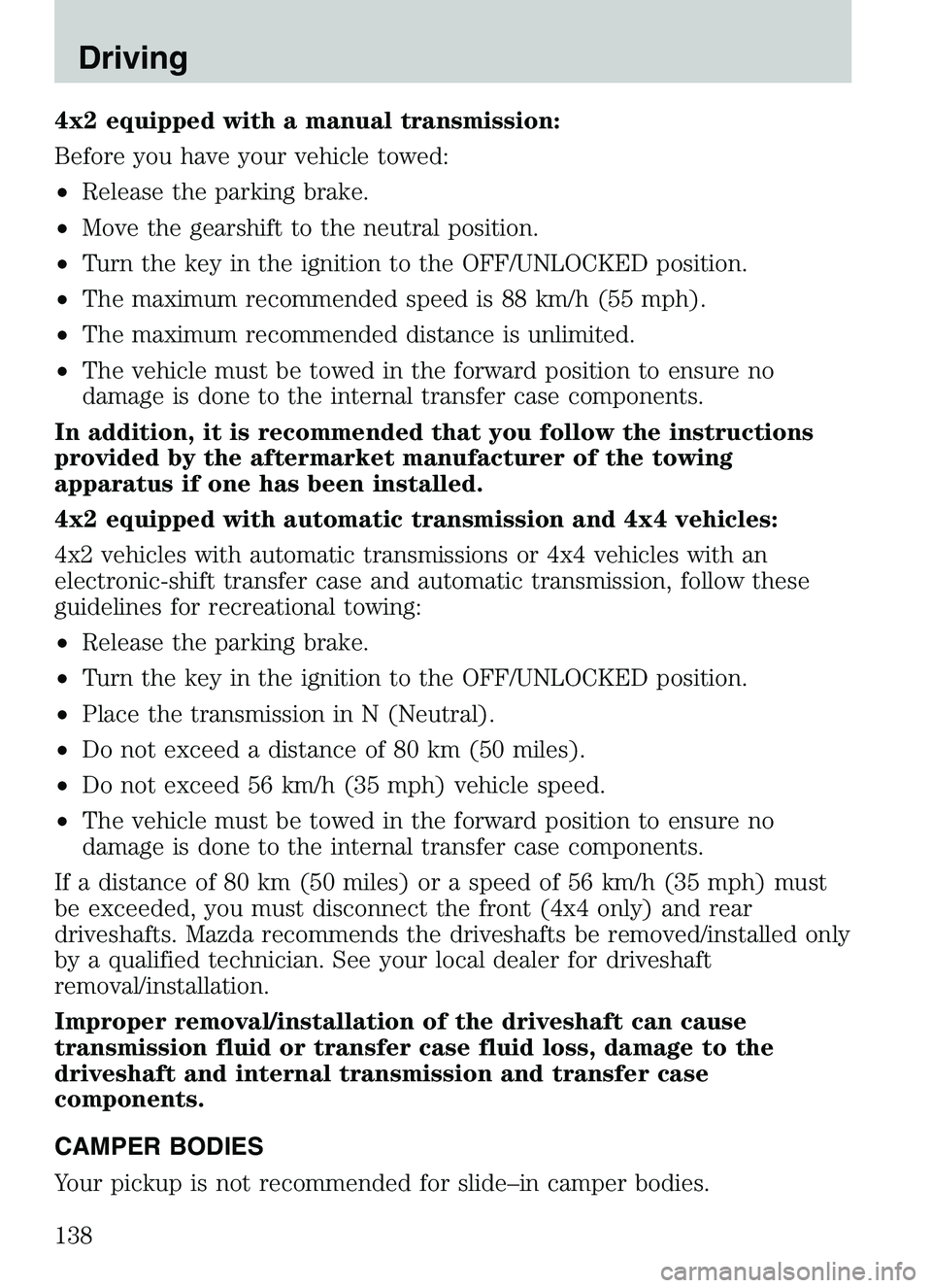
4x2 equipped with a manual transmission:
Before you have your vehicle towed:
•Release the parking brake.
• Move the gearshift to the neutral position.
• Turn the key in the ignition to the OFF/UNLOCKED position.
• The maximum recommended speed is 88 km/h (55 mph).
• The maximum recommended distance is unlimited.
• The vehicle must be towed in the forward position to ensure no
damage is done to the internal transfer case components.
In addition, it is recommended that you follow the instructions
provided by the aftermarket manufacturer of the towing
apparatus if one has been installed.
4x2 equipped with automatic transmission and 4x4 vehicles:
4x2 vehicles with automatic transmissions or 4x4 vehicles with an
electronic-shift transfer case and automatic transmission, follow these
guidelines for recreational towing:
• Release the parking brake.
• Turn the key in the ignition to the OFF/UNLOCKED position.
• Place the transmission in N (Neutral).
• Do not exceed a distance of 80 km (50 miles).
• Do not exceed 56 km/h (35 mph) vehicle speed.
• The vehicle must be towed in the forward position to ensure no
damage is done to the internal transfer case components.
If a distance of 80 km (50 miles) or a speed of 56 km/h (35 mph) must
be exceeded, you must disconnect the front (4x4 only) and rear
driveshafts. Mazda recommends the driveshafts be removed/installed only
by a qualified technician. See your local dealer for driveshaft
removal/installation.
Improper removal/installation of the driveshaft can cause
transmission fluid or transfer case fluid loss, damage to the
driveshaft and internal transmission and transfer case
components.
CAMPER BODIES
Your pickup is not recommended for slide–in camper bodies.
Driving
138
Page 150 of 250

Fuse/RelayLocation Fuse Amp
Rating Power Distribution Box
Description
42 10A* Right headlamp low beam
43 — Not used
44 — Not used
45A — Wiper HI/LO relay 45B — Wiper park/run relay
46A — Fuel pump relay 46B — Trailer tow relay
47A — A/C clutch solenoid relay 47B — Front washer pump relay
48A — Fog lamps 48B — Fog lamp relay 51 — Not used
52 — Not used
53 — Powertrain Control Module (PCM) Diode
54 — Powertrain Control Module (PCM)
55 — Blower relay
56 — Starter relay
* Mini Fuses ** Maxi Fuses
OVERHEATING
If the temperature gauge indicates overheating and you experience
power loss, you hear a loud knocking or pinging noise, the engine is
probably too hot.
If this happens: 1. Drive safely to the side of the road and park off the right-of-way.
2. Shift the automatic transmission into P (Park) or the manual transmission into the neutral position, and apply the parking brake.
3. Turn off the air conditioner.
WARNING: Steam from an overheated engine is dangerous. The
escaping steam could seriously burn you. Open the hood ONLY
after steam is no longer escaping from the engine.
Roadside Emergencies
150
Page 155 of 250
4. If your vehicle is equipped with P265/75 R15 AT tires, do not stow aflat or inflated full size spare tire in the spare tire carrier. The flat
full size tire should be stowed and tied down in the pickup box bed
until it can be repaired.
5. If removed, install the spare tire carrier lock on the access hole above the bumper.
Tire change procedure WARNING: When one of the front wheels is off the ground, the
transmission alone will not prevent the vehicle from moving or
slipping off the jack, even if the vehicle is in P (Park)
(automatic transmission) or R (Reverse) (manual
transmission).
WARNING: To prevent the vehicle from moving when you
change a tire, be sure the parking brake is set, then block (in
both directions) the wheel that is diagonally opposite (other
side and end of the vehicle) to the tire being changed.
WARNING: If the vehicle slips off the jack, you or someone
else could be seriously injured.
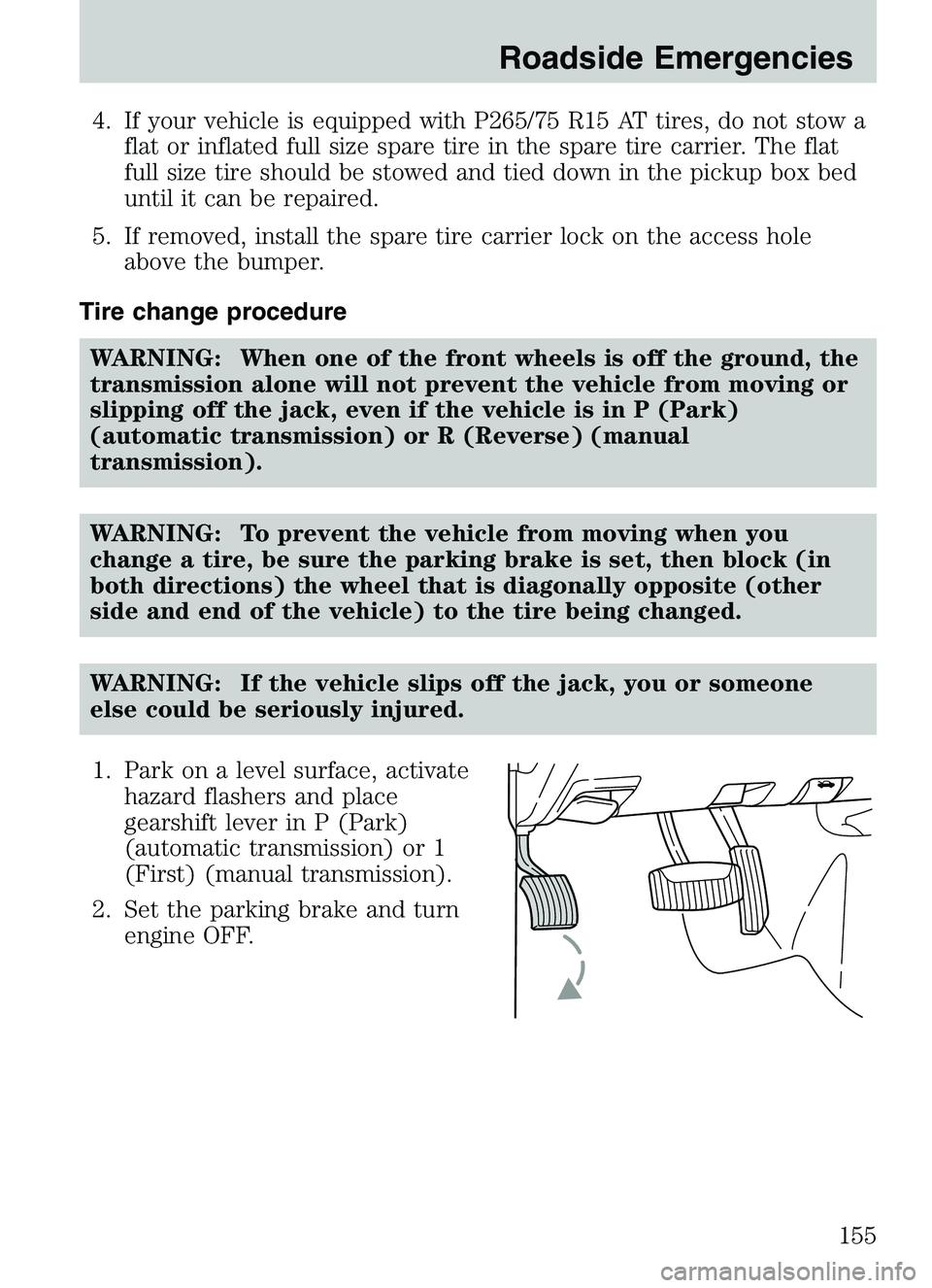
1. Park on a level surface, activate hazard flashers and place
gearshift lever in P (Park)
(automatic transmission) or 1
(First) (manual transmission).
2. Set the parking brake and turn engine OFF.
Roadside Emergencies
155
Page 159 of 250
JUMP STARTING YOUR VEHICLEWARNING: The gases around the battery can explode if
exposed to flames, sparks, or lit cigarettes. An explosion could
result in injury or vehicle damage.
WARNING: Batteries contain sulfuric acid which can burn skin,
eyes and clothing, if contacted.
Do not attempt to push-start your vehicle. Automatic
transmissions do not have push-start capability; also, the
catalytic converter may become damaged.
Preparing your vehicle
When the battery is disconnected or a new battery is installed, the
transmission must relearn its shift strategy. As a result, the transmission
may have firm and/or soft shifts. This operation is considered normal and
will not affect function or durability of the transmission. Over time, the
adaptive learning process will fully update transmission operation. 1. Use only a 12–volt supply to start your vehicle.
2. Do not disconnect the battery of the disabled vehicle as this could damage the vehicle’s electrical system.
3. Park the booster vehicle close to the hood of the disabled vehicle making sure the two vehicles do nottouch. Set the parking brake on
both vehicles and stay clear of the engine cooling fan and other
moving parts.
4. Check all battery terminals and remove any excessive corrosion before you attach the battery cables. Ensure that vent caps are tight
and level.
5. Turn the heater fan on in both vehicles to protect any electrical surges. Turn all other accessories off.
2003 Mazda B Series (mbs)
New Owners Guide own2002 (own2002)
USA English (fus)
Roadside Emergencies
159
Page 184 of 250
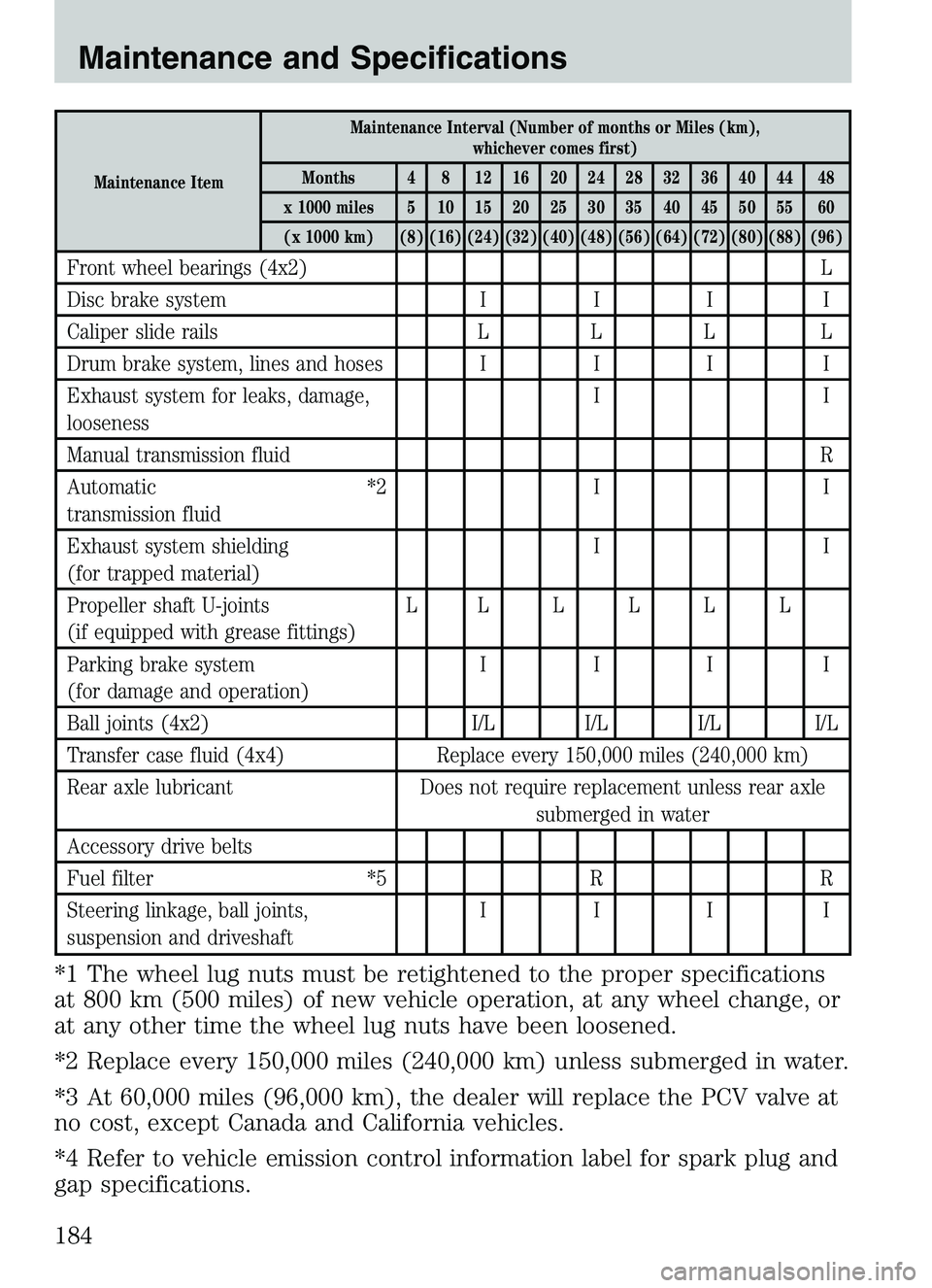
Maintenance ItemMaintenance Interval (Number of months or Miles (km),
whichever comes first)
Months 4 8 12 16 20 24 28 32 36 40 44 48
x 1000 miles 5 10 15 20 25 30 35 40 45 50 55 60 (x 1000 km) (8) (16) (24) (32) (40) (48) (56) (64) (72) (80) (88) (96)
Front wheel bearings (4x2) L
Disc brake system III I
Caliper slide rails LLL L
Drum brake system, lines and hoses I II I
Exhaust system for leaks, damage,
looseness II
Manual transmission fluid R
Automatic
transmission fluid *2
I I
Exhaust system shielding
(for trapped material) II
Propeller shaft U-joints
(if equipped with grease fittings) LLLLLL
Parking brake system
(for damage and operation) III I
Ball joints (4x2) I/L I/L I/L I/L
Transfer case fluid (4x4) Replace every 150,000 miles (240,000 km)
Rear axle lubricant Does not require replacement unless rear axle
submerged in water
Accessory drive belts
Fuel filter *5R R
Steering linkage, ball joints,
suspension and driveshaft III I
*1 The wheel lug nuts must be retightened to the proper specifications
at 800 km (500 miles) of new vehicle operation, at any wheel change, or
at any other time the wheel lug nuts have been loosened.
*2 Replace every 150,000 miles (240,000 km) unless submerged in water.
*3 At 60,000 miles (96,000 km), the dealer will replace the PCV valve at
no cost, except Canada and California vehicles.
*4 Refer to vehicle emission control information label for spark plug and
gap specifications.
Maintenance and Specifications
184