tires MAZDA MODEL B4000 2003 User Guide
[x] Cancel search | Manufacturer: MAZDA, Model Year: 2003, Model line: MODEL B4000, Model: MAZDA MODEL B4000 2003Pages: 250, PDF Size: 2.85 MB
Page 183 of 250
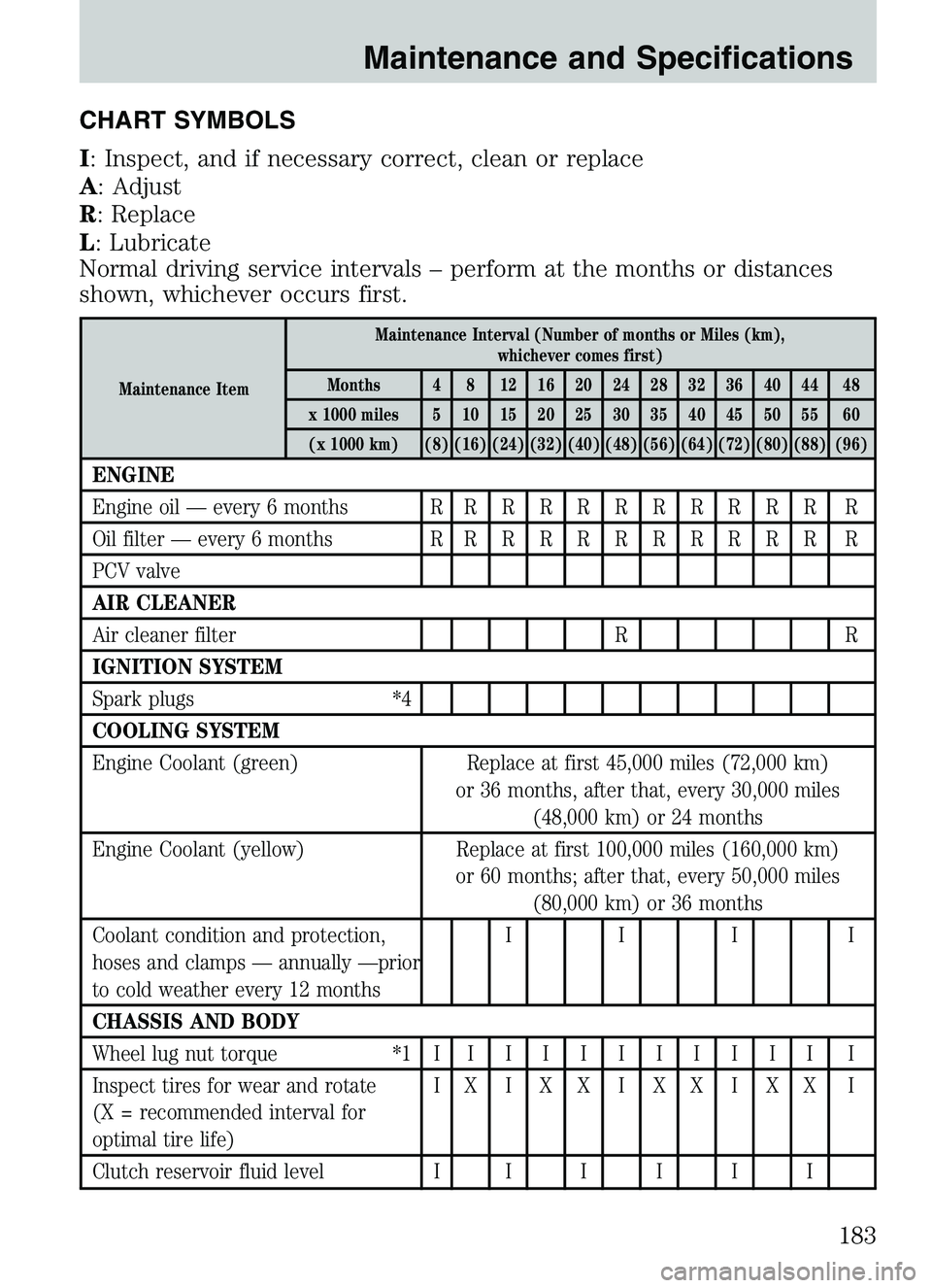
CHART SYMBOLS
I: Inspect, and if necessary correct, clean or replace
A: Adjust
R: Replace
L: Lubricate
Normal driving service intervals – perform at the months or distances
shown, whichever occurs first.
Maintenance ItemMaintenance Interval (Number of months or Miles (km),
whichever comes first)
Months 4 8 12 16 20 24 28 32 36 40 44 48
x 1000 miles 5 10 15 20 25 30 35 40 45 50 55 60 (x 1000 km) (8) (16) (24) (32) (40) (48) (56) (64) (72) (80) (88) (96)
ENGINE
Engine oil — every 6 months R RRRRRRRRRR R
Oil filter — every 6 months R RRRRRRRRRR R
PCV valve
AIR CLEANER
Air cleaner filter R R
IGNITION SYSTEM
Spark plugs *4
COOLING SYSTEM
Engine Coolant (green) Replace at first 45,000 miles (72,000 km) or 36 months, after that, every 30,000 miles(48,000 km) or 24 months
Engine Coolant (yellow) Replace at first 100,000 miles (160,000 km) or 60 months; after that, every 50,000 miles(80,000 km) or 36 months
Coolant condition and protection,
hoses and clamps — annually —prior
to cold weather every 12 months III I
CHASSIS AND BODY
Wheel lug nut torque *1 I IIIIIIIIII I
Inspect tires for wear and rotate
(X = recommended interval for
optimal tire life) IXIXXIXXIXX I
Clutch reservoir fluid level I IIIII
Maintenance and Specifications
183
Page 185 of 250
*5 The California Air Resources Board has determined that the failure to
perform this maintenance item will not nullify the emission warranty nor
limit recall liability prior to completion of the vehicle’s useful life.
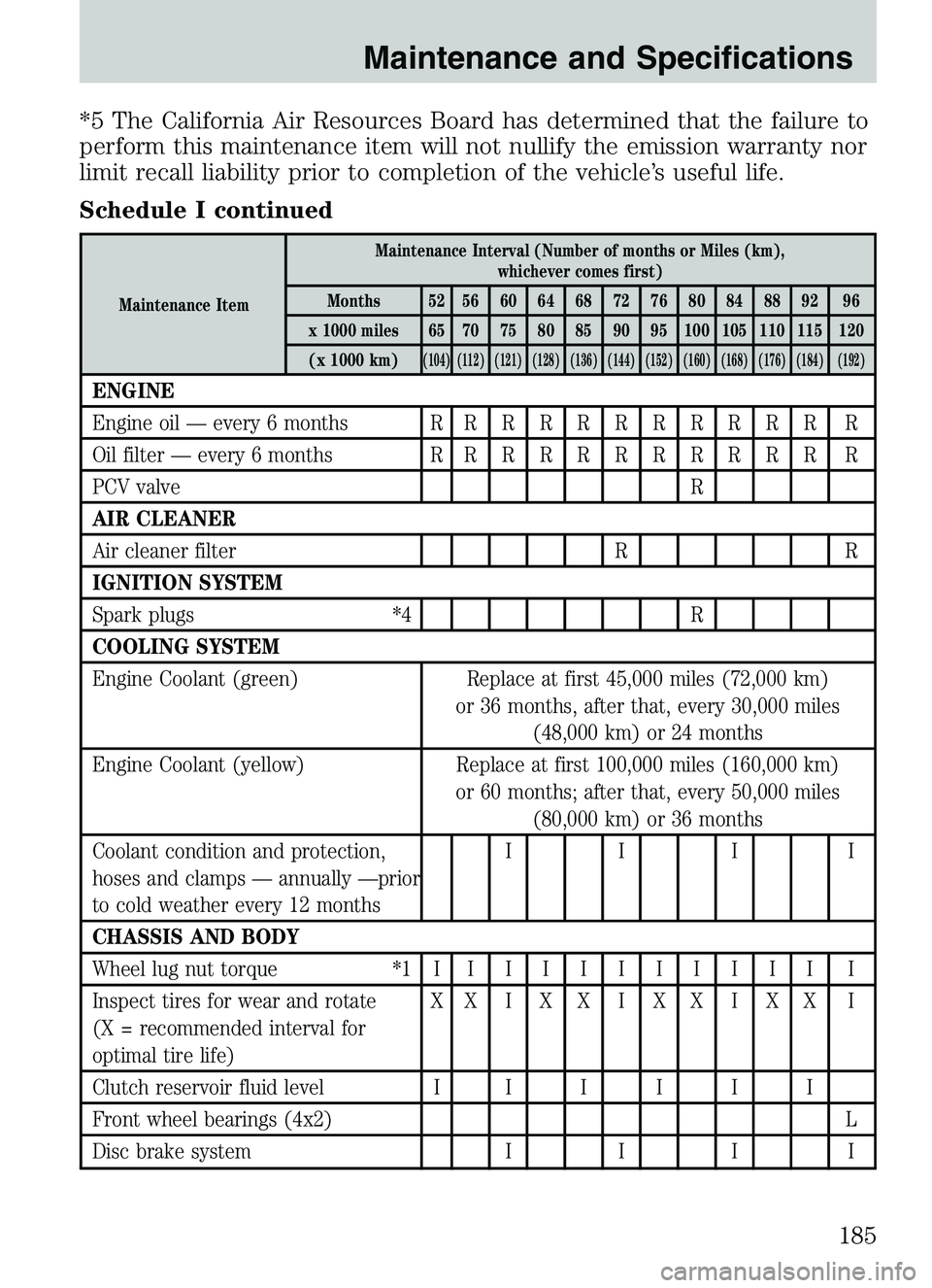
Schedule I continued
Maintenance ItemMaintenance Interval (Number of months or Miles (km),
whichever comes first)
Months 52 56 60 64 68 72 76 80 84 88 92 96
x 1000 miles 65 70 75 80 85 90 95 100 105 110 115 120 (x 1000 km)
(104) (112) (121) (128) (136) (144) (152) (160) (168) (176) (184) (192)
ENGINE
Engine oil — every 6 months R RRRRRRRRRR R
Oil filter — every 6 months R RRRRRRRRRR R
PCV valve R
AIR CLEANER
Air cleaner filter R R
IGNITION SYSTEM
Spark plugs *4 R
COOLING SYSTEM
Engine Coolant (green) Replace at first 45,000 miles (72,000 km) or 36 months, after that, every 30,000 miles(48,000 km) or 24 months
Engine Coolant (yellow) Replace at first 100,000 miles (160,000 km) or 60 months; after that, every 50,000 miles(80,000 km) or 36 months
Coolant condition and protection,
hoses and clamps — annually —prior
to cold weather every 12 months III I
CHASSIS AND BODY
Wheel lug nut torque *1 I IIIIIIIIII I
Inspect tires for wear and rotate
(X = recommended interval for
optimal tire life) XXIXXIXXIXX I
Clutch reservoir fluid level I IIIII
Front wheel bearings (4x2) L
Disc brake system I I I I
Maintenance and Specifications
185
Page 189 of 250
While operating your vehicle
•Note any changes in the sound of the exhaust or any smell or exhaust
fumes in the vehicle.
• Check for vibrations in the steering wheel. Notice any increased
steering effort or looseness in the steering wheel, or change in the
straight ahead position.
• Notice if your vehicle constantly turns slightly or “pulls” to one side
when traveling on a smooth, level road.
• When stopping, listen and check for strange sounds, pulling to one
side, increased brake pedal travel or “hard to push” brake pedal.
• If any slipping or changes in the operation of your transmission occur,
check the transmission fluid level.
• Check automatic transmission Park function.
• Check parking brake.
At least monthly
• Check function of all interior and exterior lights.
• Check tires for wear and proper air pressure.
• Check engine oil level.
• Check coolant level in the coolant reservoir.
• Check washer fluid level.
At least twice a year (for example, every spring and fall)
• Check power steering fluid level.
• Check clutch fluid level (if equipped).
• Check and clean body and door drain holes.
• Check and lubricate all hinges, latches, and outside locks.
• Check and lubricate door rubber weather strips.
• Check parking brake for proper operation.
• Check lap/shoulder belts and seat latches for wear and function.
• Check air pressure in spare tire.
• Check windshield washer spray and wiper operation. Clean wiper
blades with clean cloth dampened with washer fluid.
• Check safety warning lamps (brake, ABS, air bag, safety belt) for
operation.
Maintenance and Specifications
189
Page 217 of 250

•Revving the engine before turning it off may reduce fuel economy.
• Using the air conditioner or defroster may reduce fuel economy.
• You may want to turn off the speed control in hilly terrain if
unnecessary shifting between third and fourth gear occurs.
Unnecessary shifting of this type could result in reduced fuel
economy.
• Warming up a vehicle on cold mornings is not required and may
reduce fuel economy.
• Resting your foot on the brake pedal while driving may reduce fuel
economy.
• Combine errands and minimize stop-and-go driving.
Maintenance
• Keep tires properly inflated and use only recommended size.
• Operating a vehicle with the wheels out of alignment will reduce fuel
economy.
• Use recommended engine oil. Refer to Lubricant specificationsin
this chapter.
• Perform all regularly scheduled maintenance items. Follow the
recommended maintenance schedule and owner maintenance checks
found in your vehicle service maintenance section.
Conditions
• Heavily loading a vehicle or towing a trailer may reduce fuel economy
at any speed.
• Carrying unnecessary weight may reduce fuel economy (approximately
0.4 km/L [1 mpg] is lost for every 180 kg [400 lb] of weight carried).
• Adding certain accessories to your vehicle (for example bug
deflectors, rollbars/light bars, running boards, ski/luggage racks) may
reduce fuel economy.
• Using fuel blended with alcohol may lower fuel economy.
• Fuel economy may decrease with lower temperatures during the first
12–16 km (8–10 miles) of driving.
• Driving on flat terrain offers improved fuel economy as compared to
driving on hilly terrain.
• Transmissions give their best fuel economy when operated in the top
cruise gear and with steady pressure on the gas pedal.
2003 Mazda B Series (mbs)
New Owners Guide own2002 (own2002)
USA English (fus)
Maintenance and Specifications
217
Page 227 of 250
Use only fluid that meets Mazda specifications. Refer toLubricant
Specifications in this chapter.
DRIVELINE UNIVERSAL JOINT AND SLIP YOKE
Your vehicle may be equipped with universal joints that require
lubrication. If the original universal joints are replaced with universal
joints equipped with grease fittings, lubrication will also be necessary.
INFORMATION ABOUT UNIFORM TIRE QUALITY GRADING
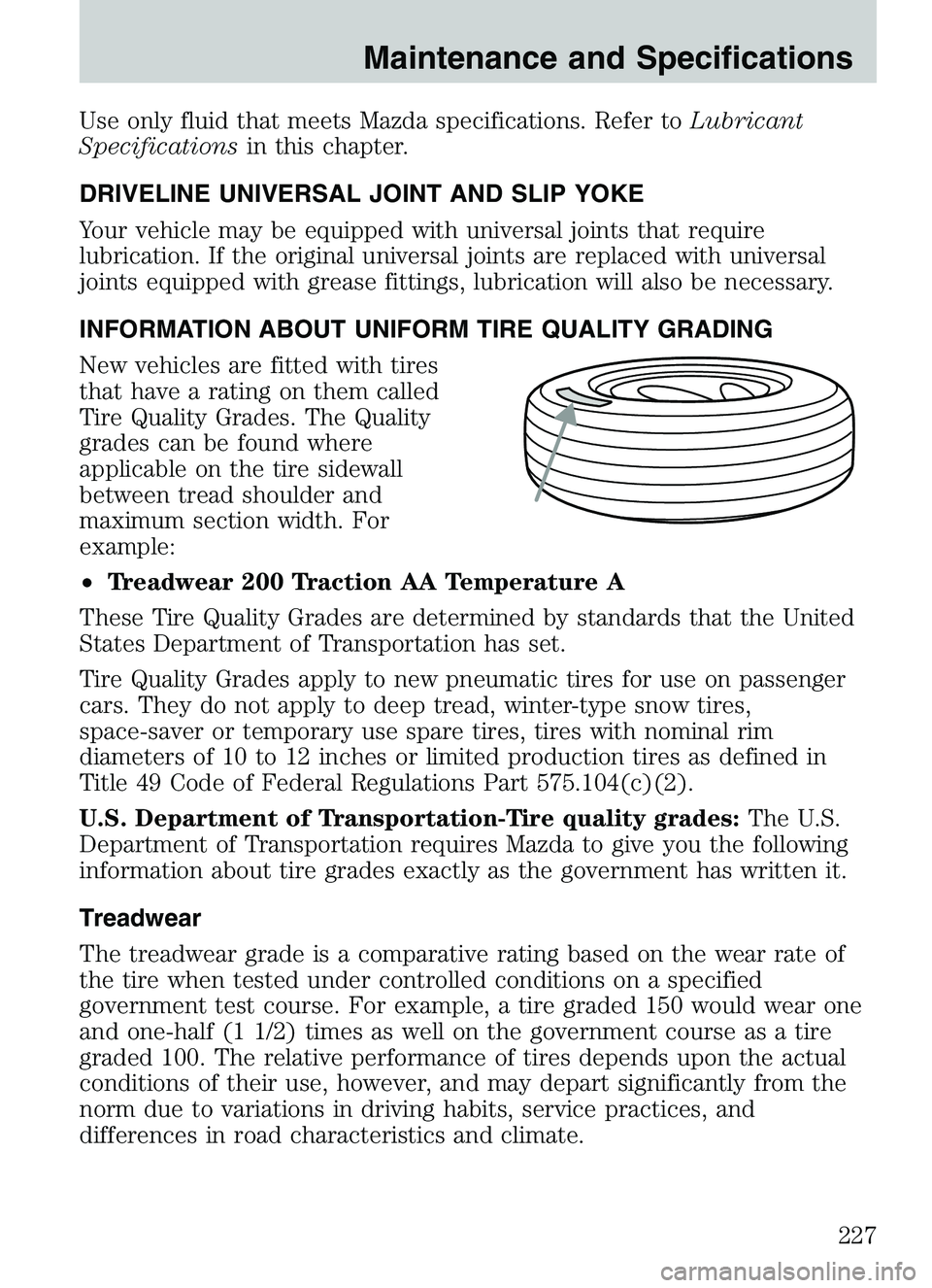
New vehicles are fitted with tires
that have a rating on them called
Tire Quality Grades. The Quality
grades can be found where
applicable on the tire sidewall
between tread shoulder and
maximum section width. For
example:
• Treadwear 200 Traction AA Temperature A
These Tire Quality Grades are determined by standards that the United
States Department of Transportation has set.
Tire Quality Grades apply to new pneumatic tires for use on passenger
cars. They do not apply to deep tread, winter-type snow tires,
space-saver or temporary use spare tires, tires with nominal rim
diameters of 10 to 12 inches or limited production tires as defined in
Title 49 Code of Federal Regulations Part 575.104(c)(2).
U.S. Department of Transportation-Tire quality grades: The U.S.
Department of Transportation requires Mazda to give you the following
information about tire grades exactly as the government has written it.
Treadwear
The treadwear grade is a comparative rating based on the wear rate of
the tire when tested under controlled conditions on a specified
government test course. For example, a tire graded 150 would wear one
and one-half (1 1/2) times as well on the government course as a tire
graded 100. The relative performance of tires depends upon the actual
conditions of their use, however, and may depart significantly from the
norm due to variations in driving habits, service practices, and
differences in road characteristics and climate.
Maintenance and Specifications
227
Page 228 of 250
Traction AA A B C
The traction grades, from highest to lowest are AA, A, B, and C. The
grades represent the tire’s ability to stop on wet pavement as measured
under controlled conditions on specified government test surfaces of
asphalt and concrete. A tire marked C may have poor traction
performance.
NOTE:The traction grade assigned to this tire is based on
straight-ahead braking traction tests, and does not include acceleration,
cornering, hydroplaning or peak traction characteristics.
Temperature A B C
The temperature grades are A (the highest), B, and C, representing the
tire’s resistance to the generation of heat and its ability to dissipate heat
when tested under controlled conditions on a specified indoor laboratory
test wheel. Sustained high temperature can cause the material of the tire
to degenerate and reduce tire life, and excessive temperature can lead to
sudden tire failure. The grade C corresponds to a level of performance
which all passenger car tires must meet under the Federal Motor Vehicle
Safety Standard No. 109. Grades B and A represent higher levels of
performance on the laboratory test wheel than the minimum required by
law.
WARNING: The temperature grade for this tire is established
for a tire that is properly inflated and not overloaded.
Excessive speed, underinflation, or excessive loading, either
separately or in combination, can cause heat buildup and
possible tire failure.
SERVICING YOUR TIRES
Checking the tire pressure
• Use an accurate tire pressure gauge.
• Check the tire pressure when tires are cold, after the vehicle has been
parked for at least one hour or has been driven less than 5 km
(3 miles).
• Adjust tire pressure to recommended specifications found on the
Certification Label or the Tire Label.
Maintenance and Specifications
228
Page 229 of 250

WARNING: Improperly inflated tires can affect vehicle
handling and can fail suddenly, possibly resulting in loss of
vehicle control, vehicle rollover and/or personal injury.
Tire rotation
Because your vehicle’s tires perform different jobs, they often wear
differently. To make sure your tires wear evenly and last longer, rotate
them as indicated in the service maintenance section. If you notice that
the tires wear unevenly, have them checked.
• Four tire rotation
• Five tire rotation
Note: Do not use a temporary spare tire for a five tire rotation.
Maintenance and Specifications
229
Page 230 of 250

Replacing the tires
Replace the tires when the wear
band is visible through the tire
treads.WARNING: When replacing full size tires, never mix radial
bias-belted, or bias-type tires. Use only the tire sizes that are
listed on the Certification Label. Make sure that all tires are
the same size, speed rating, and load-carrying capacity. Use only
the tire combinations recommended on the label. If you do not
follow these precautions, your vehicle handling may be affected
which can lead to loss of vehicle control, vehicle rollover and/or
personal injury.
WARNING: Make sure that all replacement tires are of the
same size, type, load=carrying capacity and tread (e.g., “All
Terrain”, etc.), as originally offered by Mazda. Failure to do so
can result in tire failure and a serious accident.
WARNING: Do not replace your tires with “high performance”
tires or larger size tires.
WARNING: Failure to follow these precautions may adversely
affect the handling of the vehicle, and increase the risk of loss
of vehicle control, vehicle rollover and/or personal injury.
Tires that are larger or smaller than your vehicle’s original tires may also
affect the accuracy of your speedometer.
SNOW TIRES AND CHAINS WARNING: Driving too fast for conditions creates the
possibility of loss of vehicle control. Driving at very high speeds
for extended periods of time may result in damage to vehicle
components.
Maintenance and Specifications
230
Page 231 of 250
NOTE:Snow tires must be the same size and grade as the tires you
currently have on your vehicle.
The tires on your vehicle have all weather treads to provide traction in
rain and snow. However, in some climates, you may need to use snow
tires and chains. If you need to use snow tires and chains, it is
recommended that steel wheels are used of the same size and
specifications as those originally installed.
Follow these guidelines when using snow tires and chains:
• Do not use tire chains on aluminum wheels. Chains may chip the
wheels.
• Use only SAE Class S chains.
• Install chains securely, verifying that the chains do not touch any
wiring, brake lines or fuel lines.
Drive cautiously. If you hear the cables rub or bang against the
vehicle, stop and retighten them. If this does not work, remove
the cables to prevent vehicle damage.
• If possible, avoid fully loading your vehicle.
• Remove the tire chains when they are no longer needed. Do not use
tire chains on dry roads.
• The suspension insulation and bumpers will help prevent vehicle
damage. Do not remove these components from your vehicle when
using snow tires and chains.
REFILL CAPACITIES
Fluid Mazda Part
NameApplication Capacity
Engine oil
(includes filter
change) Mazda SAE 5W-
20 Super
Premium Motor
Oil2.3L engine 3.8L
(4.0 quarts.)
3.0L V6 engines 4.3L (4.5 quarts)
Mazda SAE 5W-
30 Super
Premium Motor
Oil 4.0L V6 engine 4.7L
(5.0 quarts)
Maintenance and Specifications
231
Page 245 of 250
Tilt steering wheel ......................48
Tires ...........................151, 227–228changing ..................151–152, 155
checking the pressure ............228
replacing ..................................230
rotating ....................................229
snow tires and chains ............230
tire grades ...............................228
treadwear ................................227
Towing .......................................131 recreational towing .................137
trailer towing ..........................131
wrecker ....................................164
Traction-lok rear axle ...............118
Transfer case fluid checking .........................226
Transmission automatic operation ...............119
fluid, checking and adding
(automatic) .............................223
fluid, checking and adding
(manual) .................................225
fluid, refill capacities ..............231
lubricant specifications ..235–236
manual operation ....................122
Turn signal ..................................40 V
Vehicle dimensions ...................236
Vehicle Identification Number
(VIN) ..........................................238
Vehicle loading ..........................129
camper bodies ........................138
Ventilating your vehicle ...........115
W
Warning chimes ...........................16
Warning lights (see Lights) .......12
Washer fluid ..............................195
Washing your vehicle ................176
Water, Driving through .............128
Waxing your vehicle .................176
Windows power .........................................49
Windshield washer fluid and
wipers ..........................................47 checking and adding fluid .....195
checking and cleaning ..............47
replacing wiper blades .............48
Wrecker towing .........................164
2003 Mazda B Series (mbs)
New Owners Guide own2002 (own2002)
USA English (fus)
Index
245