wheel MAZDA MODEL B4000 2003 Owner's Manual
[x] Cancel search | Manufacturer: MAZDA, Model Year: 2003, Model line: MODEL B4000, Model: MAZDA MODEL B4000 2003Pages: 250, PDF Size: 2.85 MB
Page 154 of 250

2. If equipped, unlock and removethe spare tire carrier lock from
the rear access hole located just
above the rear bumper and
below the tailgate.
3. Insert the straight end of the jack handle into the rear access
hole located just above the rear
bumper and below the tailgate.
Forward motion will stop and
resistance to turning will be felt
when properly engaged. 4. Turn the handle counterclockwise until tire is
lowered to the ground and the cable is slightly slack.
5. Remove the retainer from the spare tire.
Stowing the spare tire 1. Lay the tire on the ground with the valve stem facing up.
2. Install the retainer through the wheel center and slide the
wheel under the vehicle.
3. Turn the spare handle clockwise until the tire is raised to its
original position underneath the
vehicle. The spare handle
ratchets when the tire is raised
to the stowed position. It will
not allow you to overtighten.
Roadside Emergencies
154
Page 155 of 250
4. If your vehicle is equipped with P265/75 R15 AT tires, do not stow aflat or inflated full size spare tire in the spare tire carrier. The flat
full size tire should be stowed and tied down in the pickup box bed
until it can be repaired.
5. If removed, install the spare tire carrier lock on the access hole above the bumper.
Tire change procedure WARNING: When one of the front wheels is off the ground, the
transmission alone will not prevent the vehicle from moving or
slipping off the jack, even if the vehicle is in P (Park)
(automatic transmission) or R (Reverse) (manual
transmission).
WARNING: To prevent the vehicle from moving when you
change a tire, be sure the parking brake is set, then block (in
both directions) the wheel that is diagonally opposite (other
side and end of the vehicle) to the tire being changed.
WARNING: If the vehicle slips off the jack, you or someone
else could be seriously injured.
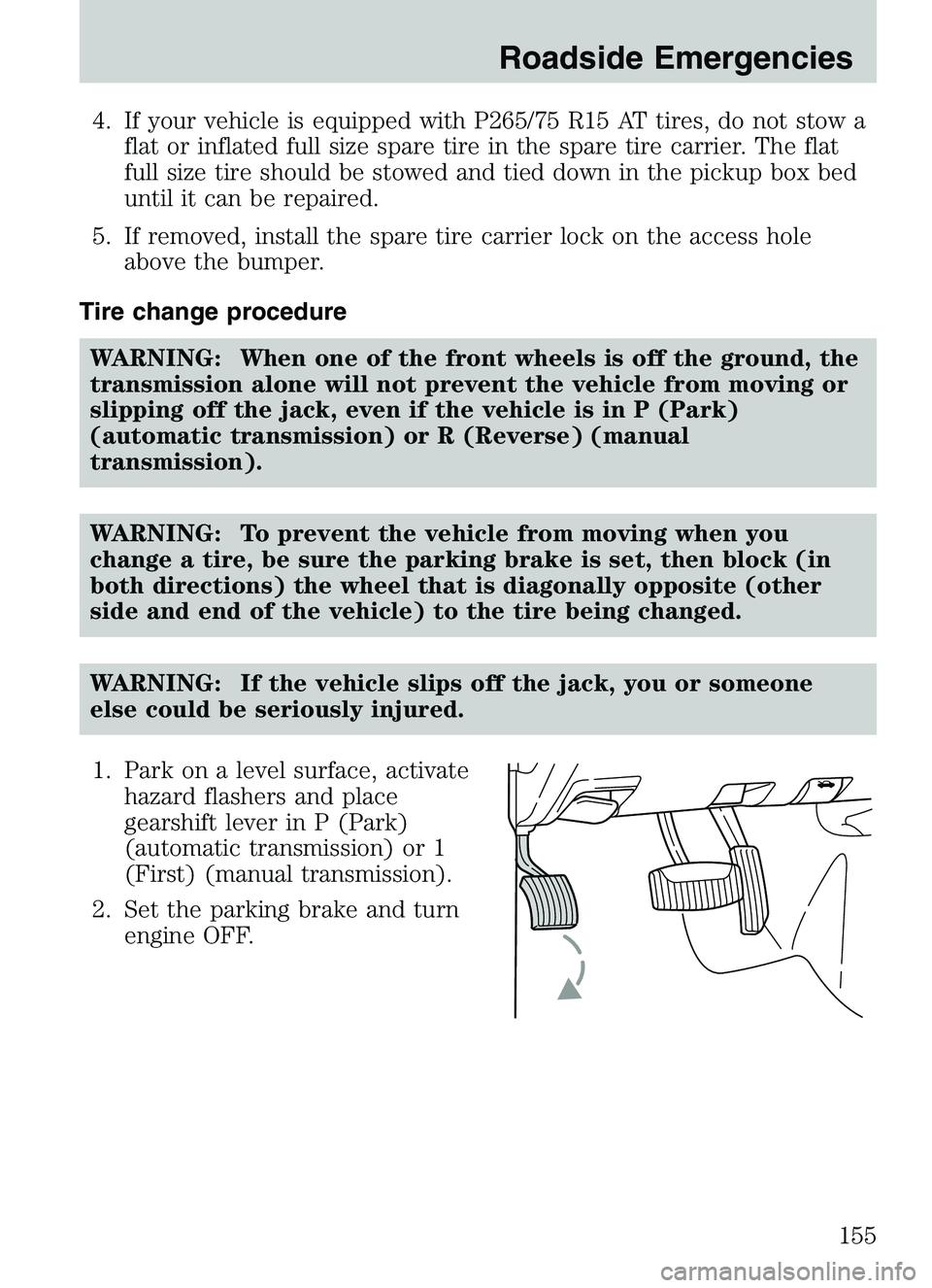
1. Park on a level surface, activate hazard flashers and place
gearshift lever in P (Park)
(automatic transmission) or 1
(First) (manual transmission).
2. Set the parking brake and turn engine OFF.
Roadside Emergencies
155
Page 156 of 250

3. Block the diagonally oppositewheel.
4. Insert tapered end of the lug wrench behind hub caps and
twist them off.
5. Loosen each wheel lug nut one-half turn counterclockwise
but do not remove them until
the wheel is raised off the
ground.
6. Position the jack according to the following guides and turn
the jack handle clockwise until the tire is a maximum of 25 mm
(1 inch) off the ground.
WARNING: To lessen the risk
of personal injury, do not put
any part of your body under
the vehicle while changing a
tire. Do not start the engine
when your vehicle is on the
jack. The jack is only meant
for changing the tire.
2003 Mazda B Series (mbs)
New Owners Guide own2002 (own2002)
USA English (fus)
Roadside Emergencies
156
Page 157 of 250

•Front
• Rear
Never use the differential as a jacking point. It is too easy for the
vehicle to tilt or fall and you can be injured. 7. Remove the wheel lug nuts with the lug wrench.
8. Replace the flat tire with the spare tire, making sure the valve stem is facing outward. Reinstall the lug nuts until the wheel is snug
against the hub. Do not fully tighten the lug nuts until the wheel has
been lowered.
9. Lower the wheel by turning the jack handle counterclockwise.
2003 Mazda B Series (mbs)
New Owners Guide own2002 (own2002)
USA English (fus)
Roadside Emergencies
157
Page 158 of 250

10. Remove the jack and fullytighten the lug nuts, in the
order shown, to 135 Nm (100
lb-ft). Note that these tightening
specifications are for nut and
bolt threads that are free of dirt
and rust. Use only Mazda
recommended (1/2–20)
replacement fasteners.
11. Stow the flat tire. Refer to Stowing the spare tire.
12. Stow the jack and lug wrench. Make sure the jack is fastened so it does not rattle when you drive.
13. Unblock the wheels.
Stowing the flat/spare tire 1. Lay the tire on the ground with the valve stem facing up.
2. Slide the wheel partially under the vehicle and install the wire and retainer through the center of the wheel.
3. Turn the jack handle clockwise until the tire is raised to its original position underneath the vehicle. The effort to turn the jack handle
increases significantly as the tire contacts the frame. The spare tire
carrier will ratchet when the tire is in the fully stowed position. The
spare tire carrier has a built-in ratchet feature that will not allow you
to overtighten. If the spare tire carrier ratchets with very little effort,
take the vehicle to your dealer for assistance at your earliest
convenience.
4. Check that the tire lies flat against the frame assembly. Push against the tire to make sure it is tightly sealed under the vehicle. Loosen
and retighten, if necessary. Failure to properly stow the spare tire
may result in failure of the winch cable and loss of the spare tire.
5. Repeat this tightness check procedure when servicing the spare tire pressure (every six months, per service maintenance section), or at
any time that the spare tire is disturbed through service of other
components.
6. Install the spare tire lock (if equipped) into the access hole above the rear bumper with the spare tire lock key (if equipped) and jack
handle.1
4
3
2
5
2003 Mazda B Series (mbs)
New Owners Guide own2002 (own2002)
USA English (fus)
Roadside Emergencies
158
Page 164 of 250

WRECKER TOWING
If you need to have your vehicle towed, contact a professional towing
service or, if you are a member of a roadside assistance program, your
roadside assistance service provider.
It is recommended that your vehicle be towed with a wheel lift or flatbed
equipment. Do not tow with a slingbelt. Mazda has not approved a
slingbelt towing procedure.
On 4x2 vehicles, it is acceptable to tow the vehicle with the front wheels
on the ground and the rear wheels off the ground.
On 4x4 vehicles, it is recommended that your vehicle be towed with a
wheel lift and dollies or flatbed equipment with all the wheels off the
ground.
If the vehicle is towed by other means or incorrectly, vehicle
damage may occur.
Roadside Emergencies
164
Page 177 of 250

REPAIRING PAINT CHIPS
Minor scratches or paint damage from road debris may be repaired with
Genuine Mazda Touch-Up Paint. Observe the application instructions on
the products.
Remove particles such as bird droppings, tree sap, insect remains, tar
spots, road salt and industrial fallout immediately.
CLEANING THE WHEELS
Wash with the same detergent as the body of your vehicle. Do not use
acid-based or alcohol-based wheel cleaners, steel wool, fuel or strong
detergents. Never use abrasives that will damage the finish of special
wheel surfaces. Use a tar remover to remove grease and tar.
The brushes used in some automatic car washes may damage the
finish on your wheels. Before going to a car wash, find out if the
brushes are abrasive.
ENGINE
Engines are more efficient when they are clean because grease and dirt
buildup keep the engine warmer than normal. When washing:
•Take care when using a power washer to clean the engine. The
high-pressure fluid could penetrate the sealed parts and cause
damage.
• Never spray the engine or other engine components with water. Water
will damage the engine or other engine components.
• Spray Engine Shampoo and Degreaser, available at your authorized
Mazda dealer, on all parts that require cleaning and pressure rinse
clean.
• Cover the highlighted areas to prevent water damage when cleaning
the engine.
Cleaning
177
Page 180 of 250
hot wax treatments used by commercial car washes. Clean the outside of
the windshield or rear window with a non-abrasive cleaner.Do notuse
abrasive cleansers on glass as they may cause scratches. The windshield
or rear window is clean if beads do not form when you rinse it with
water. The windshield, rear window and wiper blades should be cleaned
on a regular basis, and blades or rubber elements replaced when worn.
CLEANING THE INSTRUMENT PANEL
Clean the instrument panel with a damp cloth, then dry with a dry cloth.
Avoid cleaners or polish that increase the gloss of the upper portion of
the instrument panel. The dull finish in this area helps protect the driver
from undesirable windshield reflection.
Your vehicle is designed with painted controls and features which
are particularly sensitive to certain products such as insect
repellent and suntan lotion. When operating the various features
on your vehicle, be certain to wash or wipe your hands clean if
you have been in contact with any of these types of products in
order to avoid possible damage to the painted surfaces.
WARNING: Do not use chemical solvents or strong detergents
when cleaning the steering wheel or instrument panel to avoid
contamination of the air bag system.
CLEANING THE INSTRUMENT CLUSTER LENS
Clean with a damp cloth, then dry with a dry cloth.
Do not use household or glass cleaners as these may damage the lens.
INTERIOR
For fabric, carpets, cloth seats, and safety belts:
• Remove dust and loose dirt with a vacuum cleaner.
• Remove light stains and soil with Extra Strength Upholstery Cleaner,
available at your authorized Mazda dealer.
• If grease or tar is present on the material, spot-clean the area first
with Spot and Stain Remover, available at your authorized Mazda
dealer.
• Never saturate the seat covers with cleaning solution.
• Do not use household cleaning products or glass cleaners, which can
stain and discolor the fabric and affect the flame retardant abilities of
the seat materials.
Cleaning
180
Page 183 of 250
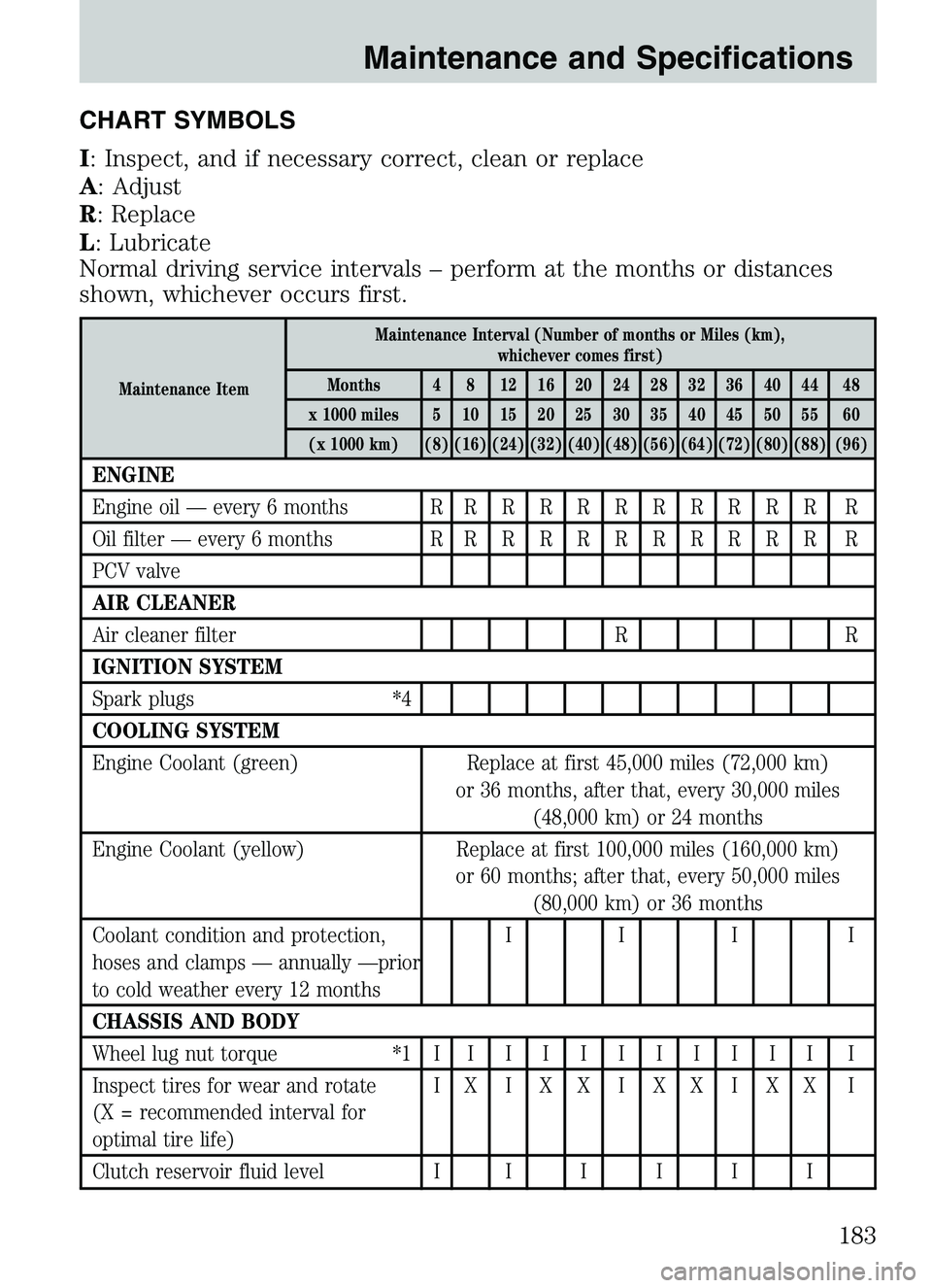
CHART SYMBOLS
I: Inspect, and if necessary correct, clean or replace
A: Adjust
R: Replace
L: Lubricate
Normal driving service intervals – perform at the months or distances
shown, whichever occurs first.
Maintenance ItemMaintenance Interval (Number of months or Miles (km),
whichever comes first)
Months 4 8 12 16 20 24 28 32 36 40 44 48
x 1000 miles 5 10 15 20 25 30 35 40 45 50 55 60 (x 1000 km) (8) (16) (24) (32) (40) (48) (56) (64) (72) (80) (88) (96)
ENGINE
Engine oil — every 6 months R RRRRRRRRRR R
Oil filter — every 6 months R RRRRRRRRRR R
PCV valve
AIR CLEANER
Air cleaner filter R R
IGNITION SYSTEM
Spark plugs *4
COOLING SYSTEM
Engine Coolant (green) Replace at first 45,000 miles (72,000 km) or 36 months, after that, every 30,000 miles(48,000 km) or 24 months
Engine Coolant (yellow) Replace at first 100,000 miles (160,000 km) or 60 months; after that, every 50,000 miles(80,000 km) or 36 months
Coolant condition and protection,
hoses and clamps — annually —prior
to cold weather every 12 months III I
CHASSIS AND BODY
Wheel lug nut torque *1 I IIIIIIIIII I
Inspect tires for wear and rotate
(X = recommended interval for
optimal tire life) IXIXXIXXIXX I
Clutch reservoir fluid level I IIIII
Maintenance and Specifications
183
Page 184 of 250
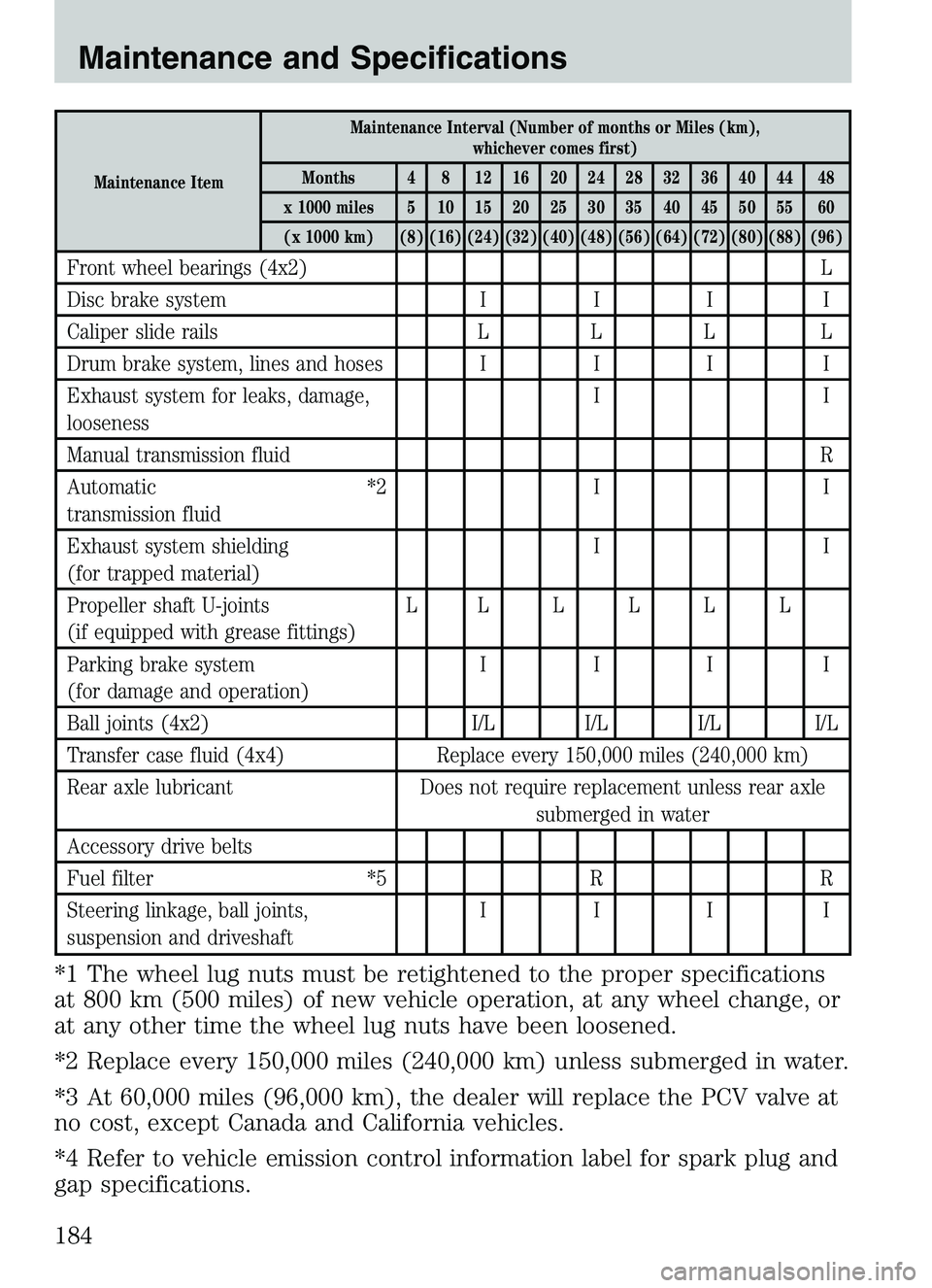
Maintenance ItemMaintenance Interval (Number of months or Miles (km),
whichever comes first)
Months 4 8 12 16 20 24 28 32 36 40 44 48
x 1000 miles 5 10 15 20 25 30 35 40 45 50 55 60 (x 1000 km) (8) (16) (24) (32) (40) (48) (56) (64) (72) (80) (88) (96)
Front wheel bearings (4x2) L
Disc brake system III I
Caliper slide rails LLL L
Drum brake system, lines and hoses I II I
Exhaust system for leaks, damage,
looseness II
Manual transmission fluid R
Automatic
transmission fluid *2
I I
Exhaust system shielding
(for trapped material) II
Propeller shaft U-joints
(if equipped with grease fittings) LLLLLL
Parking brake system
(for damage and operation) III I
Ball joints (4x2) I/L I/L I/L I/L
Transfer case fluid (4x4) Replace every 150,000 miles (240,000 km)
Rear axle lubricant Does not require replacement unless rear axle
submerged in water
Accessory drive belts
Fuel filter *5R R
Steering linkage, ball joints,
suspension and driveshaft III I
*1 The wheel lug nuts must be retightened to the proper specifications
at 800 km (500 miles) of new vehicle operation, at any wheel change, or
at any other time the wheel lug nuts have been loosened.
*2 Replace every 150,000 miles (240,000 km) unless submerged in water.
*3 At 60,000 miles (96,000 km), the dealer will replace the PCV valve at
no cost, except Canada and California vehicles.
*4 Refer to vehicle emission control information label for spark plug and
gap specifications.
Maintenance and Specifications
184