transmission MAZDA MODEL B4000 CAB PLUS 4 TRUCK 2009 Owner's Manual
[x] Cancel search | Manufacturer: MAZDA, Model Year: 2009, Model line: MODEL B4000 CAB PLUS 4 TRUCK, Model: MAZDA MODEL B4000 CAB PLUS 4 TRUCK 2009Pages: 288, PDF Size: 3.05 MB
Page 195 of 288
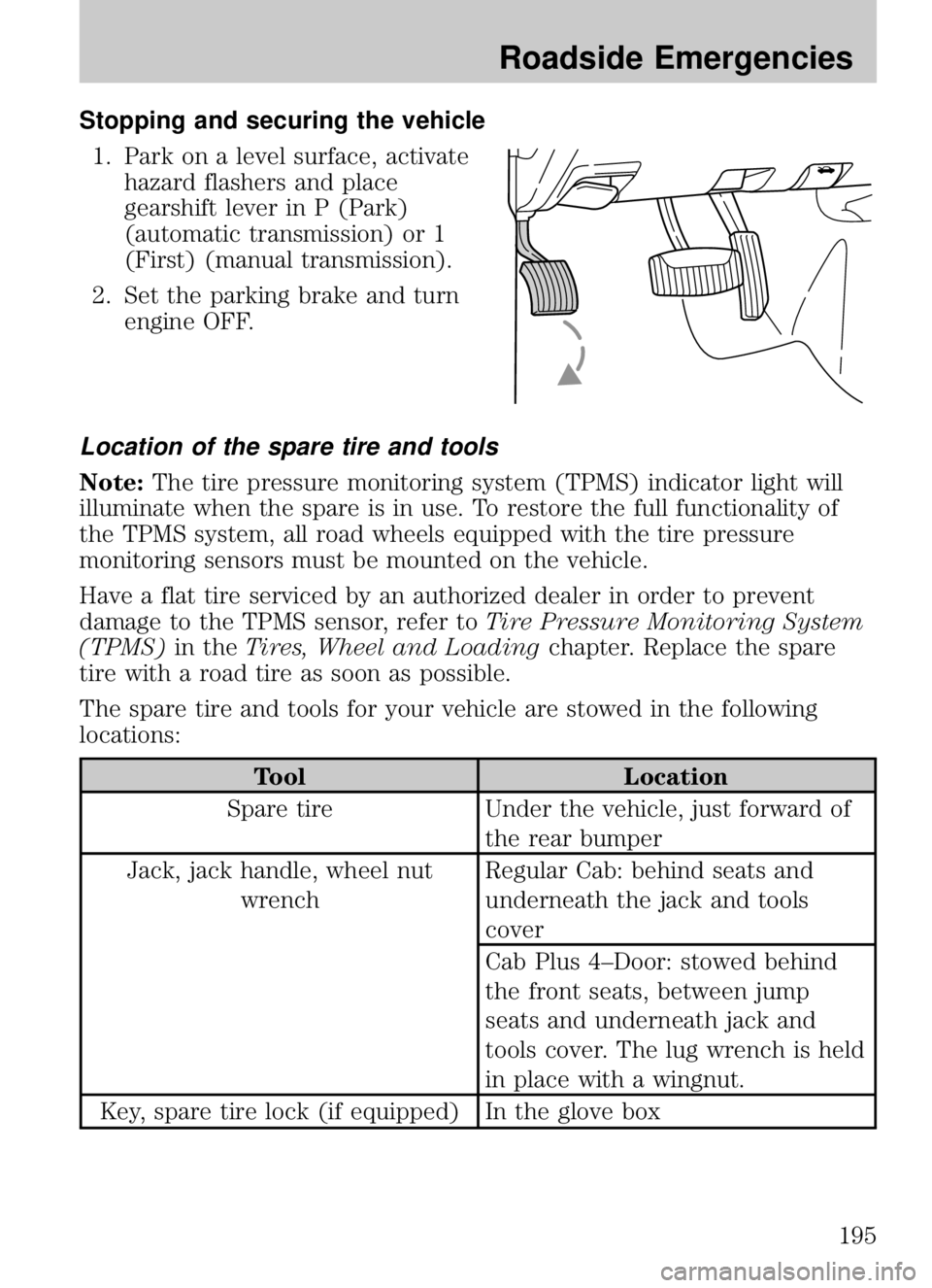
Stopping and securing the vehicle1. Park on a level surface, activate hazard flashers and place
gearshift lever in P (Park)
(automatic transmission) or 1
(First) (manual transmission).
2. Set the parking brake and turn engine OFF.
Location of the spare tire and tools
Note: The tire pressure monitoring system (TPMS) indicator light will
illuminate when the spare is in use. To restore the full functionality of
the TPMS system, all road wheels equipped with the tire pressure
monitoring sensors must be mounted on the vehicle.
Have a flat tire serviced by an authorized dealer in order to prevent
damage to the TPMS sensor, refer to Tire Pressure Monitoring System
(TPMS) in theTires, Wheel and Loading chapter. Replace the spare
tire with a road tire as soon as possible.
The spare tire and tools for your vehicle are stowed in the following
locations:
Tool Location
Spare tire Under the vehicle, just forward of
the rear bumper
Jack, jack handle, wheel nut wrench Regular Cab: behind seats and
underneath the jack and tools
cover
Cab Plus 4–Door: stowed behind
the front seats, between jump
seats and underneath jack and
tools cover. The lug wrench is held
in place with a wingnut.
Key, spare tire lock (if equipped) In the glove box
2009 B-Series (mbs)
Owners Guide, 1st Printing
USA (fus)
Roadside Emergencies
195
Page 197 of 288
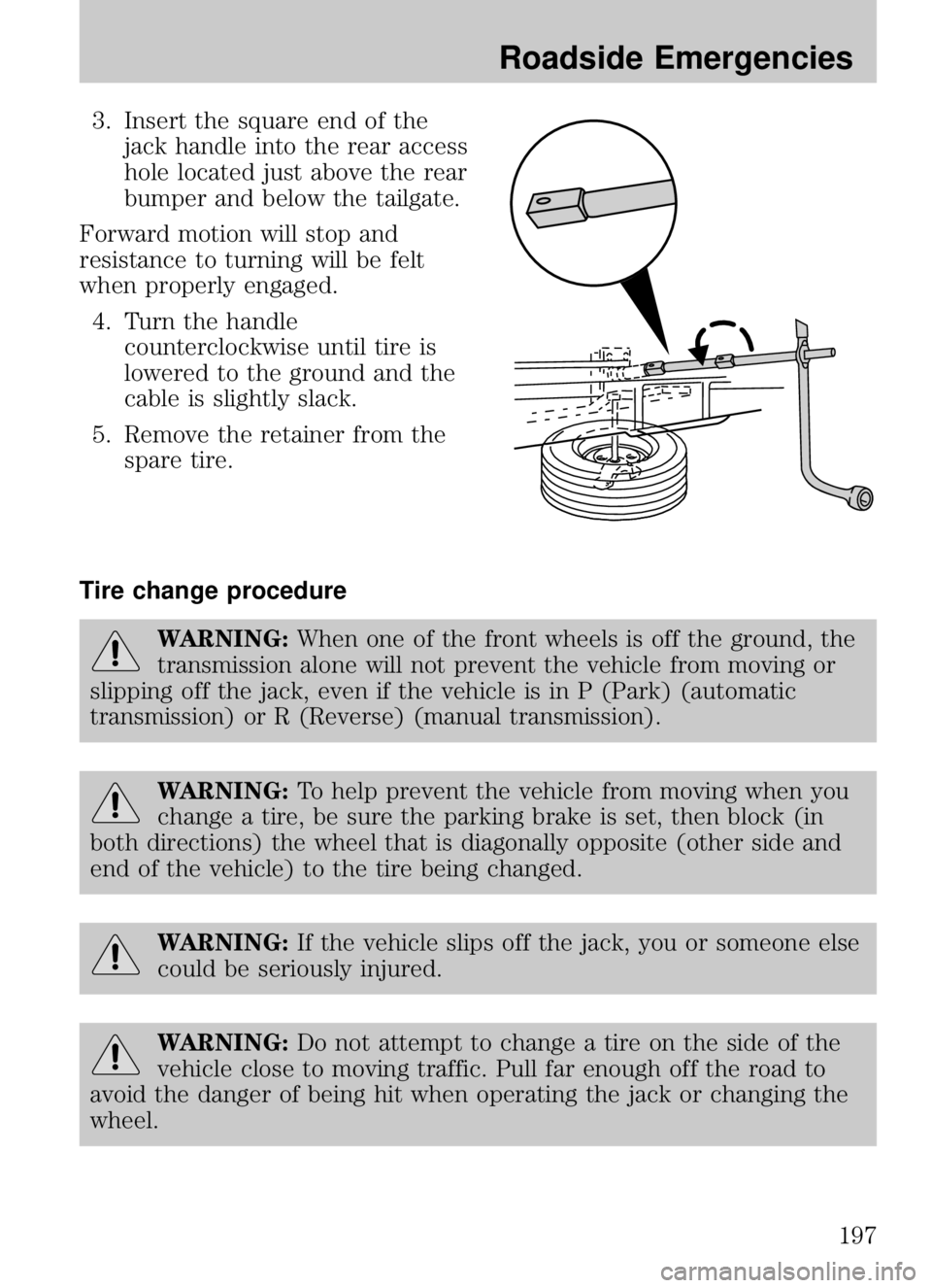
3. Insert the square end of thejack handle into the rear access
hole located just above the rear
bumper and below the tailgate.
Forward motion will stop and
resistance to turning will be felt
when properly engaged. 4. Turn the handle counterclockwise until tire is
lowered to the ground and the
cable is slightly slack.
5. Remove the retainer from the spare tire.
Tire change procedure
WARNING: When one of the front wheels is off the ground, the
transmission alone will not prevent the vehicle from moving or
slipping off the jack, even if the vehicle is in P (Park) (automatic
transmission) or R (Reverse) (manual transmission).
WARNING: To help prevent the vehicle from moving when you
change a tire, be sure the parking brake is set, then block (in
both directions) the wheel that is diagonally opposite (other side and
end of the vehicle) to the tire being changed.
WARNING: If the vehicle slips off the jack, you or someone else
could be seriously injured.
WARNING: Do not attempt to change a tire on the side of the
vehicle close to moving traffic. Pull far enough off the road to
avoid the danger of being hit when operating the jack or changing the
wheel.
2009 B-Series (mbs)
Owners Guide, 1st Printing
USA (fus)
Roadside Emergencies
197
Page 201 of 288
WARNING:When a wheel is installed, always remove any
corrosion, dirt or foreign materials present on the mounting
surfaces of the wheel or the surface of the wheel hub, brake drum or
brake disc that contacts the wheel. Ensure that any fasteners that
attach the rotor to the hub are secured so they do not interfere with
the mounting surfaces of the wheel. Installing wheels without correct
metal-to-metal contact at the wheel mounting surfaces can cause the
wheel nuts to loosen and the wheel to come off while the vehicle is in
motion, resulting in loss of control.
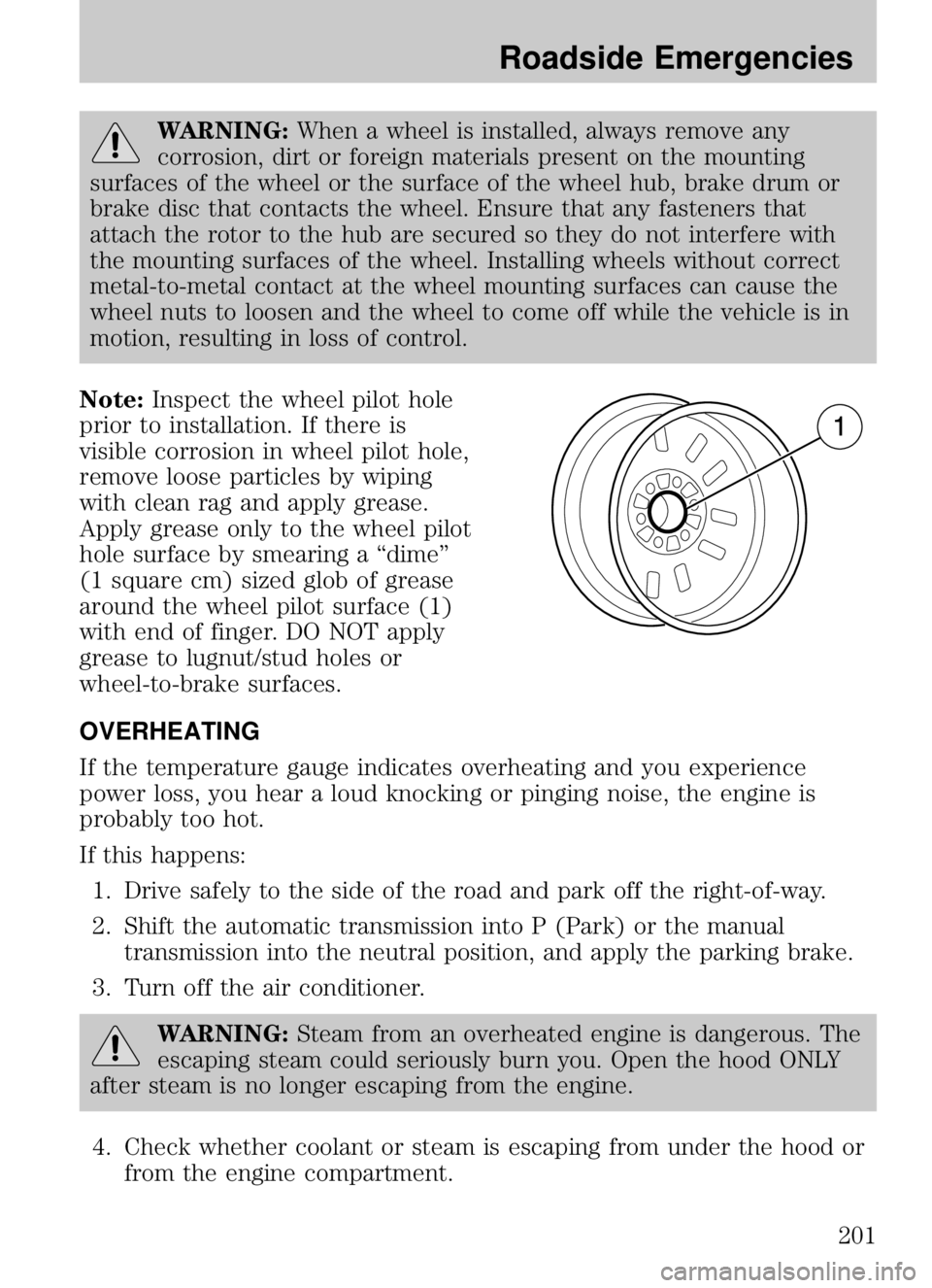
Note: Inspect the wheel pilot hole
prior to installation. If there is
visible corrosion in wheel pilot hole,
remove loose particles by wiping
with clean rag and apply grease.
Apply grease only to the wheel pilot
hole surface by smearing a “dime”
(1 square cm) sized glob of grease
around the wheel pilot surface (1)
with end of finger. DO NOT apply
grease to lugnut/stud holes or
wheel-to-brake surfaces.
OVERHEATING
If the temperature gauge indicates overheating and you experience
power loss, you hear a loud knocking or pinging noise, the engine is
probably too hot.
If this happens:
1. Drive safely to the side of the road and park off the right-of-way.
2. Shift the automatic transmission into P (Park) or the manual transmission into the neutral position, and apply the parking brake.
3. Turn off the air conditioner.
WARNING: Steam from an overheated engine is dangerous. The
escaping steam could seriously burn you. Open the hood ONLY
after steam is no longer escaping from the engine.
4. Check whether coolant or steam is escaping from under the hood or from the engine compartment.
2009 B-Series (mbs)
Owners Guide, 1st Printing
USA (fus)
Roadside Emergencies
201
Page 202 of 288
•If steam is coming from the engine compartment: do not go near
the front of the vehicle. Stop the engine, then turn the ignition switch
to the ON position without starting the engine. The radiator cooling
fans will start to cool the engine.
• If neither coolant nor steam is escaping: open the hood and idle
the engine until it cools. If this does not lower the temperature, stop
the engine and let it cool.
5. Check the coolant level. If it is low, look for leaks in the radiator hoses and connections, heater hoses and connections, radiator and
water pump.
If you find a leak or other damage, or if coolant is still leaking, stop the
engine and call an authorized dealer.
WARNING: When the engine and radiator are hot, scalding
coolant and steam may shoot out under pressure and cause
serious injury. Do not remove the cooling system cap when the engine
and radiator are hot.
See Adding coolant in theMaintenance and Specifications section. If
you find no problems, the engine is cool and no leaks are obvious,
carefully add coolant as required.
Note: If the engine continues to overheat or frequently overheats, have
the cooling system inspected. The engine could be seriously damaged
unless repairs are made.
JUMP STARTING
WARNING: The gases around the battery can explode if
exposed to flames, sparks, or lit cigarettes. An explosion could
result in injury or vehicle damage.
WARNING: Batteries contain sulfuric acid which can burn skin,
eyes and clothing, if contacted.
Do not attempt to push-start your automatic transmission
vehicle. Automatic transmissions do not have push-start
capability. Attempting to push-start a vehicle with an automatic
transmission may cause transmission damage.
Preparing your vehicle
When the battery is disconnected or a new battery is installed, the
automatic transmission must relearn its shift strategy. As a result, the
2009 B-Series (mbs)
Owners Guide, 1st Printing
USA (fus)
Roadside Emergencies
202
Page 229 of 288
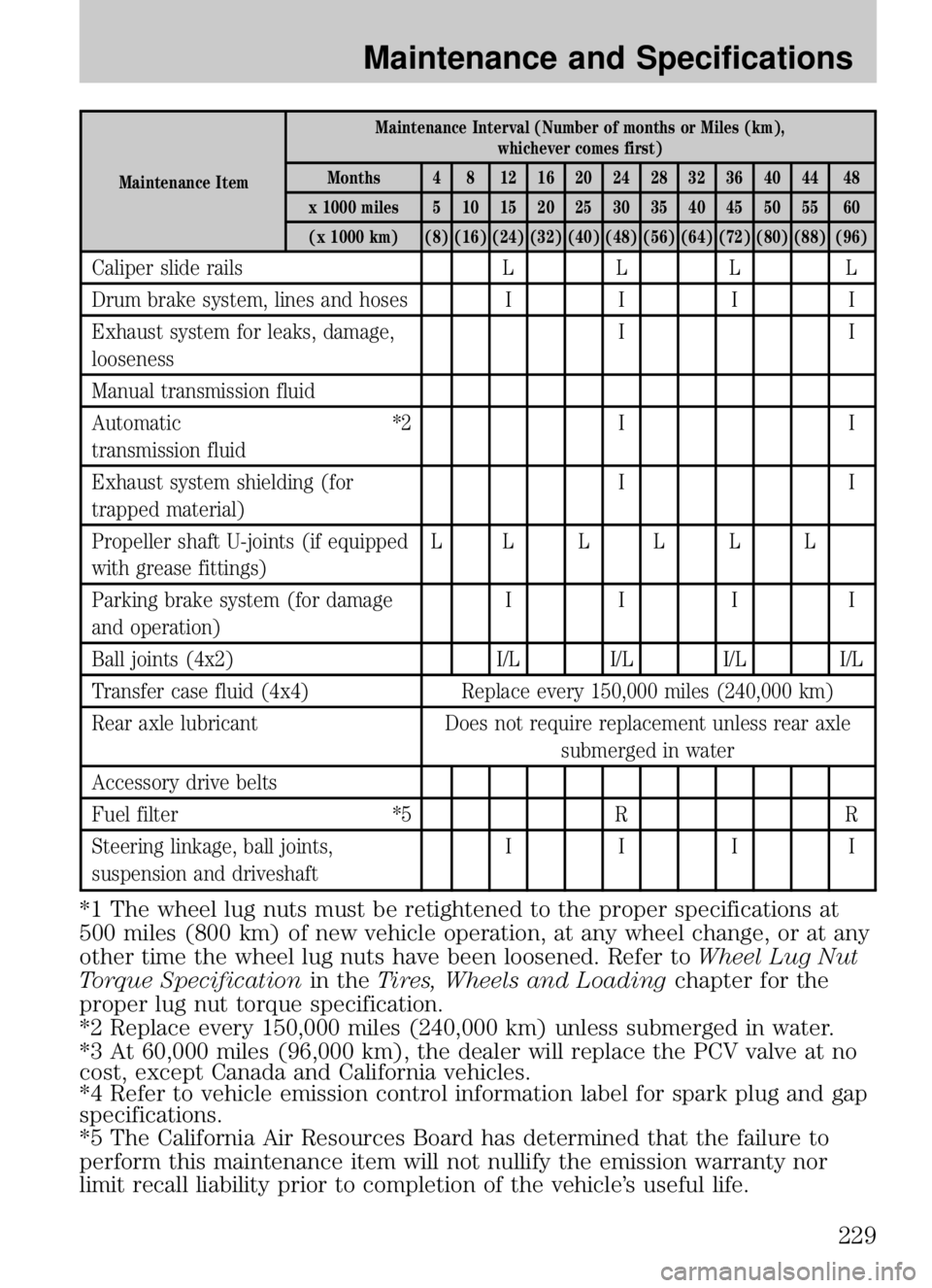
Maintenance ItemMaintenance Interval (Number of months or Miles (km),
whichever comes first)
Months 4 8 12 16 20 24 28 32 36 40 44 48
x 1000 miles 5 10 15 20 25 30 35 40 45 50 55 60 (x 1000 km) (8) (16) (24) (32) (40) (48) (56) (64) (72) (80) (88) (96)
Caliper slide rails LLL L
Drum brake system, lines and hoses I II I
Exhaust system for leaks, damage,
looseness II
Manual transmission fluid
Automatic
transmission fluid *2
I I
Exhaust system shielding (for
trapped material) II
Propeller shaft U-joints (if equipped
with grease fittings) LLLLLL
Parking brake system (for damage
and operation) III I
Ball joints (4x2) I/L I/L I/L I/L
Transfer case fluid (4x4) Replace every 150,000 miles (240,000 km)
Rear axle lubricant Does not require replacement unless rear axle
submerged in water
Accessory drive belts
Fuel filter *5R R
Steering linkage, ball joints,
suspension and driveshaft III I
*1 The wheel lug nuts must be retightened to the proper specifications at
500 miles (800 km) of new vehicle operation, at any wheel change, or at any
other time the wheel lug nuts have been loosened. Refer to
Wheel Lug Nut
Torque Specification in theTires, Wheels and Loading chapter for the
proper lug nut torque specification.
*2 Replace every 150,000 miles (240,000 km) unless submerged in water.
*3 At 60,000 miles (96,000 km), the dealer will replace the PCV valve at no
cost, except Canada and California vehicles.
*4 Refer to vehicle emission control information label for spark plug and gap
specifications.
*5 The California Air Resources Board has determined that the failure to
perform this maintenance item will not nullify the emission warranty nor
limit recall liability prior to completion of the vehicle’s useful life.
2009 B-Series (mbs)
Owners Guide, 1st Printing
USA (fus)
Maintenance and Specifications
229
Page 231 of 288
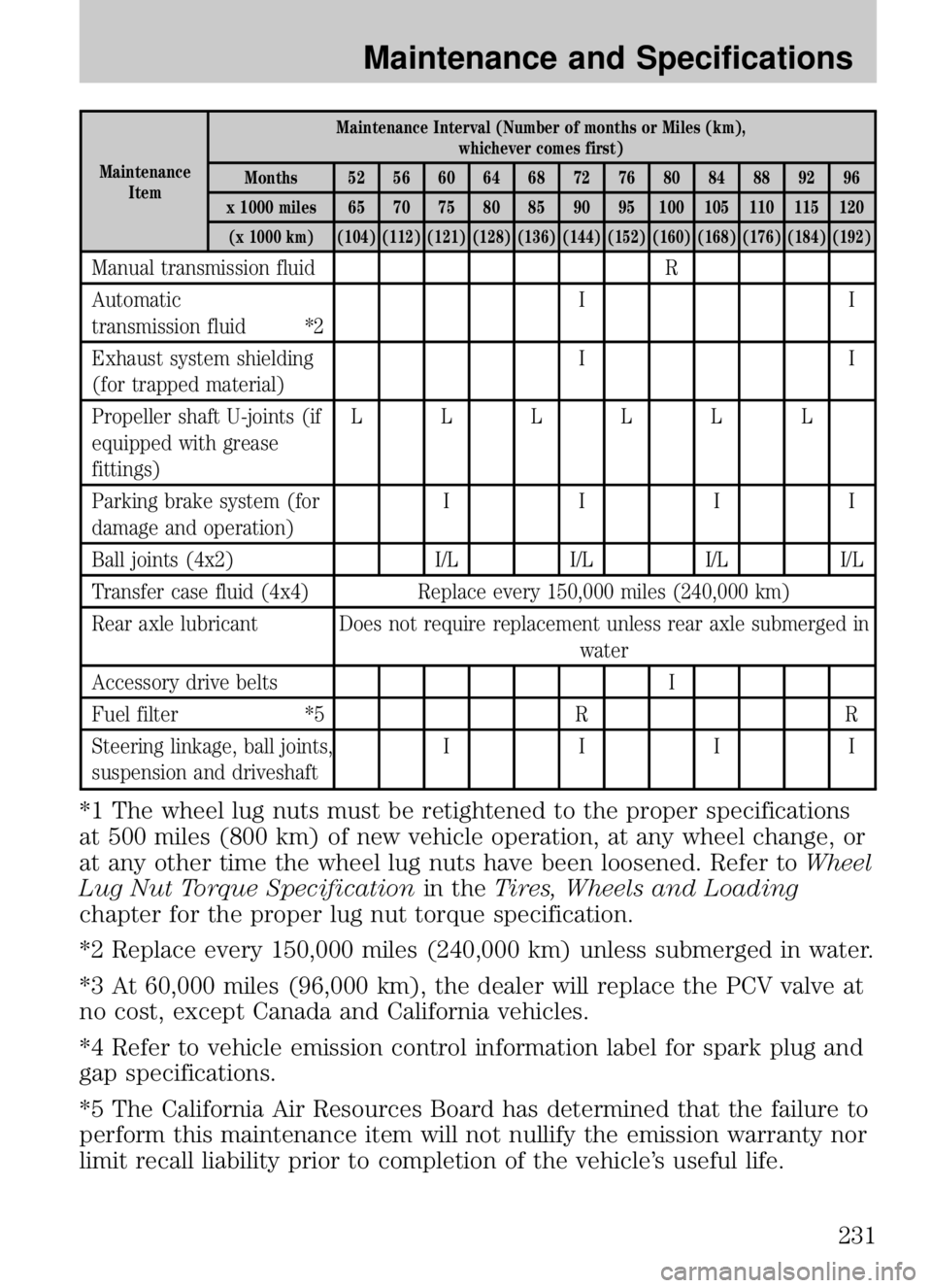
MaintenanceItem Maintenance Interval (Number of months or Miles (km),
whichever comes first)
Months 52 56 60 64 68 72 76 80 84 88 92 96
x 1000 miles 65 70 75 80 85 90 95 100 105 110 115 120
(x 1000 km) (104) (112) (121) (128) (136) (144) (152) (160) (168) (176) (184) (192)
Manual transmission fluid R
Automatic
transmission fluid *2 II
Exhaust system shielding
(for trapped material) II
Propeller shaft U-joints (if
equipped with grease
fittings) LLLLLL
Parking brake system (for
damage and operation) IIII
Ball joints (4x2) I/LI/LI/LI/L
Transfer case fluid (4x4) Replace every 150,000 miles (240,000 km)
Rear axle lubricant Does not require replacement unless rear axle submerged in water
Accessory drive belts I
Fuel filter *5 RR
Steering linkage, ball joints,
suspension and driveshaft IIII
*1 The wheel lug nuts must be retightened to the proper specifications
at 500 miles (800 km) of new vehicle operation, at any wheel change, or
at any other time the wheel lug nuts have been loosened. Refer to
Wheel
Lug Nut Torque Specification in theTires, Wheels and Loading
chapter for the proper lug nut torque specification.
*2 Replace every 150,000 miles (240,000 km) unless submerged in water.
*3 At 60,000 miles (96,000 km), the dealer will replace the PCV valve at
no cost, except Canada and California vehicles.
*4 Refer to vehicle emission control information label for spark plug and
gap specifications.
*5 The California Air Resources Board has determined that the failure to
perform this maintenance item will not nullify the emission warranty nor
limit recall liability prior to completion of the vehicle’s useful life.
2009 B-Series (mbs)
Owners Guide, 1st Printing
USA (fus)
Maintenance and Specifications
231
Page 233 of 288
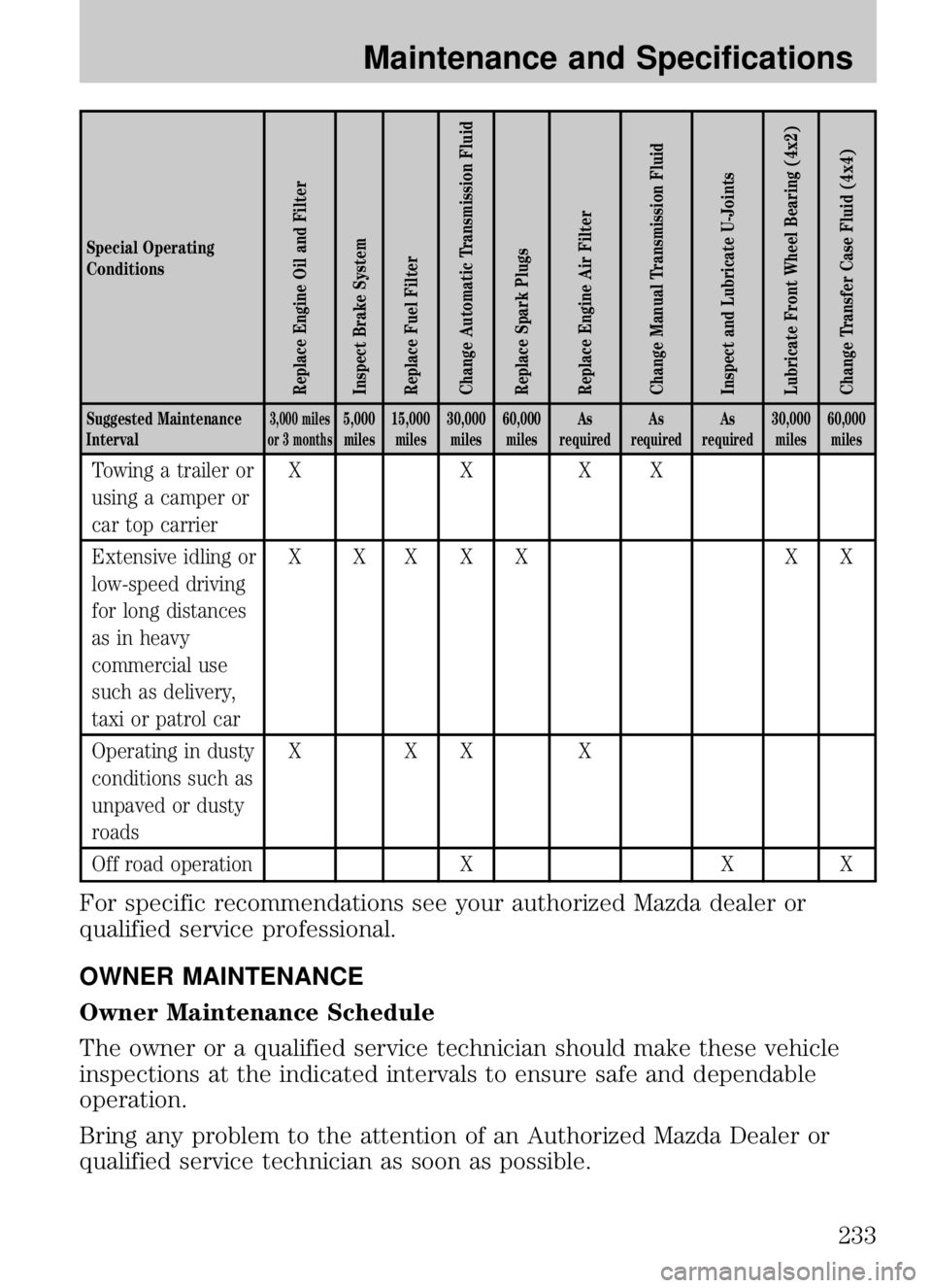
Special Operating
Conditions
Replace Engine Oil and Filter
Inspect Brake System
Replace Fuel Filter
Change Automatic Transmission Fluid
Replace Spark Plugs
Replace Engine Air Filter
Change Manual Transmission Fluid
Inspect and Lubricate U-Joints
Lubricate Front Wheel Bearing (4x2)
Change Transfer Case Fluid (4x4)
Suggested Maintenance
Interval3,000 miles
or 3 months5,000 miles 15,000
miles 30,000
miles 60,000
miles As
required As
required As
required 30,000
miles 60,000
miles
Towing a trailer or
using a camper or
car top carrier X XX
X
Extensive idling or
low-speed driving
for long distances
as in heavy
commercial use
such as delivery,
taxi or patrol car X XXXX
XX
Operating in dusty
conditions such as
unpaved or dusty
roads X XX X
Off road operation XXX
For specific recommendations see your authorized Mazda dealer or
qualified service professional.
OWNER MAINTENANCE
Owner Maintenance Schedule
The owner or a qualified service technician should make these vehicle
inspections at the indicated intervals to ensure safe and dependable
operation.
Bring any problem to the attention of an Authorized Mazda Dealer or
qualified service technician as soon as possible.
2009 B-Series (mbs)
Owners Guide, 1st Printing
USA (fus)
Maintenance and Specifications
233
Page 236 of 288
•Manual transmission:
1. Set the parking brake, depress the clutch and place the gearshift in 1 (First).
2. Turn off the engine and remove the key.
3. Block the wheels.
Working with the engine on
• Automatic transmission:
1. Set the parking brake and shift to P (Park).
2. Block the wheels.
• Manual transmission:
1. Set the parking brake, depress the clutch pedal, place the gearshift in N (Neutral), and release the clutch pedal.
2. Block the wheels.
WARNING: To reduce the risk of vehicle damage and/or
personal burn injuries, do not start your engine with the air
cleaner removed and do not remove it while the engine is running.
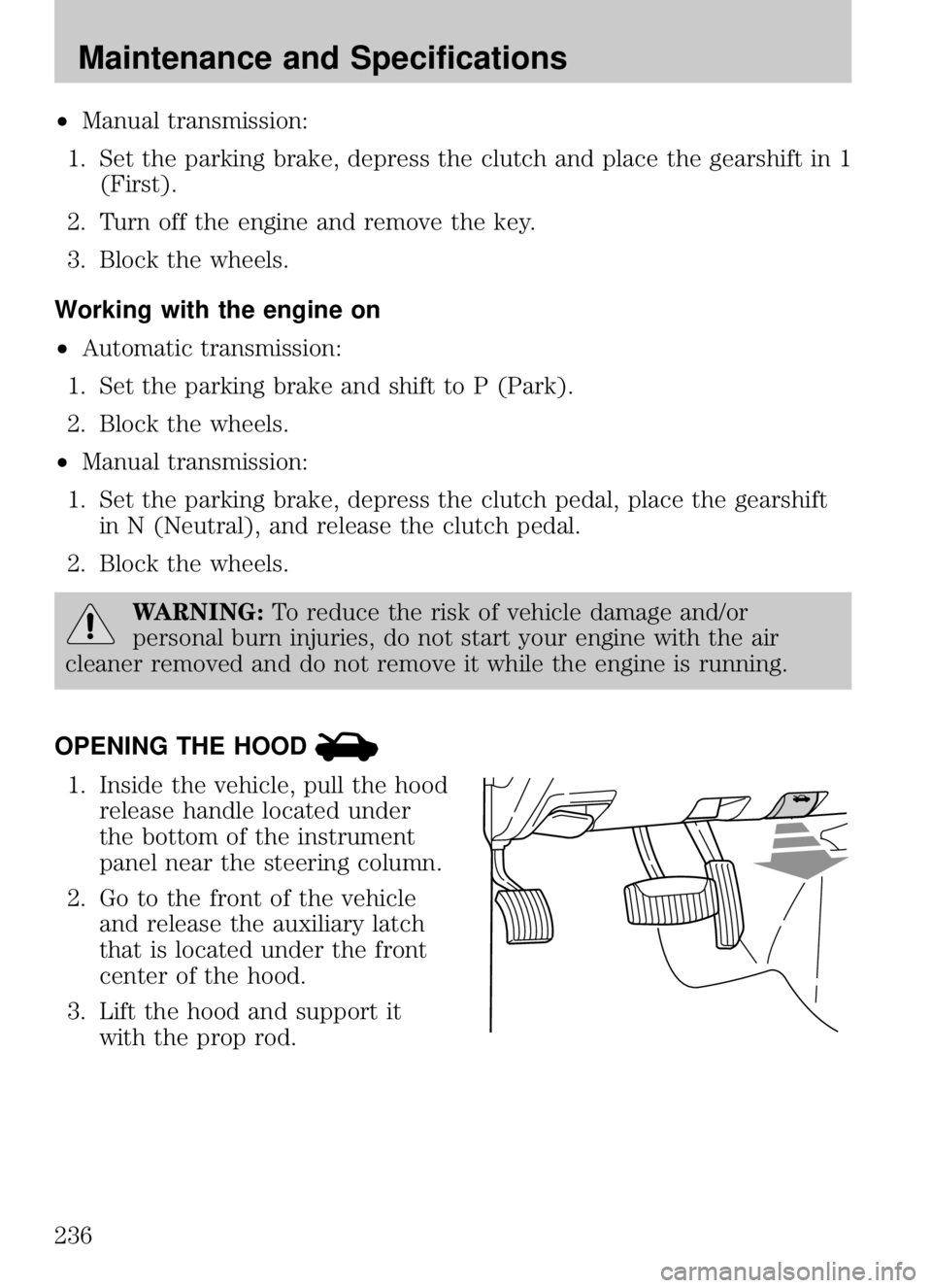
OPENING THE HOOD
1. Inside the vehicle, pull the hood release handle located under
the bottom of the instrument
panel near the steering column.
2. Go to the front of the vehicle and release the auxiliary latch
that is located under the front
center of the hood.
3. Lift the hood and support it with the prop rod.
2009 B-Series (mbs)
Owners Guide, 1st Printing
USA (fus)
Maintenance and Specifications
236
Page 246 of 288
WARNING:Batteries normally produce explosive gases which
can cause personal injury. Therefore, do not allow flames, sparks
or lighted substances to come near the battery. When working near the
battery, always shield your face and protect your eyes. Always provide
proper ventilation.
WARNING: When lifting a plastic-cased battery, excessive
pressure on the end walls could cause acid to flow through the
vent caps, resulting in personal injury and/or damage to the vehicle or
battery. Lift the battery with a battery carrier or with your hands on
opposite corners.
WARNING: Keep batteries out of reach of children. Batteries
contain sulfuric acid. Avoid contact with skin, eyes or clothing.
Shield your eyes when working near the battery to protect against
possible splashing of acid solution. In case of acid contact with skin or
eyes, flush immediately with water for a minimum of 15 minutes and
get prompt medical attention. If acid is swallowed, call a physician
immediately.
WARNING: Battery posts, terminals and related accessories
contain lead and lead compounds. Wash hands after handling.
Because your vehicle’s engine is electronically controlled by a computer,
some control conditions are maintained by power from the battery. When
the battery is disconnected or a new battery is installed, the engine must
relearn its idle and fuel trim strategy for optimum driveability and
performance. To begin this process: 1. With the vehicle at a complete stop, set the parking brake.
2. Put the gearshift in P (Park) (automatic transmission) or the neutral position (manual transmission), turn off all accessories and start the
engine.
3. Run the engine until it reaches normal operating temperature.
4. Allow the engine to idle for at least one minute.
5. Turn the A/C on and allow the engine to idle for at least one minute.
6. Drive the vehicle to complete the relearning process.
2009 B-Series (mbs)
Owners Guide, 1st Printing
USA (fus)
Maintenance and Specifications
246
Page 261 of 288
•Driving on flat terrain offers improved fuel economy as compared to
driving on hilly terrain.
• Transmissions give their best fuel economy when operated in the top
cruise gear and with steady pressure on the gas pedal.
• Four-wheel-drive operation (if equipped) is less fuel efficient than
two-wheel-drive operation.
• Close windows for high speed driving.
EPA fuel economy estimates
Every new vehicle should have a window sticker containing EPA fuel
economy estimates. Contact your authorized dealer if the window sticker
is not supplied with your vehicle. The EPA fuel economy estimates
should be your guide for the fuel economy comparisons with other
vehicles. Your fuel economy may vary depending upon the method of
operation and conditions.
EMISSION CONTROL SYSTEM
Your vehicle is equipped with various emission control components and a
catalytic converter which will enable your vehicle to comply with
applicable exhaust emission standards. To make sure that the catalytic
converter and other emission control components continue to work
properly:
• Use only the specified fuel listed.
• Avoid running out of fuel.
• Do not turn off the ignition while your vehicle is moving, especially at
high speeds.
• Have the items listed in the scheduled maintenancesection
performed according to the specified schedule.
The scheduled maintenance items listed in the scheduled maintenance
section are essential to the life and performance of your vehicle and to
its emissions system.
If other than Mazda authorized parts are used for maintenance
replacements or for service of components affecting emission control,
such non-Mazda parts should be equivalent to genuine Mazda parts in
performance and durability.
WARNING: Do not park, idle, or drive your vehicle in dry grass
or other dry ground cover. The emission system heats up the
engine compartment and exhaust system, which can start a fire.
2009 B-Series (mbs)
Owners Guide, 1st Printing
USA (fus)
Maintenance and Specifications
261