fuel MAZDA MODEL B4000 TRUCK 2005 User Guide
[x] Cancel search | Manufacturer: MAZDA, Model Year: 2005, Model line: MODEL B4000 TRUCK, Model: MAZDA MODEL B4000 TRUCK 2005Pages: 256, PDF Size: 2 MB
Page 52 of 256
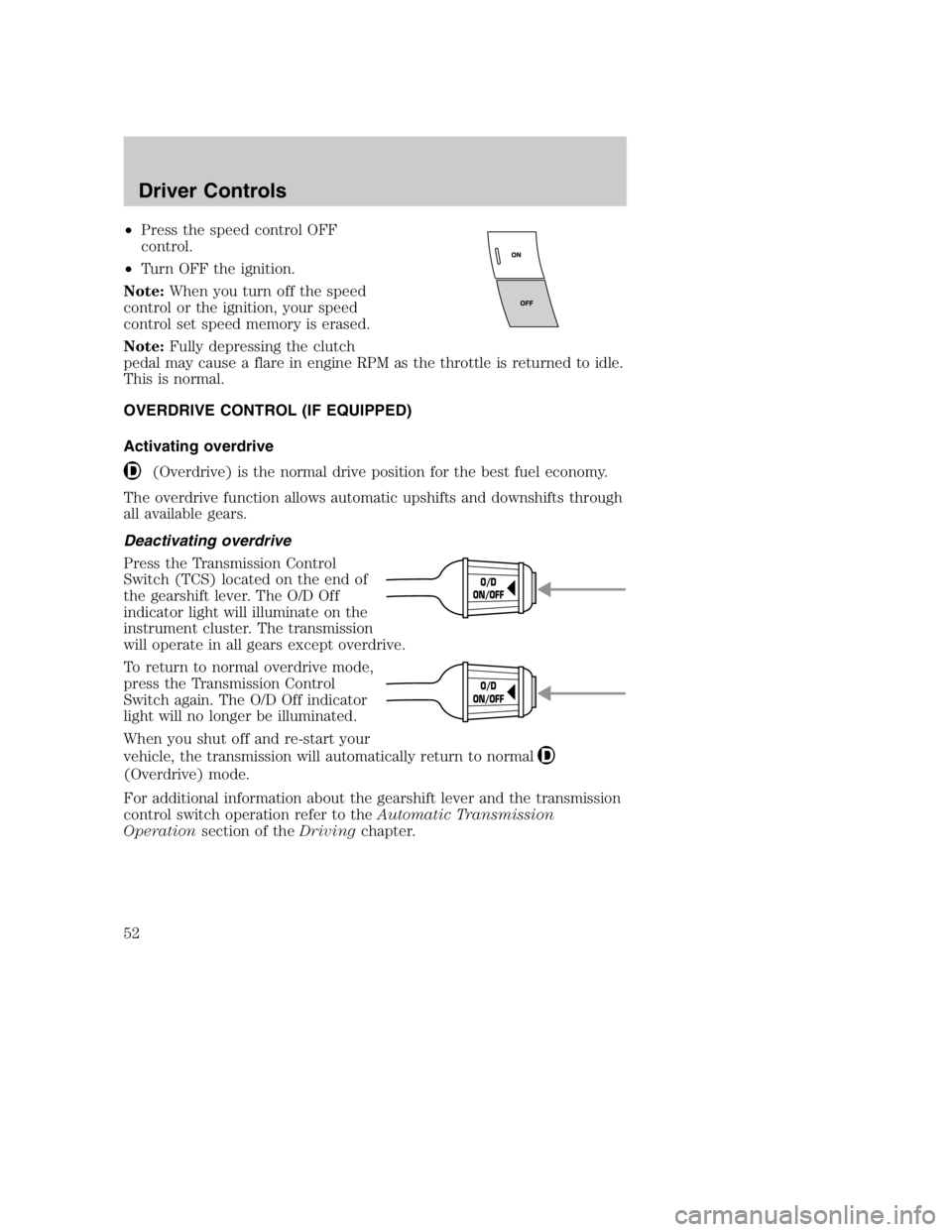
•Press the speed control OFF
control.
• Turn OFF the ignition.
Note: When you turn off the speed
control or the ignition, your speed
control set speed memory is erased.
Note: Fully depressing the clutch
pedal may cause a flare in engine RPM as the throttle is returned to idle.
This is normal.
OVERDRIVE CONTROL (IF EQUIPPED)
Activating overdrive
(Overdrive) is the normal drive position for the best fuel economy.
The overdrive function allows automatic upshifts and downshifts through
all available gears.
Deactivating overdrive
Press the Transmission Control
Switch (TCS) located on the end of
the gearshift lever. The O/D Off
indicator light will illuminate on the
instrument cluster. The transmission
will operate in all gears except overdrive.
To return to normal overdrive mode,
press the Transmission Control
Switch again. The O/D Off indicator
light will no longer be illuminated.
When you shut off and re-start your
vehicle, the transmission will automatically return to normal
(Overdrive) mode.
For additional information about the gearshift lever and the transmission
control switch operation refer to the Automatic Transmission
Operation section of the Drivingchapter.
O/D
ON/OFF
O/D
ON/OFF
2004 Mazda B Series (mbs)
Owners Guide (post-2002-fmt)
USA English (fus)
Driver Controls
52
Page 105 of 256
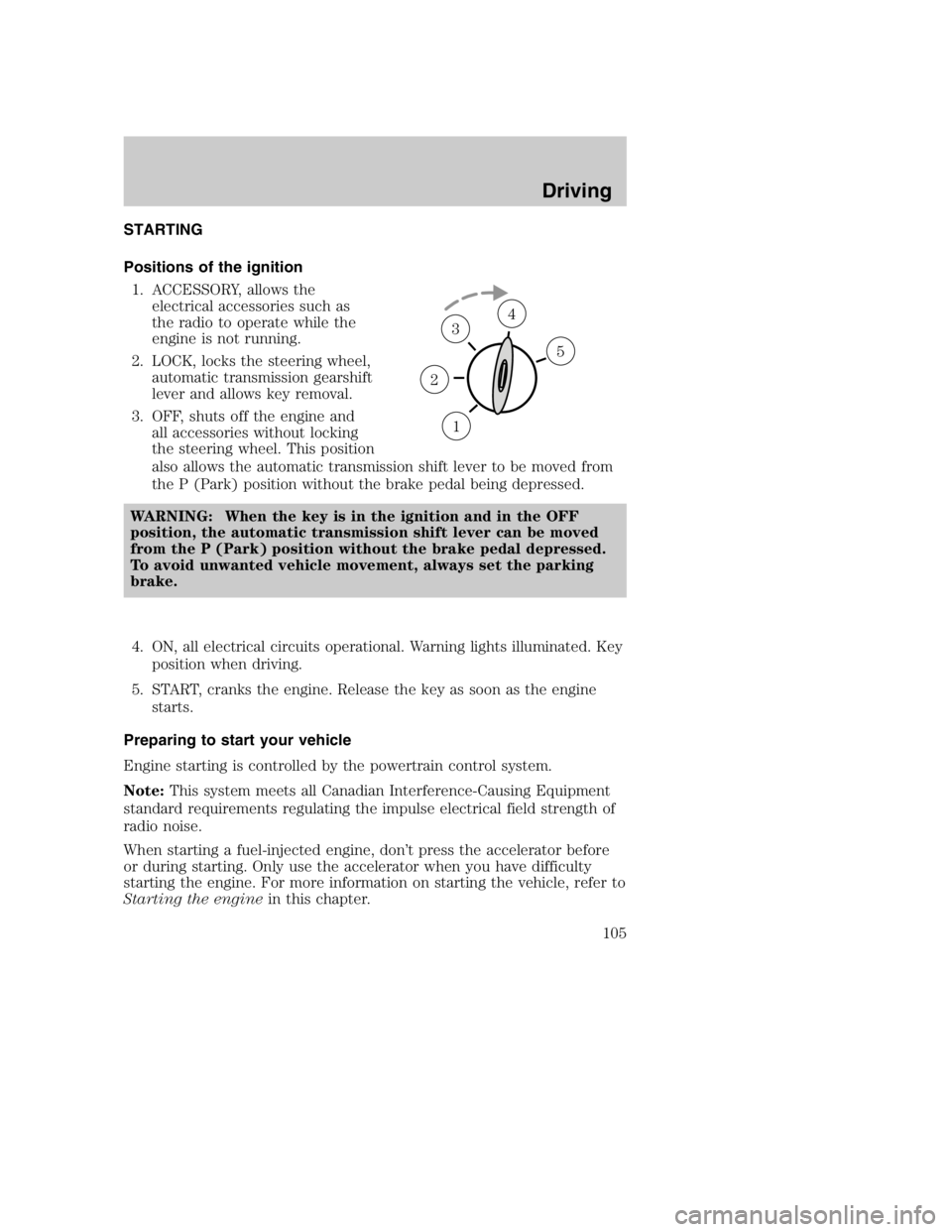
STARTING
Positions of the ignition1. ACCESSORY, allows the electrical accessories such as
the radio to operate while the
engine is not running.
2. LOCK, locks the steering wheel, automatic transmission gearshift
lever and allows key removal.
3. OFF, shuts off the engine and all accessories without locking
the steering wheel. This position
also allows the automatic transmission shift lever to be moved from
the P (Park) position without the brake pedal being depressed.
WARNING: When the key is in the ignition and in the OFF
position, the automatic transmission shift lever can be moved
from the P (Park) position without the brake pedal depressed.
To avoid unwanted vehicle movement, always set the parking
brake.
4. ON, all electrical circuits operational. Warning lights illuminated. Key position when driving.
5. START, cranks the engine. Release the key as soon as the engine starts.
Preparing to start your vehicle
Engine starting is controlled by the powertrain control system.
Note: This system meets all Canadian Interference-Causing Equipment
standard requirements regulating the impulse electrical field strength of
radio noise.
When starting a fuel-injected engine, don’t press the accelerator before
or during starting. Only use the accelerator when you have difficulty
starting the engine. For more information on starting the vehicle, refer to
Starting the engine in this chapter.
1
2
34
5
2004 Mazda B Series (mbs)
Owners Guide (post-2002-fmt)
USA English (fus)
Driving
Driving
105
Page 108 of 256
•steering wheel is turned when getting in or out of the vehicle
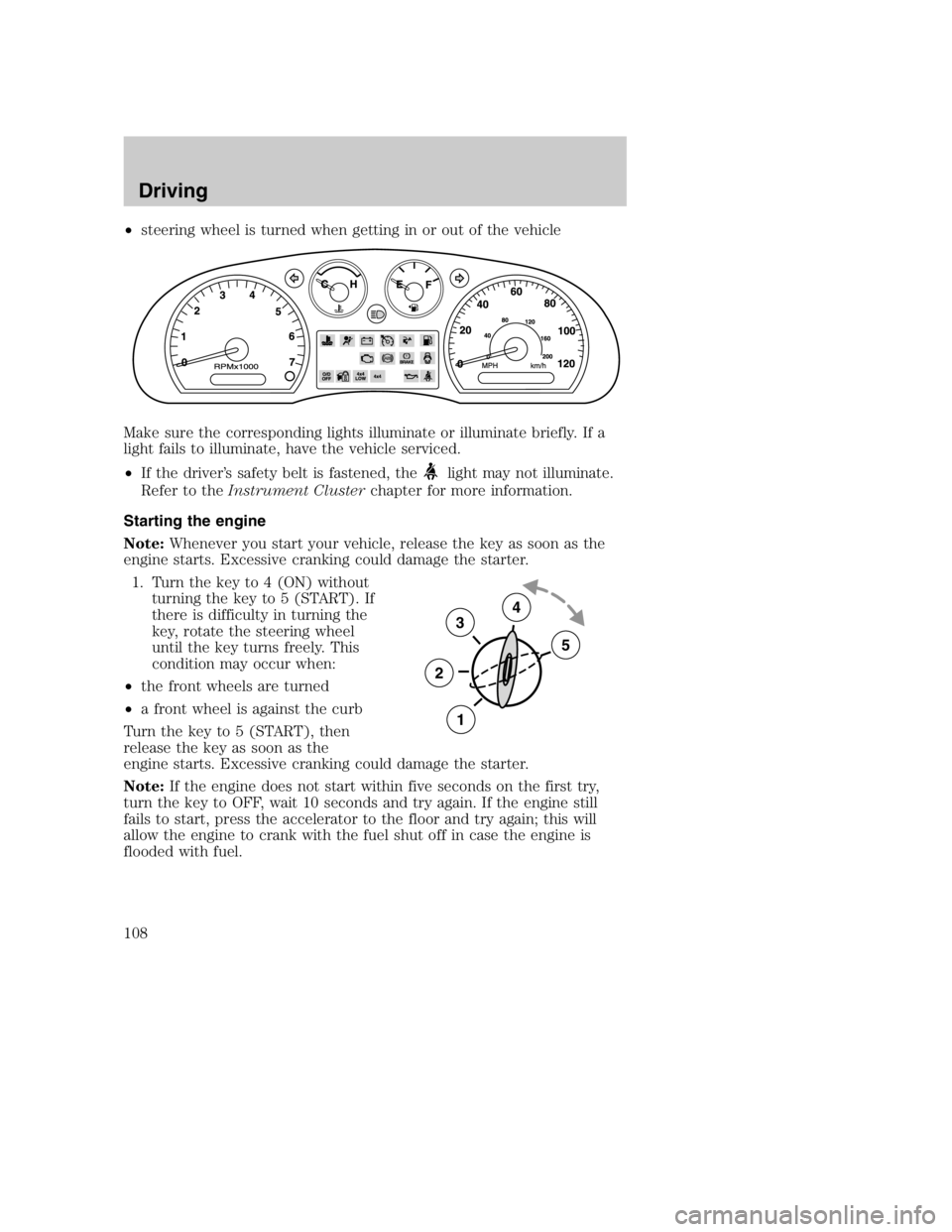
Make sure the corresponding lights illuminate or illuminate briefly. If a
light fails to illuminate, have the vehicle serviced.
• If the driver’s safety belt is fastened, the
light may not illuminate.
Refer to the Instrument Cluster chapter for more information.
Starting the engine
Note: Whenever you start your vehicle, release the key as soon as the
engine starts. Excessive cranking could damage the starter.
1. Turn the key to 4 (ON) without turning the key to 5 (START). If
there is difficulty in turning the
key, rotate the steering wheel
until the key turns freely. This
condition may occur when:
• the front wheels are turned
• a front wheel is against the curb
Turn the key to 5 (START), then
release the key as soon as the
engine starts. Excessive cranking could damage the starter.
Note: If the engine does not start within five seconds on the first try,
turn the key to OFF, wait 10 seconds and try again. If the engine still
fails to start, press the accelerator to the floor and try again; this will
allow the engine to crank with the fuel shut off in case the engine is
flooded with fuel.
3
2
1
5
4
2004 Mazda B Series (mbs)
Owners Guide (post-2002-fmt)
USA English (fus)
Driving
108
Page 109 of 256
Cold weather starting (flexible fuel vehicles only)
In cold weather, ethanol fuel distributors should supply winter grade
(E
d85) ethanol. If summer grade (Ed85) ethanol is used in cold weather,
you may experience increased cranking times, rough idle or hesitation
until the engine has warmed up. Consult your fuel distributor for the
availability of winter grade (E
d85) ethanol. High-quality blends of winter
grade (E
d85) ethanol will produce satisfactory cold weather starting and
driving results.
Cold starting performance can also be improved by using an engine block
heater. Engine block heaters are available as an option and can be
obtained from your Mazda dealer. Consult the engine block heater
section for proper use of the engine block heater.
If you experience cold weather starting problems on (E
d85) ethanol, and
neither an alternative brand of (E
d85) ethanol nor an engine block
heater is available, adding unleaded gasoline to your tank will improve
cold starting performance. Your vehicle is designed to operate on (E
d85)
ethanol, unleaded gasoline alone, or any mixture of the two.
If the engine fails to start using the preceding instructions (flexible
fuel vehicles only)
1. Press and hold down the accelerator 1/3 to 1/2 way to floor, then crank the engine.
2. When the engine starts, release the key, then gradually release the accelerator pedal as the engine speeds up. If the engine still fails to
start, repeat Step 1.
Using the engine block heater (if equipped)
An engine block heater warms the engine coolant which aids in starting
and heater/defroster performance. Use of an engine block heater is
strongly recommended if you live in a region where temperatures reach
-23° C (-10° F) or below. For best results, plug the heater in at least
three hours before starting the vehicle. The heater can be plugged in the
night before starting the vehicle. WARNING: To reduce the risk of electrical shock, do not use
your heater with ungrounded electrical systems or two-pronged
(cheater) adapters.
2004 Mazda B Series (mbs)
Owners Guide (post-2002-fmt)
USA English (fus)
Driving
109
Page 112 of 256
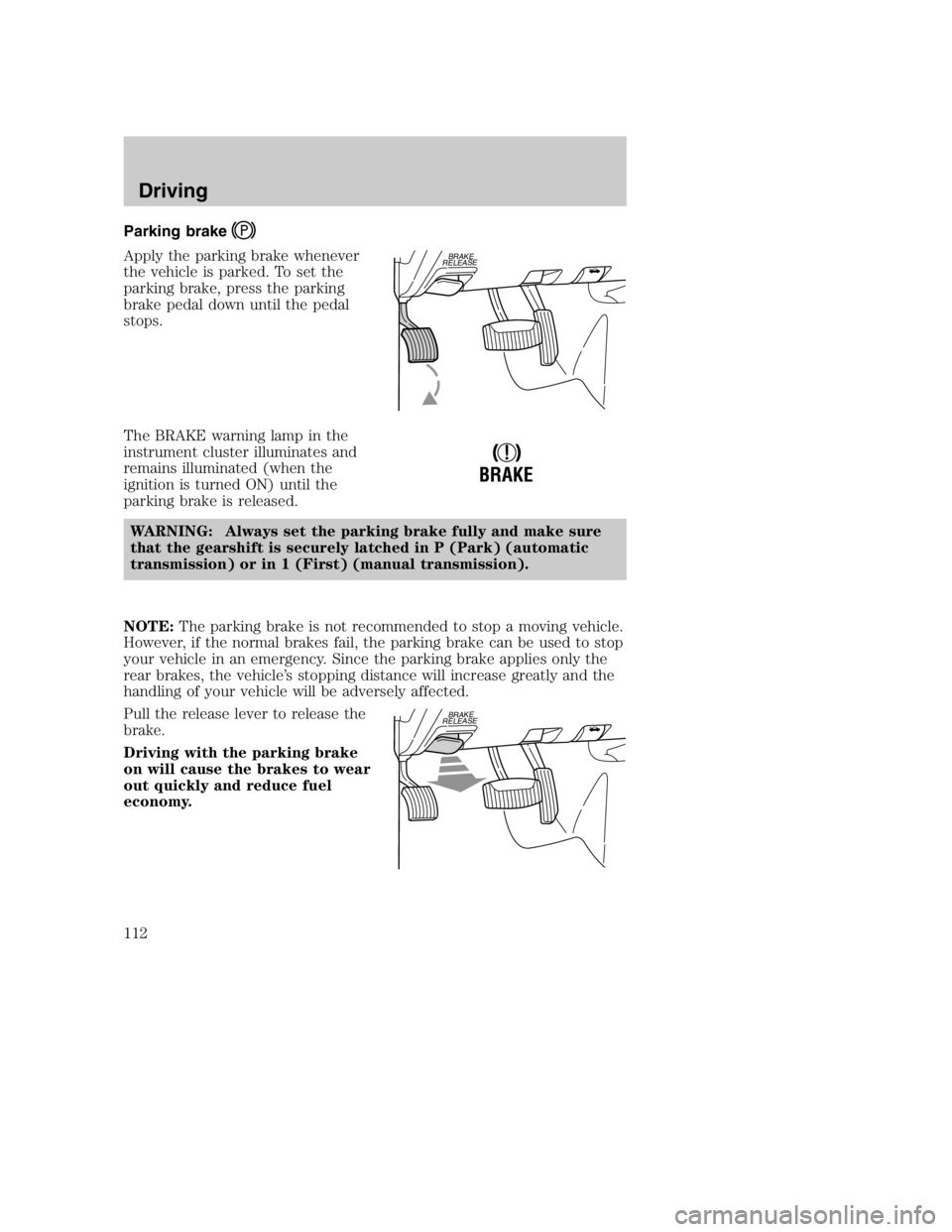
Parking brake
Apply the parking brake whenever
the vehicle is parked. To set the
parking brake, press the parking
brake pedal down until the pedal
stops.
The BRAKE warning lamp in the
instrument cluster illuminates and
remains illuminated (when the
ignition is turned ON) until the
parking brake is released.WARNING: Always set the parking brake fully and make sure
that the gearshift is securely latched in P (Park) (automatic
transmission) or in 1 (First) (manual transmission).
NOTE: The parking brake is not recommended to stop a moving vehicle.
However, if the normal brakes fail, the parking brake can be used to stop
your vehicle in an emergency. Since the parking brake applies only the
rear brakes, the vehicle’s stopping distance will increase greatly and the
handling of your vehicle will be adversely affected.
Pull the release lever to release the
brake.
Driving with the parking brake
on will cause the brakes to wear
out quickly and reduce fuel
economy.BRAKE
RELEASE
!
BRAKE
BRAKE
RELEASE
2004 Mazda B Series (mbs)
Owners Guide (post-2002-fmt)
USA English (fus)
Driving
112
Page 116 of 256
P (Park)
This position locks the transmission and prevents the rear wheels from
turning.
To put your vehicle in gear:
•Start the engine
• Depress the brake pedal
• Move the gearshift lever into the desired gear
To put your vehicle in P (Park):
• Come to a complete stop
• Move the gearshift lever and securely latch it in P (Park)
WARNING: Always set the parking brake fully and make sure
the gearshift is latched in P (Park). Turn the ignition to the
LOCK position and remove the key whenever you leave your
vehicle.
R (Reverse)
With the gearshift lever in R (Reverse), the vehicle will move backward.
Always come to a complete stop before shifting into and out of R
(Reverse).
N (Neutral)
With the gearshift lever in N (Neutral), the vehicle can be started and is
free to roll. Hold the brake pedal down while in this position.
(Overdrive)
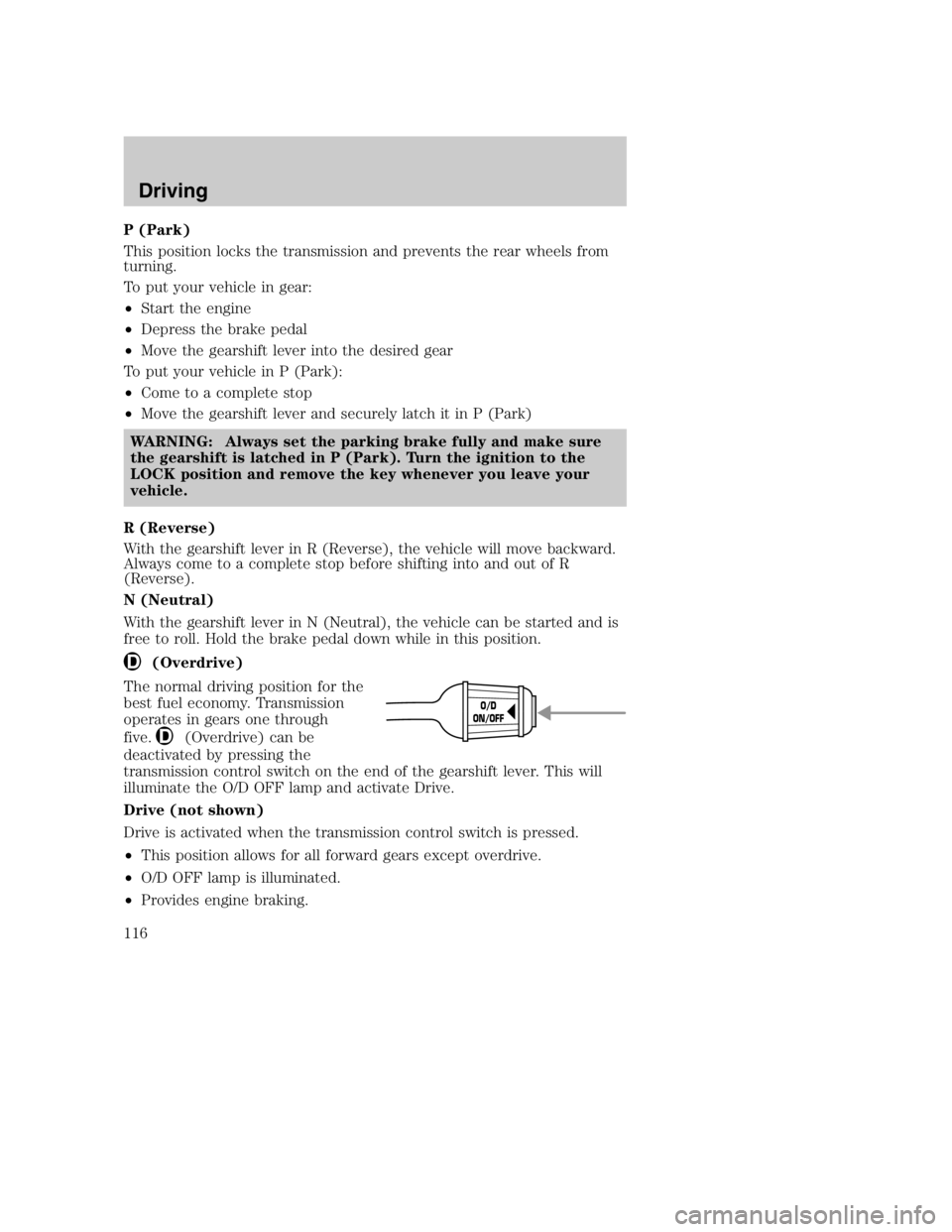
The normal driving position for the
best fuel economy. Transmission
operates in gears one through
five.
(Overdrive) can be
deactivated by pressing the
transmission control switch on the end of the gearshift lever. This will
illuminate the O/D OFF lamp and activate Drive.
Drive (not shown)
Drive is activated when the transmission control switch is pressed.
• This position allows for all forward gears except overdrive.
• O/D OFF lamp is illuminated.
• Provides engine braking.
O/D
ON/OFF
2004 Mazda B Series (mbs)
Owners Guide (post-2002-fmt)
USA English (fus)
Driving
116
Page 124 of 256
SPECIAL LOADING INSTRUCTIONS FOR OWNERS OF PICKUP
TRUCKS AND UTILITY-TYPE VEHICLESWARNING: For important information regarding safe operation
of this type of vehicle, see the Preparing to drive your vehicle
section in this chapter.
WARNING: Loaded vehicles may handle differently than
unloaded vehicles. Extra precautions, such as slower speeds and
increased stopping distance, should be taken when driving a
heavily loaded vehicle.
Your vehicle can haul more cargo and people than most passenger cars.
Depending upon the type and placement of the load, hauling cargo and
people may raise the center of gravity of the vehicle.
Vehicle Loading – with and without a trailer
This section will guide you in the proper loading of your vehicle and/or
trailer, to keep your loaded vehicle weight within its design rating
capability, with or without a trailer. Properly loading your vehicle will
provide maximum return of vehicle design performance. Before loading
your vehicle, familiarize yourself with the following terms for determining
your vehicle’s weight ratings, with or without a trailer, from the vehicle’s
Safety Certification Label and Tire and Load Information Label:
Base Curb Weight – is the weight of the vehicle including a full tank of
fuel and all standard equipment. It does not include passengers, cargo, or
optional equipment.
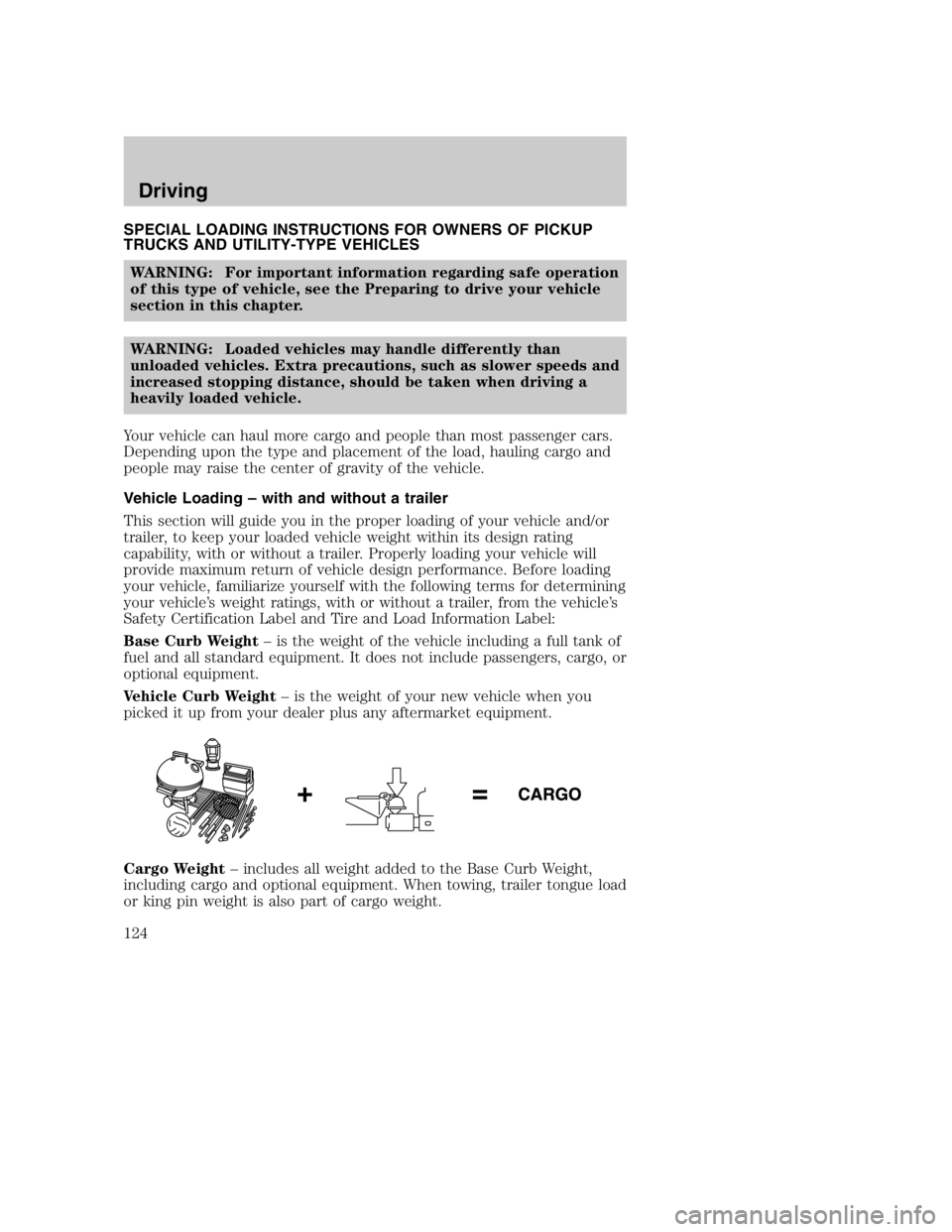
Vehicle Curb Weight – is the weight of your new vehicle when you
picked it up from your dealer plus any aftermarket equipment.
Cargo Weight – includes all weight added to the Base Curb Weight,
including cargo and optional equipment. When towing, trailer tongue load
or king pin weight is also part of cargo weight.
2004 Mazda B Series (mbs)
Owners Guide (post-2002-fmt)
USA English (fus)
Driving
124
Page 137 of 256
HAZARD FLASHER
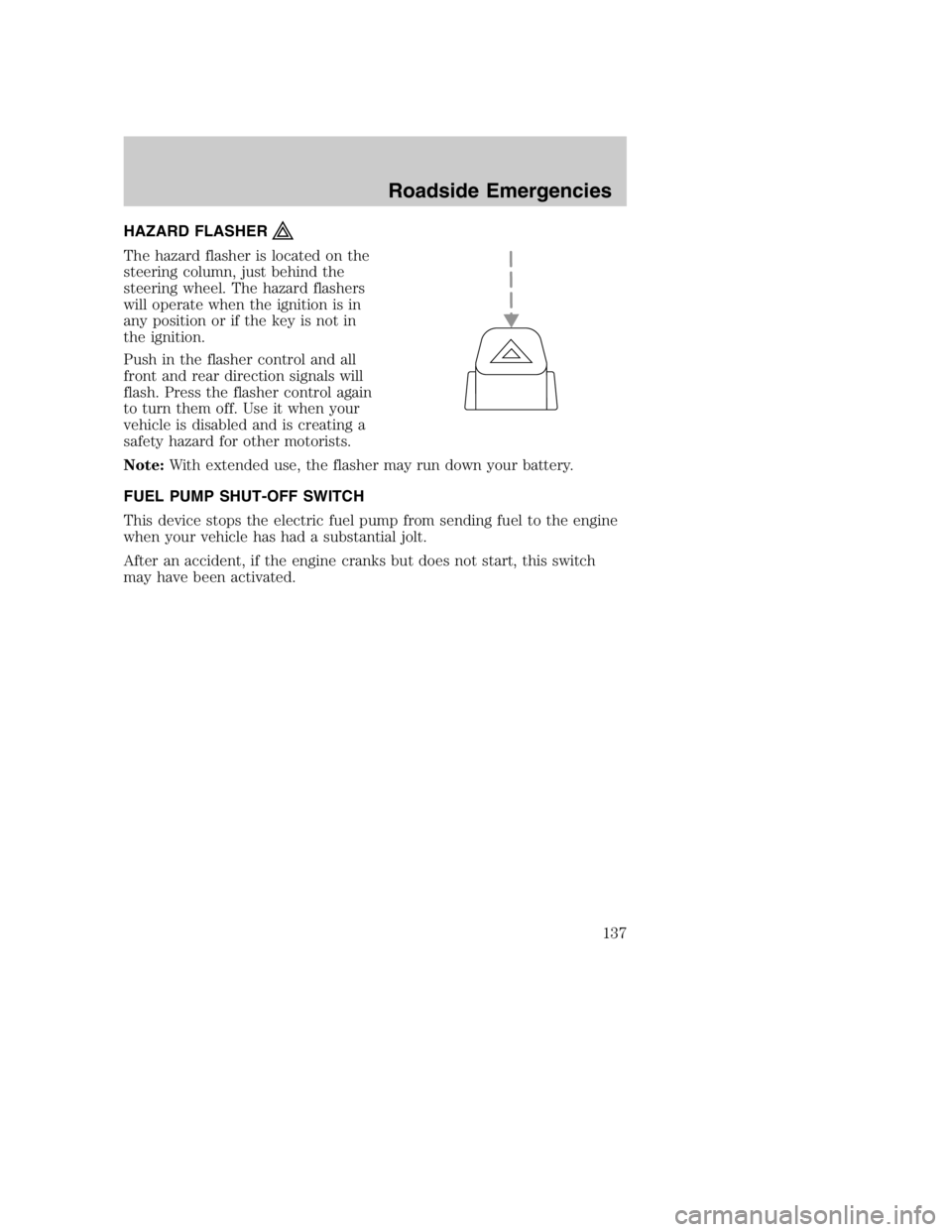
The hazard flasher is located on the
steering column, just behind the
steering wheel. The hazard flashers
will operate when the ignition is in
any position or if the key is not in
the ignition.
Push in the flasher control and all
front and rear direction signals will
flash. Press the flasher control again
to turn them off. Use it when your
vehicle is disabled and is creating a
safety hazard for other motorists.
Note:With extended use, the flasher may run down your battery.
FUEL PUMP SHUT-OFF SWITCH
This device stops the electric fuel pump from sending fuel to the engine
when your vehicle has had a substantial jolt.
After an accident, if the engine cranks but does not start, this switch
may have been activated.
2004 Mazda B Series (mbs)
Owners Guide (post-2002-fmt)
USA English (fus)
Roadside Emergencies
Roadside Emergencies
137
Page 138 of 256
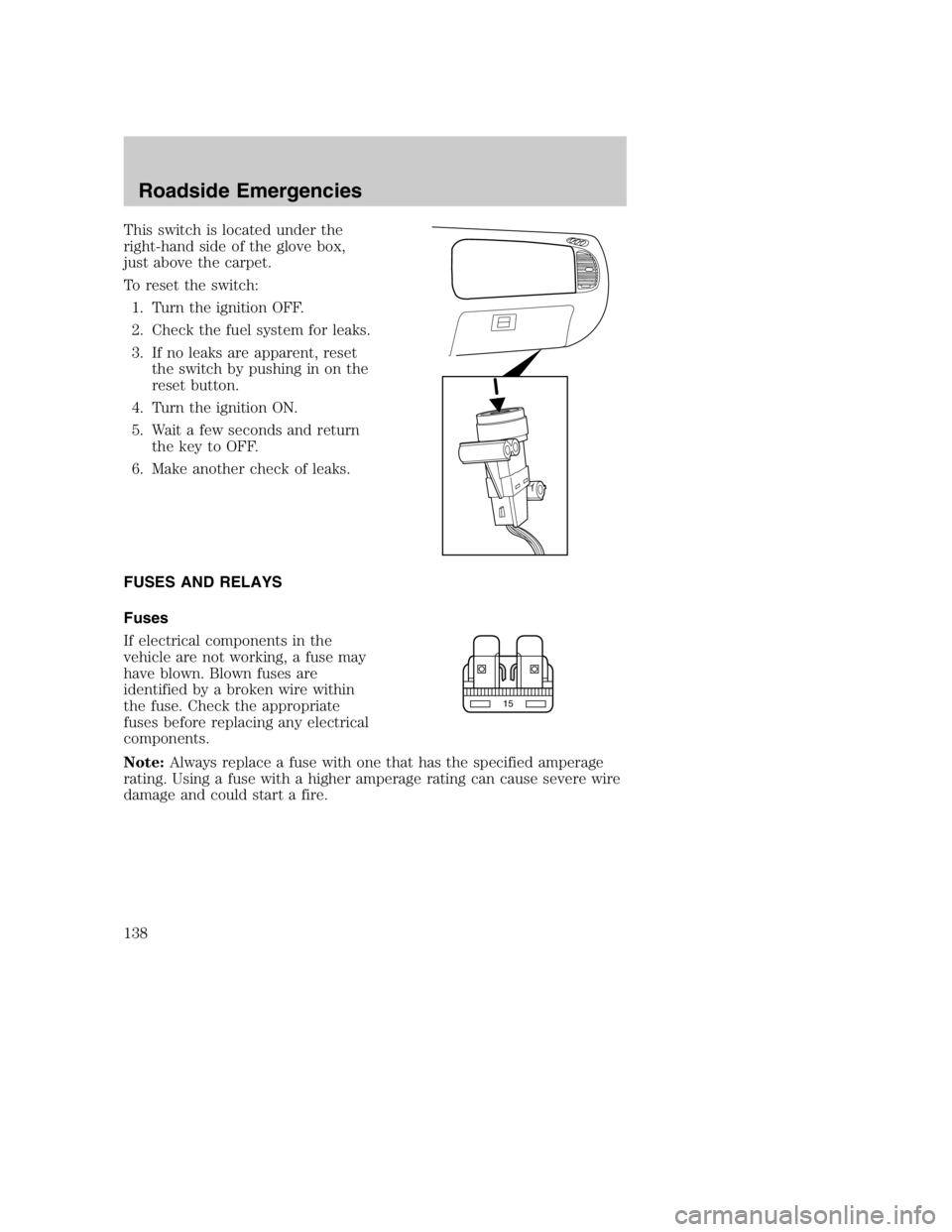
This switch is located under the
right-hand side of the glove box,
just above the carpet.
To reset the switch:1. Turn the ignition OFF.
2. Check the fuel system for leaks.
3. If no leaks are apparent, reset the switch by pushing in on the
reset button.
4. Turn the ignition ON.
5. Wait a few seconds and return the key to OFF.
6. Make another check of leaks.
FUSES AND RELAYS
Fuses
If electrical components in the
vehicle are not working, a fuse may
have blown. Blown fuses are
identified by a broken wire within
the fuse. Check the appropriate
fuses before replacing any electrical
components.
Note: Always replace a fuse with one that has the specified amperage
rating. Using a fuse with a higher amperage rating can cause severe wire
damage and could start a fire.
15
2004 Mazda B Series (mbs)
Owners Guide (post-2002-fmt)
USA English (fus)
Roadside Emergencies
138
Page 144 of 256
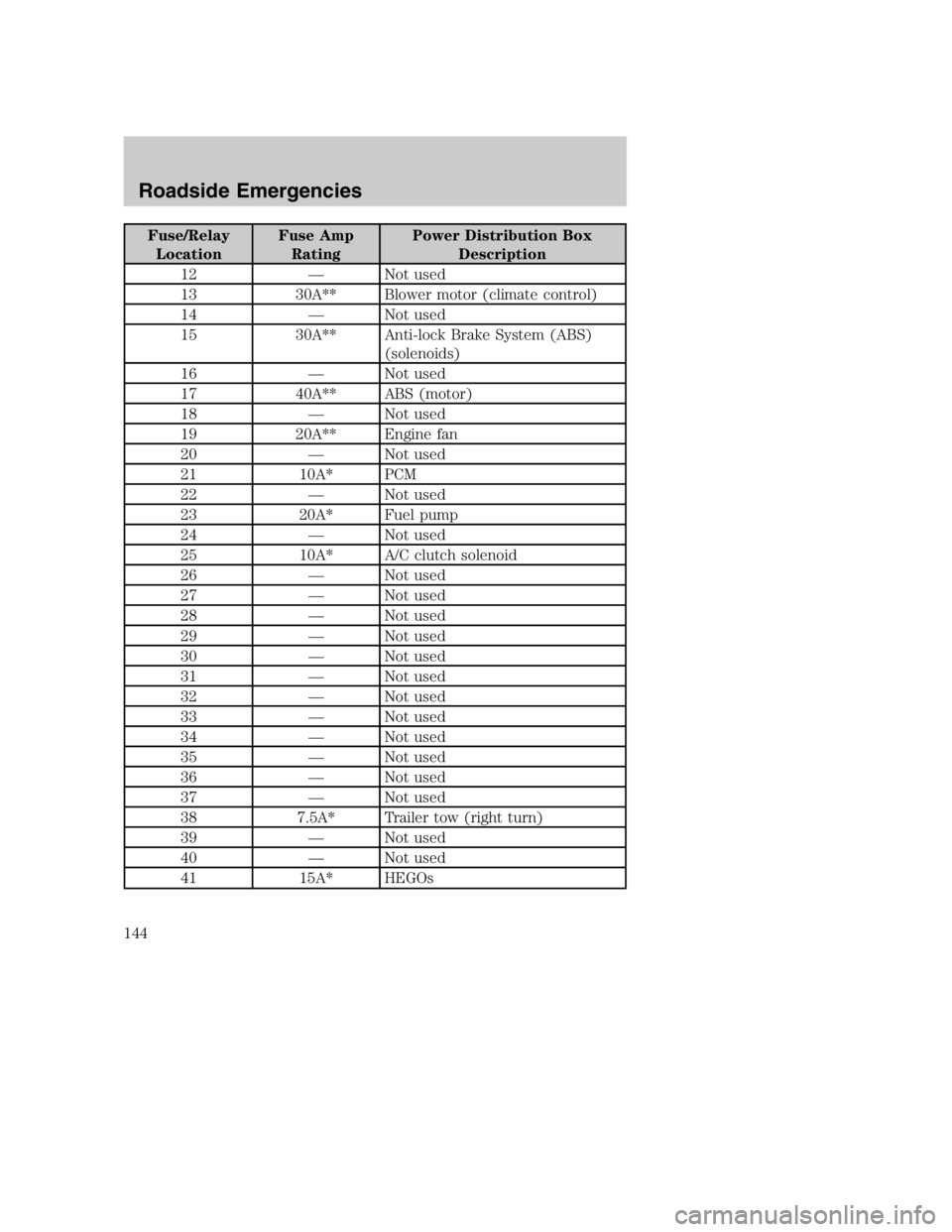
Fuse/RelayLocation Fuse Amp
Rating Power Distribution Box
Description
12 — Not used
13 30A** Blower motor (climate control)
14 — Not used
15 30A** Anti-lock Brake System (ABS) (solenoids)
16 — Not used
17 40A** ABS (motor)
18 — Not used
19 20A** Engine fan
20 — Not used
21 10A* PCM
22 — Not used
23 20A* Fuel pump
24 — Not used
25 10A* A/C clutch solenoid
26 — Not used
27 — Not used
28 — Not used
29 — Not used
30 — Not used
31 — Not used
32 — Not used
33 — Not used
34 — Not used
35 — Not used
36 — Not used
37 — Not used
38 7.5A* Trailer tow (right turn)
39 — Not used
40 — Not used
41 15A* HEGOs
2004 Mazda B Series (mbs)
Owners Guide (post-2002-fmt)
USA English (fus)
Roadside Emergencies
144