maintenance MAZDA MODEL B4000 TRUCK 2006 User Guide
[x] Cancel search | Manufacturer: MAZDA, Model Year: 2006, Model line: MODEL B4000 TRUCK, Model: MAZDA MODEL B4000 TRUCK 2006Pages: 266, PDF Size: 2.11 MB
Page 112 of 266
JOBNAME: No Job Name PAGE: 112 SESS: 1 OUTPUT: Thu Sep 15 08:22:27 2005
/ford_pdm/ford/own2002/mbs/og
6. Visually inspect the tires to make sure there are no nails or otherobjects embedded that could poke a hole in the tire and cause an air
leak.
7. Check the sidewalls to make sure there are no gouges, cuts or bulges.
TIRE CARE
Inspecting your tires
Periodically inspect the tire treads for uneven or excessive wear and
remove objects such as stones, nails or glass that may be wedged in the
tread grooves. Check for holes or cuts that may permit air leakage from
the tire and make necessary repairs. Also inspect the tire sidewalls for
cracking, cuts, bruises and other signs of damage or excessive wear. If
internal damage to the tire is suspected, have the tire demounted and
inspected in case it needs to be repaired or replaced. For your safety,
tires that are damaged or show signs of excessive wear should not be
used because they are more likely to blow out or fail.
Improper or inadequate vehicle maintenance can cause tires to wear
abnormally. Inspect all your tires, including the spare, frequently, and
replace them if one or more of the following conditions exist:
Tire wear
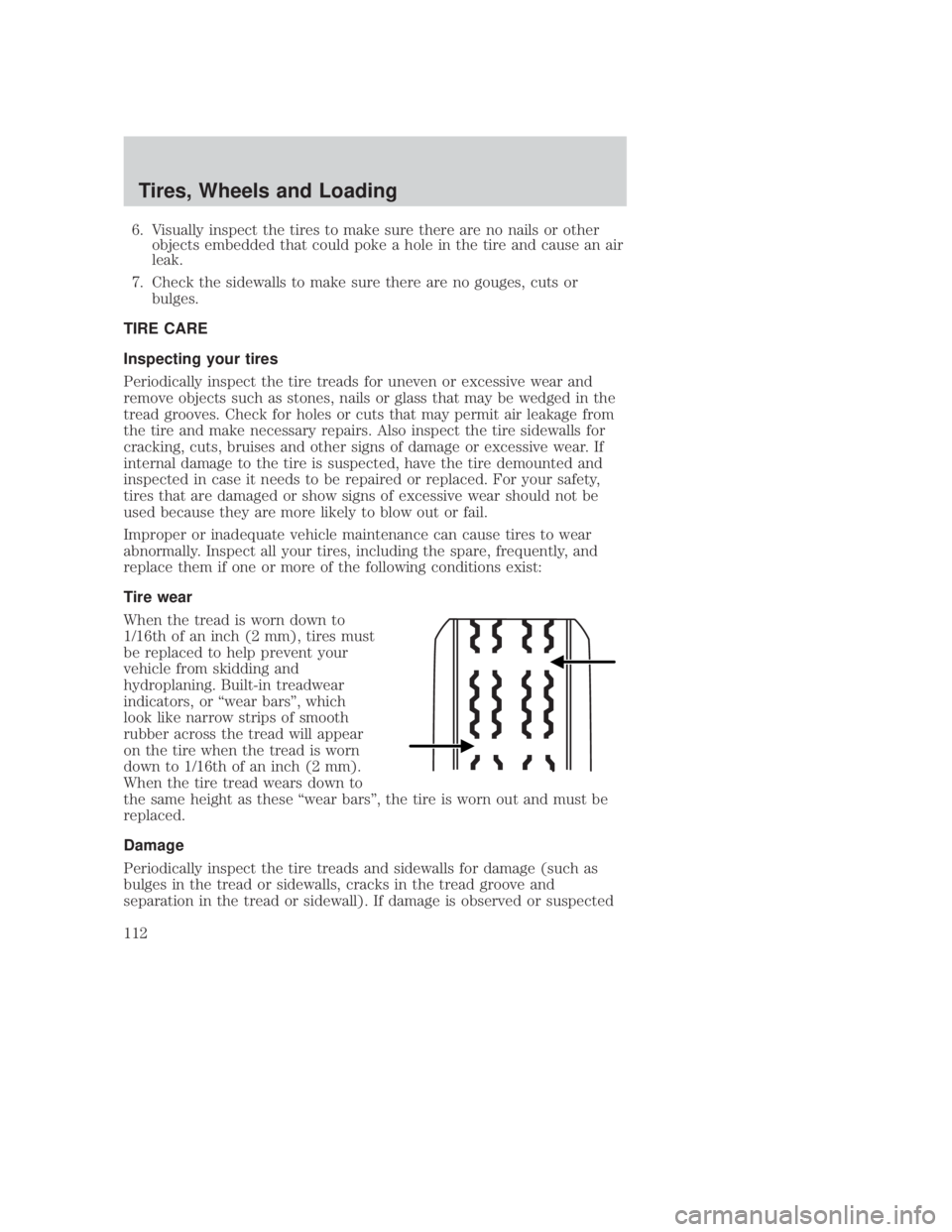
When the tread is worn down to
1/16th of an inch (2 mm), tires must
be replaced to help prevent your
vehicle from skidding and
hydroplaning. Built-in treadwear
indicators, or ªwear barsº, which
look like narrow strips of smooth
rubber across the tread will appear
on the tire when the tread is worn
down to 1/16th of an inch (2 mm).
When the tire tread wears down to
the same height as these ªwear barsº, the tire is worn out and must be
replaced.
Damage
Periodically inspect the tire treads and sidewalls for damage (such as
bulges in the tread or sidewalls, cracks in the tread groove and
separation in the tread or sidewall). If damage is observed or suspected
CIMS #1272124
com_care-for-tires itdseq=143
CIMS #1444638
com_tire-inspection itdseq=144
CIMS #1272512
com_tire-wear itdseq=145
CIMS #1512511
com_tire-damage itdseq=146
art=tsnmc001_a
REVIEW COPY ÐÐ
2006 B-Series (mbs), Owners Guide (post-2002-fmt) (own2002),Market:USA(fus)
PAGE: 11 2OP:root EDIT SESSION: 1DATE: SEPT 15 2005 at 8:22JOB:@ibm2/ford_pdm/CLS_ford/GRP_own2002/JOB_mbs/DIV_og
Tires, Wheels and Loading
112
Page 115 of 266
JOBNAME: No Job Name PAGE: 115 SESS: 1 OUTPUT: Thu Sep 15 08:22:27 2005
/ford_pdm/ford/own2002/mbs/og
speed. Drive with caution until you can safely pull off the road. Stop and
inspect the tires for damage. If a tire is under-inflated or damaged,
deflate it, remove wheel and replace it with your spare tire and wheel. If
you cannot detect a cause, have the vehicle towed to the nearest repair
facility or tire dealer to have the vehicle inspected.
Tire and wheel alignment
A bad jolt from hitting a curb or pothole can cause the front end of your
vehicle to become misaligned or cause damage to your tires. If your
vehicle seems to pull to one side, vibrate or shake when you're driving,
the wheels may be out of alignment. Have a qualified technician at a
Mazda dealer check the wheel alignment periodically.
Wheel misalignment in the front or the rear can cause uneven and rapid
treadwear of your tires and should be corrected by a qualified technician
at a Mazda dealer. Front wheel drive (FWD) vehicles and those with an
independent rear suspension require alignment of all four wheels.
The tire should also be balanced periodically. An unbalanced tire and
wheel assembly may result in irregular tire wear.
NOTE:When it is time to replace front tires with new ones, this is an
ideal time to perform an alignment. New tires should be balanced at the
time they are installed.
Tire rotation
Rotating your tires at the recommended interval (as indicated in the
Scheduled maintenance section of theMaintenance and
Specifications chapter) will help your tires wear more evenly, providing
better tire performance and longer tire life.
CIMS #1302692
com_tire-align-mazda itdseq=151
CIMS #1350081
com_rotate-tires-mazda itdseq=152
REVIEW COPY ÐÐ
2006 B-Series (mbs), Owners Guide (post-2002-fmt) (own2002),Market:USA(fus)
PAGE: 11 5OP:root EDIT SESSION: 1DATE: SEPT 15 2005 at 8:22JOB:@ibm2/ford_pdm/CLS_ford/GRP_own2002/JOB_mbs/DIV_og
Tires, Wheels and Loading
115
Page 138 of 266
JOBNAME: No Job Name PAGE: 138 SESS: 1 OUTPUT: Thu Sep 15 08:22:27 2005
/ford_pdm/ford/own2002/mbs/og
Servicing after towing
If you tow a trailer for long distances, your vehicle will require more
frequent service intervals. Refer to yourservice maintenance section
for more information.
Trailer towing tips
² Practice turning, stopping and backing up before starting on a trip to
get the feel of the vehicle trailer combination. When turning, make
wider turns so the trailer wheels will clear curbs and other obstacles.
² Allow more distance for stopping with a trailer attached.
² The trailer tongue weight should be 10±15% of the loaded trailer
weight.
² If you will be towing a trailer frequently in hot weather, hilly
conditions, at GCW, or any combination of these factors, consider
refilling your rear axle with synthetic gear lube if not already so
equipped. Refer to the Maintenance and specifications chapter for
the lubricant specification. Remember that regardless of the rear axle
lube used, do not tow a trailer for the first 500 miles (800 km) of a
new vehicle, and that the first 500 miles (800 km) of towing be done
at no faster than 70 mph (112 km/h) with no full throttle starts.
² After you have traveled 50 miles (80 km), thoroughly check your
hitch, electrical connections and trailer wheel lug nuts.
² To aid in engine/transmission cooling and A/C efficiency during hot
weather while stopped in traffic, place the gearshift lever in P (Park)
(automatic transmission) or N (Neutral) (manual transmissions).
² Vehicles with trailers should not be parked on a grade. If you must
park on a grade, place wheel chocks under the trailer's wheels.
Launching or retrieving a boat
Disconnect the wiring to the trailer before backing the trailer
into the water. Reconnect the wiring to the trailer after the
trailer is removed from the water.
When backing down a ramp during boat launching or retrieval:
² do not allow the static water level to rise above the bottom edge of
the rear bumper.
² do not allow waves to break higher than 6 inches (15 cm) above the
bottom edge of the rear bumper.
Exceeding these limits may allow water to enter vehicle components:
CIMS #83488
com_towing-tips.02 itdseq=171
CIMS #81391
com_launch-retrieving_boat.1 itdseq=172
REVIEW COPY ÐÐ
2006 B-Series (mbs), Owners Guide (post-2002-fmt) (own2002),Market:USA(fus)
PAGE: 138OP:root EDIT SESSION: 1DATE: SEPT 15 2005 at 8:22JOB:@ibm2/ford_pdm/CLS_ford/GRP_own2002/JOB_mbs/DIV_og
Tires, Wheels and Loading
138
Page 167 of 266
JOBNAME: No Job Name PAGE: 167 SESS: 1 OUTPUT: Thu Sep 15 08:22:27 2005
/ford_pdm/ford/own2002/mbs/og
Fuse/RelayLocation Fuse Amp
Rating Passenger Compartment Fuse
Panel Description
31 20A Front park lamps, Rear park lamps, License plate lamps,
Dimmer switch, Trailer tow park
lamps
32 5A Brake switch (logic)
33 5A Instrument cluster battery feed (B+)
34 20A Power point
35 15A Power locks
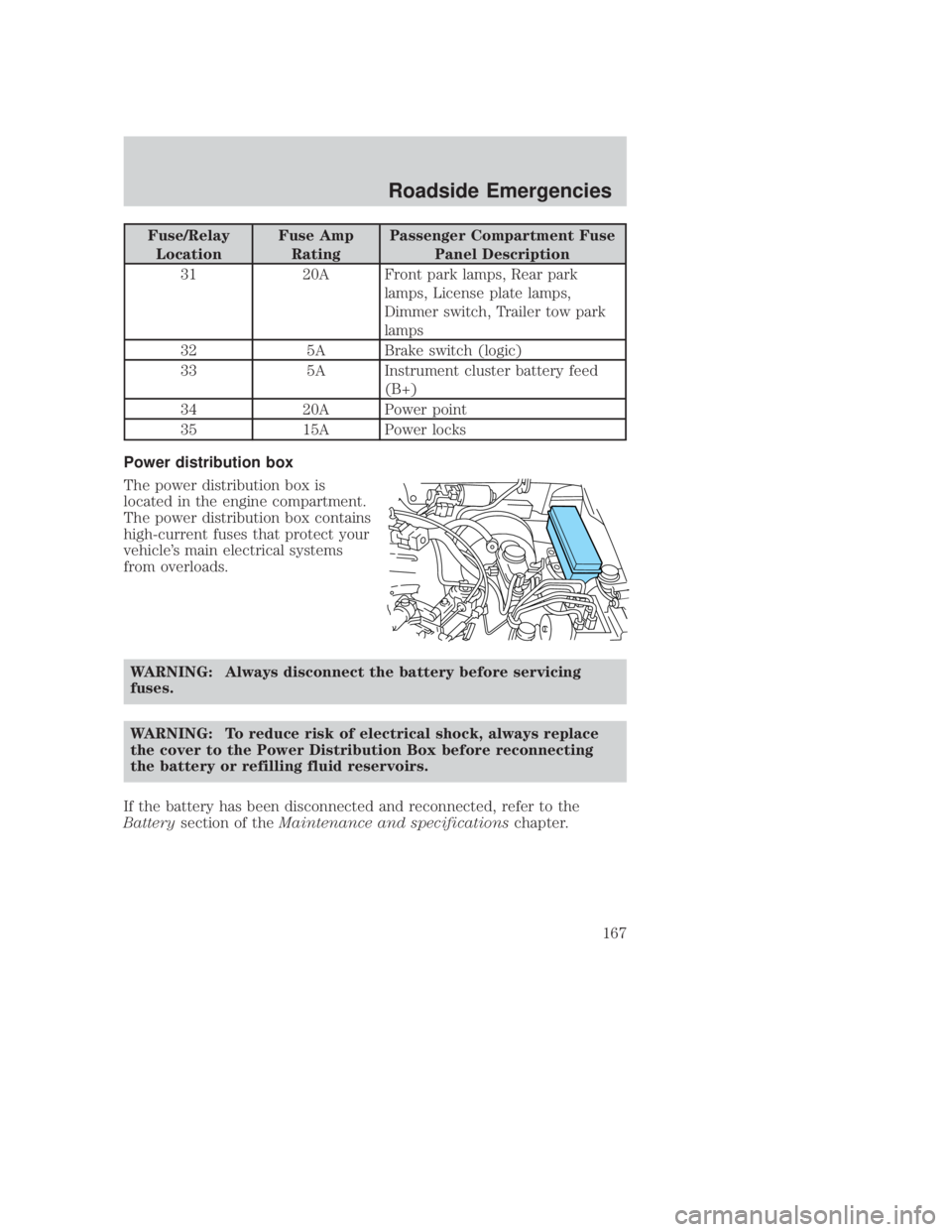
Power distribution box
The power distribution box is
located in the engine compartment.
The power distribution box contains
high-current fuses that protect your
vehicle's main electrical systems
from overloads.
WARNING: Always disconnect the battery before servicing
fuses.
WARNING: To reduce risk of electrical shock, always replace
the cover to the Power Distribution Box before reconnecting
the battery or refilling fluid reservoirs.
If the battery has been disconnected and reconnected, refer to the
Battery section of the Maintenance and specifications chapter.
CIMS #1273111
com_power-dist-title.mbs
itdseq=214
art=raner500_b
REVIEW COPY ÐÐ
2006 B-Series (mbs), Owners Guide (post-2002-fmt) (own2002),Market:USA(fus)
PAGE: 167OP:root EDIT SESSION: 1DATE: SEPT 15 2005 at 8:22JOB:@ibm2/ford_pdm/CLS_ford/GRP_own2002/JOB_mbs/DIV_og
Roadside Emergencies
167
Page 181 of 266
JOBNAME: No Job Name PAGE: 181 SESS: 1 OUTPUT: Thu Sep 15 08:22:27 2005
/ford_pdm/ford/own2002/mbs/og
1. Lay the tire on the ground with the valve stem facing up.
2. Slide the wheel partially under the vehicle and install the wire andretainer through the center of the wheel.
3. Turn the jack handle clockwise until the tire is raised to its original position underneath the vehicle. The effort to turn the jack handle
increases significantly as the tire contacts the frame. The spare tire
carrier will ratchet when the tire is in the fully stowed position. The
spare tire carrier has a built-in ratchet feature that will not allow you
to overtighten. If the spare tire carrier ratchets with very little effort,
take the vehicle to your authorized dealer for assistance at your
earliest convenience.
4. Check that the tire lies flat against the frame assembly. Push against the tire to make sure it is tightly seated under the vehicle. Loosen
and retighten, if necessary. Failure to properly stow the spare tire
may result in failure of the winch cable and loss of the spare tire.
5. Repeat this tightness check procedure when servicing the spare tire pressure (every six months, per Service Maintenance Section), or
at any time that the spare tire is disturbed through service of other
components.
6. Install the spare tire lock (if equipped) into the access hole above the rear bumper with the spare tire lock key (if equipped) and jack
handle.
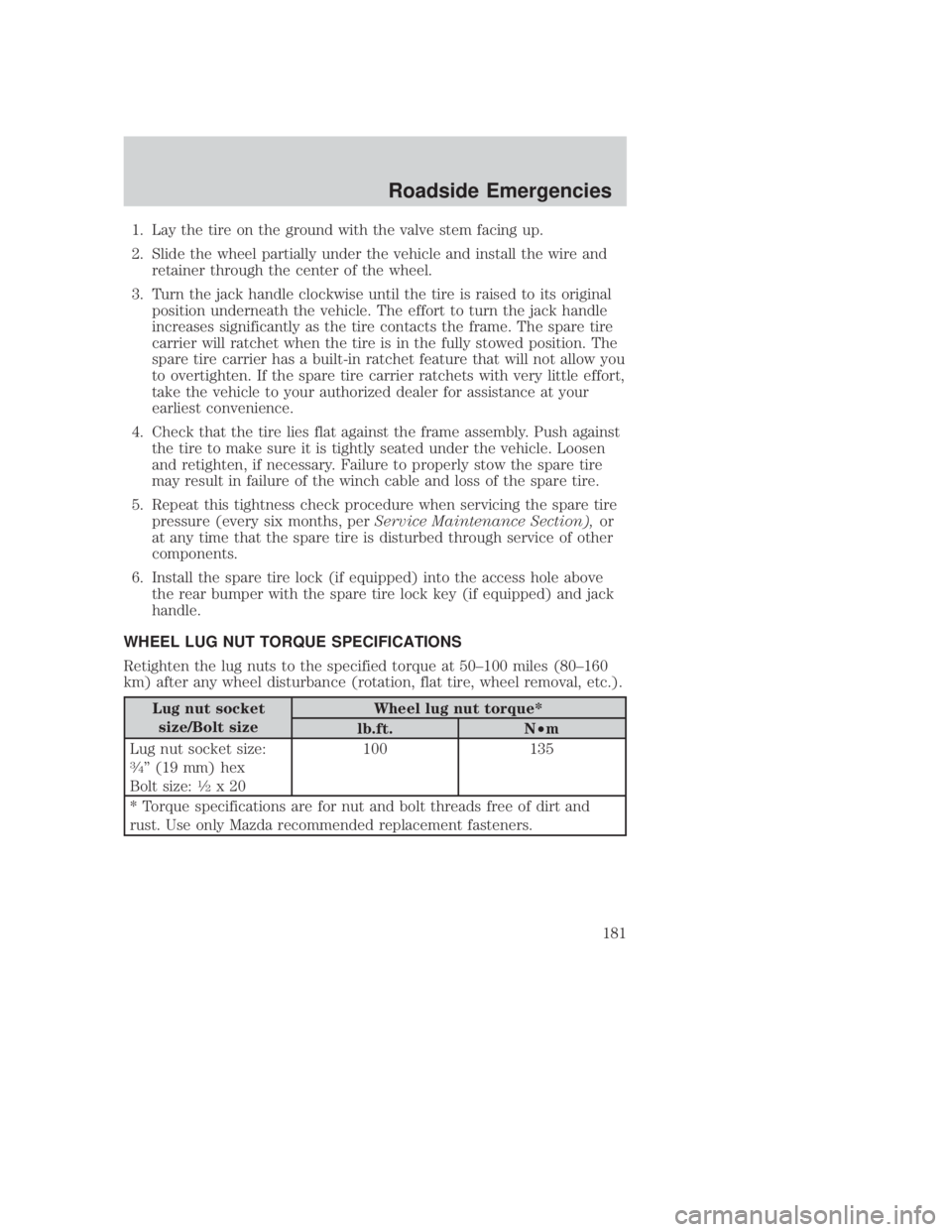
WHEEL LUG NUT TORQUE SPECIFICATIONS
Retighten the lug nuts to the specified torque at 50±100 miles (80±160
km) after any wheel disturbance (rotation, flat tire, wheel removal, etc.).
Lug nut socket size/Bolt size Wheel lug nut torque*
lb.ft. N ²m
Lug nut socket size:
3¤4º (19 mm) hex
Bolt size:1¤2x20 100 135
* Torque specifications are for nut and bolt threads free of dirt and
rust. Use only Mazda recommended replacement fasteners.
CIMS #1244586
com_lug-nut-torque.p150 itdseq=223
REVIEW COPY ÐÐ
2006 B-Series (mbs), Owners Guide (post-2002-fmt) (own2002),Market:USA(fus)
PAGE: 181OP:root EDIT SESSION: 1DATE: SEPT 15 2005 at 8:22JOB:@ibm2/ford_pdm/CLS_ford/GRP_own2002/JOB_mbs/DIV_og
Roadside Emergencies
181
Page 183 of 266
JOBNAME: No Job Name PAGE: 183 SESS: 1 OUTPUT: Thu Sep 15 08:22:27 2005
/ford_pdm/ford/own2002/mbs/og
If you find a leak or other damage, or if coolant is still leaking, stop the
engine and call an authorized dealer.
SeeAdding coolant in theMaintenance and Specifications section. If
you find no problems, the engine is cool and no leaks are obvious,
carefully add coolant as required.
WARNING: When the engine and radiator are hot, scalding
coolant and steam may shoot out under pressure and cause
serious injury. Do not remove the cooling system cap when the
engine and radiator are hot.
Note: If the engine continues to overheat or frequently overheats, have
the cooling system inspected. The engine could be seriously damaged
unless repairs are made.
JUMP STARTING
WARNING: The gases around the battery can explode if
exposed to flames, sparks, or lit cigarettes. An explosion could
result in injury or vehicle damage.
WARNING: Batteries contain sulfuric acid which can burn skin,
eyes and clothing, if contacted.
Do not attempt to push-start your vehicle. Automatic
transmissions do not have push-start capability; doing so may
damage the catalytic converter.
Preparing your vehicle
When the battery is disconnected or a new battery is installed, the
transmission must relearn its shift strategy. As a result, the transmission
may have firm and/or soft shifts. This operation is considered normal and
will not affect function or durability of the transmission. Over time, the
adaptive learning process will fully update transmission operation. 1. Use only a 12±volt supply to start your vehicle.
2. Do not disconnect the battery of the disabled vehicle as this could damage the vehicle's electrical system.
3. Park the booster vehicle close to the hood of the disabled vehicle making sure the two vehicles do nottouch. Set the parking brake on
both vehicles and stay clear of the engine cooling fan and other
moving parts.
CIMS #52573 com_jump-start itdseq=225
CIMS #57613
com_prep-for-jump itdseq=226
REVIEW COPY ÐÐ
2006 B-Series (mbs), Owners Guide (post-2002-fmt) (own2002),Market:USA(fus)
PAGE: 183OP:root EDIT SESSION: 1DATE: SEPT 15 2005 at 8:22JOB:@ibm2/ford_pdm/CLS_ford/GRP_own2002/JOB_mbs/DIV_og
Roadside Emergencies
183
Page 190 of 266
JOBNAME: No Job Name PAGE: 190 SESS: 1 OUTPUT: Thu Sep 15 08:22:27 2005
/ford_pdm/ford/own2002/mbs/og
4. Purchase date and current mileage
5. Your authorized dealer's name and location
6. Your question(s)
If you live outside the U.S.A., please contact your nearest Mazda
Distributor.
CUSTOMER ASSISTANCE (CANADA)
Your complete and permanent satisfaction is our business. We are here to
serve you. All Authorized Mazda Dealers have the knowledge and the
tools to keep your Mazda vehicle in top condition.
In our experience, any questions, problems or complaints regarding the
operation of your Mazda or any other general service transactions are
most effectively resolved by your authorized dealer. If the cause of your
dissatisfaction cannot adequately be addressed by normal authorized
dealer procedures, we recommend that you take the following steps:
STEP 1: Contact Your Authorized Mazda Dealer
Discuss the matter with a member of authorized dealer management. If
the Service Manager has already reviewed your concerns, contact the
owner of the authorized dealer or its General Manager.
STEP 2: Call the Mazda Regional Office
If you feel that you still require assistance, ask the authorized dealer
Service Manager to arrange for you to meet the local Mazda Service
Representative. If more expedient, contact Mazda Canada Inc. Regional
Office nearest you for such arrangements.
STEP 3: Contact the Mazda Customer Relations Department
If still not substantially satisfied, contact the Customer Relations
Department, Mazda Canada Inc., 55 Vogell Road, Richmond Hill, Ontario
L4B 3K5 Canada TEL: 1 (800) 263±4680.
Provide the Department with the following information: 1. Your name, address, and telephone number
2. Year and model of vehicle
3. Vehicle Identification Number (VIN). Refer to Vehicle identification
label in the Maintenance and Specifications chapter of this manual
for the location of the VIN.
4. Purchase date.
5. Present odometer reading.
CIMS # com_assist-canada itdseq=232
REVIEW COPY ÐÐ
2006 B-Series (mbs), Owners Guide (post-2002-fmt) (own2002),Market:USA(fus)
PAGE: 190OP:root EDIT SESSION: 1DATE: SEPT 15 2005 at 8:22JOB:@ibm2/ford_pdm/CLS_ford/GRP_own2002/JOB_mbs/DIV_og
Customer Assistance
190
Page 197 of 266
JOBNAME: No Job Name PAGE: 197 SESS: 1 OUTPUT: Thu Sep 15 08:22:27 2005
/ford_pdm/ford/own2002/mbs/og
Please refer to your manufacturers warranty booklet for more
information.
ADD-ON NON-GENUINE PARTS AND ACCESSORIES
Non-genuine parts and accessories for Mazda vehicles can be found in
stores. These may fit your vehicle, but they are not approved by the
manufacturer for use with Mazda vehicles. When you install non-genuine
parts or accessories, they could affect your vehicle's performance or
safety system; the manufacturer's warranty doesn't cover this. Before you
install any non-genuine parts or accessories, consult an Authorized
Mazda Dealer.WARNING: Installation of Non-Genuine Parts or Accessories:
Installation of non-genuine parts or accessories could be
dangerous. Improperly designed parts or accessories could
seriously affect your vehicle's performance or safety system.
This could cause you to have an accident or increase your
chances of injuries in an accident. Always consult an Authorized
Mazda Dealer before you install non-genuine parts or
accessories.
WARNING: Add-On Electrical and Electronic Equipment:
Incorrectly choosing or installing improper add-on equipment or
choosing an improper installer could be dangerous. Essential
systems could be damaged, causing engine stalling, air-bag
(SRS) activation, ABS inactivation, or a fire in the vehicle. Be
very careful in choosing and installing add-on electrical
equipment, such as mobile telephones, two-way radios, stereo
systems, and car alarm systems.
Mazda assumes no responsibility for death, injury, or expenses that may
result from the installation of add-on non-genuine parts or accessories.
SERVICE PUBLICATIONS
Factory-authorized Mazda service publications are available for owners
who wish to do some of their own maintenance and repair.
When requesting any of our publications through an Authorized Mazda
Dealer, refer to the chart below.
If they don't have what you need in stock, they can order it for you.
CIMS #606351
com_non-genuine-accessories itdseq=242
CIMS #689691
com_service-pubs.mbs itdseq=243
REVIEW COPY ÐÐ
2006 B-Series (mbs), Owners Guide (post-2002-fmt) (own2002),Market:USA(fus)
PAGE: 197OP:root EDIT SESSION: 1DATE: SEPT 15 2005 at 8:22JOB:@ibm2/ford_pdm/CLS_ford/GRP_own2002/JOB_mbs/DIV_og
Customer Assistance
197
Page 198 of 266
JOBNAME: No Job Name PAGE: 198 SESS: 1 OUTPUT: Thu Sep 15 08:22:27 2005
/ford_pdm/ford/own2002/mbs/og
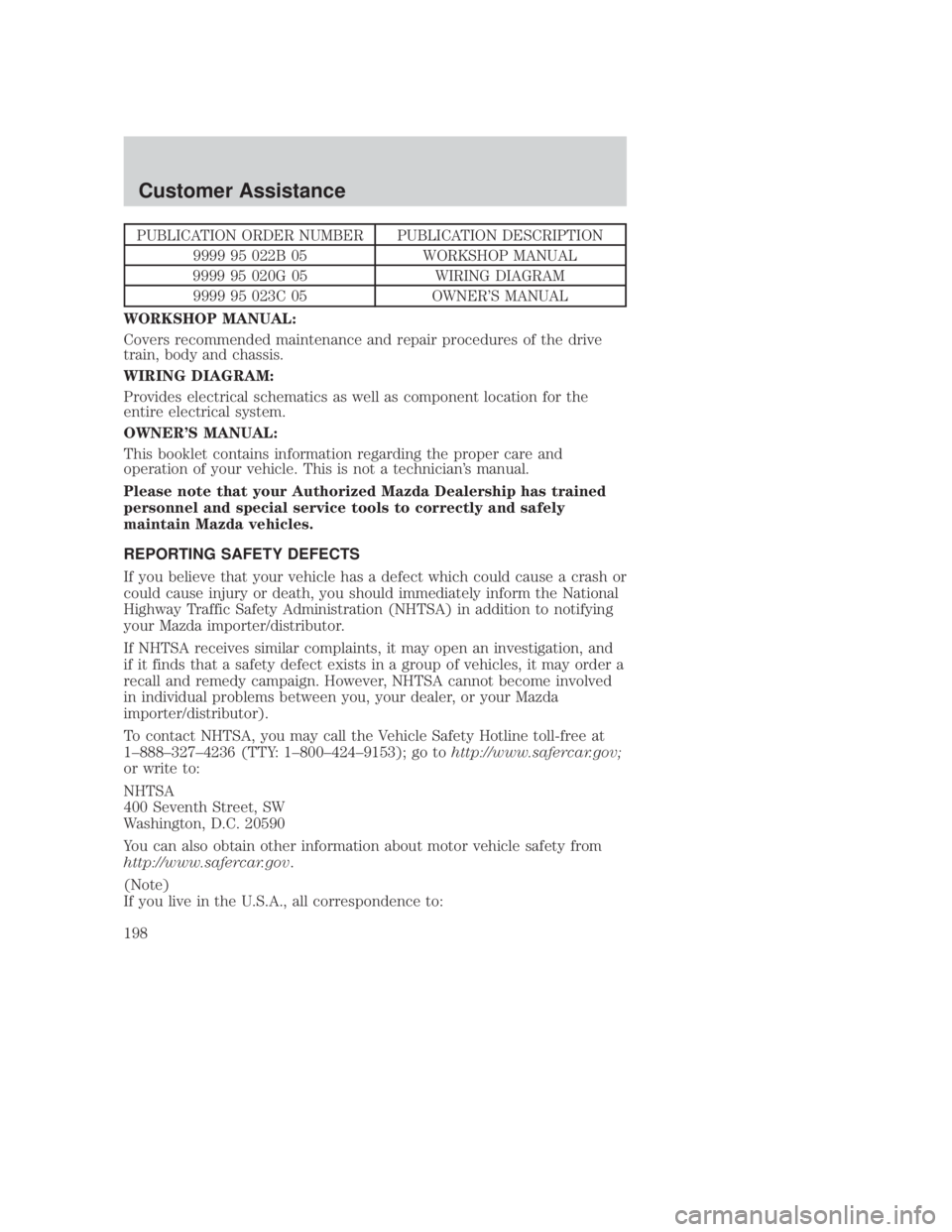
PUBLICATION ORDER NUMBER PUBLICATION DESCRIPTION9999 95 022B 05 WORKSHOP MANUAL
9999 95 020G 05 WIRING DIAGRAM 9999 95 023C 05 OWNER'S MANUAL
WORKSHOP MANUAL:
Covers recommended maintenance and repair procedures of the drive
train, body and chassis.
WIRING DIAGRAM:
Provides electrical schematics as well as component location for the
entire electrical system.
OWNER'S MANUAL:
This booklet contains information regarding the proper care and
operation of your vehicle. This is not a technician's manual.
Please note that your Authorized Mazda Dealership has trained
personnel and special service tools to correctly and safely
maintain Mazda vehicles.
REPORTING SAFETY DEFECTS
If you believe that your vehicle has a defect which could cause a crash or
could cause injury or death, you should immediately inform the National
Highway Traffic Safety Administration (NHTSA) in addition to notifying
your Mazda importer/distributor.
If NHTSA receives similar complaints, it may open an investigation, and
if it finds that a safety defect exists in a group of vehicles, it may order a
recall and remedy campaign. However, NHTSA cannot become involved
in individual problems between you, your dealer, or your Mazda
importer/distributor).
To contact NHTSA, you may call the Vehicle Safety Hotline toll-free at
1±888±327±4236 (TTY: 1±800±424±9153); go to http://www.safercar.gov;
or write to:
NHTSA
400 Seventh Street, SW
Washington, D.C. 20590
You can also obtain other information about motor vehicle safety from
http://www.safercar.gov.
(Note)
If you live in the U.S.A., all correspondence to:
CIMS #606352
com_report-safe-defects itdseq=244
REVIEW COPY ÐÐ
2006 B-Series (mbs), Owners Guide (post-2002-fmt) (own2002),Market:USA(fus)
PAGE: 198OP:root EDIT SESSION: 1DATE: SEPT 15 2005 at 8:22JOB:@ibm2/ford_pdm/CLS_ford/GRP_own2002/JOB_mbs/DIV_og
Customer Assistance
198
Page 206 of 266
JOBNAME: No Job Name PAGE: 206 SESS: 1 OUTPUT: Thu Sep 15 08:22:27 2005
/ford_pdm/ford/own2002/mbs/og
INTRODUCTION
Be extremely careful to prevent injury to yourself and others or damage
to your vehicle when using this manual for inspection and maintenance.
If you're unsure about any procedure it describes, we strongly urge you
to have a reliable and qualified service shop perform the work, preferably
an authorized Mazda Dealer.
Factory-trained Mazda technicians and genuine Mazda parts are best for
your vehicle. Without this expertise and the parts that have been
designed and made especially for your Mazda, inadequate, incomplete,
and insufficient servicing may result in problems. This could lead to
vehicle damage or an accident and injuries.
For expert advice and quality service, consult an authorized Mazda
Dealer.
The owner should retain evidence that proper maintenance has been
performed as prescribed.
Claims against the warranty resulting from lack of maintenance, as
opposed to defective materials or authorized Mazda workmanship, will
not be honored.
Any auto repair shop using parts equivalent to your Mazda's original
equipment may perform maintenance.But we recommend that it
always be done by an authorized Mazda Dealer using genuine
Mazda parts.
SCHEDULED MAINTENANCE
Schedule 1 Ð Normal Driving Conditions/Emission Control
Systems
Follow Schedule 1 if the vehicle is operated mainly where none of the
following conditions apply. If any do apply, follow Schedule 2.
² Repeated short-distance driving.
² Driving in dusty conditions.
² Towing a trailer.
² Operating in hot weather in stop-and-go ªrush hourº traffic.
² Extended periods of idling or low-speed operation.
² High-speed operation with a fully loaded vehicle.
² Off-road operation.
NOTE: After the described period, continue to follow the described
maintenance at the recommended intervals.CIMS #608142
com_maint-intro.j14 itdseq=257
CIMS #684323
com_maintenance.mbs itdseq=258
REVIEW COPY ÐÐ
2006 B-Series (mbs), Owners Guide (post-2002-fmt) (own2002),Market:USA(fus)
PAGE: 206OP:root EDIT SESSION: 1DATE: SEPT 15 2005 at 8:22JOB:@ibm2/ford_pdm/CLS_ford/GRP_own2002/JOB_mbs/DIV_og
Maintenance and Specifications
206