cooling MAZDA MODEL CX-3 2019 (in English) User Guide
[x] Cancel search | Manufacturer: MAZDA, Model Year: 2019, Model line: MODEL CX-3, Model: MAZDA MODEL CX-3 2019Pages: 608, PDF Size: 7.89 MB
Page 429 of 608

Maintenance IntervalNumber of months or kilometers, whichever comes first
Months 6 1218243036424854606672
×1000 km 10 20 30 40 50 60 70 80 90 100 110 120
Tire inflation pressure and tire wear IIIIIIIIIIII
Steering operation and linkages I I I I I I I I I I I I
Front and rear suspension, ball joints and wheel
bearing axial play IIIIII
Rear differential oil
*3*4
Transfer oil*4
Driveshaft dust boots IIIIII
Bolts and nuts on chassis and body T T T T T T
Exhaust system and heat shields IIIIII
All locks and hinges LLLLLLLLLLLL
Washer fluid level IIIIIIIIIIII
Emergency flat tire repair kit (if installed)
*5Inspect annually.
Cabin air filter R R R
Chart symbols:
I: Inspect: Inspect and clean, re pair, adjust, fill up, or replac e if necessary.
R: Replace
L: Lubricate
C: Clean
T: Tighten
D: Drain
Remarks:
*1 Use of FL-22 is recommended wh en replacing engine coolant. Using engine coolant other than FL-22 may
cause serious damage to the engine and cooling system.
*2 According to state/provincial and federal regulations, failure to perform maintenance on these items will not void your emissions warranties. However, Mazda recommends that all maintenance services be performed at
the recommended time or kilomete r period to ensure long-term reliability.
*3 If the vehicle is operated primarily under any of the followin g conditions, replace the rear differential oil at
every 45,000 km.
a) Towing a trailer or u sing a car-top carrier
b) Driving in dusty, sandy or wet conditions
c) Extended periods of idling or low speed operation
d) Repeated short trip s of less than 16 km
*4 If this component has been subm erged in water, the oil should be replaced.*5 Check the tire repair fluid exp iration date every year when performing the periodic maintenance. Replace the
tire repair fluid bottle with new one before the expiration date.
Maintenance and Care
Scheduled Maintenance
6-11
CX-3_8GR7-EA-18B_Edition1 2017-12-20 16:18:14
Page 430 of 608

▼Schedule 2
Maintenance Interval Number of months or kilometers, whichever comes first
Months 3 6 9 121518212427303336
×1000 km 5 10 15 20 25 30 35 40 45 50 55 60
Drive belts I
Engine oil & filter RRRRRRRRRRRR
Cooling system I
Engine coolant
*1Replace at first 200,000 km or 10 years; after that, every 100,000 km or 5 years
Engine coolant level IIIIIIIIIIII
Air filter CRCRCR
Fuel lines and hoses I
*2
Hoses and tubes for emissionI*2
Fuel filterReplace every 60,000 km
Spark plugs IIIIII
Replace every 120,000 km
Function of all lights IIIIIIIIIIII
Brake lines, hoses and connections II I
Brake and clutch fluid level I I II I
Brake fluid R
Disc brakes IIIIII
Tire (Rotation) Rotate every 10,000 km
Tire inflation pressure and tire wear IIIIII
Steering operation and linkages IIIIII
Front and rear suspensi on, ball joints and wheel
bearing axial play III
Rear differential oil
*3*4
Transfer oil*4
Driveshaft dust boots II I
Bolts and nuts on chassis and body TTT
Exhaust system and heat shields II I
All locks and hinges LLLLLL
Washer fluid level IIIIII
Emergency flat tire repair kit (if installed)
*5Inspect annually.
Cabin air filter R R R
Chart symbols:
I: Inspect: Inspect and clean, r epair, adjust, fill up, or replac e if necessary.
R: Replace
Maintenance and Care
Scheduled Maintenance
6-12
CX-3_8GR7-EA-18B_Edition1 2017-12-20 16:18:14
Page 431 of 608

L: Lubricate
C: Clean
T: Tighten
D: Drain
Remarks:
*1 Use of FL-22 is recommended wh en replacing engine coolant. Using engine coolant other than FL-22 may
cause serious damage to the engine and cooling system.
*2 According to state/provincial and federal regulations, failure to perform maintenance on these items will not void your emissions warranties. However, Mazda recommends that all maintenance services be performed at
the recommended time or kilomete r period to ensure long-term reliability.
*3 If the vehicle is operated primarily under any of the followin g conditions, replace the rear differential oil at
every 45,000 km.
a) Towing a trailer or u sing a car-top carrier
b) Driving in dusty, sandy or wet conditions
c) Extended periods of idling or low speed operation
d) Repeated short trip s of less than 16 km
*4 If this component has been subm erged in water, the oil should be replaced.*5 Check the tire repair fluid exp iration date every year when performing the periodic maintenance. Replace the
tire repair fluid bottle with new one before the expiration date.
(Cont.)
Maintenance Interval Number of months or kilometers, whichever comes first
Months 39 42 45 48 51 54 57 60 63 66 69 72
×1000 km 65 70 75 80 85 90 95 100 105 110 115 120
Drive belts II
Engine oil & filter R R R R R R R R R R R R
Cooling system II
Engine coolant
*1Replace at first 200,000 km or 10 years; after that, every 100,000 km or 5 years
Engine coolant level IIIIIIIIIIII
Air filter CRCRCR
Fuel lines and hoses I
*2I
Hoses and tubes for emission I
*2I
Fuel filter Replace every 60,000 km
Spark plugs IIIIII
Replace every 120,000 km
Function of all lights I I I I I I I I I I I I
Brake lines, hoses and connections III
Brake and clutch fluid level II I I
Brake fluid RR
Disc brakes IIIIII
Tire (Rotation) Rotate every 10,000 km
Maintenance and Care
Scheduled Maintenance
6-13
CX-3_8GR7-EA-18B_Edition1 2017-12-20 16:18:14
Page 432 of 608

Maintenance IntervalNumber of months or kilometers, whichever comes first
Months 39 42 45 48 51 54 57 60 63 66 69 72
×1000 km 65707580859095100105110115120
Tire inflation pressure and tire wear IIIIII
Steering operation and linkages IIIIII
Front and rear suspensi on, ball joints and wheel
bearing axial play III
Rear differential oil
*3*4
Transfer oil*4
Driveshaft dust boots II I
Bolts and nuts on chassis and body TTT
Exhaust system and heat shields II I
All locks and hinges LLLLLL
Washer fluid level IIIIII
Emergency flat tire repair kit (if installed)
*5Inspect annually.
Cabin air filter R R R
Chart symbols:
I: Inspect: Inspect and clean, r epair, adjust, fill up, or replac e if necessary.
R: Replace
L: Lubricate
C: Clean
T: Tighten
D: Drain
Remarks:
*1 Use of FL-22 is recommended when replacing engine coolant. Using engine coolant other than FL-22 may
cause serious damage to the engine and cooling system.
*2 According to state/provincial and federal regulations, failure to perform maintenance on these items will not
void your emissions warranties. H owever, Mazda recommends that all maintenance services be performed at
the recommended time or kilometer period to ensure long-term reliability.
*3 If the vehicle is operated primarily under any of the following conditions, replace the rear differential oil at
every 45,000 km.
a) Towing a trailer or using a car-top carrier
b) Driving in dusty, sandy or wet conditions
c) Extended periods of idli ng or low speed operation
d) Repeated short trips of less than 16 km
*4 If this component has been submerged in water, the oil should be replaced.*5 Check the tire repair fluid expiration date every year when performing the periodic maintenance. Replace the
tire repair fluid bottle with ne w one before the expiration dat e.
Maintenance and Care
Scheduled Maintenance
6-14
CX-3_8GR7-EA-18B_Edition1 2017-12-20 16:18:14
Page 436 of 608

WA R N I N G
Do not perform maintenance work if you lack sufficient knowledge and experience or the
proper tools and equipment to do the work. Have maintenance work done by a qualified
technician:
Performing maintenance work on a vehicle is dangerous if not done properly. You can be
seriously injured while performing some maintenance procedures.
If you must run the engine while working under the hood, make certain that you remove all
jewelry (especially rings, bracelets, watches, and necklaces) and all neckties, scarves, and
similar loose clothing before getting near the engine or cooling fan which may turn on
unexpectedly:
Working under the hood with the engine ru nning is dangerous. It becomes even more
dangerous when you wear jewelry, loose clot hing or have long hair or a long beard.
Either can become entangled in moving parts and result in injury.
Pull over to a safe location, then switch the ignition off and make sure the fan is not
running before attempting to work near the cooling fan:
Working near the cooling fan when it is runn ing is dangerous. The fan could continue running
indefinitely even if the engine has stopped an d the engine compartment temperature is high.
You could be hit by the fan and seriously injured.
Do not leave items in the engine compartment:
After you have finished checking or doing servicing in the engine compartment, do not forget
and leave items such as tools or rags in the engine compartment.
Tools or other items left in the engine co mpartment could cause engine damage or a
fire
leading to an unexpected accident.
Maintenance and Care
Owner Maintenance
6-18
CX-3_8GR7-EA-18B_Edition1 2017-12-20 16:18:14
Page 439 of 608
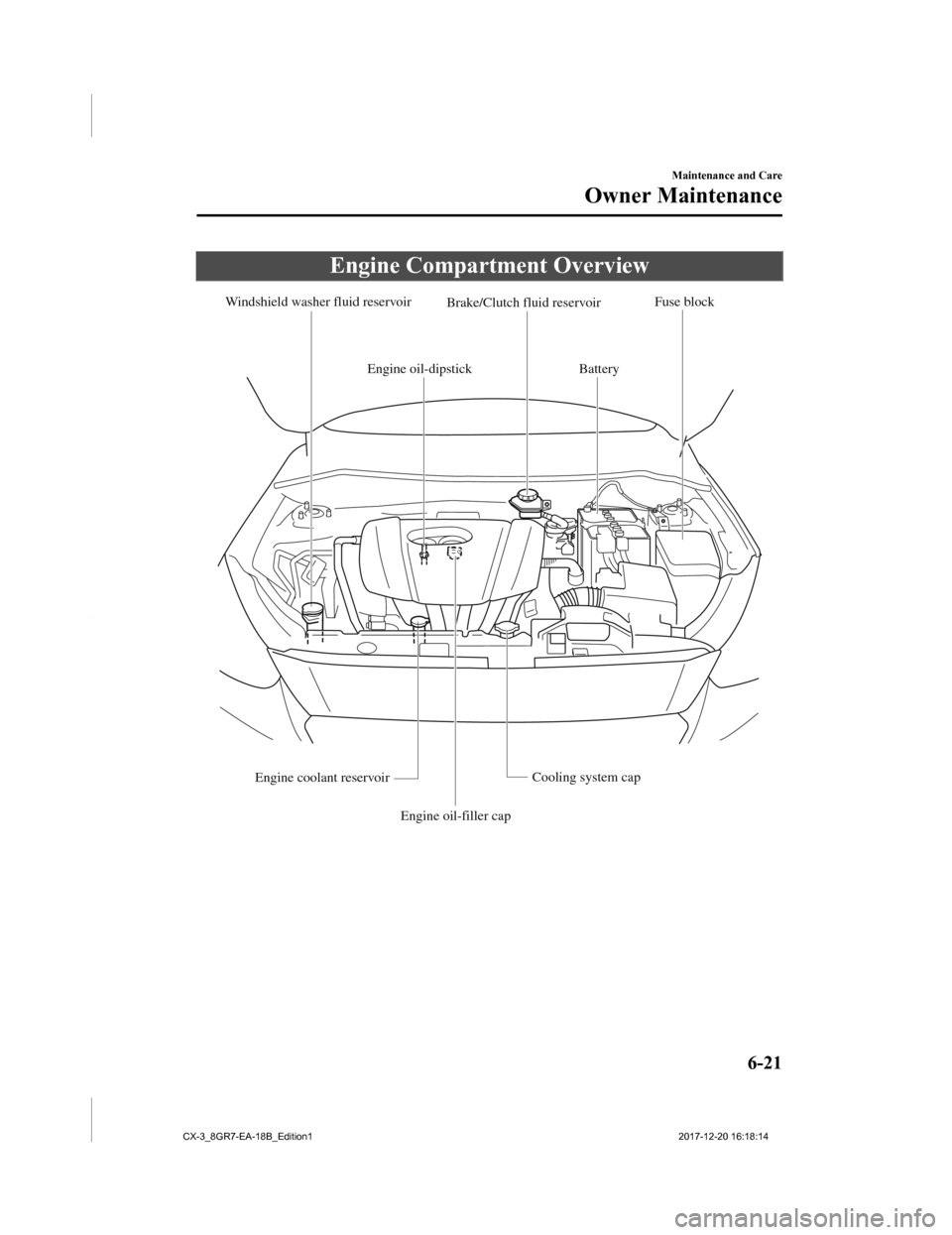
Engine Compartment Overview
Windshield washer fluid reservoir
Engine oil-dipstickBattery
Fuse block
Cooling system capEngine coolant reservoir
Engine oil-filler cap
Brake/Clutch fluid reservoir
Maintenance and Care
Owner Maintenance
6-21
CX-3_8GR7-EA-18B_Edition1 2017-12-20 16:18:14
Page 443 of 608

▼Inspecting Engine Oil Level
1. Be sure the vehicle is on a level
surface.
2. Warm up the engine to normal operating temperature.
3. Turn it off and wait at least 5 minutes for the oil to ret urn to the oil pan.
4. Pull out the dipstick, wipe it clean, and reinsert it fully.
MAX
MIN OK
5. Pull it out again and examine the level.
The level is normal if it is between the
MIN and MAX marks.
If it is near or below MIN, add enough
oil to bring the level to MAX.
CAUTION
Do not overfill the engine oil. This may
cause engine damage.
6. Make sure the O-ring on the dipstick is positioned properly before reinserting
the dipstick.
7. Reinsert the dipstick fully.
Engine Coolant
▼ Inspecting Coolant Level
WA R N I N G
Do not use a match or live flame in the
engine compartment. DO NOT ADD
COOLANT WHEN THE ENGINE IS HOT:
A hot engine is dangerous. If the engine has
been running, parts of the engine
compartment can become very hot. You
could be burned. Carefully inspect the
engine coolant in the coolant reservoir, but
do not open it.
Pull over to a safe location, then switch
the ignition off and make sure the fan is
not running before attempting to work
near the cooling fan:
Working near the cooling fan when it is
running is dangerous. The fan could
continue running indefinitely even if the
engine has stopped and the engine
compartment temperature is high. You
could be hit by the fan and seriously
injured.
Do not remove either cooling
system cap when the engine and radiator
are hot:
When the engine and radiator are hot,
scalding coolant and steam may shoot out
under pressure and cause serious injury.
Maintenance and Care
Owner Maintenance
6-25
CX-3_8GR7-EA-18B_Edition1 2017-12-20 16:18:14
Page 444 of 608

NOTE
Changing the coolant should be done by
an Authorized Mazda Dealer.
Inspect the antifreeze protection and
coolant level in the coolant reservoir at
least once a year―at the beginning of the
winter season―and before traveling where
temperatures may drop below freezing.
Inspect the condition and connections of
all cooling system and heater hoses.
Replace any that are swollen or
deteriorated.
The coolant should be at full in the
radiator and between the F and L marks on
the coolant reservoir when the engine is
cool.
Cooling system cap Coolant reservoir
Cooling fan
If it is at or near L, add enough coolant to
the coolant reservoir to provide freezing
and corrosion protection and to bring the
level to F.
Securely tighten the coolant reservoir tank
cap after adding coolant.
CAUTION
Radiator coolant will damage paint.
Rinse it off quickly if spilled.
If the “FL22” mark is shown on or near
the cooling system cap, use of FL-22 is
recommended when replacing engine
coolant. Using engine coolant other than
FL-22 may cause serious damage to the
engine and cooling system.
If the coolant reserv oir is empty or new
coolant is required frequently, consult an
Authorized Mazda Dealer.
Maintenance and Care
Owner Maintenance
6-26
CX-3_8GR7-EA-18B_Edition1 2017-12-20 16:18:14
Page 469 of 608

DESCRIPTIONFUSE
RATING PROTECTED COMPONENT
15 A/C MAG 7.5 A Air conditioner
16 AT PUMP 15 A ―
17 AT 15 A Transaxle control system
18 D.LOCK 25 A Power door locks
19 H/L RH 20 A Headlight (RH)
20
7.5 A Engine control system
21 TAIL 20 A Taillights, License p late lights, Parking lights
22 ST.HEATER 15 A / 20 A Heated steering wheel
*, Headlight*
23ROOM 25 A Overhead light
24 FOG 15 A
Fog lights
*
25 H/CLEAN 20 A ―
26 STOP 10 A Brake lights
27 HORN 15 A Horn
28 H/L LH 20 A Headlight (LH)
29 ABS/DSC S 30 A ABS, Dynamic stability control system
30 HAZARD 15 A Hazard warning flashers, Turn signal lights
31 FUEL PUMP
SCR 15 A Fuel system
32 FUEL WARM 25 A ―
33 WIPER 20 A Front window wiper
34
50 A For protection of various circuits
35 FA N 2
EPB L 30 A Electric parking brake (LH)
36 FUEL PUMP 30 A ―
37 ABS/DSC M 50 A ABS, Dynamic stability control system
38 EVVT 20 A Engine control system
39 ― ― ―
40 FA N 1
EPB R 30 A Electric parking brake (RH)
41 FAN3 40 A Cooling fan
42 ENG.MAIN 40 A Engine control system
43 EPS 60 A ―
44 DEFOG 40 A Rear window defogger
45 IG2 30 A For protectio n of various circuits
46 INJECTOR
ENG.SUB 30 A Engine control system
Maintenance and Care
Owner Maintenance
*Some models.6-51
CX-3_8GR7-EA-18B_Edition1
2017-12-20 16:18:14
Page 501 of 608

Route the jumper cables away from parts that will be moving:
Connecting a jumper cable near or to moving parts (cooling fans, belts) is dangerous. The
cable could get caught when the engine starts and cause serious injury.
CAUTION
Use only a 12 V booster system. You can damage a 12 V starter, ignition system, and other
electrical parts beyond repair with a 24 V power supply (two 12 V batteries in series or a 24 V
motor generator set).
Jumper cables
Discharged battery
Booster battery
1. Remove the battery cover.
2. Make sure the booster battery is 12 Vand that its negat ive terminal is
grounded.
3. If the booster battery is in another vehicle, do not allow both vehicles to
touch. Turn off the engine of the
vehicle with the booster battery and all
unnecessary electrical loads in both
vehicles.
4. Connect the jumper cables in the exact
sequence as in the illustration.
If Trouble Arises
Battery Runs Out
7-19
CX-3_8GR7-EA-18B_Edition1 2017-12-20 16:18:14