spare wheel MAZDA MODEL CX-30 2020 User Guide
[x] Cancel search | Manufacturer: MAZDA, Model Year: 2020, Model line: MODEL CX-30, Model: MAZDA MODEL CX-30 2020Pages: 562, PDF Size: 83 MB
Page 439 of 562
Use only a Mazda-genuine tire valve
cap:
Use of a non-genuine part is
dangerous as the correct tire air
pressure cannot be maintained if the
tire valve becomes damaged. If the
vehicle is driven under this condition,
the tire air pressure will decrease
which could result in a serious
accident. Do not use any part for the
tire valve cap that is not a
Mazda-genuine part.
Inspect all tire pressures monthly
(including the spare) when the tires are
cold. Maintain recommended
pressures for the best ride, handling ,
and minimum tire wear.
Refer to the specification charts (page
9-7).
NOTE
Always check tire pressure when tires
are cold.
Warm tires normally exceed
recommended pressures. Do not
release air from warm tires to adjust
the pressure.
Underinflation can cause reduced
fuel economy, uneven and
accelerated tire wear, and poor
sealing of the tire bead, which will
deform the wheel and cause
separation of tire from rim.
Overinflation can produce a harsh
ride, uneven and accelerated tire
wear, and a greater possibility of
damage from road hazards.
Keep your tire pressure at the correct
levels. If one frequently needs
inflating, have it inspected.
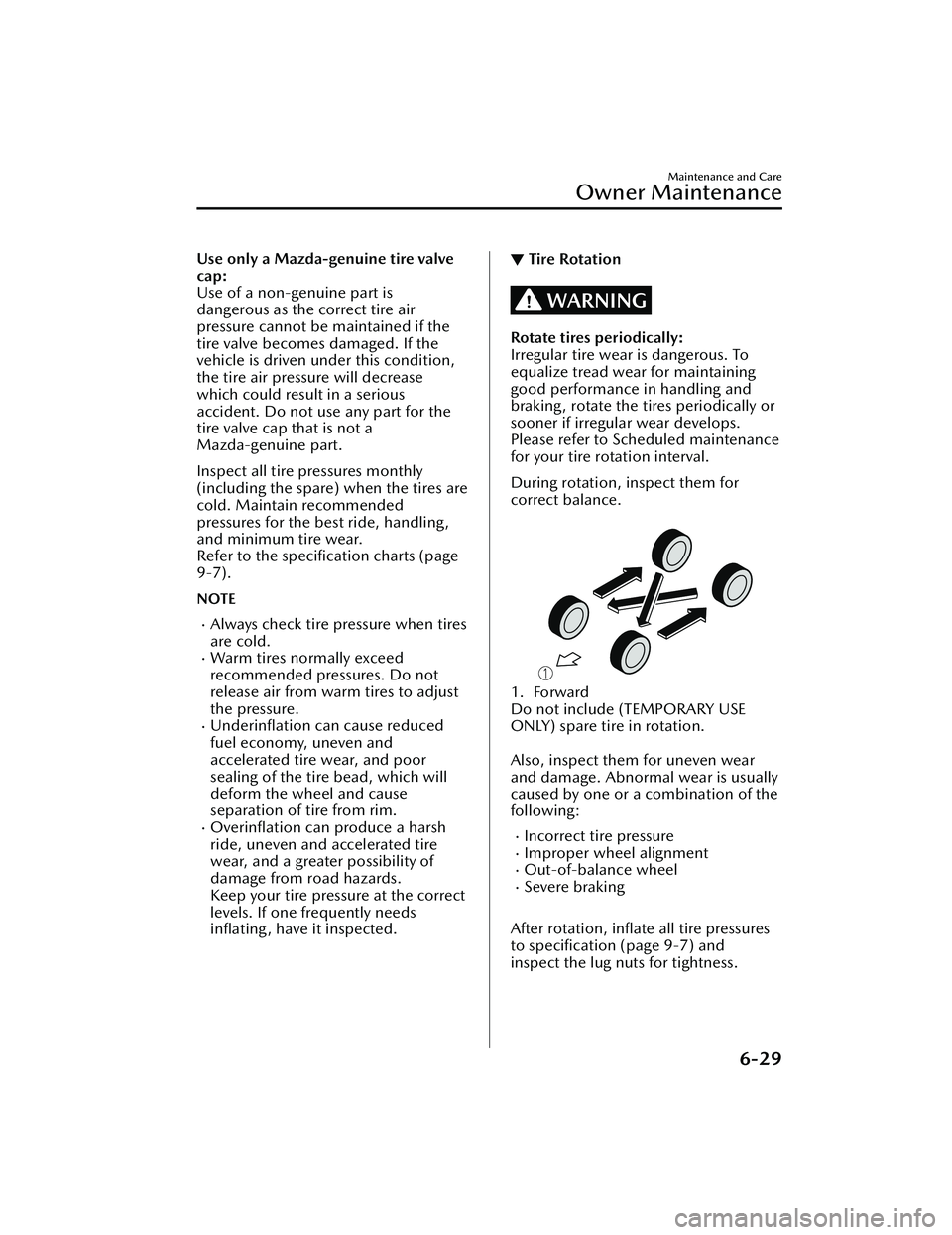
▼ Tire Rotation
WARNING
Rotate tires periodically:
Irregular tire wear is dangerous. To
equalize tread wear for maintaining
good performance in handling and
braking, rotate the tires periodically or
sooner if irregular wear develops.
Please refer to Scheduled maintenance
for your tire rotation interval.
During rotation, inspect them for
correct balance.
1. Forward
Do not include (TEMPORARY USE
ONLY) spare tire in rotation.
Also, inspect them for uneven wear
and damage. Abnormal wear is usually
caused by one or a combination of the
following:
Incorrect tire pressureImproper wheel alignmentOut-of-balance wheelSevere braking
After rotation, inflate all tire pressures
to specification (page 9-7) and
inspect the lug nuts for tightness.
Maintenance and Care
Owner Maintenance
6-29
CX-30_8HG6-EA-19I_Edition1_new 2019-6-13 18:45:11
Page 441 of 562
CAUTION
Do not use your temporary spare tire
rim with a snow tire or a
conventional tire. Neither will
properly
fit and could damage both
tire and rim.
The temporary spare tire has a tread
life of less than 5,000 km (3,000
miles). The tread life may be shorter
depending on driving conditions.
The temporary spare tire is for
limited use, however, if the tread
wear solid-band indicator appears,
replace the tire with the same type of
temporary spare (page 6-30).
NOTE
Tires degrade over time, even when
they are not being used on the road. It
is recommended that tires generally be
replaced when they are 6 years or
older. Heat caused by hot climates or
frequent high loading conditions can
accelerate the aging process. You
should replace the spare tire when you
replace the other road tires due to the
aging of the spare tire. The period in
which the tire was manufactured (both
week and year) is indicated by a 4-digit
number.
Refer to Tire Labeling on page 8-22.
▼ Replacing a Wheel
WARNING
Always use wheels of the correct size
on your vehicle:
Using a wrong-sized wheel is
dangerous. Braking and handling could
be
affected, leading to loss of control
and an accident.
CAUTION
A wrong-sized wheel may adversely
affect:
Tire
fit
Wheel and bearing life
Ground clearance
Snow-chain clearance
Speedometer calibration
Headlight aim
Bumper height
Tire Pressure Monitoring System
NOTE
When replacing a wheel, make sure
the new one is the same as the
original factory wheel in diameter,
rim width, and offset (inset/outset).
For details, contact an Authorized
Mazda Dealer.
Proper tire balancing provides the best
riding comfort and helps reduce tread
wear. Out-of-balance tires can cause
vibration and uneven wear, such as
cupping and flat spots.
Maintenance and Care
Owner Maintenance
6-31
CX-30_8HG6-EA-19I_Edition1_new
2019-6-13 18:45:11
Page 462 of 562

WARNING
Do not install the temporary spare tire
on the front wheels (driving wheels):
Driving with the temporary spare tire
on one of the front driving wheels is
dangerous. Handling will be affected.
You could lose control of the vehicle,
especially on ice or snow bound roads,
and have an accident. Move a regular
tire to the front wheel and install the
temporary spare tire to the rear.
CAUTION
When using the temporary spare tire,
driving stability may decrease
compared to when using only the
conventional tire. Drive carefully.
To avoid damage to the temporary
spare tire or to the vehicle, observe
the following precautions:
Do not exceed 80 km/h (50 mph).
Avoid driving over obstacles. Also,
do not drive through an automatic
car wash. This tire's diameter is
smaller than a conventional tire, so
the ground clearance is reduced.
Do not use a tire chain on this tire
because it will not fit properly.
Do not use your temporary spare
tire on any other vehicle, it has
been designed only for your
Mazda.
Use only one temporary spare tire
on your vehicle at the same time.
To remove the spare tire
1. Remove the luggage mat.
2.(Vehicles with sub-woofer)
Uncouple the sub-woofer
connector.
NOTE
Extra strength may be required to
uncouple the connector. Be sure to
squeeze the tab firmly.
3. (Vehicles with sub-woofer)
Turn the spare tire hold-down bolt
counterclockwise and remove the
sub-woofer and the spare tire.
If Trouble Arises
Flat Tire
7-4
CX-30_8HG6-EA-19I_Edition1_new 2019-6-13 18:45:11
Page 464 of 562
2. Put a vehicle with an automatictransmission in Park (P), a manual
transmission in Reverse (R) or 1,
and turn off the engine.
3. Turn on the hazard warning flasher.
4. Have passengers get out of the vehicle and away from the vehicle
and traffic.
5. Remove any luggage, the jack, tools, and spare tire (page 7-3).
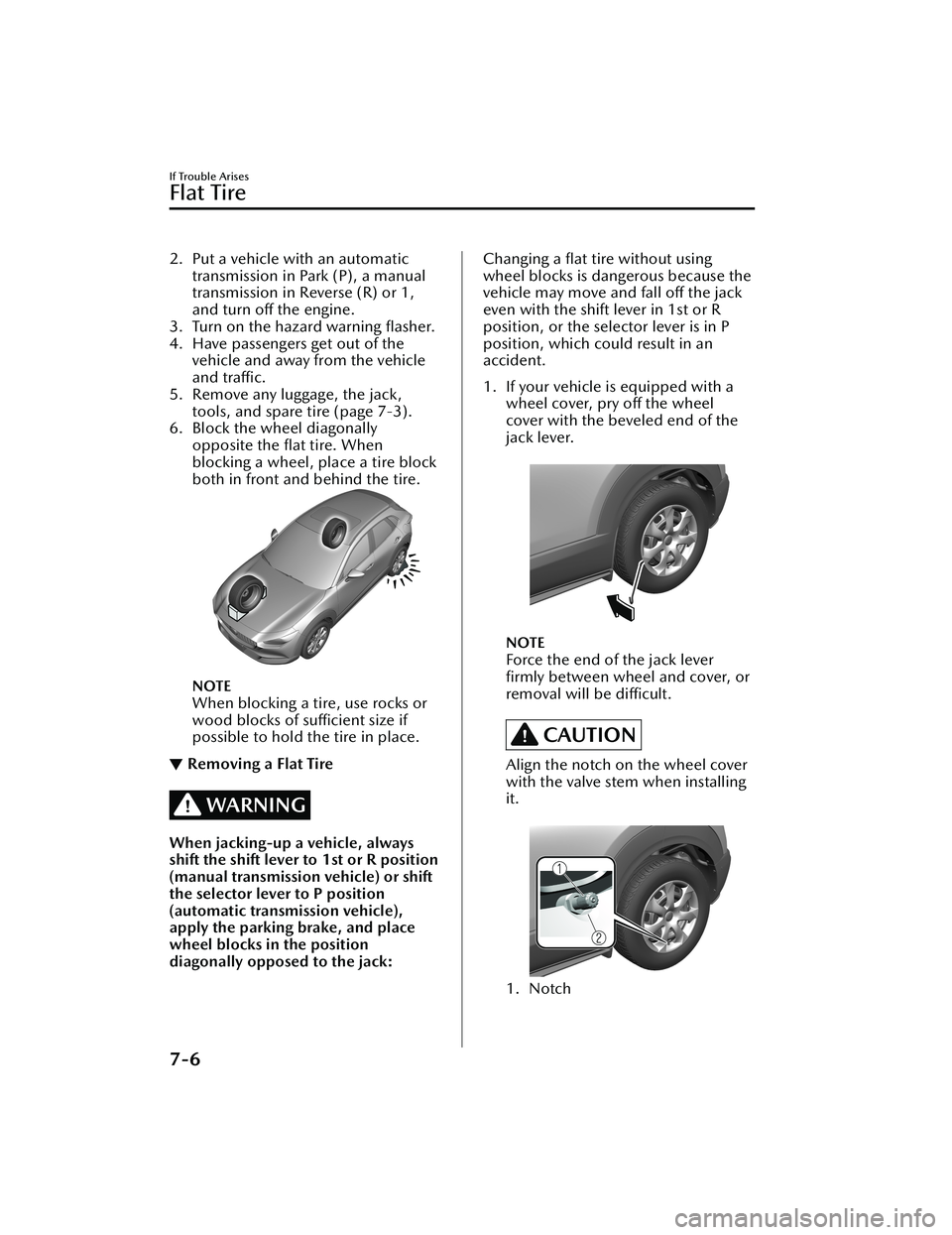
6. Block the wheel diagonally opposite the flat tire. When
blocking a wheel, place a tire block
both in front and behind the tire.
NOTE
When blocking a tire, use rocks or
wood blocks of sufficient size if
possible to hold the tire in place.
▼Removing a Flat Tire
WARNING
When jacking-up a vehicle, always
shift the shift lever to 1st or R position
(manual transmission vehicle) or shift
the selector lever to P position
(automatic transmission vehicle),
apply the parking brake, and place
wheel blocks in the position
diagonally opposed to the jack:
Changing a flat tire without using
wheel blocks is dangerous because the
vehicle may move and fall off the jack
even with the shift lever in 1st or R
position, or the selector lever is in P
position, which could result in an
accident.
1. If your vehicle is equipped with a
wheel cover, pry off the wheel
cover with the beveled end of the
jack lever.
NOTE
Force the end of the jack lever
firmly between wheel and cover, or
removal will be difficult.
CAUTION
Align the notch on the wheel cover
with the valve stem when installing
it.
1. Notch
If Trouble Arises
Flat Tire
7-6
CX-30_8HG6-EA-19I_Edition1_new 2019-6-13 18:45:11
Page 467 of 562
WARNING
Do not jack up the vehicle higher
than is necessary:
Jacking up the vehicle higher than is
necessary is dangerous as it could
destabilize the vehicle resulting in
an accident.
Do not start the engine or shake
the vehicle while it is jacked up:
Starting the engine or shaking the
vehicle while it is jacked up is
dangerous as it could cause the
vehicle to fall off the jack resulting
in an accident.
Never go under the vehicle while it
is jacked up:
Going under the vehicle while it is
jacked up is dangerous as it could
result in death or serious injury if
the vehicle were to fall off the jack.
9. Remove the lug nuts by turning them counterclockwise; then
remove the wheel and center cap.
▼Locking Lug Nuts
If your Mazda is equipped with the
optional antitheft wheel lug nuts, a
special key must be used to unlock the
locking lug nut for each wheel. The key
is stored in the glove compartment,
center console storage, storage box, or
trunk. Register the key and lug nuts
with the lock manufacturer by filling
out the registration card and mailing it
in using the accompanying envelope. If
the key is lost, consult an Authorized
Mazda Dealer or use the lock
manufacturer’s order form to order a
new key.
Antitheft wheel lug nuts cannot be
installed on a steel wheel spare tire.
When installing a temporary spare tire,
use one of the original lug nuts in place
of the locking lug nut. The original lug
nuts are stored inside your Mazda.
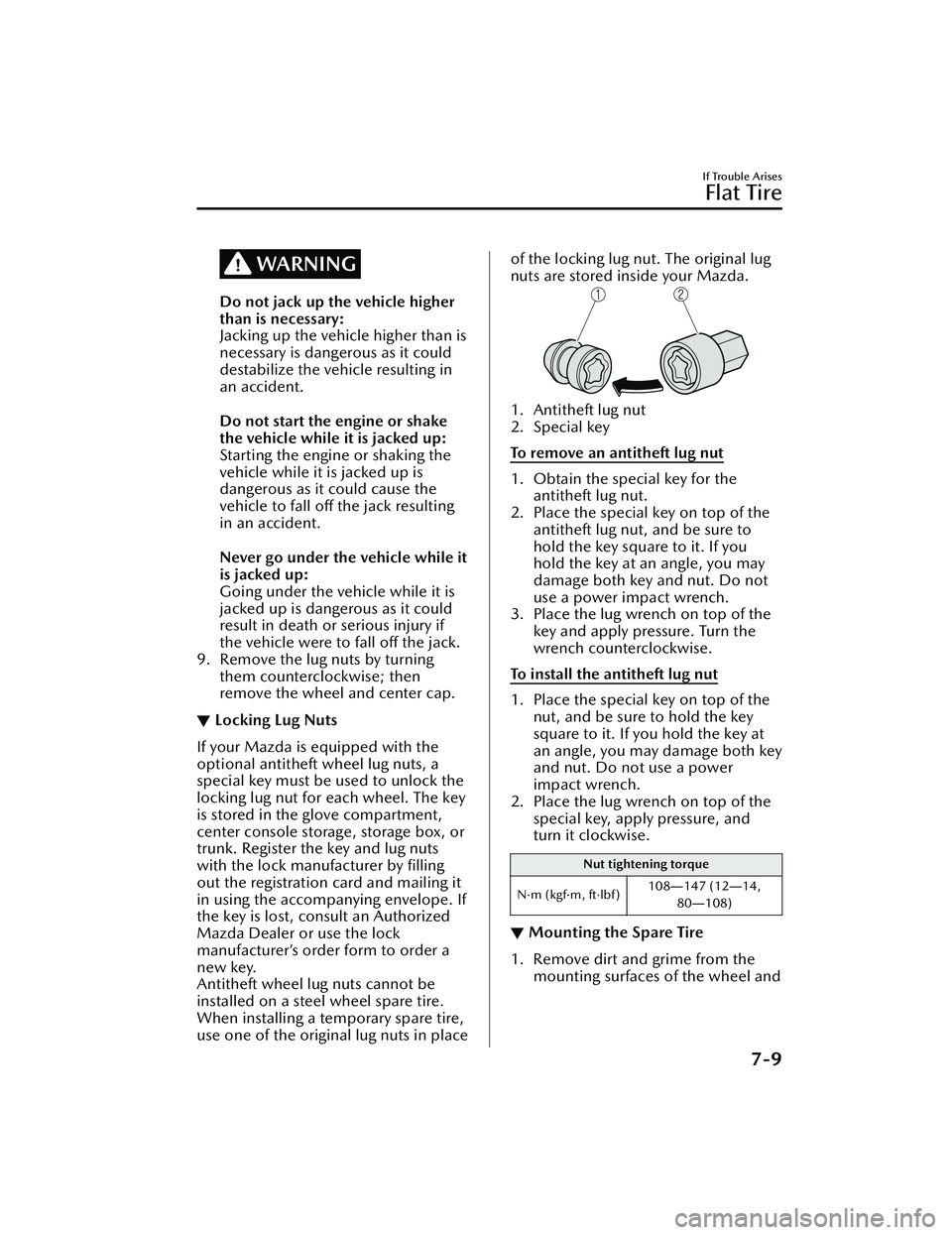
1. Antitheft lug nut
2. Special key
To remove an antitheft lug nut
1. Obtain the special key for the
antitheft lug nut.
2. Place the special key on top of the antitheft lug nut, and be sure to
hold the key square to it. If you
hold the key at an angle, you may
damage both key and nut. Do not
use a power impact wrench.
3. Place the lug wrench on top of the
key and apply pressure. Turn the
wrench counterclockwise.
To install the antitheft lug nut
1. Place the special key on top of the nut, and be sure to hold the key
square to it. If you hold the key at
an angle, you may damage both key
and nut. Do not use a power
impact wrench.
2. Place the lug wrench on top of the special key, apply pressure, and
turn it clockwise.
Nut tightening torque
N·m (kgf·m, ft·lbf) 108―
147 (12 ―14,
80― 108)
▼Mounting the Spare Tire
1. Remove dirt and grime from the
mounting surfaces of the wheel and
If Trouble Arises
Flat Tire
7-9
CX-30_8HG6-EA-19I_Edition1_new 2019-6-13 18:45:11
Page 468 of 562

hub, including the hub bolts, with a
cloth.
WARNING
Make sure the mounting surfaces
of the wheel, hub and lug nuts are
clean before changing or replacing
tires:
When changing or replacing a tire,
not removing dirt and grime from
the mounting surfaces of the wheel,
hub and hub bolts is dangerous.
The lug nuts could loosen while
driving and cause the tire to come
off, resulting in an accident.
2. Mount the spare tire.
3. Install the lug nuts with the beveled edge inward; tighten them by hand.
WARNING
Do not apply oil or grease to lug
nuts and bolts and do not tighten
the lug nuts beyond the
recommended tightening torque:
Applying oil or grease to lug nuts
and bolts is dangerous. The lug nuts
could loosen while driving and
cause the tire to come off, resulting
in an accident. In addition, lug nuts
and bolts could be damaged if
tightened more than necessary.
4. Turn the jack handle counterclockwise using the lug
wrench and lower the vehicle.
5. Use the lug wrench to tighten the nuts in the order shown.
If you are unsure of how tight the
nuts should be, have them
inspected at an Authorized Mazda
Dealer.
Nut tightening torque
N·m (kgf·m, ft·lbf) 108
―147 (12 ―14,
80 ―108)
WARNING
Always securely and correctly
tighten the lug nuts:
Improperly or loosely tightened lug
nuts are dangerous. The wheel
could wobble or come
off. This
could result in loss of vehicle
control and cause a serious
accident.
If Trouble Arises
Flat Tire
7-10
CX-30_8HG6-EA-19I_Edition1_new 2019-6-13 18:45:11
Page 529 of 562

road when it's mounted on the
vehicle.
Seating capacity means the total
allowable number of vehicle
occupants. Seating capacity is
described on the tire label.
Production options weight is the
combination weight of installed regular
production options weighing over 2.3
kilograms in excess of the standard
items which they replace, and not
previously considered in the curb
weight or accessory weight, including
heavy duty brakes, ride levelers, roof
rack, heavy duty battery, and special
trim.
Rim is the metal support (wheel) for a
tire or a tire and tube assembly upon
which the tire beads are seated.Tire Maintenance
▼ Tire Maintenance
Improper or inadequate vehicle
maintenance can cause tires to wear
abnormally. Here are some important
maintenance points:
▼Tire
Inflation Pressure
Inspect all tire pressure monthly
(including the spare) when the tires are
cold. Maintain recommended
pressures for the best ride, top
handling , and minimum tire wear. Use
the pressures specified on the vehicle
tire information placard or tire label for
optimum service.
▼Tire Rotation
To equalize tread wear, rotate the tires
every 16,000 km (10,000 miles) at the
latest or sooner if irregular wear
develops. Mazda recommends to
rotate every 8,000 km (5,000 miles) to
help increase tire life and distribute
wear more evenly.
1. Forward
Do not include (TEMPORARY USE
ONLY) spare tire in rotation.
Inspect the tires for uneven wear and
damage. Abnormal wear is usually
caused by one or a combination of the
following:
Incorrect tire pressure
Customer Information and Reporting Safety Defects
Tire Information (U.S.A.)
8-27
CX-30_8HG6-EA-19I_Edition1_new
2019-6-13 18:45:11
Page 530 of 562

Improper wheel alignmentOut-of-balance wheelSevere braking
After rotation, inflate all tire pressures
to specification (page 9-7) and
inspect the lug nuts for tightness.
CAUTION
Rotate unidirectional tires and radial
tires that have an asymmetrical tread
pattern or studs only from front to rear,
not from side to side. Tire performance
will be weakened if rotated from side
to side.
▼ Replacing a Tire
WARNING
Always use tires that are in good
condition:
Driving with worn tires is dangerous.
Reduced braking , steering , and
traction could result in an accident.
If a tire wears evenly, a wear indicator
will appear as a solid band across the
tread.
Replace the tire when this happens.
1. New tread
2. Worn tread
3. Tread wear indicator
You should replace the tire before the
band crosses the entire tread.
NOTE
Tires degrade over time, even when
they are not being used on the road. It
is recommended that tires generally be
replaced when they are 6 years or
older. Heat caused by hot climates or
frequent high load
ing conditions can
accelerate the aging process. You
should replace the spare tire when you
replace the other road tires due to the
aging of the spare tire. The period in
which the tire was manufactured (both
week and year) is indicated by a 4-digit
number.
Refer to Tire Labeling on page 8-22.
▼ Safety Practices
The way you drive has a great deal to
do with your tire mileage and safety.
So cultivate good driving habits for
your own benefit.
Observe posted speed limits and
drive at speeds that are safe for the
existing weather conditions
Avoid fast starts, stops and turnsAvoid potholes and objects on the
road
Do not run over curbs or hit the tire
against the curb when parking
CAUTION
If you feel a sudden vibration or ride
disturbance while driving or you
suspect your tire or vehicle has been
damaged, immediately reduce your
speed. Drive with caution until you can
safely pull off the road. Stop and
inspect the tire for damage. If the tire
is under-inflated or damaged, deflate
it, remove the tire and rim and replace
it with your spare tire. If you cannot
detect a cause, have the vehicle towed
to the nearest vehicle or tire dealer to
have the vehicle inspected.
Customer Information and Reporting Safety Defects
Tire Information (U.S.A.)
8-28
CX-30_8HG6-EA-19I_Edition1_new
2019-6-13 18:45:11
Page 558 of 562

Index
Key battery........................... 6-26
Tires.....................................6-30
Wheel.................................. 6-31
Wiper.................................. 6-20
Rocking the Vehicle................... 3-50
S
Safety Defects, Reporting
(Canada).................................. 8-13
Safety Defects, Reporting
(U.S.A.).................................... 8-12
Saving Fuel and Protection of the
Environment............................. 3-47
Scheduled Maintenance Canada.................................. 6-6
Mexico.................................. 6-8
U.S.A. and Puerto Rico........... 6-4
Seats Driver's seat........................... 2-4
Front passenger's seat........... 2-12
Front seat............................... 2-4
Head restraint...................... 2-15
Rear seat.............................. 2-13
Seat warmer......................... 2-17
Seat Belt System Automatic locking................ 2-22
Emergency locking................ 2-22
Extender.............................. 2-27
Pregnant women.................. 2-21
Seat belt precautions............ 2-20
Seat Belt Warning Beep............. 7-36
Security System Immobilizer system............... 3-43
Theft-deterrent system.......... 3-45
Shift Position Warning Beep....... 7-38
Smart Brake Support (SBS)....... 4-149 Collision warning................ 4-151
Stopping the Smart Brake Support
(SBS) system operation........4-151
Smart Brake Support [Rear Crossing]
(SBS-RC) .................................4-155
Collision warning................ 4-158
Stopping the Smart Brake Support
[Rear Crossing] (SBS-RC) system
operation........................... 4-159
Smart Brake Support [Rear] (SBS-
R) ........................................... 4-152
Collision warning................ 4-154
Stopping the Smart Brake Support
[Rear] (SBS-R) system
operation........................... 4-155
Spare Tire................................... 7-3
Spare Tire and Tool Storage.......... 7-3
Specifications Air conditioner....................... 9-7
Capacities.............................. 9-5
Dimensions............................ 9-5
Electrical system..................... 9-4
Engine................................... 9-4
Light bulbs............................. 9-7
Lubricant quality..................... 9-4
Tires.......................................9-7
Weights................................. 9-6
SRS Air Bags Driver and front passenger
occupant classification
system................................. 2-64
How the SRS air bags work.... 2-57
Limitations to SRS air bag...... 2-62
Monitoring........................... 2-68
SRS air bag deployment
criteria................................. 2-60
Supplemental restraint system
components......................... 2-55
Supplemental restraint system
(SRS) precautions................. 2-49
Starting the Engine...................... 4-5
Steering Wheel Heated steering wheel.......... 2-18
Horn.................................... 4-54
10-8
CX-30_8HG6-EA-19I_Edition1_new 2019-6-13 18:45:11
Page 559 of 562

Index
Storage Compartments.............. 5-41Center console..................... 5-42
Glove compartment..............5-41
Luggage compartment.......... 5-42
Overhead console................ 5-41
Storage pocket..................... 5-41
Storage Pocket.......................... 5-41
Sunshade.................................. 3-42
Sunvisors.................................. 5-34
T
Theft-Deterrent System.............. 3-45
Three-flash Turn Signal...............4-48
Tiedown Hook.......................... 7-20
Tires......................................... 6-28 Replacing a tire.................... 6-30
Replacing a wheel................ 6-31
Snow tires............................ 3-51
Specifications......................... 9-7
Temporary spare tire............. 6-30
Tire chains............................3-51
Tire inflation pressure............6-28
Tire rotation......................... 6-29
Uniform tire quality grading
system (UTQGS)................... 8-20
Tire Information Location of the tire label
(placard).............................. 8-25
Steps for determining the correct
load limit............................. 8-32
Tire labeling......................... 8-22
Tire maintenance.................. 8-27
Vehicle loading.....................8-29
Tire Pressure Monitoring
System.................................... 4-205
Touch Sensor Inoperable Warning
Beep (With the advanced keyless
function)...................................7-37
To w i n g Recreational towing.............. 3-54
Trailer towing....................... 3-54
Towing Description................... 7-19
Traction Control System (TCS).... 4-72 TCS OFF Indicator Light......... 4-72
TCS OFF switch.................... 4-73
TCS/DSC indicator light........4-72
Tra ffi c Jam Assist (TJA).............. 4-132
Close proximity warning...... 4-137
Display indication............... 4-136
Setting the system...............4-138
Shift-up/shift-down request
display............................... 4-144
Stop hold control............... 4-144
Tra ffi c Sign Recognition System
(TSR)........................................ 4-97
Trouble Battery runs out.................... 7-13
Emergency starting................7-16
Flat tire.................................. 7-5
Overheating......................... 7-17
Parking in an emergency......... 7-2
When liftgate cannot be
opened................................ 7-41
Turn and Lane-Change Signals.... 4-47
Turn Signals.............................. 4-47
U
Ultrasonic Sensor.................... 4-199
V
Vehicle Information Labels Chassis number...................... 9-2
Engine number....................... 9-3
Motor vehicle safety standard
label...................................... 9-2
Tire pressure label.................. 9-2
Vehicle emission control
information label.................... 9-2
Ve h i c l e i d e n t i fi c a t i o n
number..................................9-2
10-9
CX-30_8HG6-EA-19I_Edition1_new 2019-6-13 18:45:11