fuel MAZDA MODEL CX-30 2020 Service Manual
[x] Cancel search | Manufacturer: MAZDA, Model Year: 2020, Model line: MODEL CX-30, Model: MAZDA MODEL CX-30 2020Pages: 562, PDF Size: 83 MB
Page 438 of 562
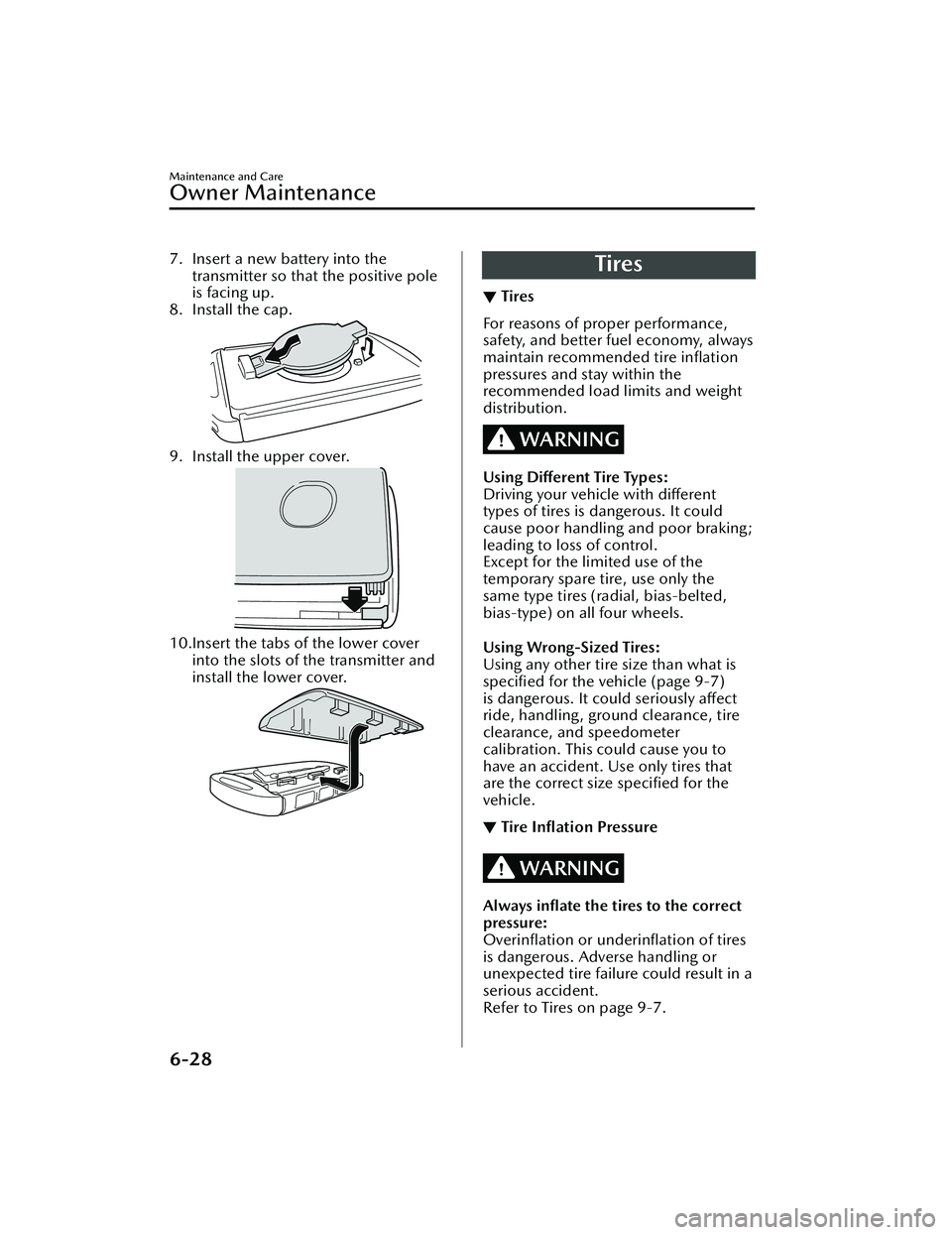
7. Insert a new battery into thetransmitter so that the positive pole
is facing up.
8. Install the cap.
9. Install the upper cover.
10.Insert the tabs of the lower cover into the slots of the transmitter and
install the lower cover.
Tires
▼Tires
For reasons of proper performance,
safety, and better fuel economy, always
maintain recommended tire
inflation
pressures and stay within the
recommended load limits and weight
distribution.
WARNING
Using Different Tire Types:
Driving your vehicle with different
types of tires is dangerous. It could
cause poor handling and poor braking;
leading to loss of control.
Except for the limited use of the
temporary spare tire, use only the
same type tires (radial, bias-belted,
bias-type) on all four wheels.
Using Wrong-Sized Tires:
Using any other tire size than what is
specified for the vehicle (page 9-7)
is dangerous. It could seriously affect
ride, handling, ground clearance, tire
clearance, and speedometer
calibration. This could cause you to
have an accident. Use only tires that
are the correct size specified for the
vehicle.
▼ Tire Inflation Pressure
WARNING
Always inflate the tires to the correct
pressure:
Overinflation or underinflation of tires
is dangerous. Adverse handling or
unexpected tire failure could result in a
serious accident.
Refer to Tires on page 9-7.
Maintenance and Care
Owner Maintenance
6-28
CX-30_8HG6-EA-19I_Edition1_new
2019-6-13 18:45:11
Page 439 of 562
Use only a Mazda-genuine tire valve
cap:
Use of a non-genuine part is
dangerous as the correct tire air
pressure cannot be maintained if the
tire valve becomes damaged. If the
vehicle is driven under this condition,
the tire air pressure will decrease
which could result in a serious
accident. Do not use any part for the
tire valve cap that is not a
Mazda-genuine part.
Inspect all tire pressures monthly
(including the spare) when the tires are
cold. Maintain recommended
pressures for the best ride, handling ,
and minimum tire wear.
Refer to the specification charts (page
9-7).
NOTE
Always check tire pressure when tires
are cold.
Warm tires normally exceed
recommended pressures. Do not
release air from warm tires to adjust
the pressure.
Underinflation can cause reduced
fuel economy, uneven and
accelerated tire wear, and poor
sealing of the tire bead, which will
deform the wheel and cause
separation of tire from rim.
Overinflation can produce a harsh
ride, uneven and accelerated tire
wear, and a greater possibility of
damage from road hazards.
Keep your tire pressure at the correct
levels. If one frequently needs
inflating, have it inspected.
▼ Tire Rotation
WARNING
Rotate tires periodically:
Irregular tire wear is dangerous. To
equalize tread wear for maintaining
good performance in handling and
braking, rotate the tires periodically or
sooner if irregular wear develops.
Please refer to Scheduled maintenance
for your tire rotation interval.
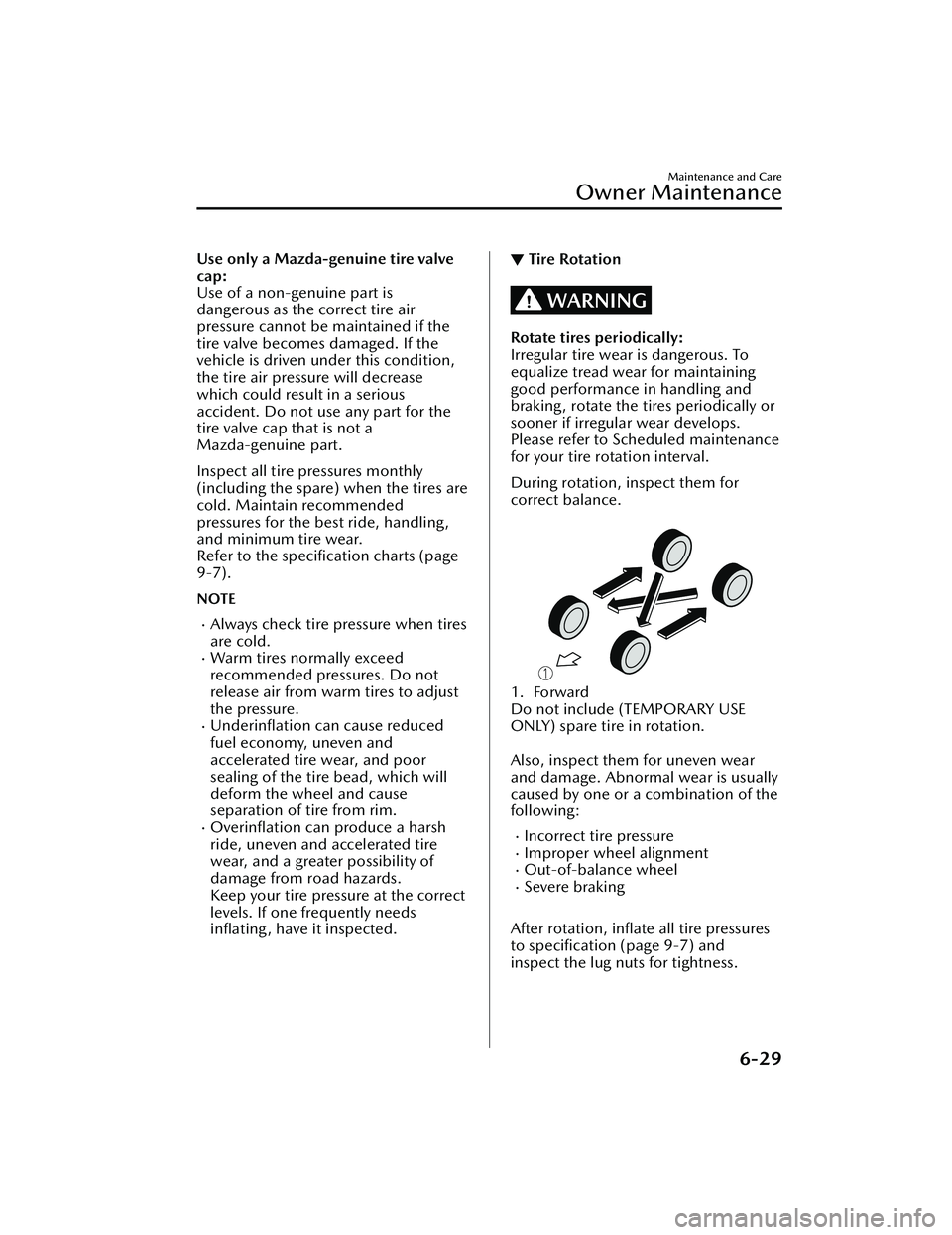
During rotation, inspect them for
correct balance.
1. Forward
Do not include (TEMPORARY USE
ONLY) spare tire in rotation.
Also, inspect them for uneven wear
and damage. Abnormal wear is usually
caused by one or a combination of the
following:
Incorrect tire pressureImproper wheel alignmentOut-of-balance wheelSevere braking
After rotation, inflate all tire pressures
to specification (page 9-7) and
inspect the lug nuts for tightness.
Maintenance and Care
Owner Maintenance
6-29
CX-30_8HG6-EA-19I_Edition1_new 2019-6-13 18:45:11
Page 446 of 562

No.FUSE RAT-
ING PROTECTED COMPONENT
F7 15 A
―
20 A Fuel pump
F8 15 A Engine control system
F9 15 A Transmission control system
*
F1015 A Engine control system
F11 7.5 A Air conditioner
F12 15 A Engine control system
F13 15 A ―
F14 20 A
Front seat warmer
*
F15 20 A ―
F16 15 A For protection of various circuits
F17 ――
F18 15 A For protection of various circuits
F19 60 A Power steering system
F20 15 A Headlight (LH) 1
F21 15 A Headlight (RH) 1
F22 15 A Keyless system
F23 30 A ABS, Dynamic stability control system
F24 15 A Headlight (LH) 2
F25 15 A Headlight (RH) 2
F26 7.5 A On board diagnostics
F27 25 A For protection of various circuits
F28 25 A For protection of various circuits
F29 15 A Windshield washer
F30 15 A Accessory sockets
F31 15 A Horn
F32 15 A Headlights
F33 ――
F34 ――
F35 50A ABS, Dynamic stability control system
F36 ――
F37 40 A Rear window defogger
F38 50 A For protection of various circuits
Maintenance and Care
Owner Maintenance
6-36*Some models.
CX-30_8HG6-EA-19I_Edition1_new 2019-6-13 18:45:11
Page 452 of 562
Do not spray water in the engine
compartment. Otherwise, it could
result in engine-starting problems or
damage to electrical parts.
When washing and waxing the
vehicle, be careful not to apply
excessive force to any single area of
the vehicle roof or the antenna.
Otherwise, you could dent the
vehicle or damage the antenna.
Make sure that the fuel-filler lid is
closed and lock the doors.
Otherwise, the fuel-filler lid may be
forcefully opened by water pressure
causing damage to the vehicle or
fuel-filler lid.
To help protect the finish from rust and
deterioration, wash your Mazda
thoroughly and frequently, at least
once a month, with lukewarm or cold
water.
If the vehicle is washed improperly, the
paint surface could be scratched. Here
are some examples of how scratching
could occur.
Scratches occur on the paint surface
when:
The vehicle is washed without first
rinsing off dirt and other foreign
matter.
The vehicle is washed with a rough,
dry, or dirty cloth.
The vehicle is washed at a car wash
that uses brushes that are dirty or too stiff.
Cleansers or wax containing
abrasives are used.
NOTE
Mazda is not responsible for
scratches caused by automatic car
washes or improper washing.
Scratches are more noticeable on
vehicles with darker paint finishes.
To minimize scratches on the vehicle's
paint finish:
Rinse off any dirt or other foreign
matter using lukewarm or cold water
before washing.
Use plenty of lukewarm or cold
water and a soft cloth when washing
the vehicle. Do not use a nylon cloth.
Rub gently when washing or drying
the vehicle.
Take your vehicle only to a car wash
that keeps its brushes well
maintained.
Do not use abrasive cleansers or wax
that contain abrasives.
CAUTION
Do not use steel wool, abrasive
cleaners, or strong detergents
containing highly alkaline or caustic
agents on chrome-plated or
anodized aluminum parts. This may
damage the protective coating; also,
cleaners and detergents may discolor
or deteriorate the paint.
Pay special attention to removing salt,
dirt, mud, and other foreign material
from the underside of the fenders, and
make sure the drain holes in the lower
edges of the doors and rocker panels
are clean.
Insects, tar, tree sap, bird droppings,
industrial fallout, and similar deposits
can damage the finish if not removed
immediately. When prompt washing
Maintenance and Care
Appearance Care
6-42
CX-30_8HG6-EA-19I_Edition1_new 2019-6-13 18:45:11
Page 454 of 562

▼Bright-Metal Maintenance
Use tar remover to remove road tar
and insects. Never do this with a
knife or similar tool.
To prevent corrosion on bright-metal
surfaces, apply wax or chrome
preservative and rub it to a high
luster.
During cold weather or in coastal
areas, cover bright-metal parts with a
coating of wax or preservative
heavier than usual. It would also help
to coat them with noncorrosive
petroleum jelly or some other
protective compound.
CAUTION
Do not use steel wool, abrasive
cleaners, or strong detergents
containing highly alkaline or caustic
agents on chrome-plated or anodized
aluminum parts. This may result in
damage to the protective coating and
cause discoloration or paint
deterioration.
▼Underbody Maintenance
Road chemicals and salt used for ice
and snow removal and solvents used
for dust control may collect on the
underbody. If not removed, they will
speed up rusting and deterioration of
such underbody parts as fuel lines,
frame,
floor pan, and exhaust system,
even though these parts may be coated
with anti-corrosive material.
Thoroughly flush the underbody and
wheel housings with lukewarm or cold
water at the end of each winter. Try
also to do this every month.
Pay special attention to these areas
because they easily hide mud and dirt.
It will do more harm than good to wet
down the road grime without
removing it.
The lower edges of doors, rocker
panels, and frame members have drain
holes that should not be clogged.
Water trapped there will cause rusting.
WARNING
Dry off brakes that have become wet
by driving slowly, releasing the
accelerator pedal and lightly applying
the brakes several times until the
brake performance returns to normal:
Driving with wet brakes is dangerous.
Increased stopping distance or the
vehicle pulling to one side when
braking could result in a serious
accident. Light braking will indicate
whether the brakes have been
affected.
▼ Aluminum Wheel Maintenance*
A protective coating is provided over
the aluminum wheels. Special care is
needed to protect this coating.
CAUTION
Do not use any detergent other than
mild detergent. Before using any
detergent, verify the ingredients.
Otherwise, the product could discolor
or stain the aluminum wheels.
NOTE
Do not use a wire brush or any
abrasive cleaner, polishing
compound, or solvent on aluminum
wheels. They may damage the
coating.
Always use a sponge or soft cloth to
clean the wheels.
Maintenance and Care
Appearance Care
6-44*Some models.
CX-30_8HG6-EA-19I_Edition1_new
2019-6-13 18:45:11
Page 474 of 562

Starting a Flooded Engine
▼Starting a Flooded Engine
If the engine fails to start, it may be
flooded
(excessive fuel in the engine).
Follow this procedure:
1. If the engine does not start within 5 seconds on the first try, wait 10
seconds and try again.
2. Make sure the parking brake is on.
3. Depress the accelerator all the way
and hold it there.
4. Depress the clutch pedal (manual
transmission) or the brake pedal
(automatic transmission), then
press the push button start. If the
engine starts, release the
accelerator immediately because
the engine will suddenly rev up.
5. If the engine fails to start, crank it
without depressing the accelerator.
If the engine still does not start using
the previous procedure, have your
vehicle inspected by an Authorized
Mazda Dealer.
Push-Starting
▼ Push-Starting
Do not push-start your Mazda.
WARNING
Never tow a vehicle to start it:
Towing a vehicle to start it is
dangerous. The vehicle being towed
could surge forward when its engine
starts, causing the 2 vehicles to collide.
The occupants could be injured.
CAUTION
Do not push-start a vehicle that has a
manual transmission. It can damage
the emission control system.
NOTE
You cannot start a vehicle with an
automatic transmissi
on by pushing it.
If Trouble Arises
Emergency Starting
7-16
CX-30_8HG6-EA-19I_Edition1_new 2019-6-13 18:45:11
Page 484 of 562

Release the accelerator pedal and
depress the brake pedal.
▼Check Engine Indication/Light
If this light illuminates while driving,
the vehicle may have a problem. It is
important to note the driving
conditions when the light illuminated
and consult an Authorized Mazda
Dealer.
The check engine light may illuminate
in the following cases:
The engine's electrical system has a
problem.
The emission control system has a
problem.
The fuel tank level being very low or
approaching empty.
The fuel-filler cap is missing or not
tightened securely.
If the check engine light remains on, or
it flashes continuously , do not drive at
high speeds and consult an Authorized
Mazda Dealer as soon as possible.
WARNING
If the check engine light turns on, do
not disconnect the battery cables.
If the battery cables are disconnected
and then reconnected, the engine
could be damaged and catch on fire.
▼ Automatic Transmission Warning
Indication/Warning Light*
The indication/light illuminates when
the transmission has a problem.
CAUTION
If the automatic tr
ansmission warning
indication/light illuminates, the
transmission has an electrical problem.
Continuing to drive your Mazda in this
condition could cause damage to your
transmission. Consult an Authorized
Mazda Dealer as soon as possible.
▼ AWD Warning Indication/
Warning Light*
“AWD Malfunction. Front Wheel
Drive Only. Have the Vehicle
Inspected” is displayed/When the
light is turned on
The indication is displayed/the light
turns on under the following
conditions. The system may have a
malfunction. Have the vehicle checked
at an Authorized Mazda Dealer.
When there is a malfunction in the
AWD system.
“Excessive AWD System Load. Drive
Slowly Until Warning Light Turns Off.
Vehicle Now in Front Wheel Drive” is
displayed/When the light is flashing
The indication is displayed/the light
flashes under the following conditions.
Park the vehicle in a safe place and
check that the warning indication light
turns off/ the warning light stops
flashing, and then drive the vehicle.
Contact an Authorized Mazda Dealer
if the indication is continuously
displayed.
If Trouble Arises
Warning/Indicator Lights and Warning Sounds
7-26*Some models.
CX-30_8HG6-EA-19I_Edition1_new 2019-6-13 18:45:11
Page 487 of 562

The indication displays if the system
has a malfunction.
Check the reason for the indication
displaying on the center display or
multi-information display.
Refer to If a Warning Light Turns On or
Flashes on page 7-22.
▼Exterior Light Warning Indication/
Warning Light
This light illuminates if there is a
malfunction in the exterior lights
(except license plate lights). Have your
vehicle inspected by an Authorized
Mazda Dealer.
CAUTION
Do not drive the vehicle while an
exterior light has a malfunction. Poor
visibility, and not being able to signal
braking and turns may cause an
accident. In addition, if the vehicle is
driven with the lights not turned on, it
may conflict with laws and regulations
due to poor maintenance.
▼Low Fuel Warning Indication/
Warning Light
The light turns on when the remaining
fuel is about 9.0 L (2.3 US gal, 1.9 Imp
gal). If you continue to drive after the
light turns on without refueling and the
fuel gauge reaches nearly empty, the
light flashes.
NOTE
The light illumination timing may vary
because fuel inside the fuel tank moves
around according to the driving
conditions and the vehicle posture.
Action to be taken
Add fuel. If the light is flashing, refuel
as soon as possible.
▼Check Fuel Cap Warning
Indication/Warning Light
If the check fuel cap warning light
illuminates while driving, the fuel-filler
cap may not be installed properly.
Action to be taken
Stop the engine and reinstall the
fuel-filler cap.
Refer to Refueling on page 3-31.
▼Engine Oil Level Warning
Indication/Warning Light
This warning light indicates that the
engine oil level is around the MIN
mark (page 6-16).
CAUTION
Do not continue to drive the vehicle
with the engine oil level warning
indication/warning light displayed/
turned on. If the vehicle continues to
be driven with an insufficient amount
of engine oil, it could cause damage to
the engine.
If Trouble Arises
Warning/Indicator Lights and Warning Sounds
7-29
CX-30_8HG6-EA-19I_Edition1_new
2019-6-13 18:45:11
Page 496 of 562

▼Key Left-in-luggage Compartment
Warning Beep (With the advanced
keyless function)
If the key is left in the luggage
compartment with all the doors locked
and the liftgate closed, a beep will be
heard outside for about 10 seconds to
notify the driver that the key is in the
luggage compartment. In this case,
take out the key by pressing the electric
liftgate opener and opening the
liftgate. The key taken out of the
luggage compartment may not operate
because its functions have been
temporarily stopped. To restore the
key's functions, perform the applicable
procedure (page 3-8).
▼Key Left-in-vehicle Warning Beep
(With the advanced keyless
function)
If all the doors and luggage
compartment are locked using another
key while the key is left in the cabin,
the beep which soun
ds outside of the
vehicle will be heard for about 10
seconds to notify the driver that the
key is in the cabin. In this case, take
out the key by opening the door. A key
taken out of the vehicle using this
method may not operate because its
functions have been temporarily
stopped. To restore the key's functions,
perform the applicable procedure
(page 3-8).
▼ Power Liftgate Warning Beep*
If system operation precautions are
necessary, the driver is notified by the
warning sound.
Warning beep What to check
The beep sounds 3
times The conditions re-
quired for the power
liftgate to operate have
not been met, such as
an object being stuck
in the liftgate.
The beep sound con-
tinues The vehicle is being
driven with the liftgate
open. Stop the vehicle
and close the liftgate.
▼
Low Fuel Warning Beep
When the low fuel warning light
flashes, a warning beep is activated
once at the same time.
▼Brake Override Warning Beep
A warning beep is activated when the
accelerator pedal and brake pedal are
depressed at the same time while
driving. Only depress the brake pedal.
▼Shift Position Warning Beep
A sound is activated when the push
button start is pressed while the
selector lever is in a position other
than P, and the ignition is switched to
ACC. Check the selector lever
position.
▼Electric Parking Brake (EPB)
Warning Beep
The warning buzzer is activated under
the following conditions:
The vehicle is driven with the parking
brake applied.
The Electric Parking Brake (EPB)
switch is pulled while the vehicle is
driven.
You attempt to start driving the
vehicle while the conditions for
releasing the Electric Parking Brake
If Trouble Arises
Warning/Indicator Lights and Warning Sounds
7-38*Some models.
CX-30_8HG6-EA-19I_Edition1_new
2019-6-13 18:45:11
Page 517 of 562

You may have the following problems
if you do take your vehicle outside of
the United States/Canada:
Recommended fuel may be
unavailable. Any kind of leaded fuel
or low-octane fuel will affect vehicle
performance and damage the
emission controls and engine.
Proper repair facilities, tools, testing
equipment, and replacement parts
may not be available.
Please refer to your Manufacturer's
Warranty Booklet for more
information.
Registering Your Vehicle in A Foreign Country
(Except United States and
Canada)
▼Registering Your Vehicle in A
Foreign Country
Registering your vehicle in a foreign
country may be problematic
depending on whether it meets the
specific emission and safety standards
of the country in which the vehicle will
be driven. Consequently, your vehicle
may require
modifications at personal
expense in order to meet the
regulations.
In addition, you should be aware of
the following issues:
Satisfactory vehicle servicing may be
difficult or impossible in another
country.
The fuel specified fo r your vehicle may
be unavailable.
Parts, servicing techniques, and tools
necessary to maintain and repair your
vehicle may be unavailable.
There might not be an Authorized
Mazda Dealer in the country you plan
to take your vehicle.
The Mazda warranty is valid only in
certain countries.
Customer Information and Reporting Safety Defects
Warranty
8-15
CX-30_8HG6-EA-19I_Edition1_new 2019-6-13 18:45:11