rim MAZDA MODEL CX-30 2021 Owners Manual
[x] Cancel search | Manufacturer: MAZDA, Model Year: 2021, Model line: MODEL CX-30, Model: MAZDA MODEL CX-30 2021Pages: 594, PDF Size: 83.37 MB
Page 19 of 594

Do not drive with either front seats
reclined:
Sitting in a reclined position while the
vehicle is moving is dangerous because
you do not get the full protection from
seat belts. During sudden braking or a
collision, you can slide under the lap
belt and suffer serious internal injuries.
For maximum protection, sit well back
and upright.
Do not place an object such as a
cushion between the seatback and
your back:
Putting an object such as a cushion
between the seatback and your back is
dangerous because you will be unable
to maintain a safe driving posture and
the seat belt cannot function at its full
capacity in a collision, which could
result in a serious accident, injury or
death.
Do not place objects under the seat:
The object could get stuck and cause
the seat to not be fixed securely, and
result in an accident.
Do not stack cargo higher than the
seatbacks:
Stacking luggage or other cargo higher
than the seatbacks is dangerous.
During sudden braking or a collision,
objects can fly around and become
projectiles that may hit and injure
passengers.Make sure luggage and cargo is
secured before driving:
Not securing cargo while driving is
dangerous as it could move or be
crushed during sudden braking or a
collision and cause injury.
Additionally, if the air bags deploy, the
cargo may scatter which could result in
serious injury or death.
Never allow a passenger to sit or
stand on the folded seatback while
the vehicle is moving:
Driving with a passe nger on the folded
seatback is dangerous. Allowing a child
to sit up on the folded seatback while
the vehicle is moving is particularly
dangerous. In a sudden stop or even a
minor collision, a child not in a proper
seat or child-restraint system and seat
belt could be thrown forward, back or
even out of the vehicle resulting in
serious injuries or death. The child in
the baggage area could be thrown into
other occupants and cause serious
injury.
CAUTION
When operating a seat, be careful
not to put your hands or fingers near
the moving parts of the seat or on
the side trim to prevent injury.
When moving the seats, make sure
there is no cargo in the surrounding
area. If the cargo gets caught it could
damage the cargo.
(Manual Seat)
When moving the seats forward and
rearward or returning a rear-reclined
seatback to its upright position,
make sure you hold onto the
seatback with your hand while
operating. If the seatback is not held,
the seat will move suddenly and
could cause injury.
Essential Safety Equipment
Seats
2-3
CX-30_8JP5-EA-20K_Edition1_new 2020-7-22 15:50:09
Page 70 of 594

Never use a rear-facing child-restraint
system in the front seat with an air
bag that could deploy:
Rear-facing child-restraint systems on
the front seat are particularly
dangerous even though you may feel
assured that a front passenger air bag
will not deploy based on the fact that
the front passenger air bag
deactivation indicator light illuminates.
The child-restraint system can be hit by
a deploying air bag and moved
violently backward resulting in serious
injury or death to the child.
Do not sit too close to the driver and
front passenger air bags:
Sitting too close to the driver and front
passenger air bag modules or placing
hands or feet on them is extremely
dangerous. The driver and front
passenger air bags inflate with great
force and speed. Serious injuries could
occur if someone is too close. The
driver should always hold onto only the
rim of the steering wheel. The front
seat passenger should keep both feet
on the floor. Front seat occupants
should adjust their seats as far back as
possible and always sit upright against
the seatbacks with seat belts worn
properly.
Sit in the center of the seat and wear
seat belts properly:
Sitting too close to the side air bag
modules or placing hands on them, or
sleeping up against the door or
hanging out the windows is extremely
dangerous. The side and curtain air
bags inflate with great force and speed
directly expanding along the door on
the side the car is hit. Serious injury
could occur if someone is sitting too
close to the door or leaning against a
window, or if rear seat occupants grab
the sides of the front seatbacks. Give
the side and curtain air bags room to
work by sitting in the center of the seat
while the vehicle is moving with seat
belts worn properly.
Do not attach objects on or around
the area where air bags deploy:
Attaching objects to the air bags or
placing something in the area where
the air bags deploy is dangerous. In an
accident, an object could interfere with
air bag inflation and injure the
occupants. Furthermore, the bag could
be damaged causing gases to release.
Always keep the deployment area of
the air bag modules free of any
obstructions.
For example, you should not do any of
the following as it may interfere with
air bag deployment.
Do not put a covering on or lean
anything against areas such as the
dashboard and lower portion of the
instrument panel that blocks the
passenger front air bag and knee air
bags.
Do not use seat covers on the front
seats and rear seats equipped with
in-seat side air bags.
Essential Safety Equipment
SRS Air Bags
2-54
CX-30_8JP5-EA-20K_Edition1_new 2020-7-22 15:50:09
Page 72 of 594

Do not modify a front door or leave
any damage unrepaired. Always have
an Authorized Mazda Dealer inspect a
damaged front door:
Modifying a front door or leaving any
damage unrepaired is dangerous. Each
front door has a side crash sensor as a
component of the supplemental
restraint system. If holes are drilled in a
front door, a door speaker is left
removed, or a damaged door is left
unrepaired, the sensor could be
adversely affected causing it to not
detect the pressure of an impact
correctly during a side collision. If a
sensor does not detect a side impact
correctly, the side and curtain air bags
and the front seat belt pretensioner
may not operate normally which could
result in serious injury to occupants.
Do not modify the supplemental
restraint system:
Modifying the components or wiring of
the supplemental restraint system is
dangerous. You could accidentally
activate it or make it inoperable. Do
not make any modifications to the
supplemental restraint system. This
includes installing trim, badges, or
anything else over the air bag modules.
It also includes installing extra
electrical equipment on or near system
components or wiring. An Authorized
Mazda Dealer can provide the special
care needed in the removal and
installation of front seats. It is
important to protect the air bag wiring
and connections to assure that the
bags do not accidentally deploy, and
that the front passenger occupant
classification system and the seats
retain an undamaged air bag
connection.Do not place luggage or other objects
under the front seats:
Placing luggage or other objects under
the front seats is dangerous. The
components essential to the
supplemental restraint system could be
damaged, and in the event of a side
collision, the appropriate air bags may
not deploy, which could result in death
or serious injury. To prevent damage to
the components essential to the
supplemental restraint system, do not
place luggage or other objects under
the front seats.
Do not operate a vehicle with
damaged air bag/seat belt
pretensioner system components:
Expended or damaged air bag/seat
belt pretensioner system components
must be replaced after any collision
which caused them to deploy or
damage them. Only a trained
Authorized Mazda Dealer can fully
evaluate these systems to see that they
will work in any subsequent accident.
Driving with an expended or damaged
air bag or pretensioner unit will not
afford you the necessary protection in
the event of any subsequent accident
which could result in serious injury or
death.
Essential Safety Equipment
SRS Air Bags
2-56
CX-30_8JP5-EA-20K_Edition1_new2020-7-22 15:50:09
Page 184 of 594

WARNING
Keep your hands on the steering
wheel rim when using fingers on the
steering shift switches:
Putting your hands inside the rim of
the steering wheel when using the
steering shift switches is dangerous. If
the driver's air bag were to deploy in a
collision, your hands could be
impacted causing injury.
NOTE
When driving slowly, the gears may
not shift up.
Do not drive the vehicle with the
tachometer needle in the RED ZONE
while in manual shift mode. In
addition, manual shift mode
switches to automatic shift mode
while the accelerator pedal is
completely depressed.
This function is canceled while the
TCS is turned off or the Off-Road
Traction Assist
* is turned on.
However, if the vehicle is
continuously driven at a high rpm,
the gears may automatically shift up
to protect the engine.
The steering shift switch can be used
temporarily even if the selector lever
is in the D position while driving. In
addition, it returns to automatic shift
mode when the UP switch (+/OFF)
is pulled rearward for a sufficient
amount of time.
▼ Manually Shifting Down
You can shift gears down by operating
the selector lever or the steering shift
switches
*.
M6 → M5 → M4 → M3 → M2 → M1
Using selector lever
To shift down to a lower gear, tap the
selector lever forward – once.
Using steering shift switch*
To shift down to a lower gear with the
steering shift switches, pull the DOWN
switch (–) toward you once with your
fingers.
1. DOWN switch (–)
When Driving
Automatic Transmission
4-38*Some models.
CX-30_8JP5-EA-20K_Edition1_new 2020-7-22 15:50:09
Page 185 of 594

WARNING
Do not use engine braking on slippery
road surfaces or at high speeds:
Shifting down while driving on wet,
snowy, or frozen roads, or while
driving at high speeds causes sudden
engine braking, which is dangerous.
The sudden change in tire speed could
cause the tires to skid. This could lead
to loss of vehicle control and an
accident.
Keep your hands on the steering
wheel rim when using fingers on the
steering shift switches:
Putting your hands inside the rim of
the steering wheel when using the
steering shift switches is dangerous. If
the driver's air bag were to deploy in a
collision, your hands could be
impacted causing injury.
NOTE
When driving at high speeds, the
gear may not shift down.
During deceleration, the gear may
automatically shift down depending
on vehicle speed.
When depressing the accelerator
fully, the transmission will shift to a
lower gear, depending on vehicle
speed. However, the transmission
does not kickdown while the TCS is
turned off or the Off-Road Traction
Assist
* is operating.
▼Second Gear Fixed Mode
When the selector lever is moved back
+ while the vehicle speed is about 10
km/h (6.2 mph) or less, the
transmission is set in the second gear
fixed mode. The gear is fixed in second
while in this mode for easier
acceleration from a stop and driving on
slippery roads such as snow-covered
roads.
If the selector lever is moved back + or
forward – while in the second gear
fixed mode, the mode will be
canceled.
When Driving
Automatic Transmission
*Some models.4-39
CX-30_8JP5-EA-20K_Edition1_new
2020-7-22 15:50:09
Page 438 of 594
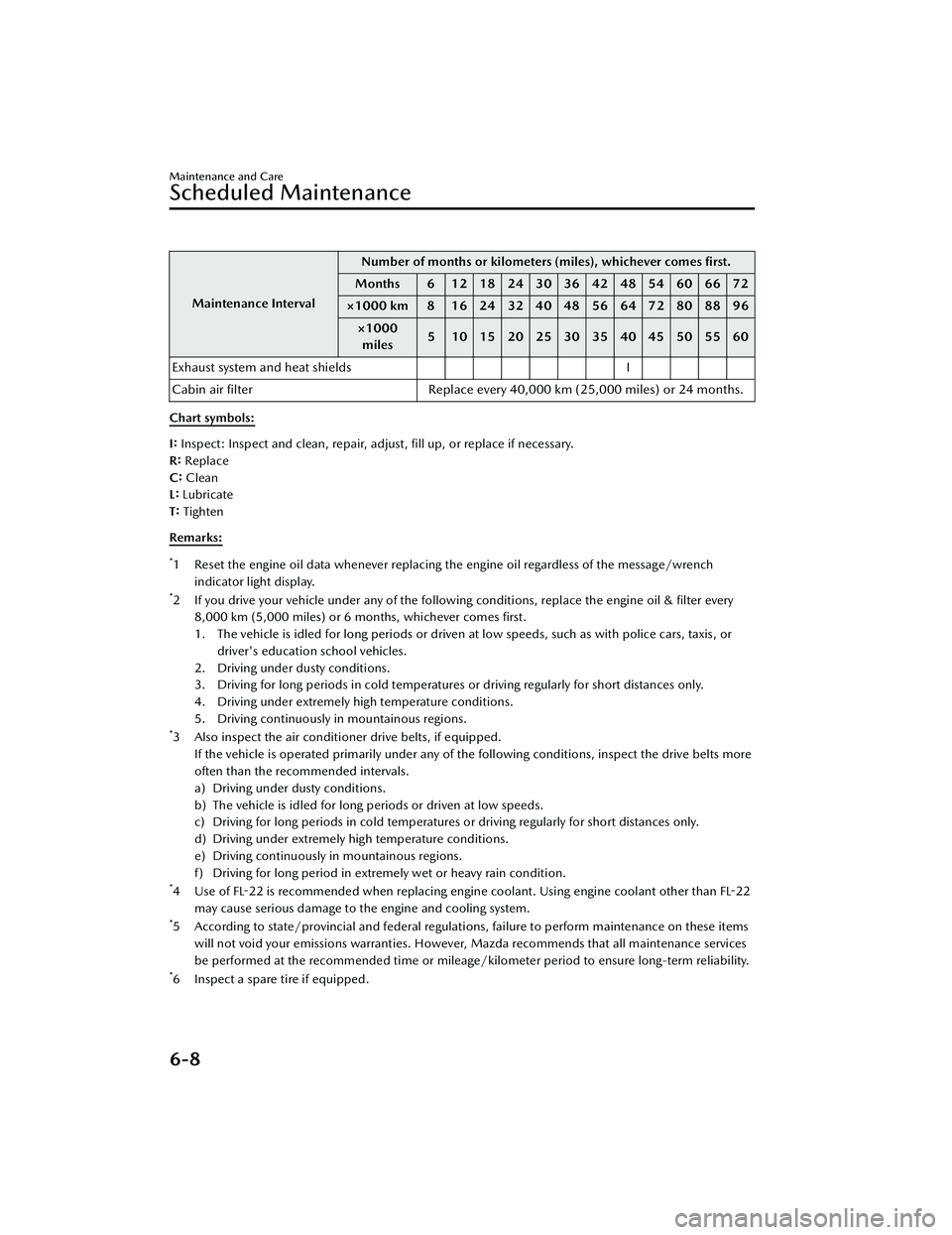
Maintenance IntervalNumber of months or kilometers (miles), whichever comes first.
Months 6 1218243036424854606672
×1000 km 8 16 24 32 40 48 56 64 72 80 88 96
×1000miles 5 1015202530354045505560
Exhaust system and heat shields I
Cabin air filter Replace every 40,000 km (25,000 miles) or 24 months.
Chart symbols:
I: Inspect: Inspect and clean, repair, adjust, fill up, or replace if necessary.
R: Replace
C: Clean
L: Lubricate
T: Tighten
Remarks:
*1 Reset the engine oil data whenever replacing the engine oil regardless of the message/wrench indicator light display.
*2 If you drive your vehicle under any of the following conditions, replace the engine oil & filter every8,000 km (5,000 miles) or 6 months, whichever comes first.
1. The vehicle is idled for long periods or driven at low speeds, such as with police cars, taxis, or driver's education school vehicles.
2. Driving under dusty conditions.
3. Driving for long periods in cold temperatures or driving regularly for short distances only.
4. Driving under extremely high temperature conditions.
5. Driving continuously in mountainous regions.
*3 Also inspect the air conditioner drive belts, if equipped.
If the vehicle is operated primarily under any of the following conditions, inspect the drive belts more
often than the recommended intervals.
a) Driving under dusty conditions.
b) The vehicle is idled for long periods or driven at low speeds.
c) Driving for long periods in cold temperatures or driving regularly for short distances only.
d) Driving under extremely high temperature conditions.
e) Driving continuously in mountainous regions.
f) Driving for long period in extremely wet or heavy rain condition.
*4 Use of FL-22 is recommended when replacing engine coolant. Using engine coolant other than FL-22
may cause serious damage to the engine and cooling system.
*5 According to state/provincial and federal regulati ons, failure to perform maintenance on these items
will not void your emissions warranties. However, Mazda recommends that all maintenance services
be performed at the recommended time or mileage/kilometer period to ensure long-term reliability.
*6 Inspect a spare tire if equipped.
Maintenance and Care
Scheduled Maintenance
6-8
CX-30_8JP5-EA-20K_Edition1_new 2020-7-22 15:50:09
Page 452 of 594

NOTE
State or local regulations may restrict
the use of volatile organic compounds
(VOCs), which are commonly used as
anti-freeze agents in washer fluid. A
washer fluid with limited VOC content
should be used only if it provides
adequate freeze resistance for all
regions and climates in which the
vehicle will be operated.
Inspect fluid level in the washer fluid
reservoir; add fluid if necessary.
1. F
2. E
The top of the
float should be between
F and E.
Use plain water if washer fluid is
unavailable.
But use only washer fluid in cold
weather to prevent it from freezing.
NOTE
Front and rear washer fluid is supplied
from the same reservoir.
Body Lubrication
▼ Body Lubrication
All moving points of the body, such as
door and hood hinges and locks,
should be lubricated each time the
engine oil is changed. Use a
nonfreezing lubricant on locks during
cold weather.
Make sure the hood's secondary latch
keeps the hood from opening when
the primary latch is released.
Maintenance and Care
Owner Maintenance
6-22
CX-30_8JP5-EA-20K_Edition1_new
2020-7-22 15:50:09
Page 462 of 594

Use only a Mazda-genuine tire valve
cap:
Use of a non-genuine part is
dangerous as the correct tire air
pressure cannot be maintained if the
tire valve becomes damaged. If the
vehicle is driven under this condition,
the tire air pressure will decrease
which could result in a serious
accident. Do not use any part for the
tire valve cap that is not a
Mazda-genuine part.
Inspect all tire pressures monthly
(including the spare) when the tires are
cold. Maintain recommended
pressures for the best ride, handling ,
and minimum tire wear.
Refer to the specification charts (page
9-8).
NOTE
Always check tire pressure when tires
are cold.
Warm tires normally exceed
recommended pressures. Do not
release air from warm tires to adjust
the pressure.
Underinflation can cause reduced
fuel economy, uneven and
accelerated tire wear, and poor
sealing of the tire bead, which will
deform the wheel and cause
separation of tire from rim.
Overinflation can produce a harsh
ride, uneven and accelerated tire
wear, and a greater possibility of
damage from road hazards.
Keep your tire pressure at the correct
levels. If one frequently needs inflating, have it inspected.
▼ Tire Rotation
WARNING
Rotate tires periodically:
Irregular tire wear is dangerous. To
equalize tread wear for maintaining
good performance in handling and
braking , rotate the tires periodically or
sooner if irregular wear develops.
Please refer to Scheduled maintenance
for your tire rotation interval.
During rotation, inspect them for
correct balance.
1. Forward
Do not include (TEMPORARY USE
ONLY) spare tire in rotation.
Also, inspect them for uneven wear
and damage. Abnormal wear is usually
caused by one or a combination of the
following:
Incorrect tire pressureImproper wheel alignmentOut-of-balance wheelSevere braking
After rotation, inflate all tire pressures
to specification on page 9-8 and
inspect the lug nuts for tightness.
Maintenance and Care
Owner Maintenance
6-32
CX-30_8JP5-EA-20K_Edition1_new 2020-7-22 15:50:09
Page 464 of 594

CAUTION
Do not use your temporary spare tire
rim with a snow tire or a
conventional tire. Neither will
properly
fit and could damage both
tire and rim.
The temporary spare tire has a tread
life of less than 5,000 km (3,000
miles). The tread life may be shorter
depending on driving conditions.
The temporary spare tire is for
limited use, however, if the tread
wear solid-band indicator appears,
replace the tire with the same type of
temporary spare (page 6-33).
NOTE
Tires degrade over time, even when
they are not being used on the road. It
is recommended that tires generally be
replaced when they are 6 years or
older. Heat caused by hot climates or
frequent high loading conditions can
accelerate the aging process. You
should replace the spare tire when you
replace the other road tires due to the
aging of the spare tire. The period in
which the tire was manufactured (both
week and year) is indicated by a 4-digit
number.
Refer to Tire Labeling on page 8-24.
▼ Replacing a Wheel
WARNING
Always use wheels of the correct size
on your vehicle:
Using a wrong-sized wheel is
dangerous. Braking and handling could
be
affected, leading to loss of control
and an accident.
CAUTION
A wrong-sized wheel may adversely
affect:
Tire
fit
Wheel and bearing life
Ground clearance
Snow-chain clearance
Speedometer calibration
Headlight aim
Bumper height
Tire Pressure Monitoring System
NOTE
When replacing a wheel, make sure
the new one is the same as the
original factory wheel in diameter,
rim width, and
offset (inset/outset).
For details, contact an Authorized
Mazda Dealer.
Proper tire balancing provides the best
riding comfort and helps reduce tread
wear. Out-of-balance tires can cause
vibration and uneven wear, such as
cupping and flat spots.
Maintenance and Care
Owner Maintenance
6-34
CX-30_8JP5-EA-20K_Edition1_new
2020-7-22 15:50:09
Page 476 of 594

CAUTION
Do not use steel wool, abrasive
cleaners, or strong detergents
containing highly alkaline or caustic
agents on chrome-plated or
anodized aluminum parts. This may
damage the protective coating; also,
cleaners and detergents may discolor
or deteriorate the paint.
Pay special attention to removing salt,
dirt, mud, and other foreign material
from the underside of the fenders, and
make sure the drain holes in the lower
edges of the doors and rocker panels
are clean.
Insects, tar, tree sap, bird droppings,
industrial fallout, and similar deposits
can damage the finis h if not removed
immediately. When prompt washing
with plain water is ineffective, use a
mild soap made for use on vehicles.
Thoroughly rinse off all soap with
lukewarm or cold water. Do not allow
soap to dry on the finish.
After washing the vehicle, dry it with a
clean chamois to prevent water spots
from forming.
WARNING
Dry off brakes that have become wet
by driving slowly, releasing the
accelerator pedal and lightly applying
the brakes several times until the
brake performance returns to normal:
Driving with wet brakes is dangerous.
Increased stopping distance or the
vehicle pulling to one side when
braking could result in a serious
accident. Light braking will indicate
whether the brakes have been
affected.
When using an automatic car wash
Retract the door mirrors.The automatic car wash brushes
could reduce the paint lustre or
hasten paint deterioration.
When using a high water pressure car
wash
High water temperature and high
water pressure car washers are
available depending on the type of car
wash machine. If the car washer nozzle
is put too close to the vehicle, the
force of the spray could damage or
deform the molding, affect the
sealability of parts, and allow water to
penetrate the interior. Keep a sufficient
space (30 cm (12 in) or more)
between the nozzle and the vehicle. In
addition, do not spend too much time
spraying the same area of the vehicle,
and be very careful when spraying
between gaps in doors and around
windows.
Waxing
Your vehicle needs to be waxed when
water no longer beads on the finish.
Always wash and dry the vehicle before
waxing it. In addition to the vehicle
body, wax the metal trim to maintain
its luster.
1. Use wax which contains no
abrasives.
Wax containing abrasives will
remove paints and could damage
bright metal parts.
2. Use a good grade of natural wax for metallic, mica, and solid colors.
3. When waxing, coat evenly with the sponge supplied or a soft cloth.
4. Wipe off the wax with a soft cloth.
Maintenance and Care
Appearance Care
6-46
CX-30_8JP5-EA-20K_Edition1_new 2020-7-22 15:50:09