change wheel MAZDA MODEL CX-5 2018 (in English) User Guide
[x] Cancel search | Manufacturer: MAZDA, Model Year: 2018, Model line: MODEL CX-5, Model: MAZDA MODEL CX-5 2018Pages: 628, PDF Size: 82.38 MB
Page 270 of 628

▼Lane Departure Warning
If the system determines that the vehicle may deviate from its
lane, the lane departure
warning (beep sound, rumble sound
*1, or steering wheel vibration) is activated and the
direction in which the system determines that the vehicle may d eviate is indicated in the
multi-information display an d the active driving display.
If the system determines that the vehicle may deviate from its lane, the color of the lane line
on the side being detected by the system changes from white to amber, and flashes.
Multi-information Display Active Driving Display
NOTE
•If you have set the lane departure warning sound to the beep sound/rumble sound*1
setting, the warning sound may not be heard depending on the surrounding noise
conditions.
•If you have set the lane departure warning system to the steering wheel vibrations setting,
the vibration may not be felt dependi ng on the road surface conditions.
•When the setting for the steering operation assist is changed to operational, the warnings
can be set to activate/not activate. (When the setting for the steering operation assist is
changed to non-operational, the warnings cannot be set to not activate.)
Refer to Setting Change (Personalization Features) on page 9-9.
•The LAS & LDWS can be changed to the following settings regardless of whether the
steering operation assist has been set to operational/non-operational. Always check the
setting status when driving the vehicle and make setting changes if necessary.
Refer to Setting Change (Personalization Features) on page 9-9.
•Steering wheel vibr ation: Strong/weak
•Warning sound volume
•Types of warnings (steering wheel vibration/beep sound/rumble sound*1)
When Driving
i-ACTIVSENSE
4-134
CX-5_8GN5-EA-17J_Edition1 2017-8-18 12:58:27
Page 278 of 628

•If you suddenly come close to a vehicle ahead.
•2-wheeled vehicles, pedestrians, animals or standing trees.
•Vehicle is driven with some of the tires having significant wear.
▼Smart City Brake Support (SCBS)
Indicator Light (Red)
If the Smart City Brake Support (SCBS) is
operating, the indicator light (red) flashes.
▼Collision Warning
If there is the possibil
ity of a collision with
a vehicle ahead, the beep sounds
continuously and a warning is indicated in
the multi-information d isplay or the active
driving display.
Multi-information Display
Active Driving Display
NOTE
The operation distance and volume of the
collision warning can be changed. Refer
to Personalization Features on page 9-
9.
▼ Automatic Brake
Operation Display
The automatic brake operation display is
indicated on the multi-information display
after the SCBS is operated.
NOTE
•The collision warning beep sounds
intermittently while the SCBS brake or
brake assist (SCBS brake assist) is
operating.
•If the vehicle is stopped by the SCBS
operation and the brake pedal is not
depressed, the warning beep sounds one
time after about 2 seconds and the SCBS
brake is automatically released.
When Driving
i-ACTIVSENSE
4-142
CX-5_8GN5-EA-17J_Edition1 2017-8-18 12:58:27
Page 284 of 628
Do not disassemble or modify the Forward Sensing Camera (FSC).
Disassembly or modification of the Forward Sensing Camera (FSC) will cause a malfunction
or mistaken operation. Consequently, each sy stem may not operate normally which could
lead to an unexpected accident.
Heed the following cautions to assure the correct operation of the Forward Sensing Camera
(FSC).
Be careful not to scratch the Forward Sensing Camera (FSC) lens or allow it to get dirty.
Do not remove the Forward Sensing Camera (FSC) cover.
Do not place objects on the dashboard which reflect light.
Always keep the windshield glass around the camera clean by removing dirt or fogging.
Use the windshield defroster to remove fogging on the windshield.
Consult an Authorized Mazda Dealer regardi ng cleaning the interior side of the
windshield around the Forw ard Sensing Camera (FSC).
Consult an Authorized Mazda Dealer before performing repairs around the Forward
Sensing Camera (FSC).
The Forward Sensing Camera (FSC) is installe d to the windshield. Consult an Authorized
Mazda Dealer for windshield repair and replacement.
When cleaning the wind shield, do not allow glass cleaners or similar cleaning fluids to
get on the Forward Sensing Camera (FSC) le ns. In addition, do not touch the Forward
Sensing Camera (FSC) lens.
When performing repairs around the rearv iew mirror, consult an Authorized Mazda
Dealer.
Consult an Authorized Mazda Dealer regarding cleaning of the camera lens.
Do not hit or apply strong force to the Forward Sensing Camera (FSC) or the area around
it. If the Forward Sensing Camera (FSC) is severely hit or if there are cracks or damage
caused by flying gravel or debris in the area around it, stop using the following systems
and consult an Authorized Mazda Dealer.
High Beam Control System (HBC)
Lane-keep Assist System (LAS) & Lane Departure Warning System (LDWS)
Traffic Sign Recognition System (TSR)
Advanced Smart City Brak e Support (Advanced SCBS)
Smart City Brake Support (SCBS)
Mazda Radar Cruise Control with Stop & Go function (MRCC with Stop & Go function)
Smart Brake Support (SBS)
The direction in which the Forward Sensing Camera (FSC) is pointed has been
finely
adjusted. Do not change the installation posi tion of the Forward Sensing Camera (FSC) or
remove it. Otherwise, it could result in damage or malfunction.
Always use tires for all wheels that are of the specified size, and the same manufacturer,
brand, and tread pattern. In addition, do no t use tires with significantly different wear
patterns on the same vehicle as the system may not operate normally.
When Driving
i-ACTIVSENSE
4-148
CX-5_8GN5-EA-17J_Edition1 2017-8-18 12:58:27
Page 289 of 628
Do not use the front bumper to push other vehicles or obstructions such as when pulling
out of a parking space. Otherwise, the radar sensor (front) could be hit and its position
deviated.
Do not remove, disassemble, or mo dify the radar sensor (front).
For repairs, replacement or paint work ar ound the radar sensor (front), consult an
Authorized Mazda Dealer.
Do not modify the suspension. If the suspensi on are modified, the vehicle's posture could
change and the radar sensor (front) may not be able to correctly detect a vehicle ahead or
an obstruction.
NOTE
•Under the following conditions, the radar sensor (front) may not be able to detect vehicles
ahead or obstructions correctly and each system may not operate normally.
•The rear surface of a vehicle ahead does not reflect radio waves effectively, such as an
unloaded trailer or an automobile with a loading platform covered by a soft top,
vehicles with a hard plastic tailgate, and round-shaped vehicles.
•Vehicles ahead with low vehicle height and thus less area for reflecting radio waves.
•Visibility is reduced due to a vehicle ahead casting off water, snow, or sand from its tires
and onto your windshield.
•The luggage compartment is loaded with heavy objects or the rear passenger seats are
occupied.
•Ice, snow, or soiling is on the front surface of the front emblem.
•During inclement weather such as rain, snow, or sand storms.
•When driving near facilities or objects emitting strong radio waves.
•Under the following conditions, the radar sensor (front) may not be able to detect vehicles
ahead or obstructions.
•The beginning and end of a curve.
•Roads with continuous curves.
•Narrow lane roads due to road construction or lane closures.
•The vehicle ahead enters the radar sensor's blind spot.
•The vehicle ahead is running abnormally due to accident or vehicle damage.
•Roads with repeated up and down slopes
•Driving on poor roads or unpaved roads.
•The distance between your vehicle and the vehicle ahead is extremely short.
•A vehicle suddenly comes close such as by cutting into the lane.
•To prevent incorrect operation of the system, use tires of the same specified size,
manufacturer, brand, and tread pattern on all four wheels. In addition, do not use tires
with significantly different wear patterns or tire pressures on the same vehicle (Including
the temporary spare tire).
•If the battery power is weak, the system may not operate correctly.
When Driving
i-ACTIVSENSE
4-153
CX-5_8GN5-EA-17J_Edition1 2017-8-18 12:58:27
Page 298 of 628
Tire Pressure Monitoring System
The Tire Pressure Monitoring System (TPMS) monitors the pressure for each tire.
If tire pressure is to o low in one or more tires, the system will inform the driver via the
warning light in the instrument cluster and by the warning beep sound.
Refer to Warning Indication/Warning Lights on page 4-30.
Refer to Tire Inflation Pressu re Warning Beep on page 7-45.
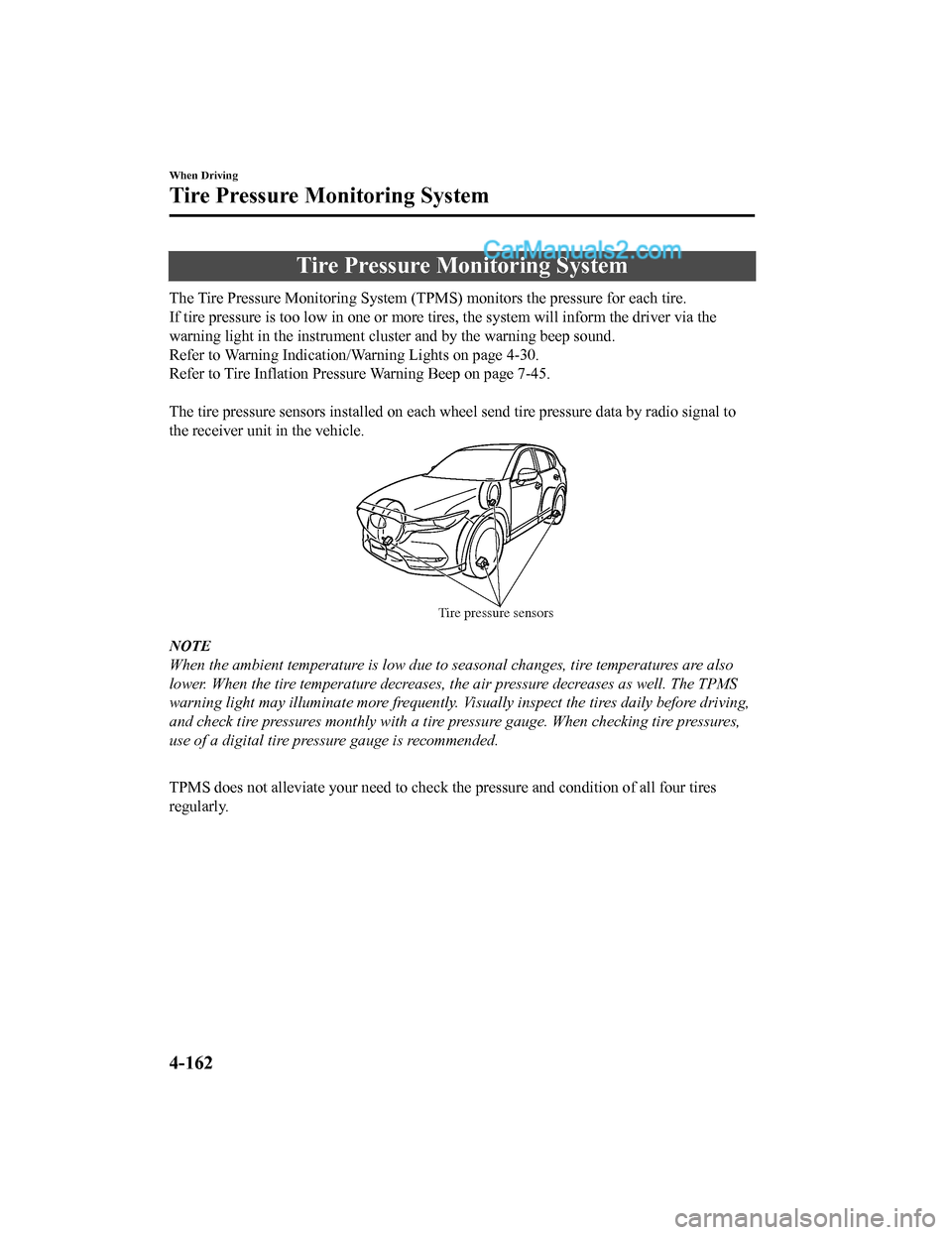
The tire pressure sensors installed on each wheel send tire pre ssure data by radio signal to
the receiver unit in the vehicle.
Tire pressure sensors
NOTE
When the ambient temperature is low due to seasonal changes, tire temperatures are also
lower. When the tire temperature decreases, the air pressure decreases as well. The TPMS
warning light may illumina te more frequently. Visually inspect the tires daily before driving,
and check tire pressures monthly with a tire pressure gauge. When checking tire pressures,
use of a digital tire pressure gauge is recommended.
TPMS does not alleviate your need to check the pressure and con dition of all four tires
regularly.
When Driving
Tire Pressure Monitoring System
4-162
CX-5_8GN5-EA-17J_Edition1 2017-8-18 12:58:27
Page 300 of 628

▼System Error Activation
When the warning light flashes, there may
be a system malfunction. Consult an
Authorized Mazda Dealer.
A system error activation may occur in the
following cases:
•When there is equipment or a device
near the vehicle using the same radio
frequency as that of the tire pressure
sensors.
•When a metallic device such as a
non-genuine navigation system is
equipped near the center of the
dashboard, which may block radio
signals from the tire pressure sensor to
the receiver unit.
•When using the following devices in the
vehicle that may cause radio
interference with the receiver unit.
•A digital device such as a personal
computer.
•A current converter device such as a
DC-AC converter.
•When excess snow or ice adheres to the
vehicle, especially around the wheels.
•When the tire pressu
re sensor batteries
are exhausted.
•When using a wheel with no tire
pressure sensor installed.
•When using tires with steel wire
reinforcement in the side walls.
•When using tire chains.
▼ Tires and Wheels
CAUTION
When inspecting or adjusting the tire air
pressures, do not apply excessive force to
the stem part of the wheel unit. The stem
part could be damaged.
Changing tires and wheels
The following procedure allows the TPMS
to recognize a tire pressure sensor's unique
ID signal code whenever tires or wheels
are changed, such as changing to and from
winter tires.
NOTE
Each tire pressure sensor has a unique ID
signal code. The signal code must be
registered with the TPMS before it can
work. The easiest way to
do it is to have
an Authorized Mazda Dealer change your
tire and complete ID signal code
registration.
When having tires changed at an
Authorized Mazda Dealer
When an Authorized Mazda Dealer
changes your vehicle's tires, they will
complete the tire pressure sensor ID signal
code registration.
When changing tires yourself
If you or someone else changes tires, you
or someone else can also undertake the
steps for the TPMS to complete the ID
signal code registration.
1. After tires have been changed, switch
the ignition ON, then back to ACC or
OFF.
2. Wait for about 15 minutes.
When Driving
Tire Pressure Monitoring System
4-164
CX-5_8GN5-EA-17J_Edition1 2017-8-18 12:58:27
Page 455 of 628
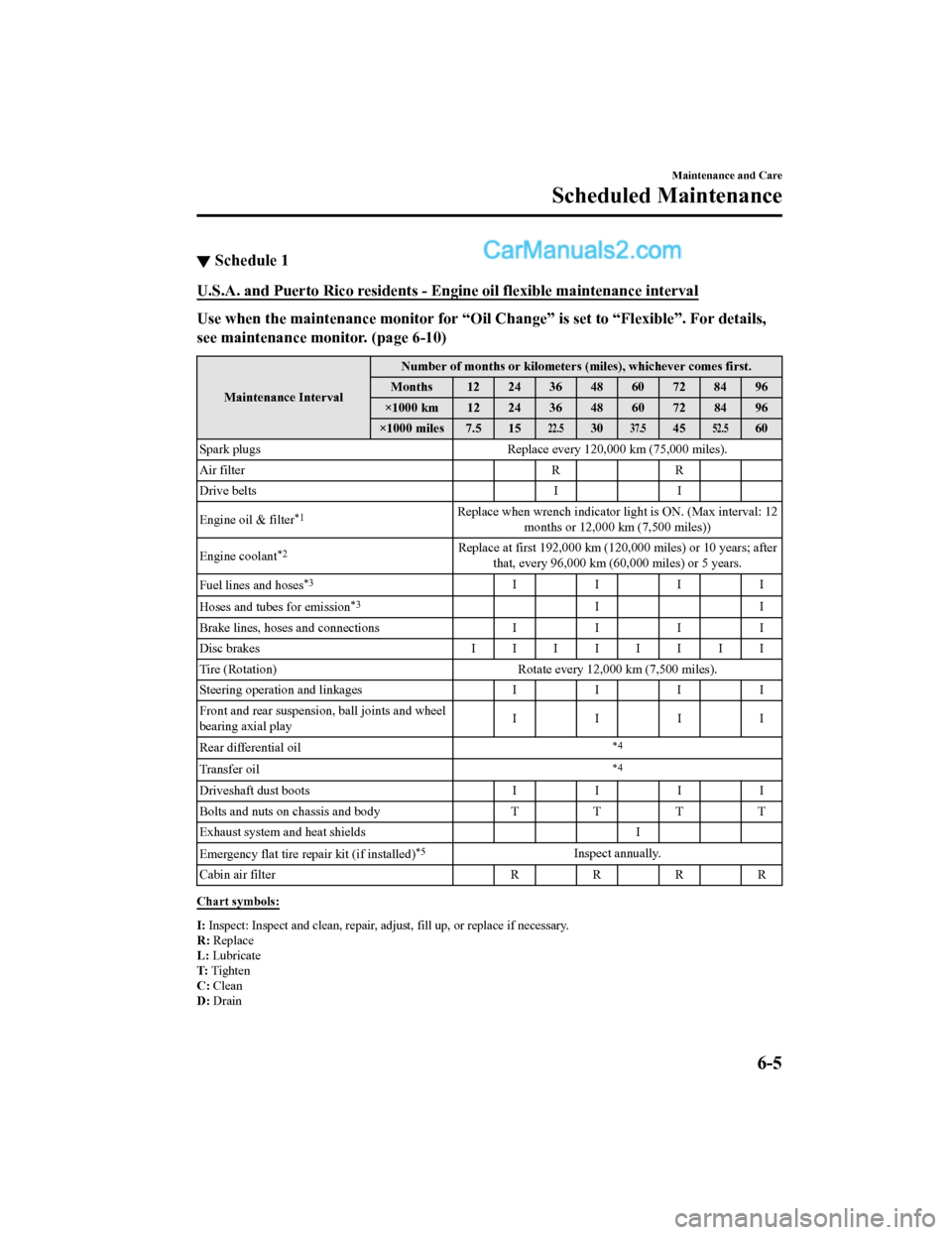
▼Schedule 1
U.S.A. and Puerto Rico residents
- Engine oil flexible maintenance interval
Use when the maintenance monitor for “Oil Change” is set to “Fl exible”. For details,
see maintenance monitor. (page 6-10)
Maintenance Interval Number of months or kilometers (miles), whichever comes first.
Months 12 24 36 48 60 72 84 96
×1000 km 12 24 36 48 60 72 84 96
×1000 miles 7.5 15
22.53037.54552.560
Spark plugs Replace every 120,000 km (75, 000 miles).
Air filter RR
Drive belts II
Engine oil & filter
*1Replace when wrench indicator light is ON. (Max interval: 12 months or 12,000 km (7,500 miles))
Engine coolant
*2Replace at first 192,000 km (120,000 miles) or 10 years; after that, every 96,000 km (60,000 miles) or 5 years.
Fuel lines and hoses
*3IIII
Hoses and tubes for emission
*3II
Brake lines, hoses and connections I I I I
Disc brakes IIIIIIII
Tire (Rotation) Rotate every 12,000 km (7,500 miles).
Steering operation and linkages II II
Front and rear suspension, ball joints and wheel
bearing axial play IIII
Rear differential oil
*4
Transfer oil*4
Driveshaft dust boots II II
Bolts and nuts on chassis and body TTTT
Exhaust system and heat shields I
Emergency flat tire repair kit (if installed)
*5Inspect annually.
Cabin air filter R R R R
Chart symbols:
I: Inspect: Inspect and clean, re pair, adjust, fill up, or replac e if necessary.
R: Replace
L: Lubricate
T: Tighten
C: Clean
D: Drain
Maintenance and Care
Scheduled Maintenance
6-5
CX-5_8GN5-EA-17J_Edition1 2017-8-18 12:58:27
Page 456 of 628
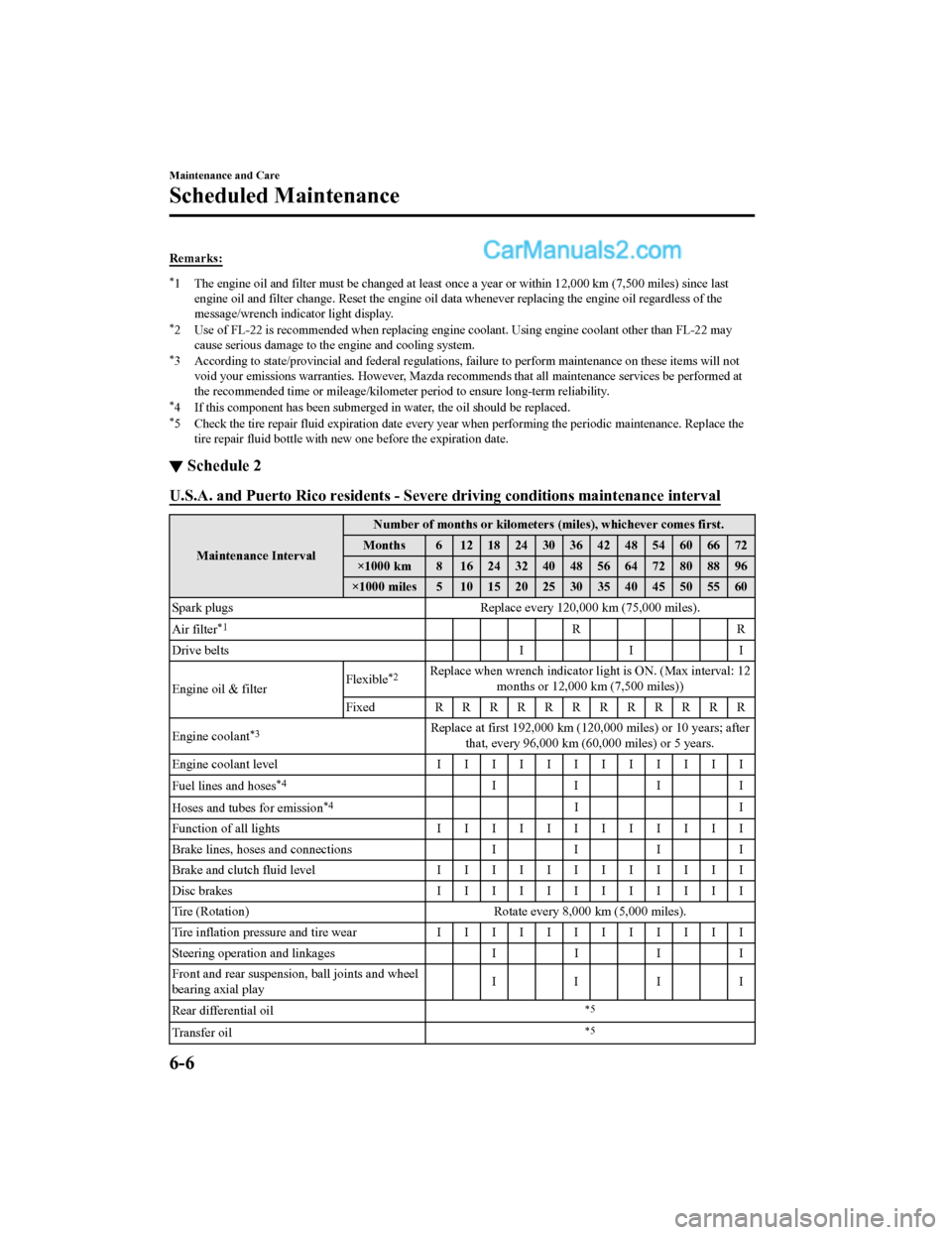
Remarks:
*1 The engine oil and filter must be changed at least once a year or within 12,000 km (7,500 miles) since last
engine oil and filter change. Re set the engine oil data whenever replacing the engine oil regardless of the
message/wrench indicator light display.
*2 Use of FL-22 is recommended when replacing engine coolant. Using engine coolant other than FL-22 may
cause serious damage to the engine and cooling system.
*3 According to state/provincial and federal regulations, failure to perform maintenance on these items will not
void your emissions warranties. H owever, Mazda recommends that all maintenance services be performed at
the recommended time or mileage/kilometer period to ensure long -term reliability.
*4 If this component has been submerged in water, the oil should be replaced.*5 Check the tire repair fluid expiration date every year when performing the periodic maintenance. Replace the
tire repair fluid bottle with ne w one before the expiration dat e.
▼Schedule 2
U.S.A. and Puerto Rico residents - Severe driving conditions ma
intenance interval
Maintenance IntervalNumber of months or kilometers (miles), whichever comes first.
Months 6 1218243036424854606672
×1000 km 8 16 24 32 40 48 56 64 72 80 88 96
×1000 miles 5 10 15 20 25 30 35 40 45 50 55 60
Spark plugs Replace every 120,000 km (75,000 miles).
Air filter
*1RR
Drive belts I I I
Engine oil & filter Flexible
*2Replace when wrench indicator light is ON. (Max interval: 12
months or 12,000 km (7,500 miles))
Fixed RRRRRRRRRRRR
Engine coolant
*3Replace at first 192,000 km (120, 000 miles) or 10 years; after
that, every 96,000 km (60,000 miles) or 5 years.
Engine coolant level IIIIIIIIIIII
Fuel lines and hoses
*4IIII
Hoses and tubes for emission
*4II
Function of all lights IIIIIIIIIIII
Brake lines, hoses and connections II II
Brake and clutch fluid level I I I I I I I I I I I I
Disc brakes IIIIIIIIIIII
Tire (Rotation) Rotate every 8,000 km (5,000 miles).
Tire inflation pressure and tire wear IIIIIIIIIIII
Steering operation and linkages II II
Front and rear suspensi on, ball joints and wheel
bearing axial play IIII
Rear differential oil
*5
Transfer oil*5
Maintenance and Care
Scheduled Maintenance
6-6
CX-5_8GN5-EA-17J_Edition1 2017-8-18 12:58:27
Page 612 of 628

ItemFeatureFactory
Setting Available Settings Settings
Change
Method
Lane-keep Assist Sys-
tem (LAS) & Lane De-
parture Warning System
(LDWS) (page 4-125) The system can be changed so that the
steering wheel assist does not operate.
On On/Off A ―
When the steering
wheel operation assis-
tance is turned onThe cancel sensi-
tivity of the steer-
ing assistance for
the system can be
changed.
High High/Low A ―
The system can
be changed so
that the Lane De-
parture Warning
does not activate.
On On/Off A ―
When the steering
wheel operation assis-
tance is turned off The warning tim-
ing in which the
system deter-
mines that the ve-
hicle may be de-
viating from its
lane can be
changed.
At At/Before A ―
The sensitivity of
the warning for
the system can be
changed.
Often Often/Rare A ―
Lane-keep Assist Sys-
tem (LAS) & Lane De-
parture Warning System
(LDWS) (page 4-125) The type of Lane-keep Assist System
(LAS) & Lane Departure Warning Sys-
tem (LDWS) warning can be changed.
Vi b r a t i o n
Vibration/Beep/
Rumbl. A―
The warning intensi-
ty/volume of the sys-
tem can be changed. Vibration Low High/Low A ―Rumbl.
Low High/Mid/Low A ―
Beep Low High/Low A ―
Blind Spot Monitoring
(BSM) (page 4-93) The system can be ch
anged so that Blind
Spot Monitoring (BSM) does not oper-
ate.*1On On/Off A ―
Warning beep volume*2High High/
Low/ Off A―
Specifications
Personalization Features
9-10
CX-5_8GN5-EA-17J_Edition1
2017-8-18 12:58:27