wheel MAZDA MODEL CX-5 SKYACTIV-D 2019 Owners Manual
[x] Cancel search | Manufacturer: MAZDA, Model Year: 2019, Model line: MODEL CX-5 SKYACTIV-D, Model: MAZDA MODEL CX-5 SKYACTIV-D 2019Pages: 721, PDF Size: 97.68 MB
Page 620 of 721
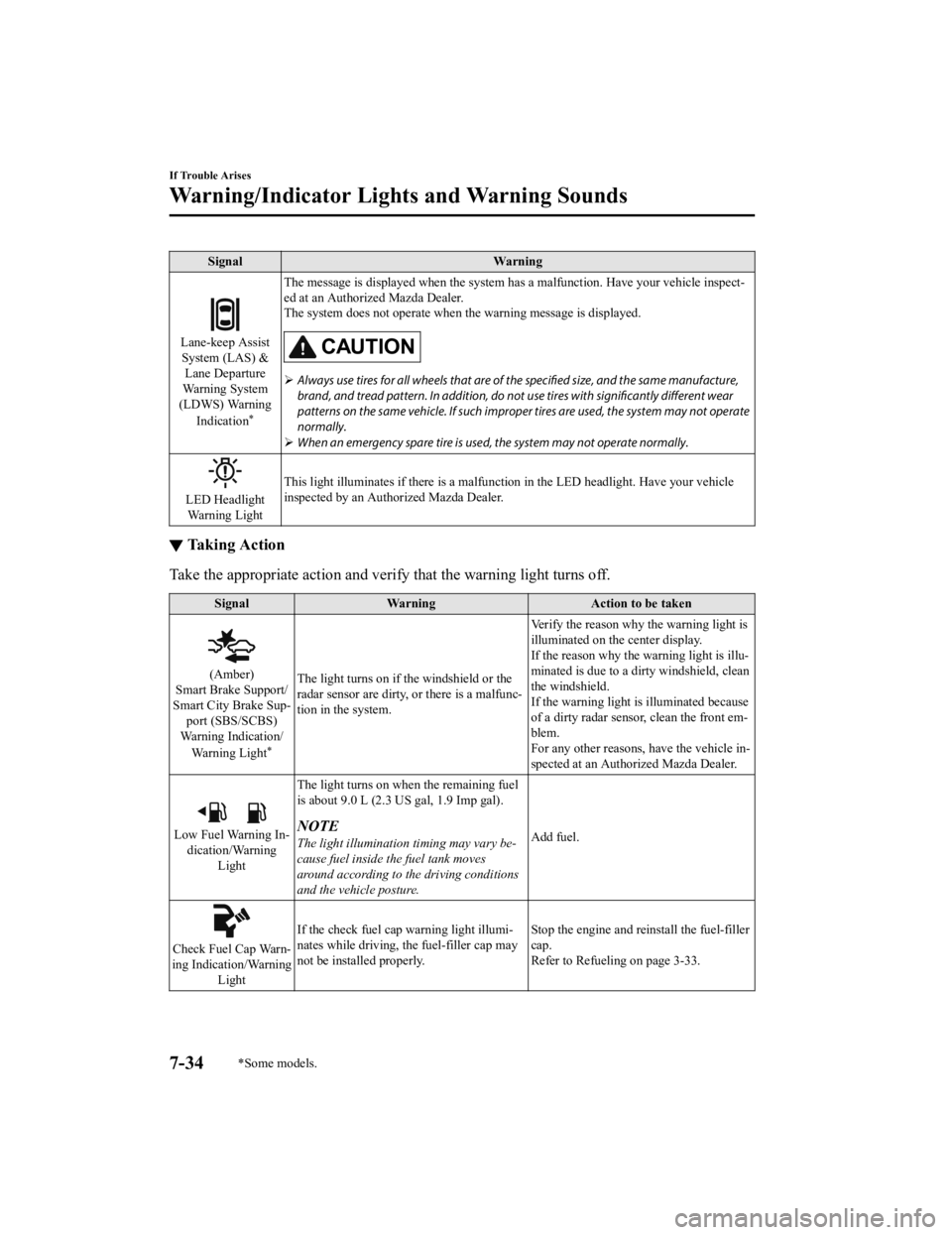
SignalWarning
Lane-keep Assist
System (LAS) & Lane Departure
Wa r n i n g S y s t e m
(LDWS) Warning
Indication
*
The message is displayed when the system ha s a malfunction. Have your vehicle inspect-
ed at an Authorized Mazda Dealer.
The system does not operate when the warning message is displayed.
CAUTION
Always use tires for all wheels that are of the specified size, and the same manufacture,
brand, and tread pattern. In addition, do no t use tires with significantly different wear
patterns on the same vehicle. If such improper tires are used, the system may not operate
normally.
When an emergency spare tire is used, the system may not operate normally.
LED Headlight
Warning Light This light illuminates if ther
e is a malfunction in the LED headlight. Have your vehicle
inspected by an Authorized Mazda Dealer.
▼ Taking Action
Take the appropriate action and verify
that the warning light turns off.
Signal Warning Action to be taken
(Amber)
Smart Brake Support/
Smart City Brake Sup- port (SBS/SCBS)
Warning Indication/
Wa r n i n g L i g h t
*
The light turns on if the windshield or the
radar sensor are dirty, or there is a malfunc-
tion in the system. Verify the reason wh
y the warning light is
illuminated on the center display.
If the reason why the warning light is illu-
minated is due to a dirty windshield, clean
the windshield.
If the warning light is illuminated because
of a dirty radar sensor, clean the front em-
blem.
For any other reasons, have the vehicle in-
spected at an Authorized Mazda Dealer.
Low Fuel Warning In- dication/Warning Light The light turns on wh
en the remaining fuel
is about 9.0 L (2.3 US gal, 1.9 Imp gal).NOTE
The light illumination timing may vary be-
cause fuel inside the fuel tank moves
around according to the driving conditions
and the vehicle posture. Add fuel.
Check Fuel Cap Warn-
ing Indication/Warning
Light If the check fuel cap warning light illumi-
nates while driving, the fuel-filler cap may
not be installed properly.
Stop the engine and reinstall the fuel-filler
cap.
Refer to Refueling on page 3-33.
If Trouble Arises
Warning/Indicator Lights and Warning Sounds
7-34*Some models.
CX-5_8HH4-EA-19A_Edition1
2018-11-21 10:03:20
Page 624 of 721

Action to be taken
Inspect the tires and adjust to the specified inflation pressure (page 6-47).
CAUTION
When replacing/repairing the tires or wheels or both, have the work done by an Authorized Mazda Dealer, or the
tire pressure sens ors may be damaged.
NOTE
Perform tire pressure adjustment when the tires are cold . Tire pressure will vary according to the tire temper-
ature, therefore let the vehicle stand for 1 hour or on ly drive it 1.6 km (1 mile) or less before adjusting the
tire pressures. When pressure is adjusted on hot tires to the cold inflation pressure, the TPMS warning light/
beep may turn on after the tires cool and pressure drops below specification.
Also, an illuminated TPMS warning light, resulting from th e tire air pressure dropping due to cold ambient
temperature, may turn off if the ambient temperature rises. In this case, it will also be necessary to adjust the
tire air pressures. If the TPMS warnin g light illuminates due to a drop in tire air pressure, make sure to check
and adjust the tire air pressures.
After adjusting the tire air pressures, it may require some time for the TPMS warning light to turn off. If the
TPMS warning light remains illuminated, drive the vehicle at a speed of at least 25 km/h (16 mph) for 10
minutes, and then verify that it turns off.
Tires lose air naturally over time and the TPMS cannot tell if the tires are getting too soft over time or you
have a flat. However, when you find one low tire in a set of four-that is an indication of trouble; you should
have someone drive the vehicle slowly forward so you ca n inspect any low tire for cuts and any metal objects
sticking through tread or sidewall. Pu t a few drops of water in the valve stem to see if it bubbles indicating a
bad valve. Leaks need to be addressed by more than simply refilling the trouble tire as leaks are dangerous
― take it to an Authorized Mazda Dealer which has all the equipmen t to fix tires, TPMS systems and order
the best replacement tire for your vehicle.
If the warning light illuminates again even after the tire pressures are adjusted, there may be a tire puncture.
If Trouble Arises
Warning/Indicator Lights and Warning Sounds
7-38
CX-5_8HH4-EA-19A_Edition1 2018-11-21 10:03:20
Page 659 of 721

Uniform Tire Quality Grading System (UTQGS)
This information relates to the tire grading system developed by the U.S. National Highway
Traffic Safety Administration for grading t ires by tread wear, traction, and temperature
performance.
▼ Tr e a d We a r
The tread wear grade is a comparative rating based on the wear rate of the tire when tested
under controlled conditions on a
specified government test course.
For example, a tire graded 150 would wear on e-and-a-half times as well on the government
course as a tire graded 100.
The relative performance of tires depends upon the actual conditions of their use, however,
and may depart significantly from the norm because of variations in driving habits, service
practices and differences in road characteristics and climate.
▼ Traction-AA, A, B, C
The traction grades, from highest to lowest, are AA, A, B, and C. These grades represent the
tire's ability to stop on wet pavement as meas
ured under controlled conditions on specified
government test surfaces of asphalt and conc rete. A tire marked C may have poor traction
performance.
WA R N I N G
The traction grade assigned to this tire is based on braking (straight ahead) traction tests and
does not include acceleration cornering (turning), hydroplaning, or peak traction
characteristics.
▼ Te m p e r a t u r e - A , B , C
The temperature grades A (the highest), B, and C, represent the tire's resistance to the
generation of heat and its abili
ty to dissipate heat when tested under controlled conditions
on a specified indoor laboratory test wheel.
Sustained high temperature can cause the material of the tire to degenerate and reduce tire
life, and excessive temperatures can lead to sudden tire failure.
Grade C corresponds to a level of performance which all passenger vehicle tires must meet
under the Federal Motor Vehicle Safety Standard No. 109. Grades B and A represent higher
levels of performance on the laboratory test wheel than the minimum required by law.
Customer Information and Reporting Safety Defects
Uniform Tire Quality Grading System (UTQGS)
8-23
CX-5_8HH4-EA-19A_Edition1 2018-11-21 10:03:20
Page 662 of 721

P215/65R15 95H is an example of a tire size and load index rating. Here is an explanation
of the various components of that tire size and load index rating. Note that the tire size and
load index rating may be different from the example.
P
Indicates a tire that may be installed on cars, SUVs, minivans and light trucks as designated
by the Tire and Rim Association (T&RA).
NOTE
If your tire size does not begin with a letter this may mean it is designated by either ETRTO
(European Tire and Rim Technical Organization) or JATMA (Japan Tire Manufacturing
Association).
215
“215” is the nominal width of the tire in m illimeters. This three-digit number gives the
width in millimeters of the tire from sidewall edge to sidewall edge. In general, the larger
the number, the wider the tire.
65
“65” is the aspect ratio. This two-digit number indicates the tire's ratio of height to width.
R
“R” is the tire construction symbol. R indicates “Radial ply construction”.
15
“15” is the wheel rim diameter in inches.
95
“95” is the Load Index. This two-or three-digit number indicates how much weight each tire
can support.
H
“H” is the speed rating. The speed rating denotes the maximum speed for which the use of
the tire is rated.
Letter Rating Speed Rating
Q9 9 m ph
R1 06 m ph
S 112 mph
T 118 mph
U1 24 m ph
H1 30 m ph
Customer Information and Reporting Safety Defects
Tire Information (U.S.A.)
8-26
CX-5_8HH4-EA-19A_Edition1 2018-11-21 10:03:20
Page 664 of 721

Traction: The traction grades, from highest to lowest are AA, A, B, and C. The grades
represent the tire's ability to stop on wet pave ment as measured under controlled conditions
on specified government test surfaces of asphalt and concrete. A tire marked C may have
poor traction performance.
Te m p e r a t u r e : The temperature grades are A (the highest), B and C, representing the tire's
resistance to the generation of heat and its ability to dissipate heat when tested under
controlled conditions on a specif ied indoor laboratory test wheel.
Snow Tires
In some heavy snow areas, local governments may require true snow tires, those with very
deeply cut tread. These tires should only be used in pairs or placed on all four wheels. Make
sure you purchase snow tires that are the same size and construction type as the other tires
on your vehicle.
SAFETY WARNING
The following safety warning appears on the tire's sidewall.
SERIOUS INJURY MAY RESULT FROM:
EXPLOSION OF TIRE/RIM ASSEMBLY DUE TO IMPROPER MOUNTING-MATCH
TIRE DIAMETER TO RIM DIAMETER; NEVE R EXCEED 40 psi (275 kPa) TO SEAT
BEADS-ONLY SPECIALLY TRAINED PERSONS SHOULD MOUNT TIRES.
TIRE FAILURE DUE TO UNDER-INFLATION/OVERLOADING/
DAMAGE-FOLLOW OWNER'S MANUAL AND PLACARD IN
VEHICLE-FREQUENTLY CHECK INFLATION PRESSURE AND INSPECT FOR
DAMAGE.
▼ Information on Temporary Tires
Please refer to the sample below.
Customer Information and Reporting Safety Defects
Tire Information (U.S.A.)
8-28
CX-5_8HH4-EA-19A_Edition1
2018-11-21 10:03:20
Page 665 of 721

1. Temporary tires
2. Nominal width of tire in millimeters
3. Ratio of height to width (aspect ratio)
4. Diagonal
5. Rim diameter code
6. Load index & speed symbol
T115/70D16 90M is an example of a tire size and load index rating. Here is an explanation
of the various components of that tire size and load index rating. Note that the tire size and
load index rating may be different from the example.
T
Indicates a tire that may be installed on cars, SUVs, minivans and light trucks as designated
by the Tire and Rim Association (T&RA).
11 5
“115” is the nominal width of the tire in mi llimeters. This three-digit number gives the
width in millimeters of the tire from sidewall edge to sidewall edge. In general, the larger
the number, the wider the tire.
70
“70” is the aspect ratio. This two-digit number indicates the tire's ratio of height to width.
D
“D” is the tire construction symbol. D indicates “diagonal ply construction”.
16
“16” is the wheel rim diameter in inches.
90
“90” is the Load Index. This two-or three-digit number indicates how much weight each tire
can support.
M
“M” is the speed rating. The speed rating denotes the maximum speed for which the use of
the tire is rated.
Letter Rating Speed Rating
M8 1 m ph
Customer Information and Reporting Safety Defects
Tire Information (U.S.A.)
8-29
CX-5_8HH4-EA-19A_Edition1 2018-11-21 10:03:20
Page 668 of 721

▼Glossary of Terms
Tire Placard:
A label indicating the OE tire sizes, recommended inflation pressure, and the
maximum weight the vehicle can carry.
Tire Identification Number (TIN): A number on the sidewall of each tire providing
information about the tire brand and manufactur ing plant, tire size, and date of manufacture.
Inflation Pressure: A measure of the amount of air in a tire.
kPa: Kilopascal, the metric unit for air pressure.
psi: Pounds per square inch, the English unit for air pressure.
B-pillar: The structural member at the side of the vehicle behind the front door.
Original Equipment (OE): Describes components originally equipped on the vehicle.
Vehicle Load Limit: The maximum value of the combination weight of occupants and
cargo.
Bead Area of the Tire: Area of the tire next to the rim.
Sidewall Area of the Tire: Area between the bead area and the tread.
Tread Area of the Tire: Area on the perimeter of the tire that contacts the road when it's
mounted on the vehicle.
Seating capacity means the total allowable number of vehicle occupants. Seating capacity
is described on the tire label.
Production options weight is the combination weight of installed regular production
options weighing over 2.3 kilograms in excess of the standard items which they replace, and
not previously considered in the curb weight or accessory weight, including heavy duty
brakes, ride levelers, roof rack, heavy duty battery, and special trim.
Rim is the metal support (wheel) for a tire or a tire and tube assembly upon which the tire
beads are seated.
Customer Information and Reporting Safety Defects
Tire Information (U.S.A.)
8-32
CX-5_8HH4-EA-19A_Edition1 2018-11-21 10:03:20
Page 669 of 721

Tire Maintenance
Improper or inadequate vehicle maintenance can cause tires to wear abnormally. Here are
some important maintenance points:
▼Tire Inflation Pressure
Inspect all tire pressure monthly (including the spare) when the tires are cold. Maintain
recommended pressures for the best ride, top handling, and minimum tire wear. Use the
pressures specified on the vehicle tire informat
ion placard or tire label for optimum service.
▼Tire Rotation
To equalize tread wear, rotate the tires every 12,000 km (7,500 miles) at the latest or sooner
if irregular wear develops. Mazda recommends to rotate every 8,000 km (5,000 miles) to
help increase tire life and di
stribute wear more evenly.
Do not include (TEMPORARY USE ONLY)
spare tire in rotation.Forward
Inspect the tires for uneven wear and damage. Abnormal wear is usually caused by one or a
combination of the following:
Incorrect tire pressure
Improper wheel alignment
Out-of-balance wheel
Severe braking
After rotation, inflate all tire pressures to sp ecification (page 9-10) and inspect the lug nuts
for tightness.
CAUTION
Rotate unidirectional tires and radial tires that have an asymmetrical tread pattern or studs
only from front to rear, not from side to side . Tire performance will be weakened if rotated
from side to side.
Customer Information and Reporting Safety Defects
Tire Information (U.S.A.)
8-33
CX-5_8HH4-EA-19A_Edition1 2018-11-21 10:03:20
Page 676 of 721

Always keep the vehicle within the axle weight rating limits.
GCW
GCW (Gross Combination Weight) is the weight of the loaded vehicle (GVW) plus the
weight of the fully loaded trailer.
GCWR (Gross Combination Weight Rating) is the maximum allowable weight of the
vehicle and the loaded trailer - including al l cargo and passengers - that the vehicle can
handle without risking damage. (Important: The towing vehicle's braking system is rated for
operation at GVWR, not at GCWR. Separate f unctional brakes should be used for safe
control of towed vehicles and for trailers weighing more than 1,500 lbs). The GCW must
never exceed the GCWR.
Maximum Loaded Trailer Weight is the highest possible weight of a fully loaded trailer
the vehicle can tow. It assumes a vehicle with only mandatory options, no cargo (internal or
external), a tongue load of 10 -15% (conventional trailer) or king pin weight of 15-25%
(fifth-wheel trailer), and driver only (150 lbs). Consult your dealership (or the RV and
Trailer Towing Guide provided by your de alership) for more detailed information.
Tongue Load or Fifth-Wheel King Pin Weight refers to the amount of the weight that a
trailer pushes down on a trailer hitch.
Examples: For a 5000 lb conventional trailer, multiply 5000 by 0.10 and 0.15 to obtain a
proper tongue load range of 500 to 750 lbs. For an 11,500 lb fifth-wheel trailer, multiply by
0.15 and 0.25 to obtain a proper king pin load range of 1,725 to 2,875 lbs.
Customer Information and Reporting Safety Defects
Tire Information (U.S.A.)
8-40
CX-5_8HH4-EA-19A_Edition1 2018-11-21 10:03:20
Page 694 of 721

ItemCapacity
Coolant U.S.A. and Can-
adaSKYACTIV-G 2.0
7.1 L (7.5 US qt, 6.2 Imp qt)
SKYACTIV-G 2.5 7.4 L (7.8 US qt, 6.5 Imp qt)/
7.5 L (7.9 US qt, 6.6 Imp qt)
SKYACTIV-G 2.5T 8.5 L (9.0 US qt, 7.5 Imp qt)
SKYACTIV-D 2.2 8.7 L (9.2 US qt, 7.7 Imp qt)
Mexico SKYACTIV-G 2.0
7.5 L (7.9 US qt, 6.6 Imp qt)
SKYACTIV-G 2.5 7.6 L (8.0 US qt, 6.7 Imp qt)
SKYACTIV-G 2.5T 8.5 L (9.0 US qt, 7.5 Imp qt)
Manual transaxle oil 1.65 L (1.74 US qt, 1.45 Imp qt)
Automatic transaxle
fluid SKYACTIV-G 2.0
7.8 L (8.2 US qt, 6.9 Imp qt)
SKYACTIV-G 2.5 7.8 L (8.2 US qt, 6.9 Imp qt)/
8.0 L (8.5 US qt, 7.0 Imp qt)
SKYACTIV-G 2.5T, SKYACTIV-D 2.2 8.0 L (8.5 US qt, 7.0 Imp qt)
Transfer case oil 0.45 L (0.48 US qt, 0.40 Imp qt)
Rear differential oil 0.35 L (0.37 US qt, 0.31 Imp qt)
Fuel tank 2WD
56.0 L (14.8 US gal, 12.3 Imp gal)
AWD 58.0 L (15.3 US gal, 12.8 Imp gal)
Check oil and fluid levels with dipsticks or reservoir gauges.
▼Dimensions
Item
Vehicle specification
Overall length 4,550 mm (179.1 in)
Overall width 1,840 mm (72.4 in)
Overall height 1,675 mm (65.9 in)
Front tread 17 inch styled steel wheel
vehicle
1,586 mm (62.4 in)
17 inch aluminum wheel
vehicle 1,596 mm (62.8 in)
19 inch aluminum wheel
vehicle 1,596 mm (62.8 in)
Rear tread 17 inch styled steel wheel
vehicle
1,586 mm (62.4 in)
17 inch aluminum wheel
vehicle 1,596 mm (62.8 in)
19 inch aluminum wheel
vehicle 1,596 mm (62.8 in)
Wheelbase 2,698 mm (106.2 in)
Specifications
Specifications
9-6
CX-5_8HH4-EA-19A_Edition1 2018-11-21 10:03:20