tire pressure MAZDA MODEL CX-7 2007 Owners Manual (in English)
[x] Cancel search | Manufacturer: MAZDA, Model Year: 2007, Model line: MODEL CX-7, Model: MAZDA MODEL CX-7 2007Pages: 406, PDF Size: 6.11 MB
Page 141 of 406

Black plate (141,1)
Before Getting In
lBe sure the windows, outside mirrors,
and outside lights are clean.
lInspect inflation pressures and
condition of tires.
lLook under the vehicle for any sign of
a leak.
lIf you plan to back up, make sure
nothing is in your way.
NOTE
Engine oil, engine coolant, brake fluid,
washer fluid, and other fluid levels
should be inspected. See Maintenance,
Section 8.
After Getting In
lAre all doors closed and locked?
lIs the seat adjusted properly?
lAre the inside and outside mirrors
adjusted?
lIs everyone's seat belt fastened?
lCheck all gauges.
lCheck all warning lights when the
ignition switch is turned to the ON
position.
lRelease the parking brake and make
sure the brake warning light goes off.
Always be thoroughly familiar with your
Mazda.
Before Driving Your Mazda
Before Starting the Engine
4-5
CX-7_8V28-EA-06B_Edition2 Page141
Monday, March 13 2006 5:6 PM
Form No.8V28-EA-06B
Page 144 of 406

Black plate (144,1)
Rocking the Vehicle
WARNING
Do not spin the wheels at more than
56 km/h (35 mph), and do not allow
anyone to stand behind a wheel when
pushing the vehicle:
When the vehicle is stuck, spinning
the wheels at high speed is dangerous.
The spinning tire could overheat and
explode. This could cause serious
injuries.
CAUTION
Too much rocking may cause engine
overheating, transaxle failure, and tire
damage.
If you must rock the vehicle to free it from
snow, sand or mud, depress the
accelerator slightly and slowly move the
shift lever from D to R.
Winter Driving
lCarry emergency gear, including tire
chains, window scraper, flares, a small
shovel, jumper cables, and a small bag
of sand or salt.
Ask an Authorized Mazda Dealer to
perform the following precautions:
lHave the proper ratio of antifreeze in
the radiator.
Refer to Engine Coolant on page 8-14.
lInspect the battery and its cables. Cold
reduces battery capacity.
lInspect the ignition system for damage
and loose connections.
lUse washer fluid made with
antifreeze―but don't use engine
coolant antifreeze for washer fluid
(page 8-20).
lDon't use the parking brake in freezing
weather as the parking brake may
freeze. Instead, shift to P and block the
rear wheels.
qSnow Tires
Use snow tires on all four wheels
Don't go faster than 120 km/h (75 mph)
while driving with snow tires. Inflate
snow tires 30 kPa (0.3 kgf/cm
2, 4.3 psi)
more than recommended on the tire
pressure label (driver's door frame), but
never more than the maximum cold-tire
pressure shown on the tires.
4-8
Before Driving Your Mazda
Driving Tips
CX-7_8V28-EA-06B_Edition2 Page144
Monday, March 13 2006 5:6 PM
Form No.8V28-EA-06B
Page 145 of 406
Black plate (145,1)
WARNING
Use only the same size and type tires
(snow, radial, or non-radial) on all
four wheels:
Using tires different in size or type is
dangerous. Your vehicle's handling
could be greatly affected and result in
an accident.
CAUTION
Check local regulations before using
studded tires.
NOTE
If your vehicle is equipped with the tire
pressure monitoring system, the system
may not function correctly when using
tires with steel wire reinforcement in
the sidewalls (page 5-28).
qTire Chains
Check local regulations before using tire
chains.
CAUTION
lChains may scratch or chip
aluminum wheels. Install tire chains
on steel wheels only.
lChains may affect handling.
lDon't go faster than 50 km/h (30
mph) or the chain manufacturer's
recommended limit, whichever is
lower.
lDrive carefully and avoid bumps,
holes, and sharp turns.
lAvoid locked-wheel braking.
lDon't use chains on a temporary
spare tire; it may result in damage to
the vehicle and to the tire.
lDon't use chains on roads that are
free of snow or ice. The tires and
chains could be damaged.
NOTE
If your vehicle is equipped with the tire
pressure monitoring system, the system
may not function correctly when using
tire chains.
Install the chains on the front tires.
Don't use chains on the rear tires.
Use only genuine Mazda tire chains.
Please consult an Authorized Mazda
Dealer.
Before Driving Your Mazda
Driving Tips
4-9
CX-7_8V28-EA-06B_Edition2 Page145
Monday, March 13 2006 5:6 PM
Form No.8V28-EA-06B
Page 152 of 406

Black plate (152,1)
WARNING
Always make sure the trailer hitch is securely attached before departure:
An unsecured trailer hitch is dangerous as it causes greater trailer sway from
crosswinds, rough roads or other causes, resulting in loss of control and a serious
accident.
Examine all trailer-hitch mounting bolts regularly and tighten any that are loose. If
the hitch is removed, seal any open mounting holes to prevent exhaust, dust, water,
dirt and other foreign elements from filtering in, possibly endangering personal safety
and damaging your vehicle.
Do not install a hitch that stiffens the bumper as it will reduce the bumper's
performance.
Make sure there are no exhaust gas leaks into the passenger compartment if any
mounting bolts are connected to the body:
Modifying your vehicle exhaust system is dangerous. Exhaust gas entering the vehicle
could cause loss of consciousness or even death.
When mounting the trailer hitch, make no modifications to the vehicle exhaust system.
CAUTION
lMake all hitch adjustments with actual loads. Don't load and unload vehicle while
adjusting hitch. This action will change the vehicle height.
lDon't use an axle-mounted hitch. This may damage the axle and related parts.
qTires
When towing a trailer, make sure all tires are inflated to the recommended cold-tire
pressure, as indicated on the tire pressure chart on the driver's door frame. Trailer tire size,
load rating, and inflation pressures should conform to tire manufacturer specifications.
WARNING
Never use the temporary spare tire when towing:
Using the temporary spare tire on your vehicle when towing a trailer is dangerous as it
could result in tire failure, loss of control, and injury to vehicle occupants.
4-16
Before Driving Your Mazda
Towing
CX-7_8V28-EA-06B_Edition2 Page152
Monday, March 13 2006 5:6 PM
Form No.8V28-EA-06B
Page 157 of 406

Black plate (157,1)
5Driving Your Mazda
Explanation of instruments and controls.
Starting and Driving ..................................................................... 5-2
Ignition Switch .......................................................................... 5-2
Starting the Engine .................................................................... 5-3
Brake System ............................................................................ 5-4
Automatic Transaxle Controls ................................................ 5-10
Power Steering ........................................................................ 5-16
All-Wheel Drive (AWD) Operation
í..................................... 5-16
Cruise Control ......................................................................... 5-18
Traction Control System (TCS) .............................................. 5-22
Dynamic Stability Control (DSC) ........................................... 5-25
Tire Pressure Monitoring System
í......................................... 5-26
Instrument Cluster and Indicators ............................................ 5-31
Meters and Gauges .................................................................. 5-31
Warning/Indicator Lights and Beep Sounds ............................ 5-36
Warning/Indicator Lights ........................................................ 5-36
Beep Sounds ........................................................................... 5-50
Switches and Controls ................................................................ 5-52
Lighting Control ..................................................................... 5-52
Turn and Lane-Change Signals ............................................... 5-55
Fog Lights
í............................................................................ 5-55
Windshield Wipers and Washer .............................................. 5-56
Rear Window Wiper and Washer ............................................ 5-57
Rear Window Defroster ........................................................... 5-58
Horn ........................................................................................ 5-59
Hazard Warning Flasher .......................................................... 5-59
5-1íSome models.
CX-7_8V28-EA-06B_Edition2 Page157
Monday, March 13 2006 5:6 PM
Form No.8V28-EA-06B
Page 173 of 406

Black plate (173,1)
qAWD Warning Light
This warning light stays on for a few
seconds when the ignition switch is turned
to the ON position.
Thereafter, the warning light will
illuminate or flash under the following
conditions:
lIlluminates when there is an
abnormality with the AWD system.
lFlashes when the differential oil
temperature is abnormally high.
lFlashes when there are continually
large differences between front and rear
wheel rotation, such as when trying to
pull away from an icy surface.
If the AWD warning light illuminates:
If the AWD warning light illuminates,
contact an Authorized Mazda Dealer.
If the AWD warning light flashes:
Park the vehicle in a safe place. After a
few moments; if the warning light stops
flashing, you can resume driving. If the
light does not stop flashing, contact an
Authorized Mazda Dealer.
WARNING
Never spin a wheel that is off the
ground:
Spinning a wheel that is off the
ground as a result of the vehicle being
stuck or in a ditch is dangerous. The
drive assembly could be seriously
damaged which could lead to an
accident or could even lead to
overheating, oil leakage, and a fire.
qTires and Tire Chains
The condition of the tires plays a large
role in the performance of the vehicle.
Moreover, to prevent adverse effects to
the drive assembly, please note the
following:
Tires
lWhen replacing tires, always replace
all front and rear tires at the same time.
lAll tires must be of the same size,
manufacture, brand and tread pattern.
Pay particular attention when
equipping snow or other types of
winter tires.
lDo not mix tread-worn tires with
normal tires.
lInspect tire inflation pressures at the
specified periods and adjust to the
specified pressures.
NOTE
Check the tire inflation pressure label
attached to driver's door frame for the
correct tire inflation pressure.
Driving Your Mazda
Starting and Driving
5-17
CX-7_8V28-EA-06B_Edition2 Page173
Monday, March 13 2006 5:6 PM
Form No.8V28-EA-06B
Page 182 of 406
Black plate (182,1)
Tire Pressure Monitoring
System
í
The tire pressure monitoring system
(TPMS) monitors the pressure for each
tire.
If tire pressure is too low in one or more
tires, the system will inform the driver via
the warning light in the instrument panel
and by the warning beep sound.
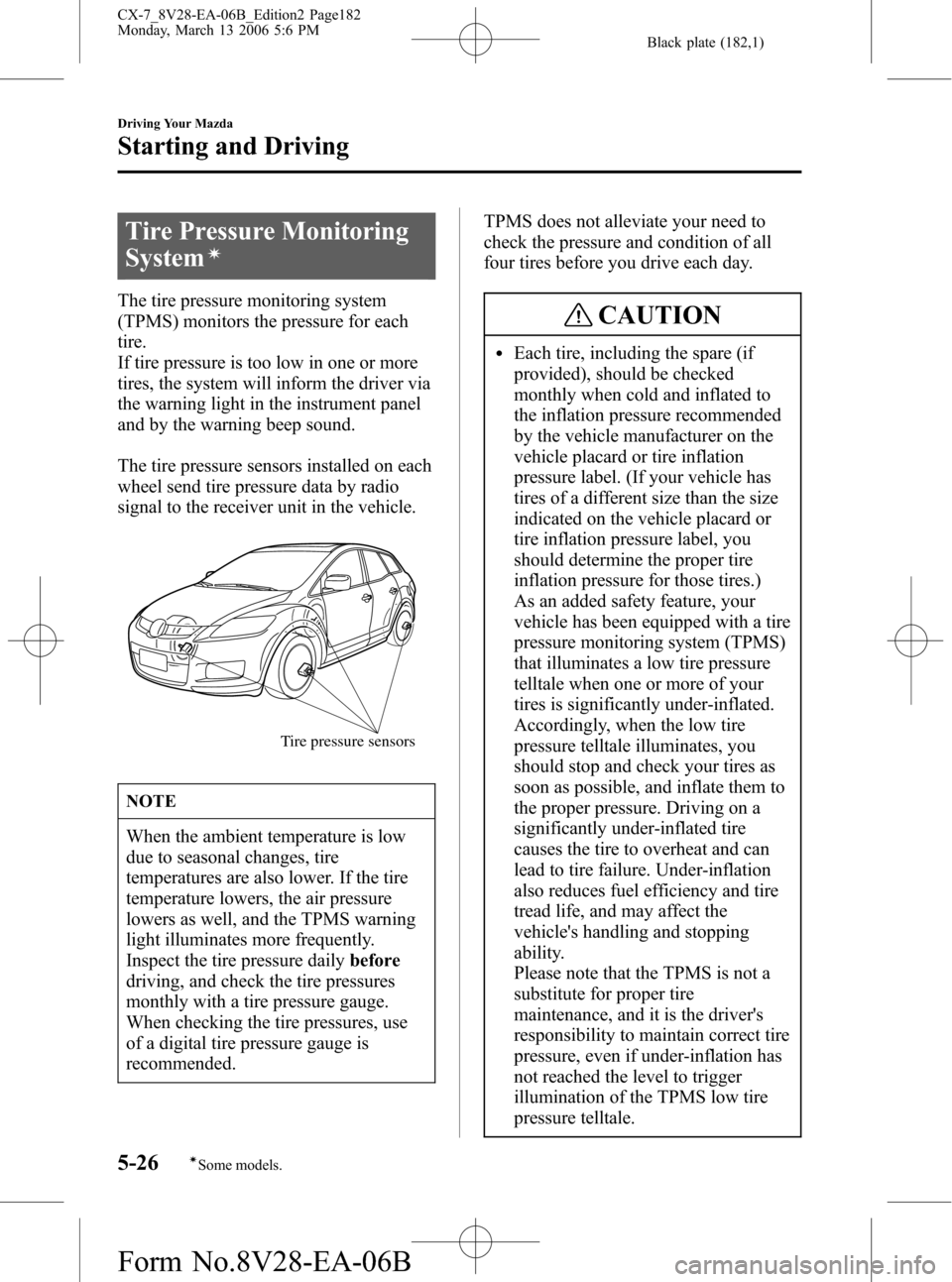
The tire pressure sensors installed on each
wheel send tire pressure data by radio
signal to the receiver unit in the vehicle.
Tire pressure sensors
NOTE
When the ambient temperature is low
due to seasonal changes, tire
temperatures are also lower. If the tire
temperature lowers, the air pressure
lowers as well, and the TPMS warning
light illuminates more frequently.
Inspect the tire pressure dailybefore
driving, and check the tire pressures
monthly with a tire pressure gauge.
When checking the tire pressures, use
of a digital tire pressure gauge is
recommended.TPMS does not alleviate your need to
check the pressure and condition of all
four tires before you drive each day.
CAUTION
lEach tire, including the spare (if
provided), should be checked
monthly when cold and inflated to
the inflation pressure recommended
by the vehicle manufacturer on the
vehicle placard or tire inflation
pressure label. (If your vehicle has
tires of a different size than the size
indicated on the vehicle placard or
tire inflation pressure label, you
should determine the proper tire
inflation pressure for those tires.)
As an added safety feature, your
vehicle has been equipped with a tire
pressure monitoring system (TPMS)
that illuminates a low tire pressure
telltale when one or more of your
tires is significantly under-inflated.
Accordingly, when the low tire
pressure telltale illuminates, you
should stop and check your tires as
soon as possible, and inflate them to
the proper pressure. Driving on a
significantly under-inflated tire
causes the tire to overheat and can
lead to tire failure. Under-inflation
also reduces fuel efficiency and tire
tread life, and may affect the
vehicle's handling and stopping
ability.
Please note that the TPMS is not a
substitute for proper tire
maintenance, and it is the driver's
responsibility to maintain correct tire
pressure, even if under-inflation has
not reached the level to trigger
illumination of the TPMS low tire
pressure telltale.
5-26
Driving Your Mazda
íSome models.
Starting and Driving
CX-7_8V28-EA-06B_Edition2 Page182
Monday, March 13 2006 5:6 PM
Form No.8V28-EA-06B
Page 183 of 406

Black plate (183,1)
CAUTION
lTo avoid false readings, the system
samples for a little while before
indicating a problem. As a result it
will not instantaneously register a
rapid tire deflation or blow out.
NOTE
This device complies with part 15 of the
FCC Rules. Operation is subject to the
following two conditions: (1) This
device may not cause harmful
interference, and (2) this device must
accept any interference received,
including interference that may cause
undesired operation.
qTire Pressure Monitoring System
Warning Light
This warning light illuminates for a few
seconds when the ignition switch is turned
to the ON position.
Thereafter, the warning light illuminates
when tire pressure is too low in one or
more tires, and flashes when there is a
system malfunction.
WARNING
If the tire pressure monitoring system
warning light illuminates or flashes,
or the tire pressure warning beep
sound is heard, decrease vehicle speed
immediately and avoid sudden
maneuvering and braking:
If the tire pressure monitoring system
warning light illuminates or flashes,
or the tire pressure warning beep
sound is heard, it is dangerous to drive
the vehicle at high speeds, or perform
sudden maneuvering or braking.
Vehicle drivability could worsen and
result in an accident.
Have the system and tires checked or
perform the appropriate repair as soon
as possible by an Authorized Mazda
Dealer.
Do not ignore the TPMS Warning
Light:
Ignoring the TPMS warning light is
dangerous, even if you know why it is
illuminated. Have the problem taken
care of as soon as possible before it
develops into a more serious situation
that could lead to tire failure and a
dangerous accident.
Warning light illuminates/Warning
beep sounds
When the warning light illuminates, and
the warning beep sound is heard (about 3
seconds), tire pressure is too low in one or
more tires.
Adjust the tire pressure to the correct tire
pressure. Refer to the specification charts
(page 10-6).
Driving Your Mazda
Starting and Driving
5-27
CX-7_8V28-EA-06B_Edition2 Page183
Monday, March 13 2006 5:6 PM
Form No.8V28-EA-06B
Page 184 of 406
Black plate (184,1)
CAUTION
When replacing/repairing the tires or
wheels or both, have the work done by
an Authorized Mazda Dealer, or the tire
pressure sensors may be damaged.
NOTE
lPerform tire pressure adjustment
when the tires are cold. Tire pressure
will vary according to the tire
temperature, therefore let the vehicle
stand for 1 hour or only drive it 1.6
km (1 mile) or less before adjusting
the tire pressures. When pressure is
adjusted on hot tires to the cold
inflation pressure, the TPMS
warning light/beep may turn on after
the tires cool and pressure drops
below specification.
Also, an illuminated TPMS warning
light, resulting from the tire air
pressure dropping due to cold
ambient temperature, may go out if
the ambient temperature rises. In this
case, it will also be necessary to
adjust the tire air pressures. If the
TPMS warning light illuminates due
to a drop in tire air pressure, make
sure to check and adjust the tire air
pressures.
lAfter adjusting the tire air pressures,
it may require some time for the
TPMS warning light to go out. If the
TPMS warning light remains
illuminated, drive the vehicle at a
speed of at least 25 km/h (16 mph)
for 10 minutes, and then verify that it
goes out.If the warning light illuminates again even
after the tire pressures are adjusted, there
may be a tire puncture. Replace the
punctured tire with the temporary spare
tire (page 7-6).
NOTE
A tire pressure sensor is not installed to
the temporary spare tire. The warning
light will flash continuously while the
temporary spare tire is being used.
Warning light flashes
When the warning light flashes, there may
be a system malfunction. Consult an
Authorized Mazda Dealer.
qSystem Error Activation
When the TPMS warning light flashes,
there may be a system malfunction.
Consult an Authorized Mazda Dealer.
A system error activation may occur in
the following cases:
lWhen there is equipment or a device
near the vehicle using the same radio
frequency as that of the tire pressure
sensors.
lWhen using the following devices in
the vehicle that may cause radio
interference with the receiver unit.
lA digital device such as a personal
computer.
lA current converter device such as a
DC-AC converter.
lWhen excess snow or ice adheres to
the vehicle, especially around the
wheels.
lWhen the tire pressure sensor batteries
are exhausted.
5-28
Driving Your Mazda
Starting and Driving
CX-7_8V28-EA-06B_Edition2 Page184
Monday, March 13 2006 5:6 PM
Form No.8V28-EA-06B
Page 185 of 406
Black plate (185,1)
lWhen using a wheel with no tire
pressure sensor installed.
lWhen using tires with steel wire
reinforcement in the side walls.
lWhen using tire chains.
qTires and Wheels
CAUTION
When inspecting or adjusting the tire air
pressures, do not apply excessive force
to the stem part of the wheel unit. The
stem part could be damaged.
Changing tires and wheels
The following procedure allows the
TPMS to recognize a tire pressure sensor's
unique ID signal code whenever tires or
wheels are changed, such as changing to
and from winter tires.
NOTE
Each tire pressure sensor has a unique
ID signal code. The signal code must be
registered with the TPMS before it can
work. The easiest way to do it is to have
an Authorized Mazda Dealer change
your tire and complete ID signal code
registration.
When having tires changed at an
Authorized Mazda Dealer
Tire pressure sensor ID signal code
registration is completed when an
Authorized Mazda Dealer changes your
vehicle's tires.When changing tires yourself
If you or someone else changes tires, you
or someone else can also undertake the
steps for the TPMS to complete the ID
signal code registration.
1. After tires have been changed, turn the
ignition switch to the ON position, then
turn it back to the ACC or LOCK
position.
2. Wait for about 15 minutes.
3. After about 15 minutes, drive the
vehicle at a speed of at least 25 km/h
(16 mph) for 10 minutes and the tire
pressure sensor ID signal code will be
registered automatically.
NOTE
If the vehicle is driven within about 15
minutes of changing tires, the tire
pressure monitoring system warning
light will flash because the sensor ID
signal code would not have been
registered. If this happens, park the
vehicle for about 15 minutes, after
which the sensor ID signal code will
register upon driving the vehicle for 10
minutes.
Driving Your Mazda
Starting and Driving
5-29
CX-7_8V28-EA-06B_Edition2 Page185
Monday, March 13 2006 5:6 PM
Form No.8V28-EA-06B