lock MAZDA MODEL CX-9 2008 (in English) User Guide
[x] Cancel search | Manufacturer: MAZDA, Model Year: 2008, Model line: MODEL CX-9, Model: MAZDA MODEL CX-9 2008Pages: 506, PDF Size: 11.52 MB
Page 26 of 506
Black plate (26,1)
Returning seatbacks to their original
positions
1. Lift the seatback to its original
position.
Make sure the seatback is secured by
attempting to lightly move it forward
and back.
2. Route the center-rear seat belt through
the seat belt guide and fasten it. Check
that all seat belts are routed properly
for passenger use (page 2-26).Third-Row Seat
WARNING
Do not stack cargo higher than the
seatbacks:
Stacking luggage or other cargo
higher than the seatbacks is
dangerous. During a sudden stop or
collision, objects can fly around and
become projectiles that could hit and
injure passengers.
Make sure luggage and cargo is
secured before driving:
Not securing cargo while driving is
dangerous as it could move or be
crushed during sudden braking or a
collision and cause injury.
Make sure the adjustable components
of a seat are locked in place by
attempting to rock the seatback:
Adjustable seats that are not securely
latched are dangerous. In a sudden
stop or collision, the seat or seatback
could move, causing injury.
Do not drive with the seatback
unlocked:
The seatback plays an important role
in your protection in a vehicle.
Leaving the seatback unlocked is
dangerous as it can allow passengers
to be ejected or thrown around and
baggage to strike occupants in a
sudden stop or collision, resulting in
severe injury. After returning the
seatback at any time, even when
there are no other passengers, rock
the seatback to make sure it is locked
in place.
2-14
Essential Safety Equipment
Seats
CX-9_8Z28-EA-07J_Edition2 Page26
Thursday, November 22 2007 12:1 AM
Form No.8Z28-EA-07J
Page 29 of 506
Black plate (29,1)
Seat Belt Precautions
Seat belts help to decrease the possibility of severe injury during accidents and sudden
stops. Mazda recommends that the driver and all passengers always wear seat belts.
Your vehicle has the following types of seat belts.
Seating Position Types of seat belt
Front seatDriver side 3-point type seat belt with emergency locking mode retractor
Passenger side
3-point type seat belt with emergency locking mode
retractor/automatic locking mode retractor Second-row seat
Third-row seat
3-point type seat belt with emergency locking mode retractor
This belt has retractors with an inertia lock that keep the belt retracted when not in use.
The lock allows the belt to remain comfortable on the user, but it will lock in position
during a collision.
Refer to Emergency Locking Mode on page 2-19.
3-point type seat belt with emergency locking mode retractor/automatic locking mode
retractor
In addition to the emergency locking mode function, this belt has retractors that operate in
another mode, the automatic locking mode, for the child-restraint system.
Refer to Automatic Locking Mode on page 2-20.
Refer to Installing Child-Restraint Systems on page 2-37.
We recommend you put all children in the rear seats, if you must use the front passenger
seat for a child, slide the front passenger seat as far back as possible and make sure any
child-restraint system is secured properly.
Essential Safety Equipment
Seat Belt Systems
2-17
CX-9_8Z28-EA-07J_Edition2 Page29
Thursday, November 22 2007 12:1 AM
Form No.8Z28-EA-07J
Page 31 of 506
Black plate (31,1)
CAUTION
Belt retraction may become difficult if the belts and rings are soiled, so try to keep
them clean. For more details about cleaning the seat belts, refer to“Cleaning the
Lap/Shoulder Belt Webbing”(page 8-58).
qPregnant Women and Persons with Serious Medical Conditions
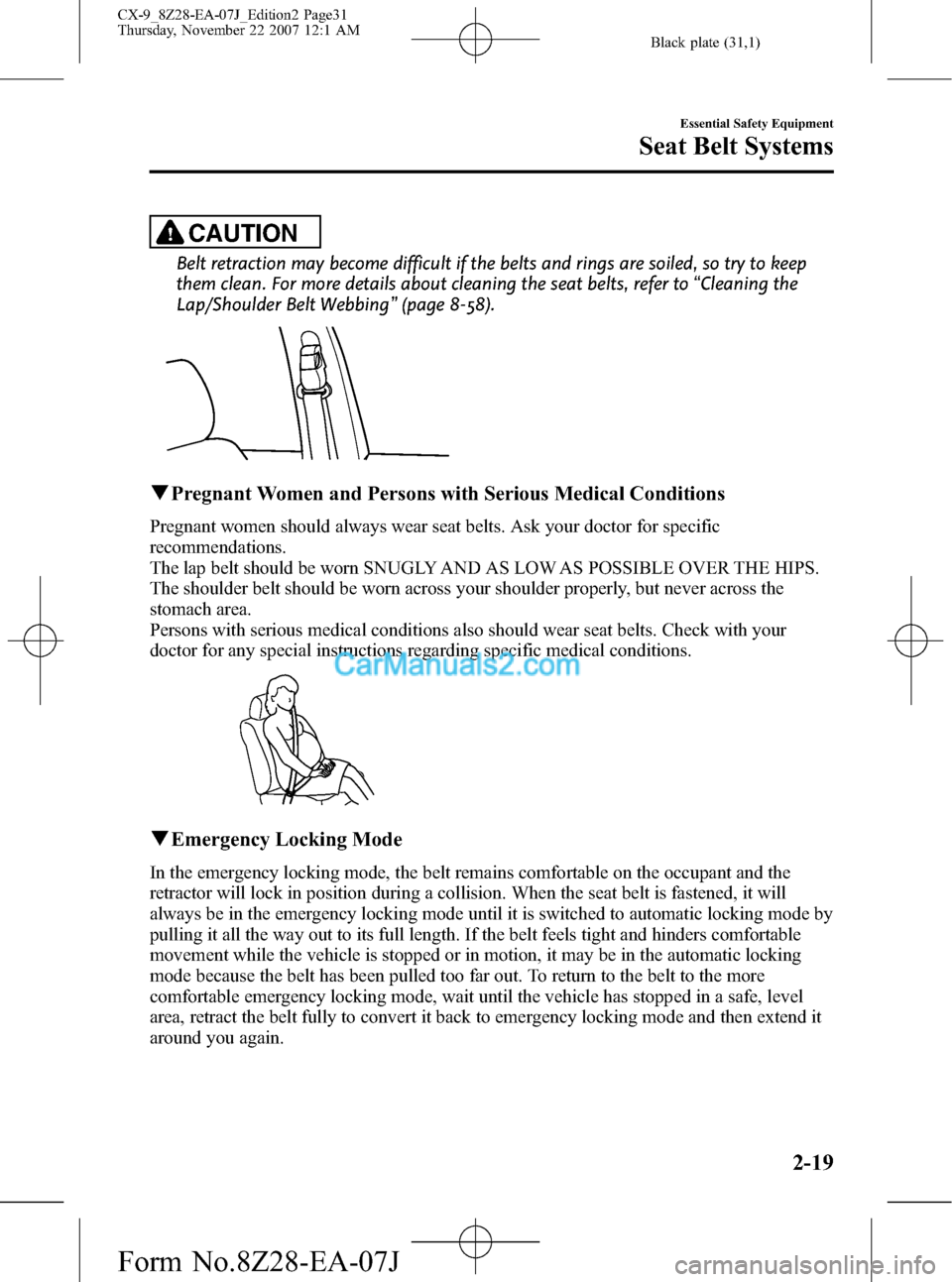
Pregnant women should always wear seat belts. Ask your doctor for specific
recommendations.
The lap belt should be worn SNUGLY AND AS LOW AS POSSIBLE OVER THE HIPS.
The shoulder belt should be worn across your shoulder properly, but never across the
stomach area.
Persons with serious medical conditions also should wear seat belts. Check with your
doctor for any special instructions regarding specific medical conditions.
qEmergency Locking Mode
In the emergency locking mode, the belt remains comfortable on the occupant and the
retractor will lock in position during a collision. When the seat belt is fastened, it will
always be in the emergency locking mode until it is switched to automatic locking mode by
pulling it all the way out to its full length. If the belt feels tight and hinders comfortable
movement while the vehicle is stopped or in motion, it may be in the automatic locking
mode because the belt has been pulled too far out. To return to the belt to the more
comfortable emergency locking mode, wait until the vehicle has stopped in a safe, level
area, retract the belt fully to convert it back to emergency locking mode and then extend it
around you again.
Essential Safety Equipment
Seat Belt Systems
2-19
CX-9_8Z28-EA-07J_Edition2 Page31
Thursday, November 22 2007 12:1 AM
Form No.8Z28-EA-07J
Page 32 of 506
Black plate (32,1)
qAutomatic Locking Mode
Always use the automatic locking mode to keep the child-restraint system from shifting to
an unsafe position in the event of an accident. To enable seat belt automatic locking mode,
pull it all the way out and connect it as instructed on the child-restraint system. It will
retract down to the child-restraint system and stay locked on it. See the section on child
restraint (page 2-33).
2-20
Essential Safety Equipment
Seat Belt Systems
CX-9_8Z28-EA-07J_Edition2 Page32
Thursday, November 22 2007 12:1 AM
Form No.8Z28-EA-07J
Page 34 of 506
Black plate (34,1)
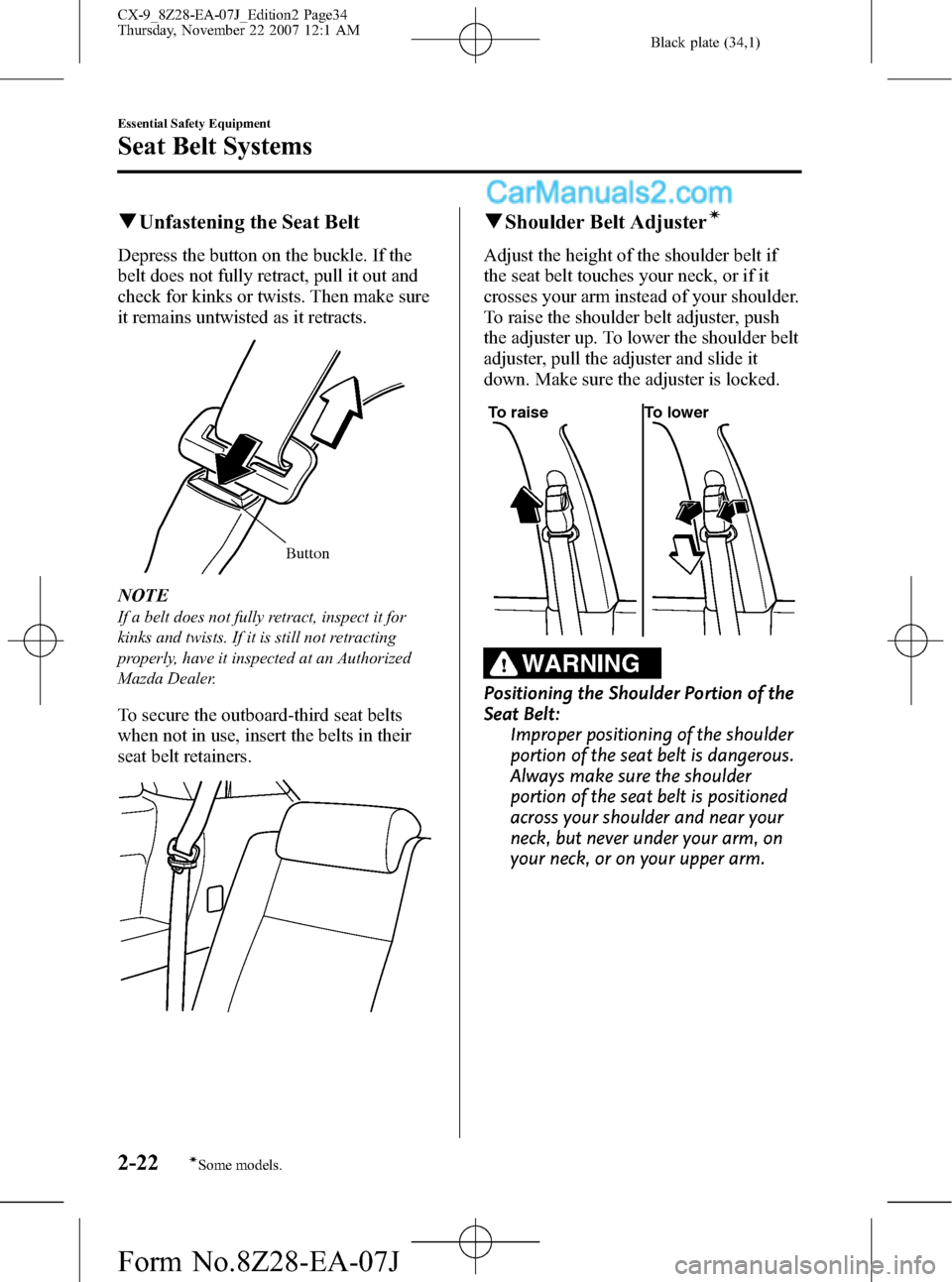
qUnfastening the Seat Belt
Depress the button on the buckle. If the
belt does not fully retract, pull it out and
check for kinks or twists. Then make sure
it remains untwisted as it retracts.
Button
NOTE
If a belt does not fully retract, inspect it for
kinks and twists. If it is still not retracting
properly, have it inspected at an Authorized
Mazda Dealer.
To secure the outboard-third seat belts
when not in use, insert the belts in their
seat belt retainers.
qShoulder Belt Adjusterí
Adjust the height of the shoulder belt if
the seat belt touches your neck, or if it
crosses your arm instead of your shoulder.
To raise the shoulder belt adjuster, push
the adjuster up. To lower the shoulder belt
adjuster, pull the adjuster and slide it
down. Make sure the adjuster is locked.
To raise To lower
WARNING
Positioning the Shoulder Portion of the
Seat Belt:
Improper positioning of the shoulder
portion of the seat belt is dangerous.
Always make sure the shoulder
portion of the seat belt is positioned
across your shoulder and near your
neck, but never under your arm, on
your neck, or on your upper arm.
2-22
Essential Safety Equipment
íSome models.
Seat Belt Systems
CX-9_8Z28-EA-07J_Edition2 Page34
Thursday, November 22 2007 12:1 AM
Form No.8Z28-EA-07J
Page 40 of 506
Black plate (40,1)
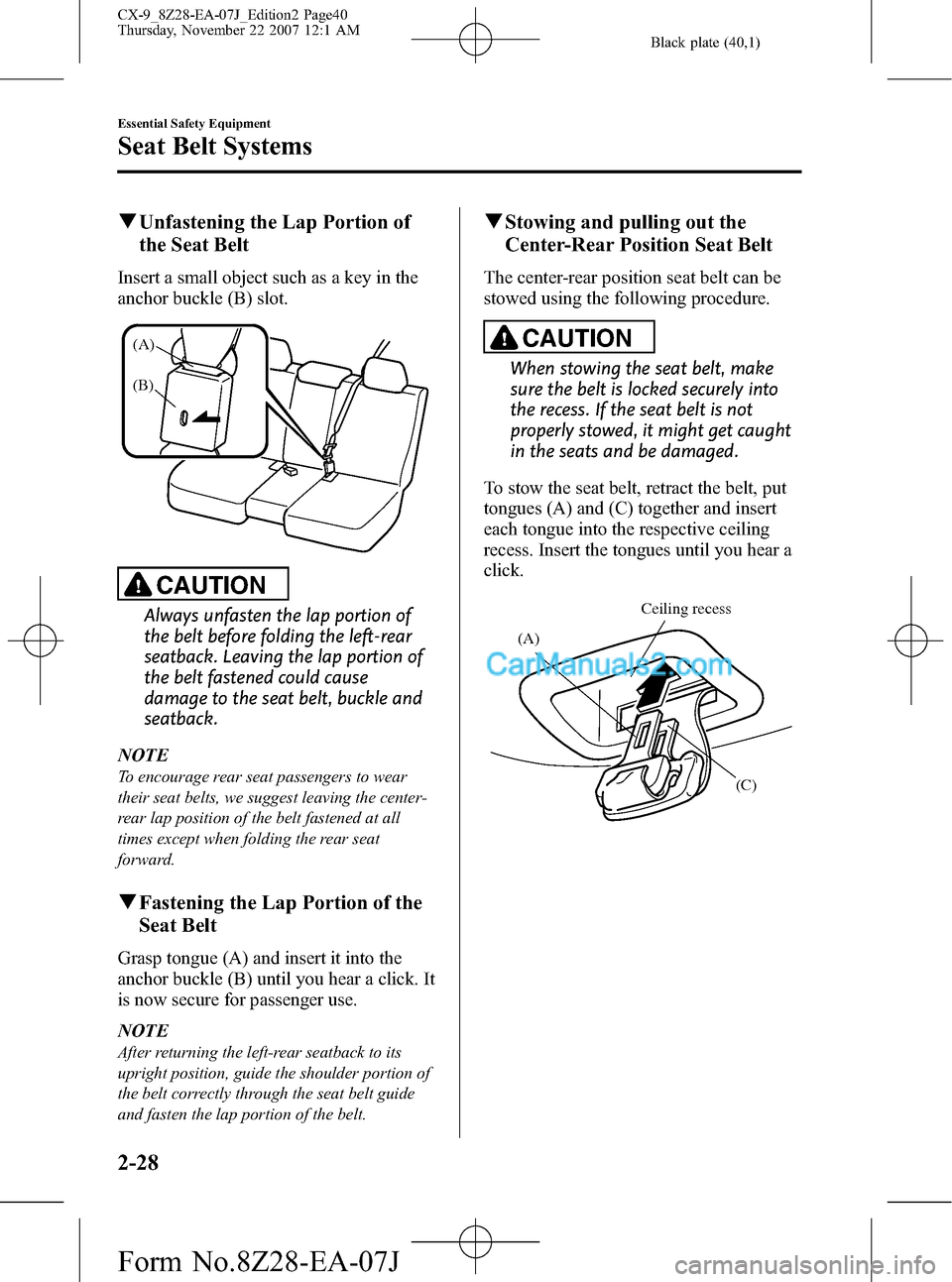
qUnfastening the Lap Portion of
the Seat Belt
Insert a small object such as a key in the
anchor buckle (B) slot.
(A)
(B)
CAUTION
Always unfasten the lap portion of
the belt before folding the left-rear
seatback. Leaving the lap portion of
the belt fastened could cause
damage to the seat belt, buckle and
seatback.
NOTE
To encourage rear seat passengers to wear
their seat belts, we suggest leaving the center-
rear lap position of the belt fastened at all
times except when folding the rear seat
forward.
qFastening the Lap Portion of the
Seat Belt
Grasp tongue (A) and insert it into the
anchor buckle (B) until you hear a click. It
is now secure for passenger use.
NOTE
After returning the left-rear seatback to its
upright position, guide the shoulder portion of
the belt correctly through the seat belt guide
and fasten the lap portion of the belt.
qStowing and pulling out the
Center-Rear Position Seat Belt
The center-rear position seat belt can be
stowed using the following procedure.
CAUTION
When stowing the seat belt, make
sure the belt is locked securely into
the recess. If the seat belt is not
properly stowed, it might get caught
in the seats and be damaged.
To stow the seat belt, retract the belt, put
tongues (A) and (C) together and insert
each tongue into the respective ceiling
recess. Insert the tongues until you hear a
click.
(A)
(C) Ceiling recess
2-28
Essential Safety Equipment
Seat Belt Systems
CX-9_8Z28-EA-07J_Edition2 Page40
Thursday, November 22 2007 12:1 AM
Form No.8Z28-EA-07J
Page 41 of 506
Black plate (41,1)
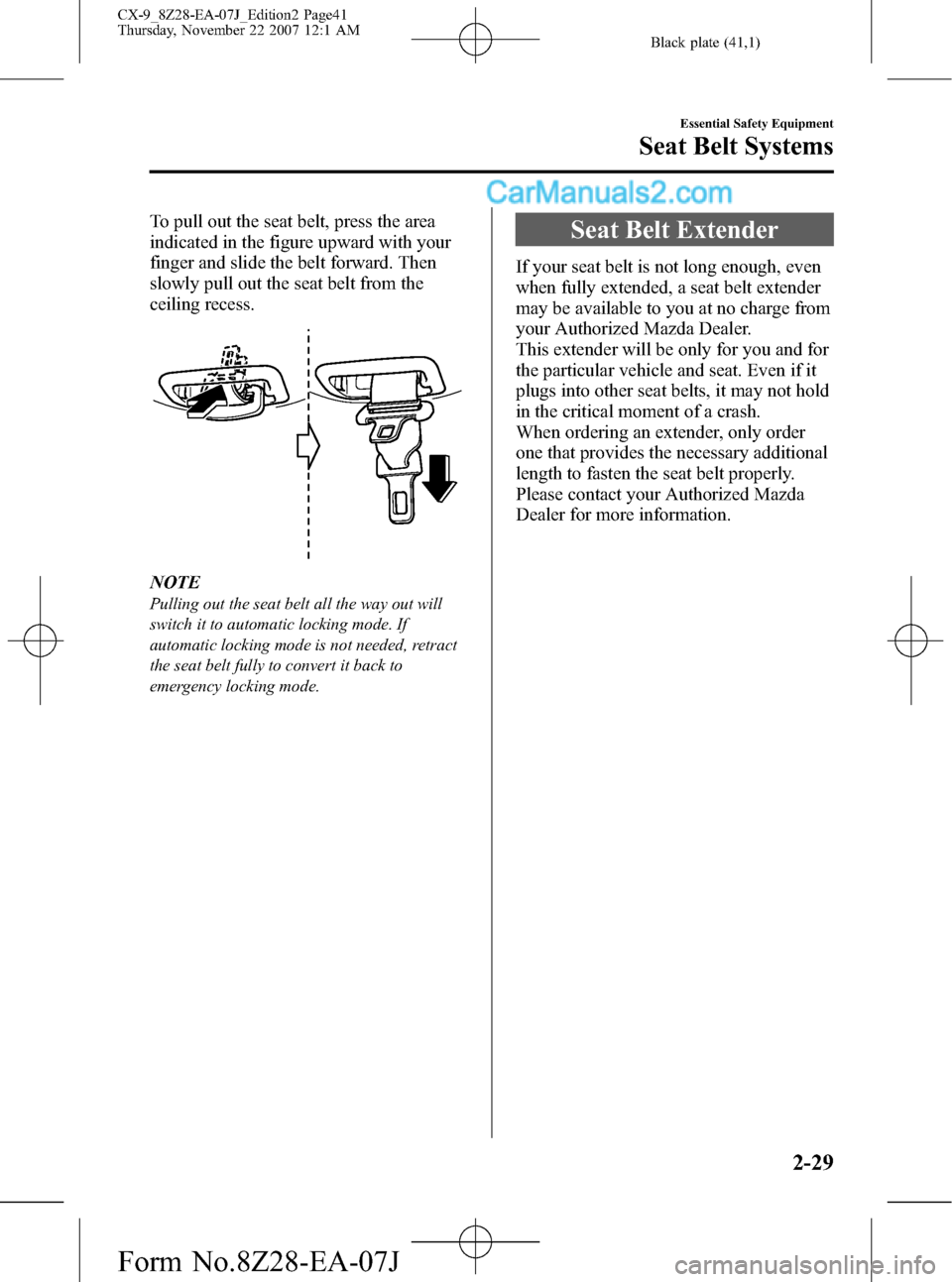
To pull out the seat belt, press the area
indicated in the figure upward with your
finger and slide the belt forward. Then
slowly pull out the seat belt from the
ceiling recess.
NOTE
Pulling out the seat belt all the way out will
switch it to automatic locking mode. If
automatic locking mode is not needed, retract
the seat belt fully to convert it back to
emergency locking mode.
Seat Belt Extender
If your seat belt is not long enough, even
when fully extended, a seat belt extender
may be available to you at no charge from
your Authorized Mazda Dealer.
This extender will be only for you and for
the particular vehicle and seat. Even if it
plugs into other seat belts, it may not hold
in the critical moment of a crash.
When ordering an extender, only order
one that provides the necessary additional
length to fasten the seat belt properly.
Please contact your Authorized Mazda
Dealer for more information.
Essential Safety Equipment
Seat Belt Systems
2-29
CX-9_8Z28-EA-07J_Edition2 Page41
Thursday, November 22 2007 12:1 AM
Form No.8Z28-EA-07J
Page 48 of 506
Black plate (48,1)
Do not allow a child to lean over or against the side window of a vehicle with side
and curtain air bags:
It is dangerous to allow anyone to lean over or against the side window, the area of
the front passenger seat, the front and rear window pillars and the roof edge along
both sides from which the side and curtain air bags deploy, even if a child-restraint
system is used. If the vehicle is equipped with side and curtain air bags, the impact of
inflation could cause serious injury or death to the child. Furthermore, leaning over
or against the front door could block the side and curtain air bags and eliminate the
advantages of supplemental protection. With the front air bag and the additional
side air bag that comes out of the front seat, the rear seat is always a better location
for children. Do not allow a child to lean over or against the side window, even if the
child is seated in a child-restraint system.
Never use one seat belt on more than one person at a time:
Using one seat belt for more than one person at a time is dangerous. A seat belt
used in this way cannot spread the impact forces properly and the two passengers
could be crushed together and seriously injured or even killed. Never use one belt for
more than one person at a time and always operate the vehicle with each occupant
properly restrained.
CAUTION
A seat belt or child-restraint system can become very hot in a closed vehicle during
warm weather. To avoid burning yourself or a child, check them before you or your
child touches them.
NOTE
Your Mazda is equipped with LATCH lower anchors for attachment of specially designed LATCH
child-restraint systems in the rear seats. When using these anchors to secure a child-restraint system,
refer to“LATCH Child-Restraint Systems”(page 2-44).
2-36
Essential Safety Equipment
Child Restraint
CX-9_8Z28-EA-07J_Edition2 Page48
Thursday, November 22 2007 12:2 AM
Form No.8Z28-EA-07J
Page 49 of 506
Black plate (49,1)
Installing Child-Restraint
Systems
Accident statistics reveal that a child is
safer in the rear seats. The front
passenger's seat is clearly the worst choice
for any child under 12, and with rear-
facing child-restraint systems it is clearly
unsafe due to air bags.
Some child-restraint systems now come
with tethers and therefore must be
installed on the seats that take tethers to
be effective. In your Mazda, tethered
child-restraint systems can only be
accommodated in the three positions on
the second-row seats.
Even if your vehicle is equipped with
front passenger seat weight sensors (page
2-62), which automatically deactivates the
front passenger air bag, a rear seat is the
safest place for a child of any age or size.
Some child-restraint systems also employ
specially designed LATCH attachments;
refer to“LATCH Child-Restraint
Systems”(page 2-44).
WARNING
Tethered Child-Restraint Systems Work
Only on Tether-Equipped Rear Seats:
Installation of a tether equipped
child-restraint system in the front
passenger's seat or the third-row
seats defeats the safety design of the
system and will result in an increased
chance of serious injury if the child-
restraint system goes forward
without benefit of being tethered.
Place tether equipped child-restraint
systems where there are tether
anchors.
qSecond-Row Seats Child-
Restraint System Installation
Follow these instructions when using a
child-restraint system, unless you are
attaching a LATCH-equipped child-
restraint system to the rear LATCH lower
anchors. Refer to“LATCH Child-
Restraint Systems”(page 2-44).
NOTE
Follow the child-restraint system
manufacturer's instructions carefully. If you
are not sure whether you have a LATCH
system or tether, check in the child-restraint
system manufacturer's instructions and follow
them accordingly. Depending on the type of
child-restraint system, it may not employ seat
belts which are in automatic locking mode.
1. When installing the child-restraint
system on the second-row seat, make
sure that the center-rear seat belt is
routed through the seat belt guide.
2. Make sure the seatback is securely
latched by pushing it back until it is
fully locked.
3. Secure the child-restraint system with
the lap portion of the lap/shoulder belt.
See the manufacturer's instructions on
the child-restraint system for belt
routing instructions.
Essential Safety Equipment
Child Restraint
2-37
CX-9_8Z28-EA-07J_Edition2 Page49
Thursday, November 22 2007 12:2 AM
Form No.8Z28-EA-07J
Page 50 of 506
Black plate (50,1)
4. To get the retractor into the automatic
locking mode, pull the shoulder belt
portion of the seat belt until the entire
length of the belt is out of the retractor.
5. Push the child-restraint system firmly
into the vehicle seat. Be sure the belt
retracts as snugly as possible. Clicking
from the retractor will be heard during
retraction if the system is in the
automatic locking mode. If the belt
does not lock the seat down tight,
repeat this step.
NOTE
Inspect this function before each use of the
child-restraint system. You should not be able
to pull the shoulder belt out of the retractor
while the system is in the automatic locking
mode. When you remove the child-restraint
system, be sure the belt fully retracts to return
the system to emergency locking mode before
occupants use the seat belts.
6. If your child-restraint system requires
the use of a tether strap, refer to the
manufacturer's instructions to hook and
tighten the tether strap after raising the
head restraint.
Anchor bracket location
Tether strap position
Tether strap
Forward
2-38
Essential Safety Equipment
Child Restraint
CX-9_8Z28-EA-07J_Edition2 Page50
Thursday, November 22 2007 12:2 AM
Form No.8Z28-EA-07J