child seat MAZDA MODEL CX-9 2008 Owners Manual (in English)
[x] Cancel search | Manufacturer: MAZDA, Model Year: 2008, Model line: MODEL CX-9, Model: MAZDA MODEL CX-9 2008Pages: 506, PDF Size: 11.52 MB
Page 5 of 506
Black plate (5,1)
CX-9_8Z28-EA-07J_Edition2 Page5
Thursday, November 22 2007 12:1 AM
Form No.8Z28-EA-07J
Table of Contents
Your Vehicle at a Glance
Interior, exterior views and part identification of your Mazda.1
Essential Safety Equipment
Use of safety equipment, including seats, seat belt system, child-restraint
systems and SRS air bags.2
Knowing Your Mazda
Explanation of basic operations and controls; opening/closing and adjustment
of various parts.3
Before Driving Your Mazda
Important information about driving your Mazda.4
Driving Your Mazda
Explanation of instruments and controls.5
Interior Comfort
Use of various features for drive comfort, including air-conditioning and audio
system.6
In Case of an Emergency
Helpful information on what to do in an emergency.7
Maintenance and Care
How to keep your Mazda in top condition.8
Customer Information and Reporting Safety Defects
Important consumer information including warranties and add-on equipment.9
Specifications
Technical information about your Mazda.10
Index11
Page 13 of 506
Black plate (13,1)
2Essential Safety Equipment
Use of safety equipment, including seats, seat belt system, child-restraint
systems and SRS air bags.
Seats ............................................................................................... 2-2
Front Seats (Manually Operated Seats) ..................................... 2-2
Front Seats (Electrically Operated Seats) .................................. 2-4
Second-Row Seats .................................................................. 2-10
Third-Row Seat ....................................................................... 2-14
Head Restraints ....................................................................... 2-16
Seat Belt Systems ........................................................................ 2-17
Seat Belt Precautions .............................................................. 2-17
3-Point Type Seat Belt ............................................................ 2-21
Front Seat Belt Pretensioner and Load Limiting Systems ....... 2-23
Center-Rear Position Seat Belt (Second-Row Seats) .............. 2-26
Seat Belt Extender ................................................................... 2-29
Seat Belt Warning Light/Beep ................................................ 2-31
Child Restraint ............................................................................ 2-33
Child Restraint Precautions ..................................................... 2-33
Installing Child-Restraint Systems .......................................... 2-37
LATCH Child-Restraint Systems ............................................ 2-44
SRS Air Bags ............................................................................... 2-49
Supplemental Restraint System (SRS) Precautions ................ 2-49
Supplemental Restraint System Components ......................... 2-54
How the SRS Air Bags Work .................................................. 2-55
SRS Air Bag Deployment Criteria .......................................... 2-59
Limitations to SRS Air Bag .................................................... 2-60
Driver and Front Passenger Occupant Classification
System ..................................................................................... 2-62
Monitoring and Maintenance .................................................. 2-67
2-1
CX-9_8Z28-EA-07J_Edition2 Page13
Thursday, November 22 2007 12:1 AM
Form No.8Z28-EA-07J
Page 22 of 506
Black plate (22,1)
Second-Row Seats
WARNING
Do not stack cargo higher than the
seatback:
Stacking luggage or other cargo
higher than the seatback is
dangerous. During a sudden stop or
collision, objects can fly around and
become projectiles that could hit and
injure passengers.
Make sure luggage and cargo is
secured before driving:
Not securing cargo while driving is
dangerous as it could move or be
crushed during sudden braking or a
collision and cause injury.
Make sure the adjustable components
of a seat are locked in place by
attempting to slide the seat forward
and backward and rocking the
seatback:
Adjustable seats that are not securely
latched are dangerous. In a sudden
stop or collision, the seat or seatback
could move, causing injury.
Adjust the seat only when the vehicle is
stopped:
Adjusting the seat while the vehicle is
moving is dangerous. Sudden
braking or a collision could cause
serious injury.Do not drive with the seatback
unlocked:
The seatback plays an important role
in your protection in a vehicle.
Leaving the seatback unlocked is
dangerous as it can allow passengers
to be ejected or thrown around and
baggage to strike occupants in a
sudden stop or collision, resulting in
severe injury. After adjusting the
seatback at any time, even when
there are no other passengers, rock
the seatback to make sure it is locked
in place.
Never allow a passenger to sit or stand
on the folded seatback while the
vehicle is moving:
Driving with a passenger on the
folded seatback is dangerous.
Allowing a child to sit up on the
folded seatback while the vehicle is
moving is particularly dangerous. In
a sudden stop or even a minor
collision, a child not in a proper seat
or child-restraint system and seat
belt could be thrown forward, back
or even out of the vehicle resulting in
serious injuries or death. The child in
the baggage area could be thrown
into other occupants and cause
serious injury.
NOTE
The second-row seats cannot be removed.
2-10
Essential Safety Equipment
Seats
CX-9_8Z28-EA-07J_Edition2 Page22
Thursday, November 22 2007 12:1 AM
Form No.8Z28-EA-07J
Page 27 of 506
Black plate (27,1)
Never allow a passenger to sit or stand
on the folded seatback while the
vehicle is moving:
Driving with a passenger on the
folded seatback is dangerous.
Allowing a child to sit up on the
folded seatback while the vehicle is
moving is particularly dangerous. In
a sudden stop or even a minor
collision, a child not in a proper seat
or child-restraint system and seat
belt could be thrown forward, back
or even out of the vehicle resulting in
serious injuries or death. The child in
the baggage area could be thrown
into other occupants and cause
serious injury.
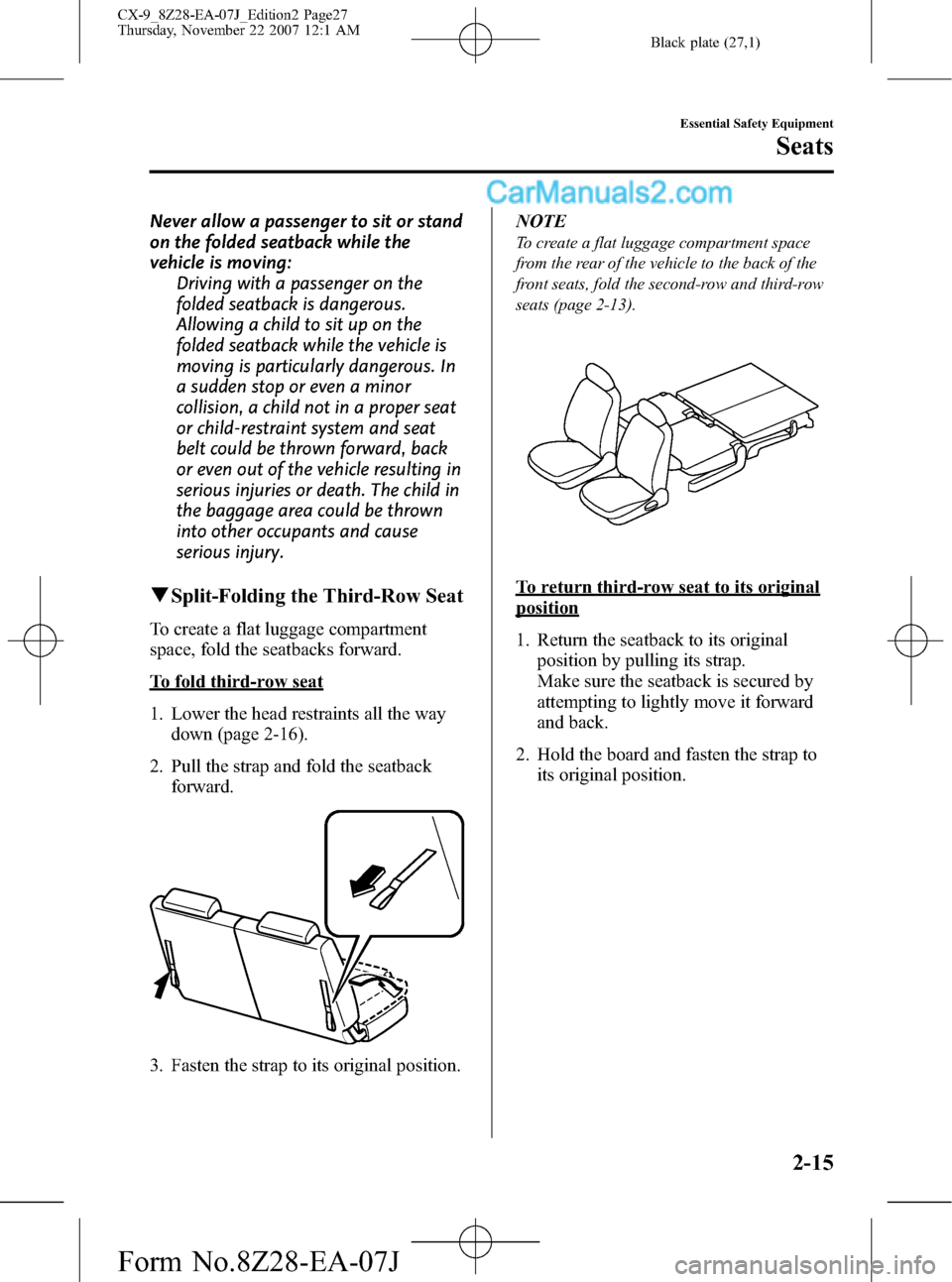
qSplit-Folding the Third-Row Seat
To create a flat luggage compartment
space, fold the seatbacks forward.
To fold third-row seat
1. Lower the head restraints all the way
down (page 2-16).
2. Pull the strap and fold the seatback
forward.
3. Fasten the strap to its original position.NOTE
To create a flat luggage compartment space
from the rear of the vehicle to the back of the
front seats, fold the second-row and third-row
seats (page 2-13).
To return third-row seat to its original
position
1. Return the seatback to its original
position by pulling its strap.
Make sure the seatback is secured by
attempting to lightly move it forward
and back.
2. Hold the board and fasten the strap to
its original position.
Essential Safety Equipment
Seats
2-15
CX-9_8Z28-EA-07J_Edition2 Page27
Thursday, November 22 2007 12:1 AM
Form No.8Z28-EA-07J
Page 29 of 506
Black plate (29,1)
Seat Belt Precautions
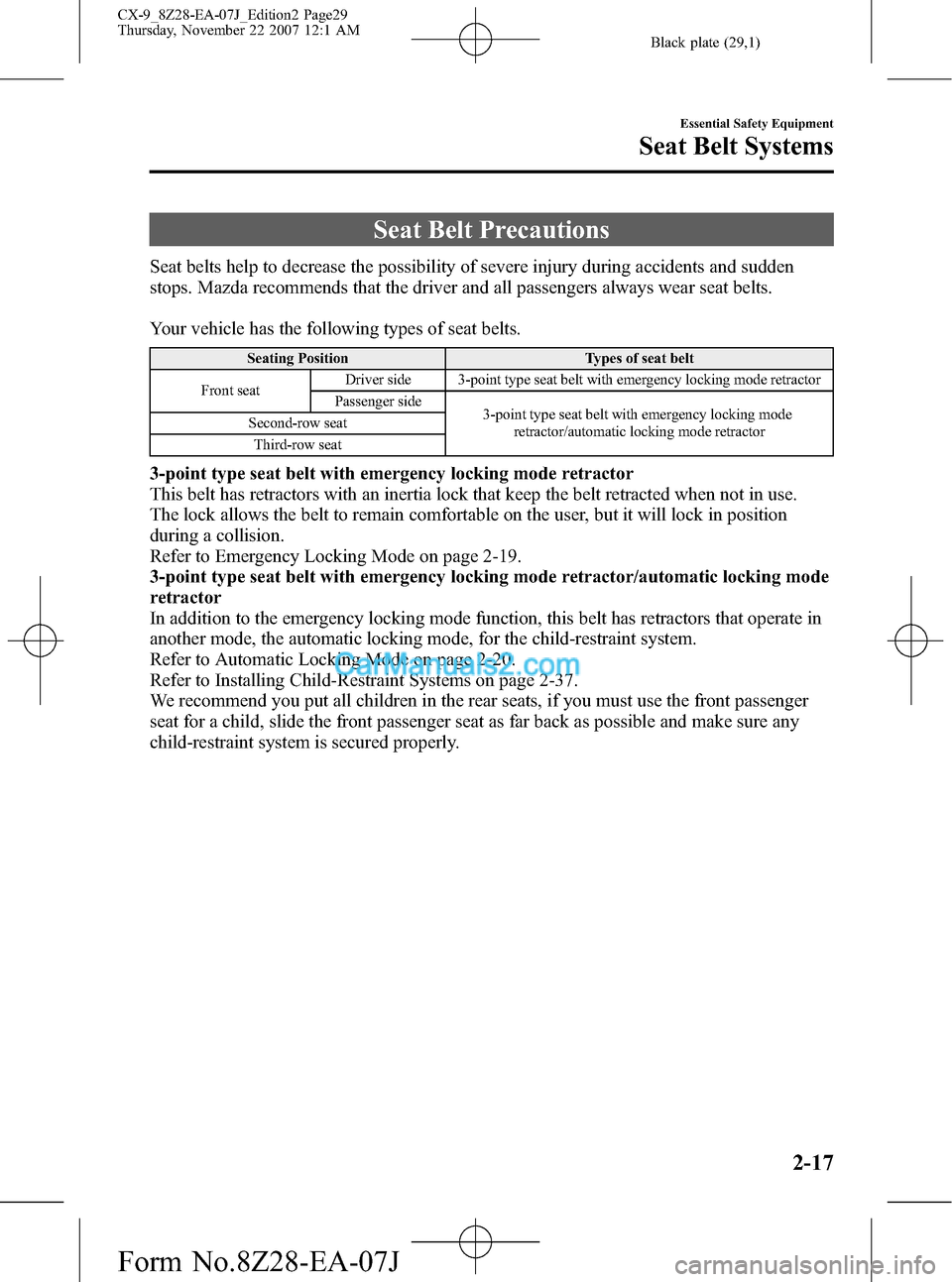
Seat belts help to decrease the possibility of severe injury during accidents and sudden
stops. Mazda recommends that the driver and all passengers always wear seat belts.
Your vehicle has the following types of seat belts.
Seating Position Types of seat belt
Front seatDriver side 3-point type seat belt with emergency locking mode retractor
Passenger side
3-point type seat belt with emergency locking mode
retractor/automatic locking mode retractor Second-row seat
Third-row seat
3-point type seat belt with emergency locking mode retractor
This belt has retractors with an inertia lock that keep the belt retracted when not in use.
The lock allows the belt to remain comfortable on the user, but it will lock in position
during a collision.
Refer to Emergency Locking Mode on page 2-19.
3-point type seat belt with emergency locking mode retractor/automatic locking mode
retractor
In addition to the emergency locking mode function, this belt has retractors that operate in
another mode, the automatic locking mode, for the child-restraint system.
Refer to Automatic Locking Mode on page 2-20.
Refer to Installing Child-Restraint Systems on page 2-37.
We recommend you put all children in the rear seats, if you must use the front passenger
seat for a child, slide the front passenger seat as far back as possible and make sure any
child-restraint system is secured properly.
Essential Safety Equipment
Seat Belt Systems
2-17
CX-9_8Z28-EA-07J_Edition2 Page29
Thursday, November 22 2007 12:1 AM
Form No.8Z28-EA-07J
Page 32 of 506
Black plate (32,1)
qAutomatic Locking Mode
Always use the automatic locking mode to keep the child-restraint system from shifting to
an unsafe position in the event of an accident. To enable seat belt automatic locking mode,
pull it all the way out and connect it as instructed on the child-restraint system. It will
retract down to the child-restraint system and stay locked on it. See the section on child
restraint (page 2-33).
2-20
Essential Safety Equipment
Seat Belt Systems
CX-9_8Z28-EA-07J_Edition2 Page32
Thursday, November 22 2007 12:1 AM
Form No.8Z28-EA-07J
Page 44 of 506
Black plate (44,1)
Driver seated/Front passenger seated
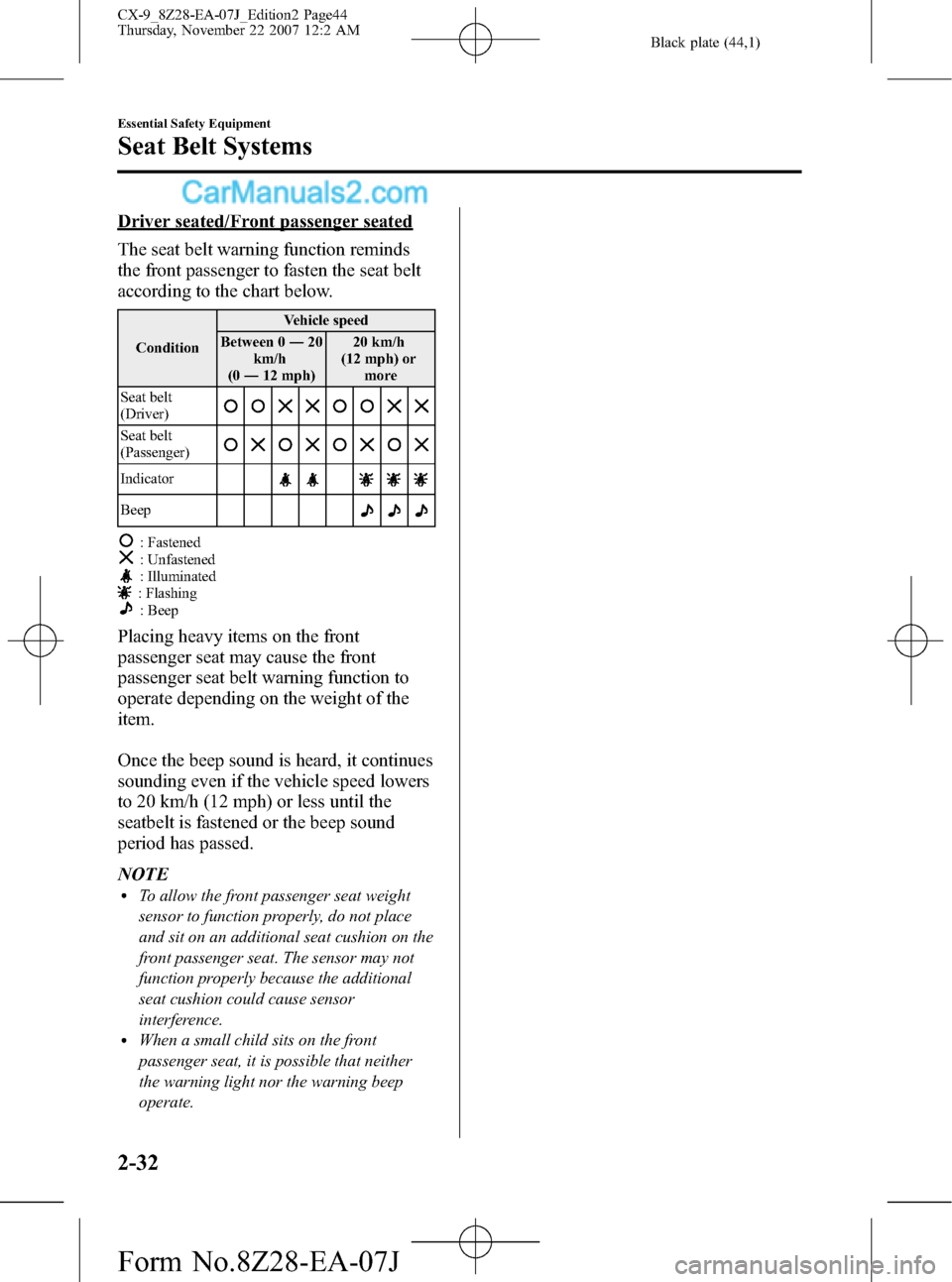
The seat belt warning function reminds
the front passenger to fasten the seat belt
according to the chart below.
ConditionVehicle speed
Between 0―20
km/h
(0―12 mph)20 km/h
(12 mph) or
more
Seat belt
(Driver)
Seat belt
(Passenger)
Indicator
Beep
: Fastened: Unfastened: Illuminated: Flashing: Beep
Placing heavy items on the front
passenger seat may cause the front
passenger seat belt warning function to
operate depending on the weight of the
item.
Once the beep sound is heard, it continues
sounding even if the vehicle speed lowers
to 20 km/h (12 mph) or less until the
seatbelt is fastened or the beep sound
period has passed.
NOTE
lTo allow the front passenger seat weight
sensor to function properly, do not place
and sit on an additional seat cushion on the
front passenger seat. The sensor may not
function properly because the additional
seat cushion could cause sensor
interference.
lWhen a small child sits on the front
passenger seat, it is possible that neither
the warning light nor the warning beep
operate.
2-32
Essential Safety Equipment
Seat Belt Systems
CX-9_8Z28-EA-07J_Edition2 Page44
Thursday, November 22 2007 12:2 AM
Form No.8Z28-EA-07J
Page 45 of 506
Black plate (45,1)
Child Restraint Precautions
Mazda strongly urges the use of child-restraint systems for children small enough to use
them.
You are required by law to use a child-restraint system for children in the U.S. and Canada.
Check your local and state or provincial laws for specific requirements regarding the safety
of children riding in your vehicle.
Whatever child-restraint system you consider, please pick the appropriate one for the age
and size of the child, obey the law and follow the instructions that come with the individual
child-restraint system.
A child who has outgrown child-restraint systems should sit in the rear and use seat belts,
both lap and shoulder. If the shoulder belt crosses the neck or face, move the child closer to
the center of the vehicle in the outboard seats, and towards the buckle on the right if the
child is seated on the center seat.
Statistics confirm that the rear seats are the best place for all children up to 12 years of age,
and more so with a supplemental restraint system (air bags).
A rear-facing child-restraint system shouldNEVERbe used on the front seat with the air
bag system activated. The front passenger's seat is also the least preferred seat for other
child-restraint systems.
To reduce the chance of injuries caused by deployment of the front passenger air bag, your
vehicle is equipped with the front passenger seat weight sensors. These sensors deactivate
the front passenger front and side air bags and also the front passenger seat belt
pretensioner system when the total seated weight on the front passenger seat is less than
approximately 30 kg (66 lb).
When an infant or small child sits on the front passenger seat, the system shuts off the front
passenger air bag, so make sure the front passenger air bag deactivation indicator light
illuminates.
Even if the front passenger air bag is shut off, Mazda strongly recommends that children be
properly restrained and child-restraint systems of all kinds are properly secured on the rear
seats which are the best place for children.
For more details, refer to“Front passenger seat weight sensors”(page 2-62).
Essential Safety Equipment
Child Restraint
2-33
CX-9_8Z28-EA-07J_Edition2 Page45
Thursday, November 22 2007 12:2 AM
Form No.8Z28-EA-07J
Page 46 of 506
Black plate (46,1)
WARNING
Use the correct size child-restraint system:
For effective protection in vehicle accidents and sudden stops, a child must be
properly restrained using a seat belt or child-restraint system depending on age and
size. If not, the child could be seriously injured or even killed in an accident.
Follow the manufacturer's instructions and always keep the child-restraint system
buckled down:
An unsecured child-restraint system is dangerous. In a sudden stop or a collision it
could move causing serious injury or death to the child or other occupants. Make
sure any child-restraint system is properly secured in place according to the child-
restraint system manufacturer's instructions. When not in use, remove it from the
vehicle or fasten it with a seat belt, or latch it down to BOTH LATCH lower anchors
for LATCH child-restraint systems, and attach the corresponding tether anchor.
Always secure a child in a proper child-restraint system:
Holding a child in your arms while the vehicle is moving is extremely dangerous. No
matter how strong the person may be, he or she cannot hold onto a child in a
sudden stop or collision and it could result in serious injury or death to the child or
other occupants. Even in a moderate accident, the child may be exposed to air bag
forces that could result in serious injury or death to the child, or the child may be
slammed into an adult, causing injury to both child and adult.
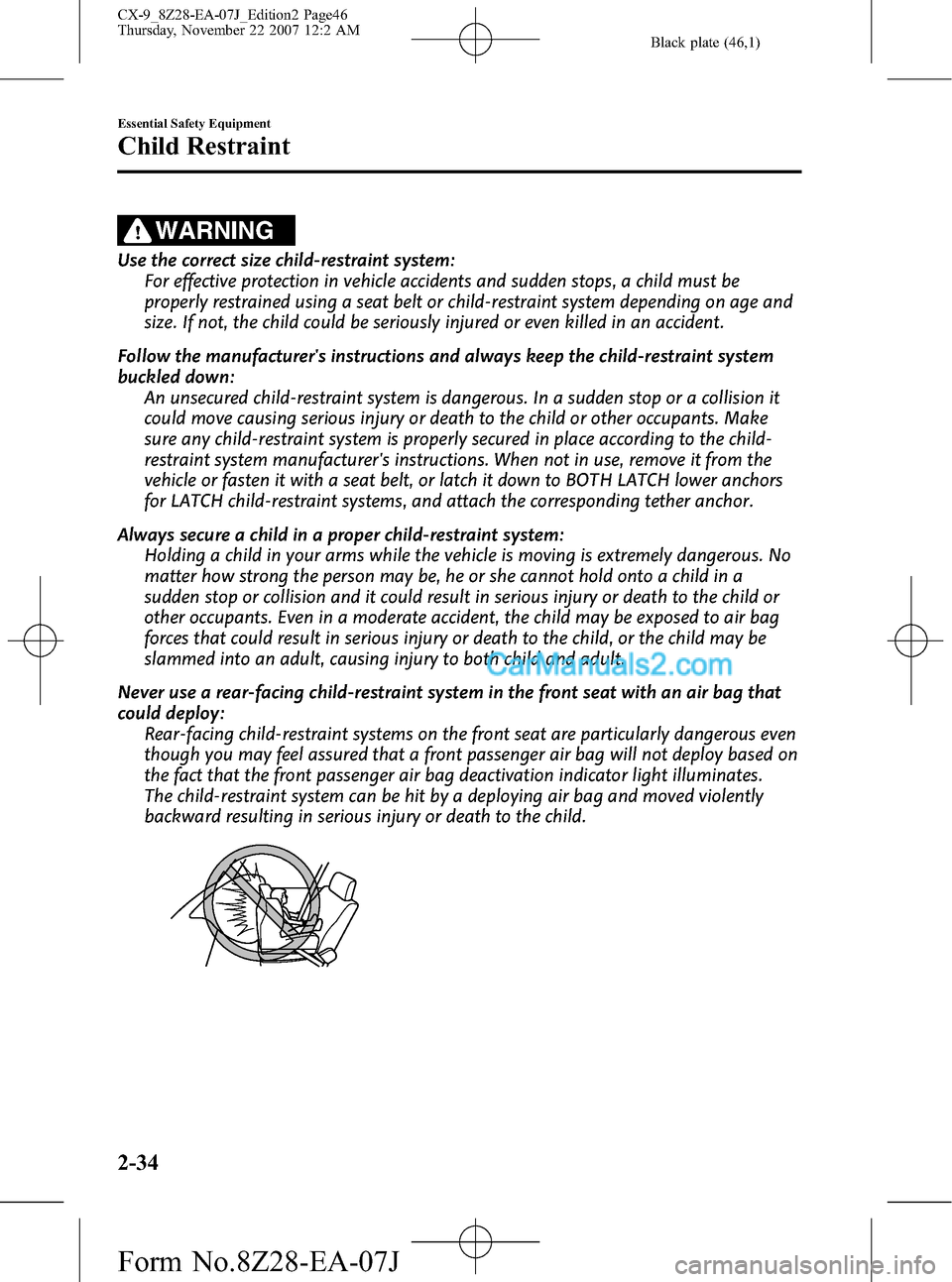
Never use a rear-facing child-restraint system in the front seat with an air bag that
could deploy:
Rear-facing child-restraint systems on the front seat are particularly dangerous even
though you may feel assured that a front passenger air bag will not deploy based on
the fact that the front passenger air bag deactivation indicator light illuminates.
The child-restraint system can be hit by a deploying air bag and moved violently
backward resulting in serious injury or death to the child.
2-34
Essential Safety Equipment
Child Restraint
CX-9_8Z28-EA-07J_Edition2 Page46
Thursday, November 22 2007 12:2 AM
Form No.8Z28-EA-07J
Page 47 of 506
Black plate (47,1)
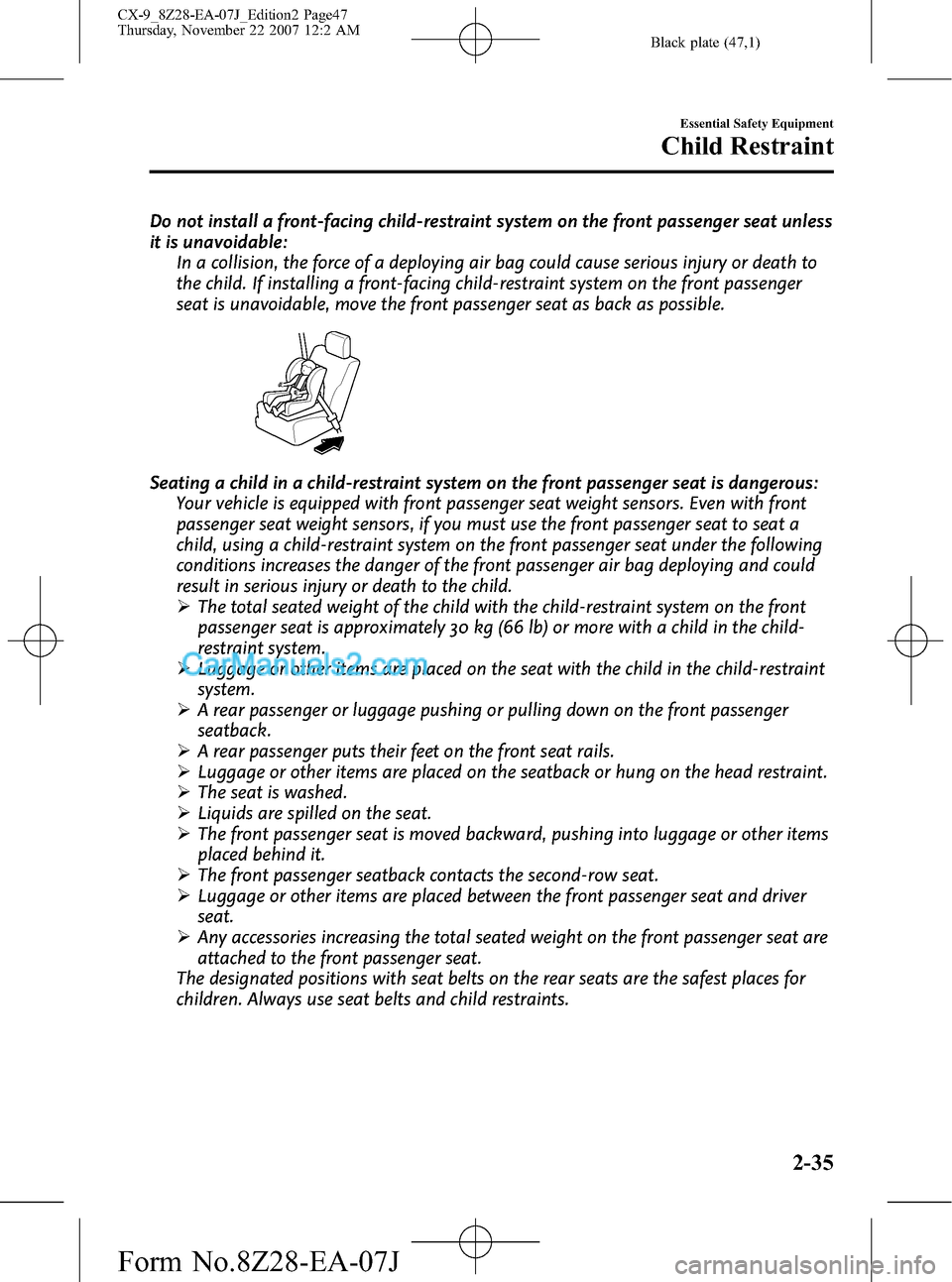
Do not install a front-facing child-restraint system on the front passenger seat unless
it is unavoidable:
In a collision, the force of a deploying air bag could cause serious injury or death to
the child. If installing a front-facing child-restraint system on the front passenger
seat is unavoidable, move the front passenger seat as back as possible.
Seating a child in a child-restraint system on the front passenger seat is dangerous:
Your vehicle is equipped with front passenger seat weight sensors. Even with front
passenger seat weight sensors, if you must use the front passenger seat to seat a
child, using a child-restraint system on the front passenger seat under the following
conditions increases the danger of the front passenger air bag deploying and could
result in serious injury or death to the child.
ØThe total seated weight of the child with the child-restraint system on the front
passenger seat is approximately 30 kg (66 lb) or more with a child in the child-
restraint system.
ØLuggage or other items are placed on the seat with the child in the child-restraint
system.
ØA rear passenger or luggage pushing or pulling down on the front passenger
seatback.
ØA rear passenger puts their feet on the front seat rails.
ØLuggage or other items are placed on the seatback or hung on the head restraint.
ØThe seat is washed.
ØLiquids are spilled on the seat.
ØThe front passenger seat is moved backward, pushing into luggage or other items
placed behind it.
ØThe front passenger seatback contacts the second-row seat.
ØLuggage or other items are placed between the front passenger seat and driver
seat.
ØAny accessories increasing the total seated weight on the front passenger seat are
attached to the front passenger seat.
The designated positions with seat belts on the rear seats are the safest places for
children. Always use seat belts and child restraints.
Essential Safety Equipment
Child Restraint
2-35
CX-9_8Z28-EA-07J_Edition2 Page47
Thursday, November 22 2007 12:2 AM
Form No.8Z28-EA-07J